
Mass Effect 2 Guide Essentials PLANETARY DATABASE
Cluster: Hades Nexus
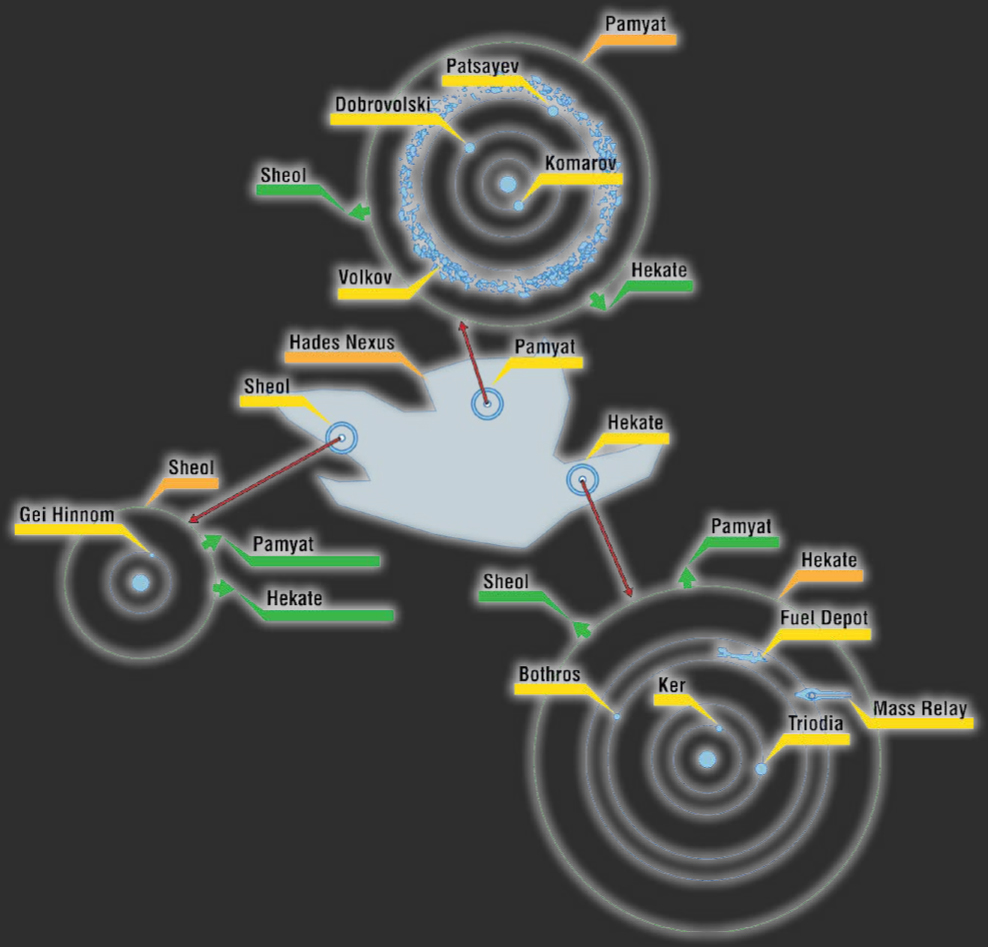
| System | Planets, Planetoids, and Other Galactic Flotsam |
|---|---|
| Hekate | Asteria, Ker, Triodia, Fuel Depot, Bothros, Mass Relay |
| Hoplos | Talaria, Makhaira (Kopis), Trident, Aegis |
| Pamyat | Komarov, Dobrovolski, Patsayev, Asteroid Belt, Volkov |
| Sheol | Gei Hinnom |
| Related Mission | System | Planet |
|---|---|---|
| Additional Mission > Firewalker > Prothean Ruin | Hoplos | Kopis (Moon) |
| Special Assignment > N7: Quarian Crash Site | Sheol | Gei Hinnom |
System: Hekate †
Asteria
World Type: Desert
Richness: Rich
Element Zero: Poor
Iridium: Moderate
Platinum: Poor
Palladium: Rich
Colony Founded: 2044 CE; Population: 188,003,870; Capital: Blackdamp; Orbital Distance: 1.3 AU; Orbital Period: 1.5 Earth Years; Radius: 5,900 Km; Day Length: 21.4 Earth Hours; Atmospheric Pressure: 1.2 Earth Atmospheres; Surface Tem-perature: 25 Celsius (habitable zone); Surface Gravity: 0.8 G.
Description: A habitable planet known for its arid sulfurous deserts, Asteria is colonized near the poles to avoid the uncomfortable temperatures that can reach 65 degrees Celsius in more southern latitudes.
While the seas contain primitive animal life, little of it can live on land, leaving the soil to hardy plants that can survive in the extreme heat. Asteria is home to thriving human and asari agrarian colonies but little in the way of manufacturing or mining.
TRAVEL ADVISORY: Carbon dioxide concentrations can reach 2,500 parts per million in Asteria’s atmosphere. Citizens should carry supplemental oxygen for children and the elderly.
Consult with local governments to discuss animal companion detection systems or other preparatory measures.
ALLIANCE BULLETIN: Geth have been encountered in the Hekate system. All civilian traffic is prohibited.
Bothros
World Type: Ocean/Ice
Richness: Rich
Element Zero: Poor
Iridium: Poor
Platinum: Rich
Palladium: Moderate
Orbital Distance: 8.5 AU; Orbital Period: 24.8 Earth Years; Radius: 7,191 Km; Day Length: 51.0 Earth Hours; Atmospheric Pressure: Trace; Surface Temperature: -142 Celsius; Surface Gravity: 1.5 G.
Description: A rock and ice planet, Bothros is home to a scientific curiosity.
Evidence of a primate-like spacefaring civilization was found frozen in its equatorial ice, ranging from melted fragments of metal to preserved remains of the creatures still wearing suits for extravehicular activity.
Further exploration revealed that their habitation centers were vaporized by orbital bombardments from railgun-like weapons hitting with a force of approximately 120 kilotons of TNT.
Only those that fled or happened to be away from the habitats were preserved in the ice, where they died of asphyxiation.
This unknown species did not come from Asteria, but scientific teams are looking for evidence that they visited there.
It is difficult to believe they would colonize a frozen rock like Bothros and ignore a lush garden world. Their world of origin is also a mystery.
ALLIANCE BULLETIN: Geth have been encountered in the Hekate system. All civilian traffic is prohibited.
Ker
World Type: Desert
Richness: Rich
Element Zero: None
Iridium: Moderate
Platinum: Moderate
Palladium: Rich
Orbital Distance: 2.2 AU; Orbital Period: 3.3 Earth Years; Radius: 6,420 Km; Day Length: 61.7 Earth Hours; Atmospheric Pressure: 1.2 Earth Atmospheres; Surface Temperature: -4 Celsius; Surface Gravity: 1.1 G.
Description: A dry desolate planet, Ker is temperate but supports little life above the microscopic level.
Its Earth-like temperatures and gravity make it an appealing place to build habitation hideaways, attracting batarian slavers and criminals who can’t afford more luxurious safehouses on other planets.
Its forgiving nitrogen-helium atmosphere makes EVAs possible with a minimal amount of equipment; a breathing mask and warm clothing are usually sufficient.
Mining and other legitimate activities are few and far between on Ker: The planet’s crust is largely free of precious metals, instead producing kilometers upon kilometers of dolomitic limestone calcite and gypsum.
ALLIANCE BULLETIN: Geth have been encountered in the Hekate system. All civilian traffic is prohibited.
Triodia
World Type: Giant Ice
Richness: Moderate
Element Zero: None
Iridium: Poor
Platinum: Moderate
Palladium: Poor
Orbital Distance: 4.8 AU; Orbital Period: 10.5 Earth Years; Radius: 27,206 Km; Day Length: 18.7 Earth Hours.
Description: A modestly sized gas giant with an icy core, Triodia has an hydrogen and methane atmosphere that gives it a bluish color. It has 14 moons named after asari virtues.
ALLIANCE BULLETIN: Geth have been encountered in the Hekate system. All civilian traffic is prohibited.
System: Hoplos
Aegis
World Type: Jovian Giant
Richness: Moderate
Element Zero: None
Iridium: Moderate
Platinum: Moderate
Palladium: Poor
Orbital Distance: 4.5 AU; Orbital Period: 9.6 Earth Years; Radius: 53,682 Km; Day Length: 11.6 Earth Hours.
Description: A hydrogen-helium gas giant, Aegis was the site of an unparalleled cosmic event roughly 1.8 million years ago.
An extrasolar body about 200 square kilometers in size was drawn into Aegis’s gravity well and struck the Jovian planet, blasting enough dust and material into orbit to create a ring. An urban legend has grown over this event.
The story goes that if the extrasolar body (usually called a comet) was unaffected by the gravity well of Aegis, it would have coincided with an orbit of Trident and created an extinction-level event on that planet.
Prevailing scientific opinion holds that this is an exaggeration at best.
Kopis
World Type: Rock
Richness: Rich
Element Zero: None
Iridium: Rich
Platinum: Rich
Palladium: Poor
Orbital Distance: 0.55 Km; Radius: 1,733 Km; Day Length: 21.3 Earth Days; Atmospheric Pressure: Trace; Surface Temp: 51 Celsius; Surface Gravity: 0.1 G.
Description: Makhaira’s largest moon, Kopis, is a desolate place with an extremely thin atmosphere. Its crust is largely silica-based, and there are no signs of water.
Like its parent planet, its high albedo keeps it from being a total inferno, and when occluded by Makhaira, its temperatures can be nearly tolerable.
Its low gravity can easily be countered by a vehicular or personal mass effect field for comfortable exploration.
Makhaira
World Type: Rock
Richness: Rich
Element Zero: None
Iridium: Rich
Platinum: Rich
Palladium: Poor
Orbital Distance: 0.5 AU; Orbital Period: 129 Earth Days; Radius: 4,733 Km; Day Length: 34.9 Earth Hours; Atmospheric Pressure: Trace; Surface Temp: 206 Celsius; Surface Gravity: 0.5 G.
Description: A small rock planet, Makhaira’s thin atmosphere and high albedo keep it from being much hotter than it is. The crust is high in sodium oxide, giving the planet a whitish tinge.
Talaria
World Type: Rock
Richness: Good
Element Zero: None
Iridium: Rich
Platinum: Moderate
Palladium: Poor
Orbital Distance: 0.1 AU; Orbital Period: 0.1 Earth Years; Radius: 3,569 Km; Day Length: 0.1 (tidal lock) Earth Hours; Atmospheric Pressure: Trace; Surface Temp: 908 (mean) Celsius; Surface Gravity: 0.2 G.
Description: A rock with all traces of atmosphere burned away, Talaria orbits the star Hoplos at a blistering pace: every 36 days. Though tidally locked, even its twilight belt and shaded side are too barren to support life.
With so many resources on its sister planet Trident, Talaria has largely been ignored by the galactic surveying community.
Trident
World Type: Garden
Richness: Rich
Element Zero: None
Iridium: Moderate
Platinum: Rich
Palladium: Moderate
Orbital Distance: 2.0 AU; Orbital Period: 2.8 Earth Years; Radius: 6,905 Km; Day Length: 27.6 Earth Hours; Atmospheric Pressure: 1.4 Earth Atmospheres; Surface Temp: 27 Celsius; Surface Gravity: 1.1 G.
Description: A human-dominated world with over 95 percent of its surface covered by saltwater, Trident is home to a dazzling array of life.
The oceans are filled with creatures ranging from tiny bivalves to mammoth vertebrates unequaled even by Earth’s whales and ichthyosaurs.
Small archipelagos create what little land there is, and its valuable real estate is fought over constantly.
Underwater extraction operations have recovered valuable minerals from the ocean floor, including irid-ium, uranium, and dust-form element zero.
A largely lawless world, Trident is home to a rogues’ gallery of unethical corporations exploiting the resources of the planet and actual rogues—criminals, slavers, and mercenaries—working the shadows.
TRAVEL ADVISORY: Due to extreme weather conditions, all traffic to the surface is grounded. Trident spaceport control predicts this condition will persist until the end of hurricane season.
System: Pamyat
Dobrovolski
World Type: Rock
Richness: Rich
Element Zero: Moderate
Iridium: Rich
Platinum: Moderate
Palladium: Moderate
Orbital Distance: 2.3 AU; Orbital Period: 3.5 Earth Years; Radius: 6,972 Km; Day Length: 59.1 Earth Hours; Atmospheric Pressure: 0.21 Earth Atmospheres; Surface Temperature: -46 Celsius; Surface Gravity: 0.9 G.
Description: Another near-Earth-sized rock planet without much atmosphere to speak of, Dobrovolski is home to Altai Mineral Works, a local extraction company noted for its success in eezo refining.
The planet itself provides aluminum for local fabricators, which are churning out habitats at an astonishing rate for a system that has no garden planets.
With its ore supply coming all the way from the Sheol system Dobrovolski is held up as the proof of the miner’s cliche: “Where there’s eezo there’s an economy.”
Komarov
World Type: Rock
Richness: Rich
Element Zero: None
Iridium: Rich
Platinum: Poor
Palladium: Poor
Orbital Distance: 1.0 AU; Orbital Period: 1.0 Earth Years; Radius: 6,861 Km; Day Length: 39.6 Earth Hours; Atmosphere: Trace; Surface Temperature: 55 Celsius; Surface Gravity: 1.3 G.
Description: First charted by the asari but colonized by humans, the Pamyat system is home to Komarov, an Earth-sized body near the star.
It has little atmosphere to speak of, but this has not stopped exploration by robo-miners, who have recovered iridium from the planet’s crust.
Patsayev
World Type: Ocean/Ice
Richness: Rich
Element Zero: None
Iridium: Moderate
Platinum: Rich
Palladium: Moderate
Orbital Distance: 4.2 AU; Orbital Period: 8.6 Earth Years; Radius: 6,351 Km; Day Length: 18.9 Earth Hours; Atmospheric Pressure: Trace; Surface Temperature: -118 Celsius; Surface Gravity: 1.0 G.
Description: A rock planet encased in frozen oceans, Patsayev is notable for the largest written message ever created by a human being.
Andrei Kobzar, a disgruntled miner whose fortunes were spent prospecting for eezo, used the mass accelerator cannon of a local mercenary group’s A-61 Mantis gunship to carve a 208-kilometer-long message in the ice saying “Zdes’ nichego net,” which is Russian for “There’s nothing here.”
The message can easily be seen from space. Ironically, the message itself, intended to discourage future colonists, now draws small tourist crowds.
Volkov
World Type: Rock
Richness: Rich
Element Zero: None
Iridium: Rich
Platinum: Poor
Palladium: Poor
Population: 3,800; Orbital Distance: 8.5 AU; Orbital Period: 24.8 Earth Years; Radius: 1,705 Km; Day Length: 68.2 Earth Hours; Atmospheric Pressure: 3.75 Earth Atmospheres; Surface Temperature: -59 Celsius; Surface Gravity: 0.1 G.
Description: A dwarf planet, Volkov has a thick atmosphere of nitrogen and krypton. Home to a thriving iridium mining community, Volkov has a reputation that is summed up as “rich but dangerous.”
Pirates often lurk behind Volkov’s two moonlets, Zenevieva and Alena, and cripple freighters leaving the atmosphere.
To make matters worse, Volkov sits in the Chazov Belt, a field of asteroids and other small bodies that leads to frequent meteor strikes on the planet.
Meteor-related casualties remain rare, but on Volkov the chances of such a death are high enough that they are factored into insurance premiums.
System: Sheol
Gei Hinnom
World Type: Desert
Richness: Rich
Element Zero: Moderate
Iridium: Moderate
Platinum: Poor
Palladium: Rich
Population: 11,503; Orbital Distance: 0.83 AU; Orbital Period: 0.8 Earth Years; Radius: 2,379 Km; Day Length: 0.8 Earth Years; Atmospheric Pressure: Trace Surface Temperature: 35 Celsius (habitable zone), 108 Celsius/-120 Celsius (uninhabitable); Surface Gravity: 0.1 G.
Description: A nearly atmosphere-less, tidally locked planet orbiting a red dwarf star, Gei Hinnom was the first place human explorers discovered a dedicated Prothean burial ground.
While a few sites were saved for posterity, Eldfell-Ashland Mining successfully lobbied to scout the rest of the planet for element zero and soon was embroiled in a scandal.
Mining teams were looting gravesites searching for eezo and other treasures, and many got rich off the so-called “cemetery business.”
While EAM officially brought a stop to the looting, its mining teams remain on the planet prospecting the unclaimed territory and taking their ore to the Pamyat system for refining.
TRAVEL ADVISORY: Armed conflicts have broken out between miners and scientists staking claims to Prothean ruins. Visitors are advised to employ security while exploring unknown regions of the planet.