
Mass Effect 2 Guide Essentials PLANETARY DATABASE
Cluster: Crescent Nebula
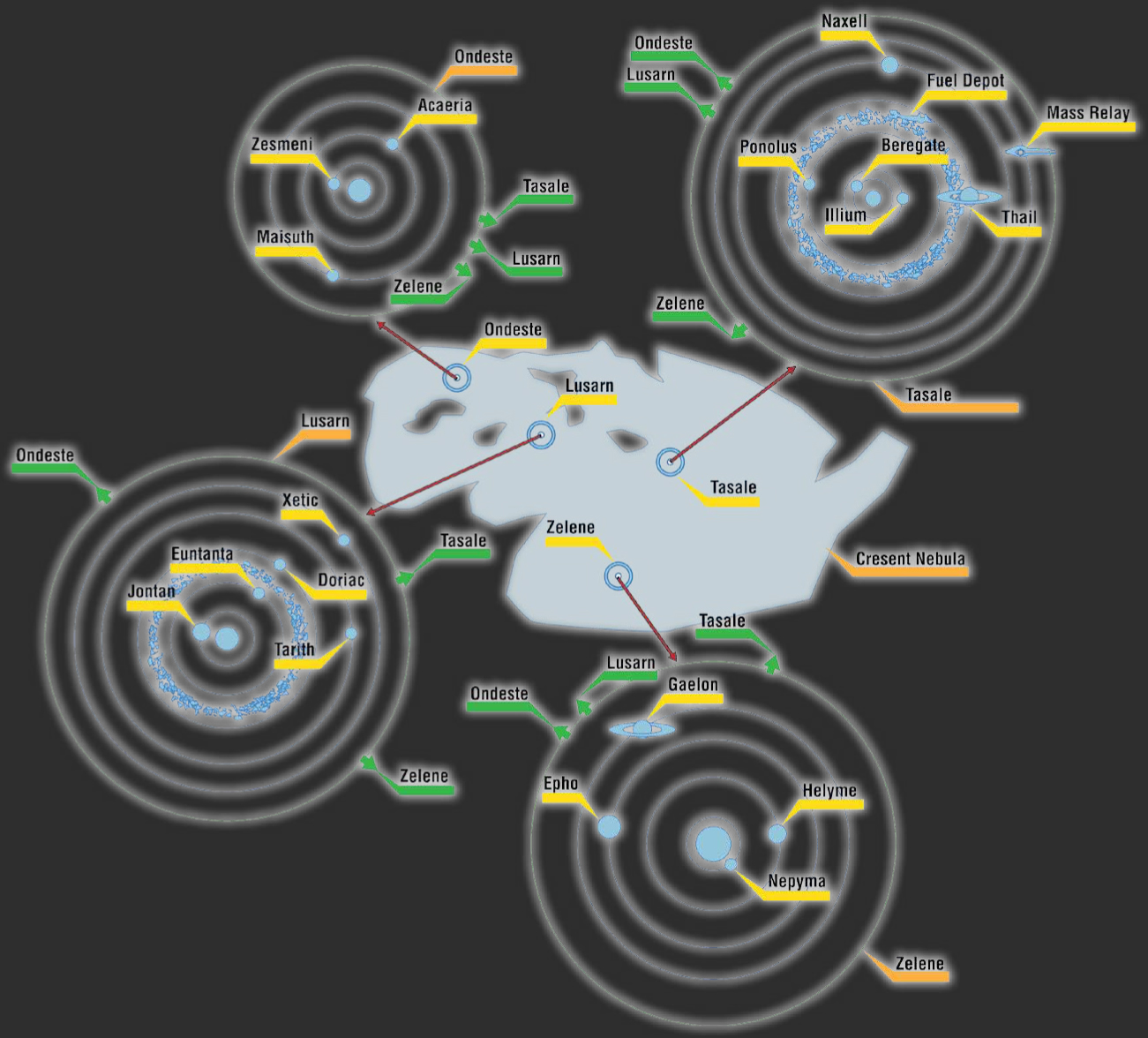
| System | Planets, Planetoids, and Other Galactic Flotsam |
|---|---|
| Lusarn | Jontan, Euntanta, Asteroid Belt, Doriae, Tarith, Xetic |
| Ondeste | Zesmeni, Acaeria, Maisuth |
| Tasale | Beregale, Illium, Ponolus, Asteroid Belt, Fuel Depot, Thail, Naxell, Mass Relay |
| Zelene | Nepyma, Helyme, Epho, Gaelon |
| Related Mission | System | Planet |
|---|---|---|
| Walkthrough Mission > Dossier: The Assassin | Tasale | Illium |
| Walkthrough Mission > Dossier: The Justicar | Tasale | Illium |
| Walkthrough Mission > Loyalty Mission: Miranda: The Prodigal | Tasale | Illium |
| Additional Mission > Lair of the Shadow Broker | Tasale | Illium |
| Special Assignment > Illium > A Troublemaker: Conrad Verner | Tasale | Illium |
| Special Assignment > Illium > Blue Rose of Illium | Tasale | Illium |
| Special Assignment > Illium > Gianna Parasini | Tasale | Illium |
| Special Assignment > Illium > Indentured Service | Tasale | Illium |
| Special Assignment > Illium > Lost Locket Found (Miranda: The Prodigal) | Tasale | Illium |
| Special Assignment > Illium > Liara > Systems Hacking | Tasale | Illium |
| Special Assignment > Illium > Liara > The Observer | Tasale | Illium |
| Special Assignment > Illium > Medical Scans | Tasale | Illium |
| Special Assignment > Illium > Salarian Family Data (Dossier: The Assassin) | Tasale | Illium |
| Special Assignment > Illium > Smuggling Evidence (Dossier: The Justicar) | Tasale | Illium |
| Special Assignment > Illium > Stolen Goods Found (Dossier: The Justicar) | Tasale | Illium |
| Special Assignment > Illium > The Prodigal: Lost Locket Found | Tasale | Illium |
| Special Assignment > N7: Blood Pack > Blood Pack Communications Relay | Lusarn | Tarith |
| Special Assignment > N7: Eclipse > Captured Mining Facility | Zelene | Helyme |
System: Lusarn
Doriae
World Type: Desert
Richness: Good
Element Zero: None
Iridium: Poor
Platinum: Moderate
Palladium: Rich
Orbital Distance: 2.48 AU; Orbital Period: 3.0 Earth Years; Radius: 8,700 Km; Day Length: 63 Earth Hours; Atmospheric Pressure: 1.17 Earth Atmospheres; Surface Temperature: 204 Celsius; Surface Gravity: 1.2 G.
Description: Doriae is a large hot world with a poisonous atmosphere of acidic nitrogen oxides. While the planet is too close to Lusarn for this to condense and fall as rain it makes the environment too hostile for forms of life more sophisticated than bacteria to evolve.
Euntanta
World Type: Desert
Richness: Rich
Element Zero: None
Iridium: Poor
Platinum: Moderate
Palladium: Rich
Population: 230; Orbital Distance: 1.04 AU; Orbital Period: 0.3 Earth Years; Radius: 7,740 Km; Day Length: 24.2 Earth Hours; Atmospheric Pressure: 0.98 Earth Atmospheres; Surface Temperature: 415 Celsius; Surface Gravity: 1.0 G.
Description: Euntanta is remarkably close to Earth. Its orbital distance is similar, and while slightly larger its reduced density yields similar mass, atmospheric pressure, and gravity.
There the similarities end, for Lusarn is a hot class F star emitting over eight times the energy of Sol. Euntanta is a parched wasteland, its water long since boiled away into its nitrogen-carbon dioxide atmosphere.
A handful of mining outposts dot the hellishly hot surface. The crews remain in underground bunkers, sending remotely controlled machines out at night to do surface work and load cargo for shipment.
Jontan
World Type: Giant Pegasid
Richness: Good
Element Zero: None
Iridium: Moderate
Platinum: Moderate
Palladium: Moderate
Orbital Distance: 0.2 AU; Orbital Period: 25 Earth Days; Radius: 67,428 Km; Day Length: 25 Earth Days.
Description: Jontan is a fairly standard close-orbiting Pegasid gas giant orbiting the star Lusarn at high velocity and heated to temperatures of over 1,000 degrees.
Analysis of its orbit has revealed a core of heavy elements with a mass double that of the planet’s hydrogen-helium atmosphere.
Tarith
World Type: Garden
Richness: Rich
Element Zero: Rich
Iridium: Poor
Platinum: Rich
Palladium: Moderate
Orbital Distance: 7.8 AU; Orbital Period: 16.7 Earth Years; Radius: 5,677 Km; Day Length: 27.7 Earth Hours; Atmospheric Pressure: 0.84 Earth Atmospheres; Surface Temperature: 21 Celsius; Surface Gravity: 0.87 G.
Description: Tarith is broadly Earth-like with a fatal flaw; it has a relatively high amount of chlorine in its atmosphere, which is the reason for the greenish haze that becomes apparent when looking at the horizon.
Chlorine has become a vital component in Tarith’s plant life; as a defense mechanism against native herbivores, many species evolved the ability to release clouds of toxic chlorine when disturbed.
This gas is heavier than the atmospheric oxygen and tends to settle in low places. While avoidable, this has placed Tarith near the bottom of the lists for colonization.
There are intermittent signals originating in the heart of a large chlorine swamp. They appear to be coded, though it is not impossible that they are garbled distress signals from a downed civilian ship.
Xetic
World Type: Giant Ice
Richness: Moderate
Element Zero: None
Iridium: Poor
Platinum: Moderate
Palladium: Poor
Orbital Distance: 15.6 AU; Orbital Period: 47.4 Earth Years; Radius: 30,054 Km; Day Length: 13.7 Earth Hours.
Description: A common methane-ammonia gas giant, Xetic is best known for the infamous Kal’thor Camp.
Established on the ice moon of Gesis, Kal’thor was a Blue Suns hostile environment training facility run by a cadre of former batarian Special Intervention Unit operators.
In 2168 a cluster-wide scandal broke out when it was revealed that the mortality rate of recruits sent to the camp might be as high as 18 percent.
Investigation by asari authorities based on Illium uncovered group graves around the facility containing the remains of several hundred recruits dating back two decades.
The camp was immediately closed and the remains sent back to their worlds of origin.
An inquest by the Blue Suns found the batarian commandos had used harsh training methods but ones that were consistent with their own training to join the SIU.
The batarians were exonerated, though Kal’thor was shut down and they were reassigned to other units. As the Crescent Nebula is beyond the sphere of Council law no civil charges could be filed against the Blue Suns.
System: Ondeste
Acaeria
World Type: Ocean/Ice
Richness: Rich
Element Zero: None
Iridium: Moderate
Platinum: Rich
Palladium: Moderate
Orbital Distance: 1.68 AU; Orbital Period: 4.0 Earth Years; Radius: 6,272 Km; Day Length: 36.2 Earth Hours; Atmospheric Pressure: Trace; Surface Temperature: -178 Celsius; Surface Gravity: 0.38 G.
Description: Though nearly the size of Earth, Acaeria contains only 28 percent of its mass. It has a trace atmosphere of neon and molecular nitrogen, but the predominant carbon dioxide has long since frozen and fallen to the surface as frost.
While Acaeria has a core of heavy metals, the bulk of the planet’s volume consists of ice. Several unique forms of long-chain carbon molecules have been recovered on the surface, pushed up from beneath the ice by cryo volcanic processes.
Acaeria has a large rocky moon composition alloy similar to Luna.
Maisuth
World Type: Ocean/Ice
Richness: Good
Element Zero: None
Iridium: Moderate
Platinum: Rich
Palladium: Moderate
Orbital Distance: 2.35 AU; Orbital Period: 6.6 Earth Years; Radius: 3,893 Km; Day Length: 54.7 Earth Hours; Atmospheric Pressure: Trace; Surface Temperature: -194 Celsius; Surface Gravity: 0.25 G.
Description: Farthest from the dim red dwarf Ondeste, the ice dwarf Maisuth has attracted no interest beyond a cursory flyby by automated probe in 1874. No significant resources were noted.
Zesmeni
World Type: Desert
Richness: Rich
Element Zero: None
Iridium: Moderate
Platinum: Moderate
Palladium: Rich
Population: 620; Orbital Distance: 0.8 AU; Orbital Period: 1.3 Earth Years; Radius: 5,806 Km; Day Length: 37.6 Earth Hours; Atmospheric Pressure: 0.64 Earth Atmospheres; Surface Temperature: -119 Celsius; Surface Gravity: 0.66 G.
Description: Cold, dim, and shrouded by a methane-ammonia atmosphere, Zesmeni has nevertheless attracted development by asari mining concerns that service military industries.
There are significant lodes of valuable light metals present, including titanium and lithium.
Titanium is the primary material used in mass accelerator slugs, and lithium is used in the military-grade “droplet” heat radiators used aboard warships.
System: Tasale †
Beregale
World Type: Desert
Richness: Rich
Element Zero: None
Iridium: Moderate
Platinum: Moderate
Palladium: Rich
Orbital Distance: 0.6 AU; Orbital Period: 0.5 Earth Years; Radius: 10,640 Km; Day Length: 45.7 Earth Hours; Atmospheric Pressure: 2.0 Earth Atmospheres; Surface Temperature: 232 Celsius; Surface Gravity: 2.1 G.
Description: While not a classical “hothouse” world like Venus, Beregale is scarcely more hospitable. In addition to being closest to the star Tasale, its core contains many radioactive and other heavy elements.
These increase the heat of the planets and drive volcanism. Beregale’s crust is too rigid for plate tectonics to function, and the planet will go through cycles in which the pressure builds to a massive super-volcanic eruption.
These spew ejecta over thousands of kilometers, leave caldera a hundred kilometers across, and spew enough molten material to repave entire continents.
The last such event was 812,000 years ago; the current rate of outgassing from volcanic hot spots suggests another will occur within the next 10 millennia.
Illium
World Type: Garden
Richness: Not Minable
Element Zero: Not Minable
Iridium: Not Minable
Platinum: Not Minable
Palladium: Not Minable
Colony Founded: 1617; Population (Surface): 84,900,000; Population (L4 and L5 stations): 80,300; Capital: Nos Astra; Orbital Distance: 1.3 AU; Orbital Period: 1.5 Earth Years; Radius: 7,431 Km; Day Length: 25 Earth Hours; Atmospheric Pressure: 1.15 Earth Atmospheres; Surface Temperature: 63 Celsius; Surface Gravity: 1.2 G.
Description: Illium is a classic garden world developed to serve as entrepôt between the Terminus Systems and the Asari Republics.
To abet this trade the normally stringent customs laws of Council space on product-safety-proscribed materials and sapient trafficking are relaxed.
Officially, Illium is not an asari world; it is colonized and operated by asari corporate interests. This gives it the same legal latitude enjoyed by the human corporate research enclaves of Noveria.
Illium is one of the youngest asari colonies settled during the 7th Expansion Wave. The first child born on the world is only now reaching her middle age.
The world is hot and massive; ground settlement is only possible at the higher polar latitudes. In more equatorial locations the population is housed in arcology skyscrapers to escape the heat of the surface.
Naxell
World Type: Giant Ice
Richness: Moderate
Element Zero: None
Iridium: Poor
Platinum: Moderate
Palladium: Poor
Population: 6,700; Capital: EAE Krafla; Orbital Distance: 9.37 AU; Orbital Period: 28.8 Earth Years; Radius: 22,981 Km; Day Length: 10.1 Earth Hours.
Description: Naxell is an ammonia-methane ice giant. Several smaller energy corporations shut out of the big market in the Faia gateway system are attempting to develop a local helium-3 fuel mining infrastructure to service Illium.
The leading investor is the human corporation Eldfell-Ashland Energy.
Their efforts have been hampered by the extralegal pressure the “H-3 Cartels” in Faia system can bring to bear, from simple price undercuts to bureaucratic obstructions (denied permits and constant “health and safety” inspections).
Ponolus
World Type: Desert
Richness: Rich
Element Zero: None
Iridium: Moderate
Platinum: Moderate
Palladium: Rich
Orbital Distance: 2.08 AU; Orbital Period: 3.0 Earth Years; Radius: 5,489 Km; Day Length: 36.2 Earth Hours; Atmospheric Pressure: 96.6 Earth Atmospheres; Surface Temperature: 539 Celsius; Surface Gravity: 0.78 G.
Description: A fairly typical Venusian “hothouse,” Ponolus seems almost tame compared to the violent volcanic outbursts of the inner world Beregale
In contrast, Ponolus is nearly inert, with no active volcanoes or plate tectonics.
The most dramatic event in the last million years was the foundering of the asari aerostat research platform Alviusic in 2092, which fell after being holed by an improbably unlucky meteor.
Most of the crew successfully reached escape capsules, but six were lost. The crushed wreck of the platform now lies on the Kriusite Plain in the southern hemisphere.
Thail
World Type: Giant Jovian
Richness: Moderate
Element Zero: None
Iridium: Poor
Platinum: Poor
Palladium: Poor
Orbital Distance: 4.46 AU; Orbital Period: 9.4 Earth Years; Radius: 55,263 Km Day Length: 15.5 Earth Hours.
Description: Thail is a typical hydrogen-helium gas giant. Its complex system of rings is unstable, dating back only a few million years. They are thought to be the shattered remains of a comet.
System: Zelene
Epho
World Type: Desert
Richness: Rich
Element Zero: None
Iridium: Moderate
Platinum: Poor
Palladium: Rich
Orbital Distance: 1.56 AU; Orbital Period: 2.22 Earth Years; Radius: 8,031 Km; Day Length: 70 Earth Hours; Atmospheric Pressure: 0.98 Earth Atmospheres; Surface Temperature: -41 Celsius (12 equator); Surface Gravity: 1.0 G.
Description: Epho is a rocky world with an atmosphere of oxygen and carbon dioxide. There are large craters scattered across its surface, obviously from hypervelocity kinetic impactors.
Stretching between these locations are the shattered remains of magnetic levitation rail lines, which strongly suggests that the craters represent the former locations of arthenni mining outposts or other settlements.
The equatorial region contains an extensive network of canyons formed by the planet’s abundant liquid water.
TRAVEL ADVISORY: Epho’s atmosphere is approximately 41 percent carbon dioxide at sea level. This is four to six times the level necessary to render most species unconscious within a few minutes of breathing it.
Breathing masks must be worn at all times when on the surface of Epho.
Gaelon
World Type: Giant Jovian
Richness: Moderate
Element Zero: None
Iridium: Poor
Platinum: Poor
Palladium: Moderate
Orbital Distance: 2.96 AU; Orbital Period: 5.7 Earth Years; Radius: 63,539 Km; Day Length: 8.9 Earth Hours.
Description: Gaelon is surrounded by an extensive ring system. The inner rings are composed of pulverized nano-manufactured carbon materials thought to be the remains of an arthenni helium-3 mining infrastructure.
The few pieces of larger debris found indicate a materials technology at least equal to the current galactic state of the art. The outer rings consist of ice, silicate dust, and the odd bit of rock.
Analysis of the debris often shows shock damage and evidence of rapid heating. Some para-historical theorists insist that the outer rings represent debris from a moon or moons destroyed by mass accelerator bombardment.
This has been rejected by every reputable xenoarchaeologist; while it is theoretically possible to destroy a small moon utterly with dreadnought bombardment, no species sees a compelling reason to do so.
Helyme
World Type: Post-Garden
Richness: Moderate
Element Zero: Moderate
Iridium: Moderate
Platinum: Moderate
Palladium: Moderate
Orbital Distance: 1.2 AU; Orbital Period: 1.5 Earth Years; Radius: 5,522 Km; Day Length: 44.4 Earth Hours; Atmospheric Pressure: 0.84 Earth Atmospheres; Surface Temperature: -15 Celsius; Surface Gravity: 0.87 G.
Description: Helyme is a post-garden world that once enjoyed an Earth-like oxygen-nitrogen atmosphere. It is still blessed with plentiful water but a generally cold climate (and extreme seasonal shifts courtesy of a 38-degree axial tilt).
Helyme is thought to be the homeworld of the arthenni, a space-faring species that disappeared approximately 300,000 years ago.
Precisely what happened to Helyme is still under debate. It appears a global extinction occurred, wiping out all native animal life forms more complex than zooplankton.
Plant forms were not affected, but the lack of oxygen-breathing life caused oxygenation of the atmosphere. Plant life was reduced after lightning storms ignited global wildfires.
The leading theory for Helyme’s devastation is an out-of-control biological weapon.
For this reason landing is strictly prohibited. The corporations of Illium have emplaced a network of quarantine satellites to dissuade would-be looters from landing in the crumbling cities.
Nepyma
World Type: Rock
Richness: Rich
Element Zero: None
Iridium: Rich
Platinum: Poor
Palladium: Moderate
Orbital Distance: 0.8 AU; Orbital Period: 0.8 Earth Years; Radius: 4,456 Km; Day Length: 40.4 Earth Hours; Atmospheric Pressure: 0.55 Earth Atmospheres; Surface Temperature: 32 Celsius; Surface Gravity: 0.57 G.
Description: Tidally locked to the star Zelene, Nepyma has the expected “hot pole” and “cold pole.” Along the terminator is a thin band of nearly habitable terrain.
Unfortunately, the local biosphere is based on a chlorinated oxygen atmosphere. It is not sophisticated, but it has proven highly dangerous.
The asari surveyor Verallas landed on Nepyma in 1684 to study the local ecology. Unbeknownst to the crew, a handful of native chlorine-fixing microbes passed through biohazard screening and entered the ship.
The Verallas returned to the port of Nos Parnalo on Illium, where the Nepyman microbes escaped into a temperate environment with plentiful unused chlorine.
The microbes devoured the chlorides in the earth; as metabolic by-products they produced toxic polychlo- rinated biphenyls (PCBs).
By the time the infestation was contained an area of nearly 30 square kilometers had been effectively turned into a toxic waste dump. Nos Parnalo had to be abandoned, accelerating the development of Nos Astra.