
Mass Effect 2 Guide Essentials PLANETARY DATABASE
Cluster: Krogan DMZ
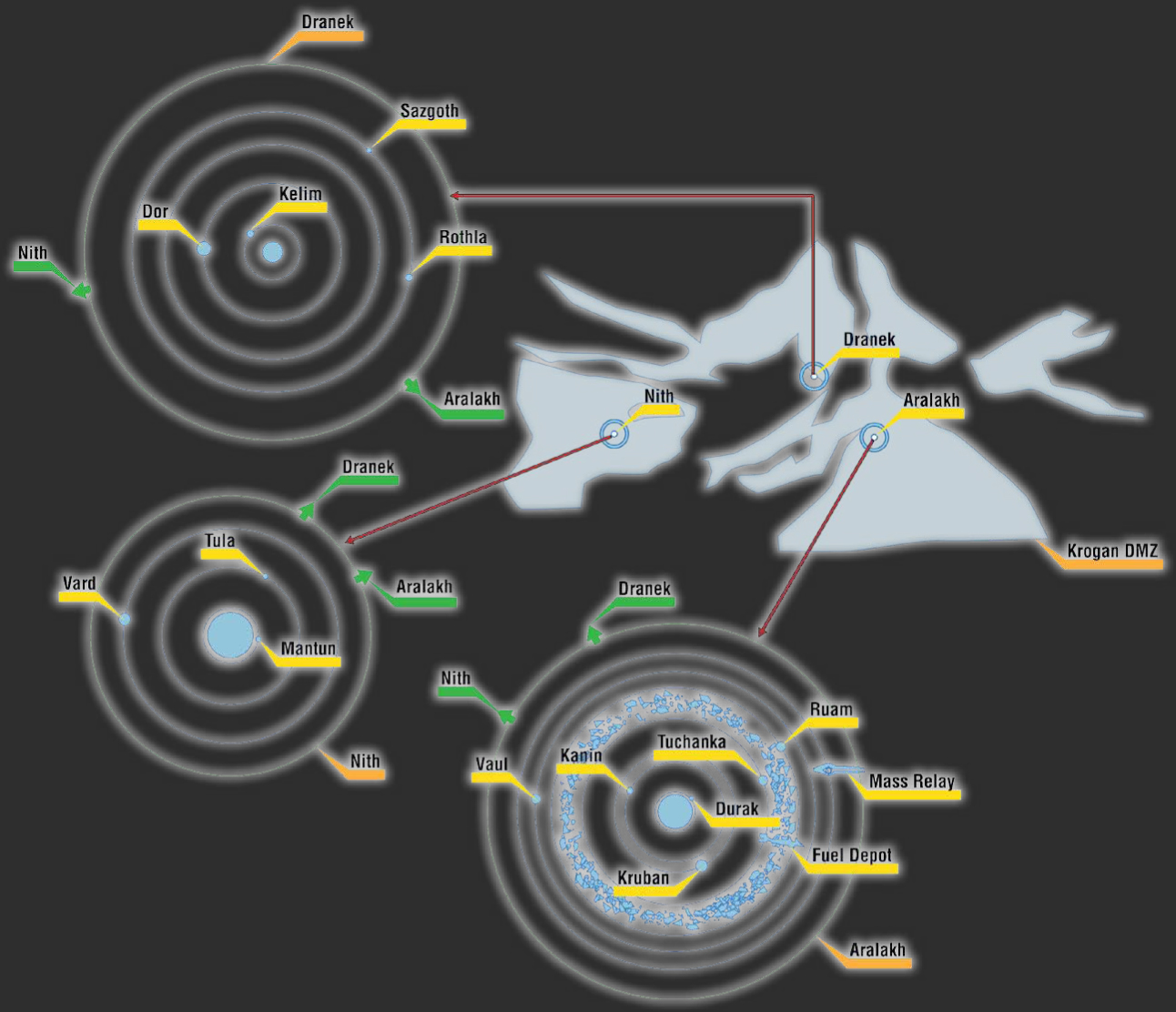
| System | Planets, Planetoids, and Other Galactic Flotsam |
|---|---|
| Aralakh | Durak, Kanin, Kruban, Tuchanka, Fuel Depot, Asteroid Belt, Ruam, Vaul, Mass Relay |
| Dranek | Kelim, Dor, Sazgoth, Rothla |
| Nith | Mantun, Tula, Vard |
| Related Mission | System | Planet |
|---|---|---|
| Walkthrough Mission > Loyalty Mission: Grunt: Rite of Passage | Aralakh | Tuchanka |
| Walkthrough Mission > Mission: Loyalty Mission: Mordin: Old Blood | Aralakh | Tuchanka |
| Special Assignment > Tuchanka > Combustion Manifold (Mordin: Old Blood) | Aralakh | Tuchanka |
| Special Assignment > Tuchanka > Killing Pyjaks | Aralakh | Tuchanka |
| Special Assignment > Tuchanka > Missing Scout (Mordin: Old Blood) | Aralakh | Tuchanka |
System: Aralakh †
Durak
World Type: Rock
Richness: Rich
Element Zero: None
Iridium: Rich
Platinum: Moderate
Palladium: Moderate
Orbital Distance: 0.83 AU; Orbital Period: 0.6 Earth Years; Radius: 1,972 Km; Atmospheric Pressure: Trace; Surface Temperature: 348 Celsius; Surface Gravity: 0.22 G.
Description: Durak is a small, heat-blasted rock lost in the blinding glare of the star Aralakh. It occasionally traps a trace atmosphere of gases blown in on Aralakh’s powerful solar wind, which inevitably blows the gases back out again.
The planetoid has a few valuable lodes of heavy metals, which were sporadically mined by the krogan at the height of their power.
In the closing years of the Rebellions the five clans working the planetoid fell to fighting over a particularly rich deposit of iridium. All five clan warlords agreed to a Crush (a meeting at a neutral location) to negotiate a truce.
Unfortunately, all five arrived planning to betray their fellows. While the leaders and their seconds met, all their bases were destroyed by simultaneous hypervelocity cannon strikes.
Left with only the food, water, and air in their hardsuits and with no way to call for rescue the warlords apparently fought each other to the death.
The survivors of the five “Durak clans” on Tuchanka still argue about which clan’s warlord was the last one standing.
Kanin
World Type: Rock
Richness: Moderate
Element Zero: None
Iridium: Moderate
Platinum: Poor
Palladium: Poor
Orbital Distance: 1.66 AU; Orbital Period: 1.6 Earth Years; Radius: 3,312 Km; Atmospheric Pressure: Trace; Surface Temperature: 155 Celsius; Surface Gravity: 0.28 G.
Description: One of Kanin’s hemispheres contains an impact crater 700 kilometers in diameter. Dubbed the Renkat Basin, it was mined for light metals in the interbellum between the Rachni War and Krogan Rebellions.
Any obvious resource concentrations have long since been stripped.
Kruban
World Type: Desert
Richness: Rich
Element Zero: None
Iridium: Poor
Platinum: Moderate
Palladium: Rich
Orbital Distance: 3.31 AU; Orbital Period: 4.6 Earth Years; Radius: 5,443 Km; Atmospheric Pressure: 47.3 Earth Atmospheres; Surface Temperature: 728 Celsius; Surface Gravity: 0.7 G.
Description: Kruban is a tidally locked Venusian hothouse. Its surface is perpetually obscured by clouds of sulfur and carbon dioxide. The first group of krogan brought into orbit by the salarian uplift teams requested a trip to Kruban.
The salarians at first thought the krogan were confused about the nature of Kruban’s environment; the planet is named for a krogan mythological paradise in which honorable warriors feast on the internal organs of their enemies.
In fact, krogan astronomers had correctly deduced the nature of Kruban in the years before the global holocaust.
In the two millennia since Kruban had come to be thought of as an ideal test of one’s toughness. Every year a few krogan attempt to land on Kruban and exit their ships naked in an attempt to prove their “kroganhood.”
The planet’s surface is littered with the crushed, corroded remains of their ships.
Only one, Shath Norda, is known to have returned from the surface alive, albeit with most of his bones crushed and all four of his lungs damaged by sulfuric gas.
Norda recovered from his trial to earn the adulation of his people. Until he died in 1943 he could lie with any fertile female he wished.
Ruam
World Type: Giant Jovian
Richness: Poor
Element Zero: None
Iridium: Poor
Platinum: Poor
Palladium: Poor
Population: 1,040; CDEM Garrison: 20; Orbital Distance: 11.1 AU; Orbital Period: 28.4 Earth Years; Radius: 67,154 Km; Day Length: 13.8 Earth Hours.
Description: The smaller of Aralakh’s hydrogen-helium gas giants maintains a small helium-3 recovery infrastructure.
Although the depth of Ruam’s gravity well makes it inefficient to export, visitors to the Aralakh system often “top off” their fuel tanks at Ruam’s stations. T
he Council Demilitarization Enforcement Mission (CDEM) maintains a token garrison to monitor any potential sale of fuel to known subversives and terrorists.
Tuchanka
World Type: Rock
Richness: Not Minable
Element Zero: Not Minable
Iridium: Not Minable
Platinum: Not Minable
Palladium: Not Minable
Population: 2.1 billion; Capital: Currently Urdnot (since 2183); CDEM Garrison: 2,400 (in orbital battlestations); Orbital Distance: 5.3 AU; Orbital Period: 16.7 Earth Years; Radius: 8,293 Km; Day Length: 21.4 Earth Hours; Atmospheric Pressure: 1.1 Earth Atmospheres; Surface Temperature: 72 Celsius (36 in shrouded areas); Surface Gravity: 1.14 G.
Description: Scarred by bombardment craters, radioactive rubble, choking ash, salt flats, and alkaline seas, Tuchanka can barely support life.
Thousands of years ago life grew in fierce abundance under the F-class star Aralakh (a Raik clan word meaning “eye of wrath”).
Tree analogs grew in thick jungles, their roots growing out of shallow silty seas. Life fed upon life in an evolutionary crucible.
This world died in nuclear firestorms after the krogan split the atom. A “little ice age” of nuclear winter killed off much of the remaining plant life.
In recent centuries many krogan have returned to their homeworld. The reduced albedo has caused global temperatures to rise.
In order to maintain livable temperatures, a vast shroud was assembled at the L1 Lagrange point. It is maintained by the Council Demilitarization Enforcement Mission (CDEM), which is based on orbiting battlestations.
CDEM ADVISORY: Visitors to Tuchanka land at their own risk. The CDEM will not attempt to extract citizens threatened by clan warfare.
TRAVEL ADVISORY: The ecology of Tuchanka is deadly. Nearly every native species engages in some predatory behavior; even the remaining vegetation is carnivorous. Travel beyond guarded areas is strongly discouraged.
Vaul
World Type: Giant Jovian
Richness: Moderate
Element Zero: None
Iridium: Poor
Platinum: Poor
Palladium: Poor
Orbital Distance: 17.8 AU; Orbital Period: 57.8 Earth Years; Radius: 73,944 Km; Day Length: 12.1 Earth Hours.
Description: Vaul is a hydrogen-helium gas giant named for an ancient krogan deity that stood watch for enemies of his pantheon.
The gas giant’s moons are named after some of Vaul’s myriad eyes and ears. The only reason to visit the Vaul system is scientific curiosity, which the krogan lack.
System: Dranek
Dor
World Type: Ice Giant
Richness: Moderate
Element Zero: None
Iridium: Moderate
Platinum: Moderate
Palladium: Poor
Orbital Distance: 0.36 AU; Orbital Period: 0.4 Earth Years; Radius: 25,588 Km; Day Length: 18.4 Earth Hours.
Description: Dor is a conventional methane-ammonia ice giant. It is the main fueling port in the Dranek cluster gateway system.
Pildea Station, the headquarters for patrol ships of the Council Demilitarization Enforcement Mission (CDEM), lies at the trailing Lagrange point of Dor.
The CDEM logs all ships passing through the Krogan Demilitarized Zone, and has the right to board and search them for contraband at any time and for any reason.
There are no exceptions; at points over the last two centuries, diplomatic incidents have been caused when the patrol frigates boarded an asari hospital ship, a batarian diplomatic courier, and private-owned human “tramp” freighters.
These measures are provided for under the terms of the krogan armistice.
While the krogan were allowed to retain their government and personal weapons, any attempt to provide starship-mounted weapons to the clans on Tuchanka is punishable by law.
Nearly a millennia after the war ended, the official penalty for smuggling proscribed weapons is still death by spacing.
Kelim
World Type: Rock
Richness: Moderate
Element Zero: None
Iridium: Moderate
Platinum: Moderate
Palladium: Poor
Orbital Distance: 0.2 AU; Orbital Period: 0.2 Earth Years; Radius: 5,580 Km; Day Length: 28.3 Earth Hours; Atmospheric Pressure: 0.5 Earth Atmospheres; Surface Temp: 42 Celsius; Surface Gravity: 0.32 G.
Description: Kelim is a tectonically inert rock with an atmosphere of krypton, xenon, and argon.
There are a few valuable lodes of light metals scattered across its surface, but these are difficult to find; most were mined out in the years leading up to the Krogan Rebellions.
Rothla
World Type: Ice Dwarf
Richness: Rich
Element Zero: Poor
Iridium: Moderate
Platinum: Rich
Palladium: Moderate
Orbital Distance: 1.15 AU; Orbital Period: 2.3 Earth Years; Radius: 4,263 Km; Day Length: 64.2 Earth Hours; Atmospheric Pressure: 0.14 Earth Atmospheres; Surface Temp: -153 Celsius.
Description: Once Rothla was a large ice dwarf with the statistics listed. In the waning years of the Krogan Rebellions it was shattered into a field of debris by what is assumed to have been the test of an exotic weapons system.
In the wake of “the event,” the planetoid was reduced to a relatively contained field of thousands of tiny moonlets rotating around one another, colliding and ricocheting.
The method used to destroy the planetoid has never been deduced. The krogan clan who performed the experiment apparently all died in the event.
Ships that have traveled to the edge of the event’s light cone observed a moment of extreme gravitational lensing around Rothla immediately before its breakup, but no other clues.
A popular extranet meme put forward by the asari author Delsae Orthysa insists that the turians are covering up the existence of a krogan “super biotic” breed that was genetically engineered within Rothla.
The CDEM enforces quarantine around the Rothla Field, citing cases of amateur investigators whose ships came to grief in the debris field.
Sazgoth
World Type: Ice Dwarf
Richness: Rich
Element Zero: None
Iridium: Moderate
Platinum: Rich
Palladium: Poor
Orbital Distance: 0.58 AU; Orbital Period: 0.8 Earth Years; Radius: 3,349 Km; Day Length: 27.1 Earth Hours; Atmospheric Pressure: 0.19 Earth Atmospheres; Surface Temp: -99 Celsius.
Description: Sazgoth is a small ice dwarf with an eccentric orbit. During perigee, portions of its icy surface sublimate into a thin atmosphere of nitrogen and carbon dioxide, which quickly freeze again as it recedes into the outer reaches of the Dranek system.
System: Nith
Mantun
World Type: Rock
Richness: Rich
Element Zero: Moderate
Iridium: Rich
Platinum: Moderate
Palladium: Moderate
Orbital Distance: 57.2 AU; Orbital Period: 112.1 Earth Years; Radius: 2,150 Km; Orbital Period: 112.1 Earth Years; Atmospheric Pressure: Trace; Surface Temperature: 641 Celsius; Surface Gravity: 0.28 G.
Description: The class-B blue giant Nith was once the most strategically valuable system within krogan territory. Though far too hot for habitation, Nith emits thousands of times the energy of a main sequence star like Earth’s Sol.
With help from salarian uplift teams, the krogan constructed a chain of solar power collector stations in orbit around Nith.
These vast arrays beamed power to particle accelerators on the surface of Mantun, which manufactured antiproton fuel for warship thrusters.
In the Krogan Rebellions the Spectre agents managed to get a virus into the computers of the solar power arrays; every fifth array suddenly applied braking thrusters.
The arrays behind them “piled up,” and all were reduced to wreckage. This has since dispersed into a relatively stable ring system.
The krogan never had the resources to rebuild the solar arrays, depriving them of their fleet’s main fuel supply for the remainder of the war.
The particle accelerators still exist on Mantun but have not been used in thousands of years.
Tula
World Type: Giant Ice
Richness: Poor
Element Zero: None
Iridium: Poor
Platinum: Moderate
Palladium: Poor
Orbital Distance: 108.7 AU; Orbital Period: 293.9 Earth Years; Radius: 5,204 Km; Day Length: 59.7 Earth Hours; Atmospheric Pressure: 0.54 Earth Atmospheres; Surface Temperature: 1,036 Celsius Surface; Gravity: 0.55 G.
Description: Tula’s methane-ammonia atmosphere traps the blistering heat of Nith, driving dayside temperatures up over 1,000 degrees.
While some lodes of useful metals are present, the planet’s incredible heat makes mining impractical.
Vard
World Type: Giant Ice
Richness: Moderate
Element Zero: None
Iridium: Poor
Platinum: Moderate
Palladium: Poor
Population: 2,072; Orbital Distance: 195.6 AU; Orbital Period: 709.6 Earth Years; Radius: 36,670 Km; Day Length: 18.0 Earth Hours.
Description: Vard is a methane-ammonia ice giant. Until the Krogan Rebellions it had a sizable helium-3 fuel-refining infrastructure.
Once the solar arrays orbiting Nith were destroyed, the constant flow of antiproton tankers visiting the system disappeared.
There was little point to maintaining the facilities, so they were shut down and abandoned. Today, transients, criminals, and outcasts are squatting in the ancient stations.
Although few of the stations are safe for habitation, neither the krogan nor the Council Demilitarization Enforcement Mission patrols care if the squatters take their chances.