
Mass Effect 2 Guide Essentials PLANETARY DATABASE
Cluster: Ismar Frontier
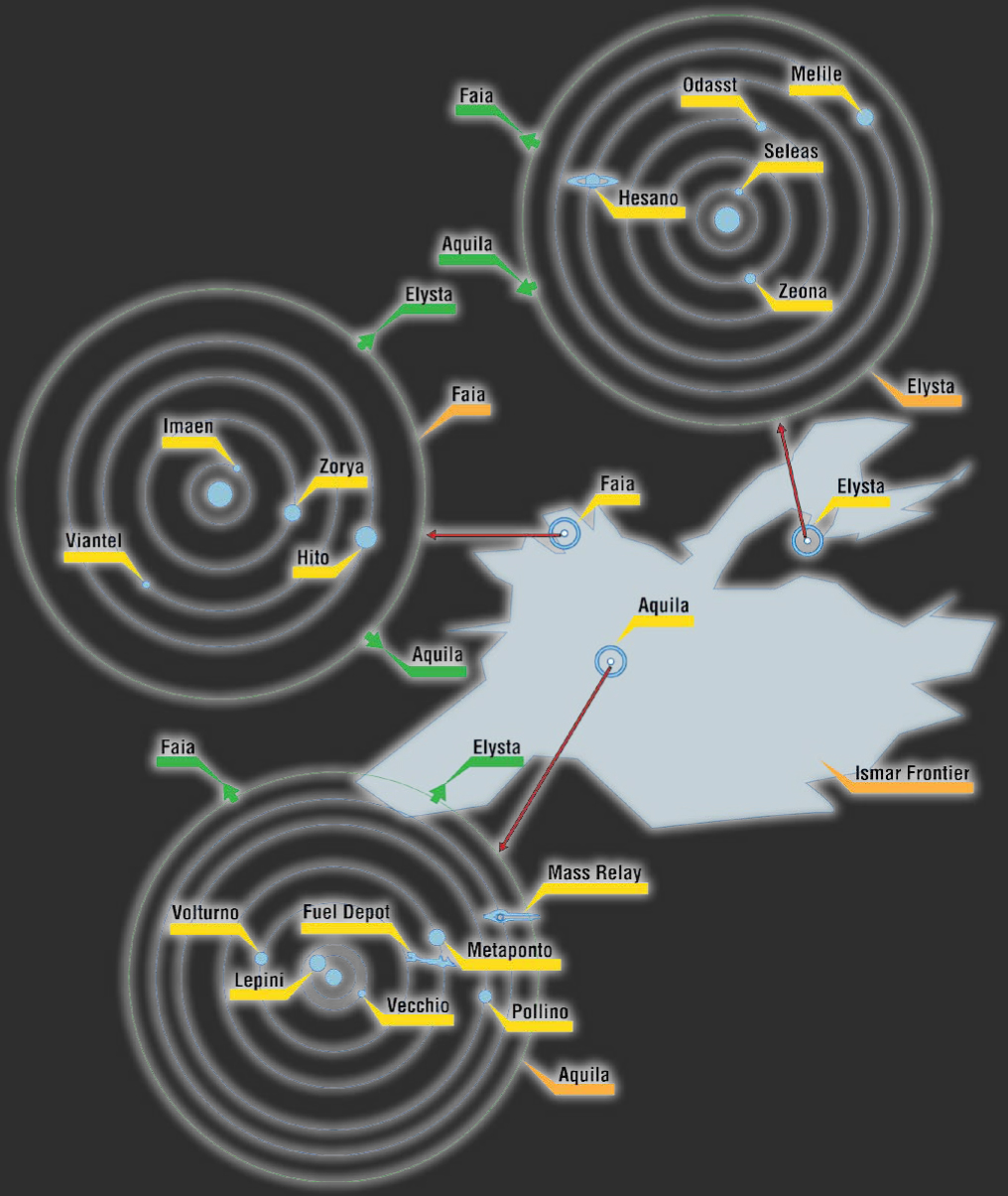
| System | Planets, Planetoids, and Other Galactic Flotsam |
|---|---|
| Aquila | Lepini, Vecchio, Volturno, Fuel Depot, Metaponto, Pollino, Mass Relay |
| Elysta | Saleas, Zeona, Odasst, Hesano, Melile |
| Faia | Imaen, Zorya, Viantel, Hito |
| Related Mission | System | Planet |
|---|---|---|
| Walkthrough Mission > Loyalty Mission: Zaeed: The Price of Revenge | Faia | Zorya |
| Additional Mission > Firewalker > MSV Rosalie | Elysta | Zeona |
System: Aquila †
Lepini
World Type: Giant Jovian
Richness: Poor
Element Zero: None
Iridium: Moderate
Platinum: Moderate
Palladium: Moderate
Orbital Distance: 0.5 AU; Orbital Period: 0.4 Earth Years; Radius: 56,666 Km; Day Length: 9.2 Earth Hours.
Description: A hydrogen-methane gas giant, Lepini and its moons have been cursorily scanned by space probes and found to have little in the way of rare resources. The galaxy at large considers it unremarkable.
Metaponto
World Type: Giant Jovian
Richness: Poor
Element Zero: None
Iridium: Moderate
Platinum: Moderate
Palladium: Moderate
Orbital Distance: 4.2 AU; Orbital Period: 8.6 Earth Years; Radius: 70,520 Km; Day Length: 12.1 Earth Hours.
Description: A hydrogen-helium gas giant, Metaponto has developed a helium-3 fueling station funded by elcor business interests that hope to bring enough attention to the system to attract terraforming investors and thus eventually develop Volturno as a habitable world.
Thus far, they have met with little success.
Pollino
World Type: Giant Jovian
Richness: Poor
Element Zero: None
Iridium: Moderate
Platinum: Moderate
Palladium: Moderate
Orbital Distance: 8.0 AU; Orbital Period: 22.7 Earth Years; Radius: 37,052 Km; Day Length: 16.5 Earth Hours.
Description: A relatively small hydrogen-helium gas giant, Pollino remains undeveloped while its sister planet Metaponto garners all the attention.
This was not always the case—in 2180, news stories seeded throughout the extranet claimed that element zero was being found on Pollino’s moons in record lodes.
This turned out to be a scam spread by the Dunawurachum Consortium, an elcor corporation trying to scare up investors.
After a small fleet of space probes scouted the area, the hype quickly deflated, and the myth persists now only in unwanted extranet e-mail messages.
Vecchio
World Type: Desert
Richness: Rich
Element Zero: None
Iridium: Rich
Platinum: Moderate
Palladium: Moderate
Orbital Distance: 1.1 AU; Orbital Period: 1.2 Earth Years; Radius: 6,443 Km; Day Length: 39.1 Earth Hours; Atmospheric Pressure: 0.79 Earth Atmospheres; Surface Temperature: 58 Celsius; Surface Gravity: 0.82 G.
Description: Vecchio is a moderately sized terrestrial world with a thin, hot atmosphere of carbon dioxide and nitrogen.
Initial surveys found trace amounts of iridium but little else of interest in the silicate desert sands that cover much of the surface of the planet.
On a recent tour, the Alliance surveyor ship Kupe discovered a group of partial graves hidden in the equatorial mountain ranges.
The ancient skeletons in the burial sites were obviously humanoid but incomplete and poorly preserved, which has made them difficult to identify.
Fragments of primitive ceramic grave goods were also found nearby. This raises further questions about who once traveled to this inhospitable planet, since the closest garden world, Volturno, has no intelligent life.
Human universities are planning further archeological investigations.
Volturno
World Type: Garden
Richness: Good
Element Zero: None
Iridium: Rich
Platinum: Rich
Palladium: Moderate
Orbital Distance: 2.1 AU; Orbital Period: 3.0 Earth Years; Radius: 11,177 Km; Day Length: 26.8 Earth Hours; Atmospheric Pressure: 0.83 Earth Atmospheres; Surface Temperature: -10 Celsius; Surface Gravity: 3.3 G.
Description: A so-called “super-Earth,” Volturno is home to organic life but is nevertheless uninhabitable for the near future.
Currently in an ice age, most of the planet from the latitude of 30 degrees north or south is a frozen wasteland, and so most organic life, limited to algae and lichens, resides near the equator.
The strong gravity prevents any sapient species but elcor from thriving on the planet, and the elcor cannot breathe planet’s atmosphere, which contains lethal amounts of carbon dioxide in addition to its oxygen.
Small packs of vorcha squatters are attempting to take the planet for themselves illegally, but most of them live miserable existences in the planet’s crushing gravity and die from falls and medical complications.
Only terraforming on a massive scale would turn Volturno into a habitable world, and the elcor lack the political capital with the Citadel Council to begin such an effort.
System: Elysta
Hesano
World Type: Jovian Giant
Richness: Poor
Element Zero: None
Iridium: Moderate
Platinum: Moderate
Palladium: Poor
Orbital Distance: 1.82 AU; Orbital Period: 2.7 Earth Years; Radius: 34,035 Km; Day Length: 13.1 Earth Hours.
Description: Hesano is a standard hydrogen-helium gas giant. Two hundred years ago, an independent volus prospector found the mangled wreck of a Prothean starship trapped within the trailing Lagrange point.
Few artifacts from the wreckage have been recovered.
The prospector, Lumen Kreop, was canny enough to keep the hulk’s existence to himself. He sold its location to a turian paleotechnology firm for nearly a million credits.
Since then, Hesano’s Lagrange points, rings, and moons have been combed over by fortune hunters seeking to strike it rich the same way. Thus far, no additional artifacts have been recovered.
Melile
World Type: Ice Giant
Richness: Moderate
Element Zero: None
Iridium: Moderate
Platinum: Poor
Palladium: Moderate
Orbital Distance: 3.1 AU; Orbital Period: 6.1 Earth Years; Radius: 28,684 Km; Day Length: 8.6 Earth Hours.
Description: Melile is a common ammonia-methane ice giant with 23 moons. It has no particularly distinctive features.
Odasst
World Type: Rock
Richness: Rich
Element Zero: None
Iridium: Moderate
Platinum: Rich
Palladium: Moderate
Population: 11,640; Capital: Jorass; Orbital Distance: 0.96 AU; Orbital Period: 1.1 Earth Years; Radius: 6,882 Km; Day Length: 28.3 Earth Hours; Atmospheric Pressure: 1.1 Earth Atmospheres; Surface Temp: 20 Celsius; Surface Gravity: 1.2 G.
Description: Odasst has an abundance of heavy metals and radioactive elements. It is heavily exploited by mining concerns based on Illium.
Forty-three years ago, a Council Spectre arrived to investigate reports that the businesses were selling platinum—a strategic metal—to pirate groups in the Terminus Systems.
The results of the investigation were never released, but no deaths were reported.
Saleas
World Type: Rock
Richness: Rich
Element Zero: None
Iridium: Rich
Platinum: Moderate
Palladium: Moderate
Orbital Distance: 0.4 AU; Orbital Period: 0.3 Earth Years; Radius: 3,485 Km; Day Length: 0.3 Earth Hours; Atmospheric Pressure: Trace; Surface Temp: 138 Celsius; Surface Gravity: 0.32 G.
Description: Saleas’s cratered surface is ancient; parts of the highlands have been unchanged for nearly three billion years. The layers of overlapping craters stand as testament to the violence of the system’s creation.
Saleas is tidally locked to Elysta and has a trace atmosphere of krypton and xenon, with helium constantly “blowing in” via solar winds.
Zeona
World Type: Rock
Richness: Rich
Element Zero: None
Iridium: Moderate
Platinum: Moderate
Palladium: Rich
Orbital Distance: 0.64 AU; Orbital Period: 0.6 Earth Years; Radius: 4,734 Km; Day Length: 49.6 Earth Hours; Atmospheric Pressure: 0.55 Earth Atmospheres; Surface Temp: 68 Celsius; Surface Gravity: 0.57 G.
Description: Zeona has a thin atmosphere of sulfur dioxide and trioxide, created by volcanic outgassing. There are traces of water vapor in the atmosphere, but over the last five centuries of observation particle counts have decreased 4 percent.
Although it’s not habitable by any spacefaring species, there is an abundance of native sulfur-devouring bacteria that thrive around the world’s many volcanic vents.
Interestingly, this bacterium bears genetic similarities to the native life of Illium, suggesting either a “panspermia” spread of microbes via asteroids, or accidental contamination of the original environment by careless spacefarers.
System: Faia
Imaen
World Type: Rock
Richness: Rich
Element Zero: None
Iridium: Rich
Platinum: Moderate
Palladium: Moderate
Orbital Distance: 0.6 AU; Orbital Period: 0.8 Earth Years; Radius: 2,370 Km; Day Length: 62.1 Earth Hours; Atmospheric Pressure: Trace; Surface Temperature: 108 Celsius; Surface Gravity: 0.24 G.
Description: Imaen is a small, cratered rock. Its crust contains various light metals, though none in any concentration worth the trouble of mining. While the rest of the Faia system has seen extensive industrialization, Imaen lies fallow.
Hito
World Type: Giant Jovian
Richness: Poor
Element Zero: None
Iridium: Moderate
Platinum: Moderate
Palladium: Moderate
Orbital Distance: 6.3 AU; Orbital Period: 15.8 Earth Years; Radius: 24,984 Km; Day Length: 14.3 Earth Hours.
Description: While the ice mines of Viantel make a great deal of profit from ships passing through Faia’s mass relay, the real money is made at Hito.
As the only gas giant in the Faia gateway system, Hito is heavily developed by rival helium-3 mining concerns.
The world has three major and 26 minor moons, each of which is claimed by a different company.
Those based on moons deeper into the gravity well tend to specialize in helium-3 extraction and refining, while those on the farther moons specialize in refueling services and shipment.
The local economy is driven by black marketeering, back-room deals, and cutthroat business. Each company attempts to sabotage its rivals’ facilities while protecting their own moon.
This has led to open corporate warfare three times in the last century.
All the major mercenary groups have offices in the Hito planetary system, though the Blue Suns enjoy a home-team advantage, shipping in cheap supplies from Zorya.
Viantel
World Type: Ocean/Ice
Richness: Rich
Element Zero: None
Iridium: Moderate
Platinum: Rich
Palladium: Moderate
Orbital Distance: 3.0 AU; Orbital Period: 5.2 Earth Years; Radius: 1,381 Km; Day Length: 28.4 Earth Hours; Atmospheric Pressure: Trace; Surface Temperature: -150 Celsius; Surface Gravity: 0.11 G.
Description: Though a dwarf planet, Viantel’s large amounts of water have led to heavy development by water-cracking industries seeking to turn the planet into hydrogen-oxygen fuel for starship thrusters.
The surface is blanketed with habitation modules, mining equipment, and cracking stations.
Since the initial settlement of Illium in the nearby Tasale system, the radius of Viantel has decreased by two kilometers, indicating removal of over 72,000 cubic kilometers of ice.
Some groups are concerned that the rate of loss may cause instability in the remaining structure.
Zorya
World Type: Garden
Richness: Not Minable
Element Zero: Not Minable
Iridium: Not Minable
Platinum: Not Minable
Palladium: Not Minable
Orbital Distance: 1.8 AU; Orbital Period: 2.4 Earth Years; Radius: 6,247 Km; Day Length: 28.4 Earth Hours; Atmospheric Pressure: 1.22 Earth Atmospheres; Surface Temperature: 33 Celsius; Surface Gravity: 1.0 G.
Description: “Mud, sweat, and spores,” is how Blue Suns mercenaries characterize the planet that gave birth to their home office.
This lush garden world is known for its heavy plant and fungal life, creating spectacular jungle zones over much of its eight continents.
Despite persistent problems with rot and rust, Zorya attracts investors and corporations from throughout the galaxy, since it has exploited only a fraction of its potential resources.
The Blue Suns dominate security contracts on Zorya, so much that residents describe them as less like a monopoly and more like a conquering regime.