
Mass Effect 2 Guide Essentials PLANETARY DATABASE
Cluster: Local Cluster (Solar System)
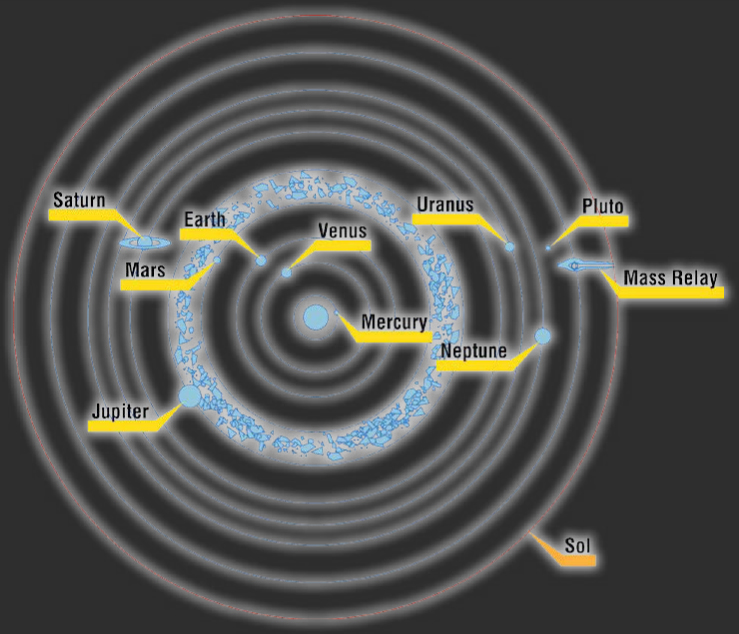
| System | Planets, Planetoids, and Other Galactic Flotsam |
|---|---|
| Sol | Mercury, Venus, Earth (Luna), Mars, Asteroid Belt, Jupiter, Saturn, Uranus, Neptune, Pluto, Mass Relay |
System: Sol
Earth
World Type: Garden
Richness: Not Minable
Element Zero: Not Minable
Iridium: Not Minable
Platinum: Not Minable
Palladium: Not Minable
Population (Surface): 11.4 billion; Population (L4 and L5 stations): 250,000, Orbital Distance: 1 AU; Orbital Period: 1 Earth Year; Radius: 6,378 Km; Day Length: 23.9 Earth Hours; Atmospheric Pressure: 1 Earth Atmosphere; Surface Temperature: 23 Celsius; Surface Gravity: 1.0 G.
Description: For detailed information please refer to the standard issue Alliance Galactic Codex.
Earth’s orbit is riddled with debris generated by “bootstrap” space development; use of kinetic barriers is recommended at altitudes over 85 kilometers.
Jupiter
World Type: Giant Jovian
Richness: Moderate
Element Zero: None
Iridium: Poor
Platinum: Poor
Palladium: Moderate
Population (all moons): 9,100; Orbital Distance: 5.2 AU; Orbital Period: 11.7 Earth Years; Radius: 71,492 Km; Day Length: 9.93 Earth Hours.
Description: Jupiter’s deep gravity well and lethal radiation have kept its moons from being significantly exploited. The largest outpost is Binary Helix Corporation’s Nautilus facility, attached to the underside of Europa’s ice sheet.
Mars
World Type: Rock
Richness: Not Minable
Element Zero: Not Minable
Iridium: Not Minable
Platinum: Not Minable
Palladium: Not Minable
Orbital Distance: 1.52 AU; Orbital Period: 1.88 Earth Years; Radius: 3,402 Km; Day Length: 24.6 Earth Hours; Atmospheric Pressure: Trace; Surface Temperature: -138 Celsius; Surface Gravity: 0.38 G.
Description: Once considered a prospect for terraforming and colonization, Mars turned into a quiet backwater after the discovery of faster-than-light travel.
Its southern pole is a historical preserve centered on the Prothean ruins found there. Immigration and development are restricted as the search for Prothean artifacts continues.
Mercury
World Type: Rock
Richness: Moderate
Element Zero: None
Iridium: Rich
Platinum: Moderate
Palladium: Poor
Population: 340; Orbital Distance: 0.39 AU; Orbital Period: 88 Earth Days; Radius: 2,240 Km; Day Length: 58.7 Earth Days; Atmospheric Pressure: Trace; Surface Temperature: 430 Celsius; Surface Gravity: 0.38 G.
Description: A handful of solar power stations exist on “peaks of eternal light” at the north and south poles of Mercury. The difficulties imposed by the planet’s proximity to the sun and high orbital velocity have limited development.
Neptune
World Type: Giant Ice
Richness: Poor
Element Zero: None
Iridium: Poor
Platinum: Moderate
Palladium: Poor
Population (Triton): 70; Orbital Distance: 29.1 AU; Orbital Period: 164.8 Earth Years; Radius: 24,764 Km; Day Length: 16.1 Earth Hours.
Description: Though Neptune, like Uranus, has plentiful helium, its remoteness made it an unpromising target for mining before the development of mass effect drive.
With Uranus cheaper to exploit it has never seen extensive development. The only permanent human presence is a small research facility on Triton.
Pluto
World Type: Rock
Richness: Moderate
Element Zero: None
Iridium: Rich
Platinum: Poor
Palladium: Poor
Population (gateway stations): 9,300; Orbital Distance: 39.5 AU; Orbital Period: 247.7 Earth Years; Radius: 1,151 Km; Day Length: 9.4 Earth Hours; Atmospheric Pressure: Trace; Surface Temperature: -229 Celsius; Surface Gravity: 0.06 G.
Description: Pluto is one of Sol’s numerous “ice dwarf” worlds. It is mainly of note for being the gravitational “anchor” for the mass relay to Arcturus.
Pluto and the Charon relay (formerly encased in ice and considered a moon) orbit each other. Pluto’s orbit was circularized in 2157 as a side effect of the Charon mass relay recovery operations.
Saturn
World Type: Jovian
Richness: Good
Element Zero: None
Iridium: Moderate
Platinum: Moderate
Palladium: Moderate
Population (orbitals and Titan) : 117,000; Capital: Huygens Dome; Orbital Distance: 9.5 AU; Orbital Period: 29.5 Earth Years; Radius: 60,268 Km; Day Length: 10.3 Earth Hours.
Description: Saturn has been a major source of helium-3 fuel for fusion plants since the 2150s. The moon of Titan is mined for hydrocarbons and used as a hostile environment training facility for Alliance Marines.
Uranus
World Type: Giant Ice
Richness: Depleted
Element Zero: None
Iridium: Poor
Platinum: Poor
Palladium: Poor
Population: 371,000; Capital: Sakharov Station; Orbital Distance: 19.2 AU; Orbital Period: 84.3 Earth Years; Radius: 25,559 Km; Day Length: 17.3 Earth Hours.
Description: After the development of mass effect FTL drive, distant Uranus was the target of a “land rush” to exploit its combination of plentiful helium-3 fuel and shallow (for a gas giant) gravity well.
Today Uranus is the largest producer of helium-3 in Alliance space.
Venus
World Type: Post-Garden
Richness: Good
Element Zero: None
Iridium: Moderate
Platinum: Moderate
Palladium: Rich
Population: 800; Orbital Distance: 0.72 AU; Orbital Period: 224.7 Earth Days; Radius: 6,052 Km; Day Length: 243 Earth Days; Atmospheric Pressure: 90 Earth Atmospheres; Surface Temperature: 465 Celsius; Surface Gravity: 0.88 G.
Description: With its molten temperatures, sulfuric acid clouds, and crushing carbon dioxide atmosphere, Venus has only a handful of aerostat research outposts.