
Mass Effect 2 Guide Essentials PLANETARY DATABASE
Cluster: Nubian Expanse
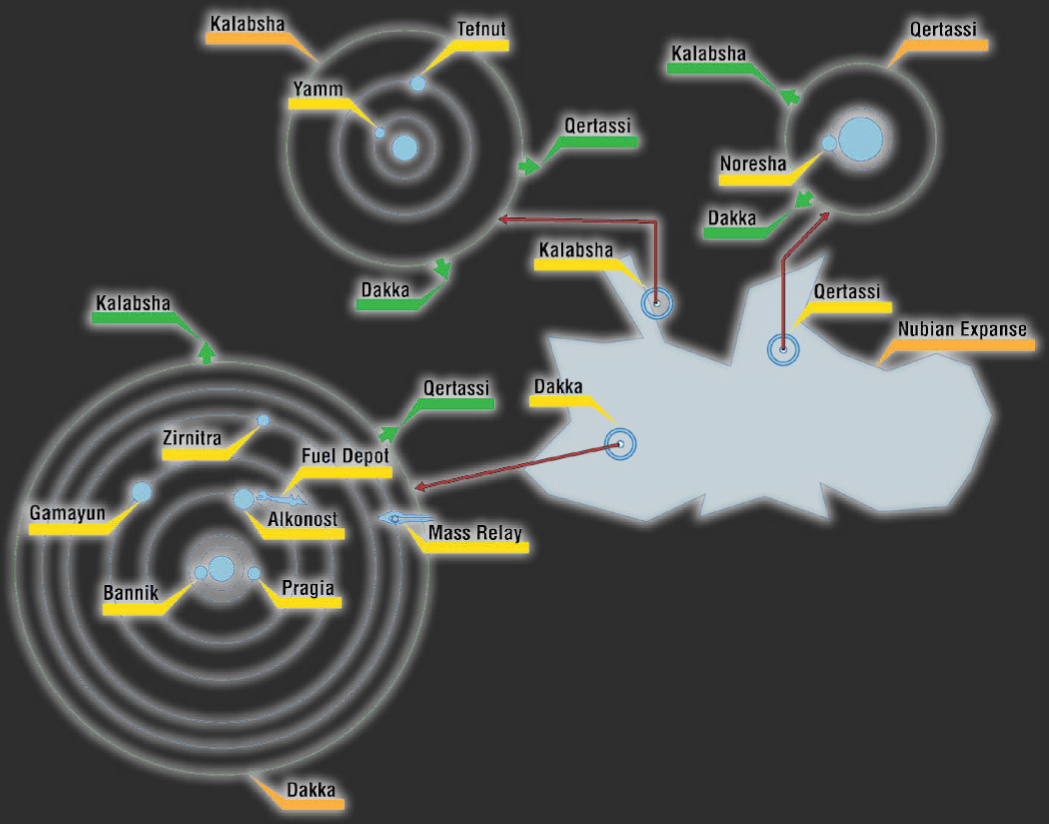
| System | Planets, Planetoids, and Other Galactic Flotsam |
|---|---|
| Dakka | Bannik, Pragia, Alkonost, Fuel Depot, Gamayun, Zirnitra, Mass Relay |
| Kalabsha | Yamm, Tefnut |
| Qertassi | Norehsa |
| Related Mission | System | Planet |
|---|---|---|
| Walkthrough Mission > Loyalty Mission: Jack: Subject Zero | Dakka | Pragia |
System: Dakka †
Alkonost
World Type: Giant Ice
Richness: Moderate
Element Zero: None
Iridium: Poor
Platinum: Moderate
Palladium: Poor
Orbital Distance: 2.47 AU; Orbital Period: 3.9 Earth Years; Radius: 17,946 Km; Day Length: 18.8 Earth Hours.
Description: Alkonost is a standard ice giant with a methane-ammonia atmosphere. It has an unusually strong magnetic field, which is occasionally useful when ships need to discharge their drives.
Bannik
World Type: Desert
Richness: Rich
Element Zero: None
Iridium: Moderate
Platinum: Rich
Palladium: Rich
Orbital Distance: 0.73 AU; Orbital Period: 0.6 Earth Years; Radius: 7,963 Km; Day Length: 54.8 Earth Hours; Atmospheric Pressure: 65.4 Earth Atmospheres; Surface Temperature: 599 Celsius; Surface Gravity: 1.6 G.
Description: Bannik is a large, superterrestrial “hothouse” with a crushing carbon dioxide atmosphere. A high average density of over 7 grams per cubic centimeter indicates that Bannik is a mineralogical treasure trove.
If only there were some way to safely reach its seas of molten metal and lodes of radioactive elements. The planet’s mass is so great that trace amounts of helium and molecular hydrogen can be found in the atmosphere.
Gamayun
World Type: Giant Jovian
Richness: Poor
Element Zero: None
Iridium: Poor
Platinum: Moderate
Palladium: Poor
Orbital Distance: 5.19 AU; Orbital Period: 11.8 Earth Years; Radius: 50,875 Km; Day Length: 65.6 Earth Hours.
Description: Gamayun is a hydrogen-helium gas giant with six large, icy moons. The outermost one, Gigula, is of note for a well-preserved wreckage of an ancient starship that was recovered by a turian military surveyor.
Little information has been released to the public on the vessel, aside from a scholarly paper regarding how the internal layout suggests a horizontally oriented race.
Pragia
World Type: Garden
Richness: Not Minable
Element Zero: Not Minable
Iridium: Not Minable
Platinum: Not Minable
Palladium: Not Minable
Orbital Distance: 1.3 AU; Orbital Period: 1.5 Earth Years; Radius: 5,137 Km; Day Length: 29.6 Earth Hours; Atmospheric Pressure: 0.84 Earth Atmospheres; Surface Temperature: 54 Celsius; Surface Gravity: 0.87 G.
Description: The jungle-planet Pragia is overrun by choking hypergrowth caused by industrially mutated plant species.
This, combined with its relative isolation and lack of population, has made Pragia an occasional base of operations for drug runners, weapons smugglers, pirates, mercenaries, terrorists, and intelligence agents seeking secrecy.
Sustained habitation on Pragia is extremely difficult; mutant and even poisonous plant life can overgrow colonies in days instead of years.
Zirnitra
World Type: Ocean/Ice
Richness: Rich
Element Zero: None
Iridium: Poor
Platinum: Rich
Palladium: Moderate
Orbital Distance: 7.78 AU; Orbital Period: 21.8 Earth Years; Radius: 2,683 Km; Day Length: 44.9 Earth Hours; Atmospheric Pressure: Trace; Surface Temperature: -158 Celsius; Surface Gravity: 0.16 G.
Description: Cold, distant Zirnitra has an extremely low density and is thought to be mainly ice around a small rocky core. It has little to recommend it.
System: Kalabsha
Tefnut
World Type: Giant Jovian
Richness: Poor
Element Zero: None
Iridium: Poor
Platinum: Moderate
Palladium: Poor
Population: 33,810 spread across five space stations; Orbital Distance: 4.1 AU; Orbital Period: 8.3 Earth Years; Radius: 57,010 Km; Day Length: 8.8 Earth Hours.
Description: A hydrogen-helium gas giant, Tefnut is home to a helium-3 collection and the refueling facility nearest to the Nubian Expanse’s mass relay.
As such it is a major gateway to the Verge and Terminus Systems and has become famous for its hospitality industry.
Tefnut’s motto is known throughout the galaxy: “Like home, only better.”
Visitors here can stay at expansive resort stations, watch locally produced entertainment, buy mind-affecting substances not welcome in Citadel space, and rent companionship.
Resources are shipped in from Yamm at substantial discounts, allowing the small space stations to have surprising luxuries, such as edible arthropods and large amounts of fresh water.
Yamm
World Type: Post-Garden
Richness: Moderate
Element Zero: Moderate
Iridium: Moderate
Platinum: Moderate
Palladium: Moderate
Colony Founded: 2170 CE; Population: 488,504; Capital: New Karnak; Orbital Distance: 2.0 AU; Orbital Period: 2.8 Earth Years; Radius: 6,501 Km; Day Length: 69.6 Earth Hours; Atmospheric Pressure: 1.8 Earth Atmospheres; Surface Temperature: 34 Celsius (temperate zone); Surface Gravity: 1.1 G.
Description: With over 90 percent of its surface covered in oceans, Yamm is a habitable nitrogen-oxygen world, but its extremes can be quite hostile to sapient life.
The heat from its extremely long days reaches dangerous levels ranging from 24 Celsius at night to 53 in the afternoon in the temperate zones.
Hurricanes run unchecked across the oceans, with winds reaching up to 250 kilometers per hour.
While there are some arthropod-like animals, the predominant forms of life are various kinds of toxic algae blooms that stretch hundreds of kilometers across.
However, other biohydrocarbon algae blooms are suitable for use as biofuel, and farming the “green gold” forms the backbone of Yamm’s economy.
System: Qertassi
Norehsa
World Type: Giant Ice
Richness: Moderate
Element Zero: None
Iridium: Poor
Platinum: Moderate
Palladium: Poor
Orbital Distance: 6.17 AU; Orbital Period: 2.4 Earth Years; Radius: 42,214 Km; Day Length: 19.2 Earth Hours.
Description: Norehsa is an unremarkable methane-ammonia ice giant with a small family of icy moons.
It is likely that the Qertassi system had additional worlds earlier in its history, but these have been swallowed by the aging giant star. Qertassi is an elderly metal-poor Population II star broadly similar to Arcturus.