
Assassin's Creed III Guide The Story So Far
Cast & Concepts
The Assassin Brotherhood
The Assassin Brotherhood has been at war with the Templar Order for over two thousand years. The Assassins have intelligence, stealth and surprise at their disposal. They send a lone agent against a legion and halt the march of ten thousand with the death of one. Assassins are sworn to preserve free will and to defend the liberty of all. Their motto – “Nothing is true; everything is permitted” – is their raison d’être, advocating the individual’s right to act of their own volition. The Templars’ desire to provide peace and stability through the enforced surrender of self-determination is anathema to the Assassins.
Operating in the shadows, the Assassins’ modern-day organization is under great pressure, and uses the cell structure of underground resistance groups. Such tactics are essential to avoid the evolved tracking and surveillance techniques provided to the resurgent Templars by the Abstergo corporation.

Abstergo & the Templar Order
The Knights Templar Order received papal blessing in 1129 and found fame (and infamy) through their military exploits in the Holy Land during the Third Crusade. However, the Templar organization – as represented in the Assassin’s Creed canon – is much older. Under various guises and with many different leaders, the Templar Order has sought absolute power to control humanity. Although some individual agents may be corrupt, the Templars should not be viewed as “evil”. They consider themselves the custodians of humanity.
Abstergo Industries takes its name from the latin to “cleanse” or “wipe away” and embodies the modern identity of the Templar Order. This front masks a worldwide operation, from telecoms to pharmacology, and enables the Templar Order to access the finest scientific minds, bleeding-edge technology… and political influence.
Abstergo’s most valuable asset is the Animus, a device that enables the exploration of genetic memories. Human DNA, it transpires, records the experiences of every living person, with each individual passing their life data to their offspring at conception – a discovery thus far unknown in mainstream science. The Templars deploy the Animus to identify genetic lines that will lead them to the locations of ancient artifacts known as Pieces of Eden, devices with astonishing capacity to influence and indeed control human behavior.
The Templars conspire to obtain an Apple of Eden and conceal this in a telecommunications satellite developed by an Abstergo subsidiary. Once in orbit, they plan to use it to control the Earth’s population. The Eye-Abstergo satellite is scheduled for launch on December 21st, 2012.

Animus A core concept of Assassin’s Creed is the capacity of human genes to carry “genetic memories”. Each time DNA is passed on, the sum of a progenitor’s experiences, up to moments before conception (for men) and before birth (for women), is passed on to the resultant offspring. Every generation of humans, therefore, is a biological archive of the experiences of all former generations. Genetic memories remain largely dormant, vestigial, untapped in modern homo sapiens. With the aid of the Animus, however, they can be isolated and decoded. Advanced software extrapolates the necessary information to build a complete simulation, converting the ancestral memory into a full virtual representation. As the subject relives the memory, the Animus then captures and records a projection of their experience that is accessible to others in audiovisual form. Those who use the Animus intensively can experience dangerous side effects. The uncontrolled resurgence of memories outside of the Animus environment suggests the technology unlocks a process that continues within the subject, causing hallucinations and leading to mental instability. |
Pieces of Eden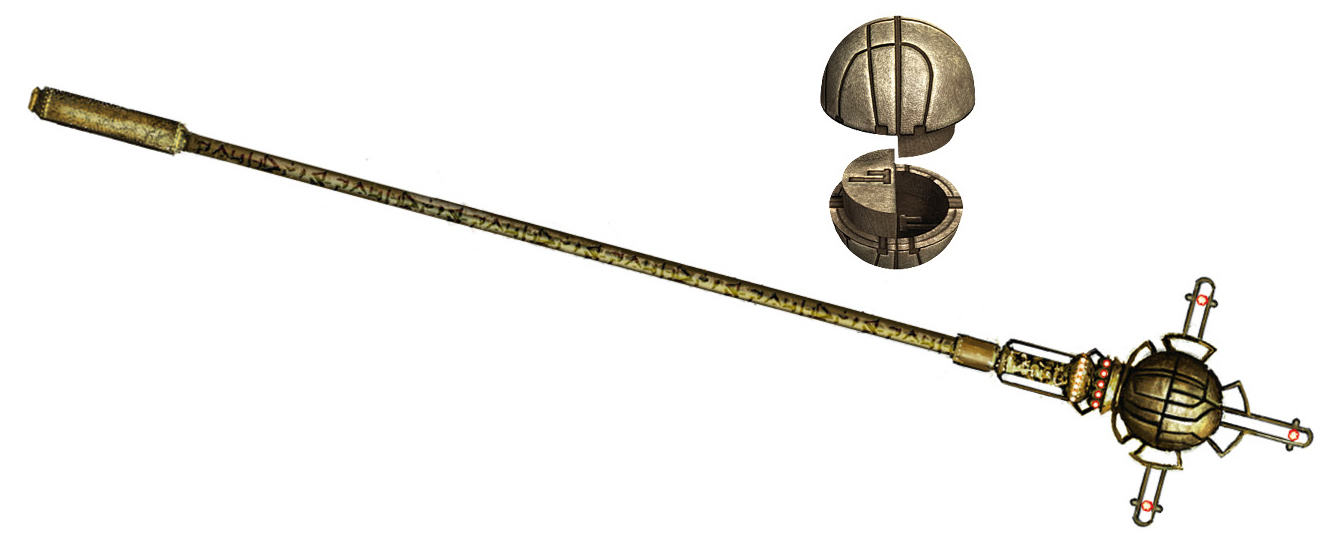 Pieces of Eden are ancient technological artifacts that were created by the First Civilization. Secret history holds that the Templars have possessed many Pieces of Eden through the centuries, enabling them to influence world events. Pieces of Eden can take various forms, from a staff to a sword or a cross, but the most powerful are the Apples of Eden. An Apple can create multiple simulacra of its holder. Of greater interest to the Templars is the fact that an Apple can also control the minds of an entire town, turning civilians into obedient soldiers or making them perceive old friends as enemies. It would appear that this is the power the Templars intend to wield with the Eye-Abstergo satellite. We know of two Apples of Eden: one once held by Altaïr (now presumed to have been destroyed in an accident at Denver International Airport while in the possession of Abstergo), and another buried by Ezio beneath the Colosseum (later retrieved by Desmond). |
Desmond Miles

Thus far, Desmond Miles is the main protagonist of the Assassin’s Creed series. He personifies the interests of both sides: the Templars want to use him as a test subject and the Assassins desperately need his help. He also links the past and present plots by exploring the memories of his ancestors to find a way to save the modern world.
Desmond was raised in The Farm, a secret Assassin compound. Largely unmoved by his parents’ stories of the aeonian struggle against the Templar Order, and the teachings of his tutors, he fled the commune at the age of sixteen. Desmond started a new life and chose to live anonymously in New York until he was kidnapped by Templar agents in September 2012.
He was held captive for several days (labeled “Subject 17” by his abductors in the Abstergo laboratory) and was forced to undergo the Animus technology to stimulate episodes
from the life of his direct ancestor, Altaïr Ibn-La’Ahad. After unwittingly leading the Templars to a specific memory featuring an Apple of Eden, Desmond managed to escape from the secret facility.
Desmond joined the Assassins in their struggle against the Templars, and recovered another Apple of Eden from a secret vault where his ancestor Ezio Auditore had concealed it centuries before. Though Desmond regularly suffers severe side effects from the Bleeding Effect, he eventually learns of a Grand Temple in New York state which could help him save humanity from a forthcoming Catastrophe.
Desmond is unique in that he exists at a nexus of several important bloodlines that run through Altaïr, Ezio and others back to the genetic union with the First Civilization race. His genes therefore offer a high concentration of First Civilization DNA. This, presumably, is the source of his (and his forebears’) physical awareness, powers such as Eagle Vision and interacting with First Civilization technology.
EAGLE VISIONEagle Vision is an aptitude dormant in most humans. It is however active in individuals with a sufficiently high concentration of First Civilization genes, enabling them to recognize details that are invisible to others. Juno implies at the end of Assassins Creed Brotherhood that Eagle Vision is but a shadow of the power of the “sixth sense” enjoyed by the First Civilization. |
Bleeding EffectThe Bleeding Effect occurs when an Animus user assimilates the memories of his or her ancestors. The upside is the subject assimilates a degree of their forebear’s knowledge and training. However, the Bleeding Effect can also lead to serious complications. In Assassin’s Creed II, Desmond experiences hallucinations and sometimes full “memories” while not connected to the Animus. At the end of Brotherhood, he is confused by the multiple overlapping identities. An extreme form of this caused Subject 16 to take his own life. |
Subject 16 / Clay Kaczmarek

Clay Kaczmarek (Subject 16) was the Assassin captured by Abstergo Industries before Desmond Miles became an Animus test subject.
The fate of Sixteen is a stark warning of the dangers of prolonged, unregulated exposure to the Animus. Having attained the memories of many different ancestors, he suffered extreme forms of the Bleeding Effect. Working against his captors, Sixteen hacked into the Animus and uploaded a “living” digital facsimile of his mind to the machine.
Exhausted, paranoid and suffering from too many overlapping identities, he committed suicide some days later. His final act was to use his own blood to smear messages and symbols on the walls of the Abstergo laboratory in the hope that an Assassin blessed with Eagle Vision – which turns out to be Desmond – might read them.
Subject 16 observed his successor Desmond from his first Animus experiences, looking for opportunities to communicate with him. When the two meet in the Animus test program after the events of Brotherhood, Sixteen guides his fellow Assassin through negating the Bleeding Effect and regaining consciousness in the real world.
The Lost Archive DLC reveals that Sixteen’s capture by Abstergo agents was ordered by William Miles. With assistance from sleeper agent Lucy Stillman, Subject 16 was to use the opportunity to gather intelligence within Abstergo’s Italian research facility – and, later, to escape. By the time he learned of Lucy’s betrayal, the Bleeding Effect had robbed him of his former ability. With no hope of escape, and with initial reluctance, he eventually agreed to Juno’s request that he sacrifice himself to aid Desmond Miles.
Shaun Hastings

The historian in Desmond’s Assassin cell structure, Shaun was a university lecturer whose radical views had him ejected from the ivory towers of academia. His intellectual prowess made him an ideal recruit for the Assassins, who needed somebody to reconcile accepted historical accounts with their knowledge of secret Templar influence on world events. Shaun puts his remarkable command of dates, people and cultural minutiae to work and maintains the Animus Database, offering assistance to Assassin agents with real-time research.
Rebecca Crane

Rebecca is the technician in Desmond’s Assassin cell structure. Her parallel development of the Animus technology has enabled the Assassins to stay abreast of advances made by the Templars. She must often work with stolen and salvaged components to keep her team’s equipment functional – testament to her remarkable resourcefulness. A geek and a technophile, Rebecca’s interest in hacking, and her mastery of counter-surveillance techniques, enable the Assassins to remain hidden from Templar observation.
William Miles

William Miles is Desmond’s father. He raised his son in a concealed remote Assassin community known as The Farm, located in the Black Hills of South Dakota. A senior member of the modern-day Brotherhood, William has the role of supervising Assassin cell structures operating throughout the world. When Desmond collapses at the end of Assassin’s Creed Brotherhood, William arrives to assume direct control of his son’s unit. He then flies with the unit to a location in Syracuse, NY, identified by the Apple of Eden, which had been found by his son.
Lucy Stillman

A sleeper agent trained by the Assassins to infiltrate Abstergo, and eventually assistant to Warren Vidic on the Animus program, Lucy Stillman helped Desmond to escape the laboratory where he was held prisoner, and assumed command of the Assassin cell formed to guide and assist him. Lucy was killed when Desmond, seemingly under the influence of Juno as he retrieved Ezio’s Apple, fatally stabbed her. Juno made a cryptic reference to Templar affiliation just beforehand that suggested Lucy had a hidden agenda.
The Lost Archive, a DLC extension for Assassin’s Creed Revelations, offers indisputable evidence that Lucy was actually a triple agent. Disillusioned with the Brotherhood, and apparently beguiled by Templar ideology, she conspired with Warren Vidic to feed targeted information to her Assassin handlers on the outside. Desmond’s escape from Abstergo was also a ruse: he was actually permitted to escape, under Lucy’s supervision, with the Templars confident that they could maintain control of their valuable asset. Vidic’s apparent attack on the Assassin hideout (at the conclusion of Assassin’s Creed II) was a deft ploy to conceal the transfer of data accumulated by Lucy during Desmond’s first experience as Ezio.
Altaïr Ibn-La’Ahad
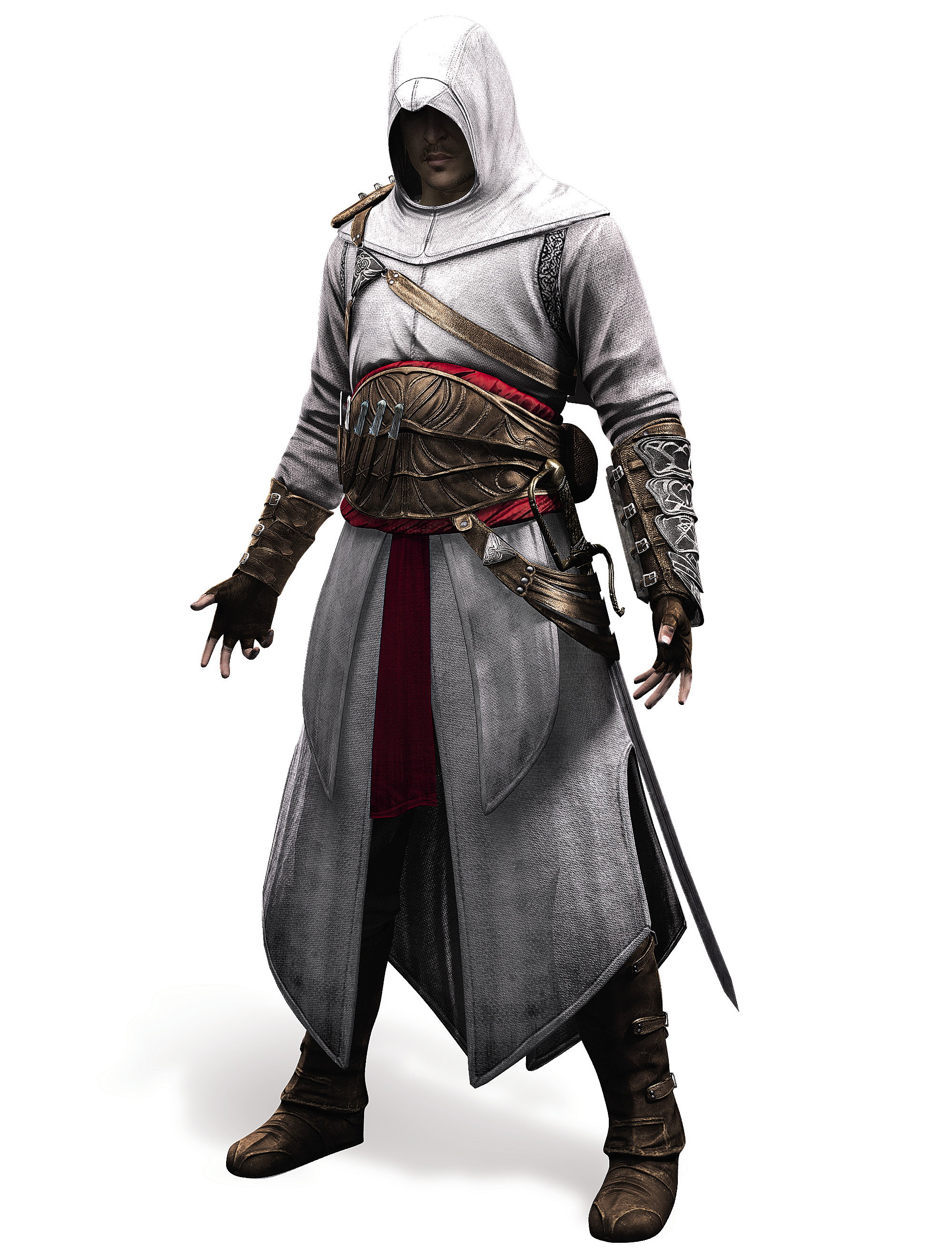
When Desmond first enters the Animus during the events of Assassin’s Creed, he explores the memory of Altaïr Ibn-La’Ahad (“The Son of None”). After inflicting a severe blow to Templar power by assassinating key figures in its hierarchy, Altaïr retrieves a mysterious Piece of Eden, which triggers a holographic projection of Earth. It highlights certain locations around the globe, suggesting this artifact may have recorded the resting places of other Pieces of Eden or First Civilization vaults and temples.
Altaïr dedicates his life to studying the Apple and taking steps to ensure that one of his successors will find the relic. At the age of 91, Altaïr locks himself in his library to pass away, his Apple safely entombed with him. His secret burial chamber remains undisturbed for hundreds of years, until Ezio discovers it and communicates the Apple of Eden’s message (from Tinia, a member of the First Civilization) to Desmond in the distant future.
First CivilizationAlso referred to as “Those Who Came Before”, the First Civilization is perceived as an advanced race that inhabited the Earth prior to mankind. They remolded a primitive indigenous species into slaves and workers that would later be known as humans. The First Civilization developed devices (described as Pieces of Eden) which controlled their workforce. Most humans, but not all, are believed to retain the dormant but still receptive neural configuration that subjected their ancestors to enslavement. The sophistication of Those Who Came Before made them appear godlike to early mankind and they were long worshipped as divine saviors – even after the global disaster that destroyed them. These beings walked among us and gave rise to the many different pantheons and gods of the cultures over which they ruled. Nevertheless, a war eventually broke out between the First Civilization and the human race, who were looking to win their freedom. In their weakened state, the overlords were unable to prevent the calamity that would deny them their existence. |
Ezio Auditore da Firenze

Ezio is the second ancestor whose life Desmond explores (in Assassin’s Creed II, as well as the Brotherhood and Revelations episodes). A Master Assassin from the Renaissance era, Ezio spends much of his life embroiled in the age-old battle against the Templars. Guided by clues left by Altaïr, Ezio travels to a First Civilization vault hidden beneath the Vatican. There, he encounters a holographic projection of a First Civilization member known as Minerva.
Ezio eventually finds and, later, conceals an Apple of Eden, obtained during his struggles against the Templars, in another vault beneath the Colosseum. He ensures that evidence of its location will only be perceptible to one of his kind.
After opening Altaïr’s secret burial chamber in Assassin’s Creed Revelations, Ezio completes his role in the First Civilization’s scheme, by communicating one last message (Tinia’s address) across the centuries to Desmond.
Vaults & TemplesThe First Civilization vaults and temples visited over the course of the Assassin’s Creed story are sealed sanctuaries where Those Who Came Before seemingly worked, each laboring with a different method designed to save the world. Vaults were built underground to avoid the war that raged above (between humans and their masters) and the imminent Catastrophe – the solar flare that scorched the face of the earth. Following the cataclysm, the few survivors of the First Civilization centralized the knowledge of all vaults into a single Grand Temple: the very destination Tinia instructs Desmond to visit at the close of Revelations. Here, Tinia asserts, Desmond will find answers to all of his questions, and possibly a way to prevent another Catastrophe. Of what is known, it seems the First Civilization had only intended specific individuals to use their vaults and temples. This is why Ezio could enter the Vatican vault that remained resolutely sealed to his Templar nemesis in Assassin’s Creed II. How the Templars have apparently acquired so many artifacts throughout history is open to speculation, but it is certain that the Catastrophe and the war with humans did not allow for an orderly inventory and confinement or destruction of all First Civilization technologies. |
Minerva

Minerva is the holographic projection of a female entity that speaks to Ezio – or, more accurately, through Ezio – when he enters the Vault beneath the Vatican at the end of Assassin’s Creed II. Though seemingly long dead, Minerva was one of the last surviving members of the First Civilization after the Catastrophe annihilated her race many thousands of years ago. She warns of an imminent Catastrophe in Desmond’s time, and claims that her kind had been developing a solution, now hidden in secret vaults around the world.
The CatastropheThe catastrophe was a solar flare – or coronal mass ejection – that long ago scorched the Earth, flipping the polarity of the planet’s magnetic field and exposing all life forms to a lethal dose of radiation. Small pockets of First Civilization survivors attempted to rebuild, but their numbers were too few; with a certain irony, their human creations proved more robust, and usurped their former masters. Erosion and vegetation over time removed any meaningful trace of the First Civilization. Minerva, Juno and Tinia – the First Civilization triumvirate – warn Desmond of an imminent repeat of the Catastrophe. |
Juno

Juno’s contempt for humanity – and enduring fury at its role in the destruction of the First Civilization – is abundantly clear during her soliloquies directed at Desmond as he seeks to retrieve Ezio’s Apple at the conclusion of Assassin’s Creed Brotherhood. Whereas Minerva and Tinia appear to regard humanity as wayward children, characterized by greed and barbarism, Juno is resolutely unsentimental in her assessment of the species. Interestingly, it may be that she is unique in directly interacting with the modern world through the use of First Civilization artifacts: Juno appears complicit in the death of Lucy by way of the Apple’s powers and Desmond’s hidden blade. (In The Lost Archive DLC for Revelations, we also learn that it was Juno who persuaded Subject 16 to assist Desmond.)
When Desmond enters the vault where Ezio hid the Apple at the end of Brotherhood, Juno reveals that the Catastrophe was so powerful that the few First Civilization members who survived knew they were doomed. Researching ways to perpetuate their race, they attempted to interbreed with mankind, or at least splice their own genetic code into human DNA. It is this information that offers an explanation for Desmond’s abilities and remarkable heritage.
Tinia

The third in the deified First Civilization triumvirate, Tinia – also known as Jupiter and Zeus – informs Desmond that their long-sealed vaults were each dedicated to researching a single method by which the Catastrophe might have been averted. Minerva, Juno and Tinia tested six methods in total, though none were completed before the solar flare scorched the planet.
Tinia reveals the existence of a single vault where he and his kind stored all of their research results – the Grand Temple that Desmond sets out to explore at the beginning of Assassin’s Creed III.
Warren Vidic

The head of research at Abstergo Industries, Dr. Warren Vidic is a leading figure in the company’s advances in genetic memory technology. Contemptuous and petulant, Vidic forces the captive Desmond into an aggressive and potentially dangerous schedule of Animus use during the events of Assassin’s Creed. Later, once he obtains the data required by his superiors within the Templar hierarchy, Lucy Stillman’s direct intervention appears to dissuade Vidic from ordering Desmond’s immediate execution.
The Lost Archive DLC that acts as a postscript to Revelations blows this subterfuge wide open: Lucy’s loyalties had shifted to favor the Templar Order, and Desmond’s escape under her direction was sanctioned by Vidic as a bold ploy to safeguard continued supply of data from their test subject.
Vidic led a Templar attack on the Assassin hideout at the end of Assassin’s Creed II, in which Desmond first demonstrated his combat prowess gained through his Animus experiences. Vidic fled the scene when the Assassins made short work of his subordinates – or so it seemed. The Lost Archive DLC suggests that the attack was little more than a maneuver to facilitate the retrieval of invaluable Animus data that Lucy had stolen from the Assassin hardware.