
Assassin's Creed III Guide Extras
History vs. Story

Having now unraveled all of Assassin’s Creed III’s plot and mysteries, we thought it would be interesting to relay how the story fits into the history of the time. This exclusive section is a unique collaboration between the writers from Ubisoft and Piggyback, and it offers parallel accounts on the game’s chronology. You will find concise summaries covering the most significant historical events supported by insights from the game’s scriptwriter, Corey May.
The following map will help you visualize the geography of 18th-century North America. This shows where the events outlined in this section took place.
North American East Coast

The lead up to the American Revolution (Part 1)

The American Revolution was the result of many political and social developments that began hundreds of years earlier. It is the story of divergences: between rivaling kingdoms, and between an emerging nation and its fatherland as the colonial descendants separated from their origins to define a new society. A brief look at the history of colonization in North America provides some insight into the events that lead to this revolution.

1492 saw the beginning of massive European colonization in the Americas with the Atlantic Ocean crossings of Christopher Columbus. In an attempt to establish a new passage to India, his expeditions inadvertently led to the European discovery of the American continents. Like many European kingdoms at that time, England and France had an interest in establishing colonies in the New World. The French started in the West Indies and North America during the 16th century. The English began later, due mainly to the Anglo Spanish War (1585-1604) under Queen Elizabeth I. The war required full access to all English maritime assets, Spain being the world superpower at that time. A truce was agreed following the succession of James I in 1603, liberating English seafaring resources; entrepreneurs offered merchant-based investment to colonization, which needed much less government support. In addition overpopulation at home, a spirit for discovery and the desire for freedom of religion played their parts in the beginning of English colonies in North America.

The lead up to the American Revolution (Part 2)

1607 marks the first English colony, founded in Jamestown, Virginia, followed by the infamous Mayflower landing at Plymouth Rock in 1620 and the establishment of the second colony – the Massachusetts Bay Colony – in 1630. English settlements on the eastern Atlantic coast continued until these numbered thirteen, with the addition of Georgia in 1732. The Thirteen Colonies, as they became known, were testament to British American economic power that had grown to rival the Spanish presence in the New World. The Thirteen were Virginia, Massachusetts, New Hampshire, Maryland, Connecticut, Rhode Island, Delaware, North Carolina, South Carolina, New Jersey, New York, Pennsylvania and Georgia.
Colonization breeds conflict – and territorial wars were common. 1756 saw the beginning of the Seven Years’ War. The great powers descended into global military conflict caused by incompatible colonial interests. In the North American theatre, British forces battled French forces, each supported by their respective colonial subjects and interchanging native allies. The British were victorious and gained the eastern part of the vast French North American colonies as defined in the Treaty of Paris of 1763. Britain was now the dominant colonial power in North America. Glory came at a price, as the British Crown was severely indebted following its triumph. The British elite, the highest taxed of any in Europe, proclaimed angrily that the colonists contributed little to tax revenues. The colonists responded that their sons had fought and died in a war that served European interests more than their own.

1753-1755Haytham Kenway, an ancestor of Desmond, assassinates a target at the London Opera House and obtains the amulet that Desmond had been trying to retrieve. Haytham believes that the amulet is the key to a First Civilization vault. He travels to the New World to establish a foothold for the organization and, more specifically, to open the vault and secure its contents. While trying to locate the vault, Haytham has a brief relationship with a Native American, and their union bears a child: Connor. |
The lead up to the American Revolution (Part 3)

The colonists in British North America saw the newly opened frontier as an opportunity to move west and expand their territories. The British government however viewed things differently: the Royal Proclamation of 1763 closed off the western frontier to the colonists, asserting that only the Crown could buy land from the natives and, in turn, sell to the colonists. The Crown wished to placate the natives and reassure them that they would not be driven from their territories. The colonists saw this as a British measure to keep them at the Atlantic seaboard, facilitating British control. Concerns grew when Parliament enacted a number of additional taxes such as the 1765 Stamp Act, a direct tax on legal documents, newspapers and other printed materials. Parliament repealed the Stamp Act the following year, as boycotts were hurting British trade, only to introduce the Declaratory Act. The declaration stated that Parliament’s authority was the same in America as in Britain and asserted this authority to pass laws that were binding on the American colonies.

As the colonists lacked representation in Parliament, they saw these laws as abusive. Tensions rose, and the Crown sent troops to Boston in 1768 to enforce the new laws and to support its local officials. Street protests and clashes between colonists and soldiers were common, and ultimately led to the 1770 Boston Massacre.
1756-1770Connor grows up in his Kanien’kehá:ka community. When Connor is five years old, his village is attacked, burnt to the ground, and he loses his mother in the tragedy. Connor believes Charles Lee to be responsible for the attack. Lee is an ally of Haytham, and is still looking for the First Civilization temple. At age fourteen, Connor takes part in a rite of passage and is contacted by Juno, who instructs him to protect the Grand Temple (where Desmond lies on the Animus in the present day) and directs him to Achilles, a former Assassin, who can train Connor at his Homestead. |
The Boston Massacre


March 5, 1770: British troops were stationed in Boston from 1768 to support the enforcement of unpopular taxes imposed by the Crown. The Boston Massacre occurred amidst this background of tensions when a mob of colonists subjected a British sentry to a chorus of verbal abuse. His officer, Captain Thomas Preston, called in reinforcements, one of whom was allegedly hit by a stone from the throng, causing him to drop his musket. On impact the gun fired into the crowd causing the rest of the regulars to open fire, killing five civilians and wounding six. Eight soldiers were arrested and tried for murder. The British soldiers were defended at their trial by John Adams, later to become the second President of the United States. Six defendants were acquitted, including Preston. The other two were found guilty of manslaughter and had their thumbs branded in lieu of the usual death sentence. The incident served to inflame tensions throughout the Thirteen Colonies.


March 5, 1770Following some weeks of training, Connor and Achilles travel to Boston. While purchasing supplies to renovate the Homestead, they are inadvertently caught up in the events of the Boston Massacre. |
The Boston Tea Party

December 16, 1773: One of the key events leading to the American Revolution. The colonists objected to a tax on tea enacted by Parliament that same year, claiming the duty’s aim was to protect the monopolistic East India Company and raise revenue for the Crown to pay the debt incurred by the recent successful French and Indian War. Protesters in New York and Philadelphia turned back ships carrying tea, but the Bostonians prevented the tea ships from leaving their port. A group of colonists known as the Sons of Liberty (some dressed as faux-Natives) boarded three of these vessels moored in the harbor and threw their entire tea cargoes overboard. The Crown responded by sending additional troops, closing Boston Harbor until the lost cargo was repaid and introducing new punitive laws known as the “Coercive Acts”. These had the reverse effect as they inspired the neighboring colonies to send supplies in support of Boston, binding the colonies in ever greater solidarity.


1773Connor, now a real Assassin, is visited by an old friend from his village, who explains that William Johnson (a Templar) plans to buy the Kanien’kehá:ka territory and expel the villagers. It seems that Johnson aims to fund his transaction by smuggling tea via British ships. Connor joins efforts with new allies (Sam Adams, Stephane Chapeau, William Molineux, Paul Revere) to start riots and dump the entire tea shipment from the British fleet into the harbor – thus taking part in the Boston Tea Party. |
The American Revolution

1775-1783: The American Revolution was the political upheaval which occurred when the Thirteen Colonies rose up against British rule to become a new nation: The United States of America. The Colonies rejected the authority of Parliament on grounds of mounting taxation without representation and proceeded to expel Crown officials. By 1774, each colony had established a Provincial Congress or equivalent governmental institution, although still within the British Empire. They then assembled delegates from each to form the governing body known as the Continental Congress. The British responded by sending combat troops to re-impose direct rule. Colonists that supported the revolution were known as Patriots, whereas those who supported the Crown were Loyalists. The ensuing conflict between the British forces and the Patriots is known as the American Revolution. Although starting as a local conflict, the war soon developed into an international theatre as other countries (especially France, which had recently lost its eastern North American colonies to the British) joined in support of the Thirteen Colonies.


1775Convinced that he will need to dispatch all of the Templars (William Johnson, John Pitcairn, Thomas Hickey, Benjamin Church and Charles Lee), Connor sets out to assassinate them one by one. After eliminating William Johnson, Connor targets John Pitcairn, who manages to escape during the battles of Lexington and Concord, and seeks refuge with the British. |
The Battles of Lexington and Concord

April 19, 1775: British regulars left Boston to raid a rebel weapons cache in nearby Concord. The idea was to make a quick swoop, defuse rebel plans to attack the British and capture the instigators John Hancock and Samuel Adams. The outcome was the beginning of the American Revolutionary War. The night before the battle, Paul Revere and William Dawes brought word that the British were advancing. The local militia was waiting in ambush when the Crown Forces marched into Lexington. It is still unclear who fired first – the British blamed the rebels, and vice-versa. The Lexington militia was considerably outnumbered and as they retreated, the British advanced to Concord in an on-going search for hidden weapons. They were met on arrival by renewed rebel resistance and there was little the British could do to counter as they were exhausted and mostly out of ammunition. The rebels followed the British retreat firing at them from vantage points along the road. Rather than disbanding, the militia gathered outside of Boston Neck, an access point to the town. This was the start of the Siege of Boston.


The Siege of Boston

April 19, 1775 to March 17, 1776: The Siege of Boston took place in the aftermath of the battles of Lexington and Concord. The colonial militia blocked access to the then-peninsular town of Boston, preventing the Crown Forces from leaving by land and restricting their resupply of naval operations in the seaport. Although the colonial forces were a mix of militias from the local Massachusetts communities they were soon adopted by the Continental Congress when forming the Continental Army, with George Washington elected as its Commander-in-Chief. The blockade lasted almost a year, characterized by sporadic raids and minor clashes. June 1775 saw one major battle: the British seized Bunker Hill and Breed’s Hill outside the town, but their losses were heavy and their gains insufficient to break the blockade. Washington took command of the siege in July 1775. In a feat of enormous heroism, the American forces managed to transport heavy artillery at night and against the winter elements up on to the Dorchester Heights overlooking the town and harbor. This made the British position untenable, and on March 17 the Crown Forces evacuated the town as their ships sailed out of Boston Harbor.

June 17, 1775Connor eventually manages to kill Pitcairn at the battle of Bunker Hill and retrieves a letter from Pitcairn’s body revealing the Templars plan to murder George Washington. |
The Battle of Bunker Hill

June 17, 1775: The Battle of Bunker Hill took place during the Siege of Boston. There were two positions from which rebel forces could mount attacks on the town: one was the Charlestown Peninsula to the north (offering elevation through Bunker Hill and Breed’s Hill), the other was the Dorchester Heights to the south. The colonial forces learned that the British were planning to take the Charlestown Peninsula. The Continental Army moved preemptively: on the night of June 16, rebels under the command of William Prescott sneaked on to the peninsula, occupied Bunker Hill and built fortifications on Breed’s Hill with lightly fortified lines across the headland. It was a poor tactical move, as Breed’s Hill, in contrast to Bunker Hill, was easier to climb, more open to attack and close enough for the British ships to bombard from the harbor. When the British learned of these new positions, they mounted an attack. When landing on the peninsula they waited for reinforcements rather than immediately attacking, giving the rebels time to strengthen their fortifications. Two initial assaults on the colonial lines failed, with significant British casualties. The Crown Forces did eventually win the positions with a third assault, after the defenders ran out of ammunition. Victory was bitter, as the British sustained heavy losses: nearly a third of the forces they had deployed. The colonists retreated successfully and suffered considerably fewer casualties. A symbolic result for the Continental Army as it had shown it could prevail against the better-trained British Armed Forces.


The Declaration of Independence

July 4, 1776: The American Revolutionary War started with colonists ostensibly fighting for their rights as subjects of the British crown. By the following summer, the movement for full independence had gathered strength. The Continental Congress was a convention of delegates from the Thirteen Colonies that acted as the governing body of the colonial forces during the war period. In mid-June 1776, a five-man committee, including Benjamin Franklin, John Adams and Thomas Jefferson, was tasked with drafting a formal statement of the Thirteen Colonies’ objectives; the result was the Declaration of Independence. This professed the Thirteen Colonies as independent states, no longer a part of the British Empire. In addition to citing grievances against the king, the Declaration justified the independence of the United States by asserting certain natural rights, particularly in the second sentence: “We hold these truths to be self-evident, that all men are created equal, that they are endowed by their Creator with certain unalienable Rights, that among these are Life, Liberty and the pursuit of Happiness.” The Declaration was a historic document and became an inspiration for other uprisings, most notably the French Revolution, which followed thirteen years later.

Thomas Hickey provided great material for us because while the record is clear that he intended to kill the Commander-in-Chief, little else is known about him. Thus he provided us with plenty of “grey area” to play with. In fact, there are several conflicting stories about how his plans were uncovered and foiled.

June 28, 1776Connor travels to New York to confront Thomas Hickey, the Templar charged with killing Washington. Connor manages to assassinate Hickey just as the latter is about to murder the Commander-in-Chief. This execution occurs just days before the adoption of the Declaration of Independence. |
The Founding Fathers

The Founding Fathers of the United States of America were members of the Continental Congress and signatories of the Declaration of Independence. They later drafted the United States Constitution. George Washington (Commander-in-Chief of the Continental Army) and Thomas Jefferson (author of the original draft of the Declaration of Independence) both feature as NPCs in the game.


Winter, 1777-1778As he tries to track down Benjamin Church, Connor meets Haytham. Haytham and Connor agree to a temporary truce and cooperate while their interests are aligned: to support the fight for independence. Though they each secretly hope they might persuade the other of the validity of their respective ideologies, theirs is a fragile alliance. As they try to help bring an end to the war, Haytham and Connor learn that the Loyalists are about to attack New York, and set out to warn George Washington. |
Valley Forge

December 1777: The onset of winter brought diminishing prospects for military campaigning and meant Washington had to choose a camp for his Continental Army of 12,000 men. With the British based in Philadelphia, Washington selected Valley Forge, twenty miles to the northwest. Conditions at the camp were severe with poor clothing, crowded quarters and rampant malnutrition. An estimated 2,500 men died of sickness and disease over the period. The timely arrival from Europe of skilled Prussian drill master Baron Friedrich Wilhelm von Steuben was to bring hope to Valley Forge by transforming it into a well-organized, centralized, military training ground. Hitherto Continental battle movements had been chaotic and ineffective because unit training had not been standardized. Von Steuben tirelessly drilled the soldiers throughout their stay, and the Continental Army emerged from the camp as an effective fighting force, winning a victory almost immediately at the Battle of Monmouth.

The Battle of Monmouth

June 28, 1778: When France joined the Revolutionary War in March 1778, British troops were ordered to withdraw from their base in Philadelphia and relocate to New York City. The Continental Army was based at Valley Forge, and Washington sent an advance force to disrupt the enemy’s retreat in order for the main American army, led by Washington himself, to engage in a follow-up attack. The advance force was composed of those troops who had most benefitted from von Steuben’s drill training at Valley Forge. Washington reluctantly tasked General Charles Lee to lead the advance operation (Washington’s preference having been the French Marquis de Lafayette). Lee engaged the British at Monmouth, New Jersey, about 90 miles northeast of Valley Forge. As Lee’s troops were gaining the upper hand, he mysteriously ordered a retreat. The British rearguard gave pursuit, but Washington arrived just in time to rally Lee’s disordered forces. With his army reformed, and with artillery support, Washington managed to counter the British advance. The battle showed the Continental Army had vastly improved in terms of co-ordination, discipline and morale. Washington emerged from the encounter with renewed heroic standing. Charles Lee, however, faced court martial for his shortcomings and, having been found guilty, was relieved of his command for a period of one year. Lee’s retreat may have been an act of duplicity. Born and raised in England, Lee had been held prisoner in March, 1777, by British General Sir William Howe. Lee was in danger of being tried as a deserter, not having resigned his British commission as Lieutenant-Colonel until several days after he accepted his American commission. During his incarceration, Lee apparently submitted plans for British military operations against the Americans.


June 28, 1778Connor gets involved in the Battle of Monmouth. Despite Charles Lee’s treachery through his now-infamous ill-timed retreat, Washington spares Lee’s life. Exposed, Lee is dismissed by the Patriots and subsequently takes refuge in Fort George. |
The Battle of the Chesapeake

September 5, 1781: The British General Lord Charles Cornwallis believed Virginia was the keystone to the rebellion. Not only was it the the largest colony, and one of the wealthiest, but its central location meant that all supplies and communications between Washington’s army in the north and Greene’s army in the south had to pass through this colony. Cornwallis decided to move his men north to join up with the British forces under General Sir Henry Clinton in New York. Arriving at Yorktown (VA), Cornwallis fortified his position and awaited naval transport to New York. Realizing the strategic opportunity presented by Chesapeake Bay (VA), Washington requested that the French fleet of de Grasse stationed in the Caribbean (twenty-eight ships) sail north to take control of the inlet and besiege Cornwallis in Yorktown. A British fleet of fourteen stationed in Antigua under Rear Admiral Samuel Hood set out in pursuit of the French and arrived at the mouth of Chesapeake Bay on August 25. As there was no French naval presence in the bay, Hood continued north to New York, not realizing that Yorktown was the target of all the Allied naval activity. As Hood made for New York, the French fleet reached the mouth of Chesapeake Bay. Hood returned from New York with Admiral Thomas Graves, who reinforced the fleet with an additional five ships. The combined British fleet was now nineteen vessels. The two navies entered battle on September 5. Only eight British and fifteen French vessels were heavily engaged. For five days the two fleets maneuvered within sight of each other with no meaningful renewed action. On September 10, de Grasse returned to the bay to discover that his fleet had been supplemented by de Barras’s naval squadron. The combined French fleet now totaled 35 ships. Outnumbered, Graves returned to New York. Although inconclusive, the battle was a major strategic defeat for the British, because it prevented the Royal Navy from resupplying, or indeed evacuating, the blockaded troops at Yorktown. Equally, it prevented the British from similarly disrupting French naval supplies to French and Continental Army troops just north of the town. The battle resulted in the successful Allied siege of Yorktown and the subsequent surrender by Cornwallis, leading to peace negotiations and the British recognition of the independent United States of America.


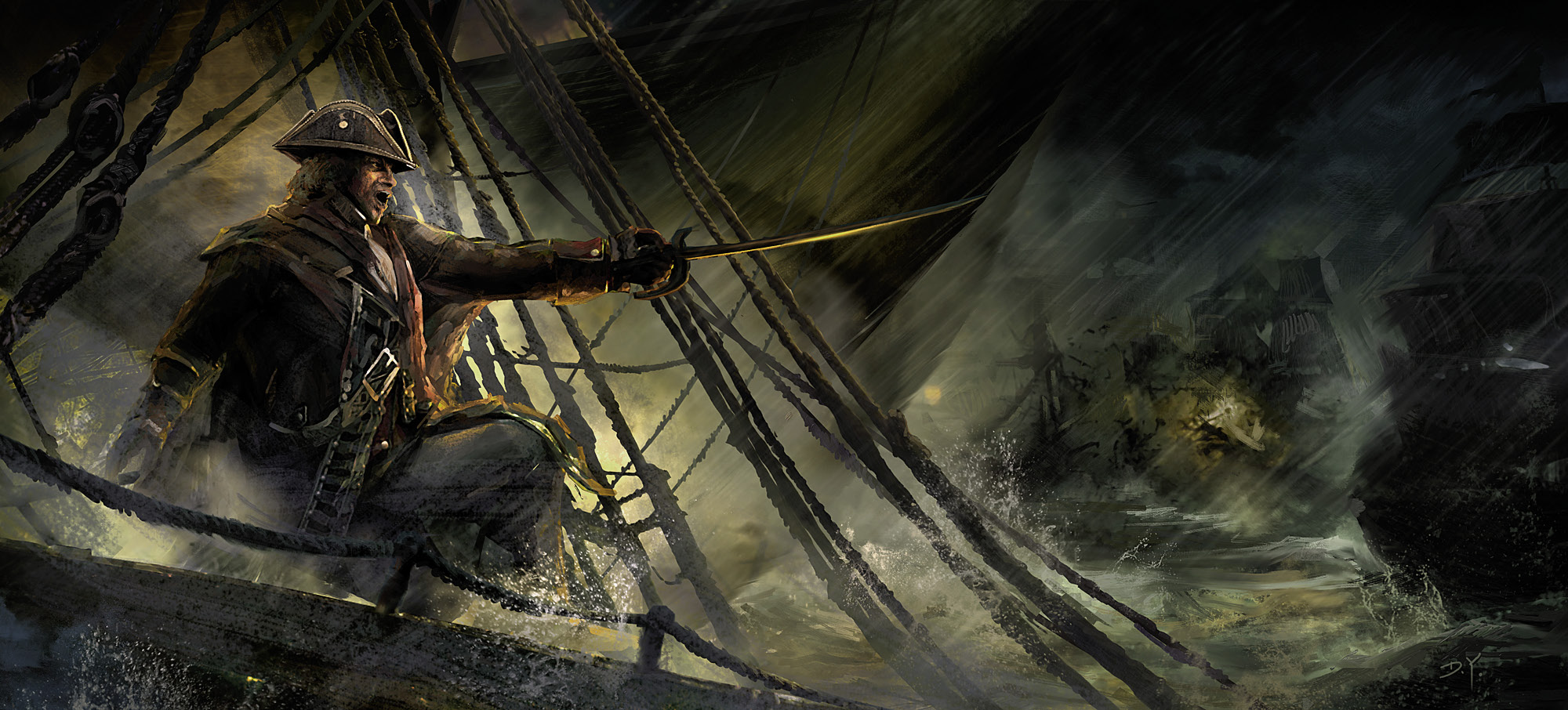
September 5, 1781Connor takes part in the Battle of the Chesapeake in order to gain access to Lee: as ships attack Fort George, Connor uses the diversion to infiltrate the fort in order to kill Lee. Connor doesn’t find Lee, but Haytham instead. Connor is forced to kill Haytham when his father’s hostility – and allegiance to Lee – leave him no alternative. |


1782-1783His course now locked, Connor sets out to confront his mortal enemy, the final Templar of significance. When his initial attack leaves Lee gravely wounded, the exhausted Connor tracks him to an ale house, where the two foes share a brief moment of silent reflection. Resigned to his fate, Lee does nothing to resist Connor’s killing blow – and the Assassin finally claims the First Civilization amulet. |