
Dragon Age: Origins Guide Essentials Traveler's Guide
Life In Fereldan
Korcari Wilds
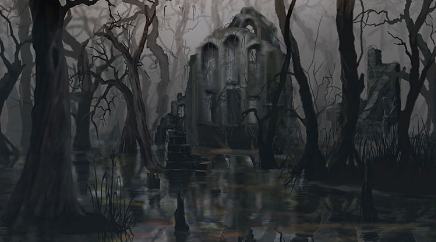
The Korcari Wilds are a large, cold wetland that covers the entire southern border of Ferelden and separates the modern nation from the wandering nomadic barbarians of the tundra lands to the far south.
The Wilds have a large culture of "Wilders" (properly known as the Chasind people, tribes who, along with the Avvar, refused to unite with the Alamarri to form Ferelden) who are considered backward even by Fereldan standards.
They think of themselves as independent of Fereldan rulership. They are still a primitive people, living in peculiar huts that sit on stilts to keep them above the winter ice and the summer swamps, and they are well known for their xenophobia.
They believe outsiders are fair game to cheat or rob. The Wilders have been particularly welcoming of rogue elves into their numbers (doing nothing for their reputation in the north) and have only one major settlement: the famous "stilt-city" of Tombigbee, though its location is kept secret from all save the Wilders themselves.
Brecilian Forest
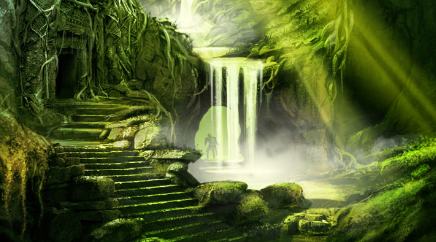
The Brecilian Forest lies in southeast Ferelden and is the subject of many local legends. Brecilian is a place of darkness and horror, and most people shun the forest altogether.
All manner of creatures are rumored to inhabit the forest, from werewolves to the possessed trees known as the wild sylvans.
Traffic between the coastal city of Gwaren and the rest of Ferelden must take the long route around the forest through the Brecilian Passage, leaving only the foolhardy or desperate to attempt passing through the forest itself.
Only the Dalish elves are known to regularly enter the forest, and this has led some to believe that the elves have a connection to whatever has cursed the forest.
Frostback Mountains
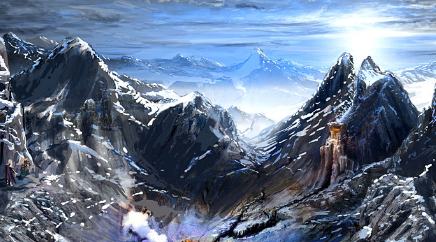
The Frostback Mountains to the west hold the hardy hillsmen known as the Avvars. The Avvars trade with the dwarves but are often at odds with the "lowlanders," having fought many wars with the Alamarri tribes in the distant past until they were finally driven into the mountains for good.
The high mountains are also known for strange ice formations, including "ice bridges" that allow movement between certain peaks - but only for a small length of time before the bridges crumble into shards of ice.
Lake Calenhad
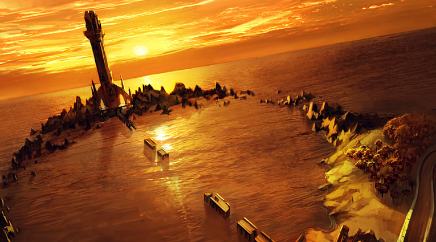
Lake Calenhad is fed from the glacier streams of the Frostback Mountains and is a beautiful clear blue.
The lake produces an abundance of fish and is perhaps most famous for the Circle of Magi situated within a tower that sits on a single island in the north part of the lake. The tower is a landmark easily seen for many miles around the entire countryside.
Denerim
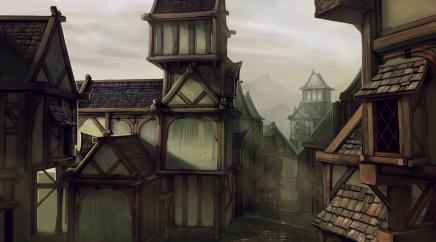
The capital of Ferelden, the city of Denerim is built around the base of a mountain known locally as "Dragon's Peak."
The city is a warren of tunnels and steep roads connecting the various districts. There is a large, walled alienage for the elves as well as the wealthy Palace District that contains the royal palace and the estates of most of Ferelden's wealthy nobility; almost all nobles who are capable of doing so maintain an estate within the city even if they use it only when a Landsmeet is called.
The oldest structure in the city is also the highest: Fort Drakon, renamed after Emperor Kordillus Drakon, is an ancient fortress built into the side of the mountain.
At one time it was the domain of Denerim's teyrn, and the city's population could retreat into the fort if it was threatened. Now it is a garrison for Denerim's city guard as well as a prison.
The most famous aspect of Denerim is that it is considered the birthplace of Andraste. An area of the Palace District is set aside as a shrine to her, one visited by a great number of pilgrims every year.
Lothering
Lothering is a major town built along the Imperial Highway, an elevated road built by the Tevinter magisters that once led from the northern coast down to Ostagar. The Imperial Highway is crumbling but is still used for travel on those sections that remain intact.
Redcliffe
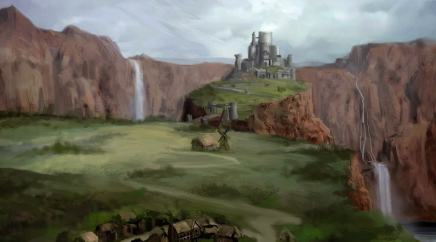
Castle Redcliffe is built on an island just off the coast of Lake Calenhad, connected to the shore (and the fishing village located there) by a narrow causeway.
The cliffs along the lake's northern shores are red tinged because of the iron content in the soil, thus the name of the castle.
The castle is of military importance, because it's shortly east of Gherlen's Pass - the primary route through the Frostback Mountains to Orzammar and ultimately Orlais. Redcliffe is home to the Arl Eamon Guerrein, brother-in-law to King Maric and considered one of the more popular noblemen in the country.
Circle of Magi Tower
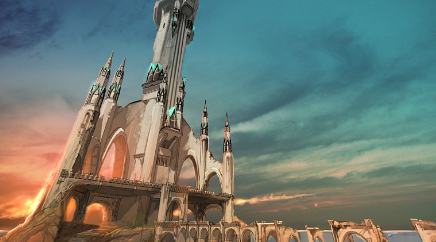
The Circle of Magi's tower is built on the remnants of a volcanic island in the northern part of Lake Calenhad.
The tower, once an ancient Avvar fort known as Kinloch Hold, was given over to the mages so that they could practice their arts well away from any civilized part of the country.
The tower was once connected to the shoreline by the Imperial Highway, but the highway has since mostly collapsed into the water, and the only way out to the tower is now by boat. A small settlement sits on the shore, a waypoint for templars stationed at the tower and travelers journeying to see the mages.
It is unknown whether the Avvar built the initial structure themselves or if the dwarves built it for them. It may even have been updated in subsequent centuries.
Ostagar
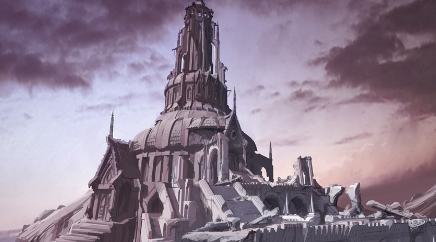
Representing the farthest point of the ancient Tevinter Imperium's encroachment into the barbarian lands of the southeast, the fortress of Ostagar was once one of the most important defensive Imperial holdings south of the Waking Sea.
It stood at the edge of the Korcari Wilds and watched for any signs of invasion by the barbarians today known as the Chasind Wilders.
Straddling a narrow pass in the hills, the fortress needed to be bypassed for the Wilders to reach the fertile lowlands to the north and proved to be exceedingly difficult for the Wilders to attack because of its naturally defensible position.
Like most Imperial holdings in the south, Ostagar was abandoned after Tevinter's collapse during the First Blight. It was successfully sacked by the Chasind Wilders and then, as the Chasind threat dwindled following the creation of the modern Fereldan nation, fell to ruin completely.
It has remained unmanned for four centuries, though most of the walls still stand - as does the tall Tower of Ishal, named after the great Archon that ordered its construction - and Ostagar remains a testament to the magical power of the Imperium that created it.
Ferelden Law
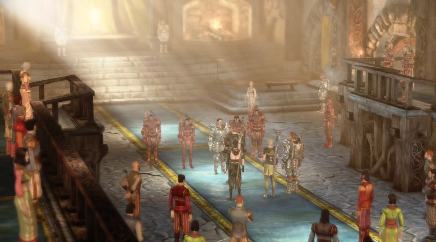
Ferelden's legal system is not incredibly complex, relying on a system of arbiters to use common sense when it comes to judgment and sentencing.
These arbiters were originally appointed by banns to represent them in disputes and make decisions on their behalf when a bann's land became too extensive for him to be everywhere and solve every dispute for the people under his command.
Every nobleman appointed his arbiter. A bann had men who resolved the disputes on his land while a teyrn did the same.
This led to inevitable disagreements as arbiters conflicted each other based on the rank of whom they served as well as the differing laws in each land. King Vortigeyrn in 4:85 Black reformed this system by decreeing that "every man had the right to be heard by the king."
After that point, all arbiters represented the king and the king's law only. This did not go over well with the Fereldan nobles, especially in the Bannorn, and it was not until the various lords were given the power to collectively determine the king's law in the Landsmeet that this was deemed acceptable practice throughout Ferelden.
Today, all arbiters represent the king and answer only to the king in the form of his seneschal in Denerim.
In the larger settlements, arbiters are able to work in one central place, and the disputed parties come to them. This generally takes place in a hall built specifically for the purpose. The seneschal's hall in Denerim is the central authority for the arbiters.
It is a distinctive structure that was built by the dwarves out of black granite and so has come to be known as "the Black Hall," with the arbiters being nicknamed "blackhallers."
Despite being specific to the city, both names have spread considerably and are used for other halls and the arbiters in general.
Outside of the larger settlements, arbiters travel between towns and villages to dispense justice periodically in the king's name.
In those settlements, a sheriff is responsible for keeping order and will keep track of which disputes must be settled by the next scheduled arbiter.
For some who face time in prison, this may mean a lengthy term inside a cell before an arbiter has the opportunity to hear their case.
It has become a common practice, then, for a man to give up something of great value to the sheriff and be released "on his bond" pending the arbiter's arrival. So long as he shows up when called to see the arbiter, his bond will be returned to him.
If he does not, the crime of fleeing justice is added to his original crime and his bond is lost for good.
This bond system has spread to the cities (for those cases involving imprisonment that may not immediately be seen by an arbiter) and to nearby Orlais and the Free Marches.
An interesting side note is the saying "my word is my bond" derives from this system: In small communities where a man charged with a crime may be well regarded, his oath that he shall show up when the arbiter comes is often considered enough, and he is released without surrendering a bond.
Thus the implication that one's word has a value of its own - "my word is my bond," a typically Fereldan attitude.
Crime
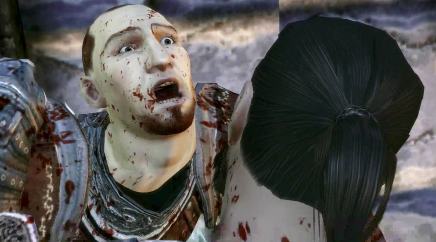
The Fereldan people have a strong tradition of personal freedom, one they will uphold by rebellion if necessary. Even nobles can be brought down to the common man's level if he steps beyond their boundaries. This tradition extends into laws and how they are enforced.
Crimes against one's person or property, such as assault and theft, certainly exist. Along with them, however, goes a certain expectation that one must take care of oneself.
A burglary of something valuable or a murder would definitely draw the attention of the guard, but a petty assault or a pickpocketing would no doubt be ignored.
Crimes against public property or in the obstruction of the king's business are more serious. Crimes that dictate behavior, however, are almost nonexistent.
Only when they reach the extremes of becoming a public nuisance are the Fereldan authorities likely to take action.
Such activities such as prostitution, drinking, gambling, and so forth are unregulated (it is worthy to note that prostitutes have tried to organize into a "companion's crafthouse," an attempt that has met active resistance from existing crafthouses because of the inherent elevation in status that would imply). The carrying of weapons and armor is also unregulated.
The only thing that is regulated closely, and perhaps even unfairly, is the use of magic: Public suspicion against magic is as strong in Ferelden now as it was in the days of Andraste's great march into the Imperium, and the Chantry is only too glad to whip this sentiment into a frenzy whenever any kind of magical incident occurs.
Thus the Circle of Magi in Ferelden is kept far away from any settlement, and mages who make their abilities known will soon find themselves unwelcome just about anywhere.
Punishment
Unlike in other nations, imprisonment is not considered an ideal form of punishment in Ferelden. For the short term it is useful, as in holding criminals until other arrangements can be made for them, but long-term incarceration it is almost unheard of.
Punishments in Ferelden tend to be quick and immediate: execution, lashings, maimings, and fines.
These punishments are often combined with public display if it is felt that an example needs to be made, and if imprisonment is determined to be necessary, it is almost always public imprisonment: stockades, for instance, or hanging in a public cage until the prisoner starves to death (or is stoned to death).
Imprisonment in dungeons and such are reserved for prisoners of the nobility: political prisoners, captured soldiers, hostages, and the like.
The Landsmeet
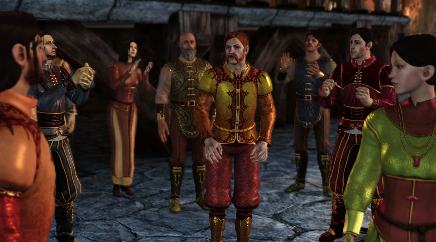
During the time when Ferelden was split into its many barbaric tribes, it was determined that some issues that affected all the banns would occasionally need to be resolved, and this required all of them to come together.
Thus the Landsmeet was created: Each bann was guaranteed safe passage to and from the Landsmeet (originally, the location changed but since the crowning of the first king, it has taken place exclusively in Denerim), where all the banns could gather to air their grievances.
Seldom was anything accomplished, as the idea of giving up personal independence for the common good is not truly a Fereldan trait, but sometimes overriding concerns brought action.
For example, in the Landsmeet, the banns fought against the occupation of the Imperium, repelled the werewolves during the Black Age, and elected to follow Maferath and Andraste into history.
Since the time of King Vortigeyrn, the Landsmeet has become a more official body as well as a legislative one.
The nobility gather to be heard by the king and together discuss and vote on the laws that will govern the kingdom.
Technically, the Landsmeet has the power to override the king on any legal matter, though in practice this has always relied solely on how much power the king personally wields.
The Landsmeet occurs at least once a year and recently (since King Maric) has begun to meet once per season.
Most noble families thus keep estates in Denerim to house them and their entourages when they are in the capital. Obviously, most nobles (especially those from faraway areas) cannot come to the capital every few months, so it is not uncommon that they appoint a proxy to act in their stead.
Normally this is a member of their family, one who opts to remain in Denerim, but occasionally it is a trusted commander.
Sometimes one's vote can even be proxied to another noble (one whose views on things are the same as yours).
The king has the option to call an emergency Landsmeet if he wishes, and on those occasions all nobles will make the effort to come to Denerim personally.
Fereldan Climate
Ferelden lies in the south of Thedas, and the climate is moderate with cold, snowy winters. Ferelden in particular suffers the extremes of weather in almost every season, a fact its durable people are quite used to and perhaps even a little proud of.
Fereldan Calendar
The current system of 12 months and 4 seasons was developed during the early years of the Tevinter Imperium (with some influence from the elves); indeed, the primary seasonal holidays have remained unchanged during much of the time since, the only exceptions being the widely celebrated Chantry holidays that became almost universally used after the Second Blight.
Each month has a High Name (the original, official Imperial name used primarily by courts and scholars) and a Low Name (the name used by commoners and merchants) and an even 30 days.
The five "annums," or annual holidays, mark the official transition between seasons and the beginning of the year; these are not the only holidays celebrated, but they are the only ones that exist without a month of their own.
Calendar and Holidays
| Holiday | First Day : The beginning of the year, this holiday traditionally involves many visits to one's neighbors and family (this was once to "check" to make sure everyone was alive at least once a year in remote parts) and a town gathering to commemorate the year past (often accompanied by much drinking and merriment). |
| Month 1 | High Name - Verimensis; Low Name - Wintermarch |
| Holiday | Wintersend : Once called "Urthalis" and dedicated to Urthemial, the Old God of beauty, this holiday has traditionally become a celebration of the Maker. It stands for the end of winter in many lands and often coincides with tourneys and contests that conjure the Proving Grounds in Minrathous (which always has its biggest contests on this day). In most southern lands, this holiday has become a day of gathering for trade, theater, and (in some areas) the arrangement of marriages. |
| Month 2 | High Name - Pluitanis; Low Name - Guardian |
| Month 3 | High Name - Nubulis; Low Name - Drakonis |
| Month 4 | High Name - Eluviesta; Low Name - Cloudreach |
| Holiday | Summerday : Once called "Andoralis" and dedicated to Andoral, the Old God of chains, this holiday is universally celebrated as the beginning of summer, a time for merriment and marriages to take place. Traditionally, boys and girls who are ready to come of age participate in a grand procession in which they cross the settlement in white tunics and gowns and end up at the local Chantry; there they are advised on the responsibilities of adulthood. This is considered a very holy day in Orlais. |
| Month 5 | High Name - Molioris; Low Name - Bloomingtide |
| Month 6 | High Name - Ferventis; Low Name - Justinian |
| Month 7 | High Name - Solis; Low Name - Solace |
| Holiday | Funalis : This holiday was once dedicated to the Old God of silence, Dumat. Since Dumat's rise during the First Blight, however, this fact has been largely ignored. Now the holiday is invariably known as All Soul's Day and is supposed to be spent in somber remembrance of the dead. In some northern lands, it is traditional for the population to dress as spirits and walk the streets in parade after midnight. The Chantry has co-opted this holiday to remember the death of Andraste, with fires that mark her burning appearing throughout the community. Plays depicting the tale of her death are also quite common. |
| Month 8 | High Name - Matrinalis; Low Name - August |
| Month 9 | High Name - Parvulis; Low Name - Kingsway |
| Month 10 | High Name - Frumentum; Low Name - Harvestmere |
| Holiday | Satinalia : In many places, this holiday—once dedicated to the Old Goddess of chaos, Zazikel, but now attributed more to the Second Moon, Satina—is still accompanied by wild celebration. Celebrants wear masks and lose their inhibitions, and they place the town fool as ruler for a day. In Antiva (Antiva City in particular), this festival lasts for a week or more, followed by a week of fasting. In more pious areas, this holiday is now marked by large feasts and gift-giving. |
| Month 11 | High Name - Umbralis; Low Name - Firstfall |
| Month 12 | High Name - Cassus; Low Name - Haring |
Fereldan Currency
|
Coin |
Fereldan Equivalent |
Orlais Equivalent |
Exchange Rate |
|---|---|---|---|
|
1 gold piece |
1 sovereign |
1 royal |
100 silver pieces |
|
1 silver piece |
1 silver |
1 crown |
100 copper pieces |
|
1 copper piece |
1 bit |
1 penny |
N/A |