
Dragon Age: Origins Guide Essentials The Classes
The Mage: Character Builds
With 64 spells to choose from and four specializations, you can make a myriad of mages. Don't feel constrained to play according to the following mage models to the letter; take bits and pieces that appeal to your play style and add your own spin.
However, these are basic models for a DPS mage, healer, or blend mage who balances offense and defense. Each shows you how to choose your spells up to level 20, what spell chains are effective, how specializations fit in, and sample combat strategies for that model.
DPS Mage Model
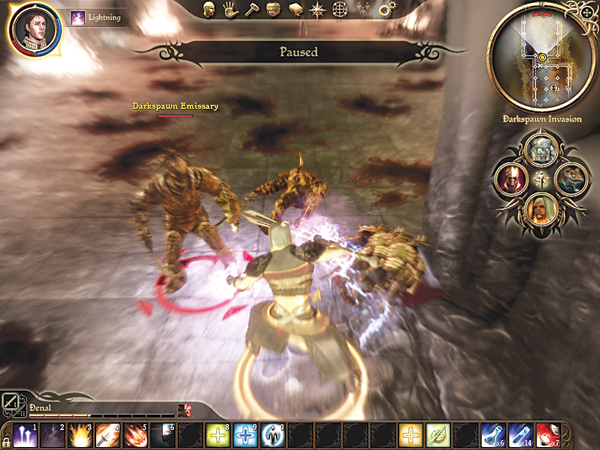
| Level | Spell |
|---|---|
| 0 | Arcane Bolt |
| 1 | Flame Blast, Heal |
| 2 | Flaming Weapons |
| 3 | Fireball |
| 4 | Spell Wisp |
| 5 | Grease |
| 6 | Walking Bomb |
| 7 | Death Syphon—First Specialization Available at This Level |
| 8 | Arcane Shield |
| 9 | Staff Focus |
| 10 | Arcane Mastery |
| 11 | Virulent Walking Bomb |
| 12 | Inferno |
| 13 | Lightning |
| 14 | Spider Shape (Shapeshifter)—Second Specialization Available at This Level |
| 15 | Bear Shape (Shapeshifter) |
| 16 | Flying Swarm (Shapeshifter) |
| 17 | Master Shapeshifter |
| 18 | Animate Dead |
| 19 | Shock |
| 20 | Tempest |
Overview
A DPS mage deals heavy damage from medium to long range. He generally concentrates in the Primal and Spirit schools.
Leveling
What does a DPS mage do best? Damage. Naturally, then, you should start off with a Primal chain.
In this case, we'll choose the Fire chain, mostly because Fireball is such a great AoE damage spell.
You could, of course, start with any of the Primal chains. (The Earth chain, however, may prove a little troublesome at level 1; it's the only Primal chain that doesn't start out with a damage spell.)
Note that to hit Fireball at level 3, you need to spend your five character creation points in magic to bring you up to 21, then spend the three attribute points you earn at level 2 and three on magic as well to raise the score to 27 (elf mages begin with one extra magic point than humans, so you can spend that one point in willpower if you like).
At level 1, invest in Flame Blast to start the Fire chain and give you an additional attack to Arcane Bolt (all mages start with this basic attack). Pick up Heal as well. Yes, it's a defensive spell, but every mage should carry it to save allies or themselves in a pinch.
Take Flaming Weapons at level 2 for some melee support. Once you hit level 3 and learn Fireball, you can roast enemy groups from a great distance. You have fine weapons already, so long as you don't run into fire-resistant mobs.
At levels 4 and 5, choose Spell Wisp and the second spell in that chain, Grease. Spell Wisp increases spellpower, which augments all your damage spells, and Grease causes enemies to slip if they miss a physical resistance check (crowd control) and the slick surface can be set on fire for extra damage, making it a perfect combo for your fire-based spells.
Start your second damage chain with Walking Bomb at level 6. This gives you a separate source of poison damage (and sets you up for another lethal AoE attack at level 11).
The follow-up to Walking Bomb, Death Syphon at level 7, restores mana; always handy in longer battles.
Levels 8, 9, and 10 fill out the standard Mage school. Arcane Shield helps divert incoming attacks, giving you some more defense. The overlooked Staff Focus powers up your basic staff attack, which you always use as back-up damage when your mana runs low.
The real reason for running these spells in a row here is to ensure that you pick up Arcane Mastery at its earliest availability: level 10. Because Arcane Mastery grants a permanent bonus to spellpower, it makes all your DPS stronger no matter what spell you choose.
At levels 11 and 12, you maximize your two damage chains. Virulent Walking Bomb functions similar to Walking Bomb with one big difference: when targets explode, they have a chance to infect other enemies and start a chain reaction of explosions.
Inferno, the top of the Fire chain, engulfs an entire area in continuous flame and will decimate enemies if they can't escape to the cooler perimeter. Note that you need 34 magic to access Inferno.
Branch out into a third damage chain, Lightning, at level 13. Two separate damage sources are usually enough, but if you rotate three, you should always have a damage spell available as long as your mana lasts.
At level 14 we try out the shapeshifter specialization with Spider Shape. With a DPS mage who really wants to hammer out lots of damage, it's best to go with your core damage spells early and slip into a specialization at level 14.
The shapeshifter specialization lets you deal melee DPS, which is fantastic for when your mana runs low or if you find yourself under direct melee attack.
To gain all the creature abilities from shapeshifter, we'll invest four points in a row to the specialization, though you could spread them out through level 20 if you like.
At levels 18 through 20, you should fill in with whatever tickles your fancy. At level 18, we pick up Animate Dead to finish off the Walking Bomb chain and gain some combat allies in the process.
For levels 19 and 20, we crank up the damage in the Lightning chain with Shock and Tempest. By level 20, you have three separate damage chain nearly maxed out, some good support spells, and an entire specialization at your disposal.
Spell Choices
Fire spells serve as your primary AoE if you have the space to deal damage to your foe without catching the party in friendly fire.
The Spell Wisp chain gives you extra spellpower and a crowd control spell in Grease. The Walking Bomb chain focuses on another cycle that can serve as either single-target damage or AoE damage.
The Lightning chain gives you a third damage alternative, the effect of bouncing from one target to the next, and another option to avoid cooldown problems.
Specialization
Shapeshifter provides melee DPS so you can conserve on mana and defend yourself if under direct attack.
Spider Shape has an effective Web snare, Bear Shape offers a good Overwhelm ability, and Flying Swarm turns into an AoE attack that also protects you from physical damage (all damage comes off your mana instead). Master Shapeshifter improves all forms, and you can hold your own against less powerful mobs.
Battle Tactics
Your standard tactic is to deal steady damage to enemies without pulling so much threat that the enemies escape your tank's hold and charge toward you.
With that in mind, you may have to delay a few seconds at the start of the fight, or during the fight, depending on the enemy position and your tank's ability to lock down the threat.
Your general spell cycle will be Fireball (if you won't hit your party with friendly fire), Walking Bomb, Arcane Bolt, and Lightning (if you've reached level 13 or higher). A neat trick inside dungeons is to open a door and hurl a Fireball at enemies on the far side of the room.
The explosion consumes the room and the walls prevent the burst from burning your party; just cast it well away from the door.
Similarly, you can use your higher damage spells, such as Tempest, to hurt enemies you can't even see. Target the spell around a corner or inside another room (if the door is open) and let it rip.
Enemies inside will take tons of damage or come running out into your well-positioned party's ambush.
An important part of your job may be to contain rather than destroy. Think of Grease whenever you see a large group ready to flank your party, or if something unexpected happens, such as your tank getting stunned and losing threat.
Grease will delay most of the enemies, and you can always follow up with a Flame Blast to ignite the oil and cause great pain to the enemy.
If you're playing pure DPS, you should have another mage, a healer, in your party too. They can do the heavy lifting when it comes to healing and keep the party alive.
However, don't ignore the supplemental healer role. In tough fights, throw a Heal into your rotation. If your primary healer is having trouble, you may even heal after every other damage spell.
As soon as that Heal spell becomes active, glance at everyone's health bars and kick it off if wounds are piling up. Yes, you are a master DPSer, but if you are the only one standing, it won't do you much good.
Healer Model

| Level | Spell |
|---|---|
| 0 | Arcane Bolt |
| 1 | Heal, Rejuvenate |
| 2 | Regeneration |
| 3 | Winter's Grasp |
| 4 | Spell Shield |
| 5 | Dispel Magic |
| 6 | Arcane Shield |
| 7 | Group Heal (Spirit Healer)—First Specialization Available at This Level |
| 8 | Revival (Spirit Healer) |
| 9 | Staff Focus |
| 10 | Arcane Mastery |
| 11 | Mass Rejuvenation |
| 12 | Lifeward (Spirit Healer) |
| 13 | Frost Weapons |
| 14 | Cleansing Aura (Spirit Healer)—Second Specialization Available at This Level |
| 15 | Cone of Cold |
| 16 | Blizzard |
| 17 | Vulnerability Hex |
| 18 | Affliction Hex |
| 19 | Misdirection Hex |
| 20 | Death Hex |
Overview
A healer focuses on health regeneration and rejuvenation. These mages generally concentrate in the Creation school.

Leveling
A healer should concentrate in the Creation school, at least until they reach Regeneration and have two solid heals.
Note that to hit Regeneration at level 2, you need to spend your five character creation points in magic to bring you up to 21, then spend two more attribute points at level 2 to raise the score to 23 (elf mages begin with one extra magic point than humans, so you can spend that one point in willpower if you like).
At level 1, pick up Heal and Rejuvenate. Heal will be your staple health spell; Rejuvenate helps to restore stamina for warriors and mana for mages. If you increase your magic attribute correctly, you can net Regeneration at level 2.
It's crucial to have at least two healing spells; otherwise, while Heal is on cooldown, a party member could become gravely wounded and you'll have no healing to help him.
Every healer should have a form of damage as well. In addition to your standard Arcane Bolt, we'll pick up Winter's Grasp at level 3.
The Cold chain has the built-in effect of freezing a target in place, which serves to slow down foes and help out on defense; this defensive component complements your healing role.
Next, branch out into the Spirit school for levels 4 and 5. Spell Shield comes first as a potential defense against hostile spells, but it's really a prerequisite for Dispel Magic.
This is always handy to remove enemy effects on party members, Dispel Magic proves critical to remove Curse of Mortality, which prevents healing and will kill party members if you don't eliminate it fast.
At level 6, pick up Arcane Shield. Much like Spell Shield, it's extra defense that may come into play in certain fights, but it's mostly a prerequisite to ramp up to Arcane Mastery later.
No matter what you have to do, you want to gain the spirit healer specialization as soon as you hit level 7. The first spell in the chain, Group Heal, is the most important spell as a healer.
The ability to heal all your party members at once will turn the tide in many battles. At level 8, the spirit healer ability Revival may tip the battle scales in your favor when one of your companions drops and you can bring them back from the brink of death.
At levels 9 and 10, you fill out your basic Mage school. Choose Staff Focus at level 9 and Arcane Mastery at level 10. Arcane Mastery will augment all your healing spells, which is a very good thing for your party's health.
Mass Rejuvenation comes in big in long battles where everyone needs a boost to stamina and mana. At level 11, this fills out your main Heal chain.
At level 12, grab Lifeward from spirit healer. It's another healing spell that works when a companion's near death: a nice luxury to throw on a tank, or someone else that you can't heal immediately.
Frost Weapons at level 13 inches you up in the Cold chain and lets you boost your party's offense if it looks to be a light fight that won't require much healing.
Cleansing Aura finishes off the spirit healer specialization at level 14. It's an AoE healing effect, which also cures injuries (and saves on buying injury kits!).
At levels 15 and 16, fill out your Cold chain with Cone of Cold and Blizzard. You won't blast an area too much with Blizzard unless your party is desperate for damage, but you will fire off a Cone of Cold once in a while.
Cone of Cold also freezes targets in place, and if your enemies aren't attacking, you don't have to spend mana healing.
Your final four slots can go to any spell chain you like. We'll go with the Hex chain: Vulnerability at level 17 up to Death at level 20.
The hexes can reduce attack percentages against your party (as well as enemy defenses), which plays to your strength as the group's main defender.

Spell Choices
Your Heal chain will be the most active as you cycle back and forth between Heal and Regeneration throughout all future battles.
The Cold chain gives you offense and defense, because foes may be frozen in place after you hit them with Winter's Grasp or Cone of Cold. Dispel Magic comes out automatically as soon as one of your companions falters to a lingering negative spell effect.
At higher levels, your Hex chain supplements your main strategy with spells that reduce the effectiveness of the enemy against your party.
Specialization
Spirit healer is paramount at level 7. Seek it out as soon as you unlock the specialization potential. Group Heal proves super effective, healing everyone at once. Revival brings a companion back into the fight who would have been useless otherwise.
Lifeward prevents an overwhelming amount of damage from finishing off an ally, while Cleansing Aura generates continuous health to all around you.
Battle Tactics
All good healers know to stay out of the heat of battle and focus not on spilling enemy blood, but on staunching the blood on your companions' tunics.
Stay out of the main confrontation so as not to draw the attention of your foes. Don't waste mana on offense except in dire circumstances where you need to kill something before it kills you, or possibly minor fights where the outcome is never in doubt. Before you leave one encounter for the next, make sure your mana has topped back off.
Learn your allies' armor and health reserves. If you misjudge someone's threshold for damage, they may end up dead before you can heal them.
With some practice, you will know when to fire off a Heal to bring a companion back to full health without wasting healing that goes above their max health rating.
Cycle through Heal and Regeneration, throwing in any other healing you have for longer fights. Preventive healing is a good idea; it keeps your companions' health high and avoids the problem of direly needing a heal that's unavailable on cooldown.
Once you gain Group Heal, master it. It's great to use when multiple party members are taking damage: you cast an economical heal that saves several people at once. You can counteract big bursts of damage that wound your team, such as traps or an unexpected Chain Lightning from an enemy spellcaster.
Should multiple party members start taking damage over time - such as from a dragon's firebreathing - Group Heal helps boost everyone's health at once and keep the party out of immediate danger.
Heal as often as seems feasible. Unlike a DPS mage, you can't afford to heal conservatively to avoid threat if companions are at risk.
Be sure to stock up on lyrium potions to replenish mana. If a DPS mage comes up dry, you might rely on the warrior to belt out the extra damage; if your healer gets stuck on empty, you had better win the fight in a matter of seconds or someone might not make it.
Blend Model
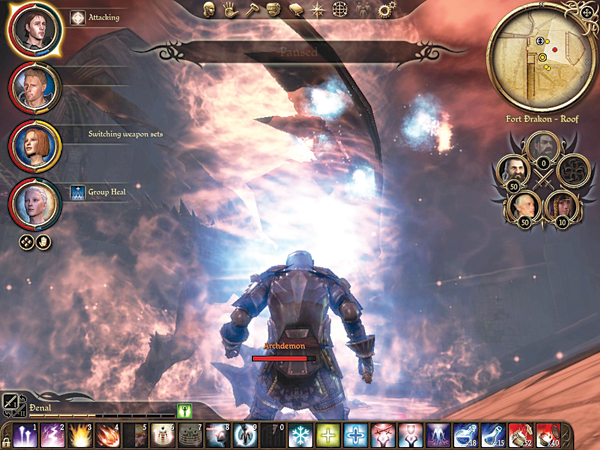
| Level | Spell |
|---|---|
| 0 | Arcane Bolt |
| 1 | Heal, Rock Armor |
| 2 | Stonefist |
| 3 | Earthquake |
| 4 | Mind Blast |
| 5 | Force Field |
| 6 | Arcane Shield |
| 7 | Combat Magic (Arcane Warrior)—First Specialization Available at This Level |
| 8 | Petrify |
| 9 | Staff Focus |
| 10 | Arcane Mastery |
| 11 | Telekinetic Weapons |
| 12 | Aura of Might (Arcane Warrior) |
| 13 | Crushing Prison |
| 14 | Shimmering Shield (Arcane Warrior)—Second Specialization Available at This Level |
| 15 | Lightning |
| 16 | Fade Shroud (Arcane Warrior) |
| 17 | Heroic Offense |
| 18 | Heroic Aura |
| 19 | Heroic Defense |
| 20 | Haste |
Overview
A blend mage has the most versatility, splits talents between offense and defense, and may pull spells from all schools.
Leveling
At level 1, choose two defensive spells: Heal and Rock Armor. As with all mages, Heal serves as health rejuvenation whenever someone needs a boost.
Rock Armor gives you an armor bonus, which you'll need because a blend mage draws more threat and enters melee more than the average mage.
Note that to hit Earthquake at level 3, you need to spend your five character creation points in magic to bring you up to 21, then spend the three attribute points you earn at levels 2 and 3 on magic as well to raise the score to 27 (elf mages begin with one extra magic point than humans, so you can spend that one point in willpower if you like).
At levels 2 and 3, you'll take two offensive spells: Stonefist and Earthquake. Stonefist is a great offensive spell that pummels a single enemy with damage and can knock it off its feet.
Earthquake will be your staple AoE attack. Note that you could take any main damage chain here (fire, cold, or electricity).
Next, enter the Mind Blast chain at level 4. Mind Blast can play out hugely when surrounded by large groups.
Stun them to prevent a swarm on you, or to give your companions more time to get into position and wield their best attacks.
Perhaps the best defensive spell in the game, Force Field at level 5 nullifies all damage against you or a targeted ally for a short duration.
You can almost stack Force Fields one after the other and keep a target alive against ridiculous damage - the only drawback is the target of the Force Field can't react in any way while defended.
At level 6, pick up Arcane Shield as added defense and the second step toward Arcane Mastery at level 10.
With this blend build, we want the arcane warrior specialization at level 7. Learn Combat Magic and suddenly you can equip high-level armor and weapons. You might not be a tank, but you're no slouch in combat any longer.
Levels 8 and 9 boost your offense again. Petrify can be a single-target kill spell if they fail a physical resistance check. (Follow up Petrify with Stone Fist for shattering results!) Staff Focus increases the damage done with your basic staff attack.
Arcane Mastery at level 10 improves spellpower and thus increases the effectiveness of all spells.
At level 11, Telekinetic Weapons enhances your companions' weapons, and even your melee weapon if you wade into melee as an arcane warrior.
The level 12 Aura of Might bolsters your attack, defense, and damage. Note that you need reach 34 magic to access Aura of Might.
Your best offensive spell comes at level 13: Crushing Prison. Break this out against single foes and encase them in a prison that roots them to the spot and deals continuous spirit damage.
At level 14, Shimmering Shield continues your arcane warrior abilities. The shield sucks up damage and cranks up resistances; it's great for melee fighting, but it drains mana quickly, so don't count on casting many spells in conjunction with your defense.
Pick up Lightning at level 15. It's another damage spell that gives you a new source of damage and single-foe targeting.
Finish off the arcane warrior specialization at level 16 with Fade Shroud. While Combat Magic is active, Fade Shroud increases mana regeneration and gives a chance to avoid attacks.
At level 17 start the Heroic chain and complete it at level 20. The first three (Heroic Offense, Heroic Aura, Heroic Defense) grant bonuses to the respective categories.
The fourth, Haste, shines for an arcane warrior, speeding up the melee damage you can do at the expense of mana. If you've maximized your character, though, you won't have to rely on damage spells as much as a DPS mage.
Spell Choices
The Earth chain gives you lots of offensive options: single-target stun with Stonefist, AoE with Earthquake, and single-target kill with Petrify.
Mind Blast and Force Field offer excellent defense, all on the way to your best offensive spell in Crushing Prison.
Lightning adds an extra damage dimension to your spell rotation, and the Heroic chain can add extra offense or defense just when you need it. Haste gives a melee edge to your entire team, even if it doesn't last a super long time.
Specialization
Arcane warrior drives this blend build. Rather than drops spells constantly, the arcane warrior mixes ranged DPS with defensive spells and hand-to-hand combat. Combat Magic gives the mage access to armor and weapons only the warrior class would normally have.
Aura of Might bolsters stats across the board. Shimmering Shield can keep you alive in a melee fight, but will cut you off from spells as your mana drains away.
On the opposite extreme, Fade Shroud will replenish your mana and help you avoid damage once you level high enough to unlock it.
Battle Tactics
Unlike your standard mage who stays in the rear, this blend mage isn't afraid to enter melee after he specializes in arcane warrior at level 7.
Suddenly, the lowly mage can wear excellent armor and wield weapons normally above his pay grade. The specialization is worth it just for that benefit alone, and it gets better for a brawler mage when you add the next three talents.
On the spell end, your offensive rotation will usually go Earthquake (if you can avoid friendly fire), Arcane Bolt, Stonefist (targeting any enemy heading directly for you), and Petrify or Crushing Prison for the kill (or against the strongest opponent).
You can pick and choose the correct spell for the situation if you forgo pure spellcasting and slip into arcane warrior mode.
Your defensive spell rotation generally goes Rock Armor, Mind Blast (when enemies close), Heal (whenever necessary), and Force Field for all-out defense.
You can do lots of tricks with Force Field. You can, of course, save someone from certain death with a handy Force Field. You can send a tank in against a difficult foe, let him pile on threat, then throw up a Force Field; the enemy will most likely stay on the tank while you deal with the surrounding enemies.
Even better still, you can take on bosses yourself. Cast a major spell, such as Earthquake or Fireball, on the enemy and follow up with a few damage spells to get him mad and fixated on you.
As soon as the return damage heads your way, throw up a Force Field. While you're trapped in the Force Field, have a second mage cast Rejuvenate on you to replenish your lost mana (or quaff a lyrium potion as soon as you emerge from the Force Field). You can deal a ton of damage over a long time, while barely taking a nick.
As a blend mage, you can tap into anything, dabbling here and there. The idea is to learn a balance of offense and defense to jump into any situation with an answer in hand. To some degree, all good mages are blends.