
Dragon Age: Origins Guide Essentials The Classes
The Mage: Skills & Spells
Skills
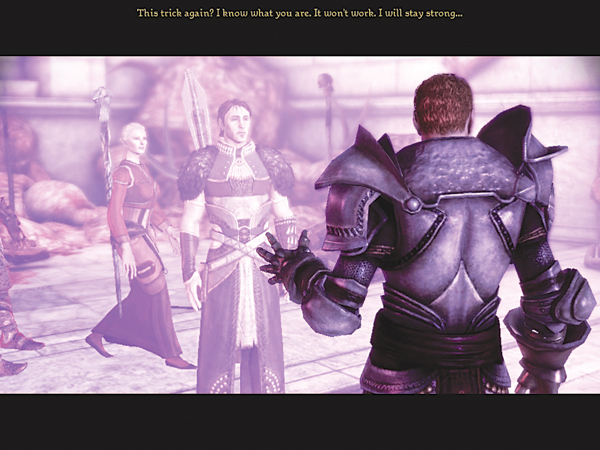
Mages are natural herbalists, so it's fitting that you begin with a skill point in Herbalism (and also one point in Combat Tactics).
They stockpile magic attribute points for spell effectiveness, and items produced by Herbalism rely on magic for effectiveness. It's a perfect union. At least one party member must be skilled in Herbalism per party.
Otherwise, you lose out on essential healing and mana potions, and won't have the same staying power in fights as a fully stocked party. Unless one of your companions (say, Wynne) supports Herbalism, you should strongly consider it as your top skill.
Because mages gravitate toward magic, Herbalism ranks high, but Coercion is usually the best skill to take.
As with any other class, Coercion grants you access to story possibilities that aren't available through brute force. Spend all your skill points here first if you don't plan on becoming a herbalist.
The more points you spend in Combat Training, the more damage you can take before the damage interrupts your spellcasting.
If you're a mage who expects to get hit often in combat, or you don't want to blow a key spell because of mob interference, then stock up on Combat Training. Two points is enough to withstand disruption from all but the most damaging attacks.
Mage Skill Recommendations
Assuming you spend 8 skill points by career's end, here's a good spread to consider. Note that many other combinations could work better for you, so experiment!
- Herbalism +4
- Coercion +4
Survival can be a good skill to have because the more you advance it, the better chance you have to detect creatures on your mini-map before they surprise you.
You can save yourself from more than a few ambushes with this skill. Don't forget about the bonus to nature resistance too.
For companion mages, who you might not always control directly, consider spending skill points in Combat Tactics. The more tactic slots you open, the more you can shape how your companion behaves in battle.
Inevitably, even if you plan on controlling your mage during fights, there will be moments when you don't program your mage's every move (or something more important is going on) and tactics come into play.
One or two points should be good, or max it out if you want the character to go on autopilot.
None of the other skills really fit the mage profile, except perhaps Trap-Making. At first it seems solely a rogue skill, but if your mage isn't strong in ranged damage (a healer, for example), you may want Trap-Making to use traps to lure enemies in. Traps deal decent damage up front while you cast a spell barrage from afar.
Spells
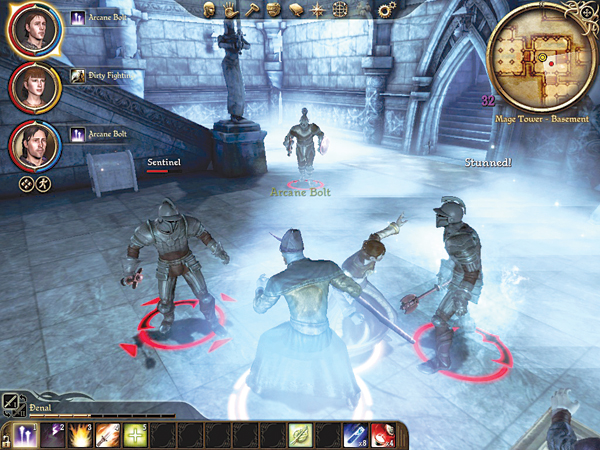
Mages have access to a vast arsenal of spells, many more than you could attain in the course of the game.
Rather than focusing on one school, pick the type of mage you'd like to be (DPS, healer, or blend) then round out your mage with a selection of spells that could deal with an array of situations.
For example, you'll want a few spells for AoE, direct attacks on single targets, buffs, etc. Notice how the stronger spells are at the end of individual chains. With that in mind, develop individual chains rather than focusing on an entire school.
You start with one point in the Mage spell school and two more points to spend wherever you like.
In addition, you receive one point for every level you gain, and you gain one talent bonus point when you survive the Joining and a second bonus point at the end of the Landsmeet when you become commander of your army.
Working with this, if you get to level 20 by the end of the game, you'll have 24 total points to spend. It might seem like a lot, but you really have to plan what spell chains you want, because you'll cap only three or four regular chains if you decide to specialize.
All mages need to familiarize themselves with the cooldown component of each spell. The worst situation is to have plenty of mana and no available spells to cast.
Branch out into different spells to avoid the cooldown problem. Yes, you may love to cast Lightning on a target, but you need a follow-up damage spell or two to use while Lightning reloads.
You also want to branch out into different chains so that your spell rotation cycles through separate damage types. For example, if you develop the Fire chain as your sole damage source and run into rage demons, who are resistant to fire, you won't do too well.
But if you have Winter's Grasp or Cone of Cold in your arsenal, you can contribute massive damage.
Even DPS mages should carry a Heal spell. It's always a luxury to have a mage who can serve the same function as a health poultice, only on a continuous basis with sometimes greater effect.
In the same regard, don't under-value your defensive spells. Your main priority may be to deal damage as a DPS mage, but at some point you will need to protect yourself.
Spells such as Arcane Shield and Force Field minimize damage that would otherwise kill you in an encounter.
Your spells draw mana from your pool. Watch how much mana you're using in a fight and cast accordingly. If you run short without ample lyrium potions to replenish, you could cost your party a victory.
Gauge what you have to do to help the team. There's no sense casting a huge Chain Lightning spell on a group of enemies that go down with one or two swings, just as you may want to hold back on that Petrify spell if the tank has the situation under control.
Save your mana. You never know when the next fight will start, and you'll be grateful you didn't waste mana.

Spell Combos
- Earthquake + Grease + Fireball + Walking Bomb should stymie most groups before they can do too much harm to your party.
- A fire spell on Grease works great at lower levels or when you don't have all kinds of time.
- Glyph of Paralysis + Glyph of Repulsion causes an explosive effect that paralyzes those nearby.
- Blizzard + Inferno + Tempest becomes Storm of the Century (spectacular electrical storm).
- Cast Blizzard on a burning Grease slick to extinguish it.
- Send a tank to draw all kinds of threat from a mob away from the party. Cast Force Field on the tank for immunity from all damage and then follow with Inferno to engulf the entire area. The enemies burn while fighting a tank that can't die.
- Drain Life and Mana Drain are twice as effective on a target with a Vulnerability Hex.
- Cast Spell Might on yourself and then cast Animate Dead on a skeleton. This skeleton is much more powerful than the ordinary skeletons you can animate.
- Cast Sleep on a target and then cast Horror on it. This inflicts massive spirit damage on the target, often killing many lesser foes outright. Those who survive emerge in a state of fear.
- Immobilize a target with Cone of Cold or Petrify. When the target is in that vulnerable state, a critical hit from any weapon, a hit from the Stonefist spell, or the effects of the Crushing Prison spell will shatter it. (Bosses and lieutenants are highly resistant to this.)
- Cast a Death Hex on a target and then cast a Death Cloud in its area. If the target is touched by the Death Cloud, it sustains massive spirit damage.