
Dragon Age: Origins Guide Essentials Traveler's Guide Elsewhere
Geography
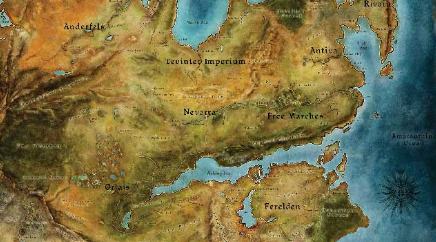
The Orkney Mountains, a rugged chain of mountains that stretches from the icy wastelands of the southeast deep into the continent's center, dominate the southern lands of Thedas.
A smaller mountain chain called the Frostback Mountains juts between Ferelden and Orlais and holds the dwarven city of Orzammar (thought to be the last until the rediscovery of Kal-Sharok).
The mountains define the southern border of Thedas, while the vast Tirishan forest and the Hunterhorn Mountains define the western border, cradling between them the fertile Orlesian Empire - the most powerful nation in Thedas and home to the Grand Cathedral of the Chantry religion.
An unbroken expanse of trees, the Tirishan is one of the wonders of the world and is as mysterious and dangerous as the hottest of deserts.
Thedas is divided in the middle by the Waking Sea. The central lands north of the Waking Sea are known as the Free Marches.
They consist of forest and plains, and they have the best agricultural lands on the continent. This land is covered with city-states, collectively known as "Marchers," that have stubbornly protected their independence, and they have used their status as the breadbasket of Thedas to become merchants without equal. Any who dare threaten one of their cities risks losing the rights to trade with them at all.
The Arlathan Forest, once home to the only known city of the elves that was destroyed by the Tevinter Imperium, lies just north of the Free Marches, and it forms the border between the Imperium and the more exotic realms of Antiva and Rivain.
This ancient forest is neither as dark as the Tirishan nor as dangerous, but its oft-plundered ruins are a sad tribute to the culture that once was.
Little of the old elves remain, and the forest is often called "the Mourning Lands" by those who visit it, because it seems few humans can make a living there, as if the forest itself resents their presence.
The lands of Tevinter around the Nocen Sea are quite temperate and were the first realms inhabited by mankind. Ruins here are plentiful, dating back to a time when the Old Gods were worshipped and the blood magic of the magisters ruled over the land.
The islands of Seheron and Par Vollen in the Boeric Ocean are junglelike and humid. They have been transformed over centuries of control by the Qunari into bastions of military and religious efficiency.
The Anderfels, to the northwest, is the first part of a great land of dry steppes. It is a harsh land famous for producing a rugged people resentful of their former Tevinter overlords, and it is the true home to the Grey Wardens at Weisshaupt Fortress.
The Donark Forest marks its northern border and is a rain forest of tall trees and uncivilized freemen who have notoriously evaded control by their southern cousins.
Seheron
Seheron is a large island nation that had been conquered by the Tevinter Imperium long ago and has been part of that nation until the Qunari took it 60 years ago.
It is still in a state of semiactive rebellion and is the site of repeated battles between the Imperium and the Qunari. The presence of Tal-Vashoth - Qunari rebels who treat both their own kind and the Imperium as enemies - in the northern portion of the island adds to the chaos.
Once an old and impressive culture with architecture dating back to the glory days of the ancient Imperium, much of Seheron has been leveled, and those humans who are not currently under Qunari domination feel largely abandoned by the Imperium.
It should be noted that Seheron once had a large population of elven slaves, almost all of whom have willingly converted to the Qun and are now placed in high roles within the Qunari-occupying forces, working hard to help the invaders stamp out the last of the resistance.
Orlais
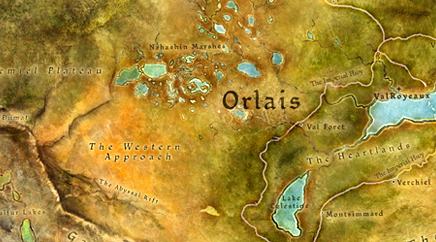
Orlais is a wealthy and powerful nation and is the center of the Chantry. It is ambitious and without a doubt the most powerful single human nation on the continent.
Its expansion is limited, because the city-states of the Free Marches would unite if it invaded, and Ferelden is difficult to assault, though the Orlesian military is powerful enough that this need not deter it completely.
Orlais has a large noble class well known for its culture and extravagance, the envy of nobility elsewhere. Their strong empress dreams of expanding their borders to encompass the entire continent, just as the founder of Orlais, Emperor Drakon, did prior to his death.
Orlais borders on the Frostback Mountains, and they have long been allies of the dwarves of Orzammar and the primary recipients of their mineral trade, smithing, and lyrium.
Avvars
The Avvarian hillsmen exist in the Frostback highlands, having originally been among the many barbarian tribes that existed in Ferelden but being one of the few that did not join the Alamarri clans in uniting under the first Fereldan king.
The Avvars are a stubbornly independent folk who see the "lowlanders" as weak and overly civilized, traitors to the gods of nature that all the old clans once worshipped.
The Avvars were once a force that brought considerable trouble to the lowlands through frequent raids, and it was not until Ferelden united and many long, bitter wars were fought that the Avvars were driven back into the mountains and forced to stay there.
Today the Avvarian hillsmen have declined considerably in power, and while they still engage in raids on Fereldan communities (and occasionally even making their way into Orlais), they deliberately avoid doing so with enough frequency to provoke a united effort to wipe them out.
Many Avvars believe that such a confrontation is ultimately inevitable, and their clan warriors long for the day when they can prove themselves in battle against the lowlander bloodline that has weakened even more than the days in which the last wars were fought.
The Avvars have a destiny to one day return to the lowlands as conquerors, or so they believe. To the lowlanders, the Avvars are a frightening and thankfully fractious people who simply refuse to disappear for good.
Antiva
Antiva is a nation in the warm northern climates that has become renowned for its merchants and sailors, though not its military tradition.
Its leaders (a body of argumentative merchant-princes who have far more power than the weak monarchy) prefer to sue for peace when they get entangled in a war, which is not often, as the nation has become equally known for its policy of neutrality and its slippery diplomacy.
Antivans are notoriously untrustworthy, though it cannot be denied that they are excellent merchants.
Antiva was once under the thumb of the Tevinters and rebelled only after the Qunari occupied their attention, and they despise the Tevinters utterly.
While the nation is relatively prosperous because of its trading practices, it is resource-poor. Other than its famous wines, Antiva would have little to sustain its wealth if cut off from the rest of Thedas.
The Free Marches
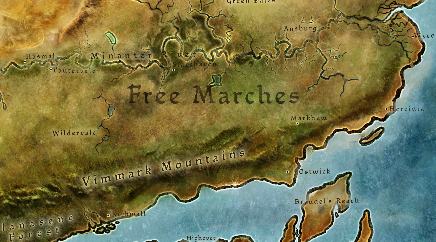
The Free Marches is a collective name given to the wealthy city-states in the central part of the continent. The "Marchers" are an independent folk who descend from tough barbarian stock.
Their cities exists in a loose confederation that rarely unites on any matter (indeed, the network of petty feuds and alliances between the cities prevents them from taking collective action on any matter) unless one of their larger neighbors such as Tevinter or Orlais becomes aggressive.
In that event, the Marchers pull together to create a united military front that even the greatest power cannot ignore. The Free Marches is best known as the breadbasket of Thedas, its farms along the banks of the great Minanter River being the source of much of Thedas's food.
Nevarra
Originally one of the larger Free Marches city-states, Nevarra has benefited from its wealth and position and has aggressively expanded over the last two centuries to become a power to rival Orlais itself.
The Nevarrans have always had a strong military tradition and have been gifted with rulers (most hailing from the famous Pentaghast clan) who are often military geniuses in their own right.
They have fought with or courted several other Free Marches states to form a powerful confederation under Pentaghast leadership and have also fought and won a long war with Orlais for control over the mineral-rich hills to the west.
The victory over Orlais has brought Nevarra considerable prestige and wealth, though the indigenous culture of the western lands are not fond of the Nevarran presence, and the harsh taxes they endure are slowly forming into a rebellion - one the Orlesians are more than happy to support.
While the capital lies in the original city of Nevarra, the city of Cumberland has seen rapid growth in the last century and has become one of the largest in Thedas, taking advantage of its position on the Minanter River to make it a natural source of trade with the rest of the Free Marches and beyond.
Anderfels
The Anders have been pummeled after centuries of battling the Blight; the darkspawn are a constant menace that can appear almost anywhere at anytime, and the population lives in constant fear and vigilance as a result.
They are the hardened warriors who fight grimly against an enemy that they cannot defeat; the rest of Thedas is remote enough that their plight is easily ignored.
Here is the last place where the Grey Wardens have retained their importance over the centuries, though the fortress of Weisshaupt is the last bastion of their influence.
Still, the Grey Wardens are a potent military force here, and they hold political power equal to the various barons, a power they have recently taken greater advantage of.
Otherwise the Anders are a poor people who live in a devastated land of vast, stark steppes, though their proud culture remains, and they are likely the most pious followers of the Chantry in Thedas, praying for a day when they are released from the clutches of the Blight.
Par Vollen
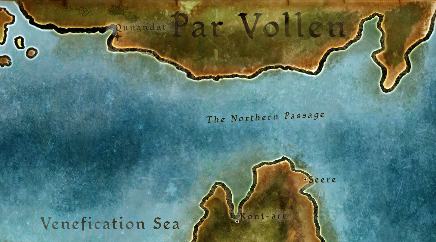
This is the original northern island nation that was invaded by the Qunari many centuries ago when they first arrived (and retreated to when largely pushed from the continent by the Exalted Marches).
Par Vollen has been assimilated to the point that it is now a peaceful Qunari nation with no resistance.
The humans who once lived here were more primitive than elsewhere in Thedas, building pyramids in their jungle cities and generally being isolated from the other cultures farther south; therefore, little hue and cry went up to free them from Qunari domination.
Now they have been part of the Qunari culture and Qun philosophy for so long that they could not even imagine going back.
For their part, the Qunari treat Par Vollen as their homeland. Contact with their original homeland was intermittent at best across the turbulent Northern Ocean before it finally ceased altogether two centuries ago.
Several ships have been sent home to restore contact, but they have not returned. The Qunari are here to remain and have accepted this.
While the pyramids of the original society were impressive, the Qunari have topped that with the great domes and aqueducts of Qunandar, which is the only city of real importance on the island and easily a rival to the size of Cumberland. Few others have seen it, but those who have report it to be one of the wonders of the world.
Rivain
Another front for the great war when the Qunari first arrived, the Qunari conquered Rivain and were eventually driven back to a single city, which they held and retained when the peace accord was signed.
In the centuries since, the city of Kont-aar has existed relatively well with the rest of Rivain; nowhere else in Thedas is there as much interaction between the two cultures.
The Rivaini, already considered a strange people by most of Thedas, have acquired some Qunari cultural traits over the centuries - they have proven resistant to the Chantry's teachings, and a version of the Qun has even gained a great deal of popularity, focusing more on its spiritual aspects than its notions of societal engineering.
This is enough that many outsiders consider the Rivaini people to be heathens or even traitors.
Rivain has waned since the old war, and some elements among their people still call for Kont-aar to be retaken. Now, however, the factions that desire peace and see trade with the Qunari as beneficial are just as strong.
Tevinter
Tevinter is an empire that stretched across the entirety of Thedas in ancient times. What remains is a decadent land in the north centering on Minrathous, a fabled city that was once the jewel of the entire continent.
It is governed by a magocracy, powerful wizards that spend almost as much time engaging in elaborate Machiavellian political schemes to prove their superiority over each other as they do ruling.
The Imperial Chantry in Minrathous is a separate entity from the main Chantry elsewhere, having split off centuries ago in a great schism over the role of magic.
Tevinter is almost universally reviled by other nations. Its nobility is self-indulgent to the extreme, and slavery is still practiced.
The Imperium is the center of the black market, involving smuggling (including the harboring of magical fugitives from other lands), and the slave trade in Thedas.
While the Imperium might seem in decline, it is still a powerful nation, and its military might is considerable.
Without a doubt, it would turn on the nations to the south if its attention were not completely drawn to the constant wars in the north with the Qunari in Seheron and Par Vollen.
The Imperium has struggled against the Qunari as their most bitter enemies since their arrival, and the rest of Thedas is happy to let them fight each other.
Unlike elsewhere, the Imperium made no peace accord with the Qunari, and none of the Qunari are allowed peaceful travel within the Imperium.
Ferelden
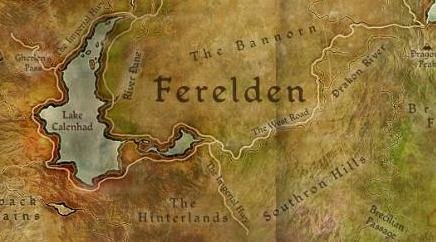
Ferelden is a relatively temperate nation in the far southeast of Thedas and is populated by a barbarian, militaristic culture that has only begun to civilize in the last few centuries.
Still considered relatively primitive and backwater by other nations, especially by the Orlesians who controlled and occupied the Fereldan valley for over a century, the Fereldens have made great strides in recent years.
They are a proud and independent people who resent being considered "backwater" and are well on their way to becoming a power on the continent.