
Disgaea D2: A Brighter Darkness Guide Essentials The Basics
Skills
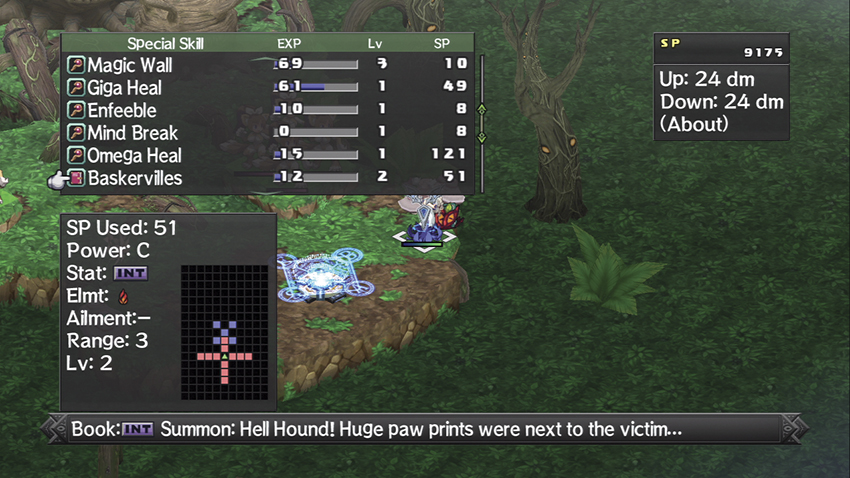
Disgaea D2 files everything from magic spells to unique attacks to the unscheduled demolition of the solar system (don’t worry, it gets better) away under the Special Skills option on your combat menu. If it costs SP to use it, you’ll find it here.
For most characters, the bulk of their combat potential comes from their Skills. Knowing when to use them and how is vital as you progress through the game.
Learning and Leveling Skills
There are two basic ways for a character to learn Skills: through his or her job and through the use of humanoid weapons.
Skills that are learned from a job are gained automatically when a character reaches a specific, predetermined level. For example, a Cleric learns Espoir at level 3.
Skills from a humanoid weapon are learned gradually as the character’s proficiency with that weapon improves. By attacking enemies with that weapon and using its associated skills, the character gains weapon experience that’s gradually used to improve its rank; the better its job’s rank for the weapon in question, the faster this process will be. For more information on this, check out the Weapons section.
Monsters can’t equip humanoid weapons, for a variety of reasons ranging from personal preference to not having thumbs (or hands, or sometimes limbs at all); they have to make do with their natural talents and monster-only equipment like Emblems.
Once a character knows a non-unique Skill, it can teach it to your other units via the Master and Apprentice system.
When a character gets a new Skill, it becomes available for use on the next turn. A Skill is level 1 when it’s learned, and you earn experience toward its next level every time it’s used, regardless of whether that use was effective. Thus, it’s possible to level a weapon by constantly hitting an invincible target, or to level the Heal spell by standing there and casting it on oneself over and over again. Skills have a level cap of 99.
Weapon Skills
As noted above, Weapon Skills are unique to Fists, Swords, Axes, Spears, Bows, Guns, and Books. Once a character learns a Weapon Skill, it’s theirs forever, but none of them can be used unless the character has one of the associated weapons equipped. There’s no way around this as far as we know; whatever you do, you cannot use Hurricane Slash unless there’s a Sword in your hand.
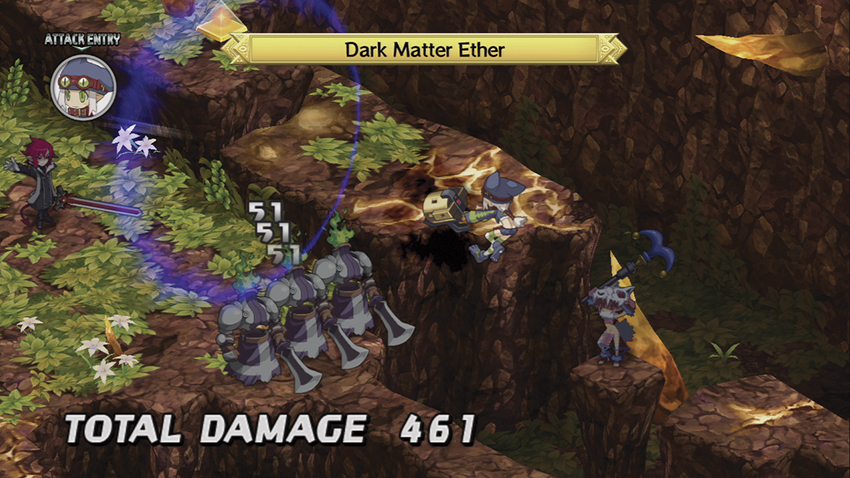
Unlike spells, Weapon Skills do not change at all as they level up. They simply start doing more damage. Weapon Skills’ range, area, and secondary effects, if any, are the same at level 1 as they are at level 99.
Each humanoid weapon teaches a new Skill at the same point. A character will learn a new Weapon Skill when his or her Mastery with a particular weapon reaches levels 1, 3, 5, 10, 15, and 21. There are two more Weapon Skills for each weapon, bringing the total to eight, but these final Skills cannot be unlocked on their own. You have to go into the depths of the Item World and find a merchant to sell them to you.
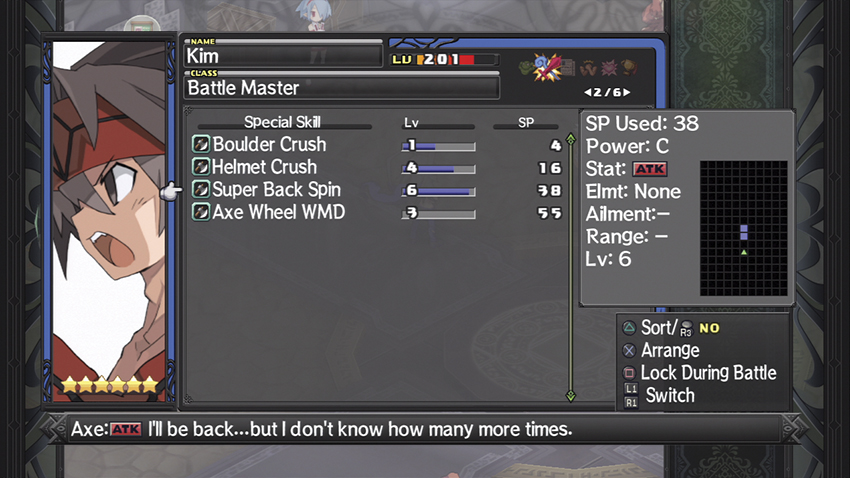
As a rule, Weapon Skills are based upon the same stats that the associated weapon favors. Several do have additional qualities, such as Hurricane Slash dealing Wind-based elemental damage, but they still run off of the weapon’s primary stat.
Spells
Spells differ from Weapon Skills in several ways. They’re typically job-based, so characters will automatically learn them as they level up, and as a spell’s level improves, so does its range and potential area of effect.
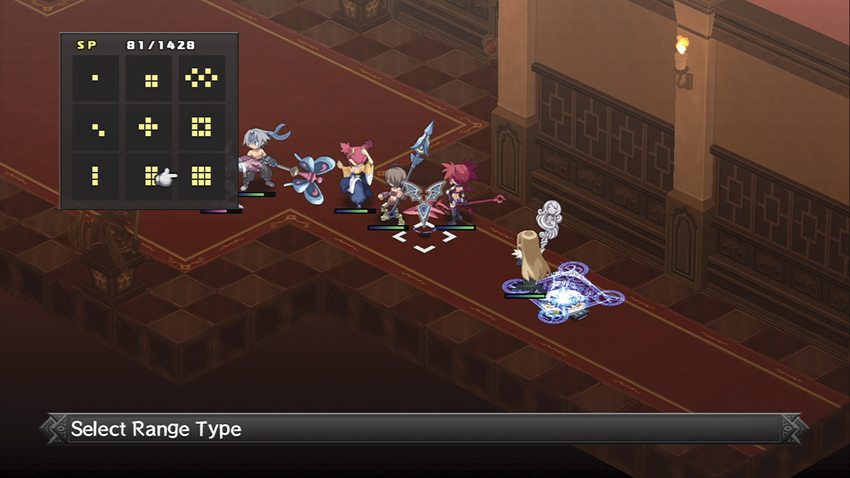
A newly learned spell, at level 1, can affect a single target and has a range of two panels, if that. The more the spell is used, however, the longer its range and the more panels it can affect at once. You can often finagle some extra effective range out of your spells once you’ve gained access to the additional range categories, by centering your spells on the panels next to your target and rotating their area of effect with the Square button.
The elemental attack spells and Heal also have additional ranks. As your characters level up, they’ll learn more effective versions of your basic spells, labeled as Mega, Giga, Omega, and Tera. As a general rule, the base damage on these higher-end spells will be far higher, but they carry the notable additional drawback of having to be leveled separately.
As you progress through the game, that gives your spellcasters a choice on every map: they can use the more flexible lower-ranked spells to inflict less damage from farther away, or move into the thick of a fight and potentially expose themselves to danger so they can use their less flexible nukes.
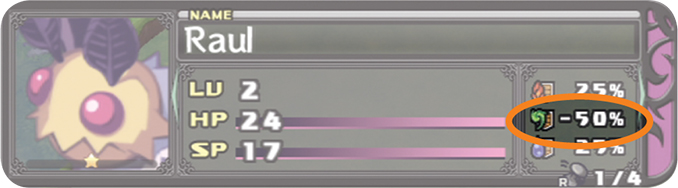
The primary reason to have an offensive spellcaster in your crew is to target and exploit enemies’ elemental weaknesses. Any enemy with a –25% vulnerability or lower is walking wounded, and will fall over quickly if you hit him with the appropriate elemental attack. You can use Reincarnation or apprenticeships to teach a single unit all three kinds of elemental attack spells, or keep a character around who is skilled with a Book. A Book’s Weapon Skills all draw upon different elemental types to do their damage, and they’ve got a long range to boot. In the event that you have a caster on the field and they’re up against an enemy that either doesn’t have an elemental weakness or doesn’t have one that they’re equipped to exploit, you can always use the Star spell. It has no elemental affiliation whatsoever and works strictly off the user’s INT stat.
Finally, it’s worth noting that both Staves and Books, when equipped, have a positive influence on spells’ power and range. This will be dealt with in greater detail in the section on Weapons, but the short version is that both Staves and Books provide a stacking percentage-based boost to spells’ power that is based upon the Weapon Mastery of the wielder, while Staves also improve their wielders’ spells’ range and area of effect. Your designated spellcasters don’t have to use Staves or Books, but it’s a very good idea.
Unique Skills
Some Skills are labeled as “unique” in the game. Many of them are the signature moves of named characters, such as Prinny Raid or Overlord’s Wrath, while others are the defining abilities of certain jobs. Unique Skills will not transfer to other characters via apprenticeship.
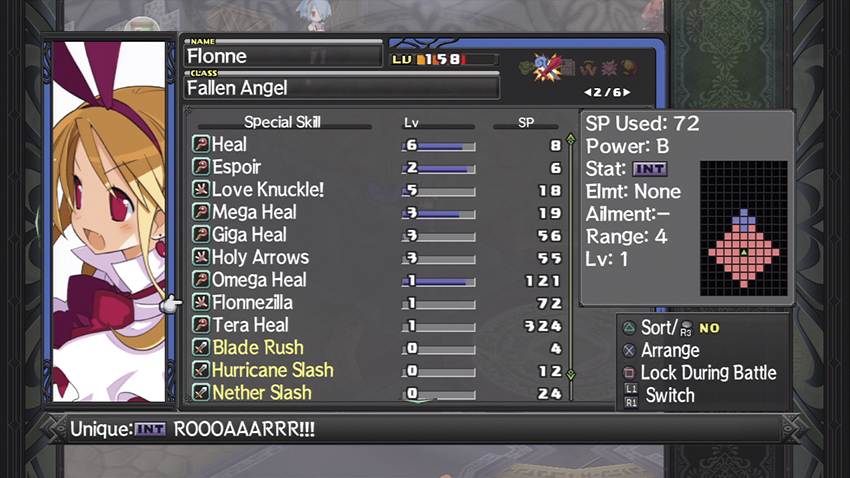
You can give a Unique Skill to a job that ordinarily wouldn’t have it through Reincarnation, but that job won’t be able to use the Skill. It’ll just sit unloved in the character’s Status screen, gathering dust, until you Reincarnate the character into a job that can use it.
Buffs
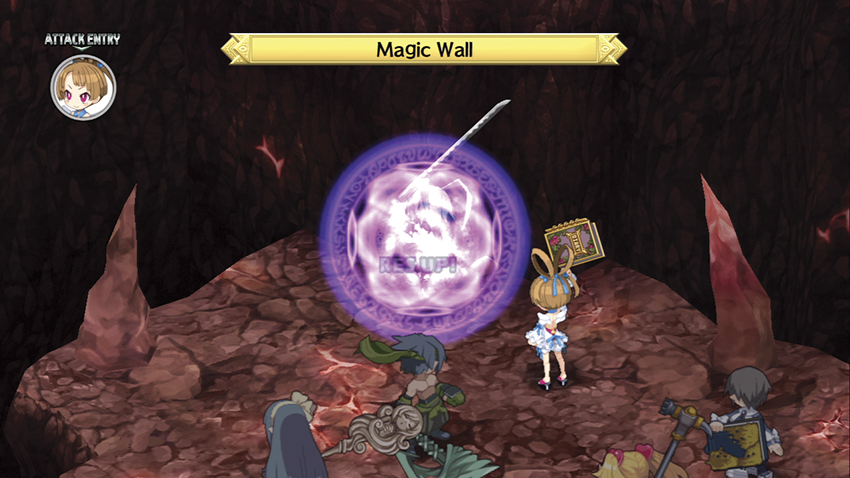
As per video game tradition, a buff is any of the skills that temporarily raise a unit’s stats. This includes Shield, Magic Wall, and Braveheart, among many others. They act like spells do, and gradually increase their target area as you level them up.
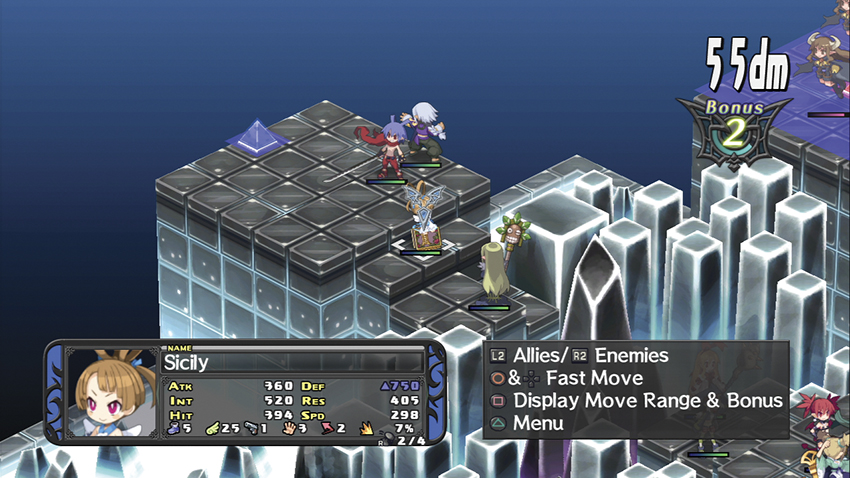
A stat that’s currently being affected by a buff shows up in blue on your character’s status screen, and is accompanied by a small blue arrow pointing upward. As a general rule, a buff lasts three turns before expiring.
Debuffs
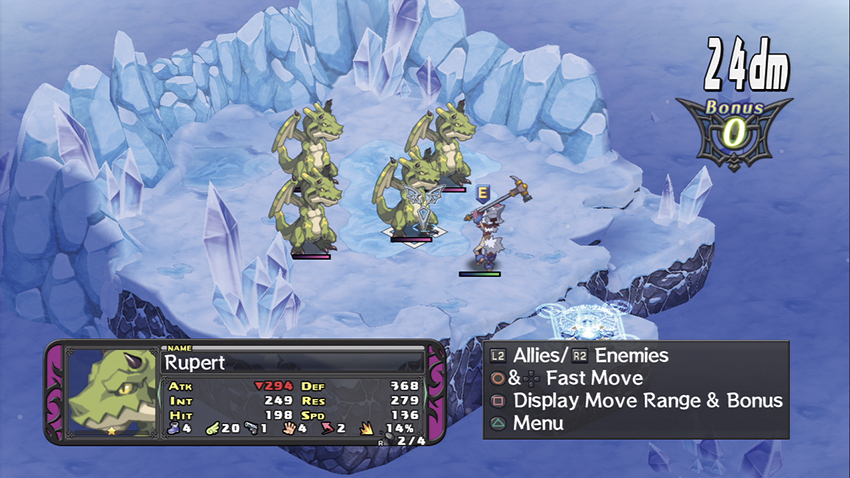
The opposite of buffs, a debuff is any effect that temporarily lowers a target’s stats. This includes hits from Axes or Guns, or being hit with skills such as Armor Break or Enfeeble. Debuffs are identified on your characters’ statistics screens with red text and a small red arrow pointing downward.
As with buffs, debuffs last three turns. You can’t remove them prematurely, although you can cancel them out with opposing buffs, such as by casting Magic Wall (+50% RES) on a unit that’s been struck by Mind Break (–30% RES).