
Disgaea D2: A Brighter Darkness Guide Essentials The Basics
Lift & Throw
One of the trademark Disgaea mechanics has made its return in D2. Any humanoid character can use the Lift command to pick up a unit on an adjacent panel and subsequently Throw it a number of panels equal to his or her Throw stat. This is not only a recipe for shenanigans, but opens up a number of tactical options.
Throwing Humanoids
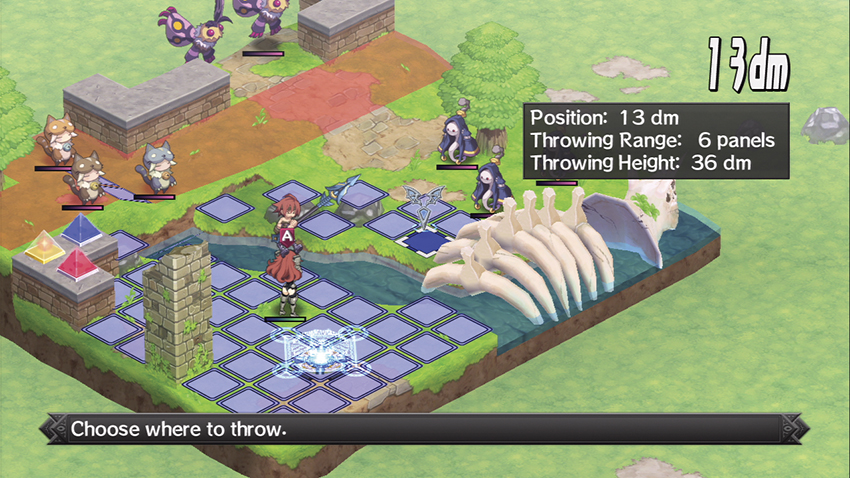
Any unit on the field can be Lifted and Thrown, unless there are Geo Effects in the area that are specifically prohibiting it. You can Throw your units across rivers or chasms, chuck an enemy across the map or off a cliff to delay its next action, use one character’s action to fling another unit closer to where the fighting is taking place, toss around Wooden Boxes or Snowmen for use as improvised stepping stones, chuck an enemy into a group of your units to set up a Combo Attack, and more. The more you use Lifting and Throwing, the more uses you’ll find for it.
You can get one of your characters to Lift another by either using the Lift command from your menu, which has a range of one panel, or by moving one of your characters into a friendly humanoid unit’s square, where the stationary character will pick up the moving character. You can even have your characters Throw a unit at each other, and the targeted character will catch the Thrown unit.
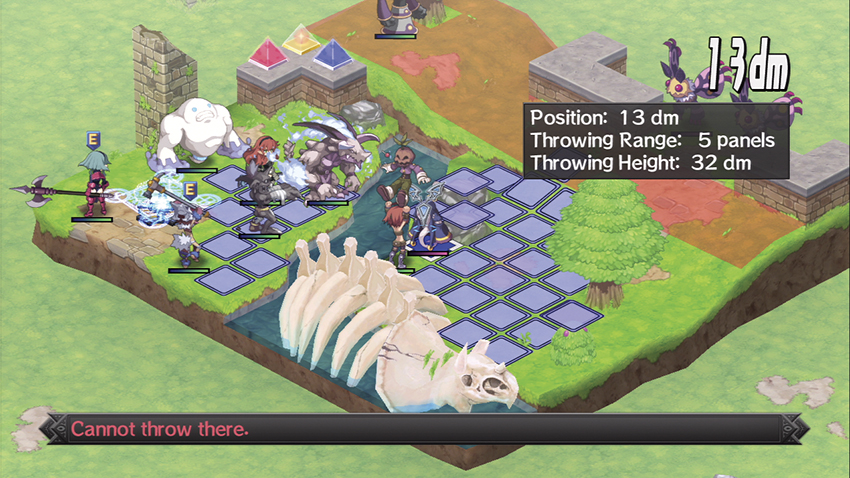
You cannot Throw your characters at neutral or hostile units on the field, however, as the game simply marks that panel off as an invalid target. Sadly, you cannot force the enemy to give you piggyback rides.
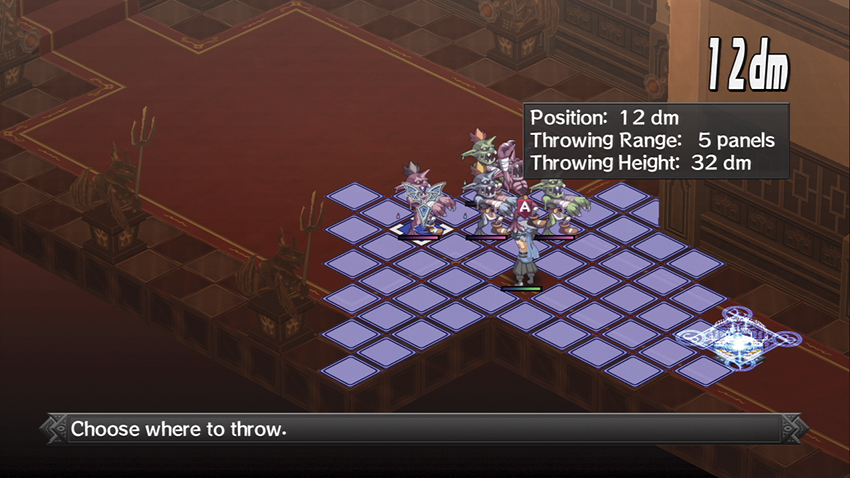
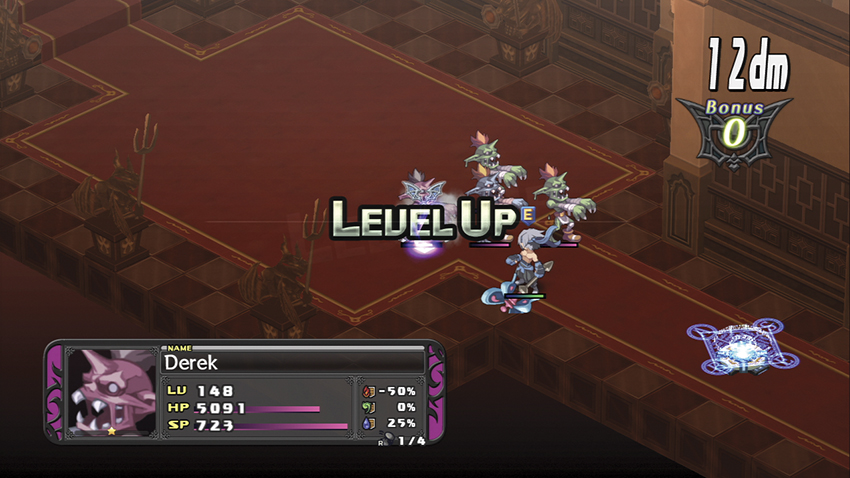
If you Throw one enemy unit at another, things get weird. In a similar fashion to the Fusion Geo Effect, the Thrown enemy kills the target and instantly gains a number of levels equal to the level of the target. This happens whether you’re Throwing humanoids at each other, monsters at each other, humanoids at monsters, or vice versa. For example, if you Lift and Throw a level 30 Warrior at a level 30 Martial Artist, you end up with a level 60 Warrior. If you replace the Warrior with a level 30 Spirit, you end up with a level 60 Spirit instead.
This can come in handy for power-leveling purposes, as you can combine several weak enemy units into a single strong one that’s worth much more EXP and Mana when it’s defeated.
If one of your characters is holding an enemy unit when you end your turn, the enemy unit will inflict damage to the character holding it at the end of the next Enemy Turn. It’s usually roughly equal to a normal attack, but even if it kills the character holding it, it does cost the enemy unit its action for the turn. If you’re willing to sacrifice a character to do it, you can use this as a way to buy some time against particularly dangerous opponents.
Throwing Monsters
Monsters do not receive the Lift command at all. Instead, they get the Mount command, which is dealt with in the next section. You can have humanoid units Lift and Throw monsters, however.
If you pick up and Throw one of your monster units at another one of your monster units, the monster you Threw will actually ricochet. It subsequently lands a number of panels equal to the target monster’s Throw stat in the direction that the monster it bounced off was facing. If that isn’t possible due to obstacles or the edge of the map, the monster will bounce off in a random direction, which can include going back to the humanoid that Threw it.
As with humanoid enemies, hostile monsters will fuse together if you toss one into another’s square, resulting in a single monster with the sum of both monsters’ levels.
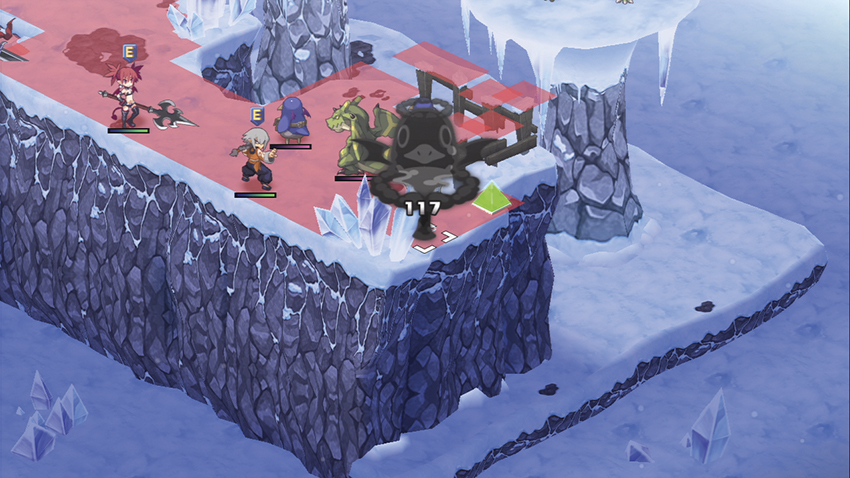
The Prinny is, as usual, an exception to these rules. As long-time Disgaea fans know, Throwing a Prinny causes it to explode when it hits the ground, which instantly kills the Prinny while inflicting damage to any nearby units. The range and damage of the explosion are both determined by the Prinny’s Evility. This means that you have the option to Throw an enemy Prinny to immediately get it off the board, but a Prinny killed by its own volatility doesn’t give you any EXP, HL, or Mana.
Tower Throws
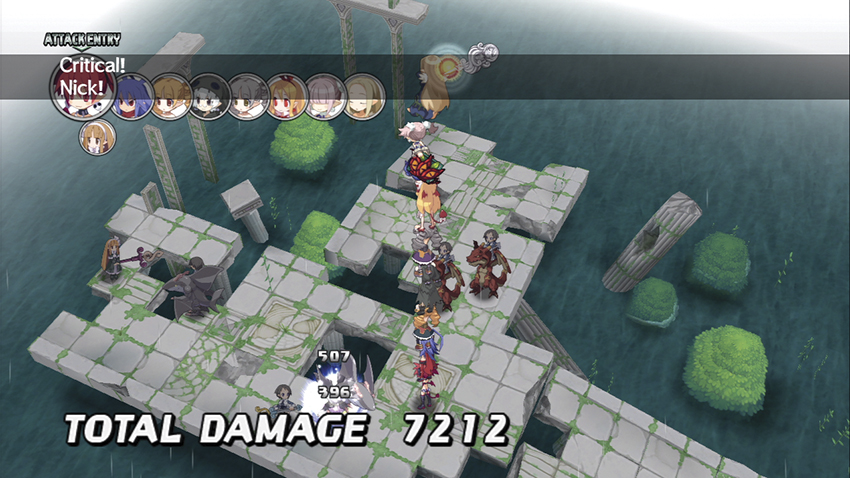
As you’ll probably notice, a single humanoid character can hold only one other character at a time, but a character that he or she is holding doesn’t count against that limit. You can use this to create a “tower” of your units, with up to ten humanoid characters standing on each other’s shoulders. This is necessary to clear several stages in the story missions.
In the event that an enemy attacks the participants in your tower, the enemy can only inflict damage on the character standing at its base. If that character dies, he or she disappears and the next character in the tower drops down to form the new base. However, spells that specifically inflict a status ailment such as Poison will spread their effects to every character in the tower.
If you build a tower, you can then have every character in it from the bottom up choose the Throw command to propel whomever they’re holding across the map. If you do this in sequence, you can cover a large amount of ground and even bypass certain obstacles, such as chasms or inconvenient Geo Effects.
There are a couple of drawbacks to using a tower throw that you need to take into account. One is that it takes some time to set up, obviously; you need a turn to make the tower, a turn for all the characters in it to throw each other around, and on the third turn, you can finally start to take action. The other disadvantage is that a tower throw tends to leave its participants scattered across the map. You need to plot out your positioning ahead of time to ensure that you don’t accidentally end up leaving vulnerable targets in the middle of enemy territory without support.
Getting ten characters into the same tower unlocks the Stacking the Deck Trophy. Monsters cannot participate in a tower at all unless they’re at the top.
Tower Attacks
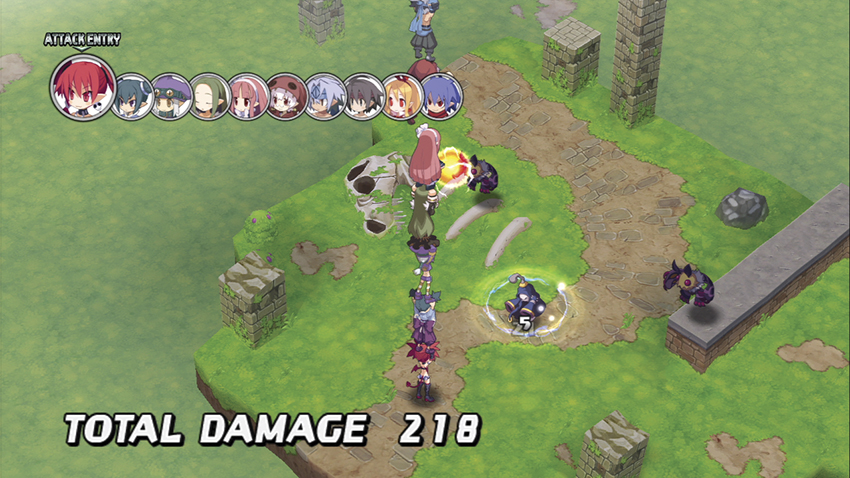
You may notice that if there’s an enemy unit within a few panels of one of your towers, the unit at the base of the tower can still use the Attack command. This is what’s called a tower attack, and it involves every character in a tower teaming up to punch somebody out.
A tower attack can be a great way to level characters, since it works in much the same way as Team-Up Attacks do. Every participant in a tower attack that kills an enemy unit earns the same amount of EXP and Mana, so you can roll around a stage with a level 100 character carrying around a stack of level 1 characters and take on all the enemy units one at a time to level the lowbies.
Tower Skills
By using tower attacks, you can gradually unlock seven Tower Skills. These are Skills that can only be used if a character is in a tower, and several require a tower of a certain height before they can be used at all.
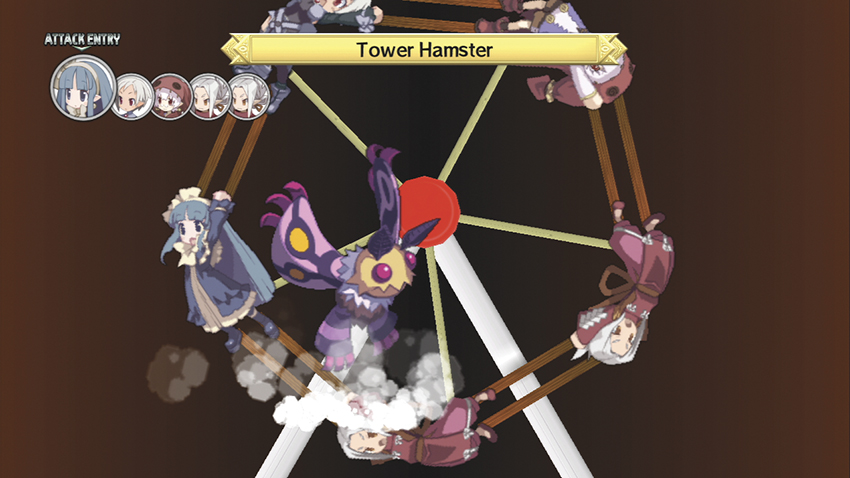
Most of the Tower Skills are fun to use if not particularly useful, since you’re giving up the individual actions of every participant in the tower in favor of taking one big move. The attack Skills like Tower Hamster are very powerful, but they’re basically canned Combo Attacks and thus can only be used against a single target.
Tower Throw is an exception, as it’s one of the most powerful movement abilities that you can get. When you use Tower Throw, the topmost participant in your tower is immediately launched to the target panel, just as with a normal Throw. The difference here is that the range of Tower Throw scales with the number of characters participating in the tower, to a maximum of 18 panels. This makes it one of the longest-range skills in the game, since there aren’t many stages in D2 that are much bigger than 18 panels wide. Its biggest advantage over the old-school manual tower throw, of course, is that it doesn’t leave you with characters scattered all over the map when you use it.
You can use Tower Throw to rapidly progress through the Item World by launching characters right next to the Mystery Anchor or to drop your characters right next to crucial targets such as Geo Symbols or enemies that are providing a problematic Evility. It can be tricky to use, since you end up wasting a couple of turns getting the tower into position and have to spend at least one more to break the tower apart, but when you need to get someone into a distant position and you don’t want to run the risk of sacrificing half of your roster to do it, Tower Throw is your best option.
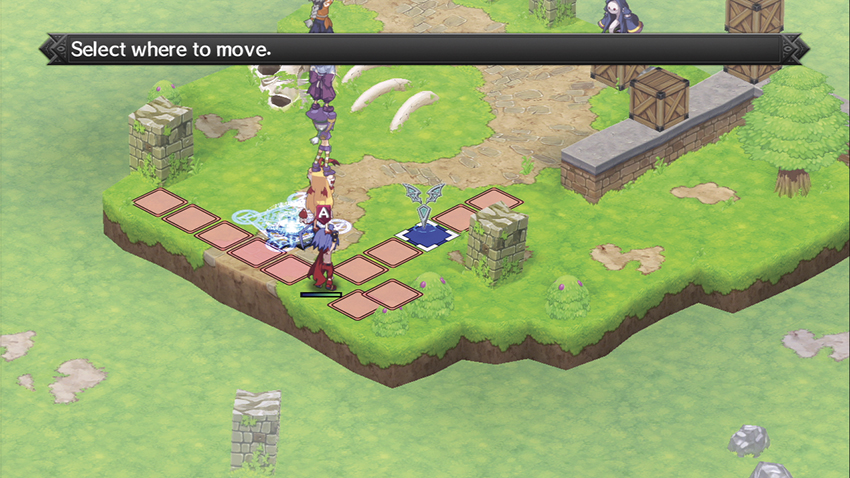
You should also make sure that all of your active humanoid characters pick up Tower Move, if only because it looks ridiculous. Ordinarily, a character in a tower can’t move, but by using Tower Move, they can go short distances in a straight line by flipping over the tower. You’ll end up with the character who was previously on top of the tower on the bottom, and vice versa.
Unlocking Tower Skills is surprisingly quick. Find a stage that has a few reasonably durable monsters near its base panel, such as Silver Witch in Episode 2, and form a tower with 10 of your characters. Use tower attacks on nearby enemies until you unlock Tower Move, then simply use that to go back and forth across the stage until you start unlocking more Skills. It’s a surprisingly fast process, particularly if you turn up the rate at which you learn Skill experience in the Cheat Shop.
Watching the animations for Tower Skills counts toward the requirements for unlocking the Special Voyeur Trophy.