
Disgaea D2: A Brighter Darkness Guide Essentials The Basics
Character Creation
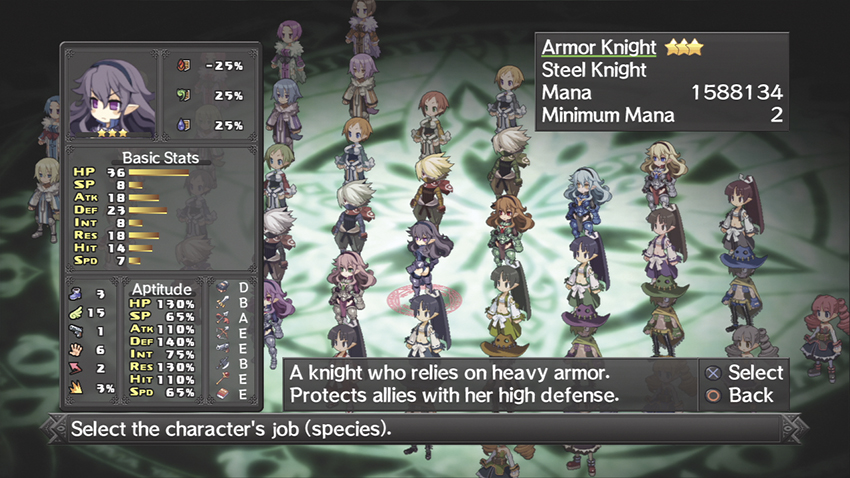
Early in Episode 1, you’ll get back from the field to discover that the Dark Assembly has reopened. In addition to all the other options it provides, this also means you can create new characters for your army.
You can have a maximum of 100 characters on your roster at any given time. Even if you make one of every generic class and recruit every available character in the Post-Game, that’s only 58 slots. That leaves you with a lot of room for experimentation.

A “standard” group that would can you through the story would consist of Laharl, Etna, Flonne, a Thief (for ranged support and swiping enemies’ equipment with Stealing Hand), an offensive spellcaster (a Witch, Magician, or Spirit), a defensive spellcaster (Sicily, Lanzarote, a Sea Angel, Priest or Cleric), an Armor Knight, and three assorted combatants to taste. If you prefer ranged combat, use an Archer, Gunner, Rifle Demon, or a Valkyrie with a Bow; if you like to mix it up in melee, use a Fight Mistress, Martial Artist, Evil Dragon, or a Warrior with an Axe.
The game does reward you for having a central cast of 10 to 12 go-to characters, mostly through the Demon Connect system and Weapon Mastery, but it’s worth the time to create and maintain a B-team. You can use your second-stringers to explore the early floors of the Item World, keeping your main characters fresh for the harder levels of the dungeon, and keep a few specialized units, such as Onmyo Monks or Magic Knights, around for situations where they’ll shine.
Mana and Bonus Points
To make a character, you’ll need to have some Mana. This is obtained only by defeating enemies in combat, which means your main damage-dealers will usually have it coming out of their ears and your support classes won’t have much at all.
When you create a character, you first spend Mana on its rank, then its Capability. Most of the time if you’re creating a brand-new character, you can create it only at rank 1 anyway.
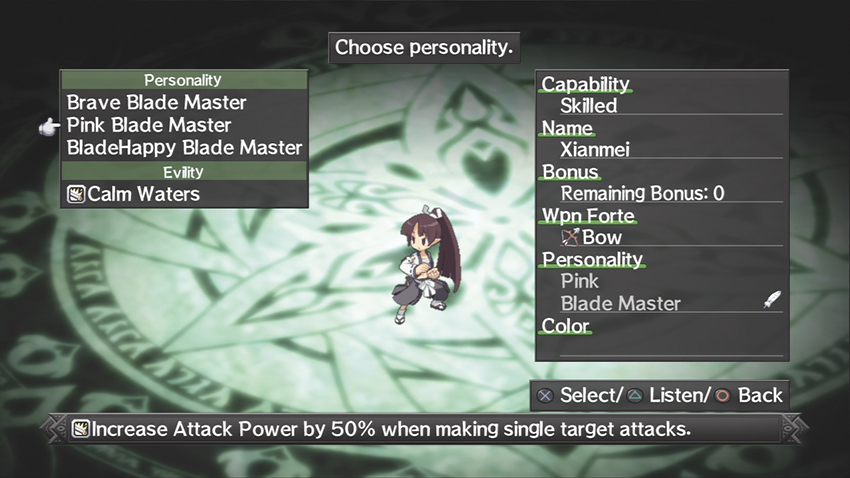
Capability is a little trickier than it looks. You can make a completely throwaway unit for 1 Mana, but it’ll be a Good-for-Nothing and you must subtract five points from its HP, SP, ATK, DEF, HIT, INT, RES, or SPD before it can be created. To make successively better units that actually receive bonuses to their stats, you must spend increasingly large sums of Mana.
Making a unit with a Capability of Distinguished or Genius requires you to call a meeting of the Dark Assembly to order. This generally isn’t worth the associated expenses, such as bribing Senators for votes or paying them off to push a failed bill through, particularly early in the game when you don’t have much in the way of resources. You can always make up for the lack with Reincarnation (see below) further down the line, as a Distinguished or Genius Reincarnation does not require the Dark Assembly’s input.
At first glance, it may not seem to be worth the Mana to create a character that’s better than Incompetent. This is a game where a character can grow to have stats in the millions, after all, so a few points at level 1 don’t seem like a big deal.
What the game doesn’t tell you is that a character’s base stats at level 1 determine its stat growth. The stats that each character accumulates with each level are not additive; they’re multiplicative, and the more Bonus Points you have to spend at level 1, the better that character’s stats will be as it levels up. Keep that in mind when you’re spending your Bonus Points, as you can use a couple here and there to shore up what will eventually be the character’s weaknesses. A point or two that you assign to a weak stat now can save you some time and a lot of damage down the road.
Note that a monster takes 20% more Mana to create than a humanoid unit does. This is clearly due to discrimination in the ranks at the Dark Assembly and our lawyers are investigating.
Evilities
When you create a character, you must select an Evility. This is a quality possessed by the character that provides powerful and/or unique advantages to your team.
Unique characters, such as Laharl and Etna, also possess unique Evilities that cannot be changed. Generic characters, on the other hand, can pick one of three Evilities that are determined by their job or species.
In past Disgaea games, and in similar strategy titles from NIS, there’s generally a point at which generic characters get outclassed or made obsolete by late-game recruits or other jobs. Due to the Evility system, such is not the case in D2. Depending on the Evility and the job in question, the Evility can be anything other than a significant modifier to a character who is already useful or a powerful enough asset that it justifies the character’s creation by itself. For discussion of specific Evilities.
Under ordinary circumstances, Evilities are one to a customer. It takes a bit of work and a lot of Mana, but it’s possible to remove an Evility from one character to give it to another. This involves maxing out those two characters’ Likability with each other via the Demon Connect system, then passing a very expensive bill in the Dark Assembly.
Generic characters can swap between their job’s three available Evilities at any time by visiting the Dark Assembly. The option for doing so is “hidden” behind the option for changing a character’s personality; once you pick a voice you can then pick a new Evility. This does not cost Mana.
Promotion
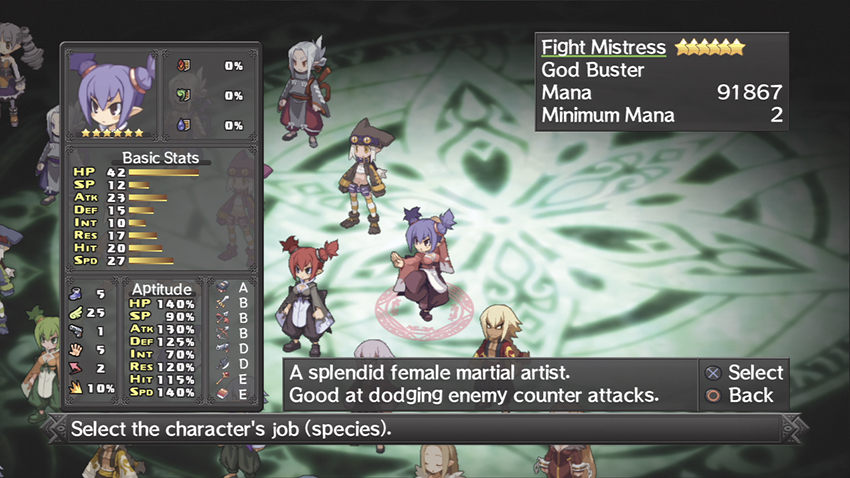
New ranks of a job become available as a character with that job reaches certain levels. The sixth rank is the best and final incarnation of that job, with the best stat growths and the highest Aptitudes.
When you unlock a new rank, you’ll be notified at the end of the stage you’re currently on. At that point, you can take the character to the Dark Assembly and use the Promotion command to advance it to the next rank. This doesn’t require you to pass a bill.
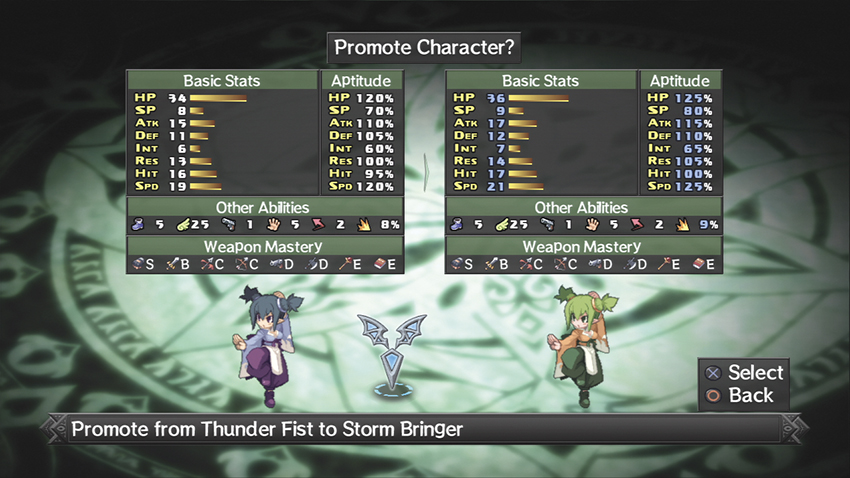
There’s no downside to promotion other than that it costs Mana. Once a character gets promoted, it instantly gains the higher Aptitudes, Weapon Masteries, and base stats of the new rank. Promotions cost 100, 200, 300, 400, and finally 500 Mana for the sixth rank of a job.
Unique characters, such as Laharl, Etna, and Flonne, don’t have higher ranks of their “jobs.” (What’s higher than Overlord, anyway? Over-Overlord?) As compensation, their stat growths and Aptitudes (see below) are higher on average than your generic units’ are, they get powerful unique skills that cannot be taught to other characters, and they don’t have as many restrictions on Reincarnation (again, see below). The difference between a unique character and a generic character in D2 is usually a question of a jack-of-all-trades vs. a specialist; generic characters tend to be very good at what they do but have glaring weak spots, while unique characters are more balanced.
Reincarnation
As mentioned in an earlier chapter, the stat cap in Disgaea D2 is 99,999,999, and the HP/SP cap is 999,999,999 (for most of the game, anyway). Simply reaching level 9,999 won’t get you anywhere near that level of power. More importantly, if you intend to achieve 100% completion of this game, you need that level of power.
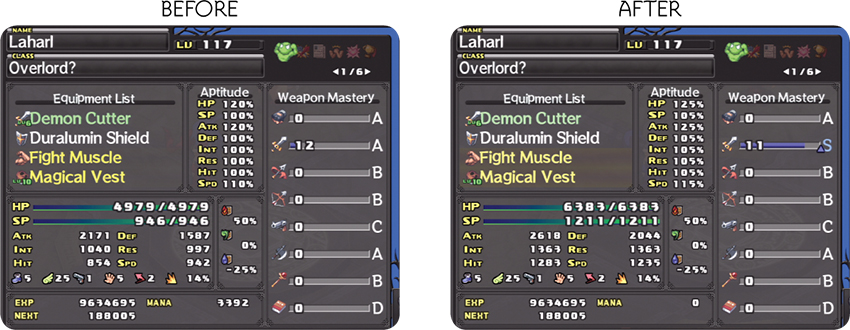
On the left, Laharl before a Reincarnation. On the right, Laharl post-Reincarnation, having reached his original level.
One of the answers to this issue is Reincarnation, which lets you spend Mana at the Dark Assembly to “reboot” one of your characters to level 1, ready to start over again with slightly better Aptitudes and stat gains. By the time your character reaches whatever level he or she was at before the Reincarnation, you’ll see a marked improvement in his or her statistics.
That said, Reincarnation is an expensive proposition, and doing it well involves both bucketfuls of Mana and waiting until a character has a few thousand levels under his or her belt. You should feel free to ignore Reincarnation completely until you’ve cleared the Final Episode, as it’s not really a practical method of character improvement until you reach the Post-Game.
Reincarnation: Mana Cost and Capability
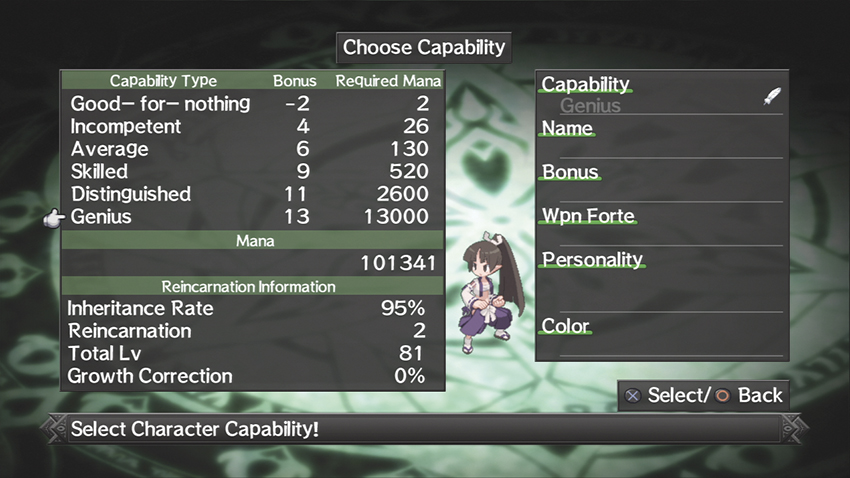
The base cost of Reincarnation is 100 Mana. For named characters like Laharl or Etna, this cost is fixed at 100 Mana regardless of how often they get Reincarnated, but for generic units, the cost doubles each time (200 Mana for a second Reincarnation, 400 for a third, 12,800 for an eighth ...), maxing out at 999,999 Mana at around their 15th Reincarnation.
That cost simply gets your character’s foot in the door. You can then spend Mana on Capability, just as you do when creating a fresh character. As Reincarnation always burns all of a character’s EXP and Mana, you should plan on always spending as much Mana as possible on a Reincarnation because you can’t take it with you. In fact, it’s worth budgeting your planned Reincarnation to account for the cost of Genius Capability. Spending the extra Mana pays off in the long run.
Reincarnation: Generic Characters and New Skills
For named characters, Reincarnation is simply a method of improving their Aptitudes and stats. Generic characters have the additional option of Reincarnating into a different job or even species to learn new Skills. Unlike some past Disgaea games, D2 lets humanoids Reincarnate into monsters directly and vice versa, with no need to spend an intermediary period as a Prinny.
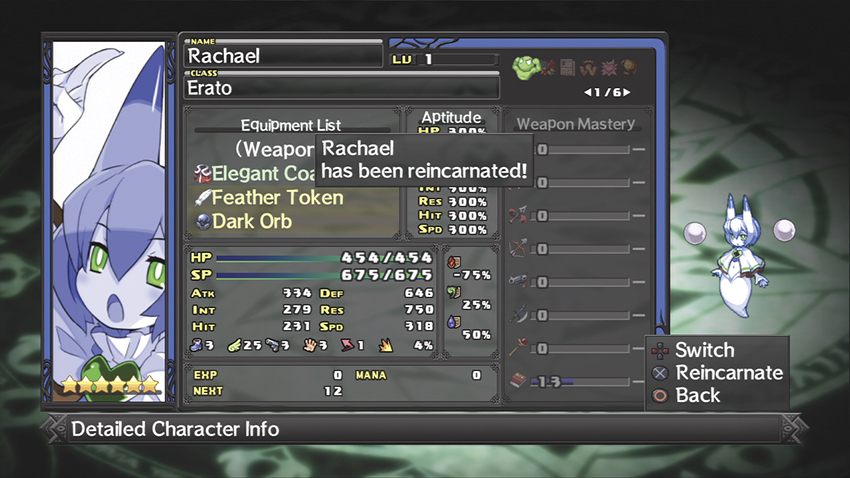
A character that Reincarnates into a different job gets to keep any Skills he or she learned beforehand, and will learn new Skills from his or her job, if any, as he or she levels up. If the character knew any Skills that are flagged as Unique before Reincarnation, such as Geo Change or Dominate, he or she retains those Skills but cannot use them until he or she Reincarnates back into the previous job. If a Thief Reincarnates into a Valkyrie, she’ll keep Stealing Hand but won’t be able to use it unless she’s Reincarnated back into a Thief. It’ll just sit there on the character’s Status screen, unloved, invisible and unusable.
If a character Reincarnates into a different job, that naturally also comes with a new set of Weapon Masteries. At this point, the character can take advantage of this to accumulate ranks of Mastery with weapons they weren’t much good with before to learn Weapon Skills that will transfer over into their next Incarnation.
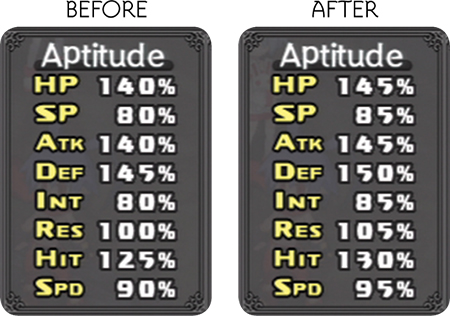
A character that Reincarnates into the same job as before, or a unique character, receives a +5% bonus to all Aptitudes, allowing him or her to get more stat value out of equipped weapons and armor. Reincarnating into a different job still raises the character’s Aptitudes, but only by 1%. A character can get a maximum of +25% to all of his or her Aptitudes through Reincarnation, regardless of how many times he or she Reincarnates. This changes in Rasetsu Mode.
Reincarnation: Weapon Mastery, Special Skills, and Demon Connect
Experience gained toward Weapon Mastery, current levels of Likability with other characters in your roster, and Special Skill experience are all affected by Reincarnation according to the level of Capability you purchase. At Genius level, a character gets to keep 95% of his or her Weapon Mastery and Special Skill experience, but nothing you can do ever completely eliminates this penalty.
| Capability | Inheritance Rate | Affection Modifier |
|---|---|---|
| Good-for-Nothing | 55% | 90 |
| Incompetent | 65% | 85 |
| Average | 75% | 80 |
| Skilled | 85% | 70 |
| Distinguished | 90% | 60 |
| Genius | 95% | 50 |
The Skill Transfer Ratio indicates how much Weapon Mastery and Special Skill experience will make the transition to your new Reincarnation. The more Mana you spent on your Capability, the more Mastery and Skill experience you get to keep.
The Affection Modifier is a bit trickier, as it deals with the hidden math behind Likability. To put it simply, the game takes your current Likability rating and reduces it by an amount equal to the Affection Modifier, but cannot reduce it below 50, which is the bare minimum needed to stay at a one-heart level of Likability with a given character.
Reincarnation: Base Stats
Upon Reincarnation, your character’s base stats are improved by an amount determined by that character’s innate values—which is to say, the base value of the stat before any multipliers added by equipment or Evilities—in those stats before the Reincarnation.
However, the Capability that you purchase once again has a ripple effect here, in that it places a ceiling on how much of the bonus you can get.
| Stat Value Before Reincarnation | Stat Bonus After Reincarnation |
|---|---|
| 40 | 1 |
| 90 | 2 |
| 150 | 3 |
| 250 | 4 |
| 400 | 5 |
| 700 | 6 |
| 1200 | 7 |
| 2000 | 8 |
| 3000 | 9 |
| 4000 | 10 |
| 5000 | 11 |
| 6000 | 12 |
| 7000 | 13 |
| 8000 | 14 |
| 10000 | 15 |
| 12000 | 16 |
| 14000 | 17 |
| 16000 | 18 |
| 18000 | 19 |
| 20000 | 20 |
| 25000 | 21 |
| 30000 | 22 |
| 35000 | 23 |
| 40000 | 24 |
| 45000 | 25 |
| 50000 | 26 |
| 60000 | 27 |
| 70000 | 28 |
| 80000 | 29 |
| 90000 | 30 |
| 100000 | 31 |
| 120000 | 32 |
| 140000 | 33 |
| 160000 | 34 |
| 180000 | 35 |
| 200000 | 36 |
| 220000 | 37 |
| 240000 | 38 |
| 260000 | 39 |
| 280000 | 40 |
For example, if Shady the rank-6 Thief has an innate SPD of 220,000 before her most recent Reincarnation, she’s entitled to a bonus of 37. That means that after the Reincarnation, before any Bonus Points are spent, she’d be a level 1 Master Thief with a base SPD of 65 (28 for a rank-6 Thief + 37). If her player inexplicably decides to cheap out and only purchases Average Capability for the Reincarnation, then despite Shady’s stats, her bonus is capped at 25. She instead reenters play with a base SPD of 53, and her future stat growth is based upon that.
| Capability | Stat Bonus Ceiling |
|---|---|
| Good-for-Nothing | 15 |
| Incompetent | 20 |
| Average | 25 |
| Skilled | 30 |
| Distinguished | 35 |
| Genius | 40 |
Reincarnation: Total Levels and Bonus Points
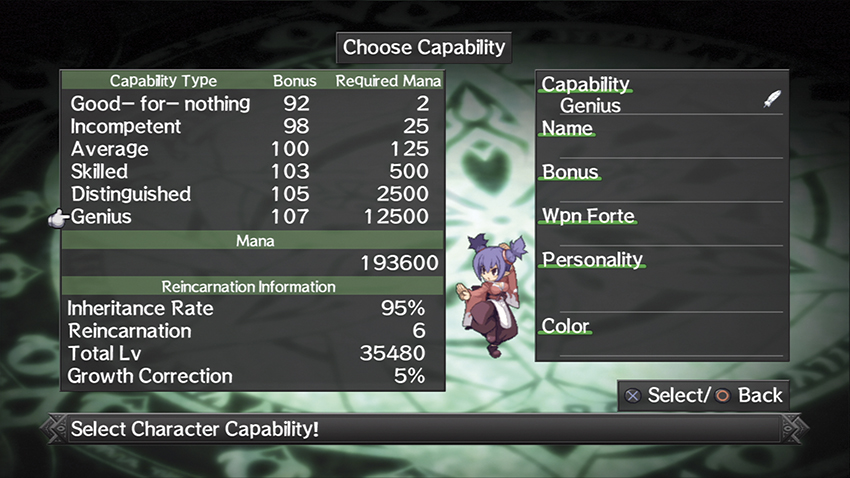
Every time a character Reincarnates, their levels from past incarnations are banked and remembered for future reference. When Reincarnating, you receive a number of additional Bonus Points determined by the amount of Mana you spent on Capability, which ranges from -5 to 10, and by the character’s total levels gained over all incarnations. (I almost said “lifetime bonus,” but that doesn’t really make sense.)
Generic characters can receive an additional 10 points as a bonus for repeatedly Reincarnating into the same job. This first kicks in on the 11th consecutive Reincarnation into that job.
To receive the maximum possible number of Bonus Points, a character must accrue a total of 166,000 levels, then pay for the Genius Capability as part of the 20th Reincarnation.
| Total Levels | Bonus Points |
|---|---|
| 1 | 1 |
| 30 | 2 |
| 60 | 3 |
| 100 | 4 |
| 150 | 5 |
| 200 | 6 |
| 250 | 7 |
| 300 | 8 |
| 400 | 9 |
| 500 | 10 |
| 600 | 11 |
| 700 | 12 |
| 800 | 13 |
| 900 | 14 |
| 1000 | 15 |
| 1100 | 16 |
| 1200 | 17 |
| 1300 | 18 |
| 1400 | 19 |
| 1500 | 20 |
| 1600 | 21 |
| 1800 | 22 |
| 2000 | 23 |
| 2200 | 24 |
| 2400 | 25 |
| 2600 | 26 |
| 2800 | 27 |
| 3000 | 28 |
| 3200 | 29 |
| 3400 | 30 |
| 3700 | 31 |
| 4000 | 32 |
| 4300 | 33 |
| 4600 | 34 |
| 4900 | 35 |
| 5200 | 36 |
| 5500 | 37 |
| 5800 | 38 |
| 6100 | 39 |
| 6500 | 40 |
| 7000 | 41 |
| 7500 | 42 |
| 8000 | 43 |
| 8500 | 44 |
| 9000 | 45 |
| 9500 | 46 |
| 10000 | 47 |
| 10500 | 48 |
| 11000 | 49 |
| 11500 | 50 |
| 12000 | 51 |
| 12500 | 52 |
| 13000 | 53 |
| 13500 | 54 |
| 14000 | 55 |
| 14500 | 56 |
| 15000 | 57 |
| 15500 | 58 |
| 16000 | 59 |
| 16500 | 60 |
| 17000 | 61 |
| 17500 | 62 |
| 18000 | 63 |
| 18500 | 64 |
| 19000 | 65 |
| 19500 | 66 |
| 20000 | 67 |
| 20500 | 68 |
| 21000 | 69 |
| 21500 | 70 |
| 22000 | 71 |
| 22500 | 72 |
| 23000 | 73 |
| 23500 | 74 |
| 24000 | 75 |
| 24500 | 76 |
| 25000 | 77 |
| 25500 | 78 |
| 26000 | 79 |
| 26500 | 80 |
| 27000 | 81 |
| 27500 | 82 |
| 28000 | 83 |
| 28500 | 84 |
| 29000 | 85 |
| 29500 | 86 |
| 30000 | 87 |
| 30500 | 88 |
| 31000 | 89 |
| 31500 | 90 |
| 32000 | 91 |
| 32500 | 92 |
| 33000 | 93 |
| 33500 | 94 |
| 34000 | 95 |
| 34500 | 96 |
| 35000 | 97 |
| 35500 | 98 |
| 36000 | 99 |
| 36500 | 100 |
| 37000 | 101 |
| 38000 | 102 |
| 39000 | 103 |
| 40000 | 104 |
| 41000 | 105 |
| 42000 | 106 |
| 43000 | 107 |
| 44000 | 108 |
| 45000 | 109 |
| 46000 | 110 |
| 47000 | 111 |
| 48000 | 112 |
| 49000 | 113 |
| 50000 | 114 |
| 51000 | 115 |
| 52000 | 116 |
| 53000 | 117 |
| 54000 | 118 |
| 55000 | 119 |
| 56000 | 120 |
| 57000 | 121 |
| 58000 | 122 |
| 59000 | 123 |
| 60000 | 124 |
| 61000 | 125 |
| 62000 | 126 |
| 63000 | 127 |
| 64000 | 128 |
| 65000 | 129 |
| 66000 | 130 |
| 67000 | 131 |
| 68000 | 132 |
| 69000 | 133 |
| 70000 | 134 |
| 71000 | 135 |
| 72000 | 136 |
| 73000 | 137 |
| 74000 | 138 |
| 75000 | 139 |
| 76000 | 140 |
| 77000 | 141 |
| 78000 | 142 |
| 79000 | 143 |
| 80000 | 144 |
| 81000 | 145 |
| 82000 | 146 |
| 83000 | 147 |
| 84000 | 148 |
| 85000 | 149 |
| 86000 | 150 |
| 88000 | 151 |
| 90000 | 152 |
| 92000 | 153 |
| 94000 | 154 |
| 96000 | 155 |
| 98000 | 156 |
| 100000 | 157 |
| 102000 | 158 |
| 104000 | 159 |
| 106000 | 160 |
| 108000 | 161 |
| 110000 | 162 |
| 112000 | 163 |
| 114000 | 164 |
| 116000 | 165 |
| 118000 | 166 |
| 120000 | 167 |
| 122000 | 168 |
| 124000 | 169 |
| 126000 | 170 |
| 128000 | 171 |
| 130000 | 172 |
| 132000 | 173 |
| 134000 | 174 |
| 136000 | 175 |
| 138000 | 176 |
| 140000 | 177 |
| 142000 | 178 |
| 144000 | 179 |
| 146000 | 180 |
| 148000 | 181 |
| 150000 | 182 |
| 152000 | 183 |
| 154000 | 184 |
| 156000 | 185 |
| 158000 | 186 |
| 160000 | 187 |
| 162000 | 188 |
| 164000 | 189 |
| 166000 | 190 |
| 168000 | 191 |
| 170000 | 192 |
| 172000 | 193 |
| 174000 | 194 |
| 176000 | 195 |
| 178000 | 196 |
| 180000 | 197 |
| 182000 | 198 |
| 184000 | 199 |
| 186000 | 200 |
In the screen where you spend Bonus Points, each stat is shown as a multi-colored bar. The basic value of the stat is shown in blue, the bonus assigned that stat from the character’s previous incarnation is in yellow, and Bonus Points spent on that stat appear in green. Each of the character’s base stats, once all modifiers are applied, cannot exceed a value of 255. At that point, it’s as good as it’s ever going to get.
Additional Characters
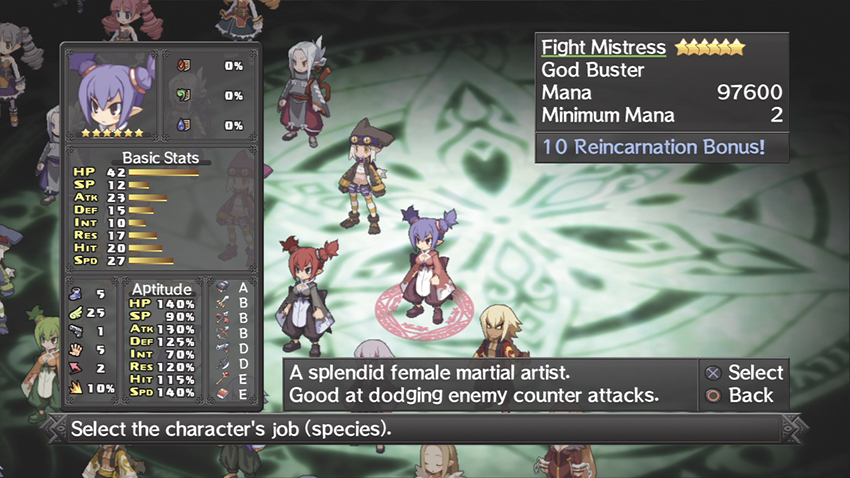
At the start of the game, you can create Warriors, Valkyries, Magicians, Witches, Priest, Clerics, Martial Artists, Fight Mistresses, Winged Warriors, Spirits, and Prinnies at the Dark Assembly. As you progress through the game, you’ll unlock more jobs.
For monsters, this is easy. Defeating a monster in combat also unlocks it for creation. It’s as simple as that: you punched it in the nose and now you’re friends. You’ll eventually find every monster in the game as you go through the story missions, or you can get them a bit earlier by exploring the Item World. Any monster can show up in the Item World at any time, in any item and on any floor, except Prinnies.
Another option is to go picking fights in the Dark Assembly. If you try to pass a bill and the vote is denied, you can try to push the bill through by force, which means you physically beat down every demon who isn’t voting your way. (Gridlock this, Senator!) If a Senator happens to be a member of a species of monster that you can’t create yet, defeating that Senator will also allow you to make one of your own.
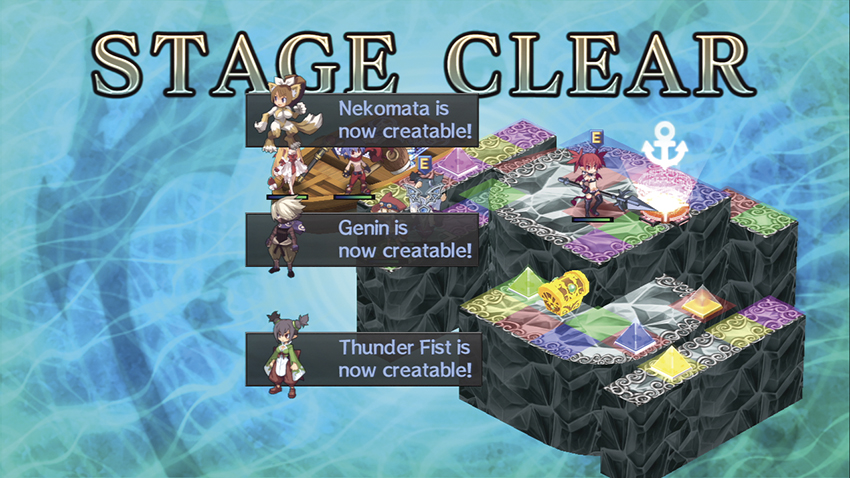
Humanoids are a little more complicated. By reaching the following milestones, you’ll unlock new humanoids for your use at the Dark Assembly. As with new ranks, you’ll be informed of the availability of a new class the next time you finish a stage or an Episode.
Thief:

Get a Martial Artist or Fight Mistress to level 5 or higher.
Onmyo Monk:

Get a Magician or Witch and a Priest or Cleric to level 10.****
Archer:

Get a Warrior or Valkyrie and a Priest or Cleric to level 15. One of your units must have raised their Weapon Mastery with a Bow to level 5 or higher.*
Gunner:

Get a Thief to level 15 or higher. One of your units must have raised their Weapon Mastery with a Gun to level 5 or higher.
Lady Samurai:

Get an Archer to level 30 or higher. One of your units must have raised their Weapon Mastery with a Sword to level 7 or higher.
Armor Knight:

Get a Warrior or Valkyrie to level 20. One of your units must have raised their Weapon Mastery with a Spear to level 7 or higher.**
Ninja:

Get a Thief and a Martial Artist or Fight Mistress to level 20 or higher.
Magic Knight:

Get a Warrior or Valkyrie and a Magician or Witch to level 20 or higher.
Male Angel:

Get a Priest and a Magic Knight to level 100 or higher.***
Female Angel:

Get a Cleric and an Onmyo Monk to level 100 or higher.***
Beast Master:

Get a Warrior or Valkyrie to level 30 or higher. You must have used a Mounted Skill at some point.
Shaman:

Get an Onmyo Monk to level 20 or higher.
Masked Hero:

Get a Martial Artist or Fight Mistress to level 25 or higher.
* If you haven’t accomplished this by the end of Episode 4, the Archer unlocks at the start of Episode 5.
** If you haven’t accomplished this by the end of Episode 9, the Armor Knight unlocks at the start of Episode 10.
*** You can (and probably will) unlock these by clearing Episode 8.
**** This only works after you’ve cleared Episode 2.
Aptitudes
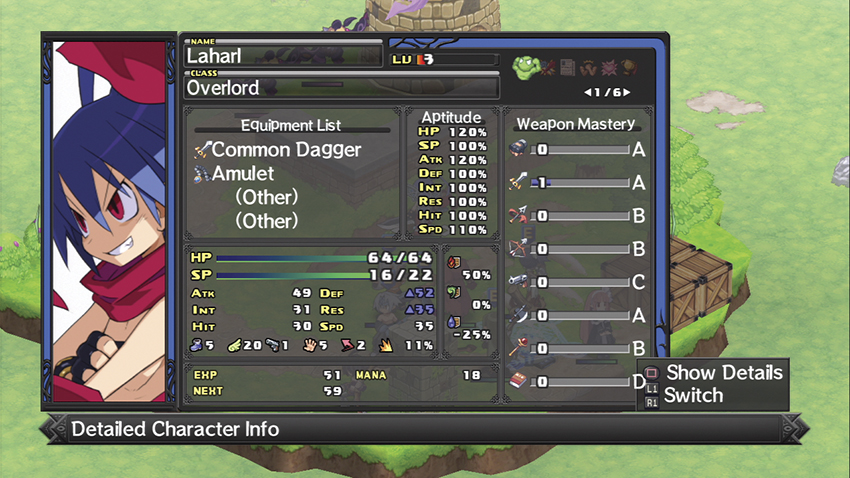
Every character in D2 has a set of Aptitudes listed on their Status screen, the meaning of which may not be obvious at first. An Aptitude is, simply enough, a stat multiplier. Whenever the character equips a piece of gear that adds points to a given stat, their Aptitude for that stat provides an appropriate bonus or penalty.
For example, Laharl has a starting ATK Aptitude of 120%. This means that if he puts on a Belt that gives a 100-point bonus to ATK, Laharl will get 120 points of ATK from it. Etna, whose ATK Aptitude is only 110%, would only get 110 points from the same Belt.
Aptitude is thus one of the ways in which the game funnels your characters into their designed roles. The higher a character’s Aptitude for a given stat, the more benefit it gets out of gear that augments it and the better it is at actions and Skills that work off of that stat. You can theoretically use any character for any role if you’re willing to put enough effort into it, but for most of the game, you’re better off going with the flow.
Aptitudes are initially set by a character’s job and can be improved through Promotion, Reincarnation, or with the right training at the Demon’s Dojo. Aptitudes cap out at 300%.
Masters & Apprentices
When you make a new character in the Dark Assembly, that character ends up apprenticed to whoever spent Mana on their creation. This is likely the first time you’ll see the Master & Apprentice system in action, but it shouldn’t be the last.
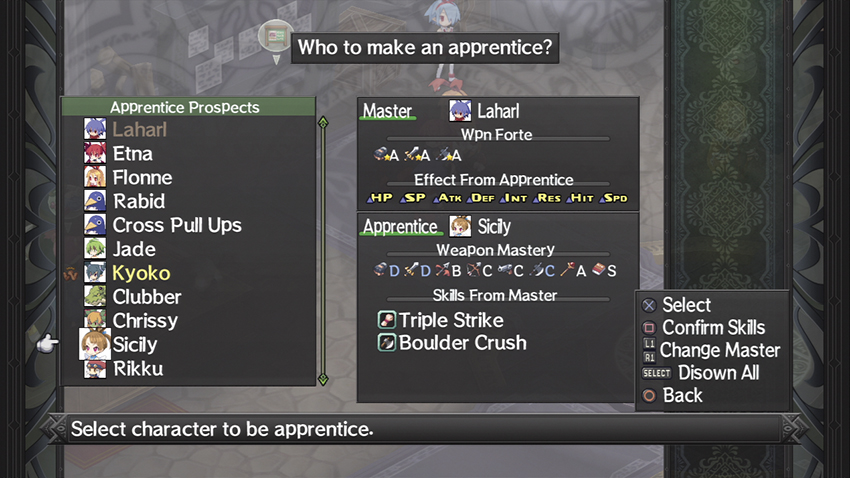
When one character becomes another’s apprentice, the benefits go both ways. The master receives a stat bonus that’s equal to 10% of the apprentice’s stats. In the event that one character has multiple apprentices, the master cherry-picks the best stats from his apprentices and takes 10% from each one. If Etna’s two apprentices are a Warrior with 200 ATK and 100 INT and a Cleric with 50 ATK and 200 INT, she’ll get 20 ATK and 20 INT as her bonus for being their master. If she just had the Warrior as an apprentice, she’d get 20 ATK and 10 INT; if she just had the Cleric, she’d get 5 ATK and 20 INT.
One character can have as many apprentices as you like, but a character can have only one master at a time. A newly created character is automatically apprenticed to whoever spent Mana to create it, but this can be changed for free from your Status menu while you’re at the Castle.
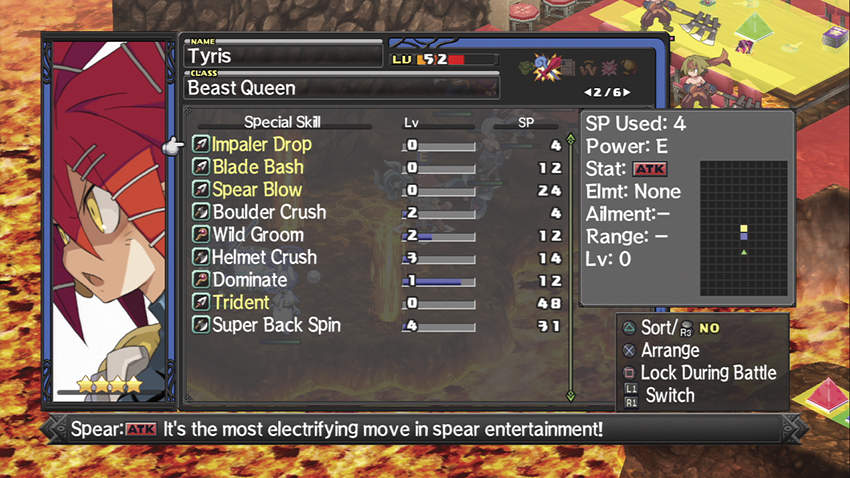
The first thing that an apprentice gets from his master is use of the master’s Special Skills. These appear on the apprentice’s Special Skill list in yellow text with a level of 0. By casting it a few times during a battle, the apprentice can level the Skill up to 1, at which point he or she learns it permanently. The Skill will remain usable by that character even if you subsequently apprentice him or her to somebody else.
Any Skill that’s labeled as “unique” in its in-game description cannot be transferred via the Master & Apprentice system. This includes the signature attacks used by named characters like Laharl and Etna, such as Blazing Knuckle or Prinny Raid; job-defining talents like Stealing Hand or Geo Change; and most monsters’ Skills, mostly because of anatomical issues. You can learn a lot from a Sea Angel, but she can’t teach you how to have tentacles on your head.
This still leaves you with a couple of dozen spells and Skills that can be transferred, including most of the magic spells in the game. Weapon Skills do transfer to the apprentice, although they still cannot be used unless the apprentice has the appropriate weapon equipped. You can use the apprentice system as a shortcut for newer characters, however, which allows them to learn certain Weapon Skills well before they’d learn it on their own.
To use yet another illustrative example, let’s say that after using a Sword for the first few Episodes, Laharl takes a Witch as an apprentice. The Witch will have access to the Sword Skills that Laharl has unlocked on his way through the game, such as Musou Slash, but must have a Sword equipped to use them. If you do give her a Sword, she’d ordinarily have to level up her Weapon Mastery with the Sword to unlock those Skills, but since Laharl knows them, the Witch can use them immediately. No matter how long she spends as his apprentice, however, the Witch will never learn Overlord’s Wrath, as that Skill is unique to Laharl.
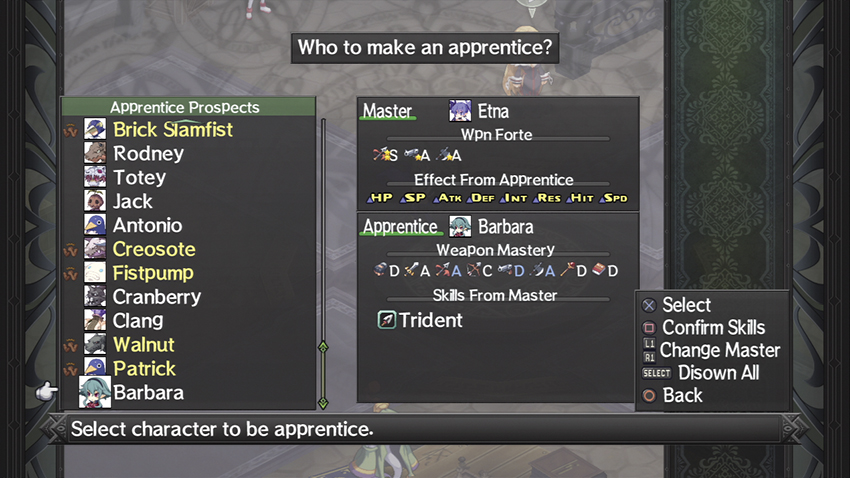
If the master has an S- or A-rank with a weapon, this also acts to improve the apprentice’s affinity with that weapon. A character’s Weapon Mastery works off a hidden point scale, where having 25 points or more is equal to an S-rank. A master’s S-rank grants the apprentice 5 points of Mastery with that weapon, and an A-rank grants 2. This is an artificial increase, however, and if it pushes the apprentice up to A- or S-rank, it does not transfer if the apprentice takes an apprentice of his or her own.
The most obvious way to use the Master & Apprentice system is to teach your primary units certain spells. There’s no reason not to teach all of your characters Espoir, so they can cure their own status ailments without needing to keep massive stockpiles of Fairy Dust on hand, and you can apprentice your Clerics or Priest to a Magician or Witch to teach them a couple of offensive spells.
Of course, the Master & Apprentice system just teaches a unit a Skill and doesn’t make him or her effective with it. If they don’t have the stats to back up the Skill, using it is usually a waste of their action. That said, the distinction between classes blurs enough at higher levels that teaching magic to a Warrior or Weapon Skills to a Magician isn’t that much of a mistake, and may in fact be a useful trump card.
If there’s an upper limit to the number of Skills that a single character can possess in Disgaea D2, it’s a little higher than the number of non-unique Skills that exist in the game. You can safely assume that a single character can learn all the Skills you want to teach it.