
Disgaea D2: A Brighter Darkness Guide Essentials The Basics
Equipment
Your characters’ base stats form a big part of their combat potential, but their equipment’s an even bigger part. Thanks to a variety of potential bonuses, your characters can get more out of well-designed, optimized equipment than they ever will out of simply leveling up.
Over the course of the game, you’ll find, steal, or buy hundreds of weapons, from the blunt knives and vaguely staff-shaped chunks of wood in Episode 1 to the glowing magical blades of doom that become available by the Post-Game.
There are ten kinds of weapons overall in Disgaea D2. Two are available only to monsters, and the other eight—Fists, Swords, Spears, Bows, Guns, Axes, Staves, and Books—can be equipped only by humanoid units. You can buy weapons of every type in Laharl’s Castle as soon as the Rosen Queen Trading Company opens for business in Episode 1.
Humanoid Weapons
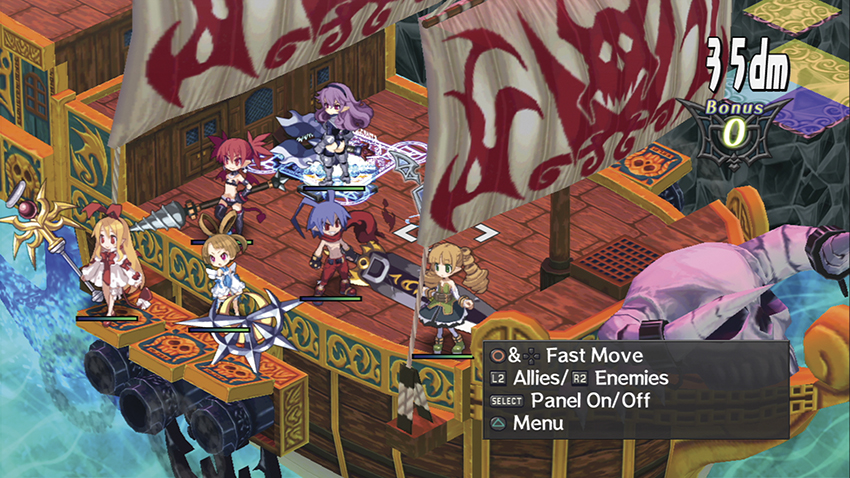
Unlike many other CRPGs, there are no job restrictions on the eight humanoid weapons. If you want to give a Magician a Sword or a Warrior a Staff, go right ahead and do it. Break out from the established paradigm. Start your own little revolution.
Each job does have features that directly affect the character’s ability with a given weapon, however, such as their Weapon Masteries and Aptitudes. You can give that Magician a Sword if you want, but due to his low rank with it and his lousy ATK and HP Aptitudes, he’s never going to be as good with the Sword as Laharl is.
(Well, that’s not quite true. It’s more accurate to say that the Magician won’t be a good swordsman unless you Reincarnate him several times in an attempt to get him to move beyond his comfort zone, but that will take days of grinding. He could also pick up a Staff and be setting monsters on fire within five minutes. You have options, but one’s got efficiency on its side.)
When you’re choosing humanoid weapons for your team, it’s a good idea to spread them out among your crew. No one weapon is inherently better than the others, and having all of them available gives you a degree of tactical flexibility. Laharl is good with Swords, Etna traditionally prefers a Spear, and Flonne is a spellcaster, and as such gets a lot out of using a Staff.
Each humanoid weapon both grants and runs off of a certain primary statistic, as listed below in parentheses. As a rule, if you want a character to inflict as much damage with a given humanoid weapon as possible, you should focus the rest of that character’s gear on accumulating more of the weapon’s favored statistic.
Note that most of the numbers listed below are generalities and do not apply to every weapon of its type in the game. Specific models of a given weapon may have quirky individual statistics, such as the Sword of Damocles’s INT bonus or the extra range on the Goddess Stick, or they may have come with Innocents that are tweaking their capabilities.
 Fist (ATK/SPD)
Fists combine a higher critical hit rate than most other weapons with a chance for the user to, without warning, explode into long multi-hit combos. On any given attack, a character wielding a Fist has a base 50% chance to get up to five additional hits. This can even happen on a Counterattack, which makes it difficult to predict a Fist user’s damage output. Sometimes he’ll underperform for an entire battle; other times he’ll obliterate anything that gets within reach.
Fists also add 2 to a character’s Counterattack stat when equipped. Many of a Fist’s Weapon Skills will move either the target or the user away from their original location, including the first ones you learn.
 Sword (ATK)
A seasoned classic and a favorite of RPG heroes everywhere, a Sword in Disgaea has traditionally been a versatile weapon with a variety of multi-target attacks. Once you have access to Nether Slash and Musou Slash, a Sword user can efficiently dispose of multiple enemies per turn.
 Spear (ATK)
Swords have a little more ATK on average, but Spears gradually accumulate a decent DEF bonus. More importantly, a Spear has a basic range of two squares, lets you attack enemies standing on the panels diagonal to the Spear-wielder’s, and gives the user a broad assortment of long-range, multi-target Skills like Blade Bash and Trident. A Sword or Axe user will usually hit harder but a Spear user makes up the difference with versatility, damage resistance, and team support.
 Bow (ATK/HIT)
A Bow is a versatile ranged weapon, and the weapon skills attached to it have similar benefits. A character equipped with a Bow trades pure damage for being able to contribute to a fight or combo attack from almost anywhere, which includes the possibility of cover attacks.
 Gun (HIT/SPD)
It may seem like Guns aren’t quite worth it compared to Bows, as they can only target along a straight line, but they make up the difference with distance. Guns offer the longest basic range of any weapon, and Skills like Dark Matter Ether further augment that. Like Bows, Guns lack a bit when it comes to pure power, but make up the lack with range and frequent cover attacks. Note that Guns run off HIT and SPD, not ATK.
A target struck with a shot from a Gun takes a 20% penalty to its SPD for the next three turns, which lowers its capacity for evading attacks.
 Axe (ATK)
Axes have a shorter effective range than most other weapons, and using one often means taking a hit to the user’s other stats (usually SPD, but specific Axes may penalize HIT, INT, or every other stat besides ATK). To compensate, a character with an Axe has a habit of hitting like a freight train.
A hit from an Axe causes a temporary 10% reduction in the victim’s DEF stat, which means follow-up attacks will inflict even greater damage. It is likely that a designated Axe-wielder in your army will be one of your most dependable front-line fighters. You’ll want to keep him or her equipped with items like Shoes to compensate for the lost SPD from the Axe.
 Staff (INT)
The Staff is a stat stick for casters, as it offers no Weapon Skills but provides its wielder with a big boost to both INT and RES. A character’s Mastery with a Staff also confers a gradual boost to spells’ range and power, with both improving dramatically as the Mastery does. Its basic attack has a two-square range similar to that of a Spear, which makes it a more effective melee weapon than you might think. A Staff’s basic attack runs off of its wielder’s INT stat.
 Book (ATK/INT)
The newest weapon in the Disgaea arsenal is interesting in that it offers a wide assortment of stats. It primarily gives its wielder extra INT, but also offers progressively larger bonuses to ATK and DEF, along with an assortment of summoning-based Weapon Skills that inflict heavy amounts of elemental damage. Like Staves, a character’s Mastery with a Book gradually improves his or her spells’ power; unlike Staves, a Book does not provide any benefit to spells’ range or area of effect.
Unlike most weapons, a basic attack with a Book equipped works off of the average of the user’s ATK and INT, rather than from the value of a single stat.
Weapon Mastery
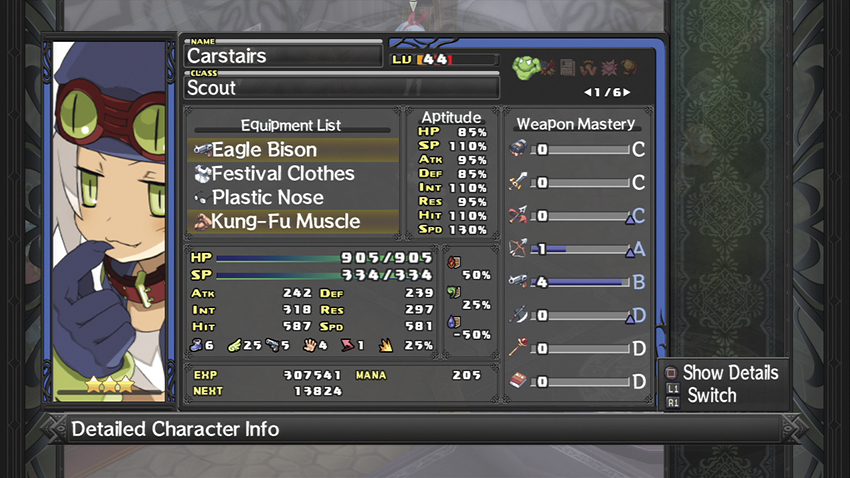
Weapon Mastery is shown on a character’s Status screen as a list of weapons that are labeled with ranks that range from E to S. This represents their basic ability with each weapon, with E as the worst and S as the best. The better their rank, the faster they’ll level their ability with that weapon, and thus the faster they’ll learn that weapon’s advanced skills.
The letters serve as the representation of a hidden numerical system.
- E = 0–4
- D = 5–9
- C = 10–14
- B = 15–19
- A = 20–24
- S = 25–35
A character’s base level of Mastery with a given humanoid weapon is set at creation by his or her job and rank. As part of the creation or Reincarnation process, you have the option to assign the character a weapon specialization, which effectively gives the character a +5 with that weapon, which is enough to push them up to the next rank.
You can also raise Mastery through apprenticeship. A character with a natural rank of S with a given weapon provides a +5 bonus with that weapon to his or her apprentices, while a rank of A only gives a +2. This bonus goes away immediately if the master-apprentice bond is dissolved, but any levels of Mastery that were earned during the apprenticeship will remain. The most you can ever add to a single character’s innate Weapon Mastery is thus +10, or enough to get them to go up two ranks.
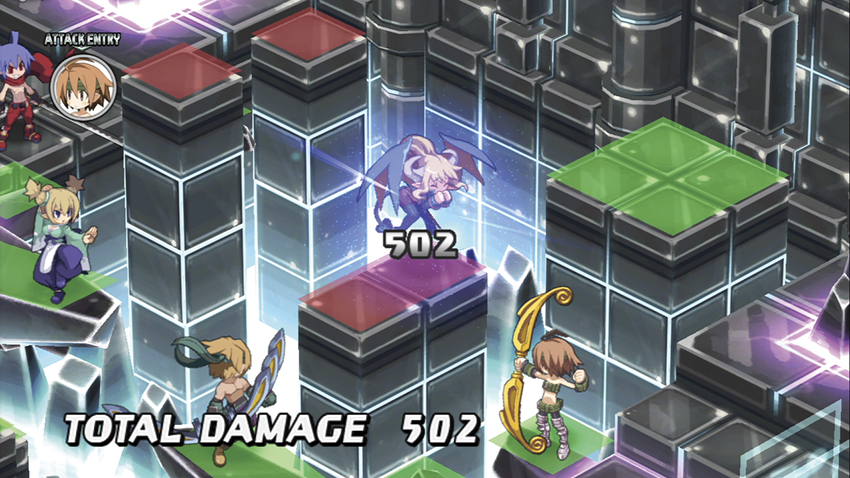
Weapon Mastery experience is gained by wielding the weapon in question. Every blow struck using a basic attack or a related Weapon Skill earns Mastery experience for a character, and unlike normal EXP, the attack doesn’t have to defeat its target. For both Staves and Books, spells also count as Weapon Skills for the purposes of gaining levels of Weapon Mastery.
When using any humanoid weapon except the Staff, a character automatically learns its Weapon Skills upon reaching a Mastery level of 1, 3, 5, 10, 15, and 21. Two more skills are available for purchase from randomly encountered Prinny merchants in the Item World, who can teach you the seventh and eighth Skills for 2,000,000 and 4,000,000 HL each. These Skills can be learned regardless of the active character’s current level of Weapon Mastery.
Weapon Mastery has a maximum level of 255. It may seem like a waste of time to level Weapon Mastery after 21, since you’ve already got all the Weapon Skills, but Weapon Mastery has a powerful secondary effect that makes it worth grinding up.
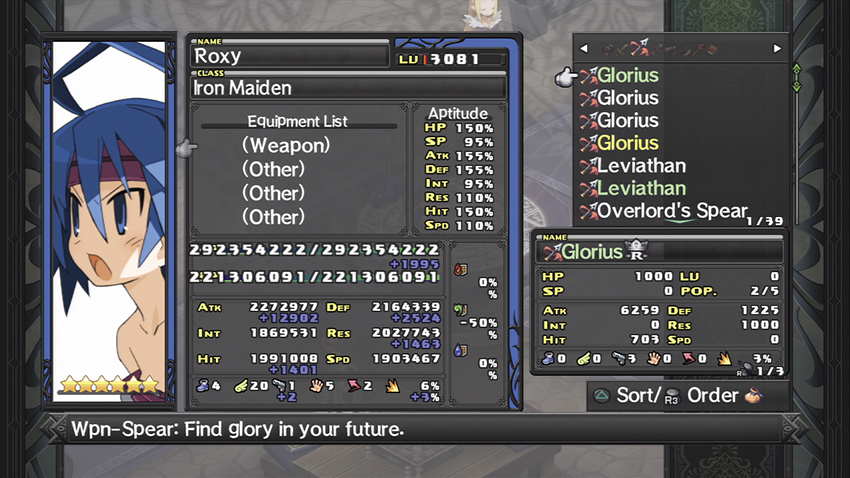
For every level of Weapon Mastery a humanoid character has, he or she receives a 3% bonus to any stats that he or she receives from equipping the weapon in question. For example, Roxy here (see picture) has 11 levels of Weapon Mastery with a Spear, and as such, receives an additional 33% of the HP, ATK, DEF, RES, and HIT granted when she equips that rare Glorius. In conjunction with the preexisting multiplier for those stats from her Aptitudes, she’s getting a lot more out of that Spear than it should be giving her.
Thus, as you can see, once you start getting into the Post-Game and the high-rank weapons it has to offer, Weapon Mastery’s value begins to skyrocket. This is a decent argument for deciding what weapon a humanoid character will specialize in near the start of the game, and then sticking with it all the way through to the end.
Since gaining Mastery is based on the number of attacks used rather than the level of enemies attacked, a good place to grind Weapon Mastery is Boundary of Darkness in Episode 5. When you begin the stage, you’re surrounded by quite a few Spirits that are much lower-level than the enemies encountered in the rest of the Episode, which makes them excellent training dummies. If you don’t mind tanking your Likability, you can also find a couple of Invincible Geo Panels somewhere, such as on Green Room in Episode 4, and have your characters spar with each other. The rate at which you gain Weapon Mastery experience can be adjusted at the Cheat Shop.
Staves, Books, Spells, & Weapon Mastery
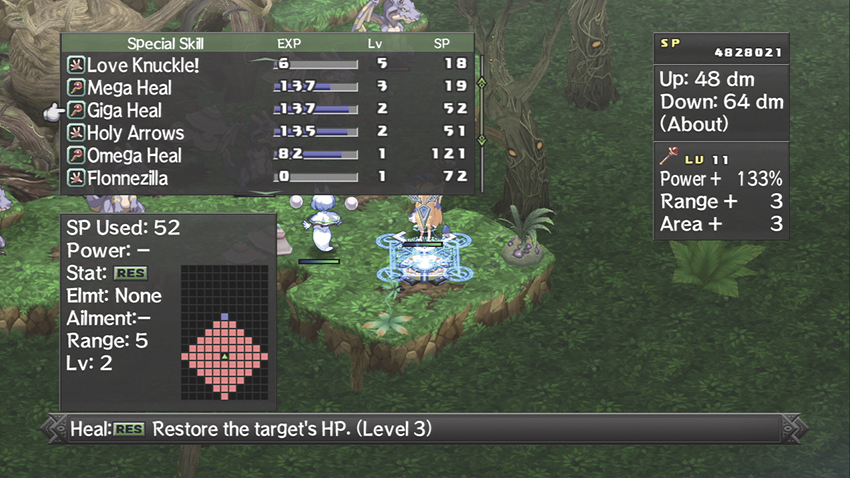
Both Books and Staves, as mentioned above, give their wielders’ spells a power boost. For every level of Weapon Mastery with a currently equipped Staff, the wielder gets a 3% bonus to his or her spells’ power, to a maximum of 200%. Books grant only a 1% bonus per level of Mastery, but have the same upper limit.
A humanoid character who’s wielding a Staff also enjoys a bonus to his or her spells’ range and area of effect that’s based upon his or her level of Weapon Mastery. This bonus stacks with whatever range and area modifiers granted by individual spells’ levels, although no spell can affect more than nine panels at a time.
STAFF MASTERY’S EFFECTS ON SPELL RANGE
| Staff Weapon Mastery | Bonus to Area of Effect |
|---|---|
| 0–2 | 1 |
| 3–6 | 2 |
| 7–15 | 3 |
| 16–20 | 4 |
| 21 and up | 5 |
| Staff Weapon Mastery | Bonus to Range |
|---|---|
| 0–2 | 1 |
| 3–9 | 2 |
| 10–14 | 3 |
| 15–20 | 4 |
| 21 and up | 5 |
Monster Weapons
Your monstrous units cannot use humanoid weaponry and do not have Weapon Mastery at all. Instead, they use Monster Weapons.
There are two kinds of Monster Weapon. One kind provides a boost to ATK and HIT and the other improves the user’s ATK and INT. If your monster is a brawler and its Skills use ATK, equip the former kind of Monster Weapon; if your monster’s a spellcaster, use the latter. Magic-friendly Monster Weapons are easy to identify at a glance, as every single one of them is a kind of Emblem. There’s something to be said for simplicity.
Monster Mastery
Given the aforementioned power of Weapon Mastery for humanoid units, its lack may seem like a drawback for monsters. Just as with the whole Lift & Throw thing, monsters have a compensation: Monster Mastery.
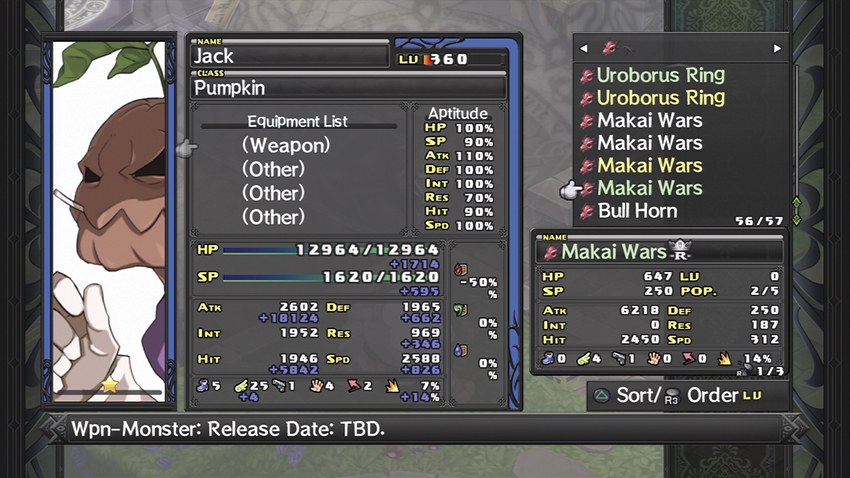
Simply enough, monsters receive a level-based multiplier to the stats of any weapon they’re using. At level 1, this is a flat 1% bonus, but as a monster levels up, the multiplier scales appropriately. At level 9,999, Monster Mastery tops out at a 1,199% modifier, which makes it both slightly easier to achieve and much more potentially powerful than Weapon Mastery. What monsters don’t have in versatility, they make up for with sheer numbers. For example, Jack here is “only” level 360, but thanks to his Monster Mastery, he’s getting nearly three times the stats that he should when he equips that Monster Weapon.
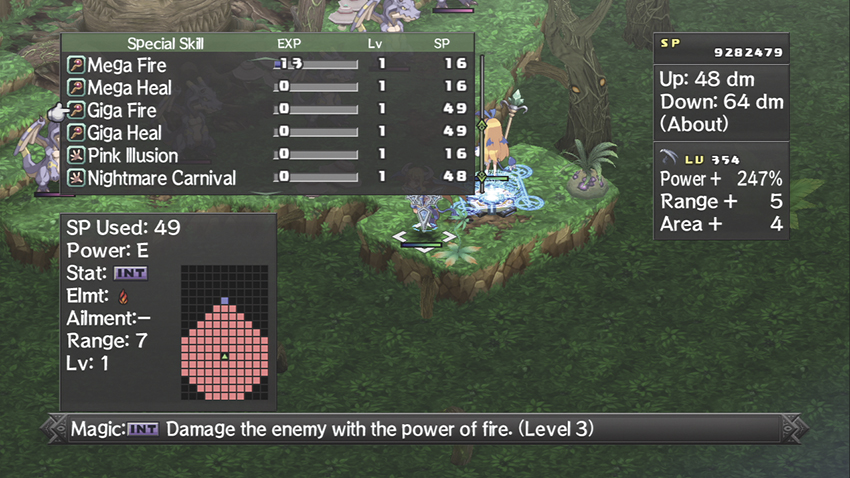
For monsters that use spells, such as the Sea Angel or Succubus, their spells’ power improves with level in much the same way that humanoid spellcasters’ do. For monsters, however, it’s much simpler; their spells receive a 1% bonus to their power per level of the monster, to a maximum of 200%. In a similar vein, a spellcasting monster also receives bonuses to its spells’ range and area of effect that are simply based upon its level.
However, neither of these bonuses apply at all unless the monster in question has the proper kind of Monster Weapon equipped. Specifically, they must use Emblems. Without one, a monster’s spells work on a purely baseline level.
MONSTER MASTERY’S EFFECTS ON SPELL RANGE & AREA
| Character Level | Area of Effect |
|---|---|
| 0–20 | 1 |
| 21–40 | 2 |
| 41–60 | 3 |
| 61 and up | 4 |
| Character Level | Range |
|---|---|
| 0–20 | 1 |
| 21–60 | 2 |
| 61–120 | 3 |
| 121–200 | 4 |
| 201 and up | 5 |
Armor & Accessories
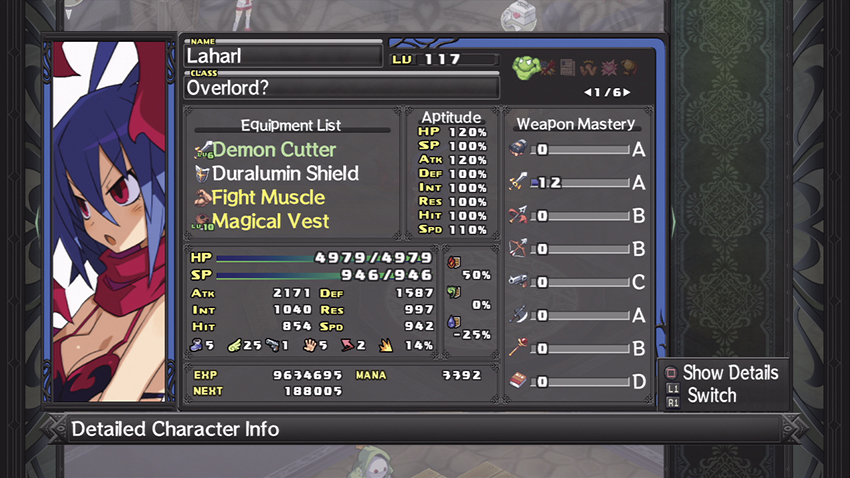
Any unit in the game can equip up to three additional pieces of equipment regardless of type. If you want to equip three pairs of Shoes, go ahead. Just don’t think too much about how you’re doing it.
For organization’s sake, when you opt to equip either armor or accessories on a character, the two menus are split into armor and accessories. Armor is a catch-all category for all sorts of hats, chest plates, robes, and shields, while the accessories section encompasses Belts, Shoes, Orbs, Glasses, Muscles, and Emblems. The term Emblems includes a variety of items that provide a bonus to all eight primary stats at once such as the Dark Rosary or Devil Ring. Don’t get them confused with the spellcaster-friendly kind of Monster Weapon.
As a general rule, Armor improves DEF and RES; Glasses boost INT and HIT; Belts provide an ATK bonus; Shoes give additional HIT, SPD, Move, and Jump to their wearers (as do several unique accessories found in the Post-Game like the Accelerator, which aren’t Shoes but basically do the same thing); Orbs give their holder more SP and RES; and Muscles give nothing but pure HP. Notably, the Rosen Queen Trading Company never sells Orbs, Emblems, or Muscles.
Items
Where other games might have elixirs that restore health, Disgaea has candy, food, and beverages. A quick snack during battle replenishes a character’s lost HP and SP, or cures status ailments.
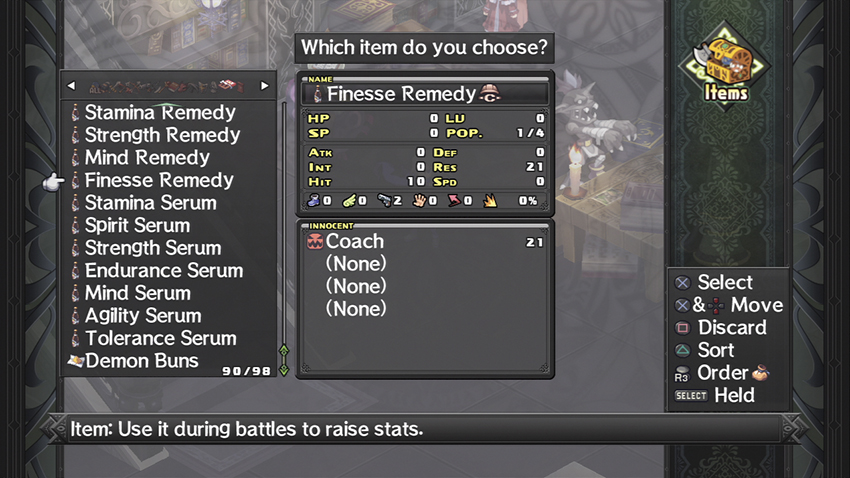
You can also find Salves and Potions in treasure chests or sold by rare vendors in the Item World. These are difficult to come by, but provide a character with an immediate and permanent boost to the associated stats. Like consumable items, you can see which stats they’ll improve by looking at their profile from the Items screen.
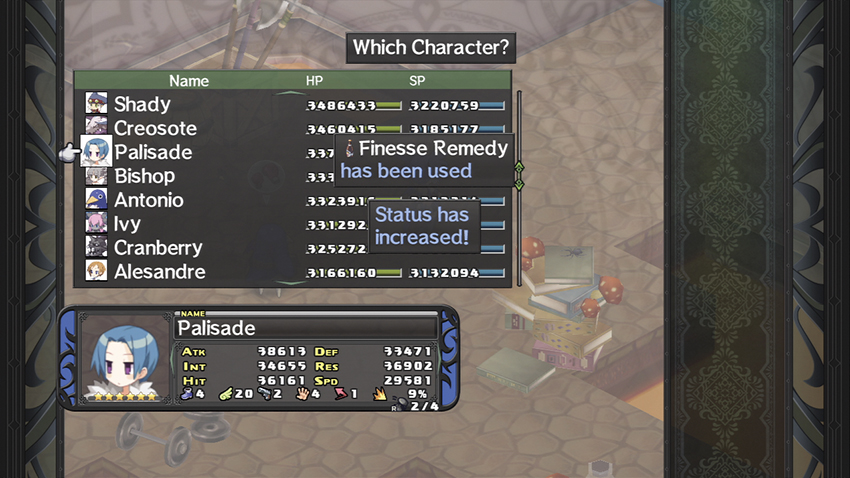
Note that even though Potions and Salves specify that they should be used in battle, you can get the full use out of them if you simply use them from the Items menu in Laharl’s Castle. This may work better for you than trying to remember they’re there while you’re in a fight.
Rarity and Quality

Every item in the game can come in one of three levels of quality: common, rare, and legendary. Common items’ names appear in lists and menus as solid white, while rare items flash yellow and legendary items’ names are listed in gold.
A common item is the baseline version of the item. It can hold up to four separate Innocents within it and you can improve its stats by passing a bill in the Item Assembly, but only once. Rare items can hold five Innocents and support up to two bills; legendary items can hold six Innocents and support up to three bills, with more made possible by descending to its lowest floor in the Item World.
There’s no reason at all to use a common item if you have a rare or legendary version on hand. A rare version of an item will give 120% to 125% of the stats of the common version, and the legendary can give anywhere from 133% to 150%. This even applies to equipment that penalizes a stat, such as Axes; a rare or legendary item will provide a greater penalty than a common version of the same item will. In the case of consumable items, the rare or legendary version will have 120% to 150% of the effect of the common edition.
It’s worth mentioning here, however, that you can upgrade common or rare items to legendary quality with a little work. If you go to Minato in Laharl’s Castle and enter the Item World inside a common-quality weapon or piece of armor, you’ll end up inside a 30-floor dungeon with a powerful Item General at its end. Going through all 30 floors will improve the item’s power and stats significantly, but also upgrades the common item to rare quality.
In a similar vein, if you enter the Item World inside rare-quality weapons or armor, you’ll find a 60-floor dungeon with an Item King waiting for you on its lowest floor. Defeating it will further improve the item and upgrade it to legendary quality. This is a great way to save money early in the game, as equipment that’s been leveled up a few times in the Item World is often better than expensive replacements from Rosen Queen.
Same Bonus
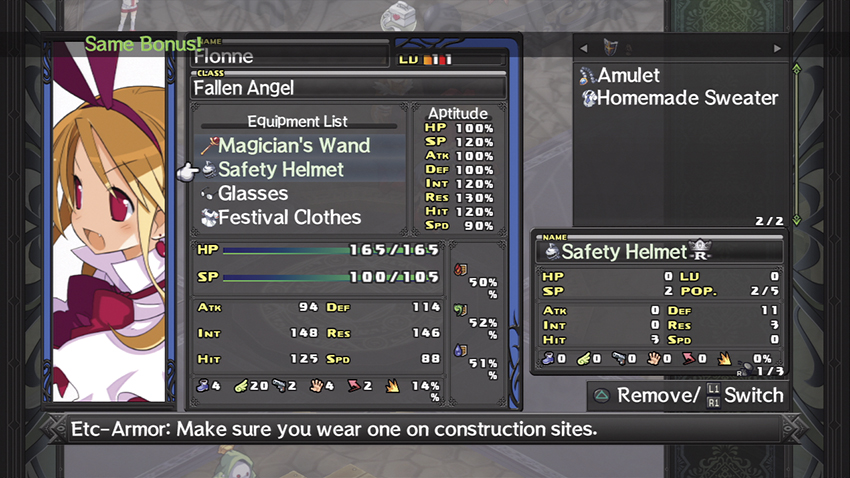
A character who equips more than one item of rare or legendary quality receives a “Same Bonus.” The Same Bonus applies to every item the character is wearing that is of the same level of quality, and takes the form of a multiplicative bonus to every stat that the item awards to its user.
For example, if Flonne is already using a rare-quality Goddess Stick and she equips a rare-quality Devil Ring, she’ll receive more of the stats that she’s getting from both the Stick and the Ring. If she then goes on to equip a rare-quality pair of Cross-Trainers, she’ll get a bonus to them and further bonuses from the Ring and Stick. If the Cross-Trainers were legendary or common quality, however, they wouldn’t be part of the Same Bonus.
This bonus can vary widely due to interaction with a character’s Aptitudes and Weapon Masteries, but is generally around 25% of the item’s original stat value. This means that if a character is wearing four rare or legendary items, they can receive up to 100% of each individual item’s stat value due to the Same Bonus.
Only the six primary stats, HP, and SP are affected by a Same Bonus. Items that raise Move, Jump, Counter, Critical, Throw, or Range are unaffected.