
Prima Games eGuides
primagames.com Browse Redeem a code Help
Nintendo Playing with Power eGuide
Sign in My Guides

Sign in or create an account

We'll email you a link. No password needed, and if you don't have an account yet, the link makes one.

By creating an account or signing in, you agree to our Terms of Service and Privacy Policy.

Have a password?

Had an account on the old eGuides site, or a code from a printed guide? Help and troubleshooting

Sign in with a password

By signing in, you agree to our Terms of Service and Privacy Policy.

Check your email

A sign-in link is on its way. It works once and expires in 15 minutes. Open it and you're in, with an account if you didn't already have one.

Contents

  • Playing with Power
    • Foreword
    • Introduction
    • The Inside Story of the NES
    • The Launch of the Nintendo Entertainment System
    • First-Party NES Titles: Launch Day
    • The Early Period (1986)
    • An Inside Look at Game Paks
    • The Middle Period (1987-1989)
    • Classified Information
    • Behind the Scenes with Shigeru Miyamoto
    • The Late Period (1990-1994)
    • Counselors’ Corner
    • NES Peripherals
  • Excitebike
    • Summary
    • How To
    • Tracks
  • Ice Climber
    • Summary
    • How to Play
    • Characters and Objects
    • Terrain
    • Scoring
    • Tips and Tricks
  • Super Mario Bros.
    • Summary
    • Levels
      • World 7
      • World 3
      • World 5
      • World 4
      • World 6
      • World 8
      • World 1
      • World 2
  • Balloon Fight
    • Summary
    • How-To
  • Donkey Kong
    • Summary
    • Playing Donkey Kong
    • Characters and Collectibles
  • Donkey Kong Jr.
    • Summary
    • How to Play
    • Cast & Items
    • Scoring
    • Recommended Tactics
  • Mario Bros.
    • Summary
    • How to Play
    • Characters and Items
    • Tips and Tricks
  • Kid Icarus
    • The Tale of Kid Icarus
    • Getting Started
    • How to Play
    • Exploring Angel Land
    • Powering Up
    • Items
    • Enemies
    • Completing Kid Icarus
    • Stages
      • Underworld
      • Overworld
      • Skyworld
      • Palace in the Sky
  • Metroid
    • The Metroid Story
    • Summary
    • Getting Started
    • How to Play
    • Power Items
    • Enemies
    • Completing Metroid
  • The Legend of Zelda
    • Summary
    • The Legend of Hyrule
    • Hero Training
    • Items
    • Characters
    • The Overworld
    • The Underworld
      • Labyrinth 1: Eagle
      • Labyrinth 2: Moon
      • Labyrinth 3: Manji
      • Labyrinth 4: Snake
      • Labyrinth 5: Lizard
      • Labyrinth 6: Dragon
      • Labyrinth 7: Demon
      • Labyrinth 8: Lion
      • Labyrinth 9: Death Mountain
    • The Second Quest
      • The Second Quest
      • Story
      • Conquering the Underworld
  • Punch-Out!!
    • Summary
    • Story
    • Roadwork
    • Minor Circuit
    • Major Circuit
    • World Circuit
    • The Dream Fight
  • Super Mario Bros. 2
    • Story
    • Characters
    • Welcome to Subcon
    • Know Your Enemies
    • Worlds
      • World 1
      • World 2
      • World 3
      • World 4
      • World 5
      • World 6
      • World 7
  • Zelda II: The Adventure of Link
    • Summary
    • The Story of the Adventure of Link
    • Hyrule
  • Super Mario Bros. 3
    • A Message From Mario
    • Story
    • Being Mario
    • Worlds
      • World 1: Grass Land
      • World 2: Desert Land
      • World 3: Water Land
      • World 4: Giant Land
      • World 5: Sky Land
      • World 6: Ice Land
      • World 7: Pipe Land
      • World 8: Castle of Koopa
  • StarTropics
    • Summary
    • A Letter From Uncle Steve
    • Chapters
      • Chapter 1: Prelude
      • Chapter 2: Dolphins
      • Chapter 3: Storm and Calm
      • Chapter 4: Confession
      • Chapter 5: Captain Bell
      • Chapter 6: Reunion
  • Dr. Mario
    • Summary
    • Dr. Mario’s Diagnosis
    • Dr. Mario’s Med School
  • Kirby’s Adventure
    • Summary
    • A Crisis in Dream Land!
    • Copy Abilities
    • Levels
      • Level 1: Vegetable Valley
      • Level 2: Ice Cream Island
      • Level 3: Butter Building
      • Level 4: Grape Garden
      • Level 5: Yogurt Yard
      • Level 6: Orange Ocean
      • Level 7: Rainbow Resort
      • Level 8: Fountain of Dreams

Nintendo Playing with Power Guide › Ice Climber

Terrain

Climbing is all about negotiating tricky terrain, and each mountain features its own combination of vital footholds and troublesome obstacles. A proper understanding of terrain helps you identify the fastest and easiest path to the top of a mountain.

Floors
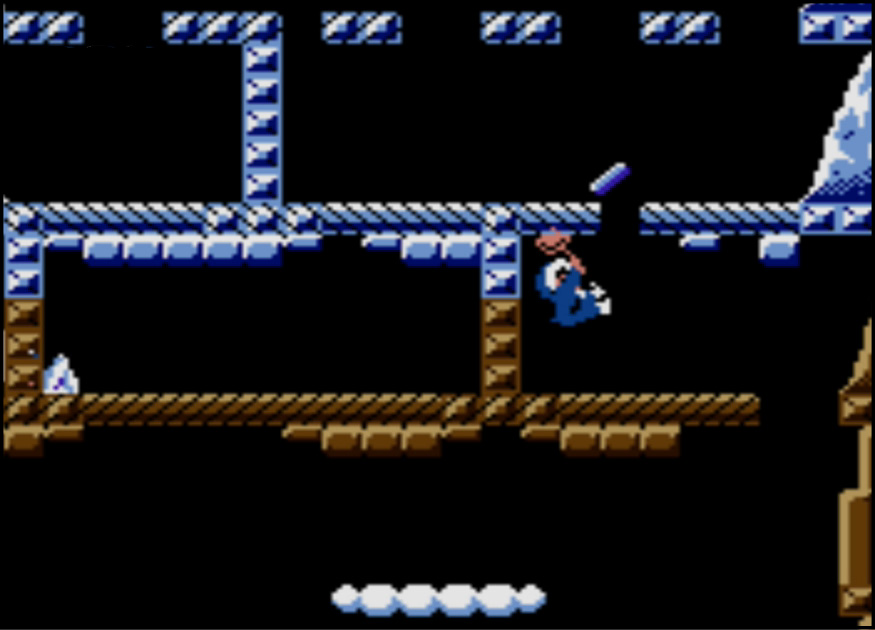
Some floors can be broken, while others are impenetrable. Some floors allow you a chance to stop and catch your breath, while others carry unsuspecting climbers to nearby gaps. Luckily, each type of floor features its own distinct appearance.

Color-Coded

A floor’s color indicates whether it’s made of grass (green), dirt (brown), or ice (blue). Icy floors offer less traction than floors made of grass or dirt, increasing the time it takes for a running climber to stop or change direction.

Standard Floors

Standard floors rank among the most reliable footholds a climber could hope to find on a mountain. As luck would have it, they’re also quite common.

Breakable Floors

Breakable floors are made up of destructible blocks of terrain. To create a hole in a breakable floor, simply stand below it and jump—your hammer does the rest!

Unbreakable Floors

Unbreakable floors are made up of indestructible beveled blocks. They serve as excellent footholds, but also make effective obstacles. When you reach an unbreakable floor, your only option is to find a path around it.

Moving Floors

Moving floors act like conveyer belts. If a climber stands on a moving floor, it won’t be long before he or she is carried to a nearby gap and dropped to the floors below. In many cases, you can counteract the effect of a moving floor by running in the opposite direction. However, some moving floors are faster than others.

When running isn’t enough to overcome the pull of a moving floor, perform a series of jumps to minimize the floor’s effect on your climber.

Breakable Moving Floors

Breakable moving floors feature a pattern of uniform diagonal lines. If the lines are angled downward from left to right, the floor moves to the right. If the lines are angled downward from right to left, the floor moves to the left. To create a hole in a breakable moving floor, jump up and hit it from below.

Unbreakable Moving Floors

Unbreakable moving floors feature a pattern of irregular diagonal lines over a row of indestructible beveled blocks. Again, the diagonal lines indicate in which direction a floor moves: if the diagonal lines are angled downward from left to right, the floor moves to the right. Otherwise, it moves to the left.

Clouds
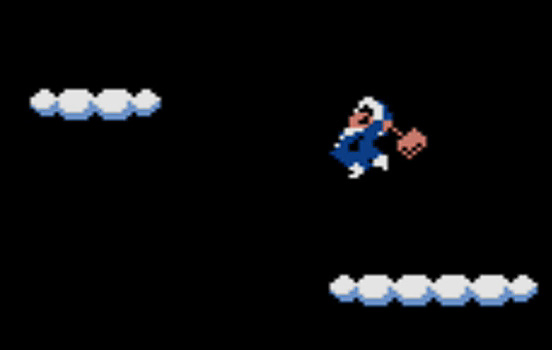
In lieu of solid ground, passing clouds can make serviceable (but temporary) footholds. Some clouds move much faster than others, but even the slowest cloud offers only enough time for a jump or two before it carries your climber out of position. A cloud always passes through at least one obstacle before it reaches the border of the area, ensuring that any onboard climbers are knocked off a cloud before it reappears on the opposite edge of the screen.

In most cases, clouds serve as helpful platforms. However, clouds that pass along floors can scoop up unsuspecting climbers, carrying them away from hard-earned footholds or into nearby hazards. It’s also worth noting that a climber can’t pass through the bottom of a cloud—colliding with an overhead cloud interrupts your climber’s jump, increasing the chances of a costly fall.

Big Cloud

In general, the larger the cloud, the easier it is to jump onto.

Small Cloud

Landing on a small cloud takes precision timing—particularly if it’s moving quickly.

Group of Clouds

You’ll sometimes encounter a group of clouds moving as a single unit.

Pillars

Pillars are essentially indestructible walls. They feature the same beveled blocks found in other unbreakable terrain—just stacked vertically!

Keep reading with a free account

The first 3 sections of Nintendo Playing with Power are open to everyone. An account opens the rest of it, and every other guide in the archive. It's free, and there's nothing to buy.

Bought guides on the old Prima Games site? Your account and every guide you own moved here, so there's nothing to buy again. Sign in.

Create a free account Or browse our free guides

PreviousCharacters and Objects NextScoring