
Prima Games eGuides
primagames.com Browse Redeem a code Help
Nintendo Playing with Power eGuide
Sign in My Guides

Sign in or create an account

We'll email you a link. No password needed, and if you don't have an account yet, the link makes one.

By creating an account or signing in, you agree to our Terms of Service and Privacy Policy.

Have a password?

Had an account on the old eGuides site, or a code from a printed guide? Help and troubleshooting

Sign in with a password

By signing in, you agree to our Terms of Service and Privacy Policy.

Check your email

A sign-in link is on its way. It works once and expires in 15 minutes. Open it and you're in, with an account if you didn't already have one.

Contents

  • Playing with Power
    • Foreword
    • Introduction
    • The Inside Story of the NES
    • The Launch of the Nintendo Entertainment System
    • First-Party NES Titles: Launch Day
    • The Early Period (1986)
    • An Inside Look at Game Paks
    • The Middle Period (1987-1989)
    • Classified Information
    • Behind the Scenes with Shigeru Miyamoto
    • The Late Period (1990-1994)
    • Counselors’ Corner
    • NES Peripherals
  • Excitebike
    • Summary
    • How To
    • Tracks
  • Ice Climber
    • Summary
    • How to Play
    • Characters and Objects
    • Terrain
    • Scoring
    • Tips and Tricks
  • Super Mario Bros.
    • Summary
    • Levels
      • World 7
      • World 3
      • World 5
      • World 4
      • World 6
      • World 8
      • World 1
      • World 2
  • Balloon Fight
    • Summary
    • How-To
  • Donkey Kong
    • Summary
    • Playing Donkey Kong
    • Characters and Collectibles
  • Donkey Kong Jr.
    • Summary
    • How to Play
    • Cast & Items
    • Scoring
    • Recommended Tactics
  • Mario Bros.
    • Summary
    • How to Play
    • Characters and Items
    • Tips and Tricks
  • Kid Icarus
    • The Tale of Kid Icarus
    • Getting Started
    • How to Play
    • Exploring Angel Land
    • Powering Up
    • Items
    • Enemies
    • Completing Kid Icarus
    • Stages
      • Underworld
      • Overworld
      • Skyworld
      • Palace in the Sky
  • Metroid
    • The Metroid Story
    • Summary
    • Getting Started
    • How to Play
    • Power Items
    • Enemies
    • Completing Metroid
  • The Legend of Zelda
    • Summary
    • The Legend of Hyrule
    • Hero Training
    • Items
    • Characters
    • The Overworld
    • The Underworld
      • Labyrinth 1: Eagle
      • Labyrinth 2: Moon
      • Labyrinth 3: Manji
      • Labyrinth 4: Snake
      • Labyrinth 5: Lizard
      • Labyrinth 6: Dragon
      • Labyrinth 7: Demon
      • Labyrinth 8: Lion
      • Labyrinth 9: Death Mountain
    • The Second Quest
      • The Second Quest
      • Story
      • Conquering the Underworld
  • Punch-Out!!
    • Summary
    • Story
    • Roadwork
    • Minor Circuit
    • Major Circuit
    • World Circuit
    • The Dream Fight
  • Super Mario Bros. 2
    • Story
    • Characters
    • Welcome to Subcon
    • Know Your Enemies
    • Worlds
      • World 1
      • World 2
      • World 3
      • World 4
      • World 5
      • World 6
      • World 7
  • Zelda II: The Adventure of Link
    • Summary
    • The Story of the Adventure of Link
    • Hyrule
  • Super Mario Bros. 3
    • A Message From Mario
    • Story
    • Being Mario
    • Worlds
      • World 1: Grass Land
      • World 2: Desert Land
      • World 3: Water Land
      • World 4: Giant Land
      • World 5: Sky Land
      • World 6: Ice Land
      • World 7: Pipe Land
      • World 8: Castle of Koopa
  • StarTropics
    • Summary
    • A Letter From Uncle Steve
    • Chapters
      • Chapter 1: Prelude
      • Chapter 2: Dolphins
      • Chapter 3: Storm and Calm
      • Chapter 4: Confession
      • Chapter 5: Captain Bell
      • Chapter 6: Reunion
  • Dr. Mario
    • Summary
    • Dr. Mario’s Diagnosis
    • Dr. Mario’s Med School
  • Kirby’s Adventure
    • Summary
    • A Crisis in Dream Land!
    • Copy Abilities
    • Levels
      • Level 1: Vegetable Valley
      • Level 2: Ice Cream Island
      • Level 3: Butter Building
      • Level 4: Grape Garden
      • Level 5: Yogurt Yard
      • Level 6: Orange Ocean
      • Level 7: Rainbow Resort
      • Level 8: Fountain of Dreams

Nintendo Playing with Power Guide › Dr. Mario

Dr. Mario’s Med School

Study and practice are the keys to success. When you face off with another potential Dr. Mario champ, you must play with precision and speed. Not only are you obliterating viruses in your own bottle, you’re also aiming to slacken your opponent’s pace by sending over colors. The way to do this is by making doubles and triples. Doubles send over two colors, triples send three, and practice makes perfect. Dr. Mario recommends that you practice the methods of making winning moves on your own, until you’re ready for a two-player game with a competitive edge.

Clinic 1: Prepare a Practice Field

In this practice session, the object is to learn how to set up and carry out double and triple scores. To clear the bottle for practicing, start with a low Virus Level. Play to a point where only a few capsules remain stacked to either the left or right edge and near the bottom of the bottle. While practicing, use the capsules shown in the examples and set the others out of the way.
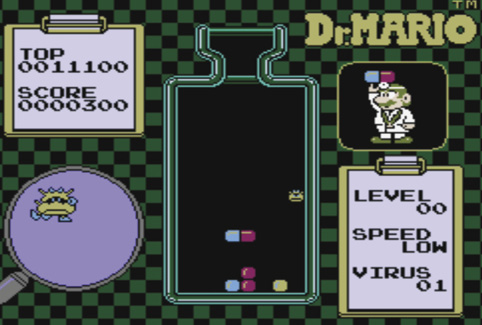
Rid the screen of all but one virus.

Dr. Mario’s Diagnosis

Be careful not to eliminate all your viruses while practicing.

Clinic 2: Doubles

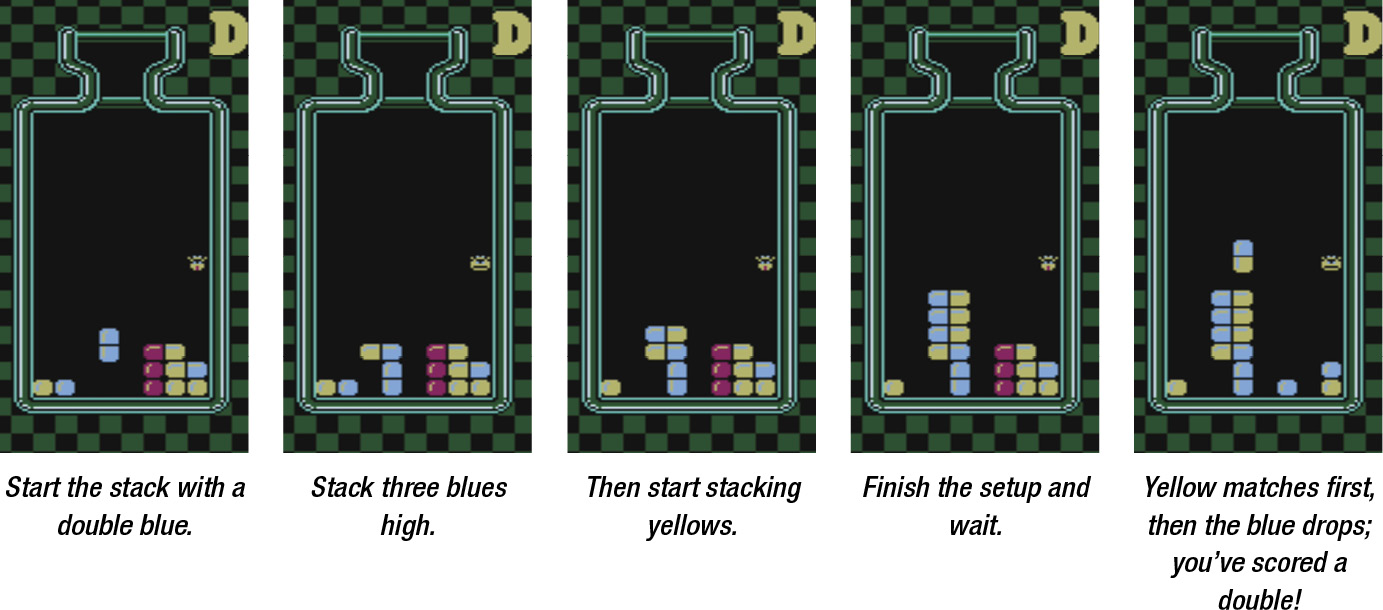
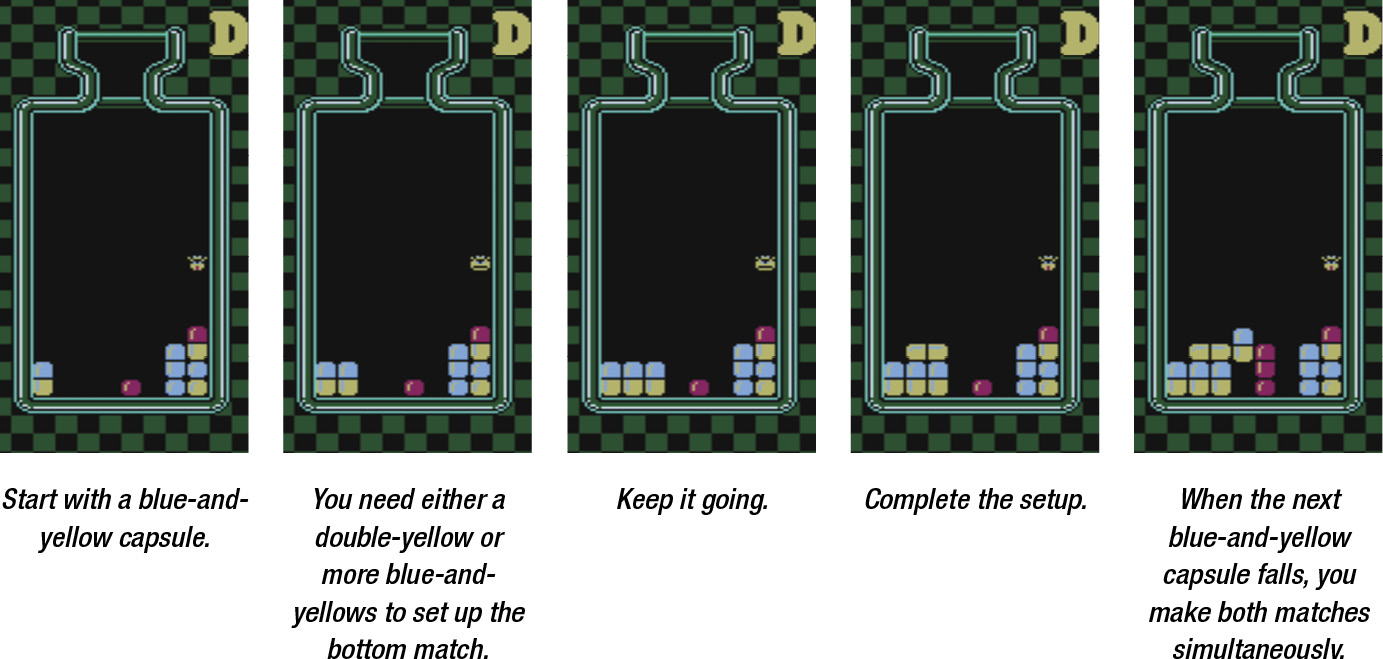
The key to making multiple matches is to arrange sets of three same-color capsules and to wait for an opportunity to complete those sets with a single move. Here are two examples of two-set matches.

Example #1

This is a basic vertical double. Stack two three-of-a-kind matches end to end and wait for a capsule with both colors.
Example #2

Remember that you can make matches both vertically and horizontally. Here’s an example of a double horizontal match.
Clinic 3: Triples

Triple-match scores are similar to doubles, but they take more precision and time to set up. The results are worthwhile, though, since your opponent is pelted with a three-color shower. When you follow these examples, remember to set capsules that don’t fit into the scenario to the side.

Example #1
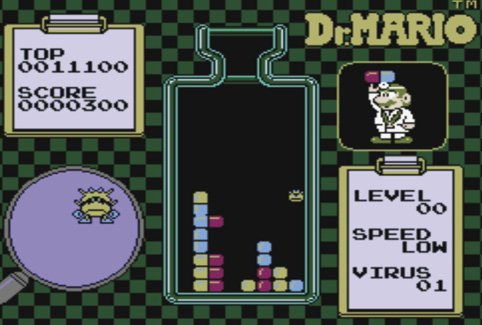
Just like the first double example, this multiple match is vertical. The twist is that now there are three colors in the equation.
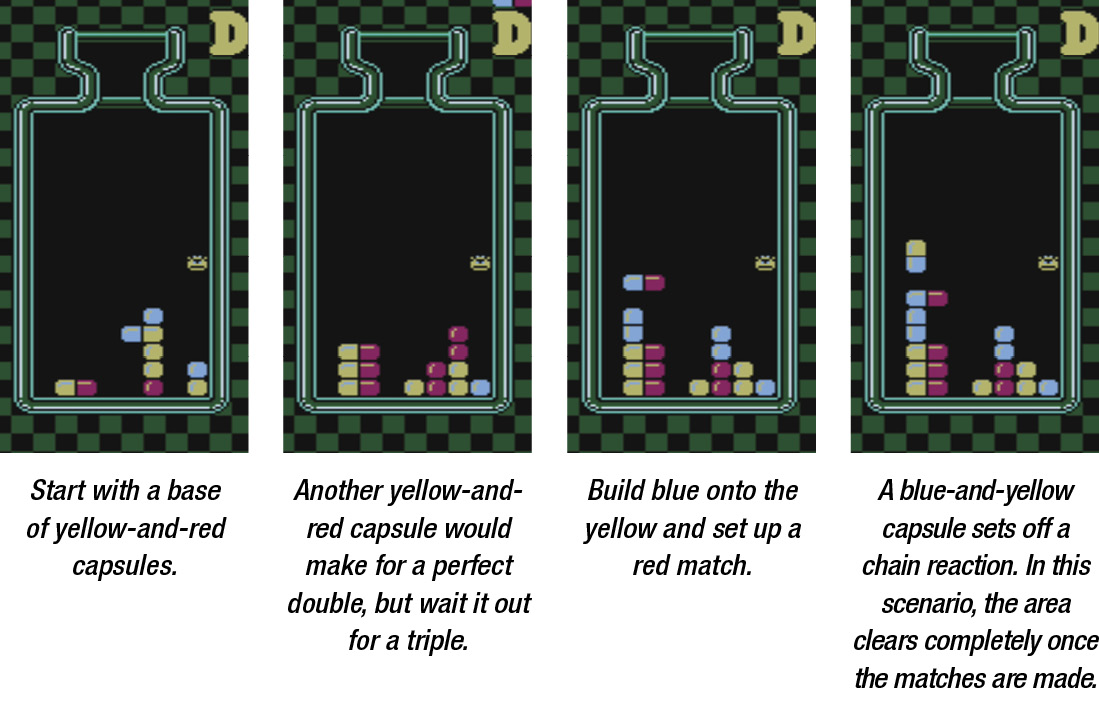
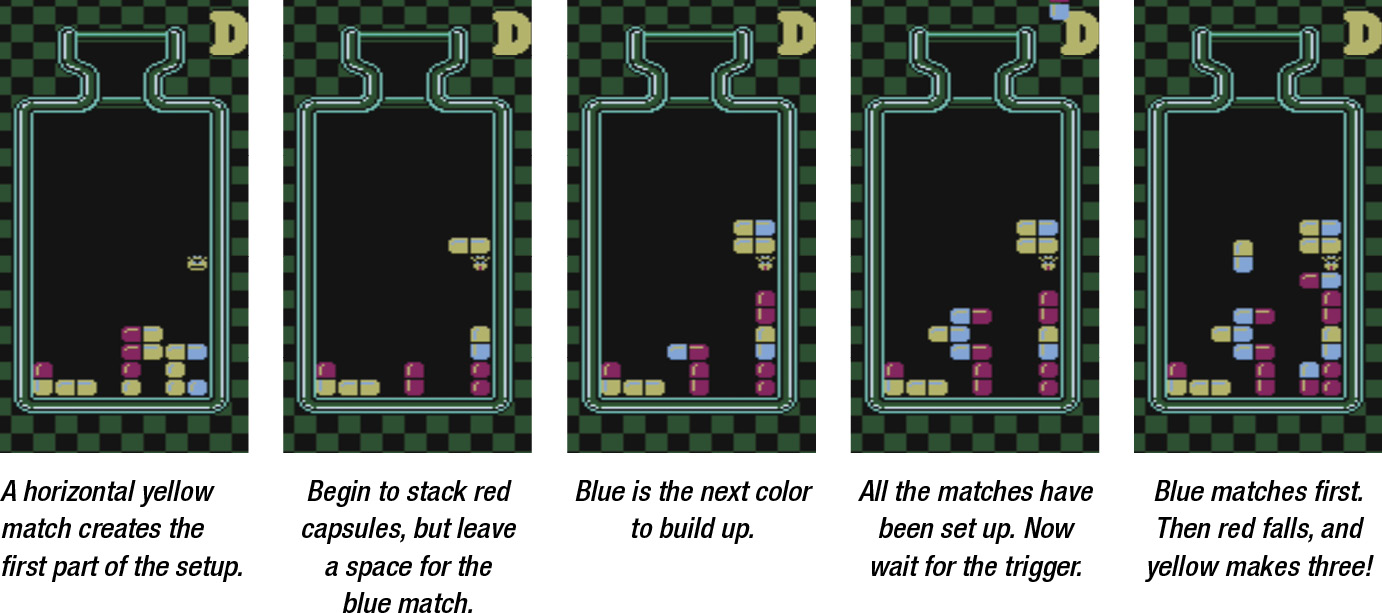
Example #2
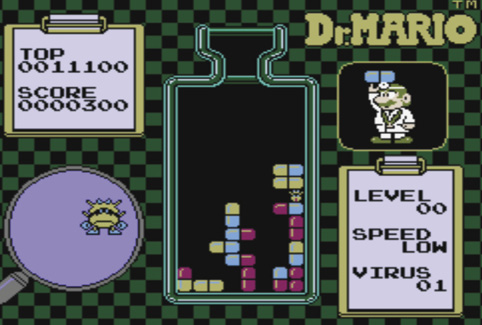
In most triple scores, you incorporate both horizontal and vertical matches. This enables you to bring a wider array of capsules into your scheme.
Dr. Mario’s Board Exam

It’s time to check up on your ability to recognize multiple score setups and see if you qualify to be a full-fledged doctor. Examine the following situations, then take a look at the next capsules to come into play, and decide where they should go in order to score a double or triple. Think about setting up near completions of the same color and then arranging for the last capsule to make the matches. The answers are in the next tip box.

Here Are the Results

If you haven’t figured out the answers to Dr. Mario’s Board Exam, study them here and try to work out a few more examples on your own. Understanding doubles and triples gives you an advantage in competitive situations.

Practice, practice, practice. Even when you understand the principles of multiple matches on paper, the only way to really master the methods is by making up a practice field in a one-player game and trying out double and triple scores. When they become second nature, try out your skills in a two-player game.

If You Find Triples Easy, Try a Quadruple!

It probably won’t ever happen in a playing situation, but you might try to find a way to score a coveted quadruple while practicing. Give it a try, and keep fine-tuning your Dr. Mario skills.

Keep reading with a free account

The first 3 sections of Nintendo Playing with Power are open to everyone. An account opens the rest of it, and every other guide in the archive. It's free, and there's nothing to buy.

Bought guides on the old Prima Games site? Your account and every guide you own moved here, so there's nothing to buy again. Sign in.

Create a free account Or browse our free guides

PreviousDr. Mario’s Diagnosis NextSummary