
Sniper Ghost Warrior 2 Guide Bonus Content Sniper Tactics Book
Taking the Shot
Ballistics
Sniper rifles do not have infinite precision. A sniper rifle fixed in a bench rest will generate a “cone of fire” that expands as the range increases.
One measures the precision of a rifle in “minutes of angle” (MOA), sixty of which make a single degree.
An M24 of very good quality can expect to fire a half MOA group in a bench rest (anything less than 1 MOA is considered acceptable).
This amounts to a group a half inch in size for every 100 meters of range. For example, a half MOA of an M24’s group at 600 meters will be 3 inches.
The disciplined sniper will attempt to gather “dope”, or data, on the rifle’s performance in every weather condition, with every type of ammo he or she plans to use and under “cold bore” conditions (the stable condition of the rifle when it’s first shot instead of the more variable conditions after the rifle has been repeatedly fired).
This dope will be stored in a data book from which the sniper and spotter will generate wind and range adjustments in the field when lining up shots.
Fundamentals of Marksmanship
The four fundamentals of rifle marksmanship are 1) sight picture/sight alignment, 2) body position, 3) breathing control and 4) trigger squeeze.
Close adherence to these fundamentals will increase the likelihood of both accurate and precise shooting.
Note that “accuracy” and “precision” are not the same. The former describes the degree to which a shooter hits at what he or she is aiming.
The latter is a measure of the repeatability of a shot.
A precise shooter may not shoot accurately if his or her rifle is improperly zeroed or using bad data but each shot will miss by the same amount and in the same direction.
A precise shooter is much easier to correct than an imprecise shooter.
The first fundamental deals with how your sights are aligned and how they are placed on the target.
If you are using iron sights, proper sight alignment demands that you have the front sight post centered within the rear sight aperture in both the vertical and horizontal direction.
To ensure precise shooting, this alignment should be as close to the same as possible for each shot.
If you are using a scope, adherence to sight alignment is a matter of ensuring that your eye relief is the same for every shot and there is no “scope shadow” in the eyepiece.
Proper sight picture is achieved when the shooter places the sights (or reticule) on the exact same spot on the target for each shot.
The slogan “aim small, shoot small” encapsulates this idea: the smaller your point of aim, the smaller your shot group and the more precise your shooting will be.
Body position is very important to a sniper. A good position will not tire out the shooter and give him a stable platform from which to shoot.
There are a wide variety of possible positions and each mission and hide will make different positions suitable or not.
If the sniper has a good idea of the general principles behind good positions, he or she will be able to choose the best one and modify it as necessary.
A good position will not require any muscular effort to maintain. Muscles tire and introduce shaking which makes for imprecise shooting.
Tired muscles also increase overall fatigue which reduces the sniper’s mental alertness.
The best positions will be those that are supported by the bones. Another important factor is the evenness with which it dissipates the recoil force.
As soon as the bullet starts moving out of the chamber, the rifle starts to recoil.
If the recoil is not evenly resisted by the body, the rifle will shift in the direction towards which it sees less resistance and any motion of the rifle while the bullet is still traveling down the barrel reduces precision.
In the same vein, the breathing of the shooter can also impart motion onto the rifle while the bullet is traveling down the barrel.
For this reason, it is important to take the shot during a pause in the breathing cycle.
In an ideal situation, this would be during the natural pause just as the lungs are emptied, but a pause can be forced at any point in the cycle.
Do not hold your breath for more than a few seconds. Lack of oxygen will cloud the mind and rapidly increase eye fatigue.
Factor's Beyond the Barrel Affecting the Bullet's Path
Because the rifle is being fired in the vicinity of the Earth, the bullet is under the influence of gravity and will accelerate downward from the moment it leaves the barrel.
This results in “bullet drop”.
The amount of bullet drop will depend on the muzzle velocity, properties of the air through which it travels and the time of flight which is, itself, determined by the range to the target.
Bullet drop is not a linear phenomenon, it varies with the square of the time of flight (and hence the range).
Apart from the wind, the air has other effects on the path of the bullet.
If the ambient temperature during a shot is higher than the temperature in which the rifle was doped, the burn rate of the powder will be higher and the bullet will have a higher muzzle velocity.
Warmer air is also less dense and provides less drag. This will raise the point of impact. It is best to dope one’s rifle in the same weather as one expects during a mission.
However, as that is not always possible, a good rule of thumb is to adjust your point of impact by one MOA for every 20°F difference between mission and doping temperature.
Humidity will serve to increase the density of the air and increase drag.
Adjust your point of impact by one MOA for every change of 20 percentage points in humidity. With increased altitude comes decreased air density, which raises the point of impact.
If the rifle was doped at sea level, expect about a .1 MOA rise in point of impact per 100 meters of range per 2500 feet of altitude.
Be aware that these rules of thumb are rough approximations and are not nearly as accurate as properly doping your rifle in the conditions in which you expect to use it.
The “Coriolis effect” is a result of being on the curved surface of a rotating body.
Due to the Earth’s rotation, objects at different lines of latitude will have different rotational velocities.
An object at the equator traces out a much larger circle over the course of a day than does an object near a pole.
If a shooter engages a target that is at a different latitude, the bullet will carry with it the rotational velocity of the line of latitude from which it was fired.
When it arrives at the target’s latitude, it will have a different rotational velocity than the target.
If the shot occurred in the Northern Hemisphere and was shot due north, the bullet will have a higher rotational velocity than the target when it arrives at the target’s latitude and will therefore appear to have a lateral component to its velocity.
In essence, it is like shooting at a very slowly moving target.
The effect varies with muzzle velocity and with latitude. For example, a due north shot taken at 43°N (the latitude of Sarajevo) with an M24 (muzzle velocity of 790 m/s) at a target 800 meters away, expect a 1.7 inch rightward def lection.
To put the Coriolis effect in perspective, a 3 mph breeze, which the shooter might barely feel on his or her face, would result in a 14.8 inch def lection at 800 meters.
A solid M24 in a bench rest will shoot a half MOA group, resulting in only a 4 inch group at the same distance.
In short, the Coriolis effect can be measured on an ideal, windless day under controlled conditions at a firing range, but it will be swamped by most other effects in the field and need not be considered when setting up a shot.
Because of this, the spin induces a slight sideways air current whose influence adds up over the course of a long trajectory .
For a 1000 meter shot with the typical ammo used by the M24, the shooter can expect about 11 inches of spin drift.
Again, this is a very small effect compared to the other factors affecting the bullet’s path at this range (wind, inherent inaccuracy, etc...), however it is large enough that it should be considered when lining up extremely long shots.
Unlike the Coriolis effect, however, spin drift cannot be easily calculated as it depends on the ammo used, the density of the air and numerous other factors.
It is best measured at the range when gathering data on one’s rifle
Range Estimation
Keeping in mind that there are 3.438 MOA in a mil3 and that 1 MOA amounts to, approximately, 1 inch per 100 meters, the mil-dot reticule in your scope provides an invaluable range estimation tool.
For example, if you observe a man of roughly 2 meters height and he shows an angle of 4 mils as seen through your scope, you know he is about 500 meters distance.
This calculation can be summarized by the range estimation formula [1]:
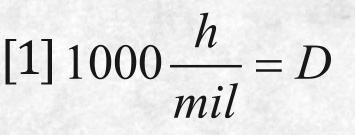
where “h” is the dimension of the object in meters (height of 2 meters in the previous example), “mil” is the angle subtended by the object in mils (4 mils, in the example) and D is the distance in meters.
The disciplined sniper will use this method to set up his or her range card upon occupying a hide and the range card will aid in rapid and accurate range estimation to targets.
This method can be used to ascertain the range to buildings (one story is roughly 3 meters) and vehicles.
It pays to know the dimensions of the enemy’s vehicles for this purpose.
For example, “I know the BRDM-2 is 5.75 meters long and that one subtends an angle of 12.5 mils in my scope, which it puts it at 460 meters.
That man is standing approximately 10 meters in front of it, which puts him at 450 meters”.
This method of range estimation is immune to the variety of optical illusions that plague more informal methods of estimation.
3. Mathematically, a mil is defined as the milli-radian (equal to 3.4377... MOA). However, as a means of practicality, different organizations specify slightly different definitions, ranging from 3.375 MOA to
3.6 MOA.
All that really matters is that you know the definition to which your scope adheres and some basic knowledge of geometry will allow you to adapt these range estimation methods to your scope.
Wind Estimation
Wind imparts a lateral component to the bullet’s velocity. The size of this component depends on the wind’s speed and direction.
Wind that is blowing perpendicular to the path of the bullet is counted as full-value.
Oblique angles are counted as quarter- or half- or three-quarter-value, depending on the obliquity of the angle.
The shooter can get good estimates of the wind’s speed and direction by observing the motion of f lags, trees, smoke rising and the behavior of mirages.
Smoke will drift in 3 miles per hour wind, though you may barely feel the breeze.
Winds between 5 and 8 miles per hour are enough to rustle the leaves of trees.
Winds between 12 and 15 miles per hour will cause small trees to sway.
Small, electronic weather stations, no larger than a cell phone, that measure wind speed, temperature, barometric pressure, altitude and humidity are indispensable tools to the sniper team.
A wind meter has the advantage of directly measuring the perpendicular component, relieving the sniper of the burden of having to estimate the direction value of the wind.
It is also much more precise than the estimation techniques described above.
Compensating for Wind
Once the wind’s speed and direction has been determined, the perpendicular component can be calculated.
A 6 mph wind that is blowing in a half-value direction will have a perpendicular component of 3 mph, for example.
This perpendicular component is plugged into the wind formula [3]: where “D” is the distance to the target in meters, “W” is the perpendicular component of the wind speed in miles per hour, “C” is a constant that depends on the distance and “MOA” is the adjustment needed, given in minutes of angle.
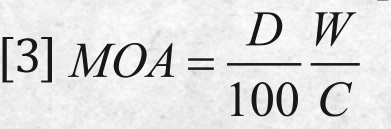
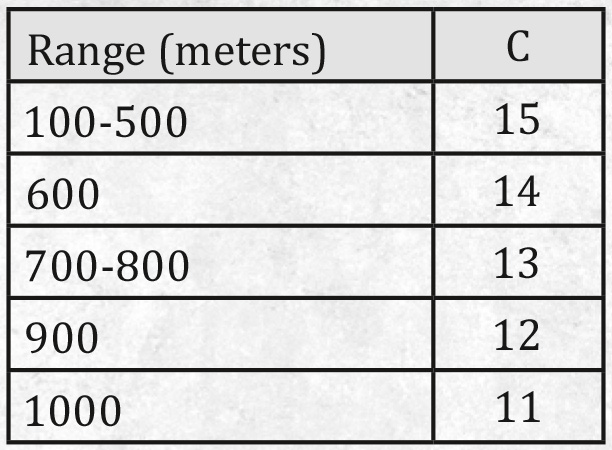
If you are 1000 meters from your target and you observe a 10 mph quarter-value wind, you calculate a 2.5 mph perpendicular component. You plug this into the wind formula to get
.jpg)
Shooting during highly variable winds presents the shooter with another problem. Winds that vary in time might be characterized by a still phase and a gusting phase that alternate.
If the shooter can time a shot to take place during a still phase, he or she can take the shot then. If the winds vary in space, the wind speed and direction will have to be averaged.
However, it is not a clean average.
Additional weight should be given to winds closer to the shooter than winds closer to the target.
The reason for this is that a component of lateral velocity imparted onto the bullet early in its f light will stay with it for the whole f light and influence its impact point a lot more than a component imparted late in its trajectory.
For example, if the shooter observes a 6 mph wind present in the first third of the bullet’s path but no wind for the last two thirds, an unweighted average would result in a 2 mph wind.
However, because this wind occurs early in the bullet’s trajectory, a weighted average would be closer to 3 mph.
Moving Targets
Just like with wind, you need to consider both the direction and speed of the target’s motion. If the target is moving in a direction parallel to the shooter-target line, you may safely ignore the target’s motion.
Oblique motions will be counted as quarter- or half- or three- quarters-value and perpendicular motion will be counted as full-value.
It is important to include the distance to the target and the time-of-f light of the bullet in your considerations when shooting at moving targets. Do not aim at where the target is; aim at where you think the target will be when the bullet arrives.
There are at least two schools of thought when it comes to shooting at moving targets: “tracking” and “trapping”. In “tracking”, you move the rifle to track the motion of the target.
In “trapping”, you keep the rifle motionless, pointed at where you predict the target will be when the bullet arrives. The former is better suited to closer tar- gets, the latter to more distant targets.
The following example shows calculation of movement.
If you are observing an enemy soldier walking at a fast pace and in a direction perpendicular to the shooter- target line, you may estimate their speed as 2 meters per second and assign it a full value (this is slightly faster than 4 miles per hour, the standard road march pace for an infantry unit).
If the shooter-target distance is 800 meters and there is no wind, the bullet’s time-of-flight will be approximately 1 second (the M24 has a muzzle velocity of 790 meters/second and most sniper rifles are in this velocity range) which means the target will have moved 2 meters during the bullet’s flight.
If you are using the trapping method, you must take the shot when the target appears 2.5 mils from the center of the reticule as 2.5 mils is the angle subtended by 2 meters from a distance of 800 meters.