
Sniper Ghost Warrior 2 Guide Bonus Content Sniper Tactics Book
In The Hide
"Ghillie Suit"
There is an important distinction between “cover” and “concealment”. The former provides protection against ballistic threats, the latter merely minimizes the chance of being seen.
A ghillie suit provides concealment but no cover. Because the sniper’s advantage comes from this, it is vitally important that your ghillie suit effectively provide concealment.
The primary goal of the ghillie suit is to eliminate the outline of the human form and minimize the presence of colors and color patterns not encountered in the environment.
A key goal of your ghillie suit is to break up the outline of your shoulders and head. Your face should be hidden and colored. Take care to eliminate any visible areas that are all a solid color (e.g., all black boots) if such solid colors do not appear in your environment.
Sharp angles and straight lines, as you might find on a rifle, should be broken up by using the same methods.
Using less reflective lenses or a honeycomb lens cover reduces reflection and glare from scopes and binoculars.
Desert and urban ghillie suit design follow the same principles. Instead of attaching vegetation, construct a desert ghillie by gluing on layers of sand or a material that mimics the texture of sand.
The urban ghillie’s design will depend on the unique features of the neighborhood in which a mission takes place.
If the sniper plans on attempting to blend in with a pile of rubble, for example, the mission-appropriate ghillie suit might include pieces of rubble or materials, like dust and dirt that mimic the texture and color of the rubble.
The primary goal remains to eliminate the outline of the human form and minimize the presence of colors and color patterns not encountered in the environment.
Observation
In most situations, a sniper’s situational awareness will be his or her greatest asset.
Whether supporting a squad during a raid or patrol, or operating apart from other units, it is the sniper’s detailed knowledge of the activity in his or her sector that creates a true advantage over the enemy.
When scanning his or her sector, the sniper should repeat the mantra “color, contrast and movement”. The sniper is looking for colors and color patterns that do not match the environment.
For example, all black boots or the glint of a scope will stand out as unnatural in a woodland area.
Natural environments do not often have straight lines or sharp edges, so seeing these things should catch the sniper’s eye.
The human brain is specially tuned to notice the arrangement of facial features and the outline of the shoulders and head.
Clever enemies will attempt to camouflage themselves by breaking up these outlines.
By becoming familiar with the methods used to camouflage themselves, you will improve your ability to spot a concealed enemy.
It also pays off to look for indirect clues of the enemy by noticing the behavior of animals and civilians, smells and sounds.
Know the local culture to help you notice any suspicious irregularities.
For example, if you know that it is unusual for a shop to close early in the afternoon, it may signal that the shopkeeper knows violence is imminent.
Familiarity with the behavior of wildlife may alert you as well. Spooked birds can betray the presence of something (or someone) unusual.
When scanning, scan from right to left and low to high. By going against the scanning direction used in reading, you protect against the brain’s tendency to skip over details as it does when reading ¹.
Learn to break up the time you spend “on glass”. Spending long stretches of time peering through a scope increases eyestrain, reduce your scanning efficiency, making it more difficult to be precise when it comes time to take the shot.
Close your shooting eye for a couple seconds after a few minutes “on glass” to allow it to recuperate, or stare at something green.
The eye is most accustomed to the color green, so looking at something green takes the least amount of effort from the eye and serves to relax it2.
Resist the temptation to tunnel in on a specific area if your mission requires you to observe a large sector.
“Range Card”
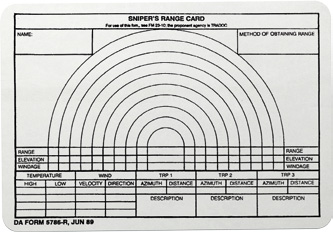
Your observations should be cataloged on a range card. The range card consists of concentric circles indicating regions of equal distance.
On this diagram you should place terrain features, landmarks, enemy positions, dead-space and important routes.
A well populated range card will make it easy to estimate the range to a briefly exposed target, permitting faster adjustments and a quicker, more accurate shot. See right for a blank range card.
Target Selection
While observing your sector, you should be noting what assets the enemy has at its disposal.
These will factor into the order in which you choose to engage targets . Enemy snipers present the greatest danger to you and should be top priority amongst your list of targets.
Also machine gun and mortar crews, dog teams and officers are very dangerous to the sniper.
Eliminating drivers, vehicle commanders, and radio operators can greatly disrupt the enemy’s ability to coordinate maneuvers.
Consider your mission and the danger to you when prioritizing your targets.
Footnotes
1. Like much received wisdom in the military, there is tenuous scientific support for the grand statement that you should scan from right to left and low to high.
However, it is based on a kernel of sound scientific findings. The disciplined sniper team will constantly train each other and test new methods during scanning and memorization drills.
2. Another nugget of received military wisdom, the claim that “green relaxes the eye” has tenuous scientific support.
However it is based on a kernel of established science (Bowmaker and Dartnall, 1980), namely that the sensitivity curves for the 4 different photoreceptor cells (achromatic rods and 3 types of chromatic cones) indicate that the overall sensitivity of the eye is highest in the low 500’s of nm, the wavelength of green light.