
Sniper Ghost Warrior 2 Guide Bonus Content Sniper Tactics Book
Sniper Rifles
THIS SECTION DESCRIBES MY EXPERIENCE, OPINION AND OBSERVATION OF SEVERAL OF THE SNIPER RIFLES IN SNIPER: GHOST WARRIOR 2.
M24
The M24 is a bolt action rifle, based on the civilian Remington 700. It usually fires the 7.62x51mm NATO round. This round is very similar, though not identical, to the .308 caliber round.
The M24 was designed with a “long action”. This means that the length through which the user must operate the action to properly cycle a round is much longer than would be expected based on the length of the 7.62x51mm NATO round.
The reason for this is that, with just a barrel change and a rechambering, the M24 can be made to fire the .300 Winchester Magnum round or the .338 Lapua round.
These more powerful rounds increase the M24’s effective range. In practice, though, this modification is rarely performed.
The M24, when firing the standard M118LR (colloquially referred to as “sniper ball ammo”), has an effective range of 800 meters and a muzzle velocity in the neighborhood of 790 meters/second (recall that muzzle velocity varies with atmospheric conditions).
This can be enhanced to 1500 meters with the .338 Lapua round. These effective ranges are merely the range during which the round is guaranteed to be supersonic.
A skilled shooter can still accurately engage targets past these distances with proper wind calls. An M24 that has been well cared for and properly broken in will be able to shoot groups approximately .6 MOA in size.
In the US military, the primary user of the M24 is the Army. The marine Corps uses an M40, another variant of the Remington 700. The M40 uses a “short action”, meaning it cannot be easily rechambered to use larger rounds. However, bolt manipulation is faster and more precise due the much shorter length of the action.
The Army originally opted for the longer action because they anticipated that the M24 would routinely be modified for use with the aforementioned longer range munitions. However, these modifications need to be performed by an armorer with specialized tools and the alternative ammo is somewhat rare in the military supply system.
Consequently, these modifications are rarely made. Because the advantage of the long action is rarely actualized, to my mind, the short action of M40 is the better alternative.
I was first trained as a sniper on the M24. Because of this, I compare all other sniper rifles to it. I am not, however, blind to the M24’s faults.
The internal box magazine makes reloading much slower than it would be with a detachable box magazine as seen in the MSR or M200. The “crown” is the last point on the inside of the barrel with which the bullet is in contact.
If there is a nick or scratch to the crown, the precision of the rifle is reduced. Because of this, snipers are notoriously paranoid about protecting the crown of their rifles.
The M24 does not have an integrated f lash suppressor, meaning its crown is exposed to all the environmental hazards one encounters on a mission.
From a logistics point of view, however, the M24 is a compelling system. It is easy to disassemble and clean. When chambered for the 7.62x51mm NATO round, the rifle can make use of any such ammo it finds, even if it is not match-grade sniper ammo.
If the sniper is in a remote outpost and resupply is not frequent, the M24 can make use of de-linked machine gun ammunition, albeit at the cost of reduced precision. Rifles that use more exotic ammunition present real logistical problems.
M200
The CheyTac Intervention (also known as the M200) holds the record for the best group at a distance, placing 3 rounds within 42 centimeters of each other at a distance of over 2100 meters. This amounts to a group of just under .7 MOA at a distance of just over 1.3 miles.
This impressive feat was possible because the Intervention was designed, from the ground up, to perform at this level. Rather than design the rifle around a pre-existing round, the Intervention was designed around two completely new rounds, the .408 CheyTac and .375 CheyTac.
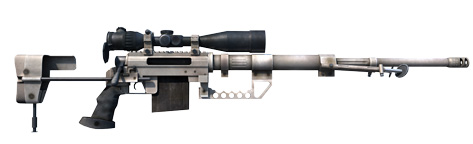
Whereas most rifle ammunition consists of a lead or tungsten carbide core with a copper jacket, the CheyTac rounds are “mono” rounds.
They do not use different metals for the core and the jacket. The entire projectile is one solid piece of metal, providing a more uniform density distribution, allowing the ammunition designer to guarantee much tighter control over the balance and aerodynamic behavior of the round.
CheyTac claims this ammunition is designed so that the nose of the bullet is always facing directly into the wind, minimizing the random deflection due to tumbling that usually occurs in rifle rounds at long distances. This extraordinary claim is backed up by the Intervention’s extraordinary accuracy record.
This outstanding bolt action rifle comes with a laser range finder and ballistic computer with integrated weather sensors. This enables the spotter to make highly accurate wind calls without the need to manually input weather data into a computer.
In adverse conditions, such as remote outposts without regular resupply or electrical power, these auxiliary electronic systems will eventually lose power and the sniper team will have to fall back on classical sniper techniques.
This is not necessarily a fault of the system, but the sniper team must not let its classical skills atrophy when using advanced systems. Additionally, the exotic ammunition used by the m200 make it less than ideal under adverse supply conditions.
MSR
Remington’s Modular Sniper Rifle (MSR) is a response to USSOCOM’s request for bids for their Precision Sniper Rifle contract. The MSR was designed around the .338 Lapua Magnum though it can be rechambered to accept the 7.62x51mm NATO round as a well as a variety of other similarly sized rounds.
It comes with the standard accoutrements common to modern sniper rifles such as an adjustable buttstock, an adjustable cheek pad, bipod legs, and a detachable suppressor.
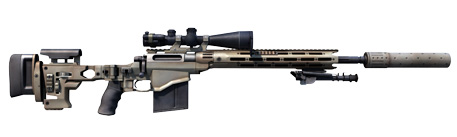
The bolt action MSR meets the contract criteria by pro- viding the user with 1 MOA at 1500 meters with the .338 Lapua Magnum. Unlike the M24 which uses an internal 5 round box magazine, the MSR employs a detachable 5 or 10 round box magazine, making reloading much smoother and faster. Its integrated flash suppressor protects the crown.
The MSR is approximately the same weight and length as the M24, making it a reasonable rifle to carry during long dismounted movements. The buttstock can be folded (though it cannot be fired well in this configuration) to reduce its carry length by 10”. Reconfiguring the rifle for alternative ammunition is an easier affair with the MSR than it is with the M24.
The change to .338 Lapua Magnum from 7.62x51mm NATO (and back) can be performed without an armorer’s specialized tools, giving this rifle the best of both worlds: the range advantages of the .338 Lapua Magnum when available, and the logistical advantages of 7.62x51mm NATO when necessary. In my opinion, with the MSR, Remington fulfilled the original promises of the M24 and corrected some of its flaws, making the MSR superior to its predecessor.
XM500
American Barrett Firearms Company’s experimental XM500 is an evolutionary improvement over its M82 .50 caliber sniper rifle. Unlike the M82, the XM500 employs a bullpup design which drastically reduces the overall length of the rifle without sacrificing barrel length.
This is accomplished by placing the action on top of the barrel rather than behind it, allowing the chamber and barrel to be shifted rearward, into the buttstock. This design also reduces the weight of the rifle by close to 6 pounds, dramatically improving usability. Most notable, however, is the XM500’s impressive improvement over the M82’s mediocre 3 MOA precision.
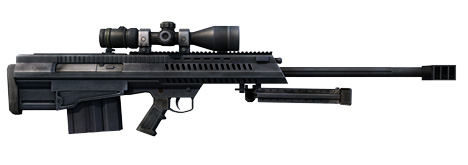
This gas operated, semi-automatic rifle uses a detachable 10 round box magazine. The .50 caliber round makes it especially suited for use on “material” targets such as lightly armored vehicles, parked aircraft, and unhardened equipment (for example radar, radio and generators).
The bipod legs and rail mounted scope allow the user to perform these tasks out to an effective range of 1800 meters. The XM500 has inherited the M82’s characteristic muzzle brake which reduces recoil and improves stability.
This is accomplished by redirecting the exhaust gases to the side and to the rear, often blasting these gases and dust into the spotter’s face. My experiences with the XM500’s predecessor, the M82, were not favorable.
It was not uncomfortable to shoot but its 30 lbs weight and 57 inch length made it unwieldy to carry on missions. The M82’s unimpressive 3 MOA precision ensured that even if available, the sniper squad rarely took this rifle on their missions.
However, if we had had the XM500 at our disposal, it would have been a different story. The XM500 improves on almost every single complaint about its predecessor making it a very compelling addition to the .50 caliber arsenal.
SV DRAGUNOV
The Dragunov is the standard sniper and squad designated marksman rifle for the Russian military. It is chambered in the 7.62x54mmR round and feeds from a detachable 10 round box magazine. Note that this is not a NATO round as it is slightly longer than the 7.62x51mm NATO round.
The standard Dragunov does not come with bipod legs, however several variants used in other countries do.
When using match grade ammunition (ammunition that has tighter tolerances in projectile mass and powder load than does conventional infantry ammunition), the Dragunov can achieve precision in the 1 MOA range, a commendable achievement for a gas operated semi-automatic rifle.
When fitted with its standard PSO-1 scope, the rifle has an effective range of 800 meters and a muzzle velocity of 830 meters/second.
The standard PSO-1 scope is a unique instrument. It is one of the few sniper scopes that has an auxiliary reticule that is specially designed for range estimation.
In addition to the standard central reticule with stadia lines indicating bullet drop and windage adjustments, there is an auxiliary reticule in the lower left corner of the visual field. This reticule consists of a lower flat horizontal line and an upper upward-curved line.
The user places his target (assumed to be a standing average sized male of 1.7 meters) in this reticule so that the target’s feet are touching the lower flat line and the target’s head is touching the upper upward-curved line.
There are numerical markings along the upper curved line indicating the distance to the 1.7 meter man that subtends that given angle. This subtle, clever, low cost, durable, and very useful solution is typical of robust inventive Russian design.
During one of many joint missions with the new Iraqi Army, I had the opportunity to play around with a Dragunov and look through the PSO-1 scope. The scope is, indeed, as intuitive and easy to use as one would expect from such a well designed instrument.
It is unclear to me why the auxiliary reticule is not copied or improved upon by other manufacturers.
AW50
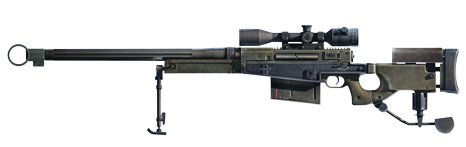
Accuracy International’s AW50 is a bolt action .50 caliber anti-material rifle. The standard model comes in at a hefty 33 lbs. Unusual among sniper rifles, the AW50 features a folding buttstock that makes it easier to carry.
The buttstock also features all the standard adjustments the modern sniper has come to expect. In addition, the AW50 has a “third leg”, an adjustable support that extends downward from the buttstock and operates in place of a sand sock. This allows for more accurate and stable use of such a large and powerful weapon.
The AW50 has a rail system that allows for mounting one of its three standard scopes: a fixed 10x, a variable 3-12x, or a variable 4-16x. The rail system conforms to the Picatinny standard, so it will also accept any of the standard night vision scopes.
This rifle comes with a built in muzzle brake but it will also accept a detachable suppressor. Fed from a 5 round detachable box magazine, this rifle offers its user an effective range of up to 2000 meters.
.50 caliber is an extremely large and powerful round. Most .50 caliber sniper rifles are semi-automatic and gas operated. This usually entails a spring-operated buffer system that dampens the recoil and preserves some degree of user comfort, as well as providing the energy to operate the action.
It is rare to find a bolt action .50 caliber as bolt action rifles usually transmit their full recoil force into the user’s shoulder.
The AW50 mitigates this problem by employing a muzzle brake and using a hydraulic dampening system in the buttstock. These features, coupled with the rifle’s prodigious weight, serve to offer the user a very powerful anti-material weapon, with the accuracy of a bolt action rifle and yet a remarkably manageable recoil.
With standard .50 caliber ammunition, the AW50 can penetrate lightly armored vehicles, unhardened equipment, parked aircraft, all body armor and other “material” targets.
Certain variants of the standard .50 caliber can improve penetration; the SLAP round (Sabot-Launched, Armor Piercing4) being the most formidable example. However, some of these non-standard rounds are not match-grade and therefore will not be fired with the same precision as match-grade ammo and can reduce the lifetime of the rifle.
The AW50’s folding buttstock reduces its length by 10”, making it the same length as the XM500. However, the AW50cannot be fired when it is 46” long, whereas the XM500 can. Additionally, the AW50 outweighs the XM500 by a good deal, making the XM500 preferable for missions that require moving long distance on foot.
However, the AW50’sbolt action is probably more accurate than the XM500’s semi-automatic action, making the former the preferred tool for extremely long distance shots.
DSR
The DSR is a German-built bolt action, bullpup sniper rifle. It can be chambered for the 7.62x51mm NATO round (technically, the .308 Winchester, however the two rounds are almost perfectly interchangeable), as well as the .300 Winchester Magnum or the .338 Lapua Magnum. __________________
4. The SLAP round is what is referred to as a “sub-caliber” munition. It features a tungsten carbide penetrator sheathed in a light plastic sabot. The entire projectile is significantly lighter than a conventional tungsten-carbide-cored copper-jacketed .50 caliber projectile, therefore it has a much higher muzzle velocity given the same powder load.
As the SLAP round leaves the barrel, the plastic sabot breaks apart, leaving the penetrator to travel on its own to the target. The higher velocity, smaller cross-section and sharper and harder impact point mean the round delivers a much higher impact pressure, vastly improving penetrating power.
The plastic sabot, however, can gum up barrels and this fouling can reduce the lifetime of the weapon system.
Like most modern sniper rifles, the DSR features bipod legs, a scope and an adjustable buttstock and cheek pad. In addition, the DSR has an integrated flash suppressor that will also accept a detachable sound suppressor.
When chambered for the 7.62x51mm NATO, the DSR feeds from a 5 round detachable box magazine and can achieve precision in the .5 to .6 MOA range. It provides an effective range of 800 meters in this configuration.
When chambered for the .300 Winchester Magnum, this rifle has been reported (under controlled conditions) to deliver outstanding bullet groups as small as .34 MOA. This change of ammunition extends the effective range to 1100 meters.
When configured for .338 Lapua Magnum, the effective range stretches out to 1500 meters. The detachable box magazine and integrated f lash suppressor, coupled with the DSR’s length and weight (both roughly the same as the M24) make this a very compelling competitor to the M24.
The phenomenal precision of the DSR puts it ahead, in my opinion. The fairly straightforward process of reconfiguring the DSR for alternative ammunition only improves my opinion of the DSR.
The DSR has several variants. Notable among these are the DSR-50, chambered for the .50 caliber round, and the DSR-1 Subsonic, chambered for the 7.61x51mm NATO subsonic rounds.
Sound suppressors do not operate as portrayed in the James Bond movies; suppressed weapons are still somewhat louder than the whisper we have come to expect. Suppressors cut down on the overall intensity of the noise and make it difficult for the enemy to get a clear idea of the location of the shooter.
What suppressors cannot do, however, is reduce the sonic boom created by supersonic rounds. This sonic boom is responsible for the characteristic “crack” heard by many a combatant as a round narrowly misses their head.
Subsonic rounds sidestep this issue by never traveling faster than the speed of sound and therefore never generating a sonic boom. Their much lower muzzle velocity means they are not well suited for long distance shots.
Because of this, the DSR-1 Subsonic is a true stealth weapon, designed for closer range but very quiet shots.
VINTOREZ
The VSS Vintorez is an unusual sniper rifle. It is chambered in the Russian 9x39mm round, a heavy subsonic round. These rounds are fed from either a 10 or 20 round detachable box magazine. Rhe Vintorez is usually fired in semi-automatic mode, but it has the ability to be fired in automatic mode as well.
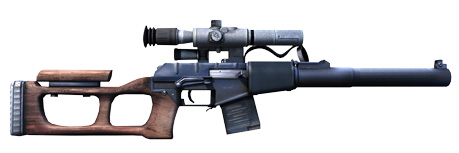
The Vintorez features a wooden skeleton stock and a fully suppressed short barrel. The weapon is designed for stealth and concealment. With the suppressed barrel and subsonic ammunition, it only achieves a muzzle velocity of 290 meters/second and an effective range of 400 meters.
However, these features enable it to be carried while on undercover and covert missions, and its compact size attracts less attention. The Vintorez can also be disassembled and placed in a specially made briefcase for concealed undercover travel.
M14 EBR
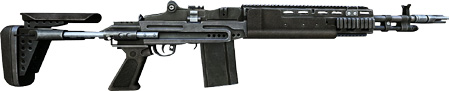
The Mk-14 Enhanced Battle Rifle (EBR) is an upgrade of the classic M14 battle rifle. The M14’s barrel and receiver are replaced, but the action is maintained.
The EBR is usually fitted with a full rail system that allows numerous accessories, including a variety of scopes and bipod legs. The upgraded barrel is a bit shorter and more accurate, as well as featuring a more modern flash suppressor.
This semi-automatic rifle, when firing its standard 7.62x51mm NATO rounds, achieves a muzzle velocity of 850 meters/second. Fed by a 10 or 20 round detachable box magazine, the rifle has an effective range of 800 meters.
When using appropriate optics, its users have reported precision in the neighborhood of .9 MOA, a commendable feat for an upgrade to such a classic rifle.