
Atari Flashback: The Essential Companion Guide 1981-82
SUPER Breakout

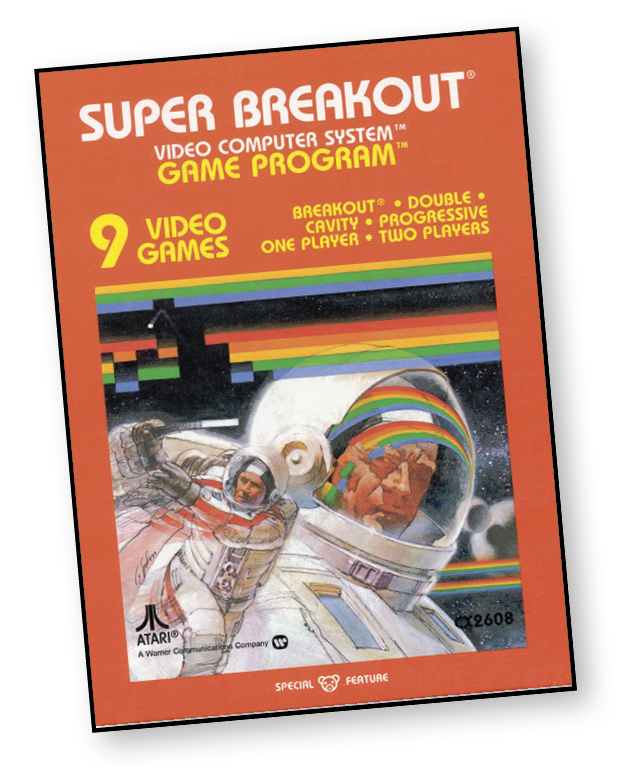
Imagine you’re in a one-man space shuttle travelling through the heavens at the speed of light. You and your tiny ship are totally engulfed in darkness, except for the luminance of an occasional passing star.
Suddenly, without warning, there’s a brilliant flash straight ahead. You check the radar screen. Nothing. Pretty soon there’s another flash, and another. Next thing you know the flashes have turned into one gigantic force field of some kind and it’s dead ahead. You check the radar screen again, still nothing.
The colors in this mysterious force field are so bright, they’re almost blinding. And they seem to be in layers. But the strangest thing is that nothing shows up on the radar screen. What could that mean? Is it possible to travel through this mysterious force field or will you crash and be destroyed? And what about the layers? If you make it through one, can you make it through the next, and the next?
It’s decision time and there are only a few seconds to think about it.
Turn back or blast ahead and try to make it through the layers of the brightly colored force field. It’s up to you.
About the Game
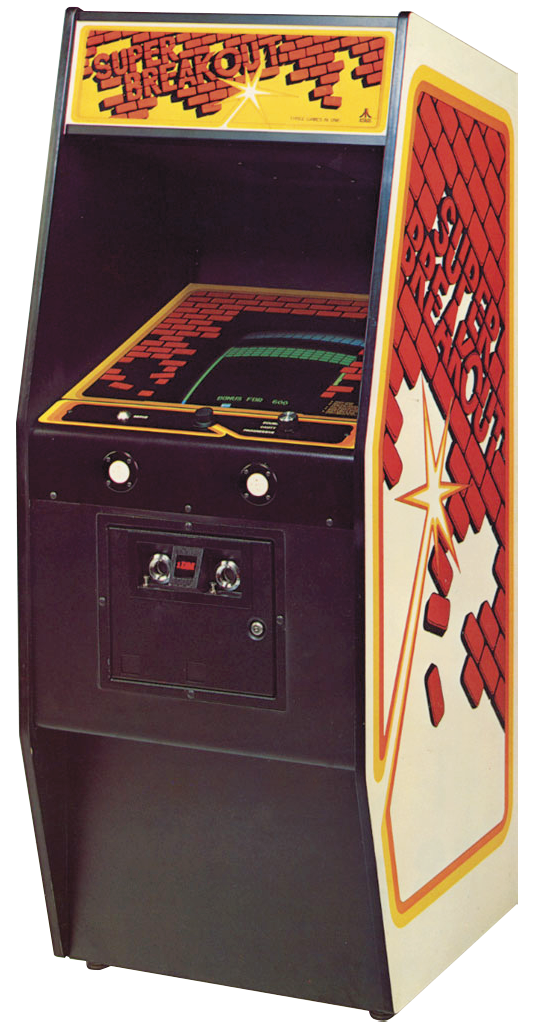
Atari produced the arcade version of Super Breakout in 1978, changing from its predecessor’s discrete logic to a microprocessor-based game. This allowed for an arcade machine that was both easier to produce and featured additional game variations.
Although not breaking the 1 million games sold barrier like its predecessor, many enthusiasts consider the Atari 2600 port of Super Breakout a superior experience. Its relatively late 1981 release, which was around the same time as ports of more high-profile arcade games like Space Invaders and Asteroids, likely resulted in its poorer commercial reception.
Object of the Game
Super Breakout contains the following game variations:
- Breakout
- Double
- Cavity
- Progressive
- Children’s Versions
Each game variation may be played by one or two players, with the exception of Progressive, which is for one player only.
The object in all of the games is to keep the ball in play (as you knock out bricks) to score the highest number of points possible, or to score more points than your opponent.
How to Play
Push the red controller button to serve the ball. To make contact with the ball and keep it in play, turn the knob on the controller—the paddle moves horizontally back and forth across the bottom of the screen. Turn the knob clockwise to move the paddle right; turn it counterclockwise to move it left.
The angle the ball rebounds off the paddle depends on which part of the paddle it hits. The paddle is divided into four sections. During the first eight hits, the ball bounces off the paddle normally.
After the eighth, 16th, and 48th hits, the ball reacts differently and speeds up (except in the Children’s Versions). The ball also speeds up after hitting any bricks in the last four rows (or the last eight rows in Progressive).
Whenever you break through the last row of bricks and the ball makes contact with the boundary at the top of the playfield, the paddle is reduced to half its original size (except in the Children’s Versions). In Double and Cavity, both paddles are reduced in size. The paddle or paddles return to normal size when a new turn begins.
Each turn ends when the ball is missed and disappears off the bottom of the playfield. In games with two or three balls in play, a turn ends when the last ball is missed.
Difficulty Options
The difficulty buttons control the size of the paddle in all games. In the B or beginner position, the paddle is twice the size it is in the A position. The A position is for experienced Super Breakout players.
Use the left difficulty button for one-player games. For two-player games, the first player uses the left difficulty button; the second player uses the right difficulty button.
Remember that the paddle reduces to half its original size when the ball breaks through the last row of bricks and hits the boundary at the top of the playfield.
Game Options
Use Select to choose the game you wish to play. There are nine game numbers in total.
There are eight exciting game sounds programmed into Super Breakout. One of these eight sounds is randomly selected each time you begin a new game (when you press Reset, you hear a sample of the sound selected for that game).
After you have selected the game number you wish to play, press Reset to start the game. Reset may also be used to reset a game at any time. When you press Reset, you hear a sample of the scoring sound to be used during the game.
Breakout (Games 1 and 2)
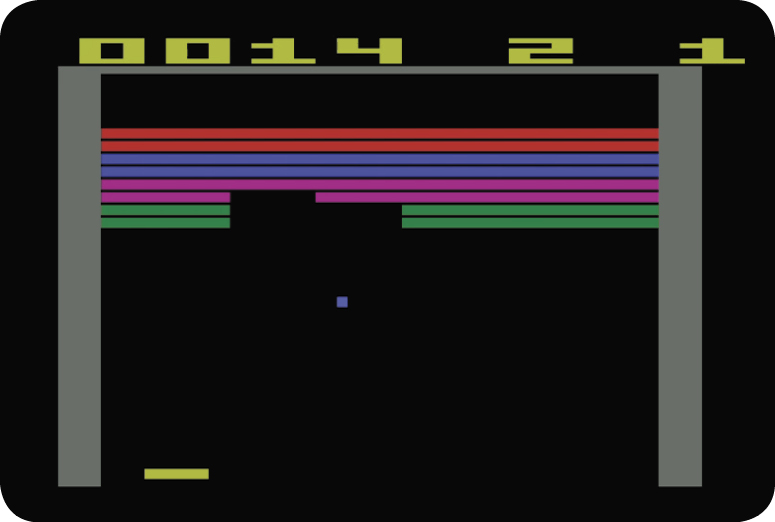
Games 1 and 2 are regular Breakout. Game 1 is for one player; Game 2 is for two players.
As in all two-player games, each player has his own wall of bricks (and corresponding score), which is displayed on the screen during that player’s turn.
Each wall of bricks contains eight rows. Bricks in the first two rows are worth one point each. The third and fourth row bricks are worth three points each. The fifth and sixth row bricks are worth five points each, and the seventh and eighth row bricks are worth seven points each.
If you knock out all the bricks (within five turns), a new wall of bricks appears on the screen. Each wall of bricks is worth 416 points.
There is no limit to the number of times a new wall of bricks can be reset during a game.
If a tie occurs in a two-player game, the player reaching that score in the fewest turns is the winner. The maximum score for Breakout is infinite since the wall of bricks resets indefinitely. However, since the screen display has room for only four digits, a player’s score resets to 0000 if it exceeds 9999.
Double (Games 3 and 4)
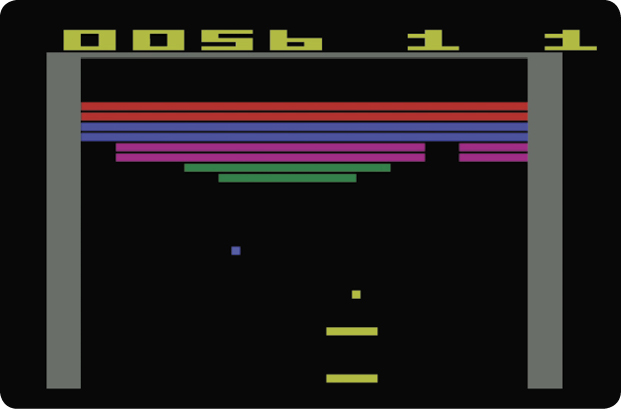
Game 3 is Double Breakout for one player. Game 4 is Double Breakout for two players.
The playfield in Double is the same as the Breakout playfield, except that there are two paddles and two balls served. The paddles are stacked one on top of the other. The point value of the bricks is essentially the same as Breakout except when there are two balls in play. When this occurs, each brick is worth twice its normal amount.
If you miss the first ball served, it counts as a miss and goes against your allotted serves (turns) per game. Otherwise, the second ball is served. If you miss the second ball (after hitting the first ball), play continues until you miss the first ball. After both balls are in play (have been hit at least once), one may be missed while the other remains in play.
The wall of bricks resets an infinite number of times after the first wall is knocked out. The maximum score for Double Breakout is infinite.
Cavity (Games 5 and 6)
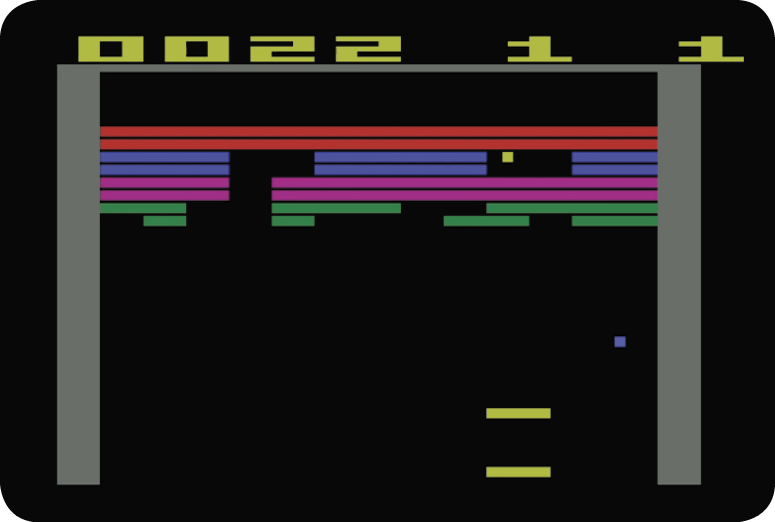
Game 5 is Cavity Breakout for one player. Game 6 is Cavity Breakout for two players.
The Cavity playfield contains slightly fewer bricks to make room for two “cavities”, each of which contains a ball. When the game begins, the balls bounce inside each cavity but are held captive for the time being while a third ball is served. There are two paddles, the same as in Double.
Point values of the bricks are the same as the other games (defined by rows) when one ball is in play. When enough bricks are removed to release a captive ball, each brick is then worth twice its normal amount when hit. If the third ball is freed, bricks are worth triple their normal amount when hit.
If any one of the balls is missed, the scoring returns to double points. If the second ball is missed and only one ball remains in the playfield, the point value of the bricks returns to normal.
The wall of bricks resets an infinite number of times, therefore the maximum score possibility for Cavity Breakout is infinite.
Progressive (Game 7)
Game 7 is Progressive Breakout for one player only.
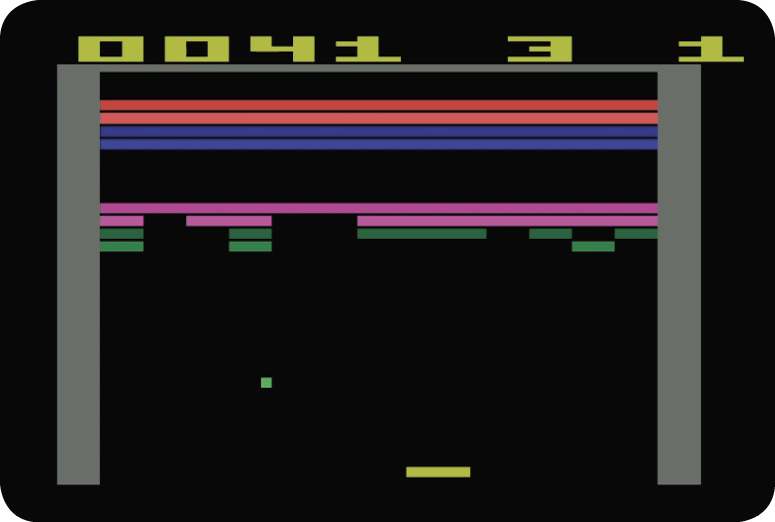
The playfield in Progressive is set up somewhat differently than Breakout. When the game begins, the playfield contains four rows of bricks at the top of the screen, followed by four blank rows, and then four more rows of bricks. The point value of the bricks is defined by row numbers, the same as in Breakout.
After game play begins, the brick walls “progress” toward the bottom of the screen. As the bricks are knocked out and the walls progressively move down toward your paddle, new bricks enter the playfield at a progressively faster rate. Four rows of bricks are always separated by four rows of blanks. As the brick walls progress downward, their colors change, which gives them a new point value. The maximum score for Progressive is infinite.
Children’s Versions (Games 8 and 9)
Game 8 is a one-player Children’s Version. Game 9 is a two-player Children’s Version. Both games are regular Breakout. The game play in these versions is programmed at a slower rate. The ball does not speed up after hitting bricks in the last four rows. Also, the paddle does not reduce to half its original size when the ball reaches the top boundary of the playfield. Scoring and other game play characteristics are the same as normal Breakout.
|
Game Number |
1 |
2 |
3 |
4 |
5 |
6 |
7 |
8 |
9 |
|
One-player |
x |
x |
x |
x |
x |
||||
|
Two-player |
x |
x |
x |
x |
|||||
|
x |
x |
||||||||
|
Double |
x |
x |
|||||||
|
Cavity |
x |
x |
|||||||
|
Progressive |
x |
||||||||
|
Children’s Versions |
x |
x |