
Atari Flashback: The Essential Companion Guide 1981-82
Missile Command

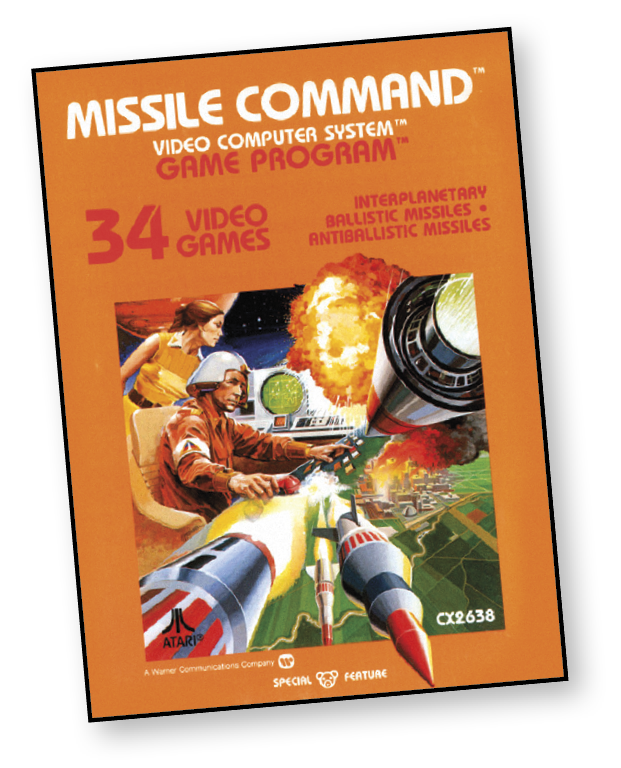
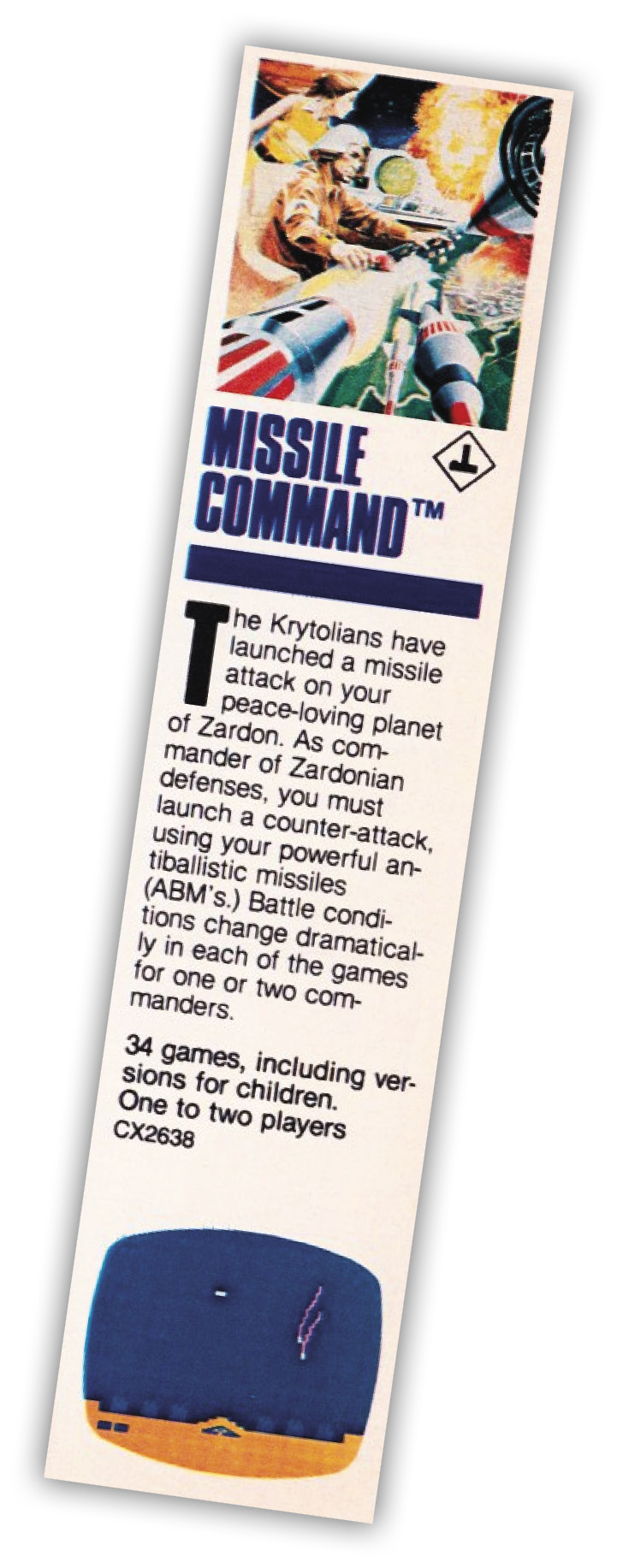
Aliens from the planet of Krytol have begun an attack on the planet Zardon. The Krytolians are warriors, out to destroy and seize the planet of Zardon. Zardon is the last of the peaceful planets. The Zardonians are skillful and hardworking people. Their cities are built-up and rich in resources. It is truly a planet void of crime and violence.
Zardon has built a powerful defense system. Several anti-ballistic missile bases have been established within the cities of Zardon. The Zardonians are ready for this attack and prepared to fight to save their cities.
As base commander, it is your responsibility to protect and defend six cities on the planet of Zardon. The Krytolians have begun firing interplanetary ballistic missiles. They are aiming at your cities and missile bases. Your only defense is to fire back with anti-ballistic missiles. But watch out, the Krytolians are sly—they also have cruise missiles. Cruise missiles look like satellites, but they are just as deadly as the interplanetary ballistic missiles.
Use your anti-ballistic missiles (ABMs) to stop the enemy before your happy and harmonious planet is destroyed.
About the Game
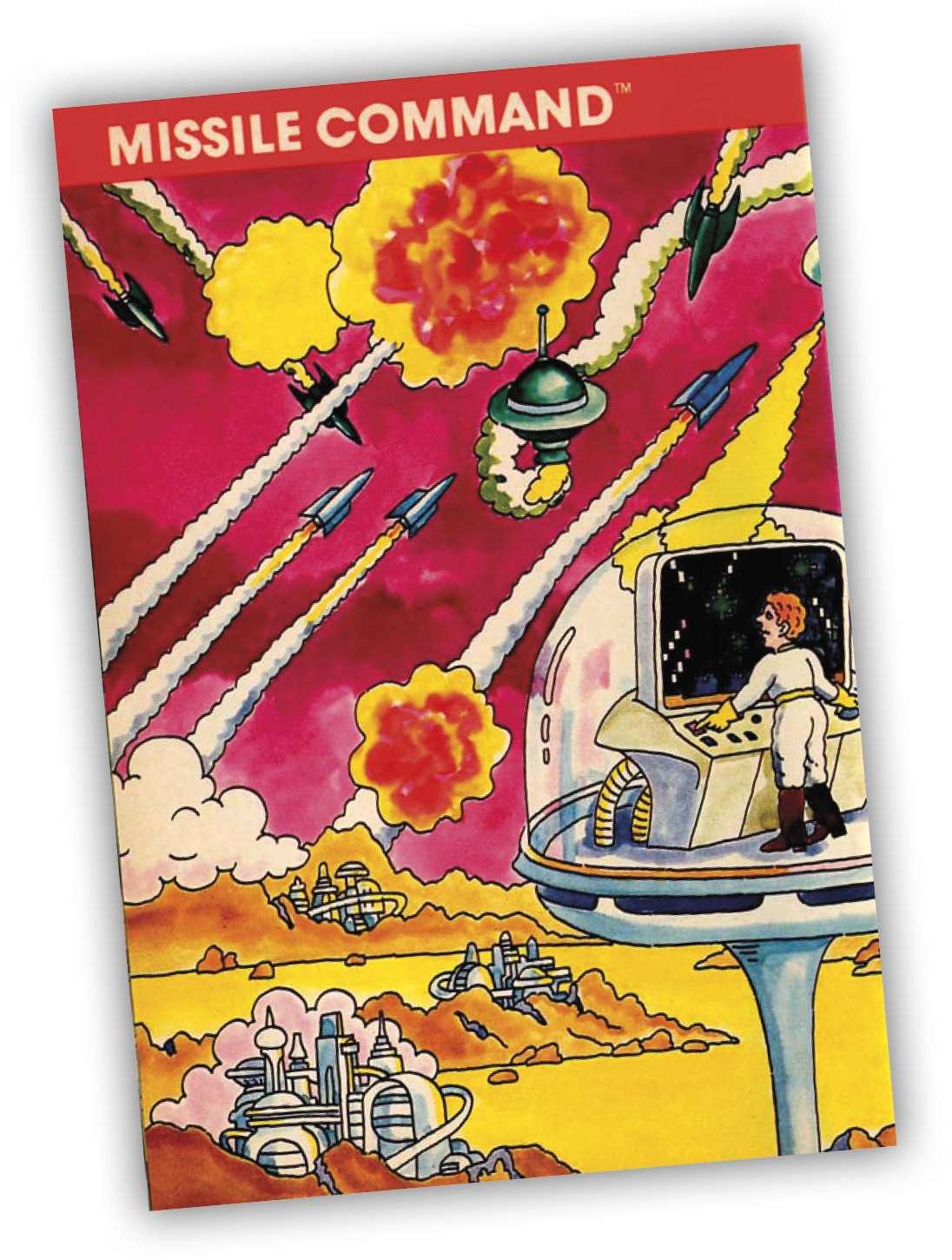
Missile Command took the coin-op arcade world by storm when it was released in 1980. Atari eventually produced over 17,000 arcade uprights and cocktail cabinets of Missile Command. The game’s popularity made it an obvious choice for a conversion to Atari’s home system. However, the coin-op game employed a track ball controller and three buttons for firing ABMs from different bases, so the programmer faced a challenge in modifying the game to fit the limitations on the home console and its controllers.
As reviews of the time attest, the conversion was done
masterfully. The home game, released in April 1981, was not an exact recreation of the coin-op Missile Command, but it managed to keep the feeling from the arcade experience. Some players preferred the home version, as you were not required to keep track of available missiles at three bases.
The appeal of Missile Command went far and above the arcade and home console. Beyond the obligatory merchandise, such as t-shirts, Missile Command was used in fast food promotions, for model kits, and even as a Halloween-themed costume.
Missile Command has appeared in movies and television shows beginning at the height of its popularity through today. Hollywood icon Steven Spielberg is such a fan of the game that a photograph of him from the 1980s book Invasion of the Space Invaders includes his personal Missile Command cabinet.
Nostalgia, retro-gaming consoles, and software collections have created a modern market for merchandise based on older games. Recent offerings include clothing, drinking glasses, and even a Missile Command-themed Hot Wheels vehicle. It’s safe to say that interest in Missile Command will never die out completely.
Object of the Game
The object of the game is to defend your cities and missile base. The game ends when all the cities are destroyed.
How to Play
The enemy fires interplanetary ballistic missiles and cruise missiles, both aimed at your cities and missile base. There are two types of cruise missiles. Dumb cruise missiles descend in a pre-set path. Smart cruise missiles, which first appear in Wave 6, attempt to evade any anti-ballistic missiles (ABMs).
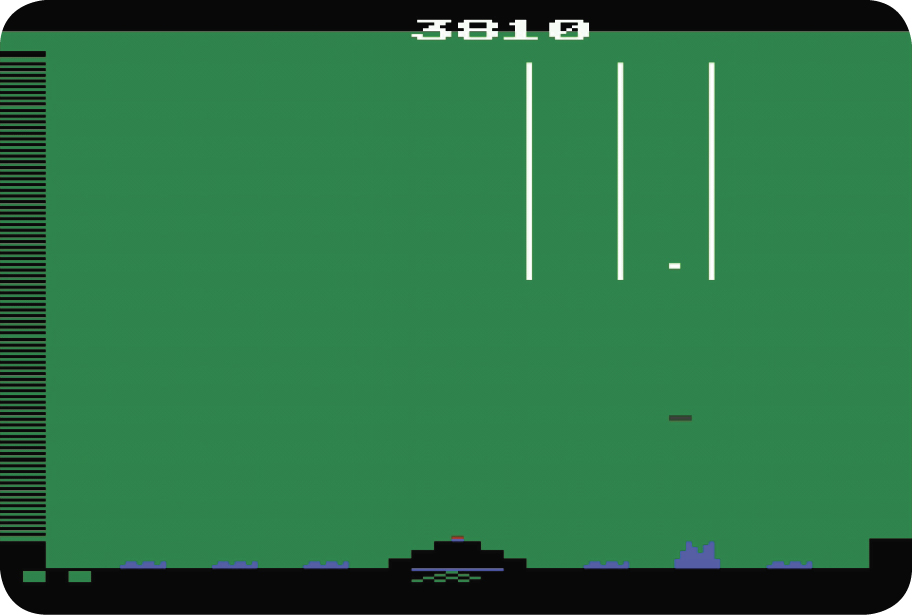
The enemy attacks in waves that may vary in the number of incoming missiles. Each consecutive wave moves faster. The faster the wave, the more difficult it is to defend the cities and the more points an incoming missile is worth.
There are 30 ABMs available during each wave. Your launching missile base, which appears in the center of the playfield, holds 10 ABMs at a time. As each set of 10 ABMs is exhausted, you automatically receive 10 more from an underground missile dump. After launching 30 ABMs, you are defenseless until the next wave begins.
If an incoming missile hits the center of your missile base, it destroys any remaining ABMs in the base. However, any ABMs in the underground dump remain unaffected.
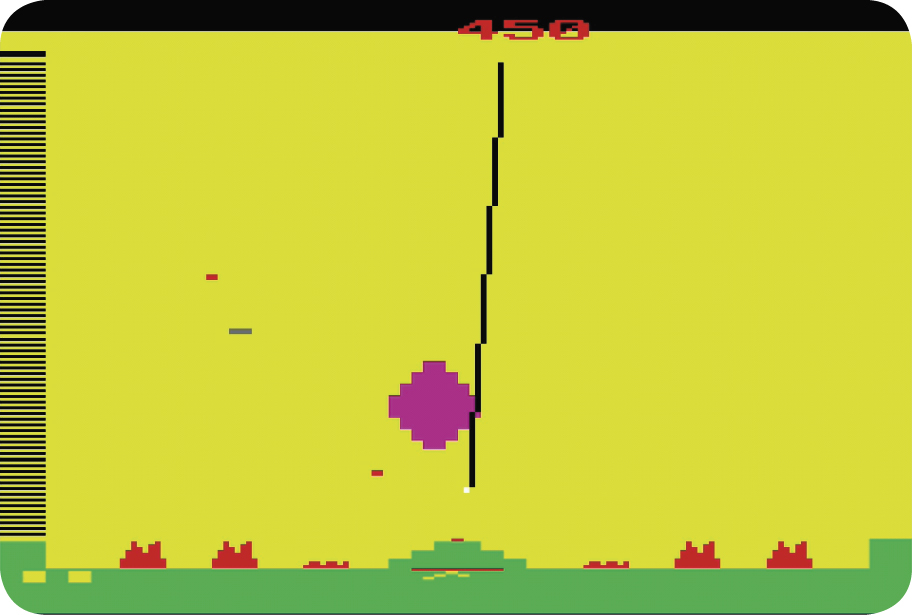
The joystick controls the blinking cursor that acts as your target control. Press the red controller button to launch an ABM at the point where the cursor is located when the button is pressed.
Your ABMs are not direct-fire weapons. Instead, they fly to the target location and then explode and destroy anything caught inside the explosion. ABM explosions build gradually, so aim ahead of the path of incoming missiles. The explosion must make contact with the tip of an enemy’s missile to destroy it. Smart missiles actively avoid explosions and may require multiple ABMs to eliminate them.
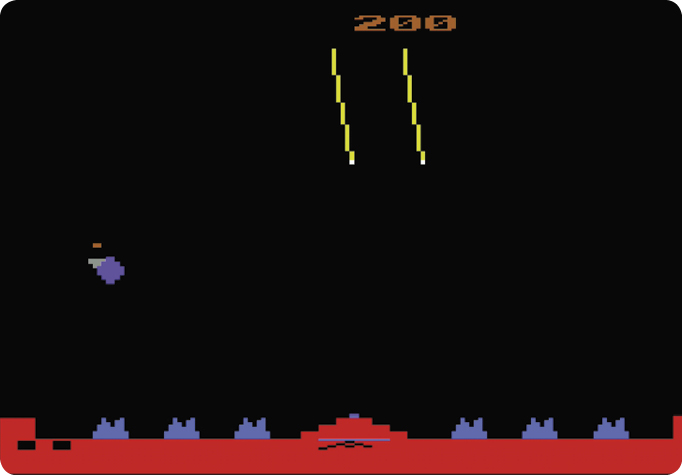
You score points by destroying ballistic missiles and cruise missiles. Unused ABMs and saved cities are tallied at the end of each wave. Between each consecutive wave, the cities fall and rise again when the next wave starts.
A bonus city is awarded every 10,000 points. If your score reaches the next 10,000 point value at the end of a wave and all six of your cities were destroyed during the wave, you will receive a bonus city. Bonus cities are saved if none of your cities are destroyed.
Difficulty Options
The B setting is for normal game play, while the A setting is for skilled players. When the difficulty button is in the A position, your ABMs move at a slower pace, making it more difficult to defend your cities and missile base.
Game Options
|
Initial Wave |
1-Player Game # |
2-Player Game # |
Features |
|
1 |
1 |
18 |
FT & DM |
|
2 |
19 |
SL & DM |
|
|
3 |
20 |
FT & SM |
|
|
4 |
21 |
SL & SM |
|
|
7 |
5 |
22 |
FT & DM |
|
6 |
23 |
SL & DM |
|
|
7 |
24 |
FT & SM |
|
|
8 |
25 |
SL & SM |
|
|
11 |
9 |
26 |
FT & DM |
|
10 |
27 |
SL & DM |
|
|
11 |
28 |
FT & SM |
|
|
12 |
29 |
SL & SM |
|
|
15 |
13 |
30 |
FT & DM |
|
14 |
31 |
SL & DM |
|
|
15 |
32 |
FT & SM |
|
|
16 |
33 |
SL & SM |
|
|
N/A |
17 |
34 |
CHILDREN |
Features
Missile Command allows skilled players to skip slower waves. Use the Initial Wave column to choose the missiles’ speed at the start of the game. Other features change the speed of your target control and the behavior of cruise missiles.
Fast Target Control (FT)
Your target control moves quickly around the screen.
Slow Target Control (SL)
Your target control moves slowly around the screen.
Dumb Cruise Missile (DM)
Incoming cruise missiles travel in a straight line and won’t evade your ABMs.
Smart Cruise Missile (SM)
Incoming cruise missiles detect and evade your ABMs.
Children
Incoming attacks use dumb enemy cruise missiles, slow target control, and the enemy attacks at a slower rate with fewer missiles.
Scoring
|
Event |
Base point Value |
|
Destroy Ballistic Missile |
25 |
|
Destroy Cruise Missile |
125 |
|
Unused Anti-Ballistic Missiles |
5 |
|
Saved Cities |
100 |
Scoring Multiplier
|
Wave |
Multiplier |
|
1-2 |
1x |
|
3-4 |
2x |
|
5-6 |
3x |
|
7-8 |
4x |
|
9-10 |
5x |
|
11+ |
6X |