Prima Games eGuides
primagames.com Browse Redeem a code Help
Atari Flashback: The Essential Companion eGuide
Sign in My Guides

Sign in or create an account

We'll email you a link. No password needed, and if you don't have an account yet, the link makes one.

By creating an account or signing in, you agree to our Terms of Service and Privacy Policy.

Have a password?

Had an account on the old eGuides site, or a code from a printed guide? Help and troubleshooting

Sign in with a password

By signing in, you agree to our Terms of Service and Privacy Policy.

Check your email

A sign-in link is on its way. It works once and expires in 15 minutes. Open it and you're in, with an account if you didn't already have one.

Contents

  • Introduction
    • Atari 2600 History
    • AtGames Atari Flashback Series
  • 1977
    • Air-Sea Battle
    • Black Jack
    • Combat
    • Fun With Numbers
    • Indy 500
    • Pong
    • Star Ship
    • Street Racer
    • Surround
  • 1980
    • 3D Tic-Tac-Toe
    • Championship Soccer
    • Circus Atari
    • Dodge ‘Em
    • Golf
    • Steeplechase
    • Video Checkers
    • Video Pinball
  • 1979
    • Adventure
    • Backgammon
    • Bowling
    • Canyon Bomber
    • Human Cannonball
    • Miniature Golf
    • Sky Diver
    • Slot Machine
    • Video Chess
  • 1981-82
    • Asteroids
    • Missile Command
    • Stellar Track
    • SUPER Breakout
    • WARLORDS
    • Centipede
    • Demons to Diamonds
    • Haunted House
    • Realsports Baseball
    • RealSports Volleyball
    • Submarine Commander
    • Swordquest:
    • SwordQuest: Earthworld
    • Swordquest: Fireworld
    • Swordquest: Waterworld
    • SwordQuest Solutions
    • Yars’ Revenge
  • 1983-87
    • Gravitar
    • RealSports Soccer
    • Crystal Castles
    • Millipede
    • Solaris
    • Desert Falcon
  • 1978
    • Basketball
    • Breakout
    • Flag Capture
    • Football
    • Hangman
    • Home Run
    • Maze Craze
    • Night Driver
    • Outlaw
    • Slot Racers
    • Space War
  • 1988-90
    • Sprint Master
    • Super Baseball
    • Super Football
    • Double Dunk
    • Off the Wall
    • Radar Lock
    • Secret Quest
    • Fatal Run
    • MotoRodeo

Atari Flashback: The Essential Companion Guide › 1978

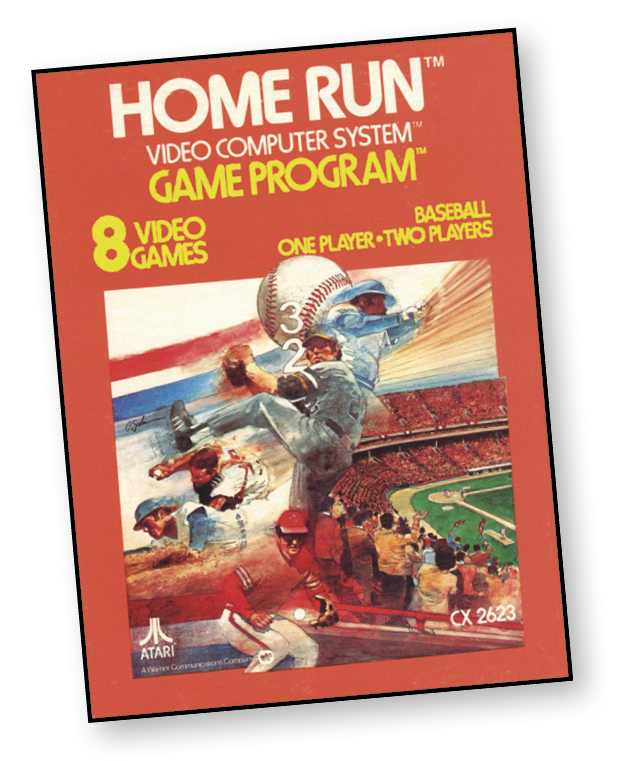
Home Run

Play a scaled-back, fast-paced version of baseball, America’s pastime.

About the Game
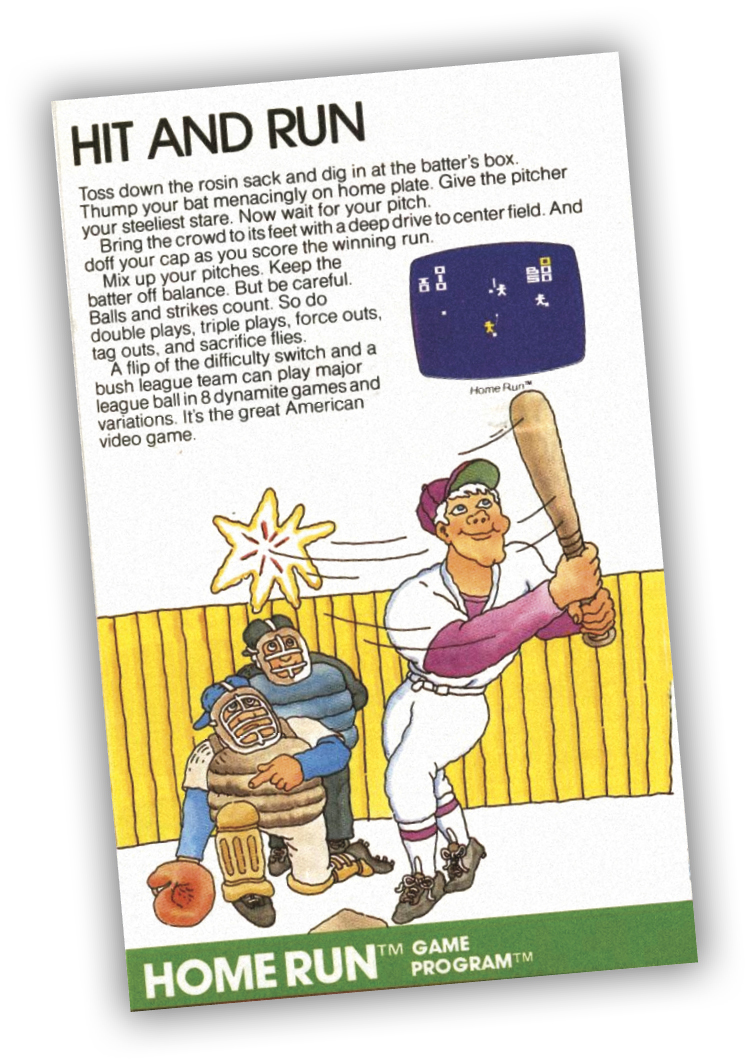
Like many of the early Atari sports games, Home Run more closely resembled neighborhood games played with friends compared to organized games with nine players per side. That resemblance made Home Run a comforting game to play on relaxing summer days.

It can be argued that Home Run most resembled the always-popular wiffle ball, with pitches dancing in every direction at variable speeds. Just like wiffle ball, the primary action involves the pitcher trying to prevent the batter from making any contact with the ball.

Once you adjust to the speed of the fielders and the responsiveness of the joystick (expect to overrun everything when you start out), Home Run games tend to become low-scoring affairs with one team being shut out or kept to a single run. This is why Home Run is such an exciting game to play. One solid hit could mean the difference between winning and losing. As long as you have one out in your last at bat, you still have a chance to get that one hit.

Object of the Game

Score more runs than your opponent.

How to Play

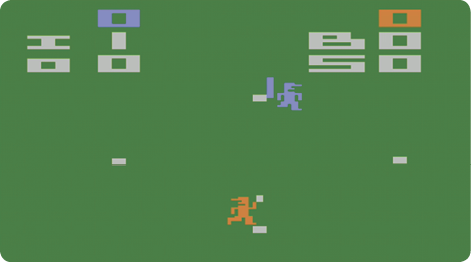
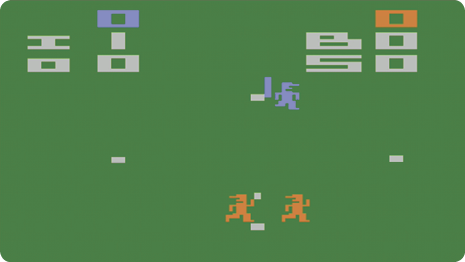
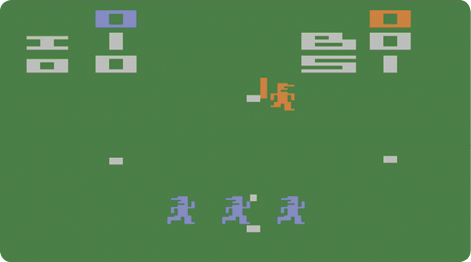
The left (blue) player is the visiting team and first to bat. In one-player games, the computer controls the blue team. The right team (red) is the home team and bats second.

The pitcher puts the ball into play after you press the red button. You control the speed (up for fast, down for slow) and direction (left and right) of the ball with the joystick.
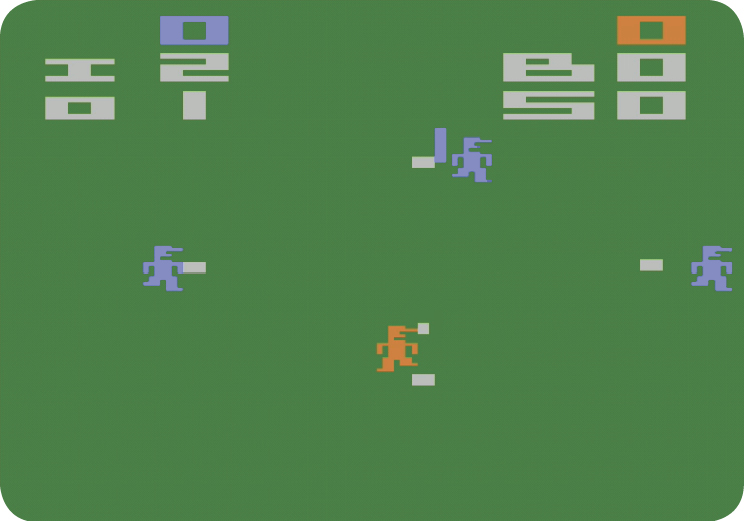
Three strikes (either swinging or pitched) result in an out. Four balls (any pitch not struck and not thrown over the plate) result in a walk, where the batter advances to first base. A pitch that hits the batter also advances the batter to first base.
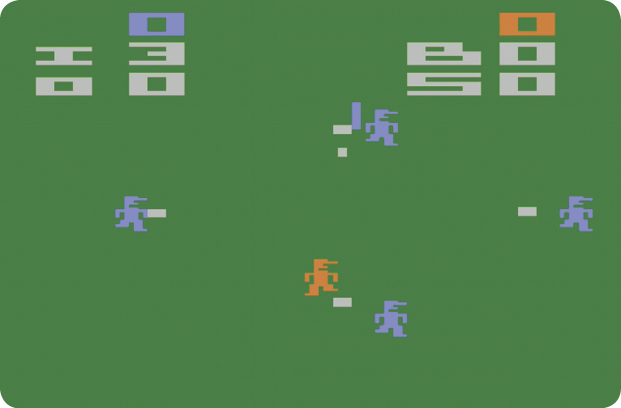
When the batter hits the ball, you take control of the outfielder(s). Balls that are hit in fair territory must be run down. A ball that goes into foul territory counts as a strike and the batter returns to home plate. Each hit ball is considered a grounder, which means you must tag out base runners. You can either run into the batter, or run to the bag if a force play is in effect.

When you’re up to bat, move the joystick from the neutral (center) position to any other position to swing. Running between bases is automatic. You must press the red button before reaching a base to stop the runner at that base. After three outs, the teams switch between fielding and batting. One inning consists of each team taking a turn at bat. Nine innings constitutes a complete game.

Each base runner who crosses home plate scores a run, as long as it happens before the third out of an inning. To hit a home run, the ball must cross directly over second base and reach the edge of the screen.

Difficulty Options

The difficulty buttons control the speed of the outfielders and batted balls. In the A position, the outfielders and batted balls will move more slowly than in the B position.

Game Options

1-Player Game #

2-Player Game #

# of Fielders

1

5

1

2

6

2

3

7

3 (tight)

4

8

3 (wide)

Games 1 & 5
Games 2 & 6
Games 3 & 7
Games 4 & 8

Features

In games with more than one fielder, only the fielder who scoops up the ball remains on-screen. The other fielders vanish instantly.

The Tele-Games version of Home Run was simply named Baseball.

Home Run was one of the first sports-themed games for the Atari 2600 in which the player determined how many players were on the field. Basketball, Football, and Championship Soccer used fixed numbers of players and always fewer than the game they emulated.

  • Fielders are much faster than base runners. You have plenty of time to scoop up the ball and make an out. It’s also possible to turn double plays, in which two outs are recorded on one play.
  • A ball that reaches the edge of the screen (but doesn’t cross over second base) ends the play. All runners stop at the next base they reach.
  • Try to hit the ball down the third base line, which pulls defensive players away from your runner heading to first. When a runner advances to second, hit the ball down the first base line to protect the lead runner.
  • Runners continue to advance until the ball is caught, even if the fielders are inches from the ball. You must press the red button before the runners reach the next base to make them stop. There’s no way to return to the previous base!
  • When playing defense, use a softly hit ball to your advantage. Let the runner try to advance a base, then pick up the ball and go for the out.
  • The computer tends to focus on getting outs at second base. It concedes most of the others, unless there’s an easy play. Once you get a runner on first, getting to second is another story. If you can move a runner to third with less than one out, though, there’s a good chance to score that runner.

What The Critics Had to Say

“Home Run can turn you into a regular Sandy Koufax, complete with singing curve, blazing fastball, and deceptive change-up. You can even hurl an authentic screwball if the spirit moves you.”

Arcade Alley, Video Magazine (Summer 1979)

“Although even the most complex of the variations only puts three men on each team, the cartridge can still be enjoyed within its limitations.”

- Electronic Games (July 1982)

Keep reading with a free account

The first 3 sections of Atari Flashback: The Essential Companion are open to everyone. An account opens the rest of it, and every other guide in the archive. It's free, and there's nothing to buy.

Bought guides on the old Prima Games site? Your account and every guide you own moved here, so there's nothing to buy again. Sign in.

Create a free account Or browse our free guides

PreviousHangman NextMaze Craze