
Atari Flashback: The Essential Companion Guide 1981-82
Demons to Diamonds
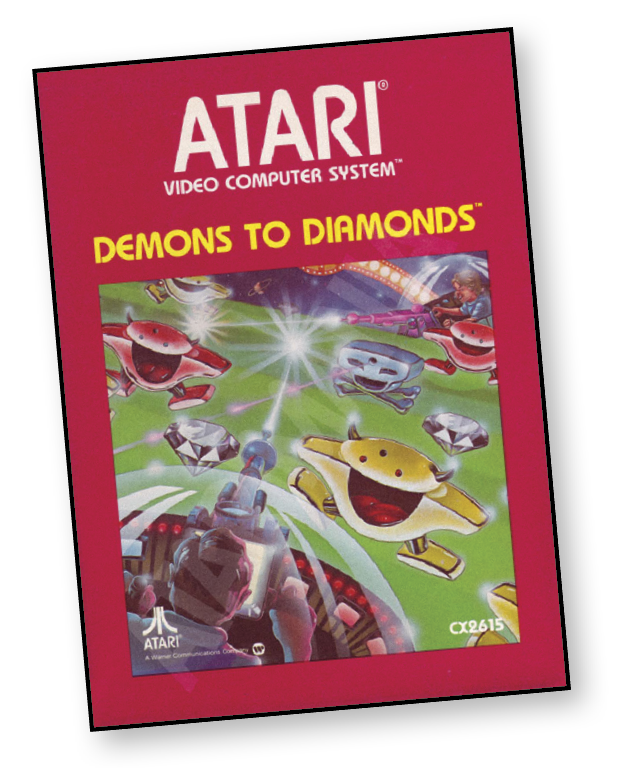
You and your best friend are spending a super Saturday at the Cosmic Carnival. So far, you’ve done all the usual things. Now you’re restlessly looking around for a new thrill—something exciting and different, some competitive skill sport. Suddenly, you hear a taunting voice coming from the vicinity of Target Skill Gallery.
“Whoa, let’s see what that’s about!”, you say as you make a sharp left and jog off in the direction of the high-pitched speech.
The non-stop voice belongs to a squat, two-foot tall demon parading back and forth in front of a huge, vertical, shooting range.
“Hey, you!” squeaks the demon, pointing directly at you. “Would you like to command a laser base? Like to hit targets and score points? Are you looking for fun, excitement—a game in which you must dodge danger? We are the demons and we dare you to try your laser-sharpshooting skills on us! We’re full of surprises. We sidestep all over the shooting range. We yak at you until you shut us up. We change into new target forms—precious diamonds or deadly skulls. Hit a diamond and you’ll score a small fortune in bonus points. But beware of skulls!”
“So, come on, reach for your laser, exercise your trigger finger on us. Put us through our paces and we’ll dazzle you with demonic tricks!”
About the Game
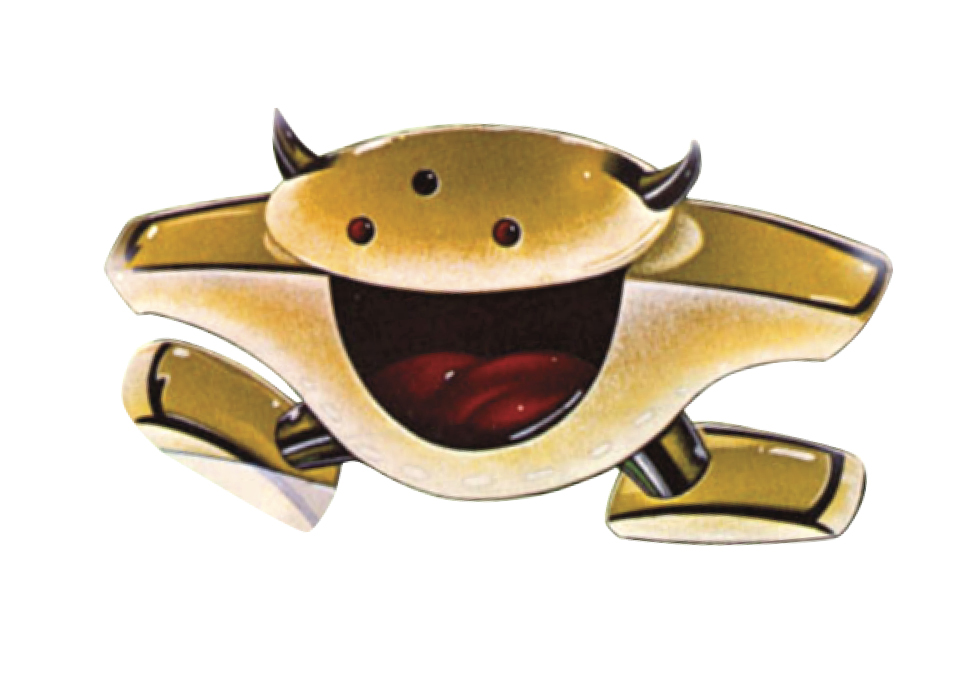
Demons to Diamonds utilizes core concepts from previously popular shooter games. Atari attempted to offset the similarities to the games Demons to Diamonds borrowed from with the introduction of new gameplay elements, such as updated animations and graphics from artist Alan Murphy, enemy movement in multiple directions at once, and the added challenge of a competing second player on the opposite side of the screen. Players not only had to shoot the enemy demons, but also avoid hitting the opposing player’s targets.
Even with the advanced graphics, animations, and new gameplay elements, Demons to Diamonds released to mediocre reception.
Object of the Game
The objective in Demons to Diamonds is to score as many points as possible while losing as few lives as possible.
How to Play
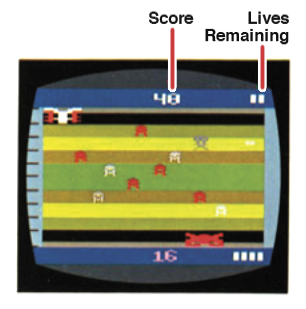
You start the game with five lives; four of which are displayed on your side of the screen in the far-right corner. The lives resemble white rectangles, as shown here.
Use the joystick to move your laser back and forth across the top or bottom of the playfield. Press the red controller button to fire at demons. The longer you press the red button, the further the laser will extend up or down the screen. The laser disappears when it hits a demon, a skull, or any other object on-screen.
Hit demons that are the same color as your laser base to score points. Demons first appear in the middle two rows. When you hit a demon of your color, it eventually changes into a pulsating diamond.
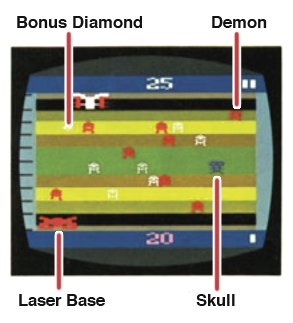
If you (or your opponent) can hit this diamond before it disappears, the one who hits it scores bonus points. When you hit a demon of your opponent’s color, it transforms into a skull that shoots in both directions. Watch out for these skulls! You lose a life each time you are struck by a skull’s bullet. In some game variations, you also lose a life when your opponent shoots your laser base.
Skulls disappear after a short period of time. The image here shows a typical Demons to Diamonds game playfield with demons, skulls, and bonus diamonds.
Demons move back and forth across the screen, changing color when they bump into either side of the wall. After hitting a wall, they may move up or down the screen into new rows. Each time you shoot all the demons on-screen, a new wave of the little devils appear.
The screen flashes briefly to signal the end of one wave and the start of the next. At first, the demons move slowly and the skulls are stationary. As the game progresses, though, the demons pick up speed and the skulls move around.
In single-player games, skulls spontaneously appear in the first wave. At first the skulls don’t move, but by wave three they move up and down the screen, making it difficult to dodge their deadly fire. In two-player games, the skulls appear in wave five and move during wave seven.
When a skull’s bullet hits you, you will know. An echoing sound plays and everything on-screen momentarily stops.
In two-player games, you score bonus points for lives that remain after your opponent loses all his lives. A high, bell-like sound chimes for each remaining life as your bonus points are added.
Difficulty Options
Difficulty buttons control the speed of the skulls’ bullets in all games. In the A position, the bullets fire almost twice as fast as in the B position.
Use the left difficulty button for one-player games. For two-player games, the bottom player uses the left difficulty button and the top player uses the right difficulty button.
Game Options
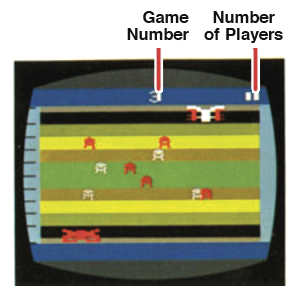
Use the game select button to choose the game variation you want to play. The game number appears at the top-center of the screen, while the number of players for that game appears at the top-right as shown in the screenshot to the left.
There are six game numbers in total.
|
Game # |
# Players |
Features |
|
1 |
1 |
FB |
|
2 |
2 |
FB |
|
3 |
2 |
FB & AT |
|
4 |
1 |
SB |
|
5 |
2 |
SB |
|
6 |
2 |
SB & AT |
Features
Fast Bullets (FB)
Skulls fire bullets that travel at normal speed, shoot often, and move quickly up and down the screen.
Slow Bullets (SB)
Skulls fire bullets that travel slower, don’t shoot as often, and take longer to move up and down the screen.
Attack Opponent (AT)
Your attacks can destroy your opponent’s laser base.
Scoring
Demons
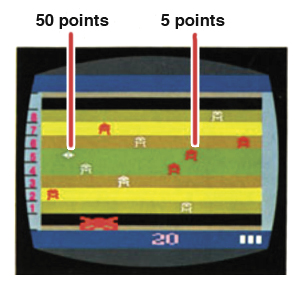
Every time you hit a demon of your own color, you receive from 1 to 8 points, depending upon which row the demon occupies. For example, a demon in the row nearest your laser base is worth 1 point, while a demon in the third row from your laser is worth 3 points.
Diamonds
Each pulsating diamond is worth 10 to 80 points, or 10 times the value of the row it occupies.
Bonus Lives
Any remaining lives after an opponent loses all five of his lives are credited to your score. The value of a bonus life increases with each wave, as shown in the following table.
|
Wave Number |
1 |
2 |
3 |
4 |
5 |
6 |
7 |
8 |
|
Points Per Life Left |
10 |
20 |
30 |
50 |
100 |
150 |
200 |
250 |
|
Wave Number |
9 |
10 |
11 |
12 |
13 |
14 |
15 |
16 |
|
Points Per Life Left |
300 |
350 |
400 |
500 |
750 |
1000 |
1500 |
2000 |