
Atari Flashback: The Essential Companion Guide 1979
Backgammon

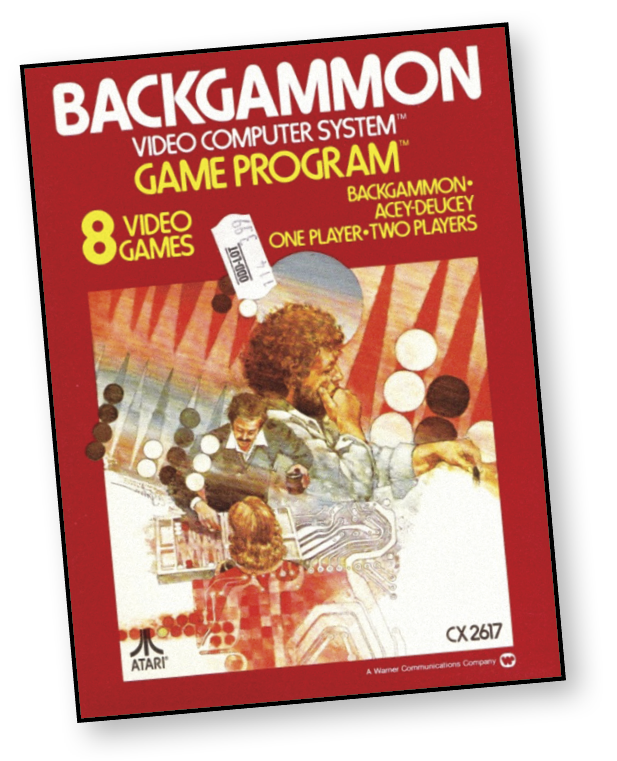
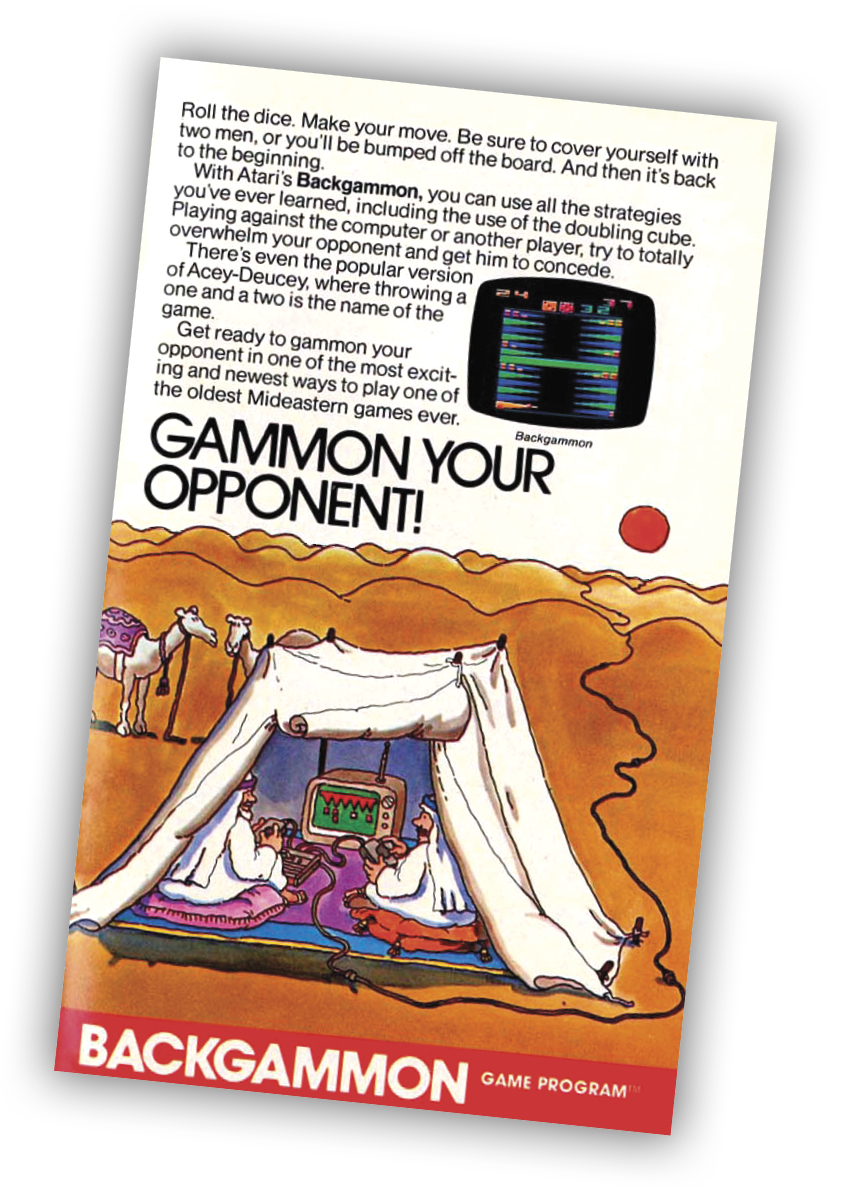
Backgammon, in some version, has been played in various parts of the world for over 5,000 years. It is possibly the oldest war game still being played. It is suggested in early writings that the game was originally designed to train soldiers for combat, as backgammon has all the intricacies of any war game: strategy, position, and timing. It is both a game of skill and luck, which probably accounts for its longevity.
The most ancient possible ancestor to be found so far dates back to the ancient civilization of Sumer. The Egyptian Pharaohs played a similar game. Game boards were found during the excavations of King Tut’s tomb that’s akin to backgammon. The ancient Greeks and Romans played different forms of the game that were mentioned in many of their writings. A form of backgammon was played in the Middle East during the Crusades. In fact, it is believed that the Crusaders brought the game back to Britain with them, where it flourished in the eighth and ninth centuries.
The earliest written mention of the name “backgammon” was made in 1645 in a description of a game that very much resembles backgammon as it is played today. The rules of today’s game were set down by Edmond Hoyle in 1743.
The object of all the variations of the game, from its beginnings to now, is to move your game pieces around the board and bear them off before your opponent does the same.
About the Game
Although hardly a best seller, Craig Nelson’s Backgammon is arguably the best overall board game implementation on the Atari 2600. The game’s color graphics, responsiveness, and feature-set are standouts in comparison to the usual chess and checkers games.
Object of the Game
To win, remove all of your pieces from the board before your opponent.
How to Play
Cycle through the Backgammon Game Program variations by pressing Select. For normal play, the left and right difficulty buttons must be in the A position. To begin play, press Reset.
The Board
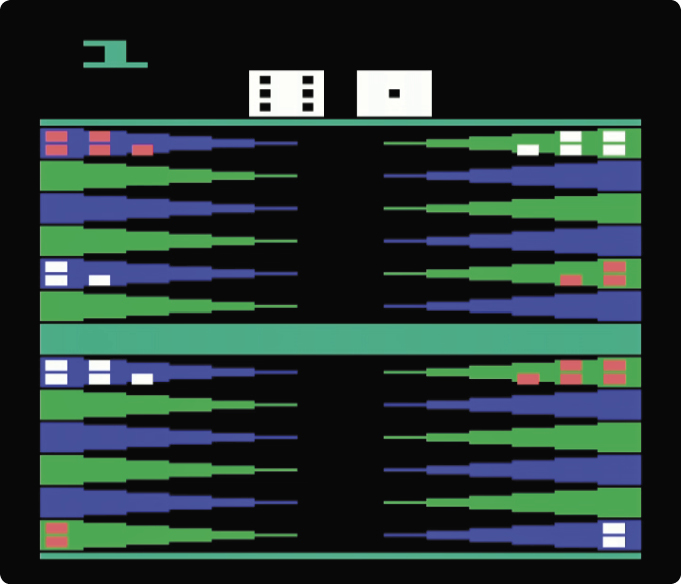
The backgammon “board” is divided into two halves or tables. The divider is called the bar. The inner table is the portion at the bottom of the playfield, while the outer table is the portion at the top of the playfield.
Each table is also divided into halves. The red player’s home (or inner) table is on the lower-right side of the playfield; the white player’s home (or inner) table is on the lower-left side of the playfield. The red player’s outer table is on the upper-right side of the playfield; the white player’s outer table is on the upper-left side of the playing field.
Each player’s inner and outer table has six “points.” The point is the area on which you rest your pieces as you move around the board. Each point is numbered for reference starting in each player’s inner table. The white side is numbered 1 to 12 starting at the bottom-right side of the board.
The Moves
The moves are governed by “casting the dice.” At the start, the players each cast one die (done automatically by the computer). The player with the highest number begins first, using the number count on both dice. On the playfield, the die on the left represents the white player, while the die on the right represents the red player for the beginning roll. The color of the dice corresponds to which player won the roll and will begin the game. After the initial move, each player rolls and moves alternately.
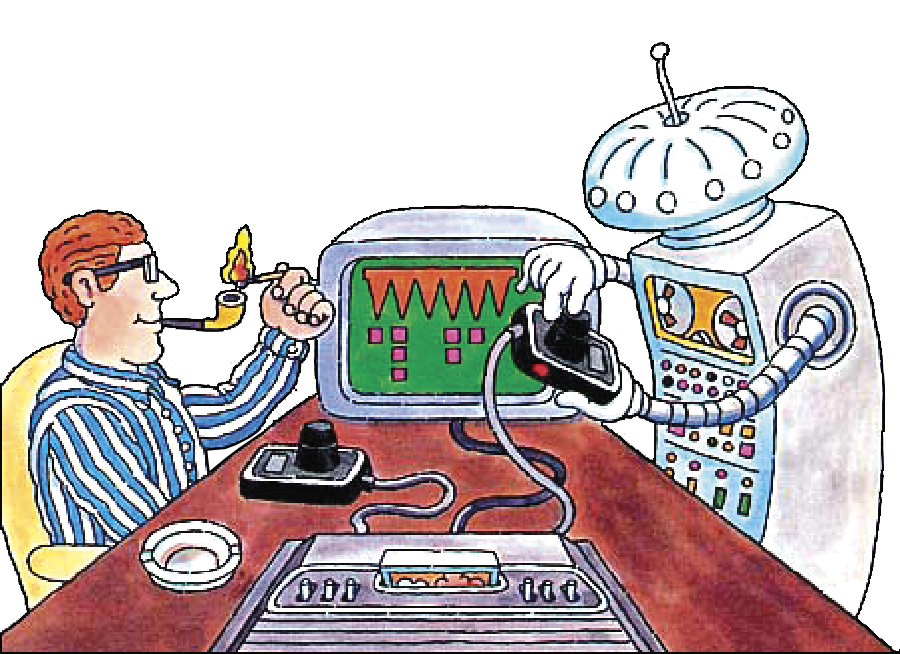
When the right difficulty button is in the A position, the computer will roll the dice. When the button is in the B position, you can use your own dice and then “dial in” the numbers to the computer. Turn the controller knob and the number on the left die changes. When you see the number you want to enter, push the red controller button. Next, dial in the second number on the right die and push the red controller button. The computer will accept the roll and your moves may be made accordingly.
In one-player games, the computer will play red. The white player must move his or her pieces counterclockwise around the board, casting off or bearing off (removing the pieces from the board) from the inner table. The red player must move his or her pieces clockwise around the board, bearing off from the red player’s inner table.
The pieces are moved across the points according to the numbers on the dice. Each die must be considered individually, but they can be applied to one piece or two pieces. For example, a roll of 5-3 would allow a player to move one piece five points and another piece three points.
When there is only one piece occupying a point, it is called a “blot.” A point with no pieces or a blot is referred to as “open.” A point with two or more pieces is referred to as “closed.”
If a point is closed, an opposing piece cannot move to that point. However, a player may move past a closed point if there is sufficient count on the dice. If a player has rolled a 5-3 and the five-count point is closed, moving five points and then three points is not allowed. However, moving three points and then five points is permissible.
If you close six consecutive points anywhere on the board, you establish a “prime.” Your opponent cannot move past the prime until you break it by moving pieces and creating an open point. The explanation contained in the following section explains why it is a good strategy to build a prime on your inner table.
The Bar
If a player lands on a blot belonging to the opponent, the opponent’s blot is “hit,” meaning the piece that occupied that point is removed to the “bar.” When a piece gets hit and placed on the bar, it must reenter the board on the opponent’s inner table. The white player enters on the lower-right inner table and the red player enters on the lower-left inner table.
A piece must enter the board only on an open point whose number has been cast on the one die. If there is an opposing blot on an entry point, the piece entering hits it and it is subsequently removed to the bar. The sum of the dice cannot be used to enter a piece.
Until all pieces on the bar have been entered, a player cannot move any other pieces on the board. If a roll does not permit entry, the turn passes. Pieces may not enter on closed points.
If a roll does not permit entry, and there are no other pieces on the bar, the remainder of the roll may be used to move other pieces on the board.
A player is said to be “shutout” if all six entry points are occupied, which is why it is a good strategy to build a prime on your inner table.
Then, if you hit one of your opponent’s blots, the piece cannot be entered from the bar until the prime is broken. This allows time to move pieces onto your inner table and begin bearing them off while your opponent’s remains stuck on the bar.
Doublets
Doublets occur when you roll double numbers (3-3, for example.) When this occurs, a player must move the number shown on one die four times. You can move one piece all four moves, or any other combination of pieces that you choose. If you cannot use all combinations, the dice is passed to your opponent.
Bearing Off
As soon as a player has all 15 pieces on the inner table, bearing off begins. This is the object of the game. Once borne off the board, a piece never returns to play. The first player to bear off all pieces is the winner.
A piece may be borne off when the number of points remaining is the same as the number on the dice. For example, a roll of 5-3 will bear off a piece from the five-point and the three-point. If the roll is higher than any occupied points, pieces may be borne off from the highest occupied point. If a player has two pieces each on the three and two-points and a 5-3 is made, both pieces from the three-point may be borne off.
A player can use all or part of the roll to move pieces within the inner table instead of bearing them off.
With a roll of 1-2, a player can move a piece from the five-point to the three-point and a piece from the two-point to the one-point. Doublets can also be used in this manner.
If your opponent has pieces on your inner table or the bar and you have begun bearing off, it is to your advantage to leave as few blots as possible. Remember that if you have both the same counts on the dice, it does not matter in which order they are taken.
In this example, you have a blot on your five-point and you roll a 5-1. If you bear off from the five-point with the higher number, you will still be leaving blots on the three-point and the four-point since you must use both numbers of the roll (which means your second move will move a piece from the four-point to the three-point). Instead, your best move is to take the piece from the five-point for the 1-count (putting it on the four-point with your other two pieces) and then bear off using the higher number. This way, you haven’t left any blots on your inner table. The point again is that you can play the dice in either order, according to you best moves.
Doubling Cube
Backgammon has enjoyed various degrees of success throughout its history. The game was in a decline in the United States during the early 1900s until the introduction of the “doubling cube” in 1920. Until this innovation, the outcome of a game could be decided in the first few rolls of the dice. Play would continue anyway, since with any dice game, there was always the chance of something unusual occurring. Unfortunately, most of the time, the games became boring.
Backgammon is one the few gambling games in which one can see what the opponent has at all times.
The doubling cube introduced the strategies of “bluffing” and psychological play that are similar to other gambling games. The game of chance is always present because of the use of dice. A skillful player can lose to a less skillful player because of the luck of the dice, but with the doubling cube added, the more skillful player likely won’t lose as much.
As a gambling game, backgammon is played for a base “stake,” which is agreed upon before beginning play. The doubling cube (represented by the number at the upper-left of the playfield) starts at 1. This means the players are competing for the original stake. Each time the stakes are doubled, this number changes (2, 4, 8, 16, 32, 64). Sixty-four times the original stake is the largest amount possible to wager.
After the player winning the first move has completed his or her turn, the computer will ask the opponent “YESdbl “ or “NOdbl.” By turning the controller knob to YESdbl and pushing the red controller button, the opponent has offered to double the stakes and the doubling cube will now show 2. The first player now has the option of accepting or not accepting the double.
To accept the double, turn the controller
knob to YESacc and the push the red controller button. The dice then rolls for your opponent’s turn. To reject the double, turn the controller knob to NOacc and push the red controller button. The game will end at that point. To start a new game, Reset.
When you offer to double the stakes and your opponent accepts the double, he or she then “owns” the doubling cube. It will be up to your opponent to redouble at a time when it is advantageous to do so.
If your opponent offers to redouble the stakes and you accept, then you “own” the doubling cube and you can again offer to redouble when you think it is to your advantage. The player who “owns” the doubling cube is shown by the color of the number (representing the doubling cube) at the top of the playfield. If it is red, it belongs to the red player; if it is white, it belongs to the white player.
In one-player games, if the computer decides to offer a double, it asks only YESacc or NOacc. If you own the doubling cube and want to double the stakes against the computer, enter YESdbl when it appears on the screen. The computer will continue to play if it accepts the double, or quit if it refuses the double.
In both one-player and two-player games, if neither player doubles during the game, the doubling cube will remain green and a 1 will appear on-screen. In two-player games, the computer will continue to ask each player in turn if they want to offer a double.
Gammon and Backgammon
If a player has borne off all of his or her pieces and the opponent has not borne off any, the game is called a “gammon.” The opponent loses twice the stakes (times whatever is showing on the doubling cube).
If a player has borne off all of his or her pieces and the opponent still has pieces on the bar or in the player’s inner table, the game is called a “backgammon.”
The opponent loses three times the stakes (times whatever
is showing on the doubling cube). A backgammon among skilled players is rare. If it appears that you are going to be gammoned or backgammoned, it’s best to refuse your opponent’s double and retire from the game.
Set Up Mode
It has been mentioned that the left and right difficulty buttons must both be in the A position for normal gameplay. To create a “set up mode” (in which you pick up pieces one by one and place them in various positions around the board), change the left difficulty button to the B position.
Use the controller that corresponds to the color of the dice on-screen when operating in the set up mode. This mode allows you to work out specific problems or strategies. As in regular play, the computer will not allow opposing colors to occupy the same point when you are moving pieces around the board.
Change the left difficulty button back to the A position to start or continue normal gameplay. When the game returns to normal play, the pieces that correspond to the color and count showing on the dice must be moved before the computer rolls the dice again.
Illegal Move
Normally, the computer will not allow you to make an illegal move. There is a specific situation, however, in which the computer will illegally allow you to move a piece using the count on one die, even though there are no open points that correspond to the count remaining on the other die. When this situation occurs, the game goes into temporary state of suspension.
If an illegal move happens during a game, there are two possible solutions. One is to use the set up mode (left difficulty button in the B position), return the white pieces to their previous position, and execute the correct move. The other is to press Reset and start a new game.
Acey Deucey
This variation was developed by members of the US Navy. It is similar to some of the game versions played in the Mediterranean area, which suggests that it started in that region. The rules for Acey Deucey may vary from ship to ship and even from player to player. They are not standardized, as are the rules for backgammon.
In the Atari version, all the pieces start out on the bar and can be entered at any time with the roll of the dice. A piece need not be entered from the bar before another piece can be moved, even if that piece was hit and sent to the bar.
The other rules of backgammon apply in terms of moving the pieces around the board (open and closed points, hitting a blot, bearing off, and using the doubling cube). A roll of 1-2 (acey deucey) allows a player to choose the most advantageous doublets after making the 1-2 move. After moving the doublets, the player is further rewarded with another roll of the dice.
After rolling the acey deucey, turn the controller knob, “dial in” the number on the left die, then push the red controller button.
The die on the right will change to match the number on the left die. Push the red controller button again and play your doublets. After the last move on your doublet, the computer will roll the dice again for you and you can make another move.
If, after moving your doublet, you roll another acey deucey, you can again move the 1-2 and choose another doublet. The left difficulty button should be in the A position when playing acey deucey.
Game Options
Use Select to choose the game you want to play. There are eight game numbers in total. After selecting the game number, press Reset to start the game. Reset can also be used to reset a game at any time.
|
Game Type |
Game # |
# Players |
Features |
|
Backgammon |
1 |
1 |
2X |
|
2 |
2 |
2X |
|
|
3 |
1 |
||
|
4 |
2 |
||
|
Acey Deucey |
5 |
1 |
2X |
|
6 |
2 |
2X |
|
|
7 |
1 |
||
|
8 |
2 |
Number of Players
In 2-player games, you and an opponent face off against each other. In 1-player games, the computer is your opponent.
Features
Backgammon and Acey Duecey share one common feature: the Doubling cube (2X). Not all games use the Doubling cube.