
Atari Flashback: The Essential Companion Guide 1981-82
Submarine Commander
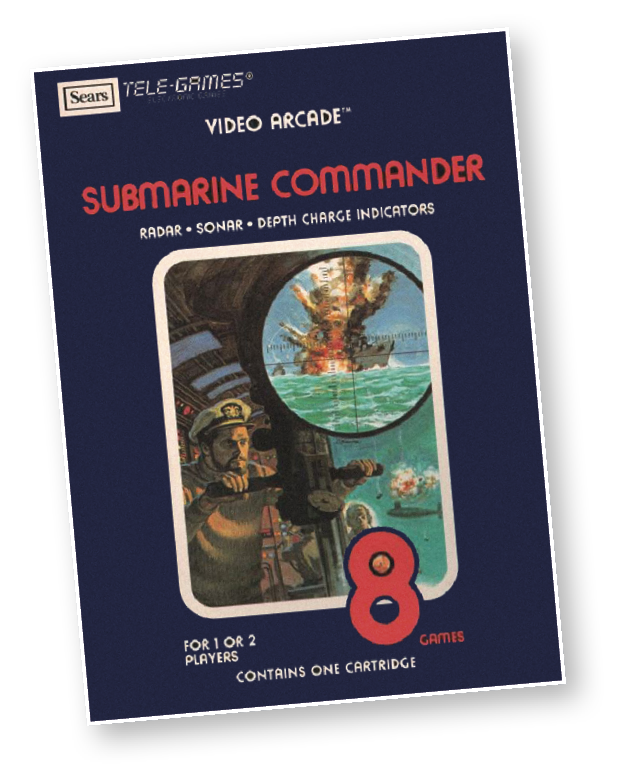
Just imagine that you are the captain of a ship, and it’s your job to protect your country. Your modern submarine is equipped with many new features to help you. The control panel includes a radar scope, a sonar depth charge detector, status indicators, a fuel readout, an engine temperature gauge, and of course, torpedoes.
Since you’re the commander, you are at the helm. It’s up to you to guide the submarine. You’ll use your periscope to scan the ocean and detect enemy vessels. When you spot the enemy, launch a torpedo. Destroy their ships before they destroy your submarine. Be on the lookout for dangerous depth charge attacks. A depth charge hit could mean serious damage to your submarine.
Your submarine is equipped with limited supplies, especially fuel. Keep a constant watch on your fuel and energy levels. Every maneuver costs you fuel. When the fuel runs out, your mission is over.
We know you can handle the job, so good luck, Commander!
About the Game
Released in 1982, programmer Matthew Hubbard’s Submarine Commander was the third and final Sears Tele-Games exclusive as part of Atari’s blockbuster contract with the retailer. Unfortunately for Submarine Commander’s sales fortunes, Sears shut down their publishing operations later that same year, limiting the game’s distribution. As such, it’s the hardest among the trio of exclusives for today’s collectors to find.
Submarine targeting simulations date all the way back to Sega’s 1966 electro-mechanical arcade game, Periscope. Perhaps the most popular of this sub-genre of games was Midway’s 1976 arcade game, Sea Wolf, and its 1978 sequel, Sea Wolf II. It’s the latter game that Submarine Commander draws the most inspiration from and what most other games of this type imitate.
Object of the Game
Your goal is to sink as many enemy ships as possible. In one-player games, try to beat your highest score. In two-player games, each player tries to beat the opponent’s score.
How to Play
As you sink ships, you score points. Some of the ships drop depth charges, which might damage your submarine.
Depth charges are indicated on the depth charge detector gauge. The gauge alerts you to the closeness and the seriousness of a depth charge. Because your sub is equipped with sonar detection, you can identify the location of enemy ships before they’re sighted through the periscope. This allows you to shoot a torpedo before the enemy drops a depth charge.
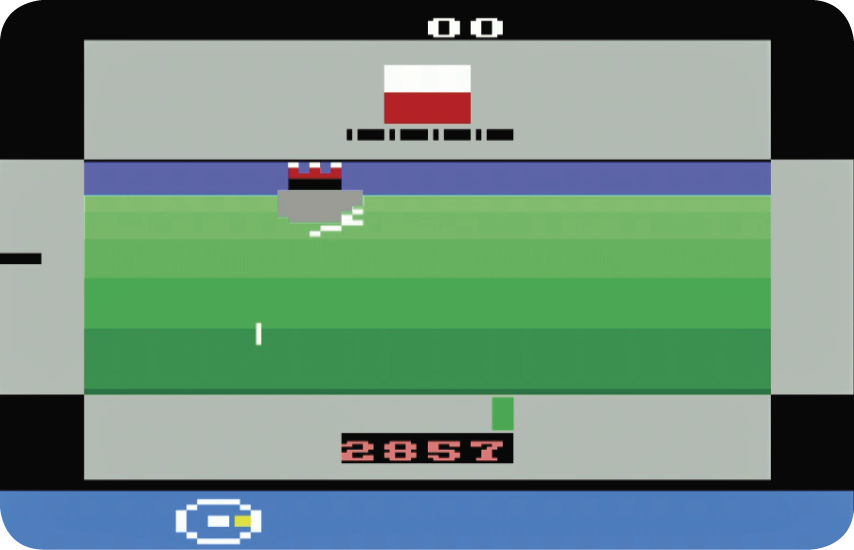
Your sub also carries 3,000 units of fuel and two torpedo launchers. The fuel level is proportional to the engine temperature. Watch the engine temperature gauge at the top center of the screen. The more maneuvers you make, the hotter the engine gets. Every torpedo launched uses three units of fuel, but every depth charge hit costs 300-377 units of fuel. Some fuel is also used to run the submarine engines. When all the fuel runs out, the temperature gauge turns black, and the game is over.
Use the joystick to view the sea and to move your submarine right and left. What you see on the screen is your view through a periscope. Moving the joystick up and down (forward and backward) allows you to see up close or far away to the horizon.
You can also use the joystick to maneuver the sub right and left. This helps you catch up to an enemy ship or move away from a dangerous depth charge. A broken black line, located just below the temperature gauge, indicates the direction in which your sub is moving. When you move the joystick right, the black lines move right, indicating that the sub is moving right. When you move the joystick left, the black lines move left, and your sub is moving left. When your sub is moving right or left, any torpedoes launched travel with a slight curve in the opposite direction.
To shoot a torpedo, press the red controller button. The torpedoes launch from the side where the torpedo status indicator is green. The torpedo launcher changes sides with every other launch. You will see the green light change sides each time you launch a torpedo.
Gauges
Each gauge on the control panel serves a specific function. With time and practice, you’ll be able to use all of the gauges to your best advantage.
Fuel Gauge
The fuel gauge at the bottom center of the screen starts with 3,000 units of fuel and counts backward until you run out.
Torpedo Status Gauge
Torpedo status gauges are located at the bottom of the screen, directly above the fuel gauge. The gauge is green when a torpedo is ready to launch. Press the red controller button, and a torpedo launches from the side with the green light. If a torpedo tube is damaged by a depth charge, it becomes black and doesn’t work for the rest of the game.
Engine Temperature Gauge
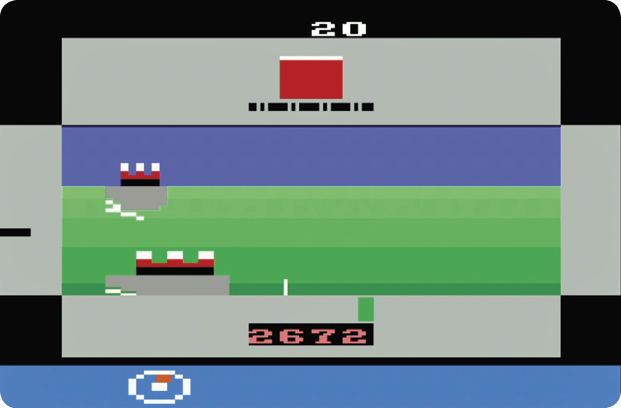
Engine temperature is indicated at the top center of the screen. As the engine gets hot, the gauge turns red. The hotter the engine, the more fuel it consumes. If the gauge turns yellow, the engine has been damaged and is running at half speed.
Directional Gauge
This is the broken black line located below the engine temperature gauge. When you move the sub right or left, the lines move right or left, as though you’re steering the submarine.
Sonar Detector
The sonar detector, located at the bottom-left side of the screen, identifies the location of an enemy ship before it’s visible on the screen. When this device turns red, it’s indicating the depth and the location of any enemy ship.
Depth Charge Detector
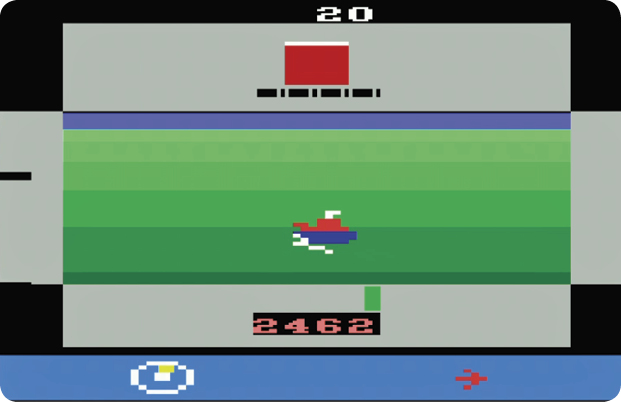
The depth charge detector is an arrow that appears at the lower-right corner of the screen. It points to where a depth charge is located in the water. If the arrow is white, the depth charge is not dangerously close and you can move your sub in the opposite direction to avoid a hit. If the arrow is red, look out! You’re about to be hit unless you quickly move away in the opposite direction.
Scoring
You score points when you sink a ship. There are three types of enemy ships in Submarine Commander, and each scores a different point value, as shown:
|
OBJECT |
POINT TOTAL |
|
Tanker |
20; two hits to go down |
|
Destroyer |
15; one hit to go down |
|
PT Boat |
35; one hit to go down |
If a ship is on the horizon, in which case it appears to be half its normal size, and you can see the blue sky in the background, the scoring is as follows:
|
OBJECT |
POINT TOTAL |
|
Tanker |
30 |
|
Destroyer |
25 |
|
PT Boat |
45 |
The game ends when the fuel level reaches zero. After a two-player game is over, the left player’s score appears at the top center of the screen; the right player’s score appears at the bottom center, where the fuel amount was indicated during gameplay.
Difficulty Options
Submarine Commander includes two skill levels: A for Expert and B for Novice. The Novice level is for the beginning player. The Expert level is more challenging because every time your sub is hit by a depth charge, you incur damage that could cause the loss of one of your gauges.
For one-player games, use the left difficulty button. For two-player games, the player using the left controller uses the left difficulty button; the player using the right controller uses the right difficulty button. The left player starts the game in two-player games.
Game Options
Submarine Commander features eight game variations. All odd-numbered games are for one player; all even numbers are two-player games.
Games 1 and 2 are the easiest. In these two variations, the enemy ships do not shoot depth charges. All you have to do is shoot torpedoes to sink the enemy ships before you run out of fuel.
In Games 3 and 4, only the destroyers attack with depth charges.
In Games 5 and 6, you have to avoid the depth charges of both destroyers and PT boats.
Games 7 and 8 are the toughest. You must dodge depth charges from destroyers, PT boats, and tankers.
|
Game # |
# Players |
Features |
|
1 |
1 |
DC0 |
|
2 |
2 |
DC0 |
|
3 |
1 |
DC1 |
|
4 |
2 |
DC1 |
|
5 |
1 |
DC2 |
|
6 |
2 |
DC2 |
|
7 |
1 |
DC3 |
|
8 |
2 |
DC3 |
Features
The number after DC indicates how many ships drop depth charges to attack your submarine. Only destroyers use depth charges in DC1 games. Destroyers and PT boats drop depth charges in games marked DC2. DC3 indicates that destroyers, PT boats, and tankers all use depth charges.