
Atari Flashback: The Essential Companion Guide 1981-82
Asteroids

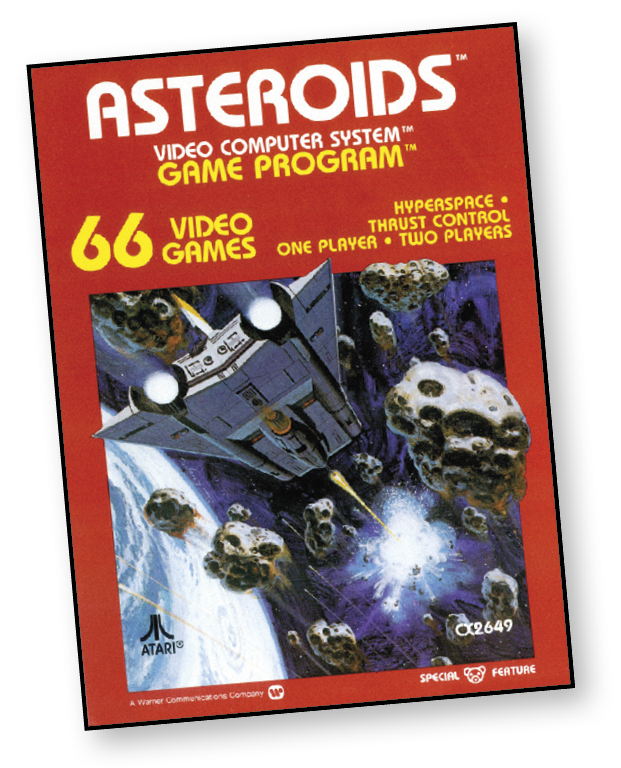
On a quiet serene evening, the Cosmic Space Patrol sets out for the usual night cruise through the boulevards of space. This beat was always the same; calm, no action, and no excitement. For some reason, this night feels different. Shortly before 0200 hours, some form of intergalactic material is sighted through the visual particle counter. The material is too large a mass to measure. It’s drifting closer. Look out, it’s a giant asteroid boulder and it’s headed straight for the Cosmic Spacecraft! The only chance for survival is to dodge the boulder or destroy it. Destroying it doesn’t mean just breaking it up, it means vaporizing it. Small asteroid boulders are equally as fatal as large ones.
Whew, the boulder just missed colliding with the Cosmic Spacecraft, but suddenly the Cosmic Space Patrol find themselves surrounded by thousands of the deadly asteroids! The Cosmic Space Patrol must act quickly to save their spacecraft and spare their lives. The spacecraft is equipped with photon torpedoes, hyperspace, shields, and flip control.
The Cosmic Space Patrol is highly trained to handle this situation. Could you do as good a job as the Cosmic Space Patrol? How would you protect yourself if you were caught in a deadly asteroid belt? This is your big chance to fly throughout the dimensions of space and fend against asteroid boulders. The longer you survive, the more space hazards you’ll encounter.
About the Game
After Asteroids took the arcade by storm, Atari began work on the home version. With advance orders as far back as a year before its release— complete with $5 deposits—Atari knew it was going to have a hit on its hands. The only catch was how they were going to deliver.
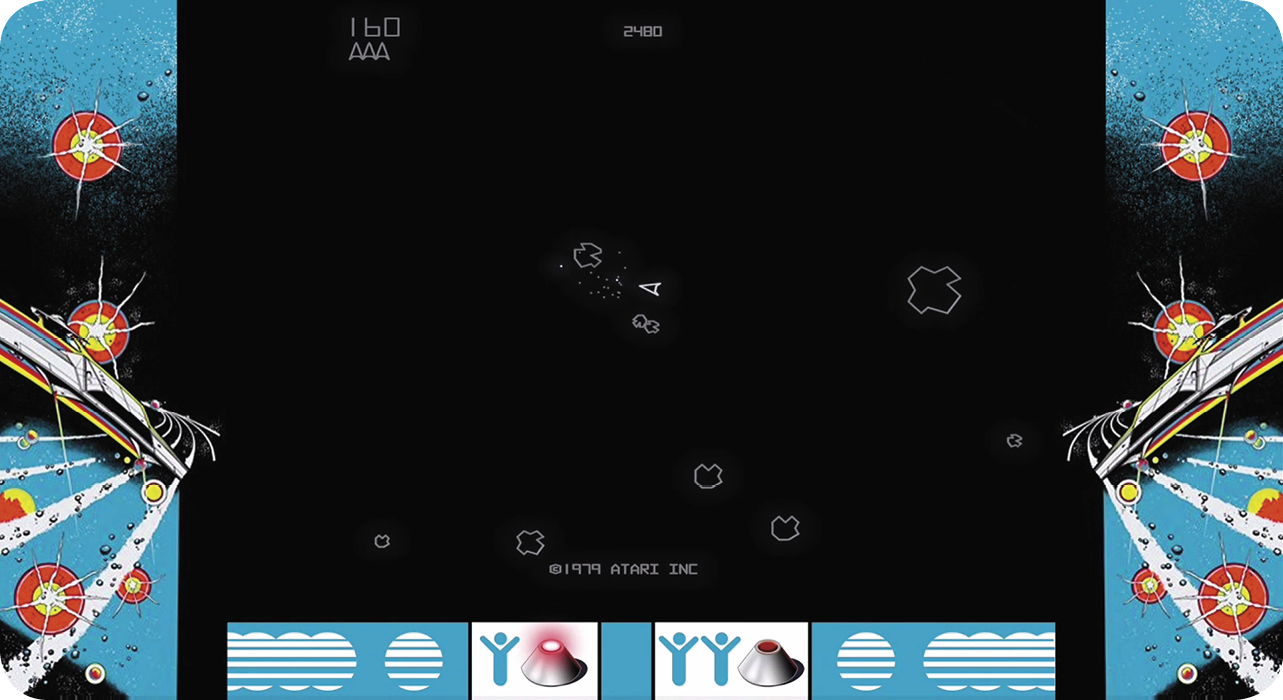
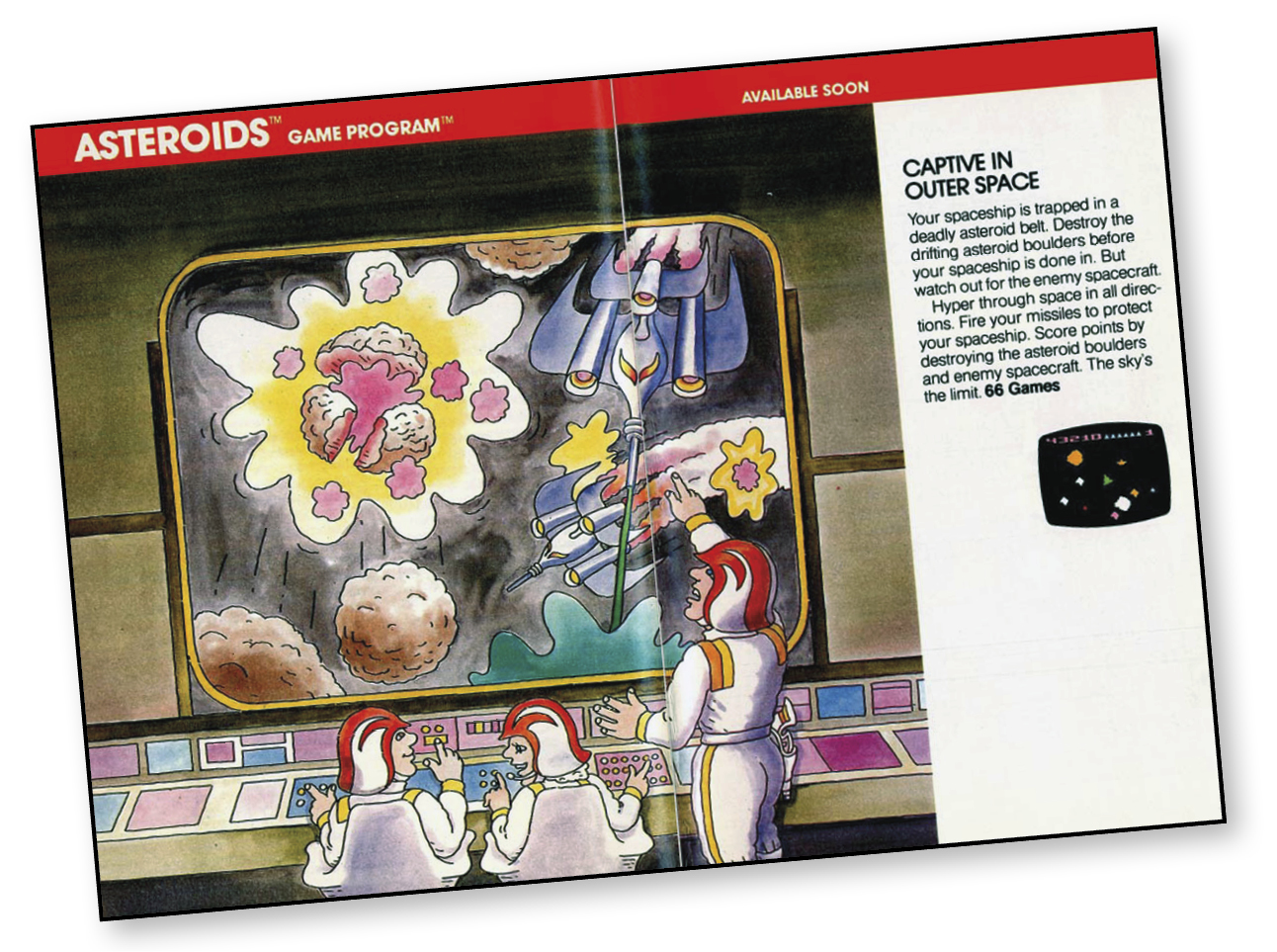
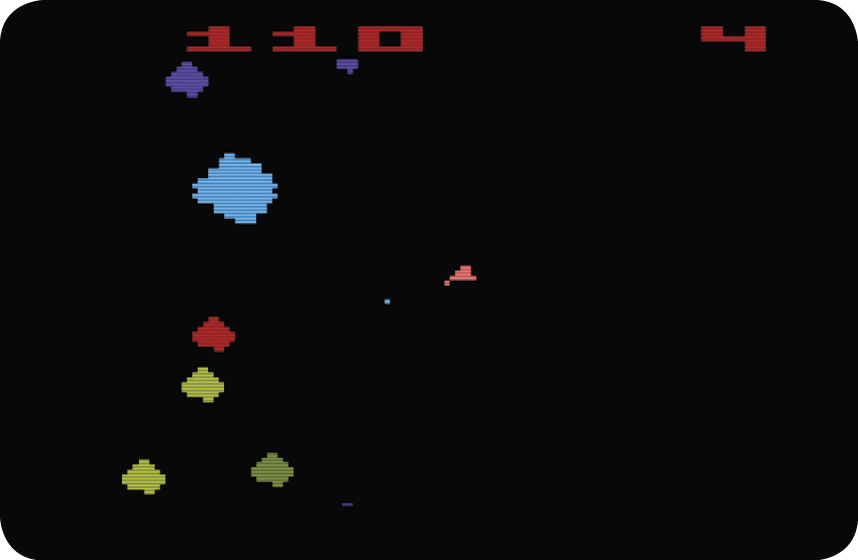
Atari previewed the Atari 2600 version at several trade shows in early 1981. Unfortunately, reaction was mixed at best. Despite the addition of color over the black-and-white vector-based coin-up, the graphics were considered overly blocky and the feel of the play not-quite-right. Heading back to the drawing board, Atari made the fateful decision to develop a bank-switching technique that allowed the 2600 to work with twice as much data as previously possible. This extra room did the trick for programmer Bradley G. Stewart.
With the extra memory, Asteroids was finally the game everyone expected it to be.
With gameplay that matched the arcade original, a plethora of game modes, and a colorful presentation that took advantage of the Atari 2600’s strengths, it’s no wonder that Asteroids would go on to become one of the platform’s best sellers. With 3.8 million copies sold on the Atari 2600, Asteroids ranks third after Pac-Man (7.7 million) and Pitfall! (4.5 million), beating out both Missile Command (2.76 million) and Space Invaders (2.5 million) in the top five.
Object of the Game
The object of the game is to destroy asteroid boulders and keep your ship in space for as long as possible. Use the joystick controller to maneuver your ship through space and press the red controller (fire) button to shoot photon torpedoes at the asteroid boulders. When an asteroid is hit, it may break up into smaller boulders, or it may be completely pulverized. In some game variations, you’ll face additional space hazards such as satellites and UFOs (unidentified flying objects); both of which may fire torpedoes at your ship.
How to Play
Use the joystick controller to aim the spaceship and fire photon torpedoes at the asteroids. Move the joystick right to rotate the ship clockwise; move it left to rotate the ship counterclockwise. Push the joystick forward to thrust (propel) the ship through space (the ship moves only in the direction it’s pointed).
Pulling the joystick down causes the ship to perform different functions such as hyperspace, shields, or flip depending upon the game variation selected. After aiming the spaceship with your joystick, press the fire button to shoot photon torpedoes at the asteroid boulders. Continue to press and release the fire button as fast as possible to quickly destroy all the asteroids.
If the game variation you’re playing includes satellites and UFOs, use the joystick to aim and press the fire button to shoot torpedoes at them just as you would for the asteroid boulders.
Difficulty Options
Asteroids has two difficulty levels, A and B. The B level is normal game play for beginning players. The A level offers a greater challenge with the addition of UFOs and satellites. UFOs are tough to hit, but each one is worth 1000 points.
Satellites are larger and easier to destroy. UFOs and satellites may fire back at your ship, so be on the lookout for their stray artillery. UFOs usually don’t attack until you accumulate between 7,500 and 15,000 points, and always after. When satellites and UFOs sneak up and attack, you’ll hear their engines. The satellites have a low-pitched engine sound and the UFOs have a high-pitched sound.
Game Options
To select an Asteroids game, press the game select button. The game number and the number of players appear at the top of the screen. The game number is on the left, while the number of players is on the right.
After selecting a game number, press the game reset button to start the action. The game starts over each time game reset is pressed down. After the game starts, the score appears at the top of the screen. To change game numbers quickly, hold down game select and game reset together.
There are 66 game variations for one or two players.
|
1-Player Game # |
2-Player Game # |
Speed |
Extra Life |
Features |
|
1 |
34 |
S |
5 |
H |
|
2 |
35 |
F |
5 |
H |
|
3 |
36 |
S |
10 |
H |
|
4 |
37 |
F |
10 |
H |
|
5 |
38 |
S |
20 |
H |
|
6 |
39 |
F |
20 |
H |
|
7 |
40 |
S |
N |
H |
|
8 |
41 |
F |
N |
H |
|
9 |
41 |
S |
5 |
SH |
|
10 |
43 |
F |
5 |
SH |
|
11 |
44 |
S |
10 |
SH |
|
12 |
45 |
F |
10 |
SH |
|
13 |
46 |
S |
20 |
SH |
|
14 |
47 |
F |
20 |
SH |
|
15 |
48 |
S |
N |
SH |
|
16 |
49 |
F |
N |
SH |
|
17 |
50 |
S |
5 |
FL |
|
18 |
51 |
F |
5 |
FL |
|
19 |
52 |
S |
10 |
FL |
|
20 |
53 |
F |
10 |
FL |
|
21 |
54 |
S |
20 |
FL |
|
22 |
55 |
F |
20 |
FL |
|
23 |
56 |
S |
N |
FL |
|
24 |
57 |
F |
N |
FL |
|
25 |
58 |
S |
5 |
W |
|
26 |
59 |
F |
5 |
W |
|
27 |
60 |
S |
10 |
W |
|
28 |
61 |
F |
10 |
W |
|
29 |
62 |
S |
20 |
W |
|
30 |
63 |
F |
20 |
W |
|
31 |
64 |
S |
N |
W |
|
32 |
65 |
F |
N |
W |
|
33 |
66 |
CHILDREN |
||
Fast/Slow
Fast/Slow (F/S) refers to the speed at which the asteroids travel.
Lives
Lives is a feature that allows you to earn extra spaceships. Game variations provide an extra ship every 5000, 10,000, or 20,000 points, depending on the game number chosen. The tougher game variations don’t provide any extra spaceships. You’ll hear a beeping sound when an extra spaceship is earned.
Features
Depending on the game variation chosen, you can save your spaceship from destruction by using one of the game features of Asteroids.
No Features
W refers to games without features.
Hyperspace
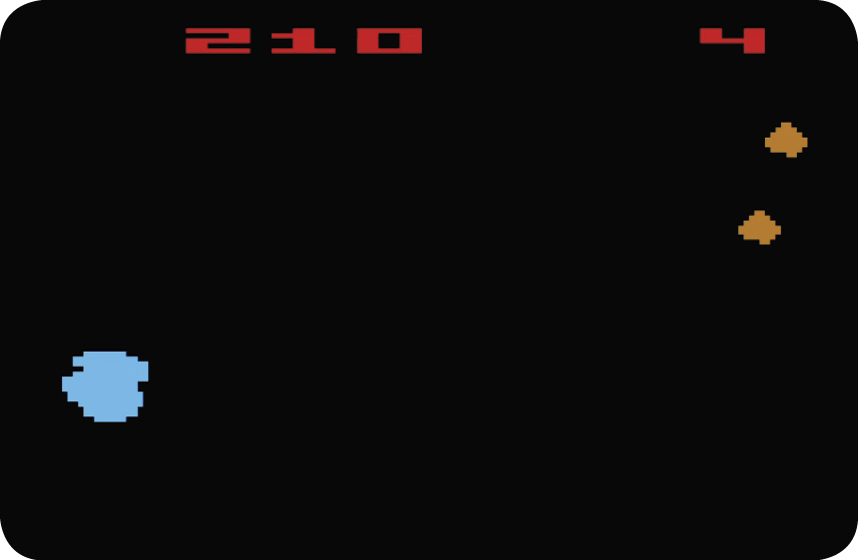
Hyperspace (H) is a feature offered in games 1 through 8 for one player and games 34 through 41 for two players. By moving the joystick down (or towards you), hyperspace makes your spaceship disappear and reappear at some other place on the screen. Hyperspace is helpful as a quick getaway when an asteroid or boulder is headed toward your spaceship, but it may also be a hindrance if your spaceship reappears in the path of an oncoming asteroid boulder.
Shields
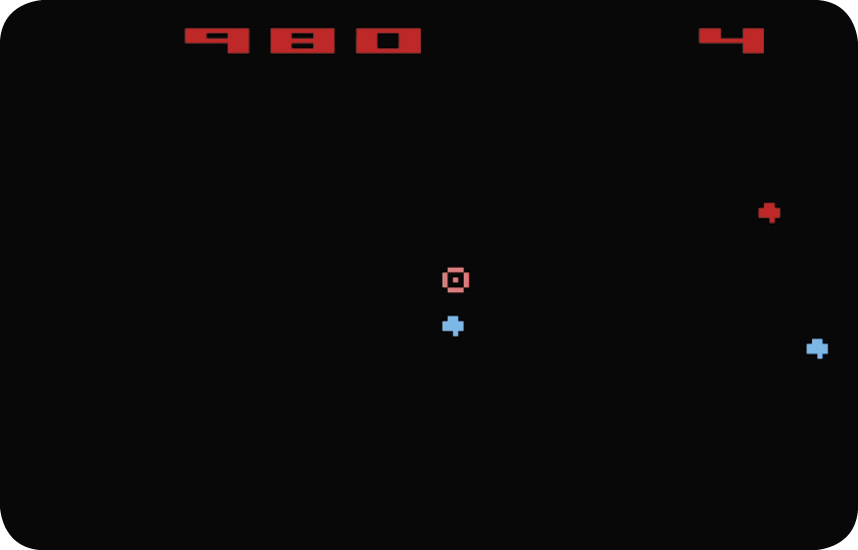
Shields appear in games 9 through 16 for one player and games 42 through 49 for two players. They allow you to protect your spaceship by surrounding it with protective shields (SH). Pull the joystick back (or towards you) to put up shields, but don’t use shields for more than two seconds or your spaceship will blow up.
Flip
In game variations featuring Flip (FL), you can flip your spaceship around 180 degrees, which aims it in the opposite direction. Flip is a great way to attack asteroids coming from behind. Flip is a feature in games 17 through 24 for one player and games 50 through 57 for two players.
Games 25-32 (one-player) and games 58-65 (two-players) have no optional features (W). This makes these game variations more challenging and you must depend solely on your quick skill and coordination.
Young Children’s Versions
Games 33 through 66 are easy versions for young children. These games feature slow asteroids, hyperspace, and an extra ship every 5000 points.
SCORING
|
Object |
Point Value |
|
Small Asteroids |
100 |
|
Medium Asteroids |
50 |
|
Large Asteroids |
20 |
|
Satellites |
200 |
|
UFOs |
1000 |