Assassin's Creed IV: Black Flag Guide Extras
The History Behind The Story
The Golden Age of Piracy in the early 18th century is the historical setting for Assassin’s Creed IV. Astonishingly, many characters in the game stem from real people of the period, Ubisoft having adapted their stories and intertwined them with the fictional narrative of Edward Kenway. The War of the Spanish Succession (1701-1714) was a significant political backdrop to this period. For more than a decade, the Caribbean islands were a theater of war, with the main belligerents being Spain and France on the one side, and England, Portugal, the Netherlands and the Holy Roman Empire on the other. These countries each encouraged their privateers to sail the waters of the Caribbean and prey on the merchant shipping of their nation’s enemies.
When the war came to an end, the Treaty of Utrecht also marked the conclusion of Caribbean-based naval battles between the warring factions. Peace was the first of two catalysts to expedite the Golden Age; with peace came economic upheaval. The Royal Navy employed 50,000 in 1703; by 1715 this had been reduced to 13,000. In the Caribbean, an end to war meant that thousands of navy sailors and privateers based in the area were suddenly without purpose. The treaty facilitated an increase in trade which led to an upsurge in high-value cargoes being shipped between the Caribbean, Europe and North America.
The second catalyst was the shipwreck of a Spanish treasure fleet in 1715, two years following the treaty. This served as the spark that lit the fuse of the Golden Age of Piracy: an era that unleashed a wave of crime, pillage and murder, which threatened to destroy the fragile economies of the North American and West Indian colonies.
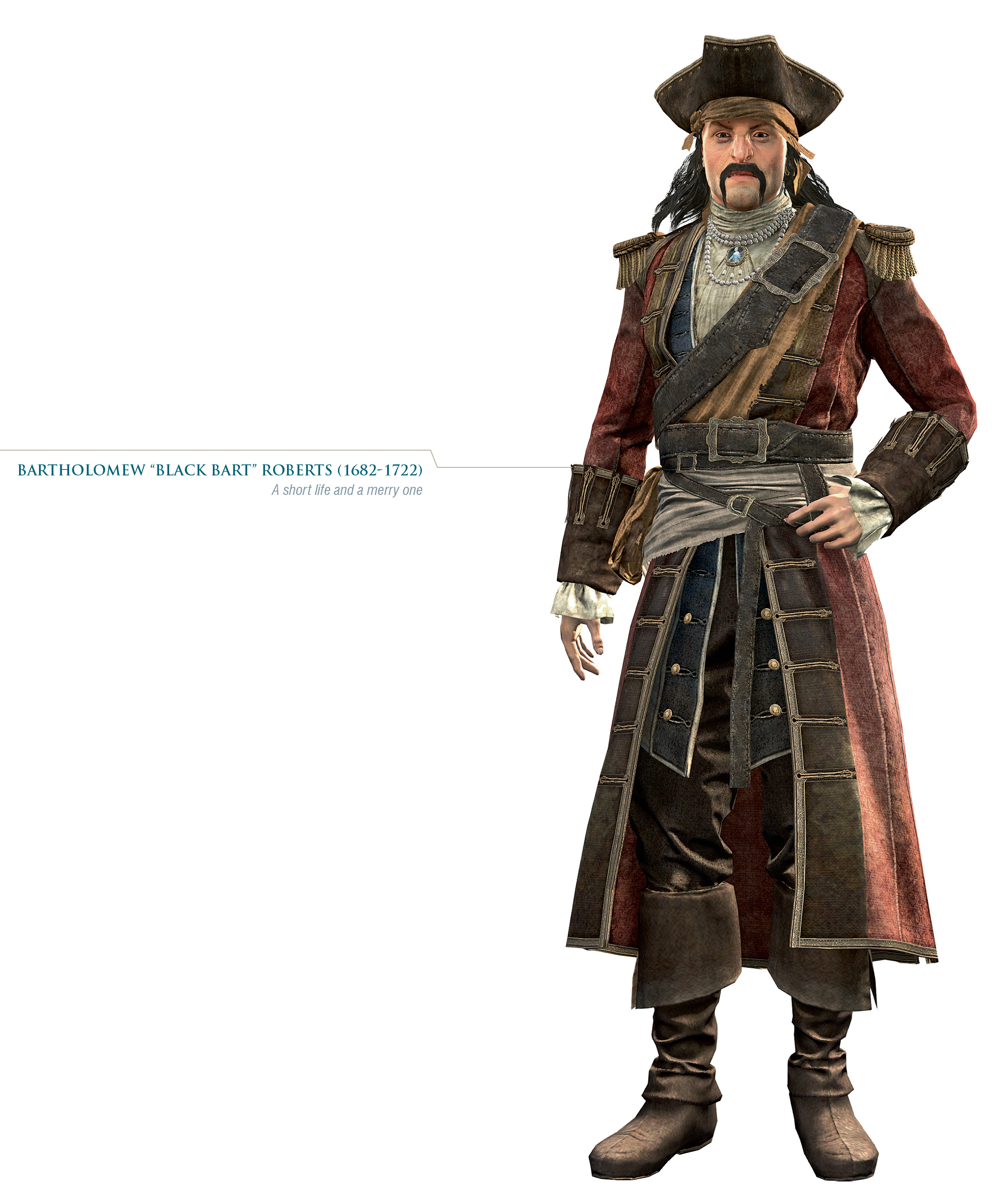
This setting provided the perfect environment for the emergence of timeless characters such as Benjamin Hornigold (died 1719), Blackbeard (1680-1718), Woodes Rogers (1679-1732), Calico Jack (1682-1720), Anny Bonny (born 1699), Mary Read (died 1720), Bartholomew Roberts (1682-1722) and Governor Laureano de Torres (1645-1722), all actual people from the Golden Age of Piracy and all integral to the Assassin’s Creed IV story. This section presents these protagonists and the historical events of their era.
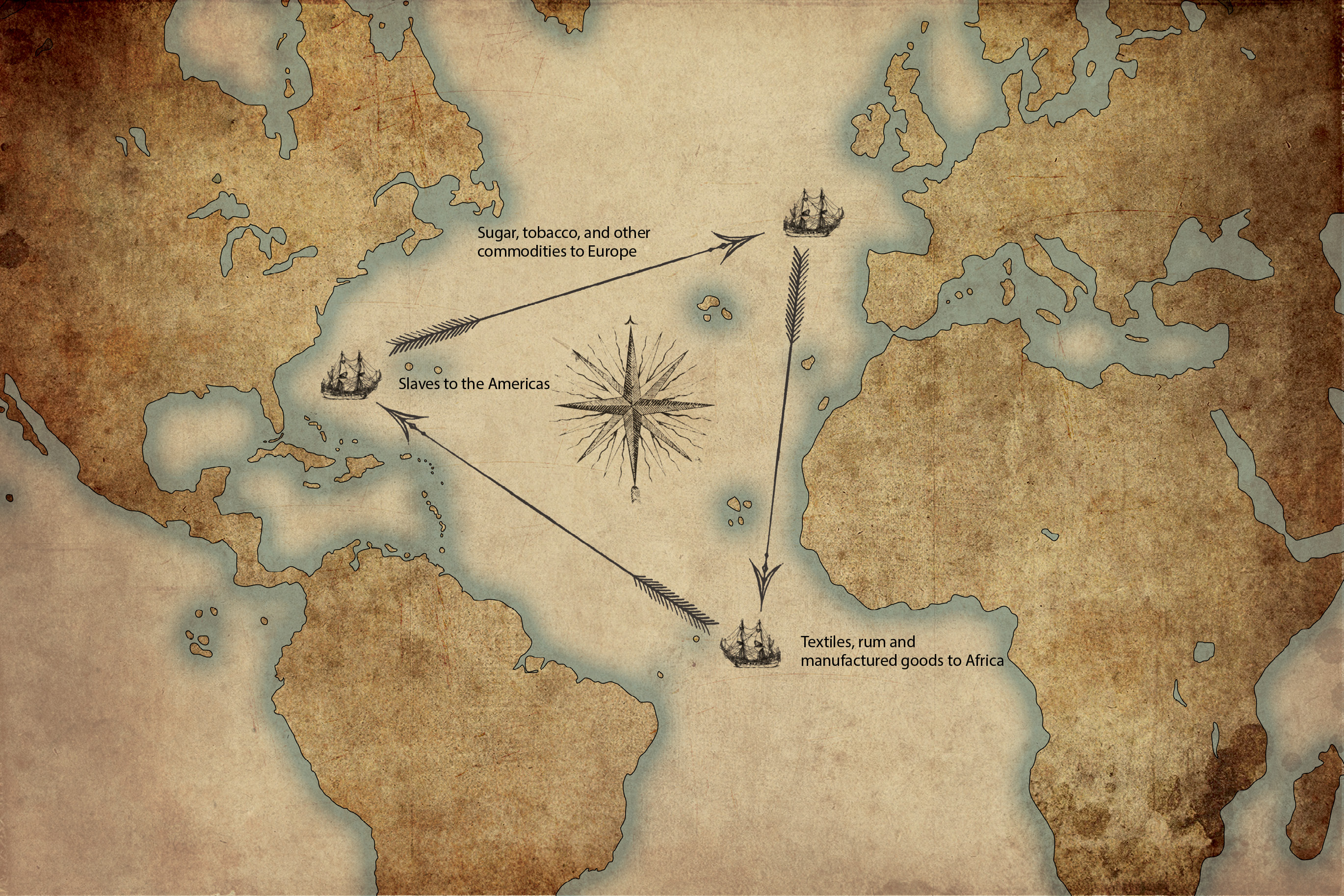
The Triangular Trade route from Europe to West Africa, then to the Caribbean and returning to Europe.
Brave New World
Piracy has been with us since the advent of shipping and there are multiple references to piracy in ancient Greece and Rome; piracy continues right up to the present day with Somali pirates terrorizing international shipping along the east coast of Africa. But when piracy is mentioned, it conjures up romantic images of colorful and eccentric characters from the Golden Age capturing Spanish galleons replete with treasure. The most fascinating question in understanding this period is: why were Spanish fleets transporting gold and silver across the Caribbean Sea and Atlantic Ocean?
When Christopher Columbus arrived in the New World in 1492, he first set foot on one of the islands of what is now known as the Bahamas. Since it was believed he had sailed west and reached India, this region became known as the West Indies. Nobody could have imagined the size of the new continent yet to be discovered when one year later almost all of it was awarded to Spain, by papal decree administered by Spanish-born Pope Alexander VI. The area of land that now represents most of present-day Brazil was awarded to Portugal.
It quickly became clear that the Americas were much too large to be plundered and colonized by Spain alone, which had a population of seven million at that time, with only a minority inclined to venture to the New World. As a consequence, the colder North American area (except Florida), as well as certain Caribbean islands, gradually came under the control of the would-be colonial powers of the time: England, France and the Netherlands.
The high sugar yield from the West Indies supported the development of a trading triangle from Europe to Africa.
■ Ships transported textiles, rum and manufactured good from Europe to West Africa.
■ These goods were traded for slaves, who were transported by the same ships and sold to the sugar and other plantations in the Caribbean.
■ The ships then returned to Europe carrying sugar, tobacco and other commodities from the New World.
The Spanish Main

The Spanish Main: coastline outlined in red, Spanish territorial possessions in yellow.
The Spanish were drawn to America by the lure of gold, but it was silver that gave them unimaginable wealth. Within 30 years of the discovery of the New World the Spanish had made significant in-roads into the new continent, an area that became known as the Spanish Main. In 1519-1521, the Spanish led a campaign into current day Mexico and conquered the Aztec Empire, thereby accessing local gold and silver mines. Barely a decade later (1532), in what is now Peru, they ambushed and captured the Inca Emperor Atahualpa. It was the first step in a long campaign that took decades of fighting, but the prize was the Spanish conquest of the Incas, a civilization of 12 million people, then the largest empire in the world. Not least, this led to control of a mountainous area, called Potosí, at the southern end of the empire (present-day Bolivia), where a mining town was founded in 1545, known as Silver Mountain. Within a few years of operating the Potosí mines, silver from Spanish America began to flow across the Atlantic, starting at a modest 300 lbs. a year and increasing to over six million lbs. in 1590. By 1610, the population of the village of Potosí had grown to 150,000, making it a major city by European standards. To this day, Potosí is still renowned for its wealth, in fact the Spanish even have a saying, “vale un Potosí”, which means “worth a fortune”.
The Spanish Treasure Fleet
At first, the gold from Mexico and silver from Potosí was sent to Spain in the form of bars and crude ingots. From 1536 the Spanish rulers established mints on the Spanish Main to convert the precious metals into coins. The most celebrated of the minted coins were the pieces of eight (peso de ocho reales), which swiftly became the first truly global currency. Around the year 1600, a piece of eight would have purchased the equivalent of $75 in modern terms and could have been spent practically anywhere in the world.
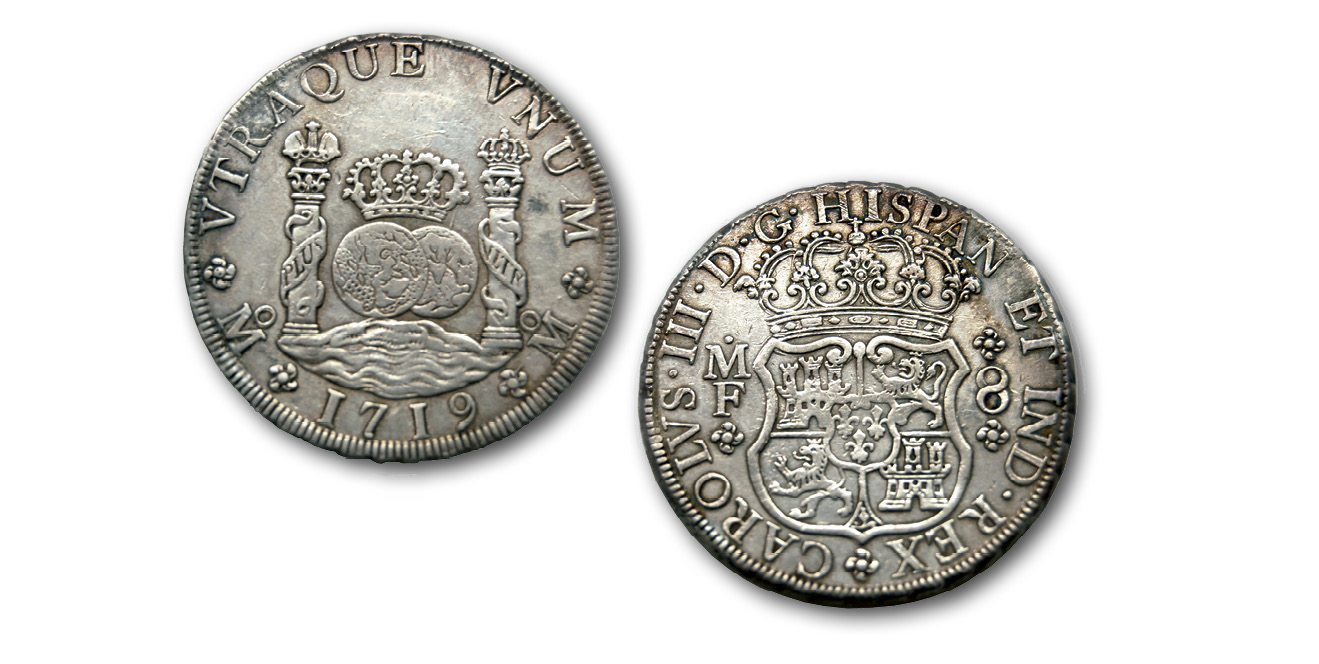
The piece of eight coin was introduced in Spain in 1497 and became the first global currency, underpinning Spain as the first world empire. It remained legal tender in the United States until the Coinage Act of 1857.
The Spanish transported their treasure back to the homeland twice a year and these vast riches quickly became an important, regular source of income. There were only three occasions when the fleet failed to reach Spain. In 1628 it was seized by the Dutch, and on the other two occasions it was wrecked by a hurricane, which is also what befell the 1715 treasure fleet in our story, when, in late July of that year, the convoy was hit by a fearsome hurricane, which wrecked the ships against the reefs of Florida. Only one vessel survived to carry the bad news back to Havana. The vessels had sunk in shallow waters, which enabled the Spanish to salvage most of the treasure and store it temporarily on land. Unfortunately for the Spanish, news of the treasure reached Jamaica, then a British colony. In November 1715, Governor Hamilton of Jamaica sent two sloops on an anti-piracy patrol, under the command of Captain Henry Jennings. Jennings secretly met up with three other sloops crammed with ex-privateers (two of which are believed to have been “Blackbeard” and Charles Vane, and set sail in search of the Spanish spoils. Jennings and his crew landed close to the Spanish shipwrecks and attacked the salvage camp, driving off the Spanish guards. The successful expedition returned to Jamaica with 60,000 pieces of eight –an absolute fortune! Governor Hamilton turned a blind eye to the celebrations that ensued, which only served to inflame the treasure fever sweeping like wildfire across the Caribbean as hundreds of former privateers joined Jennings. Despite a formal complaint to Hamilton by the Spanish, Jennings arranged a second expedition to the salvage camp, which yielded even more spoils. The Spanish finally sent two warships to carry home the remaining treasure, which put an end to the plunder.

Throughout this period, the treasure fleets were vulnerable to attack by privateers and pirates. Spanish sovereign rivals and enemies were aware of the scale of wealth flowing back to Seville from the New World. Aspiring empires wanted a share of the booty, and the most cost-effective way to encourage intervention and seizure of the Spanish treasure was by sanctioning privateering.
Privateering was nothing more than state-sponsored piracy. In times of war, a ship owner or sea captain could apply to his government for a “letter of marque and reprisal”. The aspiring privateer agreed to attack the merchant shipping of his country’s enemies and to take the prizes (captured vessels) into a haven port where the ship and cargo could be sold. In return, the sponsoring sovereign took a share of the plunder – generally 10%. This was a very lucrative arrangement for the parties, except, of course, the foreign ship owners; and, indeed, all seafaring nations participated in this activity at the time. It has been estimated that during the war of the Spanish Succession more than 300 privateer vessels of various nationalities were operating in the waters from Newfoundland to Brazil. Most based themselves in the Caribbean, where the trade in rum, sugar and slaves ensured there was no shortage of prizes.
Privateers of the Caribbean
Nassau
By the spring of 1716, following Spanish outrage at Jennings’ seizing of treasure from the 1715 Spanish ship wrecks, Jennings became a diplomatic issue in British Jamaica. He urgently needed a new base, and settled in Nassau on the island of New Providence in the Bahamas, which was within easy reach of the Florida Strait with its busy shipping lanes replete with European vessels crossing the Atlantic. Nassau’s harbor could easily accommodate hundreds of ships, and was, importantly, too shallow for the Royal Navy’s larger vessels to navigate. The island had already become a minor haven for privateers turned pirate, led by Captain Benjamin Hornigold. The arrival of Jennings turned this small haven into a pirate boom town. By the summer of 1716 it had become a hive of illicit pirate activity. The result was a marked increase in piracy around the Bahamas and the Florida Strait. Soon the Nassau bandits were venturing as far as the West Indies and the seaboard of the British American colonies. It was reported in early 1717 that there were over 500 pirates in Nassau and at least a dozen pirate vessels, mainly sloops. Rough-and-ready inns and brothels were established, and traders from the West Indies came to buy the pirate plunder at bargain-basement prices. In 1716, the pirate captains based out of Nassau included Benjamin Hornigold, Henry Jennings, Blackbeard and Charles Vane. Others known to have based themselves in Nassau around this time included: Stede Bonnet, Calico Jack, Mary Read and Anne Bonny.
The beginnings were humble in the small village, not at all as portrayed in pirate movies where large warships pass each other side by side, firing broadside after broadside, as dashing captains swing on ropes with gleaming cutlasses between their brilliantly white teeth. While many pirate captains may well have been handsome, it was advisable to stay upwind of them, as their personal hygiene usually left more than a little to be desired! Most pirate captains did not command a man o’ war, but rather sloops, or indeed smaller sailing canoes, called Piraguas.
They preyed mostly on lesser merchant vessels or harmless coastal targets such as isolated sugar plantations – the latter attacks were in fact quite common. Merchant vessels usually had a crew of 10, possibly 20. Pirate vessels, in contrast, frequently carried dozens of men, who were armed to the teeth. This enabled them to overpower their targets by sheer numbers. It was also known for pirates to join forces to attack larger vessels. If successful, they would often keep that ship and make it their own, fitting it out for their needs. With the exception of Blackbeard and Bartholomew Roberts, few pirates ever controlled vessels the size of a (small) warship, with more than 40 cannons.
The pirates were adept at working with many forms of cargo. Merchant ships rarely sailed with chests of gold and silver. They transported all of the commodities of the time, such as sugar and cocoa; they shipped goods, such as barrels of rum (always welcome), bales of linen and other cloths, crates of candles, nails, and soap, household goods such as pots and pans. They also transported slaves, who were most often handled as merchandise. Once seized, these cargoes had to be offloaded and the pirates of Nassau found willing helpers in the settlers of neighboring islands. As such, a flourishing black market emerged, and many pirate smugglers became very, very wealthy.
Pirates did not generally manage to keep hold of their riches for long. They spent their earnings on drinking and gambling, and the stories of debauchery are legendary. As a consequence of the black market, the population of Nassau increased daily, with most of the newcomers being pirates (read: villains) and smugglers (also villains), women of negotiable affection, a few escaped slaves from other islands, whereas the regular settlers left for good. Some referred to Nassau as a Pirate Republic, but for most, it was seen as an outlaws’ den.
To combat the growing problem of piracy, King George I appointed Woodes Rogers in 1717 as Governor to the Bahamas, based in Nassau. On arrival, Rogers had the dilapidated fort rebuilt, and set about offering the King’s Pardon to all outlaws based on the island. Those who declined were hunted down and publicly executed following a show trial. This public execution marked the beginning of the end of Nassau as a pirate haven.
Book of Thieves
The publication of A General History of the Robberies and Murders of the Most Notorious Pyrates in May 1724 was an immediate hit on both sides of the Atlantic; it provided readers with a sensational account of the lives of the most notorious pirates of the preceding decade, including Blackbeard, Stede Bonnet, Calico Jack, Charles Vane, Mary Read, Anne Bonny, Bartholomew Roberts, and many more. It was written under the pseudonym of Captain Charles Johnson; the author’s true identity remains unknown to this day. What we do know is that much of the first-hand content was provided to the author by the then Governor of the Bahamas, Woodes Rogers.
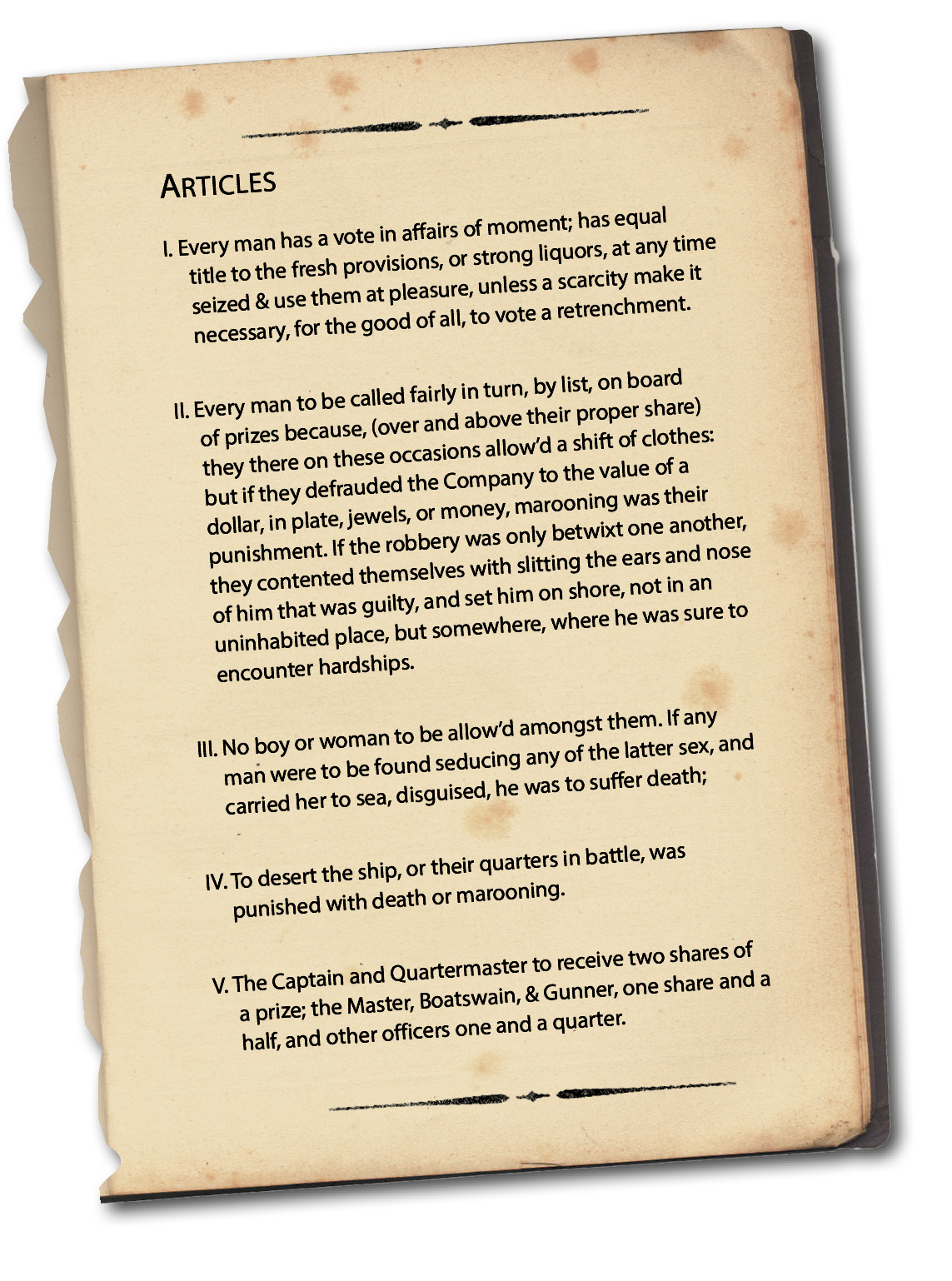
A General History, as it is most commonly known, gives us a lot of insight into various aspects of pirate life and, of particular interest, the pirate code. This was an agreed set of articles that defined the manner in which a pirate company was structured, and which had to be signed by each crew member. It is important to understand that a pirate ship was like a modern-day company in which each pirate was a shareholder with one vote. Unlike any sovereign navy, or indeed country, at the time, many pirate ships were run as democracies. The irony is that although pirates of the Golden Age were groups of ruthless, murdering thieves, their commitment to freedom and the way in which they institutionalized that freedom meant that they were in fact more advanced politically than any other society of their time. This political institutionalization is all the more significant when you consider that the articles (pirate code) and the democracy they enshrined also applied to black members of the crew; a radical political structure that pre-defined much of what was to result from the forthcoming Enlightenment.
Few originals of pirate articles have survived; impending capture or surrender would force pirates to burn their articles or throw them overboard, to prevent the documents being used against them at trial. Some still remain, however, and to the right you can see an extract from the articles of Bartholomew Roberts’ crew, as recorded in A General History.
William Kidd
Captain William Kidd (1645-1701) was one of the most notorious pirates of his time. He started his short career as a privateer, bound to hunt pirates in the Indian Ocean. Kidd never intended to become a pirate, and to the end proclaimed his innocence. It was his misfortune to find himself a pawn of political intrigue involving players from London to New York to India. Kidd arrived in London from New York in 1695, hoping to make his fortune from privateering. He devised a scheme with fellow investors to finance the purchase of a large vessel, sail to the Indian Ocean and capture pirates selling goods to merchants in New York. England was at war with France at the time so there was little difficulty in procuring a letter of marque, which authorized the capture of French ships. Kidd arranged a second commission for his venture, which sanctioned him to hunt down “pirates, freebooters, and sea rovers”. The most surprising element was that the King of England, William III, took a personal stake in the scheme. Once backing had been arranged, Kidd set off on his 34-gun Adventure Galley in April 1696. He had little success from the start, and following a catalogue of bad decisions, he came under increasing pressure from his crew, who had been hired on the conventional “no prey, no pay” basis. Desperate for some plunder, he ordered the attack of a small trading ship under English flags, off the Malabar Coast. Since the vessel was neither French nor pirate, his attack was tantamount to piracy. He went on to plunder some merchant ships registered with the powerful East India Company. The company had him declared a pirate, and the hunter became the hunted. Having also killed one of his crew by striking him on the head with a round-hooped bucket, Kidd was liable for murder.
Kidd was eventually captured and convicted in London of piracy and murder. The high-profile nature of his exploits and trial gave much attention to Kidd. The story circulated that Kidd had buried gold and silver from a plundered vessel near New York before he was arrested, and so the legend of pirates and buried treasure was born. He was hanged for his crimes in 1701.

Benjamin Hornigold
_06_130910_DS_opt.jpeg)
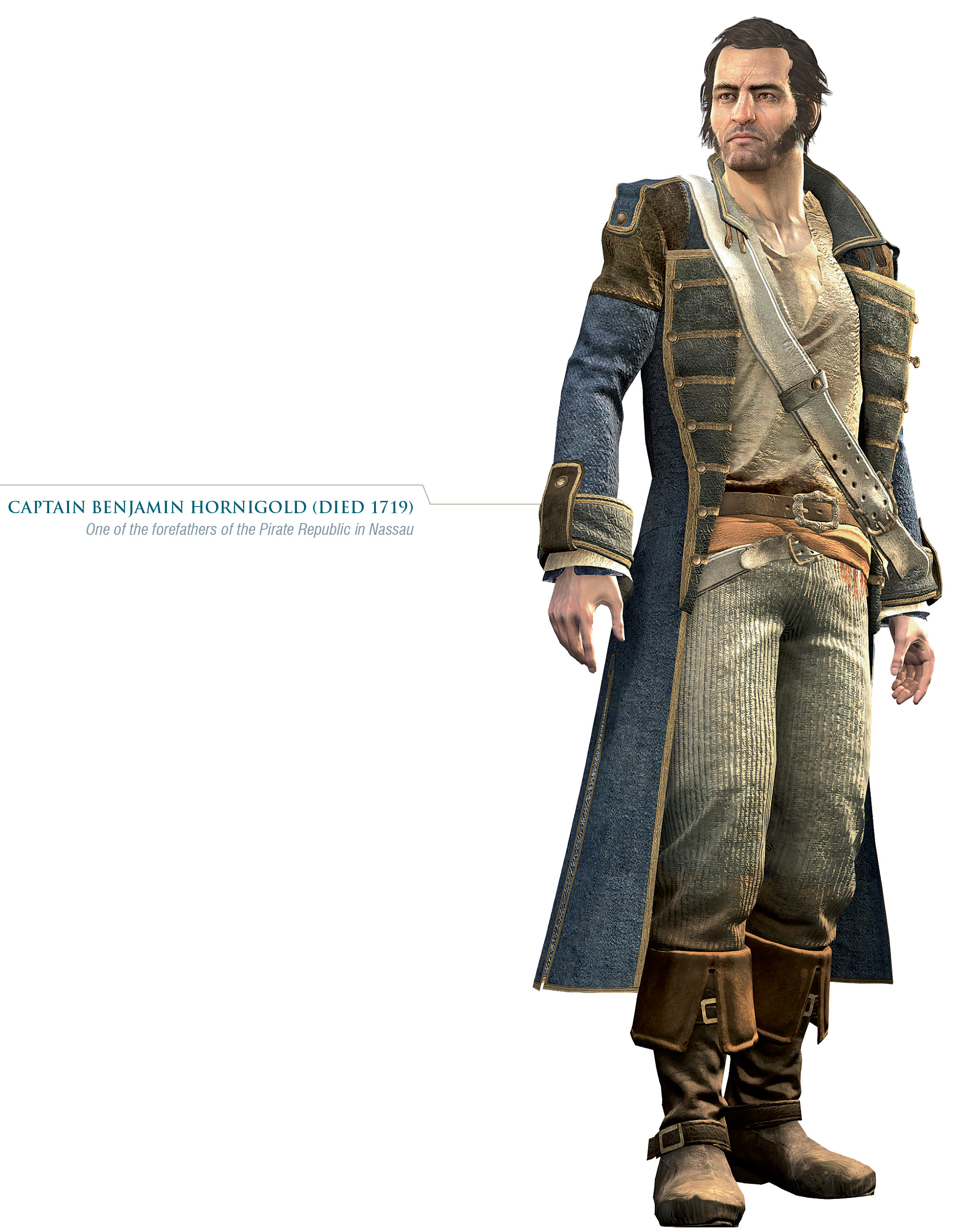
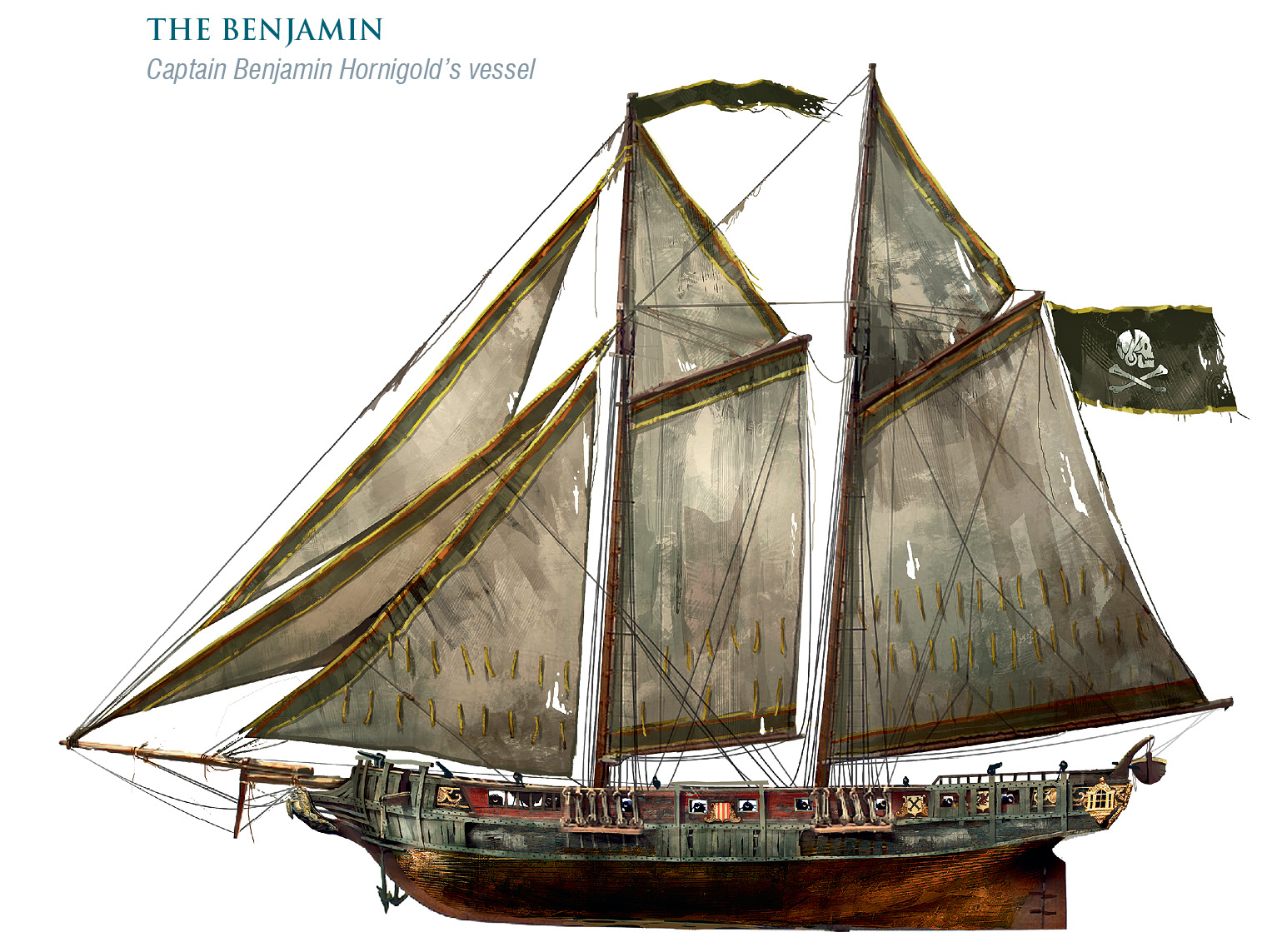
Very little of Benjamin Hornigold’s early life has been documented. We know he was born in England, and the first records of his acts of piracy were recorded in 1713. At this time he was one of the principal pirates to settle in Nassau on the island of New Providence. Blackbeard joined his crew around 1716 and was put in charge of a sloop previously taken as a prize. In early 1717, Hornigold and Blackbeard, each captaining a sloop, enjoyed a lot of success in seizing merchant vessels.
As an Englishman, Hornigold initially resolved to attack only Spanish or French vessels, the former enemies of the Crown. This soon changed, not least because his crew had a say in defining target vessels. Nonetheless, Hornigold always considered himself a patriot, which is most likely the reason behind his swift acceptance of the King’s Pardon. This clemency was granted to him in 1718 by the newly appointed Governor of the Bahamas, Woodes Rogers. Hornigold went on to collaborate with the new governor, a move considered irreconcilable in the eyes of his former contemporaries. He then turned pirate hunter when he received a privateering commission to pursue his former pirate mate, Charles Vane. He didn’t capture Vane, however, and died one year later when his ship struck a reef in a hurricane.
Stede Bonnet
_07_130910_DS_opt.jpeg)
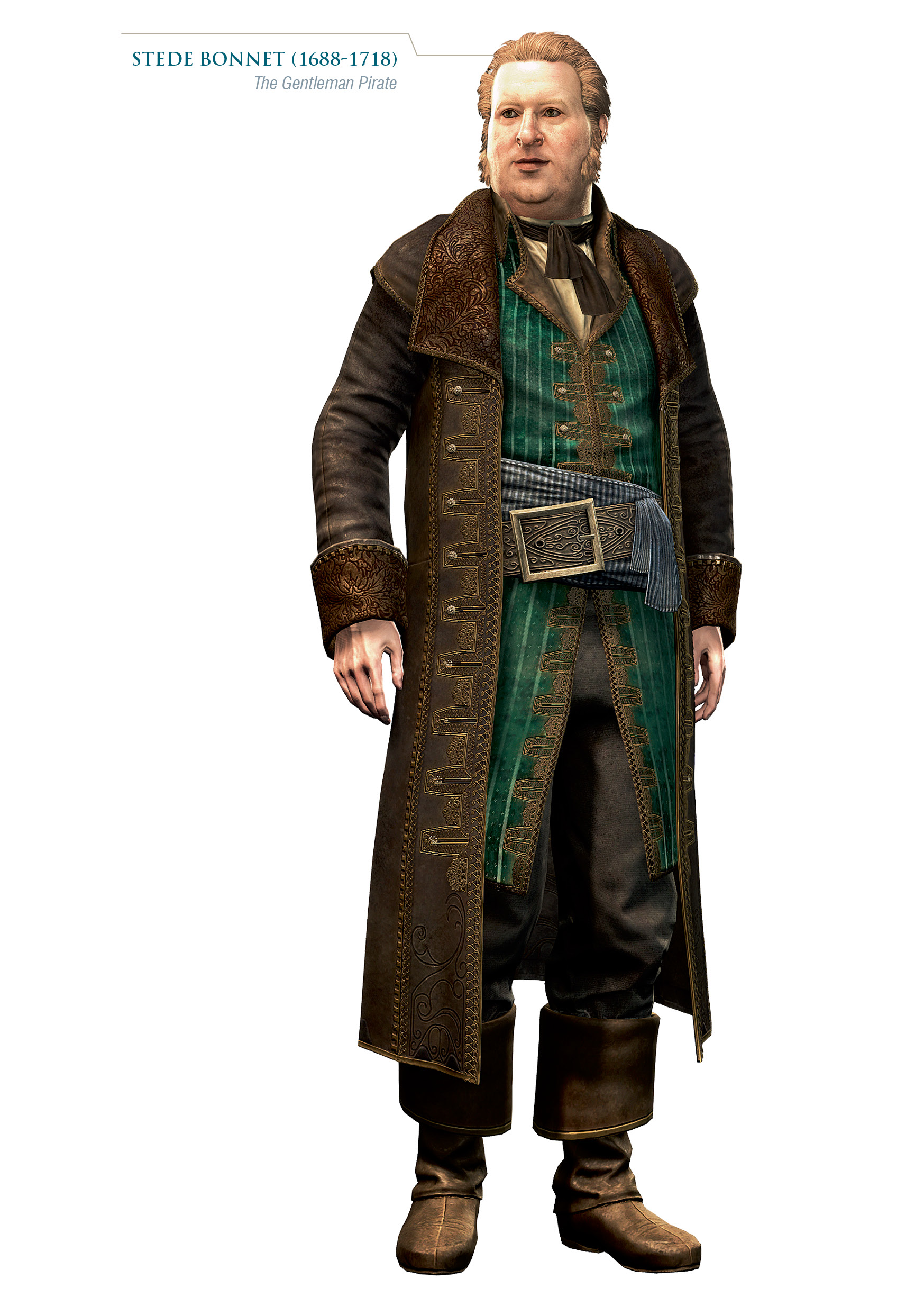
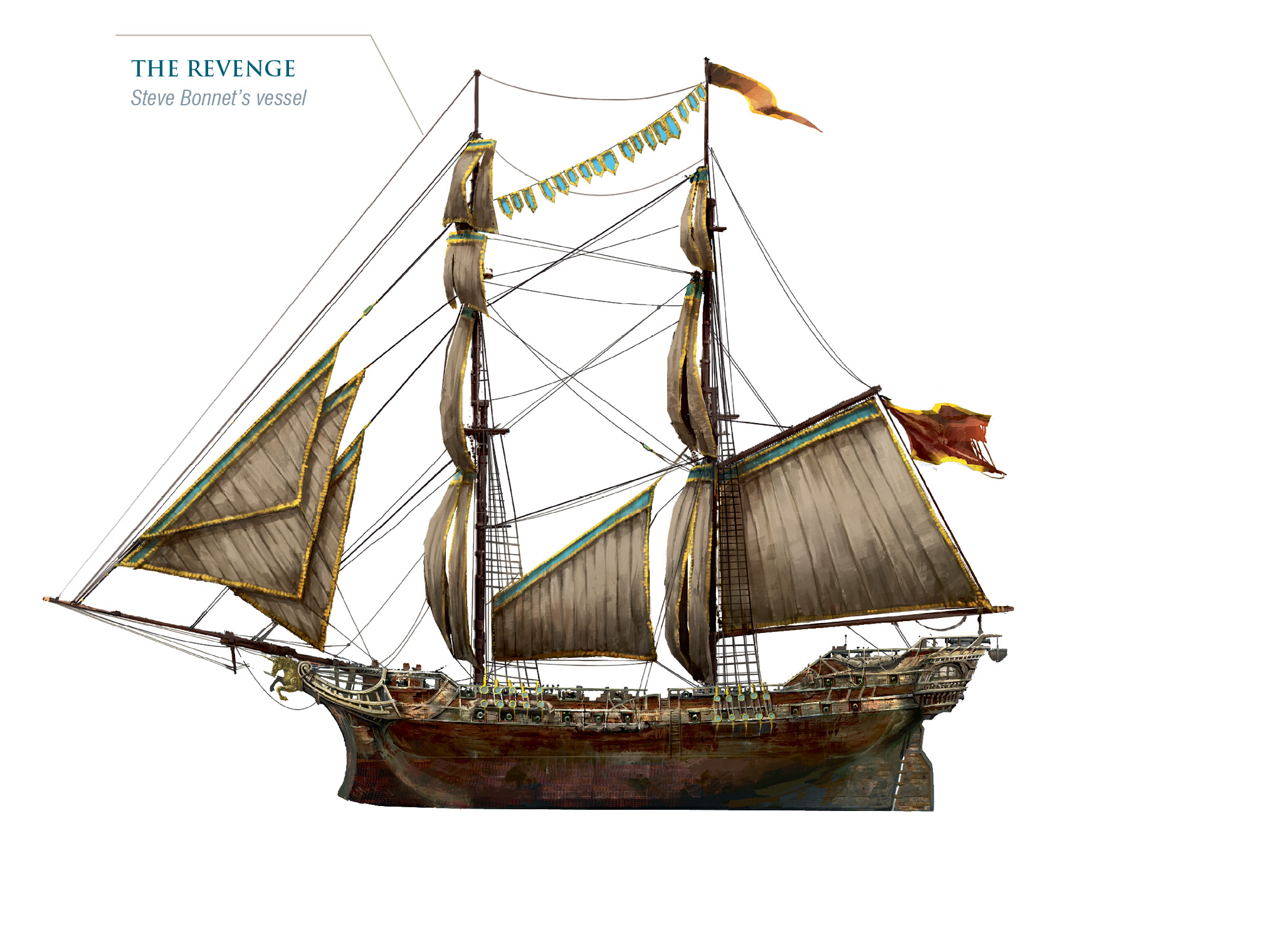
Bonnet was the most unlikely of pirates, having been born into a wealthy Barbadian family of sugar cane plantation owners in 1688. After the death of the first of his four children, he became depressed; some believe he went insane. He abandoned his family for a pirate life, despite not having any experience as a seafarer. Bonnet commissioned a local shipyard to build him a sloop, probably making him the only pirate ever to have paid for his vessel. His inexperience was evident to his crew, to whom he paid wages, in contrast to the established pirate code of “no prey, no pay”. Nonetheless, he did have success on the seas and captured and plundered a number of vessels along the eastern seaboard of the North American colonies before setting course for Nassau. He crossed swords with a Spanish man o’ war en route, suffering many casualties and serious personal injuries. On arrival, Bonnet met Captain Benjamin Hornigold and Blackbeard for the first time. Disabled by his wounds, Bonnet temporarily granted command of his vessel to Blackbeard, but remained aboard as a guest of the more experienced pirate leader. Their partnership was fruitful, as they proceeded to plunder and capture more than 11 vessels together. Following the siege of Charles-Towne, both men resolved to take the King’s Pardon from North Carolina Governor Eden in June 1718, but within months of receiving their clemency, they had both fallen back on their former ways – however, this time not together. Blackbeard had double-crossed Bonnet, who resumed his pirate activities by taking command of his own vessels. He went in search of Blackbeard, but the two never met again.
By the end of August, news had reached Charles-Towne that Bonnet’s vessel and crew were moored in the Cape Fear River, North Carolina. The Governor of South Carolina authorized a naval expedition to capture the pirates, even though the Cape Fear River was in Governor Eden’s jurisdiction. Bonnet and his men were captured in October of that year and brought to Charles-Towne for trial. Bonnet managed to escape incarceration, during which time his crew was tried and hanged. He was recaptured, tried and hanged for piracy in December 1718.
Blackbeard
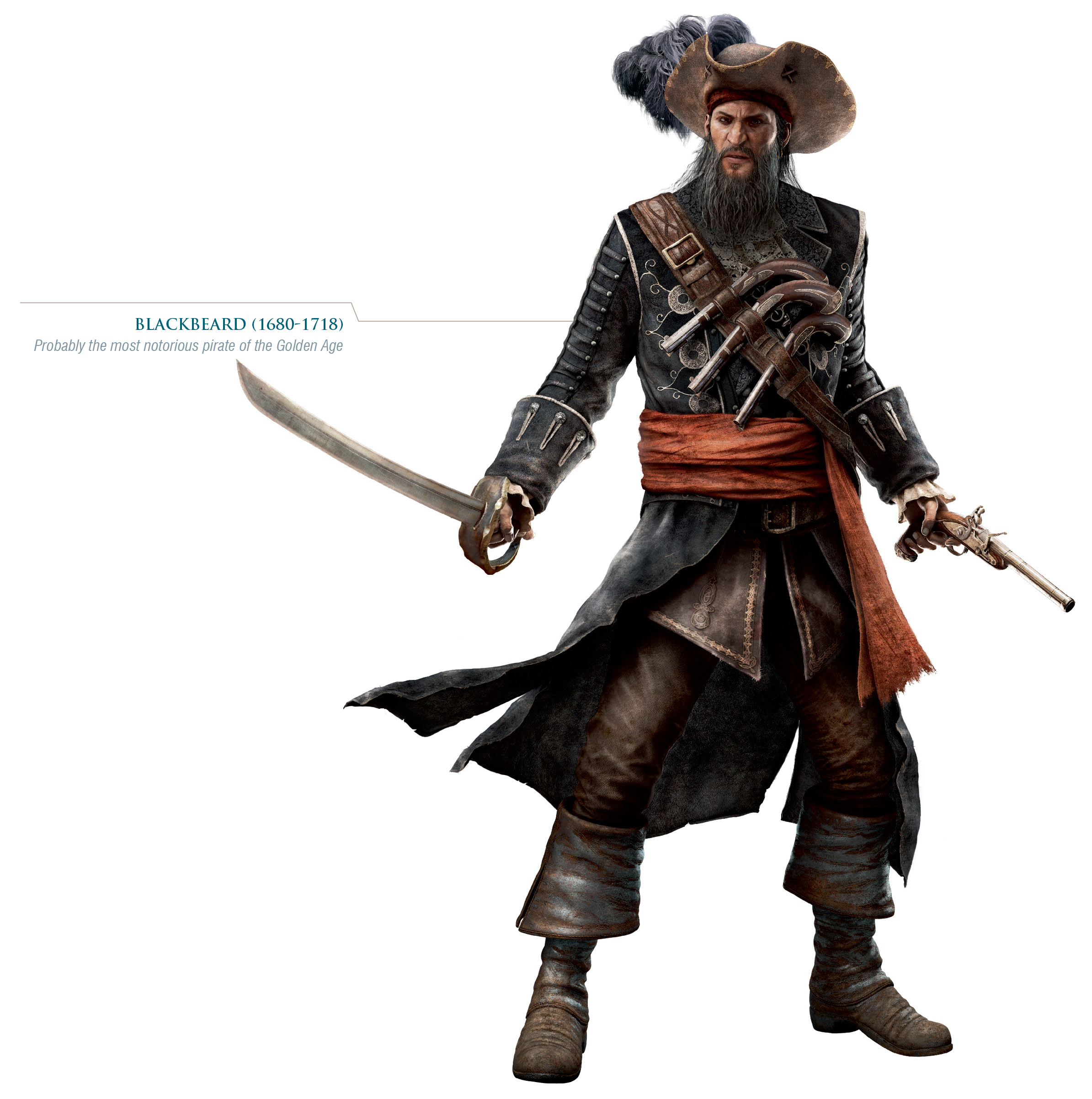
Ed Thatch, better known as Blackbeard, was a notorious English pirate whose achievements led him to command hundreds of men and a flotilla of pirate vessels. He plagued the waters of the West Indies and the eastern seaboard of the North American colonies. Although little is known of his beginnings, it is believed he was born in Bristol, England, although the exact spelling of his name is a topic of much discussion; alternative forms include Teach, Teache, Titche, Thach and Tache. Nonetheless, the spelling chosen throughout the game and in this guide is Thatch, and for a very good reason; he appeared as Thatch in the first edition of A General History, which was published six years after his death. He most probably started his career as a sailor on privateer ships during the War of the Spanish Succession before settling in Nassau around 1716, which was then under the leadership of Benjamin Hornigold. Blackbeard’s natural qualities quickly attracted the attention of Hornigold, who placed him in command of a sloop, and the two engaged in numerous acts of piracy.
Thatch’s alias stemmed from his beard, which he grew thick and long and braided with ribbon ties at the ends. He further enhanced his appearance by placing slow-burning cannon fuses into his hat, which he would ignite just before boarding a vessel that he was about to plunder, thereby appearing with a halo of smoke and fire. Single-shot muskets were notoriously unreliable at sea, so Blackbeard ensured he always had a back-up; he carried a collection of loaded pistols across his chest. Despite his fearsome reputation, there are no confirmed accounts of his captives having been murdered or harmed by him.
At the height of his power in 1718, Blackbeard had his fleet blockade the port of Charles-Towne in the English colony of South Carolina. No vessel could leave or enter without being searched. He duly commandeered one such vessel, which was transporting some prominent citizens to London. Blackbeard informed the authorities that he required medical supplies and that if none were sent, all prisoners would be executed. The supplies were duly provided and Blackbeard freed the hostages.
It was during the blockage that Blackbeard learned of the King’s Pardon. Days later, Blackbeard and a small crew presented themselves to the governor and their pardons were granted in June 1718. Blackbeard settled briefly in North Carolina, apparently close to Governor Eden’s home. Eden granted him permission to sail to the West Indies in August to seek a commission as a privateer, but in the same month, Blackbeard took two French ships leaving the Caribbean, moved one crew across to the other, and sailed the remaining ship back to the island of Ocracoke, in North Carolina.
Blackbeard had returned to piracy, and Eden, the Governor of North Carolina, became complicit in arranging a cover-up court ruling.
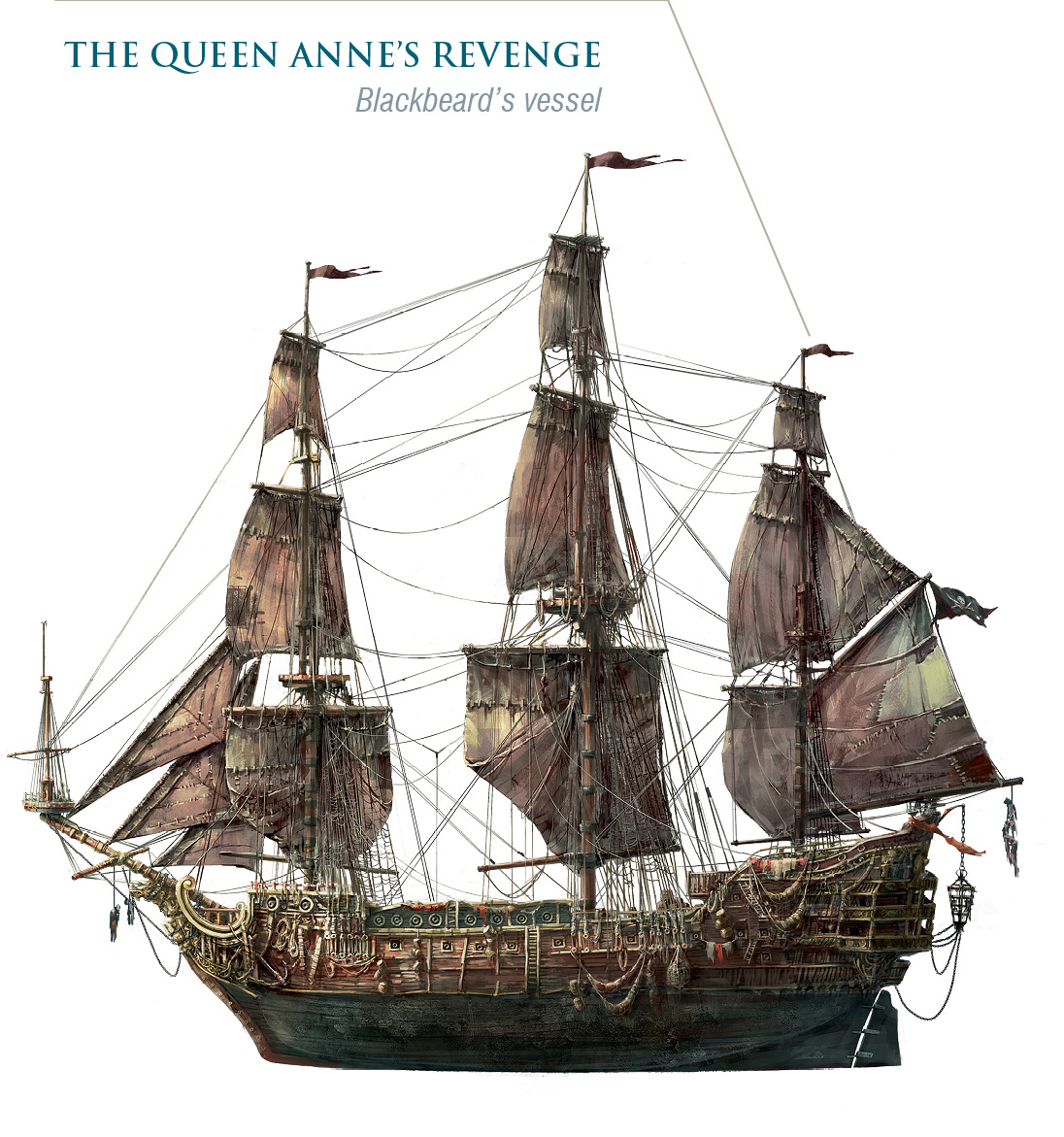
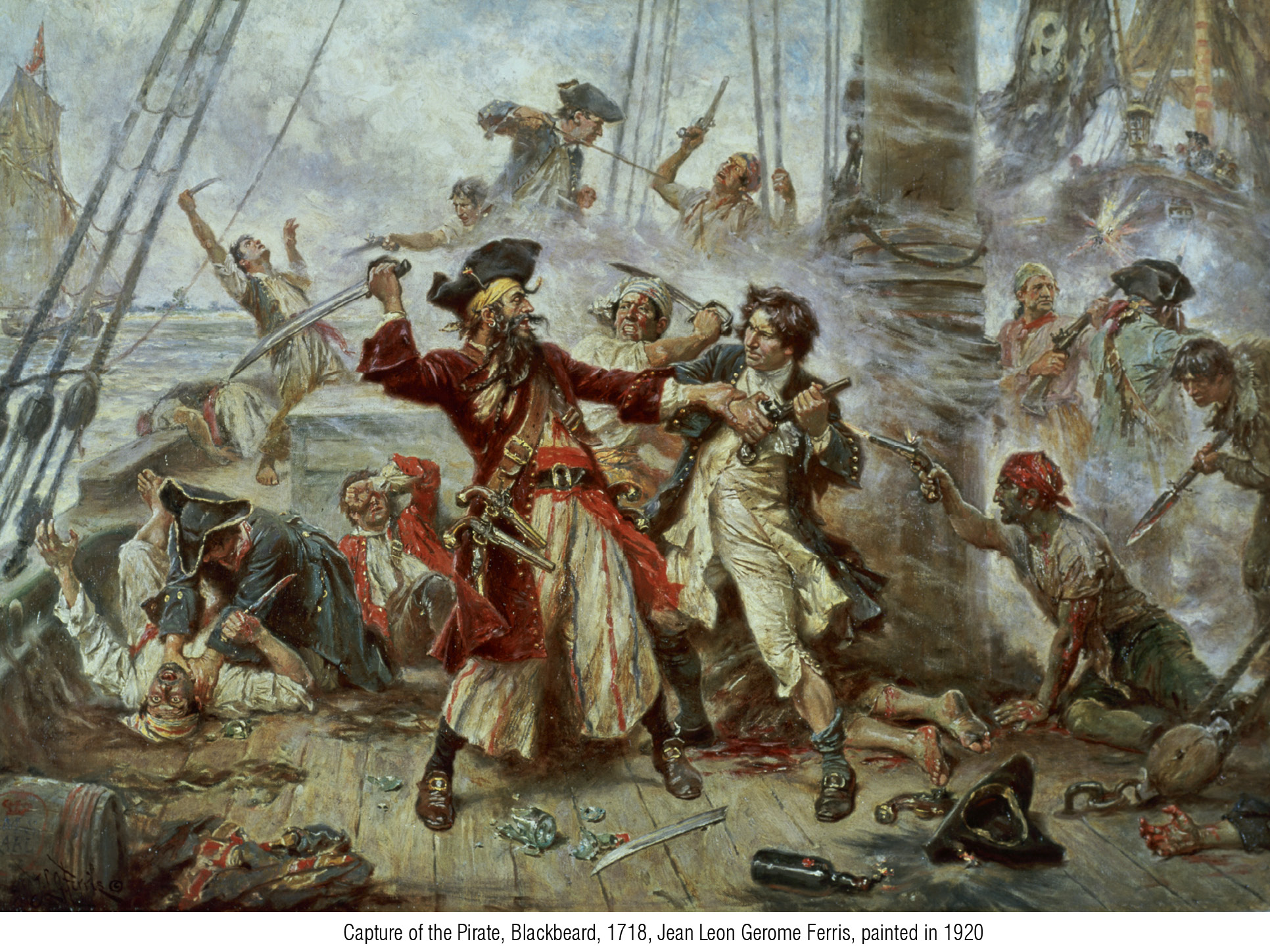
Alexander Spotswood, the then governor of the English colony of Virginia, realized that, with quasi political support, piracy was a never-ending threat to trade and to the nascent economies of the eastern seaboard colonies. Spotswood decided to take matters into his own hands and to send a message to all would-be pirates that he and others like him were no longer prepared to offer pardons or to forgive crimes. In addition, he planned to expose Governor Eden for colluding with the pirates. Having established Blackbeard’s whereabouts in North Carolina, he devised a plan to send forces across the border by land and by sea; his intention was to hunt down Blackbeard and to use his capture to make a very public statement. Spotswood gave Lieutenant Robert Maynard of HMS Pearl command of 50 men and two sloops. By stopping ships along his journey, Maynard established the location of the pirates, anchored on the inner side of Ocracoke Island. On spotting Maynard’s approach at daybreak, Blackbeard turned his guns on the two attacking sloops and fired a devastating broadside. In one blow, Maynard lost a third of his men. As the opposing side’s vessels approached, Blackbeard readied his men to board. What he did not know, was that Maynard, in anticipation of Blackbeard boarding his vessel, instructed some of his men to hide below deck. When Blackbeard and his crew boarded, those hidden in the hold burst onto the deck. The surprise overwhelmed Blackbeard and his men. The hand-to-hand combat continued, but Blackbeard was eventually hacked and killed, whereupon the remaining pirates surrendered. Maynard later examined Blackbeard’s body and noted that it had been shot five times and cut about twenty. Legend has it that on his decapitation, Blackbeard’s corpse swam round the vessel three times. Maynard attached the severed head to the bowsprit of his sloop and returned to Virginia to display his gruesome trophy, thus fulfilling Spotswood’s objective of a very public message to would-be pirates. This was just the first half of his statement; the second was the public trial and mass execution of Blackbeard’s remaining crew in Williamsburg, Virginia.
Woodes Rogers & The King’s Pardon


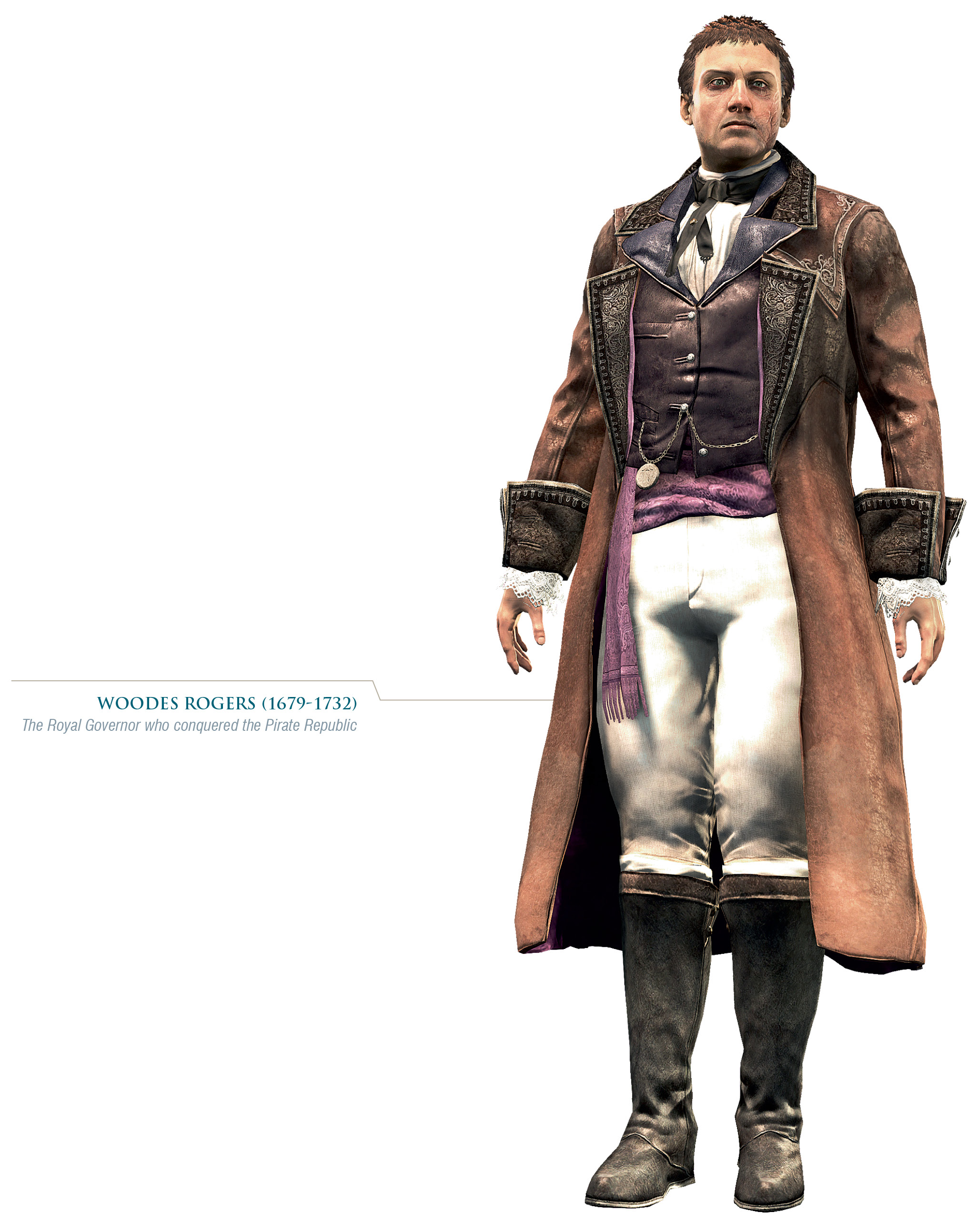
Before he became Governor of the Bahamas, Woodes Rogers was a successful privateer. Between 1707 and 1711, he circumnavigated the globe in his vessel, the Duke, causing havoc to Spanish interests, including sacking and holding to ransom the town of Guayaquil (now the largest city port in Ecuador). His expedition is a fascinating story of daring privateering, much of which is covered in his 1712 biography, which is still in print, “Life Aboard a British Privateer: The First Hand Account of a Famous Privateer Captain at War with the Spanish During the Reign of Queen Anne 1707-1711”.
Rogers fell into financial difficulties on his return to England. He was successfully sued by a group of 200 of his crew, who stated that they had not received their fair share of the expedition plunder. The profits from his book were not enough to cover the shortfall, and he was declared bankrupt. A way out of his financial difficulties was to lead another expedition, this time against pirates. In 1713, he led a voyage to supposedly purchase slaves in Madagascar and sell them in the Dutch East Indies. However, Rogers’ hidden agenda was to gather details on the pirates of Madagascar, hoping to destroy or reform them, and colonize Madagascar on a future trip. Rogers collected information regarding Madagascar-based pirates and their vessels, only to realize that a large number had settled locally. He therefore proposed to many of them that they sign a petition to Queen Anne requesting clemency. His plans to colonize Madagascar were scuttled by the powerful British East India Company, which vetoed the move, fearing such a development would threaten its monopoly on spices from the island. Accordingly, Rogers turned his sights to the West Indies. His entourage included several advisers to the new king George I, and Rogers was able to attain an agreement for a company to manage the Bahamas, in exchange for a share of the colony’s profits.
It is estimated there were 1,500 to 2,000 pirates operating in the Caribbean and North America at this time, on a par with the populations of Charles-Towne or Port Royal. The problems of piracy had been increasingly brought to the King’s attention by local governors in the colonies.
As a consequence, a number of measures were put in place to empower the colony governors to combat the situation:
■ Pirates could now be tried and hanged locally (formerly they had to be brought to London to meet their fate).
■ Naval patrols in the affected areas would increase dramatically.
■ Bounties were offered for the capture of pirates.
■ The King would grant a pardon to pirates who sought clemency.
On September 5th, 1717, King George I issued a royal proclamation to the governors of British colonies in the West Indies and North America. This became known as the King’s Pardon and it affirmed that any pirates who surrendered to the authorities before September 5th, 1718, would receive “His most gracious Pardon”.
Armed with three warships and a commission from the British government to act as the first Royal Governor of the Bahamas, Rogers sailed into Nassau with the intention of rooting out the pirates and establishing proper Crown control of the wayward pirate haven.
On arrival, Rogers set about offering the King’s Pardon to all outlaws based on the island. One of the first to accept the pardon was none other than Benjamin Hornigold. In contrast, Captain Charles Vane was one of the first to decline, going so far as to set fire to a freshly taken prize right under the newly appointed governor’s nose. Rogers immediately set about sending a message to all local outlaws that the authorities were no longer prepared to tolerate piracy, and he planned to make a public show of intent. Ten pirates captured by the newly appointed pirate-hunter, Hornigold, were subjected to a high-profile show-trial. Eight were publicly hanged in front of the garrison in Nassau. This public execution marked the demise of Nassau as a pirate haven.
Spain and Great Britain went to war anew in 1719-1720. With the focus back on this European conflict, the Bahamas was once again forgotten and neglected. Nevertheless, Rogers continued with his undertaking and invested much time and his own money in fortifying Nassau’s defenses. As he received no support from Britain, the local traders gradually declined him further credit. Concerned with the lack of support, Rogers set sail for London in 1721. On arrival, he learned that a new governor had been appointed and his company had been put into receivership. As he was personally liable for the debts in Nassau, he was tried and sent to debtors’ prison.
Rogers’ debtors showed mercy and absolved him of his arrears and he was released from prison. In 1722, he was invited to contribute to a book on the history of piracy titled: “A General History of the Robberies and Murders of the Most Notorious Pyrates”. The book was an immediate hit in Britain and North America and re-launched Rogers as a national hero. With his newly gained status, Rogers successfully petitioned the king in 1726 for financial recompense. Not only did King George I grant him a pension, retroactive to 1721, but also the king’s son and successor, George II, re-appointed Rogers as Governor of the Bahamas in October 1728.

Charles Vane
_09_130910_DS_opt.jpeg)
_08_130910_DS_opt.jpeg)
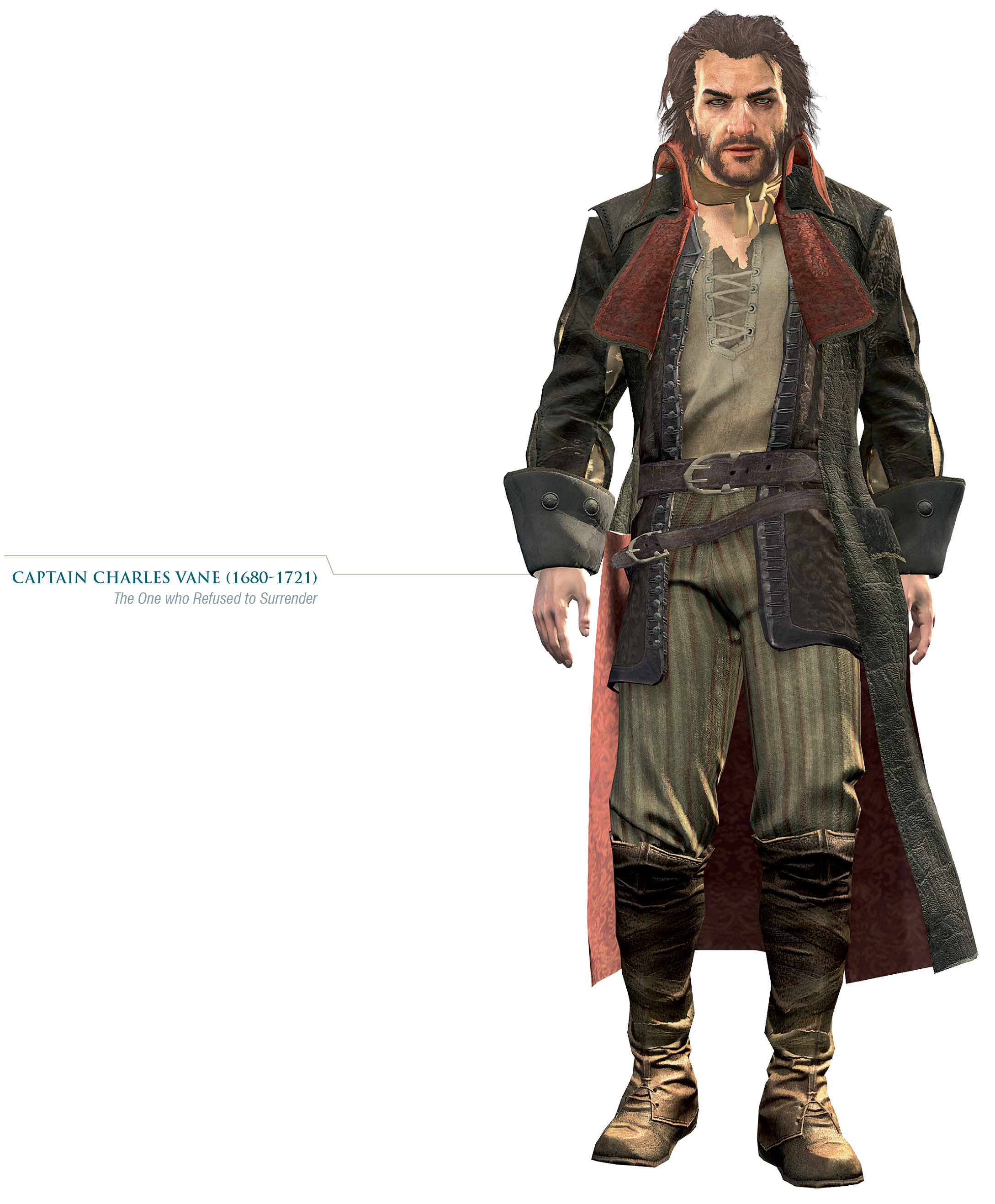
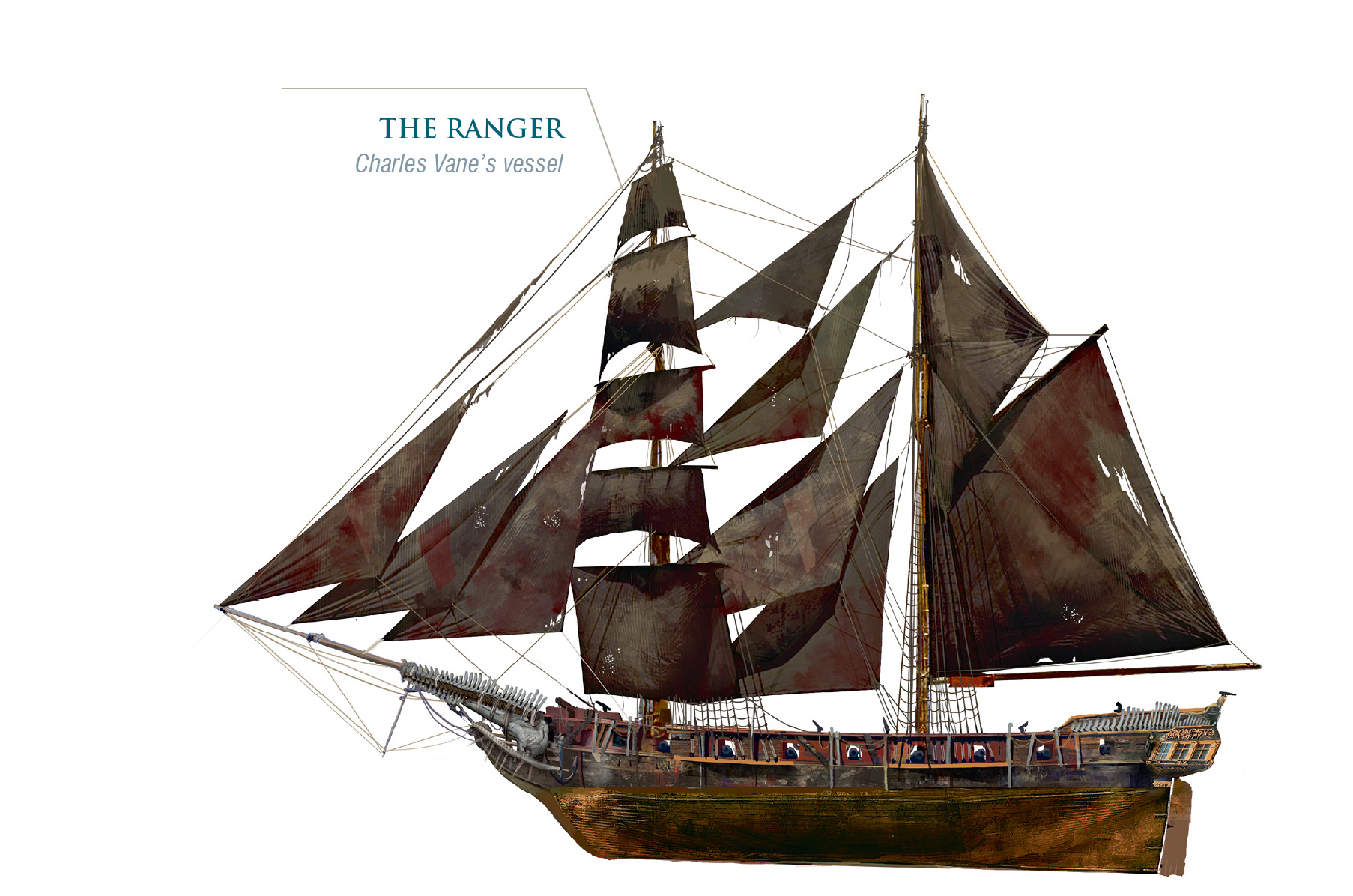
Charles Vane was a ruthless English pirate based in Nassau. He came into contact with many of the characters in our story, including Henry Jennings (when he participated in the raid on the Spanish treasure fleet) and Woodes Rogers (he refused Rogers’ offer of the King’s Pardon). Vane was also unsuccessfully pursued by pirate-turned-hunter Benjamin Hornigold, and even spent some time on Ocracoke Island with Blackbeard and Calico Jack.
Vane’s ruthless and brutal approach instilled fear amongst his captives and crew alike. In August 1718, Woodes Rogers arrived in Nassau with his three warships to administer the King’s Pardon, and, of greater importance to Vane, apprehend any who rejected it. While many pirates accepted the clemency, Vane declined in a very public way. He drove Rogers’ approaching man o’ wars out of Nassau with a fireship and, as he sailed from the harbor, fired broadside on the new governor and escaped. Having rejected the pardon, he went on to amass a large crew and many additional vessels. He focused increasingly on the eastern seaboard of the North American colonies, where he met up with his old friend Blackbeard. It is reported that Vane, Blackbeard and their crews went on a week’s drinking binge on the shores of Ocracoke Island. During his stay, Vane tried unsuccessfully to persuade Blackbeard to join forces to attack and recapture Nassau from Rogers.
Vane continued north and encountered a large French man o’ war outside of New York. The warship was at least twice the size of Vane’s sloop. Realizing he had no chance of victory, Vane retreated from battle. However, his quartermaster, Calico Jack, contested the decision. Only 15 of the crew of 90 supported Vane, and so he was deposed. He was given a sloop and set off with his crew of 15, but was shipwrecked in a storm and washed up on an uninhabited island. He was eventually rescued by a passing vessel, but unfortunately identified as the pirate captain Charles Vane. He was arrested on board and eventually brought to trial, and was hanged in March 1721.
Calico Jack, Anne Bonny & Mary Read
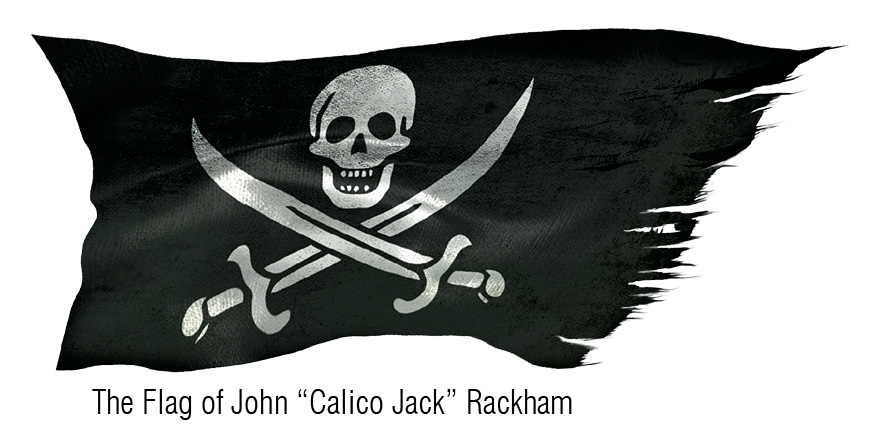
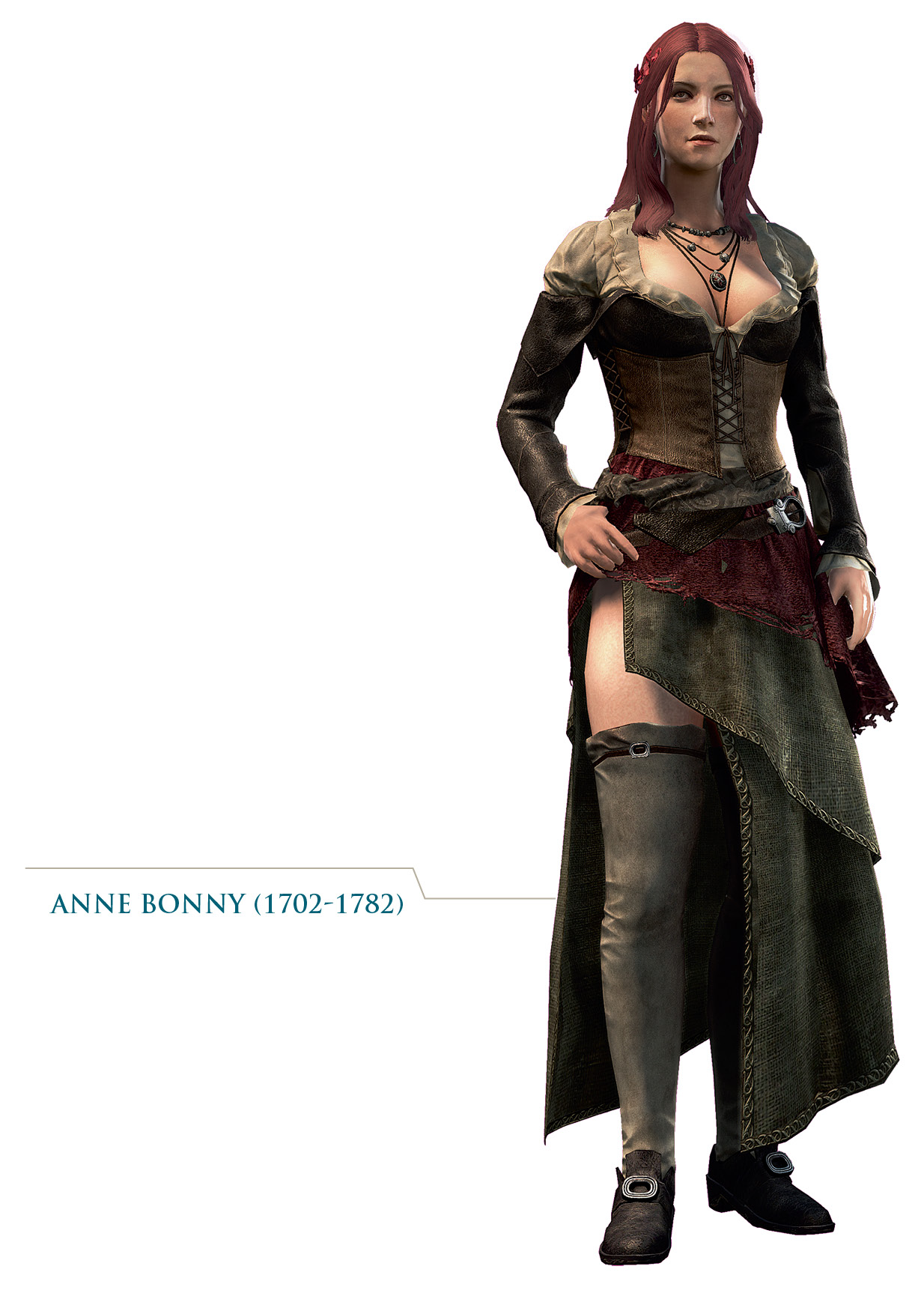
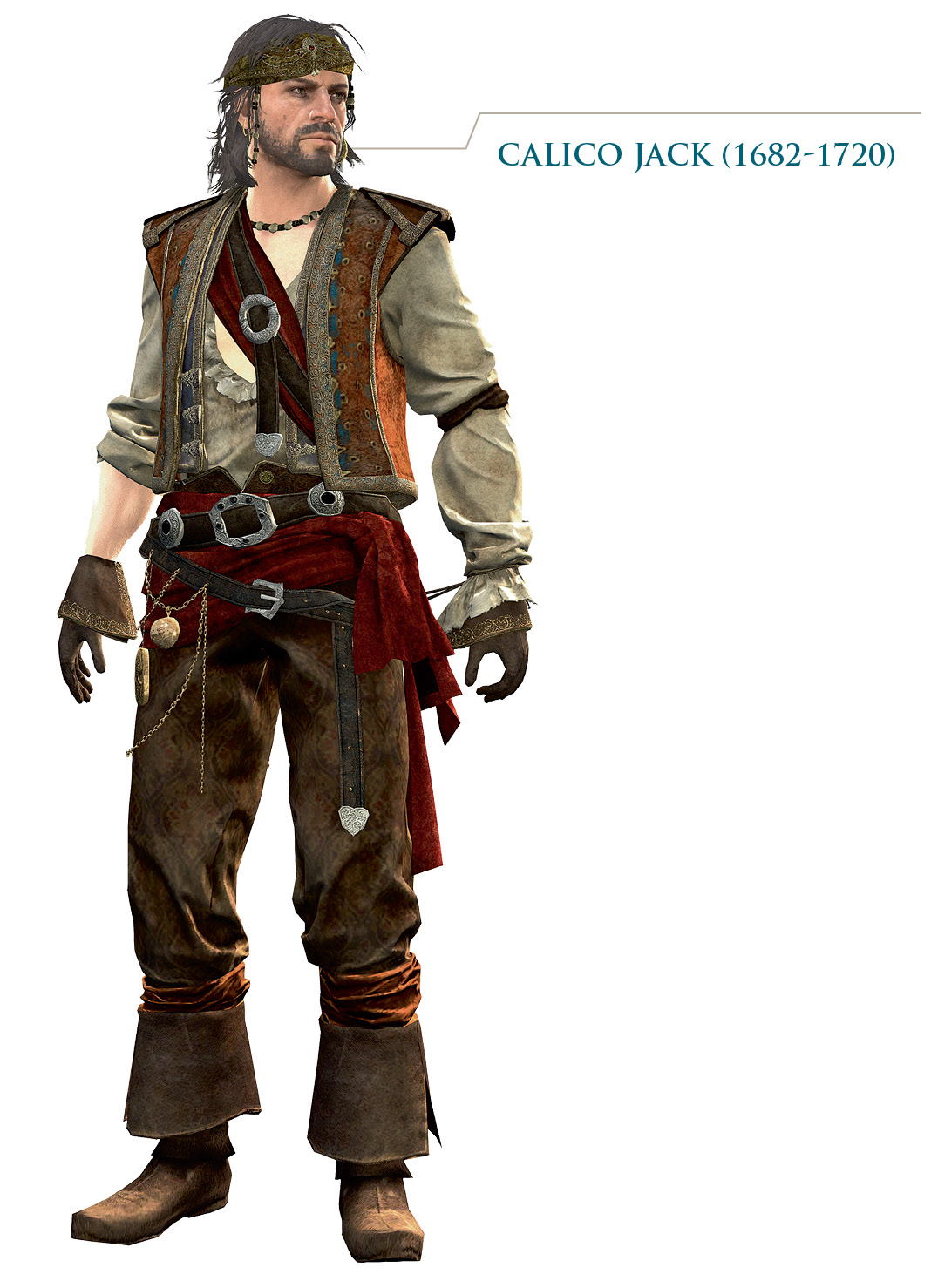
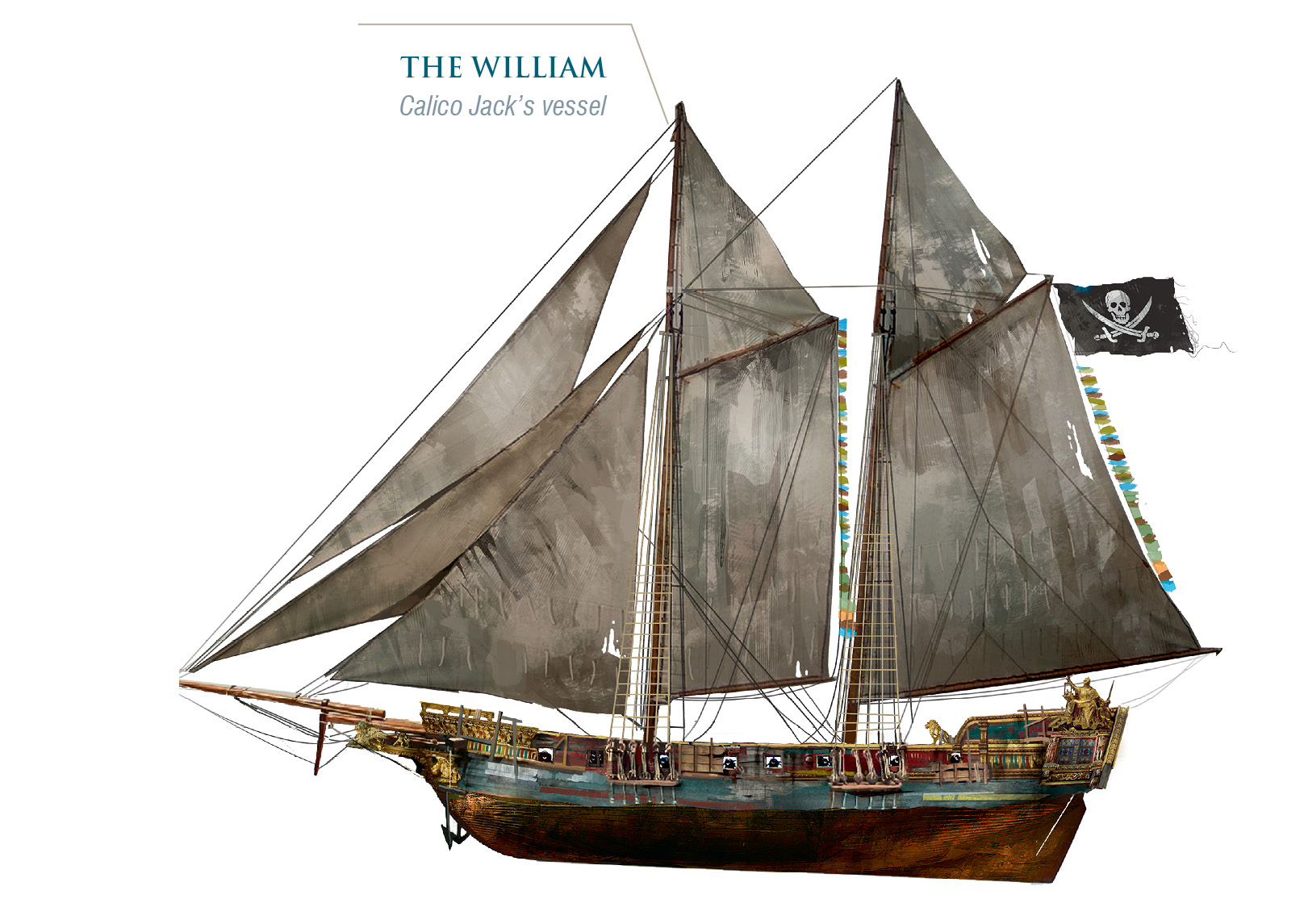
John Rackham, a.k.a. Calico Jack (1682-1720), was a Cuban-born pirate captain operating out of Nassau. He had the penchant for wearing flamboyant clothes made from brightly printed Indian Calico, leading to his moniker: Calico Jack. Although less prominent than some of his peers, he left two pirate legacies. The first was his flag, which was the skull with two crossed cutlasses, known as the Black Jack, which remains to this day one of the icons of pirate imagery. The second was that he had two female co-pirates in his crew: Mary Read, and his lover, Anne Bonny.
The first record of Calico Jack is as quartermaster on Charles Vane’s sloop in 1718, when Jack contested a volte-face by Vane and, with the support of the majority of the crew, deposed the captain to take command. He led his crew to capture several vessels including the heroic seizure of a sloop from a Spanish warship off the coast of Cuba. Jack set course back to Nassau where he and his crew elected to accept the King’s Pardon. While on shore, Jack met Mrs. Anne Bonny, and the two fell in love. The affair was hotly contested by Anne’s husband. Jack and his new lover, along with a fresh crew, captured a sloop and set off to sea. This return to piracy voided his recently gained pardon.
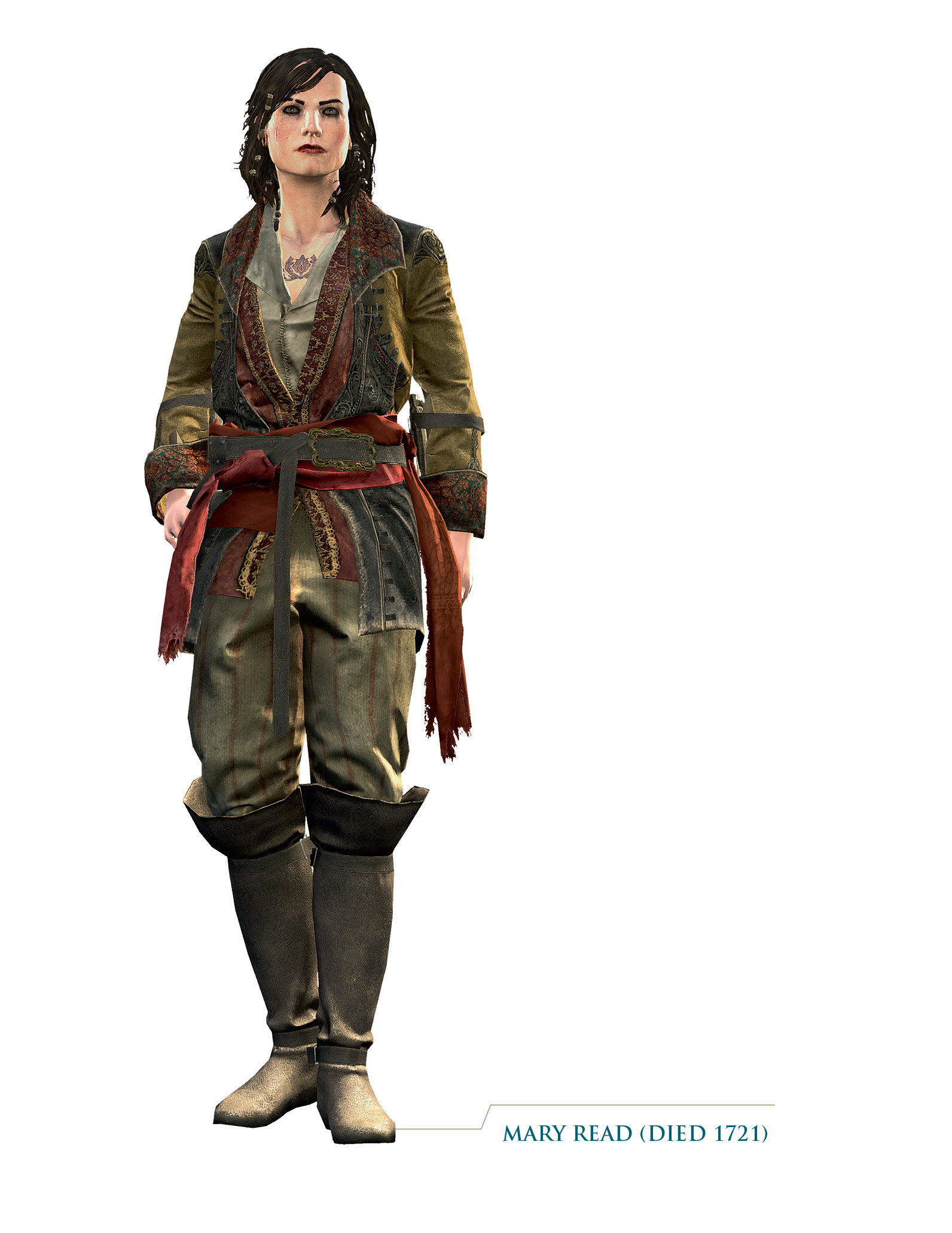
Mary Read spent most of her early life dressed as a boy to impersonate her deceased brother in order to gain an inheritance for her mother. She went on to gain a commission to privateer in her late teens. Astonishingly she lived on board the vessel with her true identity undetected. She supported her shipmates in a mutiny, turned pirate and eventually joined Calico Jack, revealing her true identity to Anne Bonny. Jack became jealous of the burgeoning closeness between the two women (believing Read to be a man) and so Jack was let in on the secret. He chose to break with seafaring tradition and permitted both women to remain as crew. Soon afterwards, Jack and his company were arrested and brought to trial in Jamaica in 1720. All, including Bonny and Read, were sentenced to death. Jack was hanged; however, the two women received a temporary reprieve, because they were “with child”, an appeal known as “pleading the belly”. Read died in prison and Bonny disappeared from all records.
Bartholomew Roberts
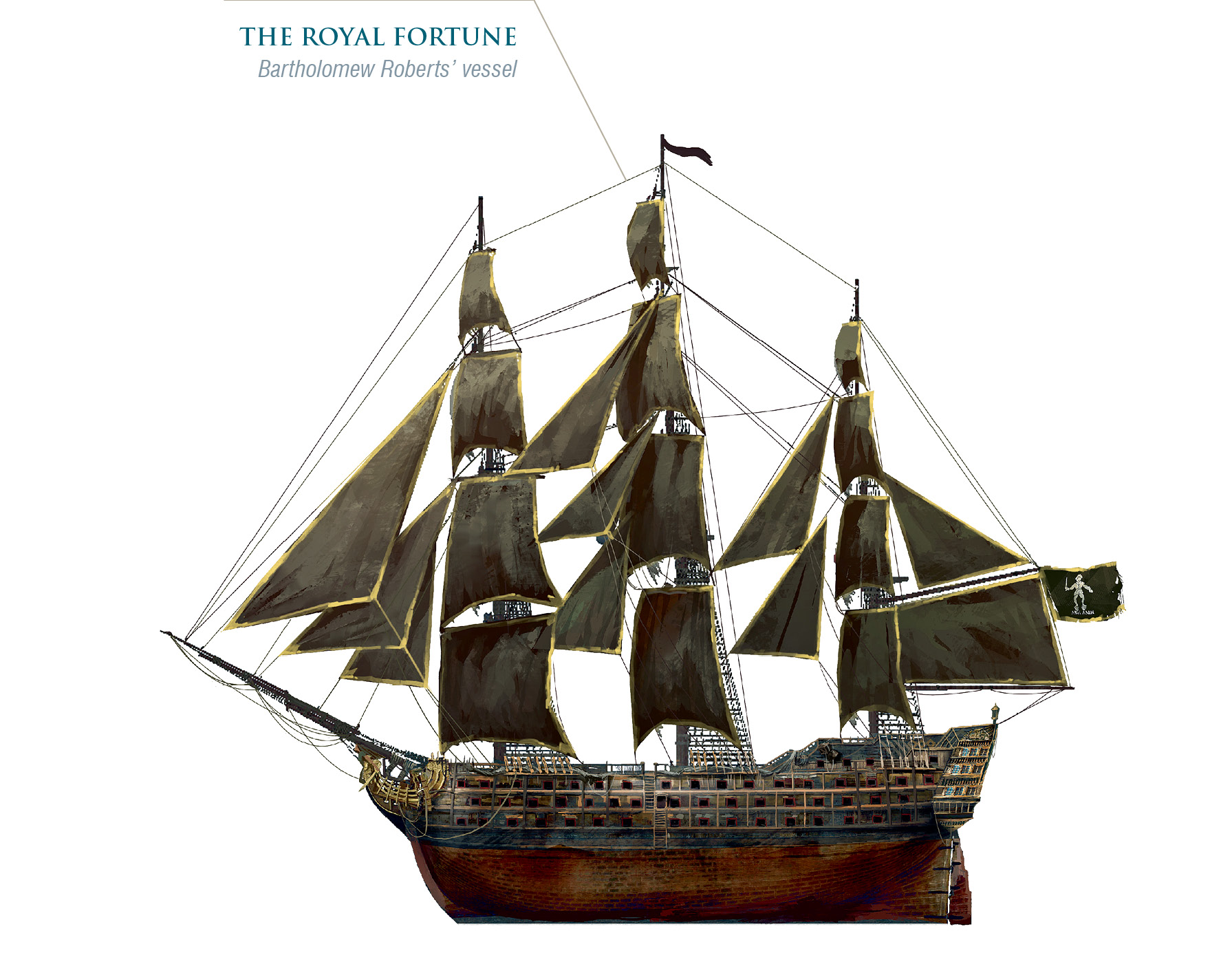
As the Golden Age of Piracy in the Caribbean was coming to a close, the story of the most successful pirate was only just beginning on the other side of the Atlantic. To put it in context, Blackbeard captured about two dozen vessels during his time; Captain Kidd really only took two; Bartholomew Roberts captured close on 400 in a three-year period. He was one of the few pirates who managed to seize a man o’ war, a vessel with 42 cannons, which he called the Royal Fortune.
Bartholomew Roberts was third mate on the slave ship Princess when she was captured by pirates off the coast of Africa in 1719. The pirate captain was killed six weeks later by Portuguese soldiers on the West African island of Príncipe. The crew voted Roberts to take the helm. Roberts embraced his new role and emerged as a born leader; he was very disciplined and ruthless and, exceptionally, he was a pirate who abstained from alcohol. He took many bold decisions, such as one particular incident, which occurred when he encountered a flotilla of 42 Portuguese merchant ships near the South American coast. As they awaited their armed escort vessels, he boarded one of the ships and forced the captain to point out the vessel in the fleet with the most valuable cargo. He boldly sailed up to the top prize, boarded her and made off with a hold full of gold and jewels. In 1721, Bartholomew Roberts attacked a man o’ war carrying the Governor of Martinique. Legend tells how he hoisted a French flag to pose as a merchant ship and then opened fire at the last moment. On boarding the ship, he had the governor strung up.
The HMS Swallow of the Royal Navy brought an end to Roberts’ plunder. The 50-gun ship encountered Roberts’ Royal Fortune as it lay at anchor near the West African coast. Roberts was trapped and outgunned. As he tried to sail to safety, adverse winds enabled the Swallow to fire several broadsides. The pirate captain was struck by grapeshot, which tore open his throat. The crew honored his wish to be buried at sea, his body never to be found.
Black Flags
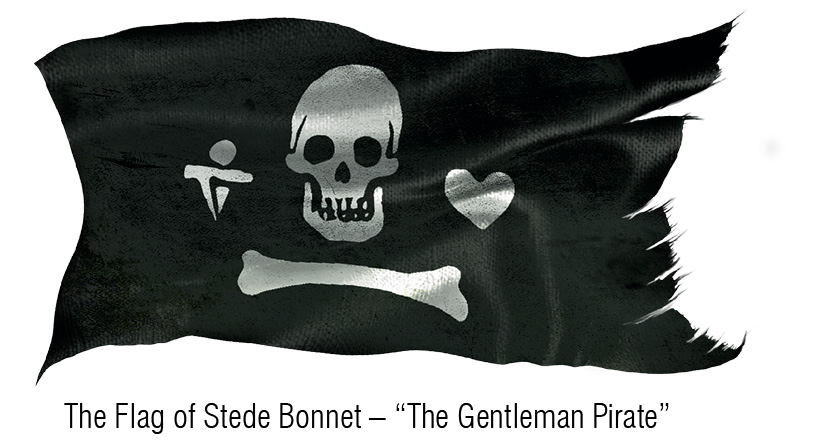
The skull and crossbones is the conventional symbol of piracy, striking fear into the hearts of luckless merchants across the Golden Age. There were, in fact, nearly as many flags as pirate vessels at this time. Flags used a variety of symbols with skeletons, swords, skulls, cross bones, hourglass, (bleeding) hearts being the most common.
Flags were generally in one or a combination of the colors black, white and red. The full, bright red flag was originally used by French pirates and became known as the jolie rouge, which evolved into the English Jolly Roger.
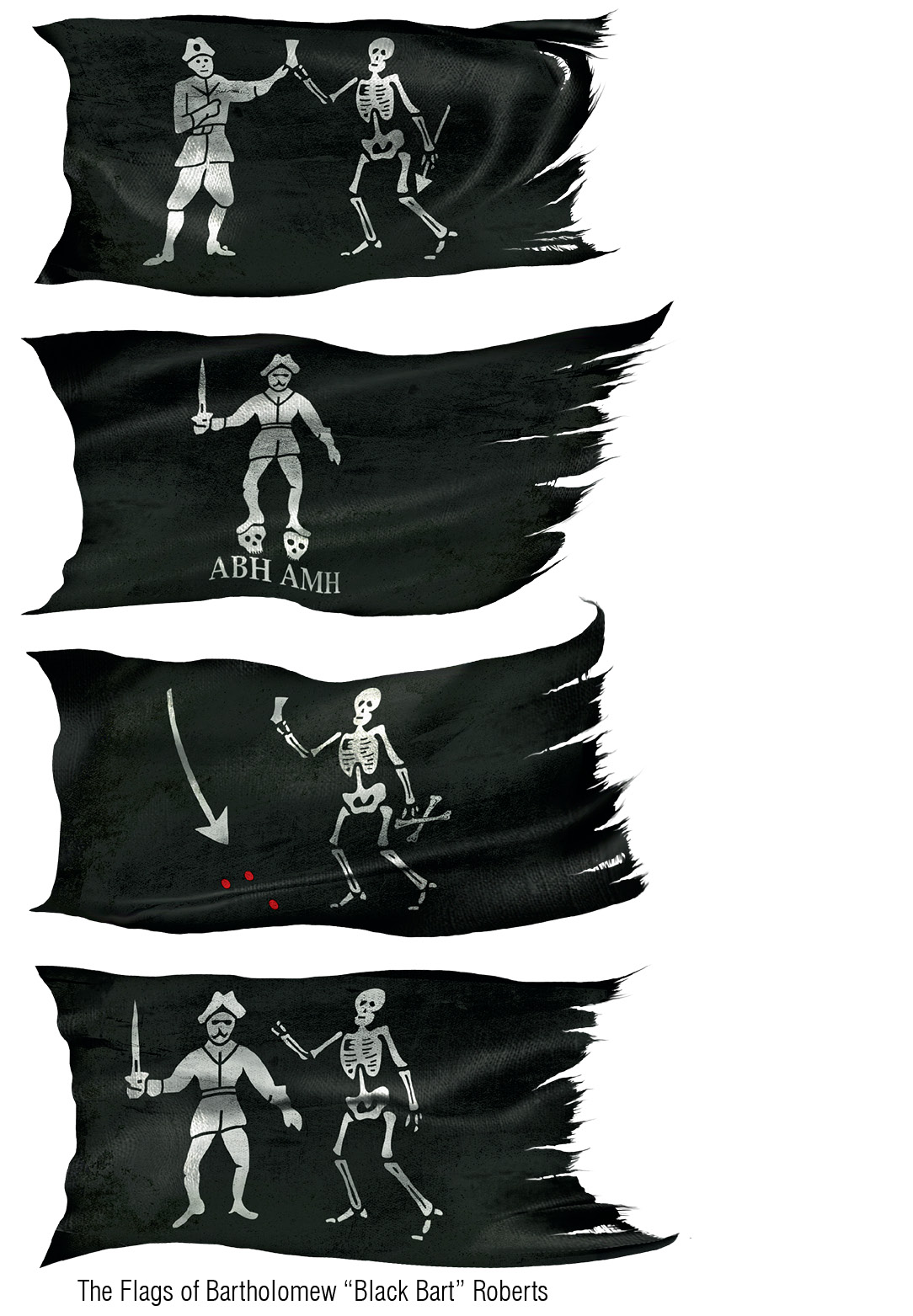
Bartholomew Roberts is reputed to have used at least four different flags. His most common being the black and white skeleton with a pirate holding an hourglass.
As his activities developed, Bartholomew Roberts came into conflict with the islands of Barbados and Martinique, and their governors sent armed ships to pursue him. This inspired him to develop a second flag, which had a black base with a white pirate (himself) standing on two skulls, beneath which were the letters ABH and AMH: “A Barbadian’s Head” and “A Martinico’s Head”.
When Roberts sailed to Africa, he used a black flag with a white skeleton. The skeleton held an hourglass in one hand and crossbones in the other. A spear and three drops of blood lay next to the skeleton.
In his final battle, Roberts selected a flag depicting a skeleton and a man holding a flaming sword.
In Assassin’s Creed IV, Kenway receives his own flag from none other than Blackbeard, when in the company of Hornigold. It is a solid black flag, and thus Blackbeard expounds: “We fly no colors out here, but praise the lack of ‘em. So let the Black Flag signal nothing but your allegiance to man’s natural freedoms. This is yours. Fly it proud.”