
Medal of Honor: Warfighter Guide Essentials Behind-the-Scenes
Developer Interviews
Developer Interviews
Kevin Hendrickson
Director of Product Development
What are some highlights of your professional background?
I have worked at EA and on the Medal of Honor franchise for the last 7 years. In 2010, with the formation of Danger Close Games, I became the Director of Product Development. Prior to working at EA, when I was part of a small start-up company called Studio Mythos Inc., we got our first break helping out with some level art on Medal of Honor: Frontline, so you could say that my game career has been tied for a long time to EA and the Medal of Honor franchise.
What are your main responsibilities for Medal of Honor Warfighter? Which do you consider the most challenging and why?
My role of the team is to keep the trains moving on time. I am responsible for the overall schedule, timing, logistics, and execution of the product. This was a challenging and exciting project as we switched over to the Frostbite 2 engine. It is extremely powerful, and it took some time to learn to harness all its strengths. Now the team is able to move at an extremely fast pace, which is gratifying to see. Another challenge on Medal of Honor Warfighter was working with lots of studios within EA. The level of coordination and support from all of them on Medal of Honor was impressive. The credits list is pretty epic.
What are your goals for the project and what were some of the challenges?
One of the goals was to add the additional element of real driving to the game in both the Karachi and Dubai levels. In order to achieve this real experience, we needed to use the Frostbite 2 engine that was set up for driving. This required us to switch between the two engines twice in the middle of the single-player campaign and make sure that the player didn’t notice the switch. That was extremely challenging and thanks to all our world-class engineers, they pulled it off.
What do you want the player to experience as they play Medal of Honor Warfighter?
We really wanted players to be immersed in the wide variety locations, as in this version of Medal of Honor we move around the world and have some unique backdrops. Further, we wanted to take players on to the next chapter, carrying on the story of our main characters. The fight didn’t end on the top of Takur Ghar after losing their fallen brother Rabbit. Mother, Preacher, and Voodoo continued the fight. With this game, the story is not just about the brotherhood story, but also goes deeper to show the special relationship that Preacher has with his family.
How involved were members of the Special Forces community in writing the missions in the campaign?
They were extremely involved with us through the whole process, not just story elements. It was great and we all felt honored to have them be a part of the Medal of Honor Warfighter product.
The campaign takes the player around the globe. How did you decide on which locations and mission types to include in the campaign?
The story of chasing the PETN helped to establish the locations and how Mother, Preacher, Voodoo, and Stump followed the trail around the world through the Cleric’s distribution chain.
Was there a challenge in balancing realism and playability in the campaign?
It is a balancing act, but at the end of the day we want to make sure we are making a piece of entertainment that will keep the fans coming back for more.
What new features are included in Medal of Honor Warfighter?
There are a number of things we wanted to make sure that we brought back from the previous Medal of Honor games that fans like, for instance our Peak and Lean, Ammo Mechanic, and refined shooting controls. New to our single-player campaign is our door breach mechanic that unlocks new ways of breaching as the player progresses. Our multiplayer gameplay is an evolution of elements from the last Medal of Honor, coupled with new classes, units, gun customization, game modes, Fireteams, and Battlelog—and of course all driven by Frostbite 2.
Is there something in the game of which you are particularly proud?
The visuals, animations, and moments of micro destruction that all come together in a symphony of combat that captures the essence of Warfighter.
What do you hope that people will say about the campaign in Medal of Honor Warfighter?
Danger Close – Nicely Done.
Ben Jones
Senior Designer
What are some highlights of your professional background?
I was fortunate to be part of the Day of Defeat team many years ago, and learned a tremendous amount from that experience, but working on the PS3 game MAG from start to finish really pushed my professional career forward by working in Level, Systems, and UI Design.
What are your main responsibilities for Medal of Honor Warfighter? Which do you consider the most challenging and why?
Level and Game Type design, along with Systems Integration, were my primary focus on Warfighter. Among them, I’d say that integrating our gameplay systems into our environments was the greatest challenge because of their varied nature. On any given day I’d be looking at anything from MAARS Robot movement through the environment to how Blackhawks arrived at their destination.
What are your goals for the project and some of the challenges?
My goal as a senior member of the team was to remove roadblocks for less experienced co-workers so that we could focus on creating the best possible levels for Warfighter. The greatest challenge we faced as a team was making levels that catered to each class and their varied abilities.
What are the steps you go through when designing a new multiplayer level, from start to finish?
The first step is to work with the Art Director to create a theme for the level. Then, based off that direction, I’ll draw a paper map to outline the gameplay space. Once that’s approved, I take the design into FrostEd and transform the paper map into a 3D space, generally with simple block assets. We then test the space extensively and refine gameplay. Once we are satisfied and art resources become available we’ll shift into production. A second design pass, and oversight throughout production, helps to push the level forward, and finally when lighting and effects are added the level comes into form.
Do you try to balance a map so that each side has some equality in cover and terrain?
Balance is a central component of our design process, but in order to give the player varied experiences and levels of challenge we must also consider the benefits of asymmetric gameplay. Though the Team Fortress classic 2Fort is an excellent design, I’m sure we’d all be quite bored by now if every level took such an approach.
Is there something in your levels of which you are particularly proud?
Combat Mission contains a series of progressive objectives that require a vast play space, and we’ve broken out each game mode into different sections of that larger map. Though this presented development challenges, the end result is that players get a fresh experience with each game mode, which greatly increases replay value!
What do you hope that people will say about the multiplayer levels in Medal of Honor Warfighter that you designed?
That they have long legs. Not in the physical sense, but that they’re defined by rich and engaging gameplay opportunities that lead to longevity. You can make an environment that caters to all of your gameplay systems and be successful, but to create a classic you must open your environment to the unexpected and let players tell a different story each day.
Do you have any tips for players on how to get the most out of a multiplayer level? What should they do the first time they play on a new level/map?
Success in multiplayer depends on reducing unknown factors, and to best do this you must remove your environment from the equation. Time spent in any map breeds familiarity, but I’d urge every player to explore early and often. Seek out vantage points and hiding spots to gain an advantage and secure your team’s victory.
Which level in Medal of Honor Warfighter is your favorite?
The levels in Warfighter are some of the best I’ve ever seen and, though I’m obviously biased, I’d have to say that Hara Dunes is my favorite. The setting is absolutely gorgeous and the Combat Mission objectives, dangerous cliffs, and engaging verticality make for a varied and enjoyable experience!
Chris Salazar
Art Director
What are some highlights of your professional background?
Developing the visual style of the Ultimate Spider-Man game (PS2), and working as Associate Art Director on Call of Duty: Black Ops. I hope my roller disco skills played a part in there as well.
What are your main responsibilities for Medal of Honor Warfighter? Which do you consider the most challenging and why?
I am responsible for the look and feel of the game as you see it when you play. This trickles down into every art department, from staffing it at the core, to finagling the levels at the end. The most challenging responsibility is the forever push for higher quality. As a studio, we are obsessed and fanatical about quality issues—everyone simply has amazing standards. It’s a challenge because time and resources will always nip at that...but we never give up, we never back down. We will never rest.
What are your goals for the project and some of the challenges?
My goals were to bring to life the authenticity that Greg Goodrich impressed upon us, respect the real-world situations each country’s people face with terrorism, and create a unique visual identity for Warfighter. In a competitive marketplace, I felt these goals would yield imagery and details that would set us apart. The challenge comes with marrying those ideals with gameplay, which has its own needs. The game has to be fun and entertaining throughout, so to retain high-minded ideals while having “fun” is a tough thing to do. I’m proud to say it’s a line we kept intact.
Where does research come into play during the design of a game? Does it continue throughout the process?
Research is a cornerstone of the artistic design, and it’s not just architecture and surface details. In order for research to have any validity, it must relate to the core fundamentals of the game, whether that is story or gameplay. For instance, a real world, Tier 1-based game requires an understanding of not just how the soldiers function, but the places they operate in, how the people who live there deal with adversity, how far back the roots of terrorism reach, and how we deal with it today. Learning the how and why of the world we live in provides all the visual inspiration ever needed…and it continues through the entire process, right up until the very end. Visuals need to have a strong understanding of the world they live in.
Do you feel the art helps set the tone for a mission?
Absolutely. The story or design might have a loose description handy, but in the end the visual is the only thing that will ever communicate what the mission was really like. Everyone knows the physical and environmental adversity Tier 1 Operators face—“man vs. nature” —but missions in Warfighter give us all the chance to experience it for ourselves. The tone for each mission is reflected in the weather, time of day, and architecture styles we chose.
Did you or the team travel to the actual locations for the missions? If so, where?
As the nature of Warfighter takes place in so many politically sensitive countries, it was difficult, but we did get the chance to travel to Manila, in the Philippine Islands. Experiencing with your own senses a country that faces so much adversity—natural, political, and economical—is overwhelming. It taught me what the Tier 1 Operators do is of the highest regard. To protect people over the world, and to pay homage to their homelands is an immense privilege. Travelling there gave me a sense of respect that brings tears to my eyes.
Did you also do research on the uniforms and clothing?
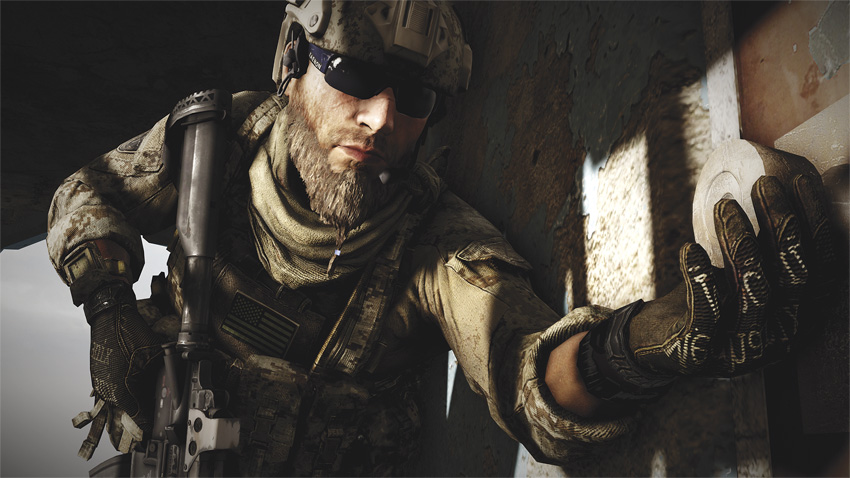
The uniforms and clothing in Warfighter are the absolute most accurate and highest quality I have ever seen. We were immensely fortunate—not only did we have actual Tier 1 gear at our fingertips, we had the Operators behind it to explain the nuances and features of it all. How it’s worn, why, what the different roles one might play have different needs….no fantasy elements at all. We also worked with a fantastic costumer, who helped us physically outfit nearly all of the characters on live models, giving us all the realism and detail one could ask for.
What sources did you use for your information?
The Tier 1 Operators were the single most valuable source of accurate and surprising information we could ever get. They are immensely knowledgeable about the world in a practical way that surpasses expectation. From there we just had to follow their lead, to take the view they have on any research angle we needed.
Is there something in the game of which you are particularly proud?
The scene at the end of the Basilan level, when the boats are lifted by the helicopters. The boat fight was one of the first sequences we put together, and to watch it with the music and FX all playing at the right times, to witness the power and future of the team, was amazing. I could tell then we were capable of great things. I will always be proud of the team for pulling that off.
What do you hope that people will say about multiplayer in Medal of Honor Warfighter?
That is was fun! Really MP is all about fun… the visuals are there to help immerse you and carry the experience, and in the end, time spent with your Fireteam Buddy getting the best of everyone is a fantastic sense of satisfaction. We pushed hard to make the environments unique, the characters real, and the destruction tangible. I hope people love to talk about those things.
Any final thoughts?
Medal of Honor Warfighter has been a truly defining experience. It exists in a pantheon, a lineage reaching back to the core of military first-person shooters. To have been a part of that, and to have had it be a time of growth and coming together, will stay with me forever.