
Foreword by Sam Lake
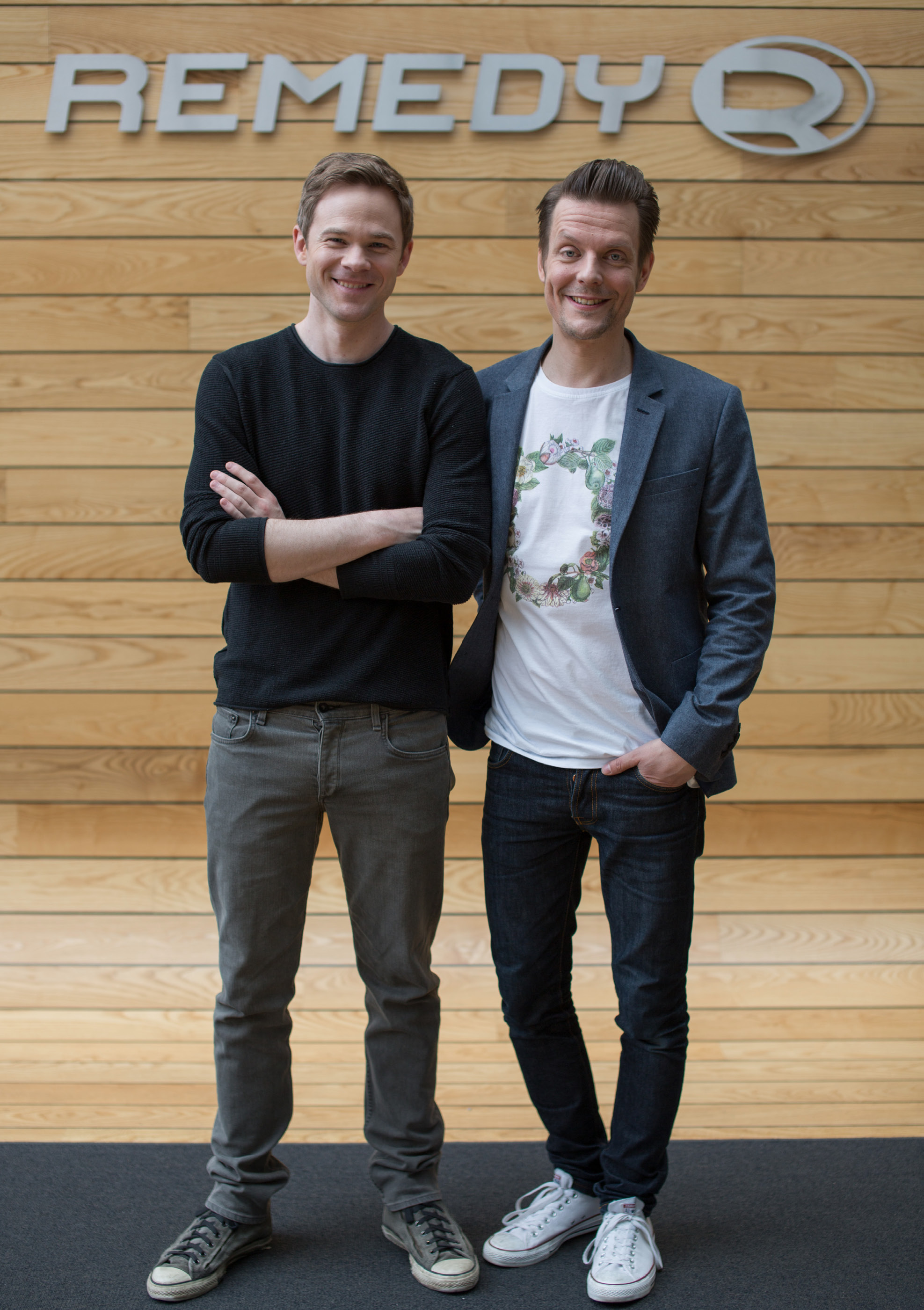
It’s done. I’m writing this foreword on the night we got the news that Quantum Break has gone gold, concluding the journey we embarked upon four, almost five years ago. Tomorrow at Remedy we will open a huge bottle of champagne with a “When it’s done!” sticker on the side. As the creative director, I feel immensely proud of our accomplishment. Quantum Break was a long, hard project, my first big game in that role.
Why was it a hard project? Well, making games is fundamentally difficult. Games are defined by their technology, and that technology is advancing rapidly, which means that every new game project is a prototype project. You are trying to create something that no one has done before. There is no roadmap and the rules are changing; what was impossible before might well be possible now.
With Quantum Break we wanted to do so many new things: build it on a new platform; create new tools and engine with a big focus on the cutting-edge character technology and time-bending special effects, a genre that was new to us (sci-fi!); a new setting; a new story; new ensemble cast of characters; new core gameplay; Interactive narrative as a method of storytelling; big name actors; and a live-action show. Alone, each and every one of the items listed above is a challenge; put together it’s borderline madness—but a good kind of madness, madness as ambition that we embraced gladly when given the trust and opportunity to do so by our publisher, Microsoft Studios. It took us close to five years to get there—a roller-coaster ride with a lot of concept work, prototyping, iteration, trial and error, and going back to the drawing board. Also a lot of learning moments, of both despair and triumph. And here we are.
Both of our previous games, Max Payne and Alan Wake, are very character-centric experiences. Everything you experience in them is filtered through the mind of the main character. Is it always night in all the New York levels in Max Payne, or is that just how Max sees the world? In Alan Wake you are playing a story that is the manuscript Alan Wake has written—a story that has come true. Quantum Break as a game is also character-centric in that it is Jack Joyce’s hero’s journey, his origin story as a superhero. But there’s a very good reason why this game is not called Jack Joyce.
In the style of a TV show, Quantum Break is bigger than one character’s story. You play as Paul Serene, as well, and in the show, you follow multiple other characters. Because of this ambition to achieve a wider perspective, for us it was more important than ever before that we create an immersive, cohesive, and believable universe, something that works not just from the perspective of one character, but of all of them. The ambition was always that we should have no feature, no element just for its own sake. Everything had to fit into the big picture, so that the whole of the end result is more than just the sum of its parts.
This included both the game and the show, and all the crossover elements between them, the history of the world, the architecture, the branding of Monarch Solutions—the company that opposes Jack in the game—as well as the fictional science around time breaking down and the time-related superpowers. A big part of this comes from the art direction. This book provides a glimpse into the planning, iteration, and work it took to get us to what Quantum Break is—its secret history, if you will.
I hope it will be illuminating!