
Summit Units
Engineer
Hit Points:

Damage Caused:

Movement:

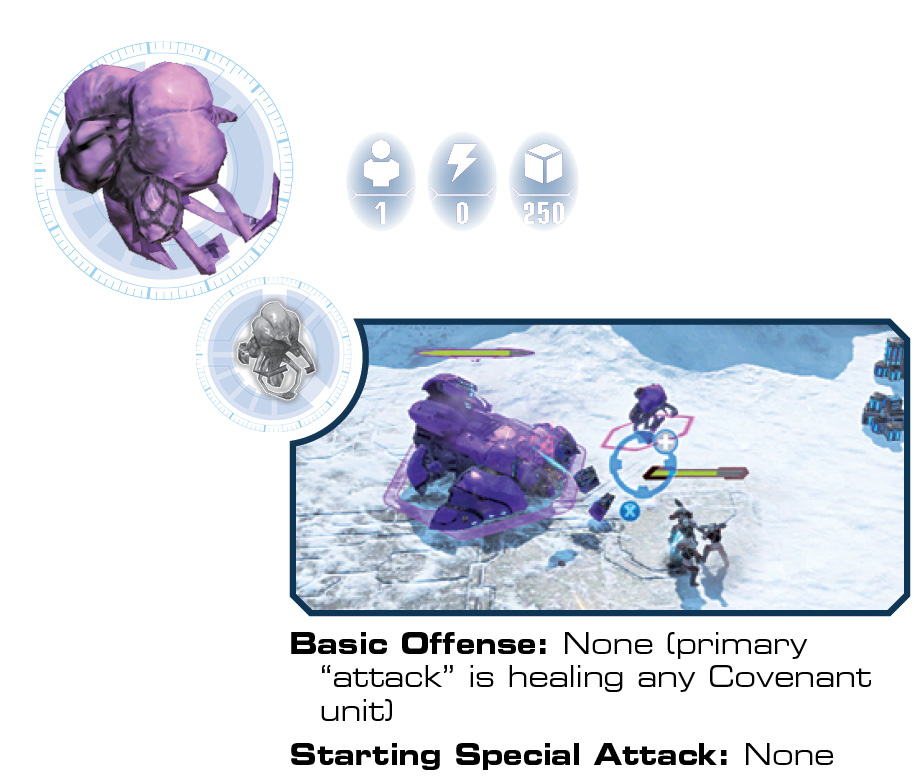
A support unit that repairs and heals nearby allied units.
Base Unit
Upgrade #1: State of Grace

Increases repair rate.
Upgrade #2: Harmonious Digestion

Increases movement speed.
Engineer Overview
|
Unit Class: Support Unit Strengths: Excellent at healing and regenerating friendly units that are under constant and heavy enemy barrage. Weaknesses: Slow prior to upgrades, and with no offensive capabilities whatsoever. Accessed via: Summit |
The Engineer, known as the Huragok by the Covenant, is a race of gas-filled alien creatures created by the Forerunners to perform maintenance on Forerunner structures. Engineers are the only way the Covenant can repair their buildings and vehicles during combat, and they are very effective, especially once upgraded. They automatically search out damaged machinery to repair. They have no defenses or weapons and are easily killed, although they can repair each other but not themselves. They can be upgraded to State of Grace, which increases their repair rate, and to Harmonious Digestion, which increases their movement speed. The Engineers can easily take apart random technological objects and can put them back together exactly how they found them. This is probably their way of studying and understanding new technologies.
Tactics
Without the orbital Heal & Repair that the UNSC counts on, the Covenant’s main source of troop regeneration is the adapted Forerunner repurposed entity known as the Engineer.
This slow-moving airborne creature is supremely adept at healing. However, Engineers are unable to attack enemy units or buildings; they have no offensive capabilities whatsoever.
Use Engineers to float behind your main attack line, repairing units that you’ve pulled out of combat. Or, have Engineers float near friendly units already engaged in combat to keep them attacking for as long as possible. The enemy usually doesn’t know whether to attack the Engineer or the unit the Engineer is healing. It is best to remove an offensive unit first.
Remember that Engineers can also heal buildings, which can be helpful if you’re in a defensive or Turtling position.
Construct a mass of Engineers with the sole role of buffing up a Covenant leader or a Scarab; this is a very effective strategy. With enough Engineers (the number varies depending on difficulty), you can heal a leader or Scarab faster than they receive damage, although this depends on the type and number of foes they are fighting. Effectively turning your best troops “invincible” is the key asset this troop can bring to the battlefield.
Banshee
Hit Points:

Damage Caused:

Movement:

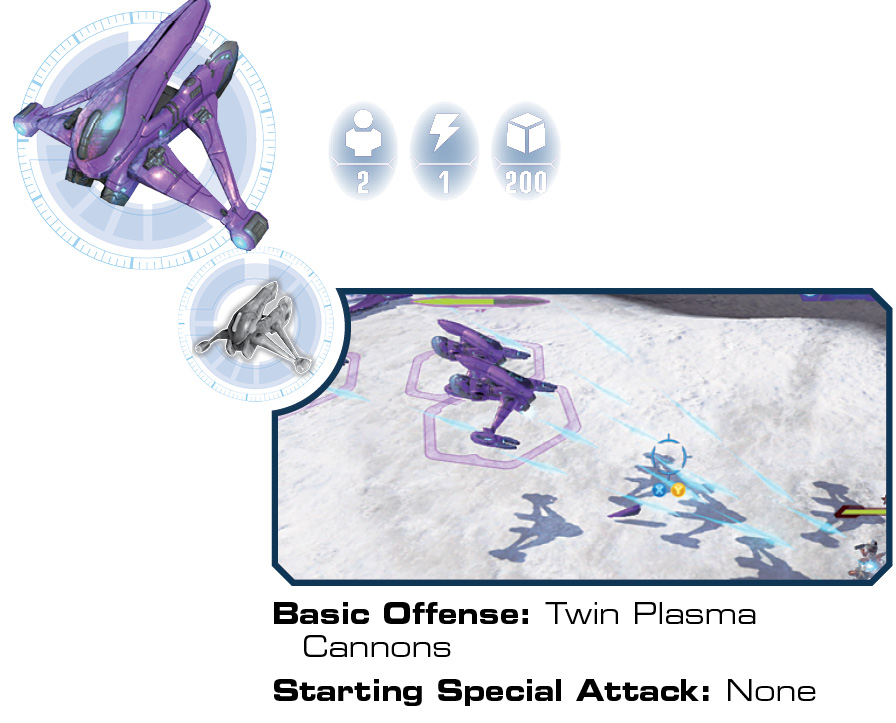
Mainline air unit, Banshees are armed with both Plasma Cannons and Fuel Rod Cannons.
Base Unit
Upgrade #1: Boost

Enables Speed Boost ability.
Upgrade #2: Repeating Cannon

Increases the rate of fire for the Banshee’s weapons.
Upgrade #3: Sacrifice

Banshees attempt to crash into ground targets and inflict damage when destroyed.
Banshee Overview
|
Unit Class: Main Air Strengths: Excellent at attacking all unit types and ignoring terrain difficulties. Once Boost is available, extremely adept at raiding. Weaknesses: Light armor and susceptible to attack from a wide variety of foes. Accessed via: Summit |
The most frequently seen Covenant air unit is the Type-26 Ground Support Aircraft, or Banshee. Carrying one pilot, this versatile and nimble aircraft is used to scout and harass enemy forces. Carrying Twin Plasma Cannons and a Fuel Rod Cannon, the Banshee can deal serious damage to both ground and air forces. It also has a speed boost ability.
Tactics
The Banshee is the Covenant’s main air unit and fills the exact same role as the UNSC’s Hornet. Read strategic advice for the Hornet, as it is applicable to the Banshee as well.
The only difference between the Banshee and the Hornet is the upgrade. One of the Banshee’s upgrades is the Boost, a secondary ability that increases its speed for a short amount of time.
The Boost ability is extremely useful if you’re employing Banshees to raid enemy structures or escape from combat. Simply employ the Boost to quickly act on an intended target faster than your foes can counteract, or use it to speed away more quickly than your opponent’s defenses can follow you—unless, of course, your foe is using upgraded Banshees!
Think of the Banshee as a Hornet but with better raiding capabilities thanks to its Boost.
Vampire
Hit Points:

Damage Caused:

Movement:

Antiair aircraft, heavy Needler turret can track and engage enemy aircraft in a large area.
Base Unit
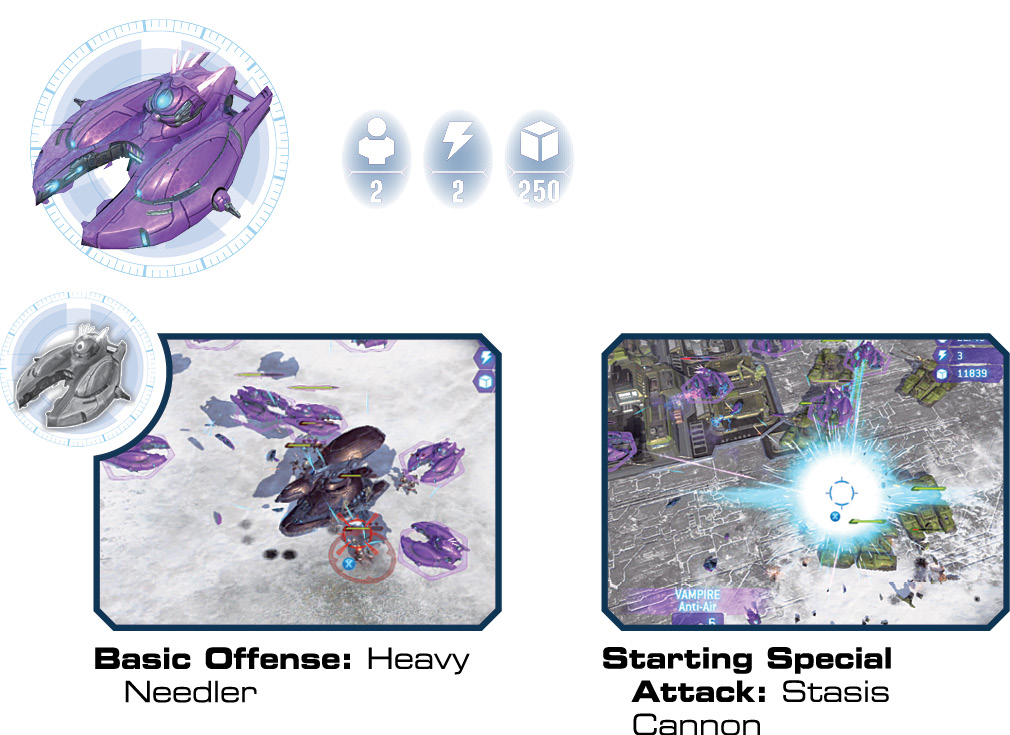
Upgrade #1: Stasis Drain
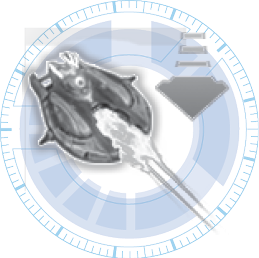

Stasis ability now drains target Hit Points and heals the Vampire.
Upgrade #2: Stasis Bomb


When a target is drained with the Stasis ability, it explodes, doing area-of-effect damage.
Vampire Overview
|
Unit Class: Antiair Strengths: Devastating against enemy air units. Self-healing when attacking after a Stasis Drain upgrade. Weaknesses: Weak against ground troops, both infantry- and vehicle-based. Accessed via: Summit |
The Vampire is the mainstay of Covenant antiair aircraft. With a heavy Needler turret, the Vampire can quickly overwhelm enemy air forces with a large barrage. Very effective in groups, it can bring down an opposing aircraft in seconds. When upgraded, the Vampire can drain enemy aircraft of their energy and cause it to crash; however, this makes the Vampire take damage as well. The Vampire’s upgrades can be a game-changing element in air battles. The Stasis Drain can lock down enemy air units while the Stasis Bomb can freeze enemy ground units for Covenant forces to pick off.
Tactics
A slow-moving airborne antiair unit, the Vampire is the Covenant’s answer to any air unit your foe may be fielding.
It is incredibly effective against massed enemy air units; if your foe is creating Hornets, Vultures, Hawks, or Banshees, begin to counter this by stepping up your Vampire production. One Vampire can decimate around four Hornets if used cunningly.
The Vampire’s Stasis ability can completely immobilize an enemy air unit. It can be further upgraded to drain the Hit Points from enemy air units that are already trapped by Vampires. Vampires are arguably the finest force for dropping enemy air units from the skies, immobilizing them, destroying them, and taking little or no damage in the process.
Vampires have extreme vulnerabilities, though; they are poor at combat when attacked by ground troops.
Counteract the Vampire’s problems by pairing them with units that have weaknesses to air troops, such as Wraiths, Jackals, and Hunters. With a flexible army of this nature, you can rely on (and bring to bear on your opponents) your forces’ strengths and none of their weaknesses.