
SimCity Guide Essentials Utilities
Utility Management
Providing power, water, sewage, and waste disposal services is a fundamental responsibility for all mayors. If you’re not doing your job, you’ll hear about it from angry Sims protesting outside City Hall. Red thought bubbles will also pop up all over the city, revealing the complaints of individual Sims.
Failure to meet any utility demands could eventually lead to abandoned buildings as Sims pack up and leave the city. As the population drops, so does tax revenue. To avoid a massive exodus, stay on top of the ever-changing demands on your city’s utilities.
Pollution and Land Value Concerns
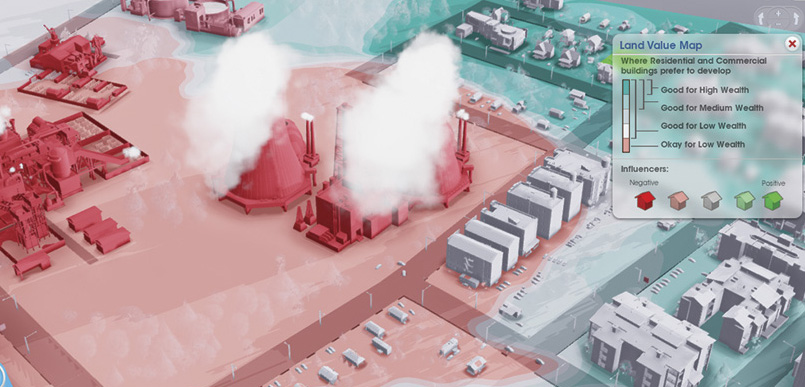
Most utility buildings cause land values to plummet, as visible in the Land Value map.
Although they provide vital services to your city, nobody wants to live or conduct business next to your utility infrastructure. Why? Many of these structures emit some level of ground or air pollution. Plus, nearly all utility buildings reduce land value.
Go ahead, activate the Land Value data map to see how these buildings bring down the neighborhood. As a result, it’s a good idea to keep these buildings far from your residential and commercial zones. Industrial zones can tolerate the ill effects of pollution and low land value much better, but still, consider keeping these utilities somewhat isolated from the rest of your city.
A classic SimCity strategy is to build these structures along the edge or corners of your city site, helping minimize the effects of pollution and low land value—when placed on a border, a portion of the negative footprint lands outside your city limits.
But when doing this with a polluting power plant or the Garbage Dump’s Garbage Incinerator, make sure the wind direction carries all air pollution away from your city, otherwise air pollution blowing over your city will lead to complaints and sickness
. If you’re running low on space and simply need to build closer and closer to utility buildings, consider building parks to serve as a buffer. Parks reduce air and ground pollution as well as increase land value, helping offset the negatives associated with utilities.
Or dedicate an entire city to utilities, selling and volunteering services to other cities in the region. This helps keep pollution consolidated in one city instead of spreading it throughout the region.
Expansion of Services
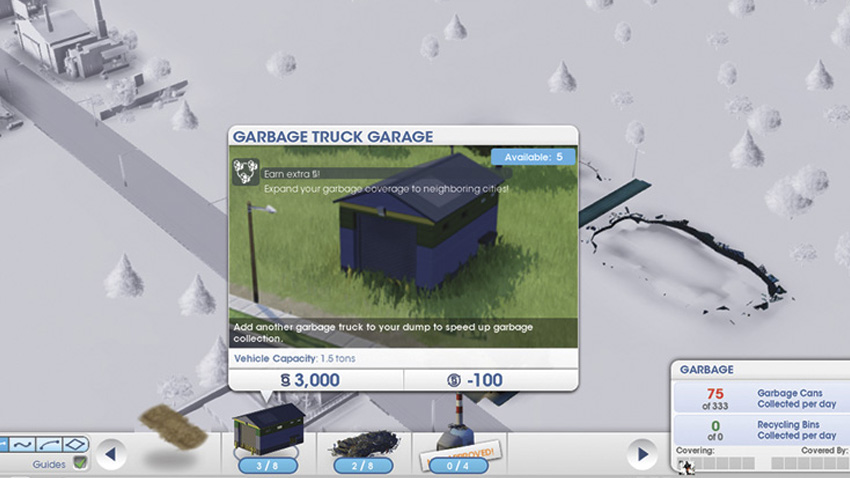
Most utilities can be expanded by constructing additional modules. This allows you to expand services as needed.
Once your utility infrastructure is in place and working splendidly, don’t turn your back on it. As your city grows, so will the demand for more power, water, sewage, and waste disposal. Periodically open the associated menus and study the data in each info tab to ensure services are adequate—those analog gauges are a quick and easy way to analyze the situation.
As a rule of thumb, check in on your utilities every time your City Hall earns an upgrade. City Hall upgrades are tied to increases in the population, a good indicator of increasing demand on your utilities. If you’re seeing any deficiencies in service, expand the impacted utility buildings with additional modules to meet the increased demand.
Also, keep an eye on your city’s skyline. When high-rise residential and commercial buildings start popping up, take another look at the utility menus. The increased density of these structures can put a sudden strain on your utilities, potentially leading to shortages.
As you can see, the demand on a city’s utilities never ends. In fact, it only increases as the city grows. Keep this in mind when placing your utility buildings, leaving enough space around them so you can construct additional modules as needed.
Outsourcing Services
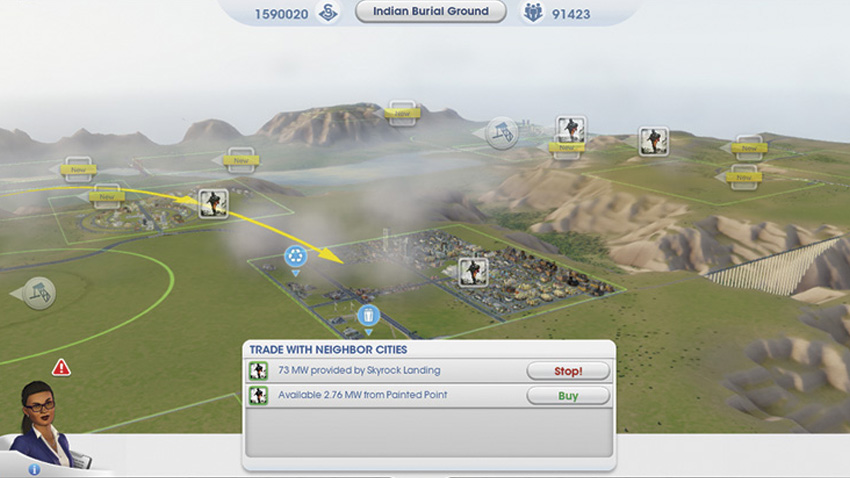
Open the Region View to buy power, water, and sewage service from neighboring cities.
Don’t feel like supplying your city with utility services? You can always attain power, water, sewage, and waste disposal services from neighboring cities in the region. Open the Region View and look for nearby cities connected to the regional highway—all regional utility services are transmitted along the highway.
If no cities are connected to the same highway, you’re on your own. Open the Power, Water, or Sewage menu to open a new trade window, giving you the opportunity to buy services from any of the connected cities. Click the Buy button to begin buying services—you can stop the deal at any time by clicking the Stop button.
All deals of this nature must be initiated by the city in need of services. Buying services from another city is easy, but it may not solve all your problems. For example, if a neighboring city is only supplying 15 MW of surplus power and your city needs 20 MW, you’ll need to address the deficit by constructing a power plant or by purchasing additional power from another city.
So even if you’re purchasing utility services from another city, keep a close eye on the info tab within each menu to ensure demands are being met.
Volunteering Trucks
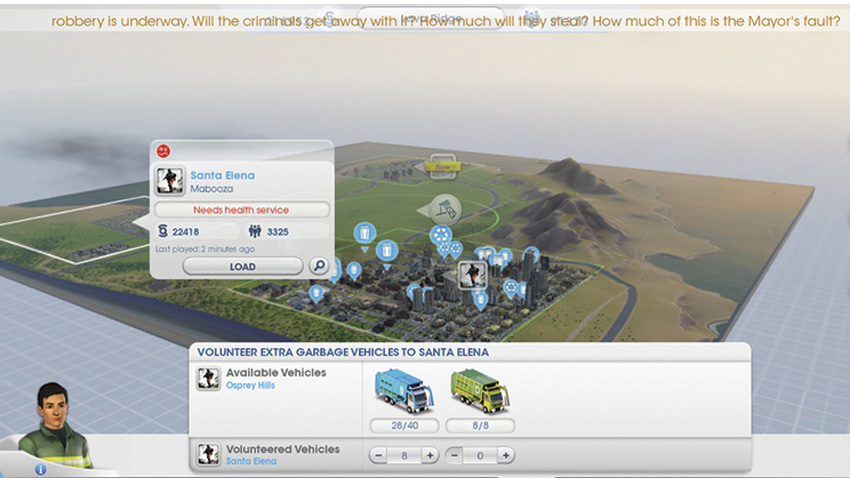
As you add new garbage and recycling collection trucks to your fleet, volunteer them to neighboring cities to generate extra income.
The sharing of garbage and recycling collection trucks works a little differently. You can’t buy waste disposal services from a neighboring city. Instead, a city can volunteer its trucks to your city, free of charge. When receiving coverage in this fashion, you pay nothing, but have no control over the number of trucks charged with emptying garbage cans and recycling bins in your city.
If some cans and bins are going uncollected, ask neighboring cities to volunteer more trucks, or build a Garbage Dump and Recycling Center of your own to handle the shortfall. If you already have a Garbage Dump and Recycling Center, open the Region View and click on the Waste Disposal menu.
Here you can volunteer your own garbage and recycling collection trucks to neighboring cities. Click on the city you wish to assist, then adjust the number of trucks you wish to volunteer. Feel free to scatter your fleet of trucks among multiple cities.
When volunteering vehicles, your city loses no coverage—the same trucks can service both cities simultaneously—so there’s no reason not to volunteer every truck in your fleet. Each truck receives a small fee for collecting garbage cans and recycling bins in neighboring cities. This additional income can help offset the operational costs of running your Garbage Dump and Recycling Center.
| Icon | Name | Criteria |
|---|---|---|

|
2 Kilometer Island! (Secret) | Have a nuclear meltdown in your city. |

|
Aqua Max | Have a city that has over 100 kgal of water needed per hour. |

|
Blowin’ in the Wind (Secret) | Have 24 Wind Turbines at Wind Power Plants in your city to gain access to the Tornado disaster. |

|
Dump City! | Have 560 tons of garbage in your Garbage Dumps. |

|
Garbage Man! | Pick up 10 tons of garbage in a day. |

|
Green Plumbobs | Pick up 10 tons of recyclables in your city in a day! |

|
Ick or Treat! | Treat 200 kgal/hr of sewage at a Sewage Treatment Plant. |

|
Make Sure You’re Grounded… | Provide both power and water to a neighbor, at the same time. |

|
Mayor Yuck (Secret) | Have 500 Sims complaining about dirty water in a day. |

|
Sewage Stuffing | With 10,000 or more residents, prevent sewage issues using only Sewage Outlet Pipes. |

|
Sludge-free H-2-0! | Pump 500 kgal of fresh, clean water in an hour. |

|
Super-Powered | Have a city that has over 300 MW of power needed per hour. |

|
Time to Relocate | Have 200+ garbage issues at once in a region. |

|
What’s Cookin’? (Secret) | Burn 100 tons of garbage in an Incinerator at the Garbage Dump to gain access to the Big Lizard disaster. |