
SimCity Guide Essentials City Specialization
City Specialization
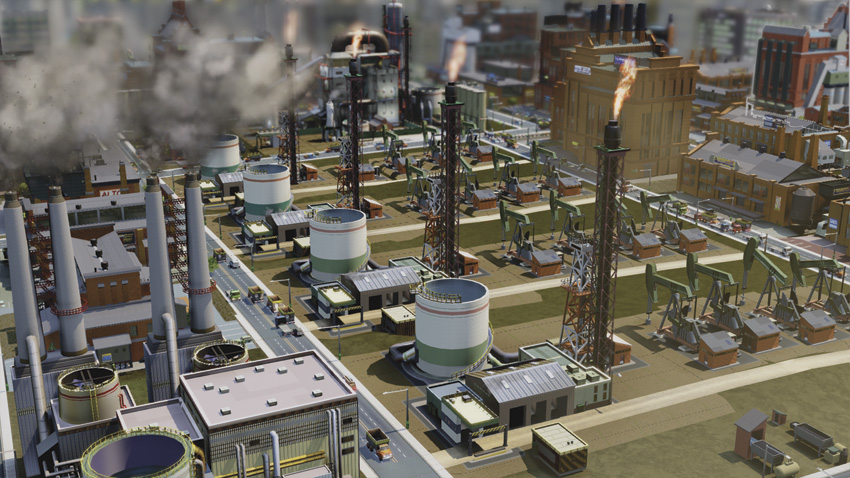
Mayor, I have some bad news. The treasury is running a little low—maintaining all those city services and schools isn’t cheap.
And I don’t think the Sims can tolerate another tax increase. But now for some good news. We’ve identified a number of natural resources, just beneath the city. Consider building mines or an Oil Well to extract those resources, then export them though a Trade Depot to make a quick profit.
Or take city specialization to great heights by processing resources through a Smelting Factory or Oil Refinery to produce even more valuable metal, alloy, plastic, or fuel. By exploring opportunities in the metals, petroleum, trading, and electronics businesses, you may get the city’s budget back on track.
And all those Sims bellyaching about no jobs? These specializations employ tons of workers of various wealth and education levels, potentially leading to a boost in tax revenue as more Sims move in and new shops open. It’s too early to tell, but city specializations may be the economical antidote we’ve been looking for!
City Specialization Overview
Have you managed to pull some raw ore, coal, or crude oil from the ground? What are you going to do with it? Extracting resources is just the first step and will earn you no money. So before you start mining or drilling, it’s important to understand how resources and resources move throughout your city and region.
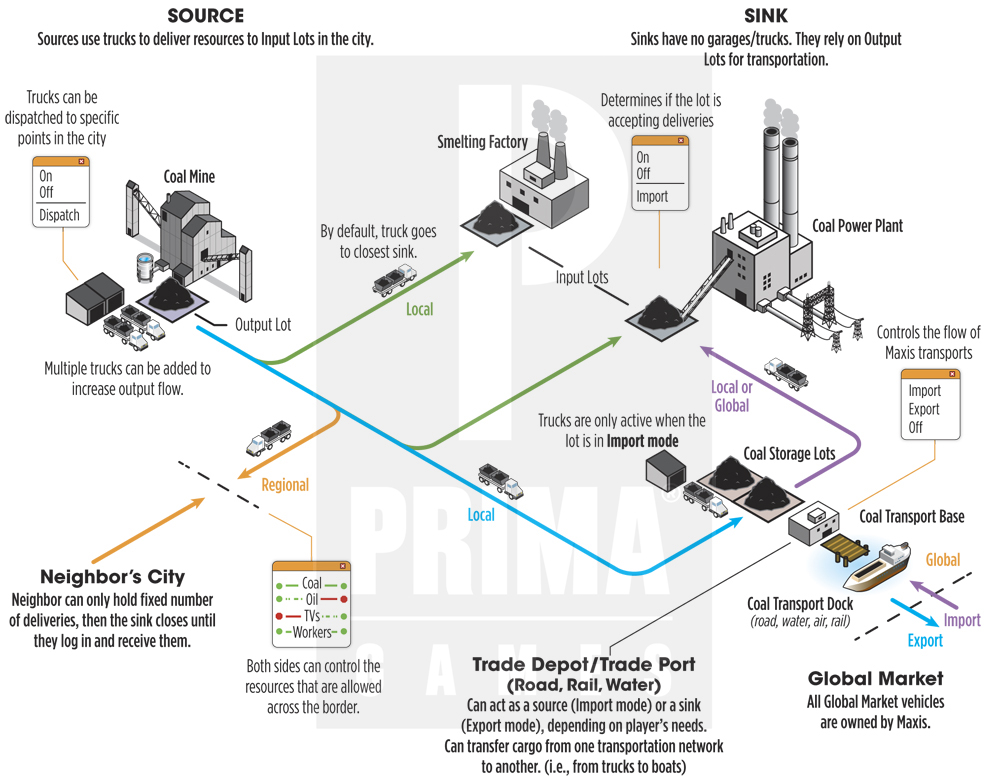
In the accompanying example, a Coal Mine produces coal, which is stored in the mine’s output lot. Trucks from the Coal Mine are then used to transport coal to a variety of possible locations—trucks automatically deliver coal to any input lots open to local deliveries. Coal can be sent to a Coal Power Plant to generate power for the city and region.
It can also be sent to a Smelting Factory where it is combined with raw ore to create alloy, a valuable commodity in its own right, essential in electronics or constructing Great Works. The coal can also be gifted to neighboring cities or simply sold for a quick profit on the global market through a Trade Depot or Trade Port.
When a Trade Depot or Trade Port is set to export, trucks, trains, or cargo ships arrive from the region to buy coal at the current market price. If no Coal Mine exists, it’s still possible to supply the Smelting Factory and Coal Power Plant with coal from imports bought on the global market or gifted from a neighboring city.
Transporting cargo
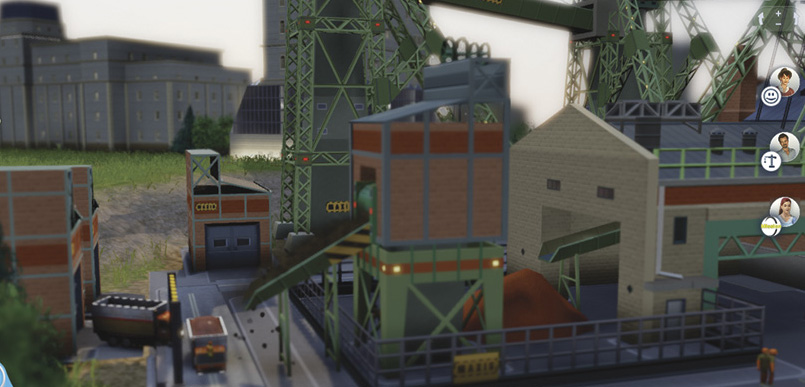
Trucks are the key to moving resources throughout your city. Make sure your mines, Oil Wells, and other buildings have enough truck garages to accommodate all that cargo.
As you can see, it’s a very fluid process with many options and moving pieces. But whatever your intentions, it’s important to keep the supply chain moving. Any interruptions can bring the whole system to a halt, reducing profits. And if your city is relying on those profits to cover its expenses, a financial collapse may be imminent.
For best results, place the participating buildings as close to each other as possible. In this case it means placing the Coal Mine, Smelting Factory, Coal Power Plant, and Trade Depot or Trade Port within close proximity. This significantly reduces transportation time, minimizing the chances of trucks getting stuck or delayed in traffic on the opposite side of the city. With less travel time, trucks from the Coal Mine can make regular deliveries to the input lots of all participants in the supply chain.
Planning
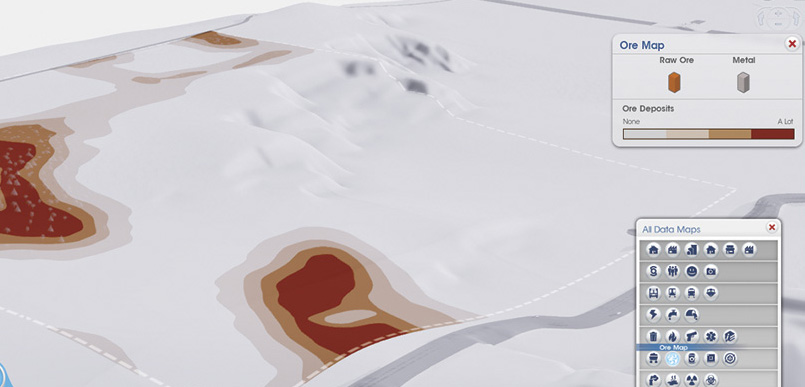
Access the data maps early on to identify resources beneath your city site. This makes it easier to plan the layout of your road system and supply chain.
The creation of an efficient city specialization supply chain should begin early on, preferably before you even connect a city to the highway. Use the data maps to locate your resources, and then determine where each building should go. While money is in short supply at these early stages, it costs nothing to plan ahead.
If you intend to sell your resources on the global market, where will your Trade Depot go? Or if you have access to rail or water, plan to eventually build a Trade Port to move large amounts of cargo. Due to geography, some participants in the supply chain may need to be placed far apart.
Figure out what kind of roads will be necessary to keep resources moving, preferably avoiding high-traffic areas in the process. Try to keep roads connecting supply chain participants as isolated from the rest of the city as possible. If these roads become clogged by commuters or tourists, everything may grind to a halt.
Specialization
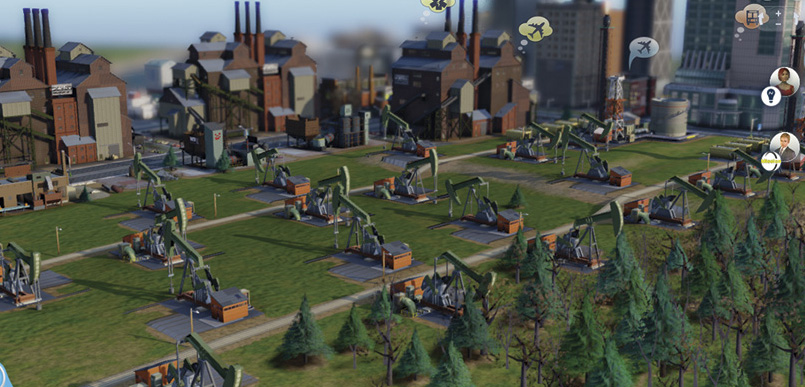
With three sprawling Oil Wells and a nearby Oil Refinery, this is an oil town. Consider specializing in one city specialization, especially if you have multiple deposits or reservoirs of one natural resource.
Running any one of the city specializations requires a lot of your attention. Most buildings and their associated road networks occupy a large portion of your city, lowering land value and spreading air and ground pollution. When you have a city with numerous natural resources, consider focusing on city specializations instead of taking a balanced RCI approach.
Like industry, city specializations require workers to operate, so it’s important to supply a work force by zoning some residential, which workers will require. Workers can also be imported from other cities, so make sure mass transit options are available to get commuters to work in a timely fashion.
Importing workers from other cities allows your specialized city to focus solely on producing resources and making money—if virtually no Sims live in the city, you won’t have to worry too much about commercial, industrial, or education. But you will still need to provide basic utilities and city services including power, water, sewage, waste disposal, fire, police, and health.
City specialization isn’t taxed, so these expenses must be offset through selling resources to the global market. But as long as your city specializations have a steady supply chain, income generated from selling resources should be more than enough for your city to pay its bills.
City Specialization HQs
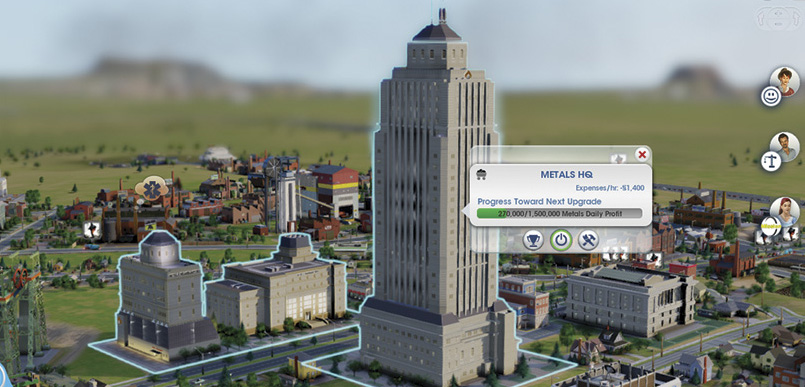
Divisions associated with each HQ do not have to be attached. Instead, these separate office buildings can be plopped within a radius around the HQ, even across the street.
Each city specialization comes with its own headquarters, or HQ. These towering office buildings aren’t immediately available for construction—you earn them. Mine, drill, or sell the specified amount of resources to unlock the HQ associated with each specialization.
HQs function much like the City Hall, utilizing a similar upgrade scheme—upgrades are often tied to production or sales. Once an upgrade is triggered, the HQ grows even taller, often dwarfing the highest skyscrapers in your city. More importantly, upgrades also give you access to new divisions, department-like buildings that can be built adjacent to the HQ.
Each division grants access to new buildings, allowing you to expand your business. For example, you’ll need a Refining Division at your Petroleum HQ before you can build an Oil Refinery. Once you’ve attained every division associated with an HQ, there’s no stopping you—all buildings are unlocked and the sky’s the limit.
The HQs also allow you to compete with friends and other SimCity players in the leaderboards. Once you’ve plopped an HQ, the production of metals, oil, or other associated resources will be tracked on the leaderboards. Feel free to compete with your friends and see who can mine the most coal or generate the most plastic. A little friendly competition won’t hurt, and you’ll earn a small fortune in the process.
The Global Market
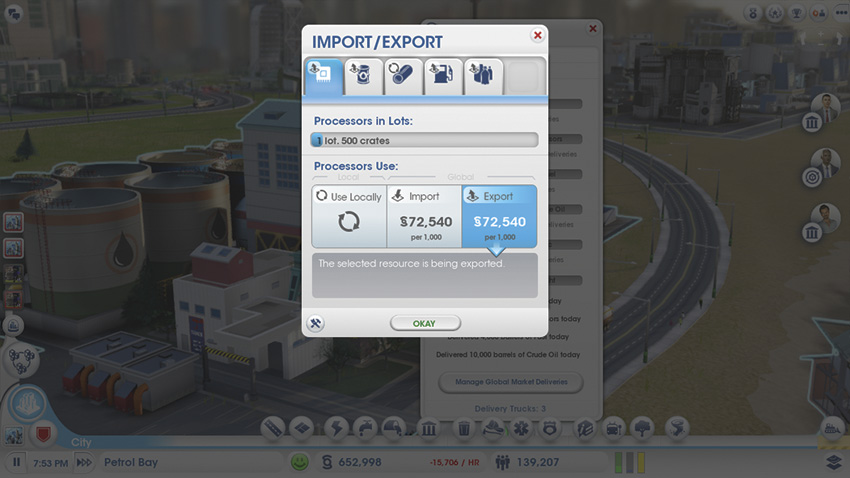
The massive storage lots available at the Trade Port make it ideal for importing, exporting, or simply storing large volumes of resources.
Don’t feel like digging in the dirt to extract coal or raw ore? Have a phobia of Oil Well accidents? No worries. As long as you have the money, you can buy/import any commodity your city needs directly from the global market. Or if you need money, you can sell/export those same resources, securing a nice little profit for your city.
The global market is accessed through Trade Depots and Trade Ports. These specialized facilities serve as warehouses, capable of storing all ten resources in the game: coal, raw ore, crude oil, metal, alloy, plastic, fuel, processors, TVs, and computers. These resources are stored in separate storage lots, each capable of importing or exporting.
Or if you simply want to accumulate resources for use in local industry or a Great Works project, you can simply use the Trade Depot or Trade Port as a storage facility, holding on to those goods until you’re ready to use or sell them. When importing or exporting, the amount of money exchanged is based on the current market value of each commodity.
Just like real-world stock markets and commodity exchanges, market values change throughout the day based on real-time supply and demand. For example, the plastic you imported an hour ago may be worth a lot more now, giving you the opportunity to export it for a profit. For more information on the global market and managing your Trade Depots and Trade Ports, advance to the Trading section within this chapter.
Gifting
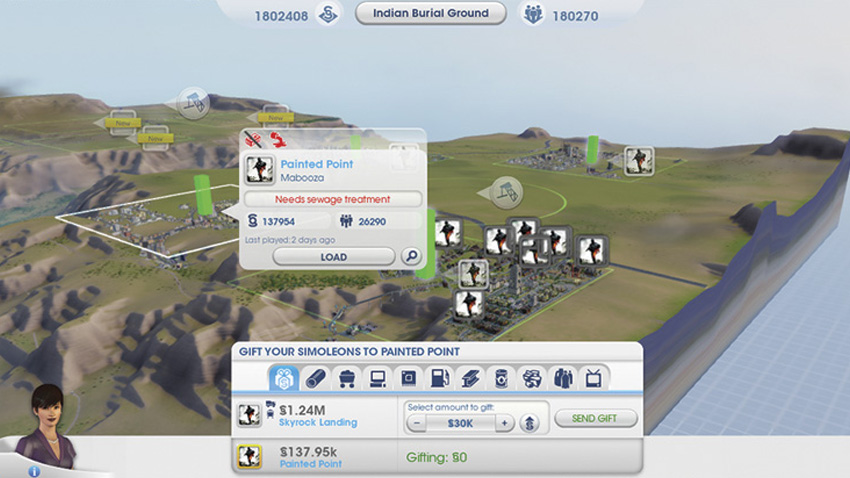
Using the Gift menu in the Region View you can send Simoleons or any of the ten resources to a connected city in your region.
If you have some surplus Simoleons or resources, why not share them with your fellow mayors? They may need the extra help now. And who knows, they may even return the favor in the future. The sharing of Simoleons and resources is handled through the Gift menu in the Region View.
Here you can select from any of the ten resources currently stored at any of your Trade Depots or Trade Ports and transfer them to another city in the region. Before a city can accept a gift, they must have a storage lot with enough capacity to contain the incoming goods. In some instances, a mayor may have to add a new storage lot to accept a shipment.
Once the gift has been initiated, resources are exchanged between the two cities by either truck, train, or cargo ship. So don’t panic if the incoming resources don’t appear in your storage lots immediately—they’re in transit. Gifting is important as cities begin to specialize.
For example, if one city has a Coal Mine and a neighboring city has an Ore Mine, they can exchange their resources to create alloy at their respective Smelting Factories. Or if you’re not in a giving mood, chat with local mayors to establish deals, exchanging a predetermined volume of resources for a set price. Gifting really enhances the sense of community encouraged by multi-city play.
Sharing resources will only make your region stronger.
Depletion of Resources
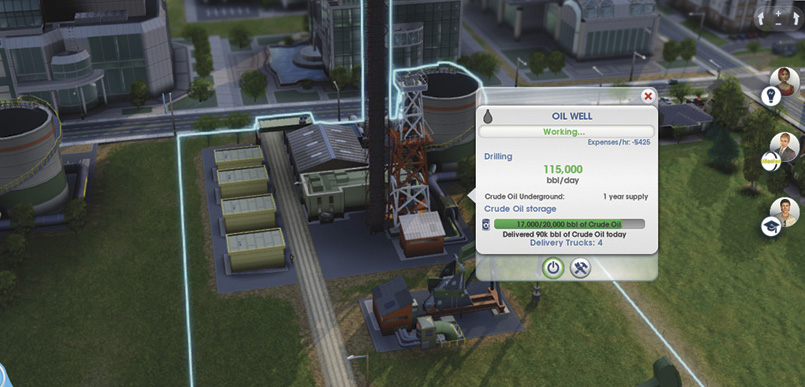
There’s only a one-year supply of crude oil left beneath this Oil Well. What happens when the oil runs out? Time to start planning for the future before this Oil Well runs dry.
Whether you’re mining or drilling, the amount of raw ore, coal, or crude oil beneath your city should keep you in business for several years. But then what? These natural resources are finite, and if you play the same city for several years, there will come a point when these raw materials are depleted.
Periodically click on your mines and Oil Wells to see exactly how many more years you can keep extracting resources from each deposit or reservoir. As supply dwindles, access your data maps to identify other deposits or reservoirs beneath your city and consider moving operations to a new location.
If there’s no more resources beneath your city, it’s time to rethink your business strategy. By importing crude oil, raw ore, and coal from a Trade Depot or Trade Port, you can keep your Smelting Factory and Oil Refinery in business, while continually supplying any Coal or Oil Power Plants.
Or perhaps you can get these raw materials from a neighboring city? In any case, plan ahead for this transitional phase to avoid a sudden disruption of supply. Shortly before you run out of resources, begin imports at a Trade Depot or Trade Port.
This will lessen the likelihood of a supply interruption and your businesses and power plants will continue functioning without a hitch. Shut down and bulldoze your old mines and Oil Wells to save money and clear space for new construction. Maybe it’s time to pursue high tech industry or the electronics specialization?