
SimCity Guide Behind the Scenes Behind the Scenes
Maxis: A Closer Look
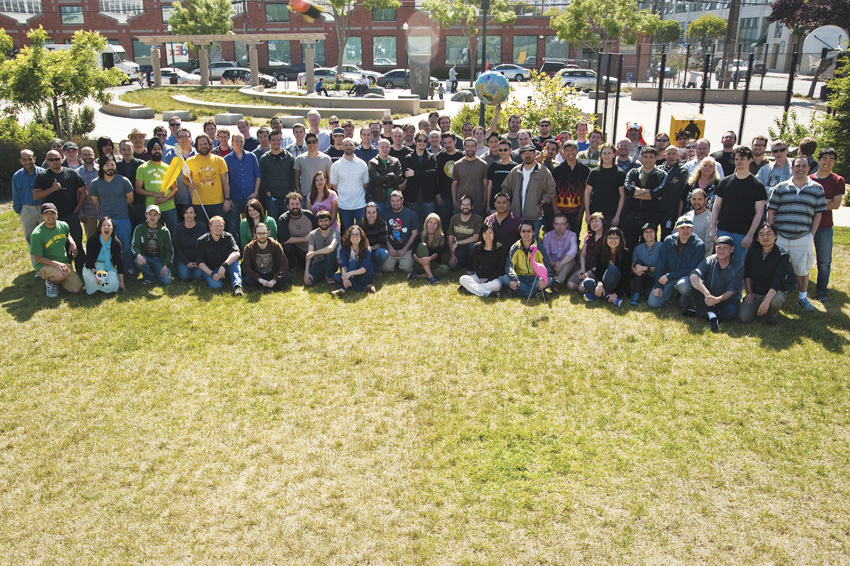
The SimCity development team at the Maxis studio in Emeryville, California.
Maxis, originally founded in 1987 and now an Electronic Arts label with studios in Emeryville, Redwood Shores, and Salt Lake City, has created some of the world’s most popular franchises including SimCity , Spore, and The Sims—one of the best selling franchises in gaming history.
Maxis games exemplify deep simulations that encourage player-driven creativity.

Soon after entering the office, visitors are greeted by a familiar logo set against the backdrop of a massive cityscape, clearly a nod to the SimCity franchise.
These simulations, often referred to as “god games,” allow players to create the environments and stories of the games themselves. Will Wright, co-founder of Maxis, says that what players really like about games like SimCity and The Sims is exploring what he calls “possibility space.”
“I believe both games ( SimCity and The Sims) deliver an experience that is uniquely Maxis,” says Lucy Bradshaw, Senior Vice President of Maxis. “We take real world systems, deconstruct them, and then put them back together again in a fashion that invites our players to tinker, experiment, explore, and master these systems—from urban planning to family dynamics.
Through play and experimentation, you begin to understand how the game system works, and as you begin to master that system, you get to decide how you want to play.”


Lead Designer Stone Librande lays out a prototype city consisting of tiny papercraft buildings.
Many members of the Maxis team have been playing SimCity since its first release in the late 1980s. Key staff—Lucy Bradshaw, Ocean Quigley, Stone Librande, and others—have been with the company for more than a decade. Despite the long hours and bug fixes involved in the final push to the launch of SimCity , the delight in the game is palpable.
One team member has developed an elaborate story about a resident criminal he is keeping tabs on. Another finds that his prize city has suffered a nuclear meltdown (see Developer Cities in the Getting Started chapter).
When a game can still offer discovery, surprise, and sometimes heartbreak to the people who have been living and breathing its development for months and months, you know you have a good thing going.


When creating the new SimCity , the team drew inspiration from many sources. The office is filled with numerous artifacts from this process, including tiny city models as well as walls covered with reference photography.
The games developed at Maxis are built to be fun, and they are. They also give players glimpses into systems and theories that shape the world we live in. The team at Maxis brings a wealth of information and experience to the development of games like SimCity . Wandering around the studio, one finds mechanical engineers, artists, philosophers, psychologists, musicians, and, yes, computer programmers.
The assumptions underlying the structure of the games they create are not arbitrary, but are based on the real world. The folks at Maxis believe these games are more than just entertainment; they also invite us to think critically and creatively. We not only learn how the game works—we also learn about how the world works.

Here a few team members enjoy a quick lunch break before getting back to work, helping make this the best SimCity yet!