
SimCity Guide Essentials Introduction
Introduction

Hi everyone. I’m Lucy Bradshaw and I lead the Maxis label here at EA. Over the course of the last year, we have been talking to fans about this new SimCity . We have received some great questions on a range of topics, including the city size, the GlassBox engine powering SimCity , and even how many splines we’ve reticulated over the years. (Short answer: a lot.)
One particular topic that comes up pretty regularly is our decision to require an online connection to play the game. I understand why this may be a concern for fans who have been playing SimCity for decades now. Like all of you, I’m a long-time SimCity fan. But it’s not just me—we have several veterans from previous versions of the game here at the Maxis studio, and we are all proud and excited about the game we’re making and we think you’ll really love it.
Creating a connected experience has always been a goal for SimCity , and this design decision has driven our development process for the game. This is easily the most ambitious game in the franchise and we’ve taken great care to make sure that every line of code embodies the spirit of the series.
To do this, we knew we had to make sure we put our heart and soul into the simulation, and the team created the most powerful simulation engine in its history—the GlassBox Engine. GlassBox is the engine that drives the entire game—the buildings, the economics, trading, and also the overall simulation that can track data for up to 100,000 individual Sims inside each city.
There is a massive amount of computing that goes into all of this, and GlassBox works by attributing portions of the computing to EA servers (the cloud) and some on the player’s local computer.
Perhaps Ocean Quigley, our Creative Director, said it best when he said that real cities do not exist in a bubble; they share a region and affect one another. GlassBox does more than just segregate computing tasks, it also allows us to make it so that you can create specialized cities that are visually unique and personalized, and that can be economically integrated into a larger region.
You’re always connected to the neighbors in your region, so while you play, data from your city interacts with our servers, and we run the simulation at a regional scale. For example, trades between cities, simulation effects that cause change across the region (like pollution or crime), as well as depletion of resources, are all processed on the servers and then data are sent back to your city on your PC.
Every city in the region is updated every three minutes, which keeps the overall region in sync and makes your decisions in your city relevant to any changes that have taken place in the region.
Running the regional simulation on our servers is something we also use to support features that will make this SimCity even more fun. We use the Sim data to update worldwide leaderboards, where you get to see your city or mayoral standings as compared to the other cities in your region and between all of the regions in the world.
And since SimCity is a live service, we’re also using the data to create weekly global and local challenges for our players that keep the gameplay fresh and surprising.
We think this is the best SimCity ever and it wouldn’t be possible without the technology that powers our game. SimCity was designed to be connected from the ground up. We built the game around GlassBox, which takes the game to another level. And, we’ve given the player control over how to play. You can set your region to private and never interact with other people, or you can play exclusively with friends or join a public region.
As I write this, we’re entering the final stages of development. We’re still tuning and refining the game, but already it has that special magic that sucked me into the franchise in the first place. We really look forward to seeing what you will create and how you will mayor come March 5th.
Thanks
Lucy Bradshaw, SVP Maxis

Millions of people around the world have been playing SimCity since it first came out in 1989. It’s been eight years since the release of SimCity 4, and Maxis is now ready to unveil the next chapter of the SimCity story.
SimCity is about solving puzzles. It is a game of strategy, experimentation, creativity, and fun. This version of the game keeps all the great elements that have kept fans engaged, and adds new elements that deepen engagement with the game. I’m excited to think that, with this version of SimCity , people who played the game as kids can now introduce it to their children.
The game is easy to learn and immediately accessible, but not at all “dumbed down,” making SimCity a delight to veteran players and those new to developing their own cities. I think one reason SimCity has endured over the years is that it’s an antidote to the mindless, violent, and disposable games on the market today.
There is no “right way” to play SimCity . One player may decide that she wants to maximize her city’s population, while keeping all systems in working order. Another may re-create his hometown or build a utopia of sustainable energy.
You may wish to keep your Sims happy in such a paradise, or build a wildly profitable, crime-ridden city whose economy is based on casinos and oil refineries. With multi-city play, you can build both, and see how the two cities impact each other! There are no right answers, only different approaches. SimCity allows you to craft your own puzzles and try out different solutions.
One thing you’ll notice right away, the game is constantly in motion. Sims travel to work and school, winds blow and carry pollution or provide an energy source, tourists arrive at ferry docks to spend Simoleons at your city’s commercial and cultural hotspots, traffic waxes and wanes at different hours of the day, buildings erupt in fire, and waves lap against your city’s shoreline.
There are dozens of these systems, or flows, each moving at their own rate with their own internal purpose. To grow a prosperous region, a player endeavors to keep all of these flows open and dependable.
Each system in SimCity is clear and simple to understand. Build a Water Tower over that nice aquifer and, as long as everything is connected by roads, the Sims in your city will be able to water their lawns and the restaurants will be able to wash dishes. As you build up your city, more systems and services are needed to keep the residents happy.
As one simple system feeds into another, the complexity of the game increases. An accident in a chemical factory contaminates the ground water and sickness spreads amongst the residents in your city. A new Hospital cures your sick Sims, but causes gridlock along a narrow access road. And these systems are now not confined to one city, but extend to the region and the world.
This is why SimCity never gets old, and why we never get tired of making it a new experience with each version of the game. SimCity , and everything you see in it, is responsive to your actions. At any level into the game, you are working to sort out cause and effect relationships and are able to observe the results of your decisions—for good or ill.
So jump right in and get building. I hope you enjoy playing the game as much as we’ve enjoyed designing it.
Stone Librande, Lead Designer

SimCity is one of those games that transcends gaming. It’s a game that is near and dear to my heart. It’s a franchise that I grew up with and always came back to through the years. Ever since I discovered it those many years ago on my parents’ computer, I had a love for this quirky little city builder.
SimCity taught me about how cities work and I never looked at real cities in real life the same. Maxis gave me the tools to be anything I wanted, to construct my own beautiful worlds to control and manage.
With a flick of my mouse, I was transformed into a mighty politician, planning highways, financial districts, and raising taxes. I was an artist, an architect, a city planner, a god. It was these memories that stuck with me throughout my life that steered me into the game industry and to ultimately come to work for Maxis eleven years ago.
Another memory I had of SimCity was one of solitude. Creating great cities, so full of life and stories, but always alone—no one to share them with or any way to play with others. This next chapter in SimCity was designed to change all of that. Cities are not isolated things that sit alone on chips in space, disconnected from the universe.
They are connected living organisms, each with a purpose and a story of their own. In this SimCity , we wanted to capture the ways in which real cities work together with one another: How they share services, goods, jobs, people, and more.
In SimCity , you’ll be able to create your networks of cities that work together in ways only you can imagine. Create your own bedroom communities, where the Sims that live in the city commute to a neighboring city that is full of high-tech jobs. Build a city of knowledge full of schools, universities, and libraries providing education to all Sims in the region.
Experiment with strange combinations like a green city full of wind turbines powering its neighboring city, which is filled with dirty industrial companies. All of the simulation and gameplay you find in the city extends to other cities. The multi-city play adds an entirely new level of strategy to city planning.
Once you’ve mastered the ins and outs to playing a single city, try to run two cities, three cities, or more. Anyone familiar to SimCity will appreciate the added depth that multi-city play brings to the franchise. Anyone new to SimCity will wonder how anyone could have played SimCity any other way.
The team here at Maxis has worked hard to bring you the next great city builder. Enjoy!
Kip Katsarelis, Senior Producer
A Message from the Author
Welcome to the official game guide for SimCity ! As Lucy and Stone have alluded, this is the most ambitious SimCity yet, giving players an unprecedented amount of access and control while encouraging the same level of creativity that has been a hallmark of this acclaimed series for more than 20 years.
Personally, I spent days upon days nurturing my sprawling, imperfect cities on the Super NES version, released back in 1991—and no, I didn’t use any cheats! So I jumped at the chance to work on the latest SimCity , knowing full well it wouldn’t be easy. But thanks to my wonderful team at Prima Games and the gracious developers at Maxis, it’s been well worth the long days and nights.
As all SimCity veterans know, there is no right or wrong way to play the game—formulate an imaginative vision and use it as your blueprint to create any city you’d like, defining your own goals along the way. During the creation of this guide we kept that in mind, with an emphasis on providing you with all the information you need to create the city and region you want.
The organization of the guide reflects this, serving more as a reference tool than a linear step-by-step narrative. While we’d recommend reading every chapter, it’s not necessary. Simply flip ahead to the topics that interest you, or read it cover to cover and digest every bit of detail. The choice is yours.
The SimCity development team at Maxis has taken an active role in the creation of this guide. In addition to ensuring the accuracy of the content, several developers have participated, writing various pieces scattered throughout the guide on a wide range of topics. Given the scope and complexity of SimCity , who better to offer insight than those who actually made the game?
Be sure to read through the various Developer Cities in the next chapter, offering plenty of useful gameplay hints as well as some cautionary tales. Look for more nuggets of city-building wisdom in our Chat with the Developers sections found at the end of most chapters.
We’re very excited about this collaborative effort and feel it provides a better understanding of how the game’s various systems function and interact with one another. For example, did you know that uncollected garbage poses fire and health risks? Or that Sims will walk a maximum of 400 meters before relying on a car or mass transit to reach their destination? By understanding the various rules of the simulation, it’s easier to craft the city you’ve envisioned.
Now and beyond the release date, SimCity is a constantly evolving game, with the development team making occasional tweaks and updates to ensure a fun and balanced gameplay experience for all.
Every time you start SimCity , the game automatically searches for new updates. If a new update is found, it is automatically downloaded and installed. As information and data changes in the game, we’ll continue to update this guide at www.primagames.com.
As the owner of this guide, you have access to our updated eGuide—go to www.primagames.com and enter the provided voucher code to gain access to the eGuide. Here you can find the same information in the print guide as well as new content pertaining to recent updates. So check back frequently for updated stats, challenges, achievements, and more.
Our team has had a blast playing SimCity and creating this guide. We hope you find this information helpful when developing your own cities and regions. See you online!
David Knight
February 2013
What’s New?
SimCity has a loyal following that literally spans generations. Many of us who grew up with the game are now playing it side by side with our children, nephews, and nieces. While the essence of SimCity remains intact, the latest iteration adds several new and exciting elements even veterans of the franchise should be aware of.
But don’t worry, the game you know and love is still here. Instead of fundamentally changing the game, these additions merely enhance and expand the same gameplay experience we’ve enjoyed throughout the years.
Multi-City Play
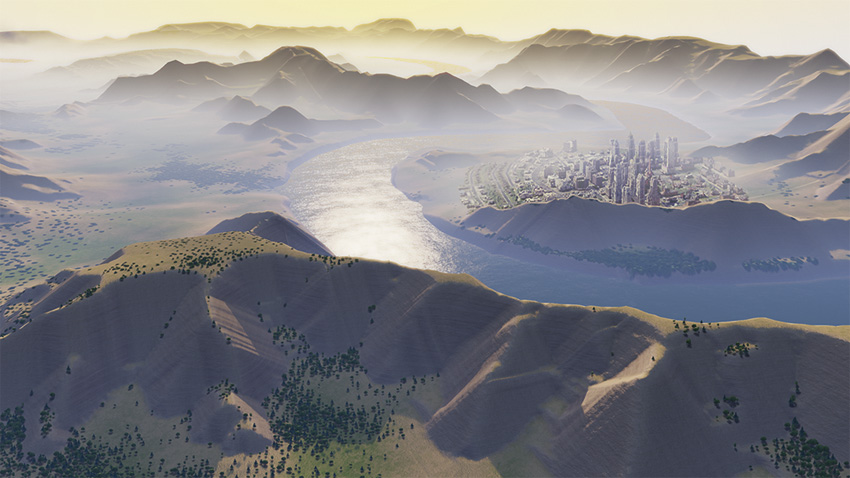
You’re not alone. Look out beyond your city and seek opportunities to trade and collaborate with other mayors in the region.
The concept that “no city exists in a bubble” comes alive with multi-city play. While regions aren’t new to SimCity , the way regions function has been completely overhauled with a heavy emphasis on cooperative gameplay. Now, up to sixteen players can occupy a region, each the mayor of their own city.
Cities interact with each other in numerous ways. They can gift each other Simoleons and resources or share service vehicles such as garbage trucks, ambulances, and fire trucks. But cities can also collaborate on Great Works, donating money and resources to construct the Arcology, International Airport, Solar Farm, or Space Center—each Great Works project benefits all connected cities with a variety of perks.
So don’t get tunnel vision and focus only on your city. Zoom out to the Region View and see what your fellow mayors are up to. You can even visit their cities, learning from their successes and mistakes. Before long you’ll begin thinking about the region as a whole, perhaps becoming the Mayor of multiple cities or collaborating with friends and strangers.
Live Service
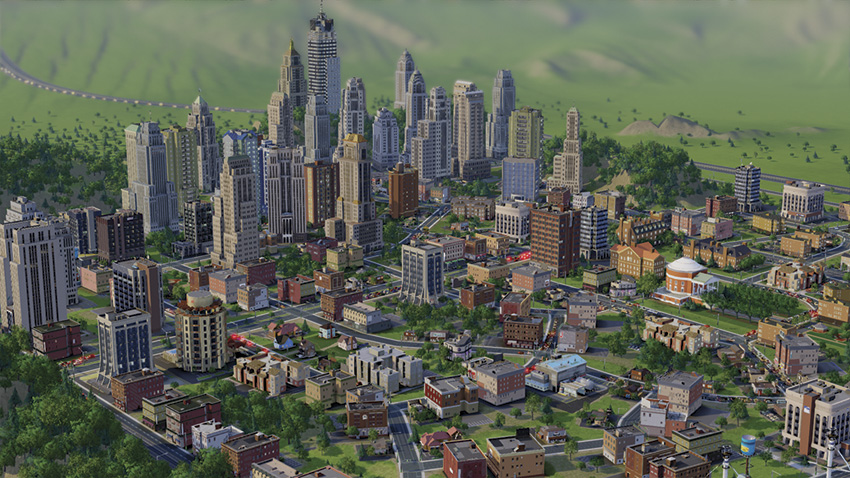
There’s no need to manually save that masterpiece of a city—your game is automatically saved to the cloud.
As Lucy mentioned in her foreword, SimCity requires a constant online connection to play—like most video games in 2013. While this is a departure from past installments, the benefits far outweigh any drawbacks, providing a truly integrated gameplay experience. An online connection isn’t only a necessity for the simulation to function, but it also allows for greater depth.
One of the coolest features is the global market, a virtual marketplace where in-game resources are exchanged—the market value of each resource fluctuates based on real-time supply and demand! Cloud saves have also been integrated, meaning there’s no way to revert back to an old saved game.
This gives each decision you make greater weight, potentially having far-reaching consequences. But don’t worry. You can always play in Sandbox mode if you’re more interested in learning and experimenting—the cheats offered in Sandbox mode make the game much more forgiving.
City Specializations
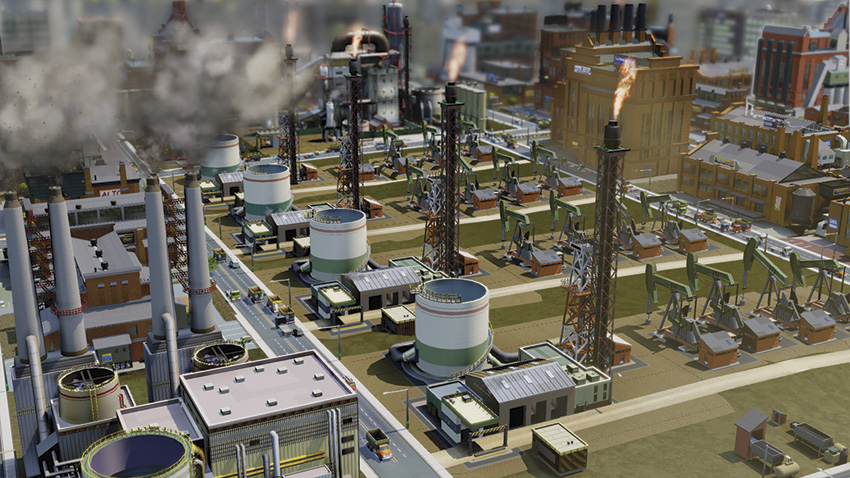
They’re not pretty, but Oil Wells are a necessity if you’re hoping to make millions in the petroleum business.
Tired of relying on taxes to fill your city’s treasury? With the new city specialization options you can now turn to a variety of alternative sources of income. Have oil beneath your city? Pursue the petroleum business, pumping crude oil from the ground to export on the global market for a quick profit.
Or take that oil and process it in an Oil Refinery to produce plastic and fuel for even larger profit margins. By specializing in petroleum, metals, trade, electronics, or gambling there’s an exciting variety of potential revenue streams available. But you’ll need to master supply lines, transportation, and other challenges to ensure a steady flow of revenue from these lucrative businesses.
Modules
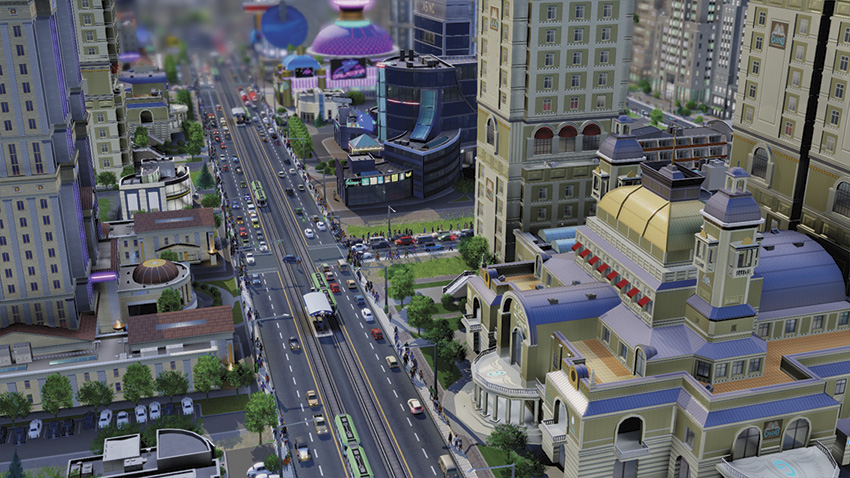
Each casino has a variety of modules useful for accommodating and luring more tourists into your city.
All non-RCI buildings in the game can now be customized with modules to better meet the demands of your growing city. Running low on power? Add a new turbine to your Wind Power Plant. Want to increase police coverage? Add more Patrol Car Lots to your Police Station or Police Precinct.
This gives you much more control over how utilities and city services are implemented and expanded. But these modules aren’t free. Just like buildings, each module has an initial cost as well as an hourly operational cost, cutting into the city’s budget. Before you add a new module to a building, make sure your city can afford it, otherwise your good intentions may lead the city to a financial crisis.
SimCity World
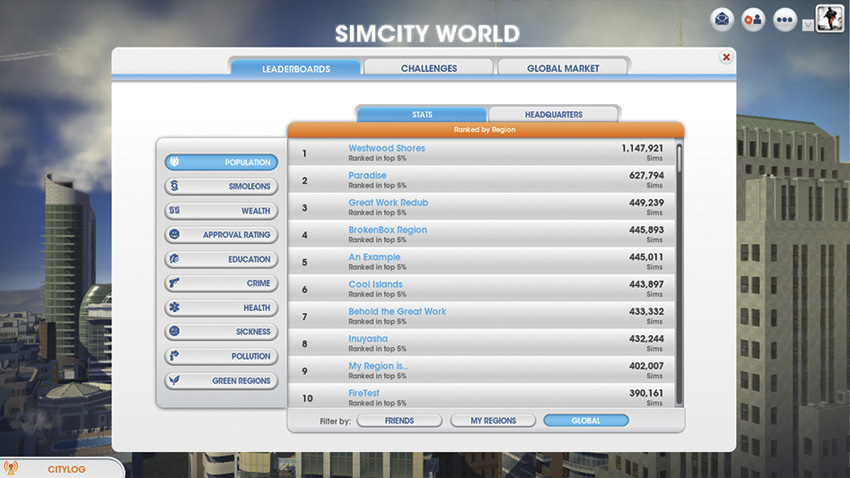
Check out the leaderboards to see how your cities and regions stack up against the competition.
SimCity World is the underlying network that ties everyone’s gaming experience together through leaderboards, achievements, challenges, and the global market. There are a total of fifteen leaderboards tracking data and ranking players through a variety of categories including wealth, crime, and pollution, as well as all five city specializations.
This adds a competitive element to the game for players interested in climbing to the top of the rankings or at least nudging past their friends. Achievements and challenges offer optional goal-oriented tasks to complete, sometimes requiring the cooperation of other mayors in your region.
The global market tracks the prices of resources based on real-time supply and demand. This makes the import/export game extremely addictive, allowing you to buy low and sell high through Trade Depots and Trade Ports. In all, SimCity World keeps the game fresh, always providing new tasks and experiences to enjoy with others or on your own.