
Rage Guide Essentials Extended Play
Rage Frenzy
Card Overview
| Game Costs and Point Caps | |||
| Difficulty | Hendrick Cost | Teague Cost | Points |
| Easy | $25 | $75 | 75 |
| Normal | $55 | $150 | 125 |
| Hard | $125 | $225 | 250 |
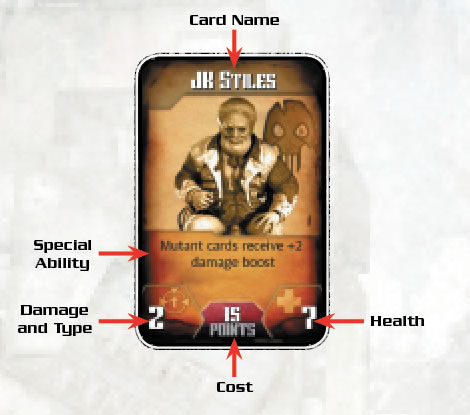
Depending on the difficulty level you choose, you will be provided with a different amount of points, which you can spend on building a deck, as seen in the table above. Each card has a cost associated with it, located on the bottom of the card. The weakest cards cost 5 points and the most powerful cards cost 50 points. Use your available points to construct a deck of 12 or fewer cards. Cards also have a damage value and a health value. In combat, the damage value determines how much damage a card does while the health value determines how much damage a card can take before it’s killed. When a card’s health is reduced to zero, the card is removed from play. Several cards also possess special abilities that may enhance or stun other cards on the table. Spend your points wisely when building a deck and try to find the best combination of offense and defense to build the strongest deck possible. Destroy all your opponent’s cards to win, or tie to break even. There are five different types of cards: melee, ranged, healers, explosive, and vehicles.
Melee Cards
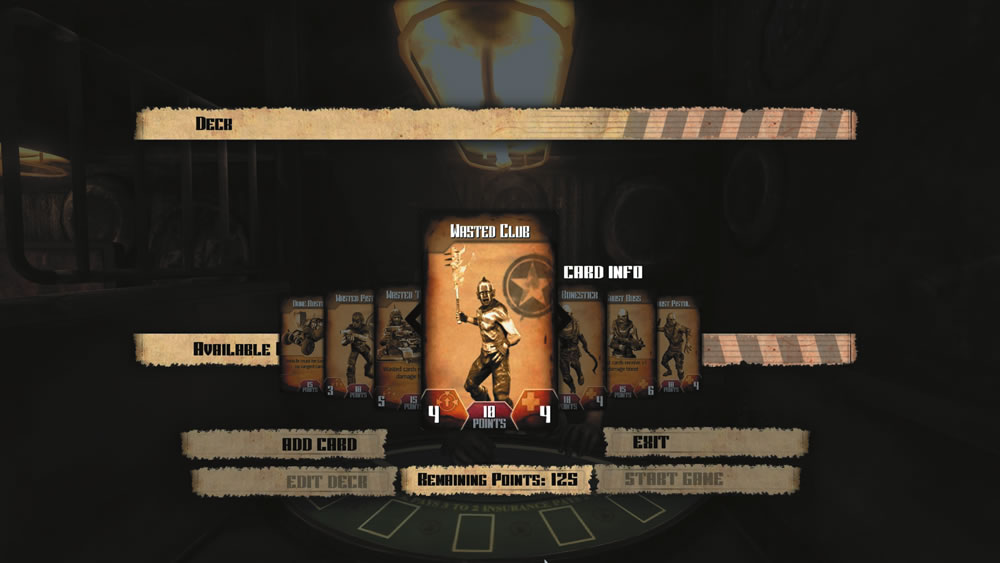
Melee cards can only attack cards directly across from themselves. If there are no cards to attack, they have the option to take cover, reducing incoming damage by 50%. Cards in cover are shown with a transparent shield overlay. While they lack the targeting versatility of ranged cards, melee cards should always make up a fair portion of your deck. Their ability to dish out and absorb damage plays a large part in any victory. Plus, their attacks aren’t restricted when your opponent plays a vehicle card.
Ranged Cards
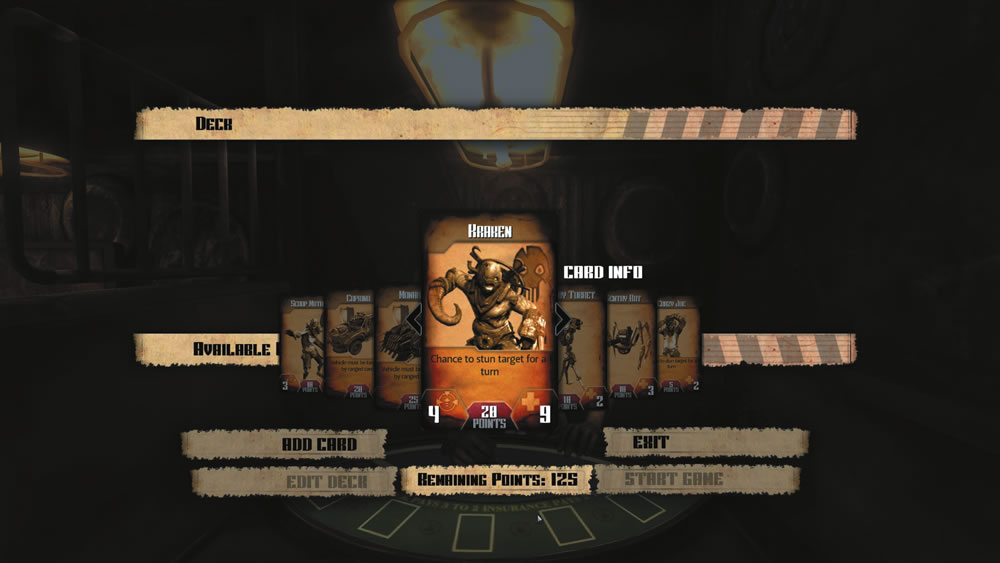
Ranged cards have the ability to choose their targets, allowing them to remove cards that may pose a threat. However, when a vehicle card is in play, it must target and destroy the vehicle before being able to select any target again. Being able to choose targets makes ranged cards very versatile, especially if you’re trying to take out one of your opponent’s powerful cards. Your ranged cards can effectively gang up on one card to take it out quickly, assuming no vehicles are in play. Since ranged cards can attack every turn, they can’t take cover.
Healer Cards
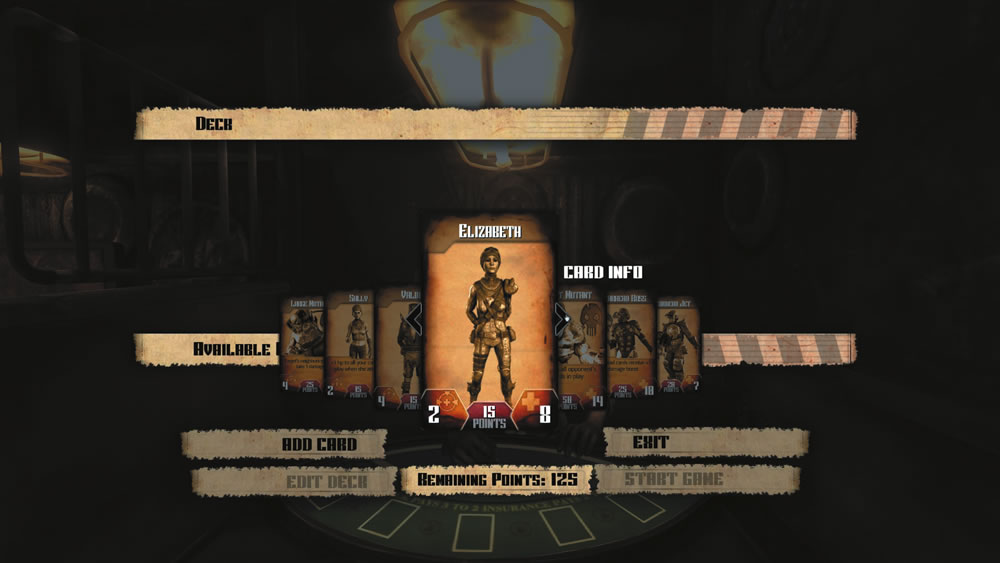
Healer cards can select a damaged card to restore hit points to or they can choose to take cover. Healers cannot heal themselves or other healing cards. Before loading your deck with heal cards, realize that healers cannot attack either. The damage value on each heal card represents how many hit points it restores to a card when healing. If all your cards are healthy, the healer can only take cover. As you can see, healer cards are very specialized and can play a big role in certain situations, but you probably never need more than one healer card in your deck.
Explosive Cards

Explosive cards damage all opponent cards when they enter the play area. They destroy themselves in the process, however, and do not stay in your hand. The effectiveness of explosive cards is largely determined by when they’re played—a factor determined purely by chance. If an explosive card is the first card drawn, it’s a total waste, maybe injuring one or none of your opponent’s cards. However, these cards can be extremely effective if drawn when your opponent’s side of the table is filled with cards. Still, once they explode, they’re gone. They can’t stick around to attack or absorb damage. Limit yourself to one explosive card per deck.
Vehicle Cards
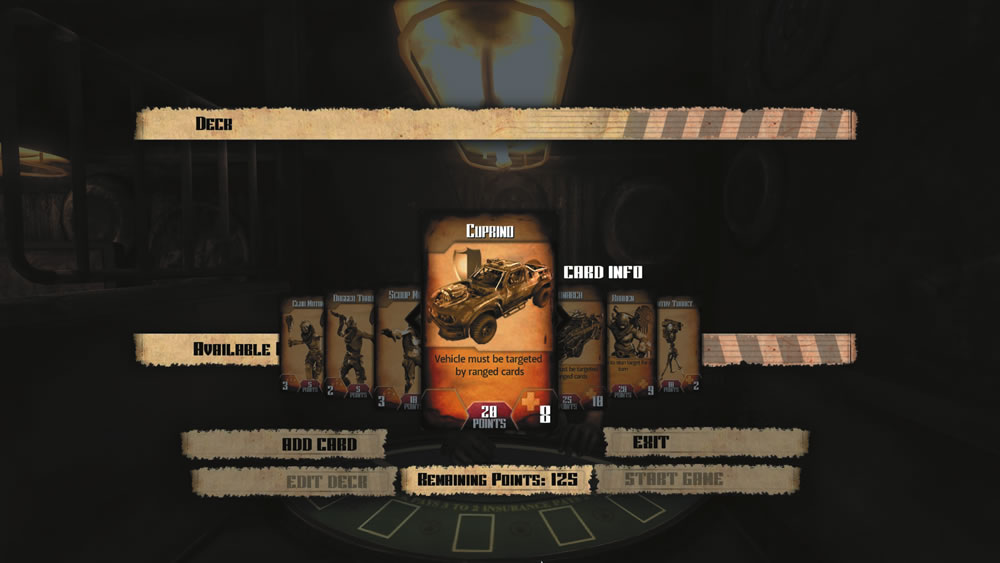
Vehicle cards are only capable of taking cover, making them a strong defensive card. Since vehicle cards can only take cover, all incoming damage is always reduced by 50%. When a vehicle is in play, any ranged cards must target the vehicle and destroy it before targeting other cards. Think of vehicles as a ranged magnet, absorbing all ranged attacks. This is a great way to prevent your other cards from taking damage. Like healers, vehicles have no offense, so you probably only want one or two vehicle cards per deck.
Building a Deck
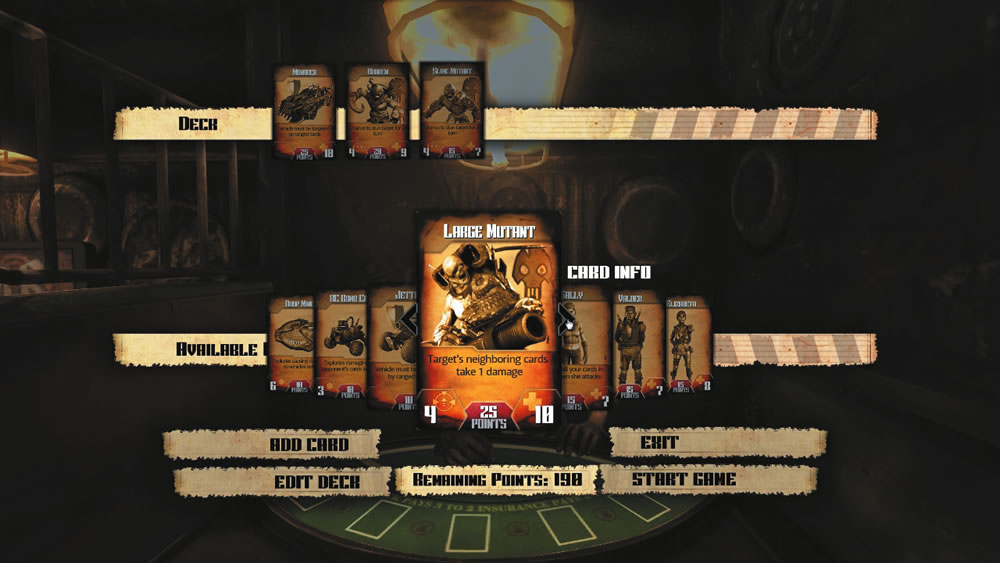
Now that you have a basic understanding of the different card types, work on building a deck. Before each game, you’re tasked with building your deck from the cards you’ve collected, as well as those from the starter deck. The first thing you need to consider is how many points you have to spend. For example, in an easy game, you have a 75 point cap. While browsing through the available cards, study the cost of each card and determine whether you have enough points to add it to your deck. Beyond the cost of each card, study its health and damage values, as well as its special abilities.
Factions and Clans
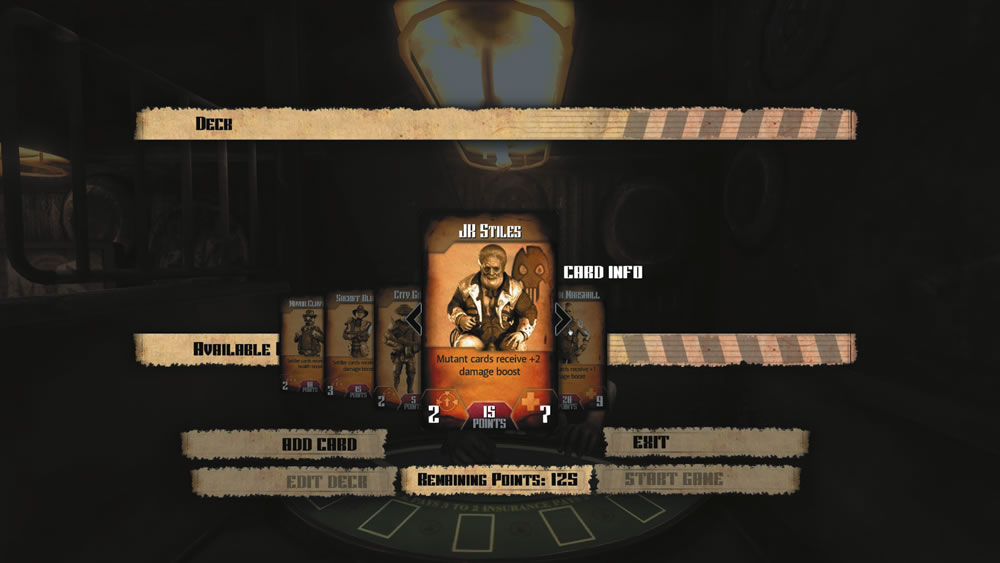
Most cards also have affiliations with a specific faction or clan. Each faction has one or two leader cards with a special ability that enhances other cards of the same affiliation. For example, JK Stiles is considered the leader of the mutants. As such, his card is marked with a mutant icon and provides a +2 damage boost to all mutant cards as its special ability. When you play the JK Stiles card, the damage of every mutant card on your side of the table is increased by two. However, if the JK Stiles card is killed, the +2 damage boost is lost, and the mutant cards return to their default damage value. So when using JK Stiles, consider building a deck consisting primarily of mutant cards to benefit from the +2 damage boost special ability. Other factions include Settlers, Ghost Clan, Wasted Clan, Shrouded Clan, Gearhead Clan, Jackal Clan, and the Authority. It’s not always possible to build a deck consisting solely of cards from one distinct faction or clan, but make an effort to match as many cards as possible to take advantage of the leader card’s special abilities.
Gameplay
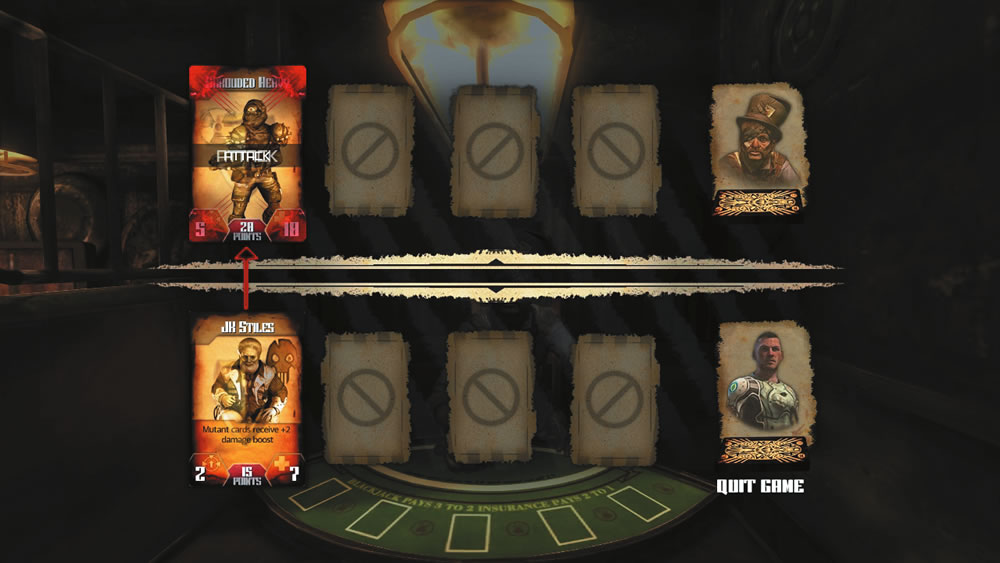
Rage Frenzy is a turn-based card game. At the start of each game, each player plays one card from the player’s deck. The order in which the cards are played is totally random, so you never know which card will come up first. Notice that when you first play a card, it is covered in a transparent shield icon, indicating the card is guarded. Every time a card is drawn from the deck, it remains guarded for one turn, reducing incoming damage by 50%. This rule helps protect new cards, preventing your opponent from killing them before you get a chance to use them.
Attack Phase
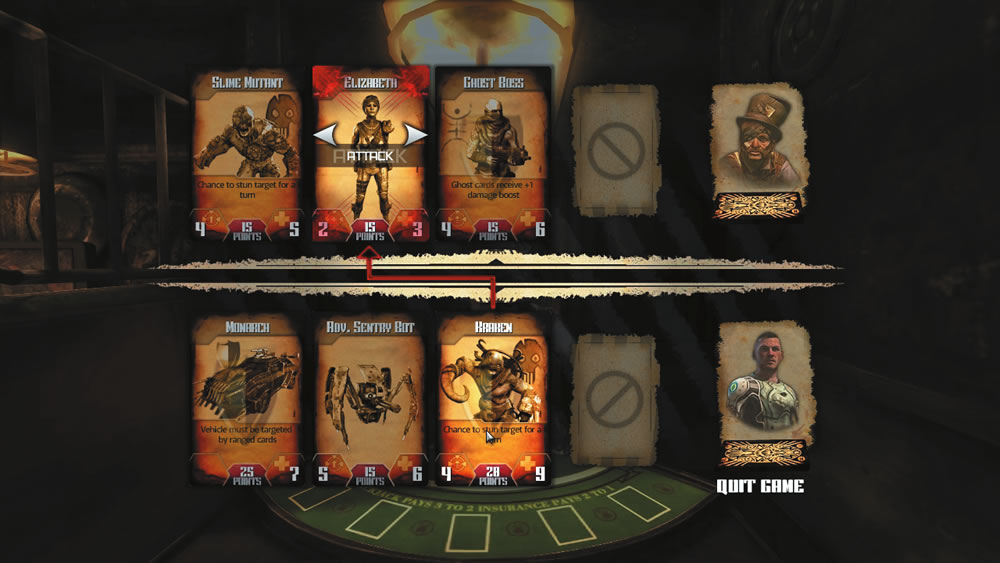
Once both cards are on the table, it’s your turn. If you have a melee or ranged card, you can attack your opponent’s card. Remember, you only deal 50% damage (rounded down) to a guarded card, so don’t expect to do much damage in your first turn. If a vehicle or healer card is drawn first, you can’t attack at all—you can only take cover. As you progress through the game, and more cards are added to your side of the table, every card is allowed to take an action during your turn. Melee cards can only attack straight across from themselves while ranged cards can attack any opponent card, unless a vehicle card is played. Healer cards can choose to take cover or apply hit points to a damaged card. Vehicle cards can only take cover, so in this sense, they’re always in a guarded state, making them extremely difficult to kill.
Draw Phase
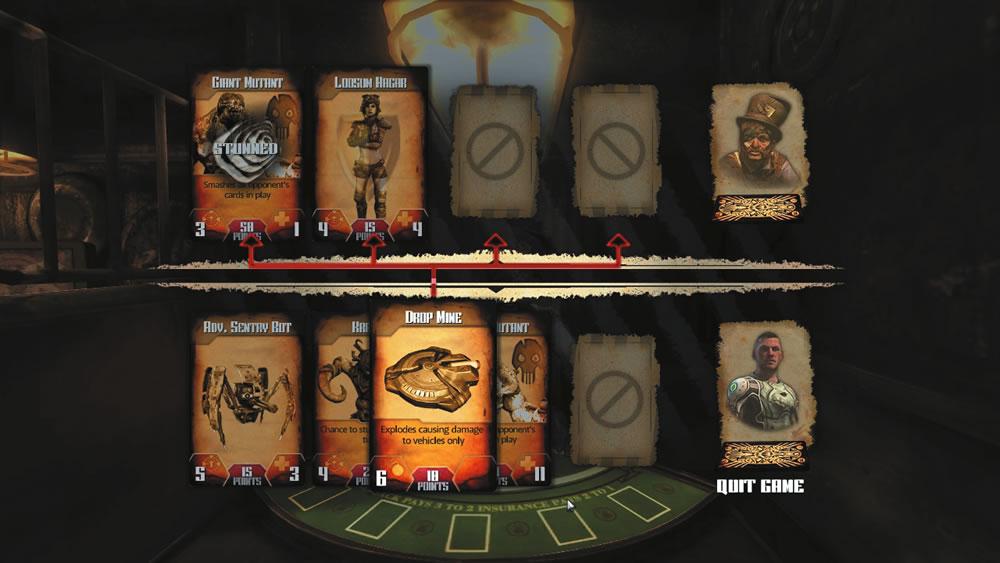
At the end of your turn, any dead cards are removed from your opponent’s side of the table and a new card is drawn from your deck and placed on your side of the table—at this point, the previously drawn card loses its guarded status. Your opponent’s turn plays out the same way, beginning with an attack phase, and ending with the drawing of a card. Each player can have up to four cards on their side of the table. If you already have four cards in play at the end of your turn, no new cards are drawn from the deck. In the event that an explosive card is drawn at the end of your turn, the effect is immediate. The explosion goes off, damaging all your opponent’s cards, and then the explosive card is immediately discarded. The goal is to completely wipe out every card in your opponent’s deck. You and your opponent can have up to 12 cards each, so games can last a while, depending on the chosen difficulty. If your opponent has no more cards to draw, you win the game, earning the wagered amount. If you run out of cards first, you lose.

Hardest Deck
Think you have what it takes to beat Teague’s hardest deck? If so, you can unlock this achievement/trophy. When you’re ready for the challenge, choose a Hard game against Teague and begin constructing your deck. Teague always uses the same deck in Hard games, consisting mostly of Authority and mutant cards. To see the deck she uses, reference the Dealer Decks section in the back of the guide. By matching her deck card for card, you have a decent chance of beating her, depending on how the cards are dealt.