
Harvest Moon: Light of Hope A 20th Anniversary Celebration Guide Farmer’s Handbook
Basics of Farming
As shown during the opening tutorial with Jeanne, growing crops is fundamentally a four-step process:
- Till the soil using your Hoe.
- Plant the seeds available for purchase from Sam and Carol.
- Water the seeds every day to keep them from drying out.
- Harvest the crops after a plant-specific number of days.
As it turns out, there are numerous factors that dictate whether your crops grow, the quality they achieve, and whether they mutate. It’s a complex system influenced by soil type, season, weather patterns, Fertilizer, neighboring crops, and in select situations, even the pattern in which the crops are planted. Before we get to the crop-specific tables that compose the bulk of this chapter, it’s important to understand how these various systems affect your harvest.
Season and Terrain
The first thing to understand about farming is that crops can grow from seeds in any season, provided they receive adequate Fertilizer and water. Each crop has a preferred planting season and isn’t only less likely to wither and die when planted in that season, but far more likely to grow a “Great” version. Crops planted out of season are far more vulnerable to storms, but they will still grow. Some only mutate when planted out of season, or in soil conditions outside their normal recommendations.
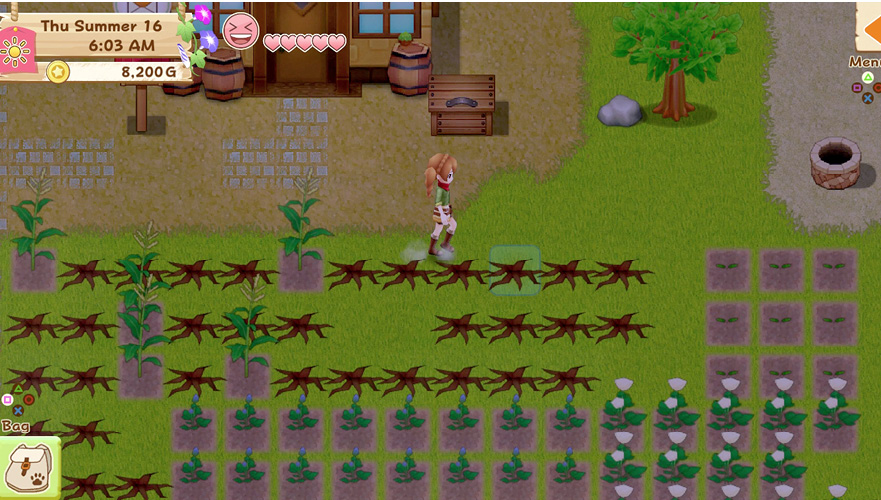
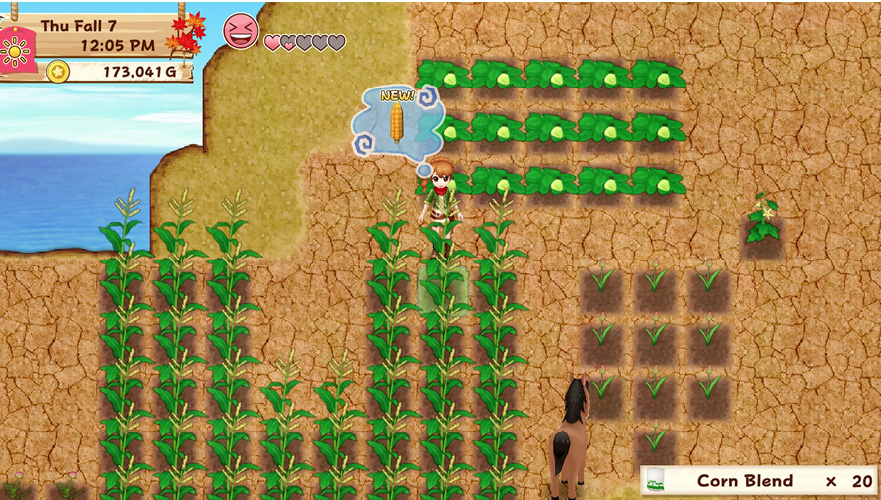
There are four terrain types on the island, and, as with season, each crop has its preference. However, unlike with seasons, it’s much more difficult to get crops to grow in foreign soil types. We don’t recommend doing so unless striving for a specific—and known—mutation, as it seldom produces Great harvests and consumes an abundance of Fertilizer. The four terrain types are as follows:
Farm: The grassy area that extends throughout the three farm zones is perfect for growing a host of vegetables. Though not as many crops mutate on the farm as in some other areas, this is a great place to do the bulk of your farming.
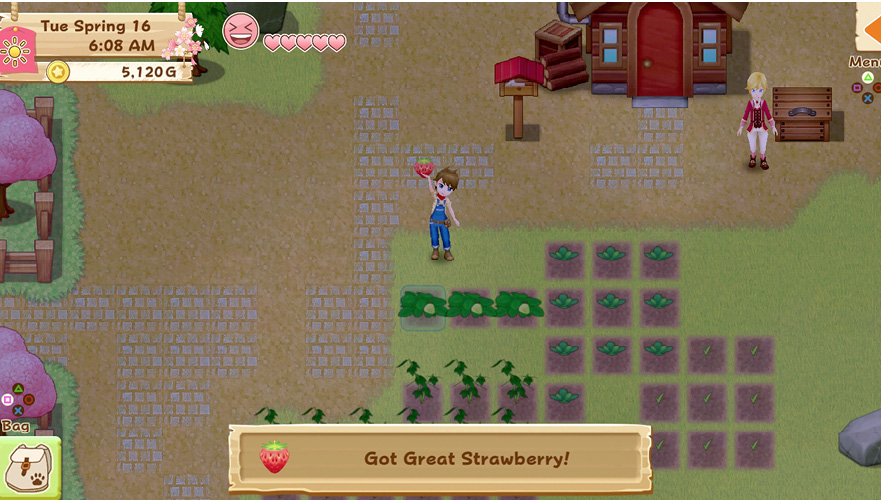
Mountain: The mountain region is a sprawling zone with three distinct farming areas encompassing two distinct terrain types. The infertile grass of the lower mountain, including the small plateau to the east of Gus’s Smithy, is known as the mountain terrain.
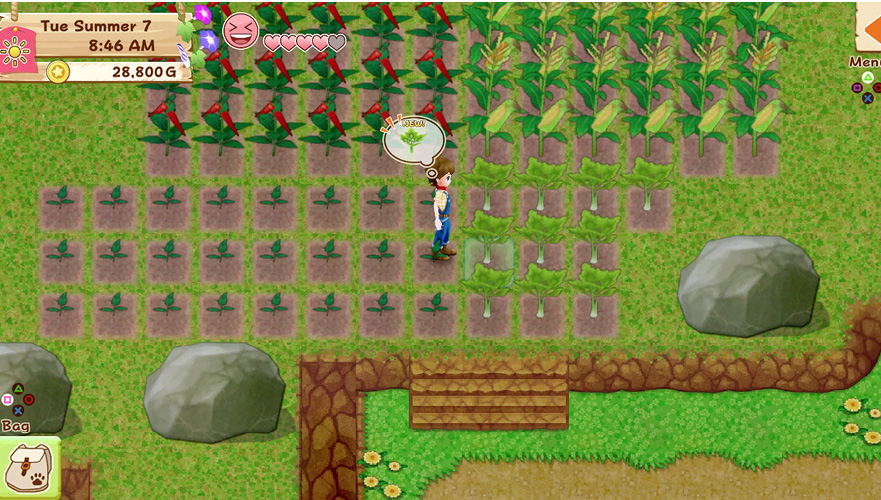
Marsh: The central and eastern areas of the beach contain a swampy area known as the marsh. Not a lot of crops grow there naturally, but some of the most prized mutations only occur in this wetland-like area.
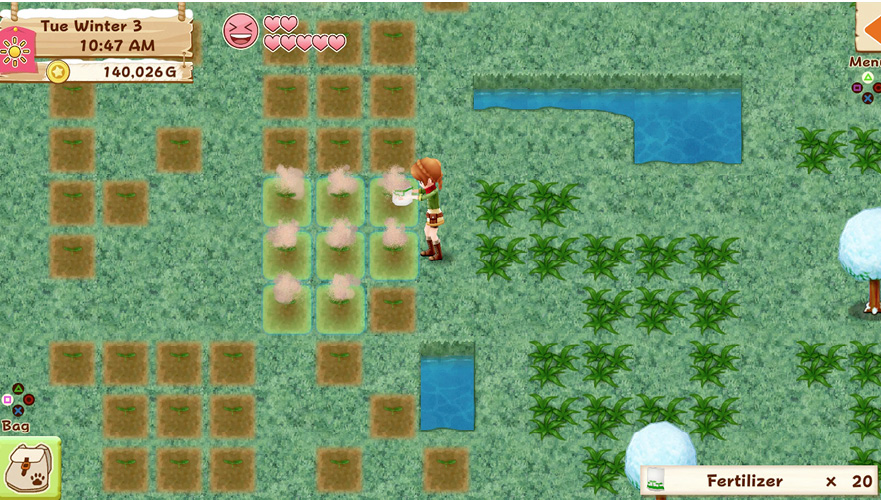
Desert: The rocky, arid area of the upper mountain (the region where Edmond lives) contains the fourth terrain type. As with the marsh, this is more of a specialty terrain, primarily used for encouraging plant mutation than general crops.
Water and Fertilizer
Once planted, the seeds must be watered to grow. Though watering your crops every day isn’t mandatory—and rain and snow do this for you automatically—we recommend doing so anyway to form good habits and to maintain a higher quality. Though only crops left unwatered for multiple days have a chance of dying, the quality of the resulting produce diminishes every day a plant goes unwatered. This is particularly true during the summer heat. Pay close attention to villagers commenting on a heat wave, and water your plants daily!
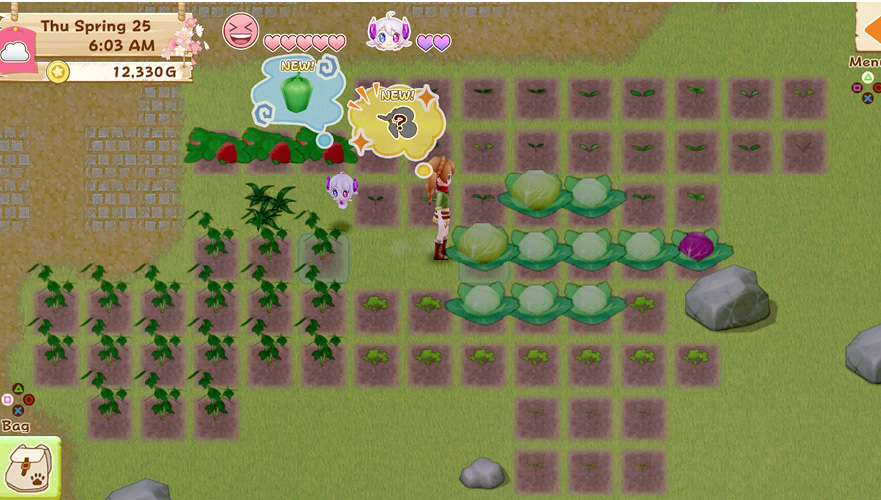
The game employs a complex behind-the-scenes system known as Quality Points (QP) that determine whether a crop achieves a Great harvest, mutates, or dies. Though the system is far too robust to detail here, players can gauge how their crops are doing by walking through the fields and noting the colors of the status bubbles that appear. While blue bubbles indicate crops in need of Fertilizer or water, golden bubbles show crops at maximum QP and likely to mutate or yield a “Great” variety. Plain white-colored bubbles indicate a basic crop.
Fertilizer comes in a number of varieties, unlocked by completing Dean’s requests, that fundamentally fall into two classes: general and crop-specific. The basic Fertilizer can be applied to any type of crop and helps you achieve some low-level mutations (see the following charts) while primarily helping to ensure the crop can survive a weather event out of season. Crop-specific blends (and super blends) are required to achieve the much rarer second- and third-generation mutations.
We recommend applying Fertilizer to basic crops once every week to keep them alive in season, or once every four days out of season. This is particularly useful for crops such as Corn and Hot Peppers that can continue to yield multiple harvests over multiple seasons. Consider applying crop-specific Fertilizer more frequently when trying to cultivate a new mutation.
Lack of Watering Effects on Crops
| Time Since Ground Dried (hours) | Chance Crop Dies |
|---|---|
|
24 |
0 |
|
36 |
0 |
|
48 |
0 |
|
52 |
0 |
|
57 |
10% |
|
62 |
30% |
|
72 |
60% |
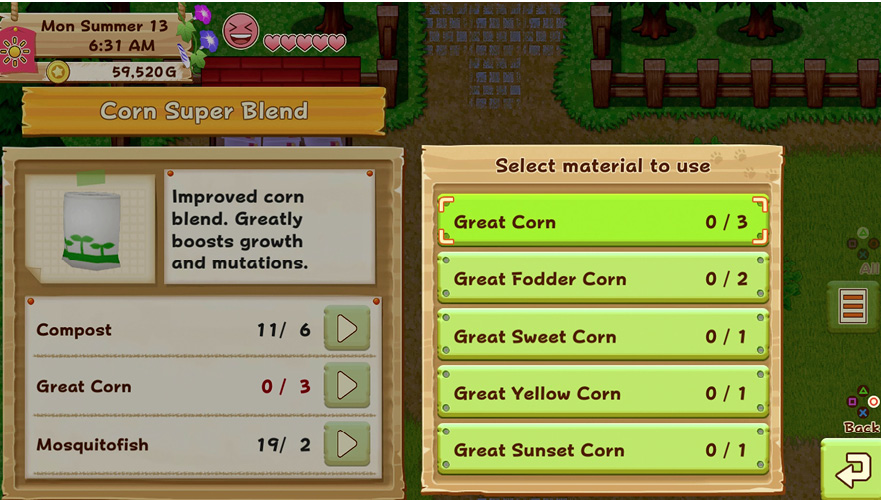
The Fertilizer Bins located throughout the island are well-positioned to help you store and access a variety of Fertilizer types. Consider keeping your basic Compost and Fertilizer on hand while leaving all of your crop-specific Fertilizers stored away in the Fertilizer Bin until you need them. Interact with the Fertilizer Bin to make new Fertilizer.
Fertilizer Recipes
| Type | Ingredients | Qty Made | Learned |
|---|---|---|---|
|
Fertilizer |
Compost x4 |
10 |
Repair Fertilizer Bin |
|
Tomato Blend |
Compost x4, Tomato x3, Bluegill x2 |
10 |
Dean: Fertilizer 2 |
|
Tomato Super Blend |
Compost x6, Great Tomato x3, Bluegill x2 |
10 |
Dean: Fertilizer 2 |
|
Corn Blend |
Compost x4, Corn x3, Mosquitofish x2 |
10 |
Dean: Fertilizer 2 |
|
Corn Super Blend |
Compost x6, Great Corn x3, Mosquitofish x2 |
10 |
Dean: Fertilizer 2 |
|
Cabbage Blend |
Compost x4, Cabbage x3, Bluegill x2 |
10 |
Dean: Fertilizer 2 |
|
Cabbage Super Blend |
Compost x6, Great Cabbage x3, Bluegill x2 |
10 |
Dean: Fertilizer 2 |
|
Celery Blend |
Compost x4, Celery x3, Sardine x2 |
10 |
Dean: Fertilizer 2 |
|
Celery Super Blend |
Compost x6, Great Celery x3, Sardine x2 |
10 |
Dean: Fertilizer 2 |
|
Onion Blend |
Compost x4, Onion x3, Sardine x2 |
10 |
Dean: Fertilizer 2 |
|
Onion Super Blend |
Compost x6, Great Onion x3, Sardine x2 |
10 |
Dean: Fertilizer 2 |
|
Wheat Blend |
Compost x4, Wheat x3, Mosquitofish x2 |
10 |
Dean: Fertilizer 2 |
|
Wheat Super Blend |
Compost x6, Great Wheat x3, Mosquitofish x2 |
10 |
Dean: Fertilizer 2 |
|
Potato Blend |
Compost x4, Potato x3, Mosquitofish x2 |
10 |
Dean: Fertilizer 2 |
|
Potato Super Blend |
Compost x6, Great Potato x3, Mosquitofish x2 |
10 |
Dean: Fertilizer 2 |
|
Carrot Blend |
Compost x4, Carrot x3, Sardine x2 |
10 |
Dean: Fertilizer 2 |
|
Carrot Super Blend |
Compost x6, Great Carrot x3, Sardine x2 |
10 |
Dean: Fertilizer 2 |
|
Spinach Blend |
Compost x4, Spinach x3, Mosquitofish x2 |
10 |
Dean: Fertilizer 2 |
|
Spinach Super Blend |
Compost x6, Great Spinach x3, Mosquitofish x2 |
10 |
Dean: Fertilizer 2 |
|
Berry Blend |
Compost x4, Strawberry x3, Sardine x2 |
10 |
Dean: Fertilizer 4 |
|
Berry Super Blend |
Compost x6, Great Strawberry x3, Sardine x2 |
10 |
Dean: Fertilizer 4 |
|
Pepper Blend |
Compost x4, Hot Pepper x3, Sardine x2 |
10 |
Dean: Fertilizer 4 |
|
Pepper Super Blend |
Compost x6, Great Hot Pepper x3, Sardine x2 |
10 |
Dean: Fertilizer 4 |
|
Pumpkin Blend |
Compost x4, Pumpkin x3, Mosquitofish x2 |
10 |
Dean: Fertilizer 4 |
|
Pumpkin Super Blend |
Compost x6, Great Pumpkin x3, Mosquitofish x2 |
10 |
Dean: Fertilizer 4 |
|
Broccoli Blend |
Compost x4, Broccoli x3, Sardine x2 |
10 |
Dean: Fertilizer 4 |
|
Broccoli Super Blend |
Compost x6, Great Broccoli x3, Sardine x2 |
10 |
Dean: Fertilizer 4 |
|
Melon Blend |
Compost x4, Watermelon x3, Bluegill x2 |
10 |
Dean: Fertilizer 6 |
|
Melon Super Blend |
Compost x6, Great Watermelon x3, Bluegill x2 |
10 |
Dean: Fertilizer 6 |
|
Asparagus Blend |
Compost x4, Asparagus x3, Bluegill x2 |
10 |
Dean: Fertilizer 6 |
|
Asparagus Super Blend |
Compost x6, Great Asparagus x3, Bluegill x2 |
10 |
Dean: Fertilizer 6 |
|
Retention Agent |
Compost x4, Egg x5, Seashell x2 |
10 |
Dean: Fertilizer 8 |
|
Retention Agent Super |
Compost x6, Great Egg x5, Seashell x2 |
10 |
Dean: Fertilizer 8 |
|
Retention Agent EX |
Compost x6, Ultimate Egg x5, Seashell x2 |
10 |
Dean: Fertilizer 8 |
|
Retention Agent SP |
Compost x8, Supreme Egg x5, Seashell x2 |
10 |
Dean: Fertilizer 8 |
|
Retention Agent Omega |
Compost x10, Miracle Egg x5, Seashell x2 |
10 |
Dean: Fertilizer 8 |
|
Growth Promoter |
Compost x4, Yogurt x3, Seashell x2 |
10 |
Dean: Fertilizer 8 |
|
Growth Promoter Super |
Compost x6, Great Yogurt x3, Seashell x2 |
10 |
Dean: Fertilizer 8 |
|
Growth Promoter EX |
Compost x6, Ultimate Yogurt x3, Seashell x2 |
10 |
Dean: Fertilizer 8 |
|
Growth Promoter SP |
Compost x8, Supreme Yogurt x3, Seashell x2 |
10 |
Dean: Fertilizer 8 |
|
Growth Promoter Omega |
Compost x10, Legendary Yogurt x3, Seashell x2 |
10 |
Dean: Fertilizer 8 |
|
Herbicide |
Compost x4, Salt x4 |
10 |
Dean: Fertilizer 8 |
|
Perfect Blend |
Compost x4, Kegling x3 |
10 |
Dean: Fertilizer 10 |
|
Ultimate Blend |
Compost x6, Great Kegling x3 |
10 |
Dean: Fertilizer 10 |
Weather Effects on Crops
Weather events are both a blessing and a curse. For your crops planted in season, a rain shower or snowfall is convenient, as it means you don’t have to water them. But you generally need to safeguard against thunderstorms, fog, heat, and snow. Especially if you have crops planted out of the preferred season.
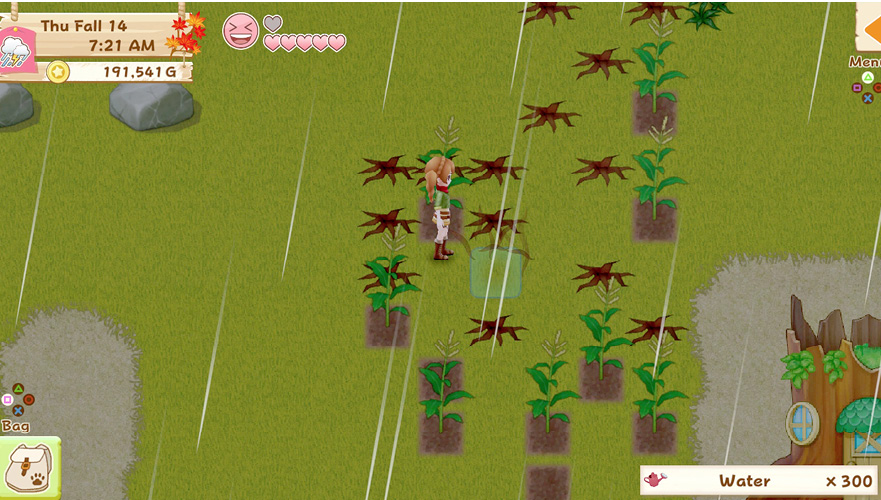
Though you should always strive to keep your crops well-fertilized (and watered in case of a heat wave), this is particularly true if inclement weather is on the way. Speak to Gareth at night in his house to hear his weather forecast for the coming day. He doesn’t always reveal the next day’s weather, but be sure to fertilize if he mentions any coming storms.
Spring: Generally pleasant weather with occasional rain showers. Chance of thunderstorm exists, though less common than in summer.
Summer: Chance of thunderstorms is increased, as is the prevalence of heat waves. Keep plants well-watered and fertilized throughout the summer.
Fall: Still a chance of thunderstorms, but also fog. Fog can cause plants to wilt from the cold, so keep them fertilized. Plants must still be watered on foggy days.
Winter: Cold weather brings more fog and snowstorms. Occasional blizzards keep everyone indoors and wreak havoc on unfertilized plants. Take caution when planting summer crops in winter.