Dragon Age II Guide Essentials Dragon Age Encyclopedia
Introduction
The Continent of Thedas
Orlais
Ambitious and wealthy Orlais is the most powerful single human nation in Thedas. Under its current ruler, Empress Celene I, Orlais has a large aristocracy famed for its culture and extravagance. Celene shares the expansionist dream of Orlais’ founder, Kordilius Drakon, that the nation’s borders should stretch to the edges of the continent.
Many Orlesian nobles belong to its renowned knightly order, the Chevaliers. The martial training of the Chevaliers is legendarily harsh, instilling in the knights a fierce discipline and code of honor that takes precedence over the value of their own lives. The Chevaliers know no fear and their loyalty is absolute. The penalty for dishonor is death, something that a Chevalier welcomes if he or she has failed their lord.
Another characteristic of the noble class is their penchant for high fashion, often copied in other lands such as Nevarra and the Free Marches but always at its most extreme within Orlais. Both men and women wear cosmetics of various kinds, with subtle differences that indicate social standing. In public, they are also prone to wearing very elaborate masks. These are hereditary and identify one’s family almost as uniquely as the heraldry on a crest.
The capital city is Val Royeaux, which boasts the University of Orlais: a major center of learning that attracts young nobles from all over Thedas with the best education one can buy. The University is a relatively modern institution, whose liberal-minded professors have already clashed with religious conservatives over the content of their classes. This is likely to become a much larger issue in the future.
Tevinter Imperium
Formerly an empire that stretched the entirety of Thedas, all that survives of Tevinter is a decadent remnant, centered around Minrathous in the north. This fabled city, once the jewel of the entire continent, is governed by powerful magic users through a form of magocracy.
Tevinter is almost universally reviled by other nations. Its nobility is famously debauched and slavery is still practiced. The Imperium is the center of the black market, smuggling (including the harboring of mage fugitives from other lands), and slave trade. While it might seem in decline, the Imperium is still a very powerful nation with considerable military might. Without a doubt, it would turn on the nations to the south if its attention were not diverted by the constant wars with the Qunari, in Seheron and Par Vollen.
The ancient magister lords ruled the Imperium as a group, maintaining a tight hold over the people through the power to infiltrate their dreams. These lords are no more, but even today some mages are quietly acknowledged as the most proficient dream-walkers and diviners.
The Imperium draws a variety of soldiers from its territories to form its impressive army. Two features of the Tevinter military, however, are considered legendary and are known throughout Thedas. One is the use of elephant mounts, these huge creatures having been imported into Tevinter for centuries through the coastal colonies near the northwestern jungles. The other is equally impressive: a trio of gigantic war golems purchased from the dwarves, which are known as
the juggernauts.
The Tevinters have left their mark all over Thedas, still felt in the ruins and roads of the fallen empire. Though the tales are now told to scare children, the truth of their excesses could still shock the hardest heart.
Ferelden
Ferelden is a relatively temperate nation in the far southeast of Thedas populated by a barbarian, militaristic culture that has only begun to civilize in the last few centuries. Still considered a backwater by other nations – especially the Orlesians, who controlled and occupied the Ferelden valley for centuries – the Fereldans have made great strides in recent years. A proud and independent people, they resent being considered “primitive” and are well on their way to becoming a power on the continent.
Ferelden borders the Orlesian Empire to the west, with whom it continues to have a very tense relationship. The Frostback Mountain range divides the two nations and prevents hostilities from being more frequent. Orzammar, the last kingdom of the dwarves, rests in
the Frostbacks.
Fereldan cities are considered anarchic by most standards. The Fereldan desire for freedom has engendered a laissez-faire cultural attitude towards law enforcement and behavior in general. While the worst offenses are quickly put down, many others are ignored and citizens are often left to make their own justice. Petty theft is common, as guardsmen will only go out of their way to deal with major crimes. Commerce is largely unregulated as long as taxes are paid: businesses such as brothels and gambling halls are not only tolerated,
but expected.
Lothering and the Imperial Highway
The Hawkes made their home in Lothering, a village north of the ancient fortress of Ostagar. The settlement arose on a crossroads of the Imperial Highway, starting out as a trading post and supplying goods to Redcliffe and the merchants of Orzammar. In time, the settlers became self-sufficient through mills and farmland.
The Imperial Highway is an ancient architectural wonder that was originally built by the Tevinter Imperium. Constructed from stone quarried by slaves in Kirkwall, this elevated road ran from Minrathous down to Orlais and then east to Ferelden. The intended project was never finished, and many sections have fallen into disrepair over the centuries. Nevertheless, it remains useful to many travelers fearful
of wolves.
The Free Marches
The Free Marches is a collective name given to the group of wealthy city-states in the central part of the continent. The “Marchers” are independent descendants from tough barbarians, their cities standing in a loose confederation that rarely unites on any matter unless one of their larger neighbors becomes aggressive. In this event, the Marchers assemble a united military front that even the greatest power
cannot ignore.
The Free Marches is best known as the breadbasket of Thedas, its farms along the banks of the great Minanter River being the source of much of the continent’s food. Starkhaven is the largest of the cities, welcoming visitors on the waterway to its regal central square.
Kirkwall
The last of the great Imperium cities, Kirkwall was founded in 620 Ancient by archmage Emerius Krayvan. Elven slaves were shipped in by the thousand to quarry the stone, enduring brutality that would first mark Kirkwall’s bloody reputation. Built on this foundation of suffering, the “City of Chains” became the center of the Imperial slave trade and the destination of those taken captive by conquest. It is now one of the larger Free Marches cities.
Approaching by sea, it is impossible to miss the imposing black wall that gives the city its name. Leering from the cliff face are the carvings of the Old Gods, a pantheon of profane idols smugly provoking the waves. Despite the best efforts of both the Chantry and the weather to eradicate them, the continued presence of these vile guardians seems assured for centuries
to come.
Marine access to the harbor is via a narrow channel, also carved into the cliff, and flanked by colossal bronze statues – the Twins of Kirkwall. By extending a chain net from the lighthouse to the Twins, the city is able to close off the only navigable sea lane and extort duties from passing ships.
The Gallows
Petrified in anguish, the many statues of tortured slaves pay no tribute to those sold into bondage. Instead, this city entrance and its high-walled courtyard are legacies of Kirkwall’s cruel past. The magisters intended the Gallows to crush the spirit of new arrivals, allowing no hope of escape or emancipation to enter the city. Daily executions furnished the gibbets with corpses as a visceral reminder of the only way a slave might one day find release. Stepping from the pitch-black hold of a galley to be corralled along the docks toward the Gallows, today’s Fereldan refugees might feel the same enfeebling sense of utter hopelessness.
Lowtown
In the days of the Imperium, this area was an enclosure for the slaves. Living conditions may have improved – slightly – but there’s no mistaking Kirkwall’s geographical divisions of social class. An endless labyrinth of shantytowns, alleyways and makeshift buildings, Lowtown is home to characters both colorful and occasionally pungent. The elven alienage is the largest of many ghettos, where despair at the squalid conditions is occasionally swept away by the evident pride of the close-knit communities.
The residents can at least take heart that they are not at the bottom of the social ladder: the poorest of all resort to making their beds in the sewers below, and in such numbers that Kirkwall’s underground tunnel network has earned the nickname of “Darktown”.
Hightown
Constructed for the local elite at the height of the Imperium’s fortunes, the mansions and plazas of Hightown still have the power to impress. Ascending the narrow staircase, visitors in the past would have entered a more decadent, extravagant playground than the refinement that greets them today.
Both the Keep and the Chantry now stand proud as symbols of Kirkwall’s respectability. Both are converted from the lavish residences of magister lords who accrued wealth from the slave trade. The original masters imagined that Hightown’s elevation could isolate them from events below: when the uprising came, they were unprepared for the self-sacrificing determination of those who had absolutely nothing to lose.
Nevarra
Originally one of the larger Free Marches city-states, Nevarra benefited from its position and has aggressively expanded over the last two centuries, becoming a power to rival Orlais itself. When a long war with the Orlesians wrested control of the mineral-rich hills to the west, the victory earned Nevarra considerable prestige in addition to the wealth.
While the capital lies in the original city of Nevarra, the city of Cumberland’s location on the Minanter River makes it a natural and busy point of trade with the rest of the Free Marches and beyond.
The Nevarrans can boast many legendary heroes in their past, with names that are still worshipped by the modern populace. Statues of these men and women are common, their bodies preserved in palatial tombs. Ancestors of the ruling Pentaghast family were once famed as dragon hunters, driving the beasts to near-extinction.
The Anderfels
The Anders people were the first humans to fight the darkspawn, and it is from their language that hurlocks and genlocks received their names. In this desolate landscape, centuries of Blight have so devastated expanses of the steppes that it is said the corpses of the fallen never decay: no beast or insect survives there to feed on them. Nevertheless, a history of repelling darkspawn incursions has hardened the proud inhabitants of this poor, remote nation with a steel spirit and grim determination. Their priests are the most devout, their warriors the most feared throughout Thedas.
The order of the Grey Wardens was founded in the Anderfels to drive back the first Blight, and it retains its headquarters at Weisshaupt fortress with a strong military force. Though a king sits in the capital of Hossberg, the Wardens are also treated as lords and banns. While their political power has waned elsewhere, the old order can still wield influence wherever the people are beset by the constant menace of invasion.
Antiva
Enjoying a warm north-eastern climate, Antiva is a nation of prodigious vineyards and good living. It possesses a respected noble lineage that can be traced back over millennia, though it is unofficially a private plutocracy. In reality, the authority of the existing monarchy has long been eclipsed by the true power of the bankers and the affluent classes. Money controls power in Antiva, possessing sufficient capital to resolve any external diplomatic quandaries with a well-aimed purse or threat of withdrawn trade.
Despite the lack of a strong military tradition, there is another reason why Antiva has rarely feared invasion: the infamous House of Crows. Contemporary Antivans may not boast a distinguished reputation on the battlefield, but they produce some of the deadliest assassins in Thedas. Were a conquering general to make this land his own, how long would he enjoy it before death arrived in the form of a wine glass, a loose balcony or a delicious cake? Such is the reputation of the Crows, to have kept whole armies at bay. Should you ever do something to regret in docile Antiva, understand that you have entered a land
of daggers.
Deep Roads
Any dwarf today can tell you tales of the Deep Roads as they once were – a grand network of tunnels that joined the thaigs, the caverns where settlements were built in honor of the Paragons. These subterranean highways were works of unparalleled artisan achievement, with centuries of planning and engineering demonstrated in the geometry of their walls. Statues of the Paragons watched over passing travelers, and channels carried a flow of lava that kept the Deep Roads lit and warm.
This once-proud creation is now the source of much lament for what they have lost. Today, only two thaigs even remain inhabited: Kal-Sharok and Orzammar in the Frostback Mountains. When the darkspawn first appeared, the dwarves sealed off the entrances to their cherished roads, abandoning everything that lay beyond, and retreated. With each passing year, the foulness spreads a little further.
Par Vollen
Some scholars believe that the first humans in Thedas came from the rainforests of Par Vollen many thousands of years ago, migrating south from the archipelago. The pyramids they built still stand to this day and are regarded by travelers to the region as true wonders.
Three hundred years ago, circa 6:30 Steel, the first Qunari warships landed. Clad in armor and bearing cannons, the invading force swiftly overwhelmed the native people in a brief but decisive bloodbath. A colony was established and the settlers built a strategic base on the southern coast. Qunandar is now a glittering capital city, famous for its great domes and aqueducts.
Though they were ousted from the Thedas mainland by the Exalted Marches, the Qunari held Par Vollen and regard it as part of their empire. It remains their strongest foothold in the region. Contact with their homeland has been intermittent at best across the turbulent northern oceans and there is doubt as to whether a ship has made contact in
many years.
It is said that another people known as the Fex also inhabit Par Vollen, though little is known of them.
Rivain
The Rivaini are unique among the humans of Thedas in regard to their appearance and their culture. They are olive-skinned or darker and often distinguish themselves further with tattoos and body piercings – the more elaborate the decorations, the higher one’s social standing or rank. They have a cordial relation with the elves, from whom the practice may have been adopted. They are not commonly followers of Andraste, and some have even converted to the Qun, the Qunari religion.
Another front for the great war when the Qunari invaded the mainland, there are many tales of massacres and war crimes on both sides of Rivain’s history. The Qunari forces were eventually driven back to the north, which they retained when the peace treaty known as the Llomeryn Accords was negotiated. In the centuries since, the city of Kont-aar has existed relatively peacefully within the rest of Rivain – nowhere else in Thedas is there as much interaction between the two cultures.
Despite prohibitions on magic, the Rivaini revere their seers as a matter of tradition. These apostates are wise women, local hedge witches who converse with spirits and even allow themselves to be possessed, though they supposedly do so for the benefit of their villages.
Seheron
While Par Vollen remains comfortably in the grip of the Qunari, Seheron is an island in dispute. It was part of the Tevinter Imperium until it was claimed by the Qunari sixty years ago, though the battle for domination continues. Adding to the turmoil is the significant presence of the Tal-Vashoth, bands of the horned race (known as the kossith) who have rejected the Qun.
Seheron’s most impressive features date back to the glory days of the ancient Imperium, but its legacy has turned against it. Many elven slaves have willingly converted to the Qun and now hold office within the Qunari ranks, helping the invaders to oust their old Tevinter masters. Some humans who remain also feel abandoned by the Imperium. Because the Tevinters never signed the Llomeryn Accords, it is here that the Qunari invasion continues to be fought. Seheron is still kabethari in Qunari eyes – a land to be conquered and converted, literally “those who need to be taught”.
Races and Religion
Humans
The most numerous, yet the most divided of all the races. Only four times have they ever united under a single cause, and it has been many centuries since the last. Religion and the Chantry play a large part in human society. It distinguishes them culturally from elves and dwarves more than anything else. While the other races dwindle, humanity has thrived and continues to spread.
Humans in times past worshipped a draconic pantheon of Old Gods, dragonlords that supposedly once ruled over Thedas and now slumber beneath the earth. But the people would come to suffer instead under the yoke of the Tevinter Imperium, a vast empire famously ruled by lords of dark magic, the magisters. Eventually, the Imperium was challenged from the south by a barbarian uprising, the armies led by Maferath and his wife, the prophet Andraste.
Andraste brought the teachings of a new god, the Maker, and her word spread quickly. The oppressed masses of the Imperium rose up in rebellion to support the invading barbarians and eventually most of the south fell to their might. Andraste was not stopped in her Exalted March until she was betrayed by her husband: jealous of her power, Maferath turned Andraste over to the Tevinter archon and she was burned at the stake.
The Chant of Light would say that the Maker turned his back on humanity when she died. He would only return and make the world into a paradise when the Chant of Light was sung from all corners of the world, and so the Chantry began to spread. The clerics of the Chantry were oppressed until the legendary emperor Drakon of Orlais converted and took up their cause, spreading the Chantry throughout all the lands that he conquered in its name. In modern times, the Chantry has spread throughout the known world, its power unquestioned even as it begins to give way to internal strife.
Dwarves
It is well known that dwarves are a stout, bearded race, often making up in width what they lack in height. The stereotype also suggests a hardy constitution, as sickness is thought to be rare among the dwarven folk. But their proximity to the darkspawn means their numbers are dwindling – a low fertility rate, combined with the steady rate of fatalities in battle, means the population of dwarves has been falling steadily for nearly a thousand years.
Their steadfast nature has been a blessing and a curse. It has granted them the mental fortitude to survive in conditions that would kill any other race, and the patience to develop their engineering to a level of technology that surpasses everyone but the Qunari (the dwarves have mastered clockwork and limited steam power). They have also developed some immunity to lyrium. However, their refusal to accept change over tradition has stultified their society with a rigid caste system, in which everything a dwarf can expect from life is determined at birth. The worst victims of this system are the casteless, dwarves who lost their legal standing by committing a crime, are descendant of criminals, or who have relinquished caste to live on the surface. Eventually they may end up running with the Carta, the criminal organization whose gangs can always find unpleasant work for the desperate.
The dwarves don’t have a religion, per se, nor do they believe in gods. Instead, their philosophy promotes excellence and an almost intimate tie to the rock that houses them. Referring reverentially to the Stone, the dwarves speak of it as being alive. They are the Stone’s children: they respect her, they fear her, they cherish her, and they give thanks to her for protecting them and providing them with her bounty.
Worship is reserved for ancestors. The greatest dwarves form the stuff of legend, their achievements earning the status of Paragon. In death, a Paragon is said to become one with the densest stone at the base of all mountains – quite literally, a part of the foundation upon which all dwarven society rests. In the thaig of Orzammar, enormous statues of past Paragons hold up the cavernous ceiling. This honor isn’t restricted solely to warriors: some of the greatest Paragons have been smiths and artisans, commoners as well as kings.
Elves
When they were the first and only race, the elves are said to have been immortals who lived in harmony with nature. Then came the “shemlen”, human migrants from the north, and before long the great forests were making way for towns and cities. These quicklings, whose lives blinked by in an instant, were considered no more than a pest. But too late did the elves discover that contact with humans brought disease and even caused the immortal races to “quicken”– to age, and finally to die. Horrified at this, they withdrew to their home of Elvhenan before humanity’s relentless expansion and broke off all contact.
In 981 Ancient, the Tevinter Imperium took the act of isolation as hostility and declared war. The fabled elven city of Arlathan was besieged but held out for six grim years. Eventually, the magisters resorted to an unprecedented blood ritual that dragged the entire city beneath the earth, obliterating it. The few survivors were enslaved and all evidence of their ancient culture was lost.
Despite being freed upon the Imperium’s collapse, the damage was done: the elves had lost their immortality, much language and history, and they blamed humanity for it. They attempted to rebuild a homeland in the Dales, but their pagan practices caused the Chantry to declare an Exalted March against them. Defeated again, the elves themselves were divided. The proud nobility became homeless wanderers known as the Dalish, traveling in groups and stubbornly continuing to worship their gods and maintain their traditions. The other elves became bitterly resigned to their fate and now live amongst humankind as “city elves”: second-class citizens, servants, and laborers who have all but forgotten the proud folk they once were.
Qunari
Bronze-skinned giants who sailed from a land far beyond the Boeric Ocean, the Qunari are a mystery to most. Technologically advanced, they reached the shores of Par Vollen in fabulous ships and immediately embarked on a conquest of human territory. The cannons of their dreadnaughts laid waste to the mainland, striking first into Rivain and then Seheron. On land, the glitter of their steel armor accentuated their physical superiority. Surprised by an unknown enemy, the defenders were no match for regimented Qunari discipline. Human history books may call this the First Qunari War, but there was little resistance to record as they marched deep into Tevinter for ten years.
They were finally repelled by an Exalted March, a crusade declared in 7:25 Storm that united the human forces on a scale unseen since the previous Blight. Its secret weapon was the Circle of Magi: the Qunari disdain for magic had not prepared them for its advanced potential, and their artillery was countered with volleys of fireballs. By 7:84 Storm, the invading army had withered and was ready to make a truce. All sides gathered in Rivain to sign a peace treaty, the Llomeryn Accords, with the exception of the Tevinters.
The Qun
The horned race formerly called the kossith only became known as the Qunari after the prophet Koslun bestowed upon them the Qun philosophy and religion. The teachings of the Qun turned their society into a model of efficiency and order. That order rested on unity, so no deviant beliefs would be tolerated again.
Rigorously structured, Qunari society has dispensed with the family unit. Couples are paired for breeding purely to reproduce, and all children are handed to the Tamassran to be raised. Priests and teachers, the Tamassran evaluate the talents of their wards and assign them a station in life at the age of twelve. Gender precludes certain roles, so only men may become warriors while women are favored for administrative tasks. Not all Qunari are born with horns, and those without can be assigned envoy roles as a Ben-Hassrath.
The Qun philosophy regards magic as a corrupting influence, at odds with self-discipline: the more you attempt to master it, the more it masters you. But everyone must have a role to play, so those saarebas born with magical talent are placed on a lead and entrusted to a handler or arvaarad. If found practicing forbidden magic, their tongues are cut out to prevent them corrupting others.
To the Qunari, humanity is a lesser race that still practices forbidden magic and would benefit from the higher order that the Qun brings. To humans, the Qunari are tyrannical zealots with an unfathomable disregard for individual rights. Though a delicate peace exists currently between the Qunari and humanity, future aggression is almost assured: the Qun is an implacable doctrine that will not be denied.
Nature and History of Thedas
Darkspawn & Blight
Darkspawn is the collective name for the corrupted creatures that dwell underground, infesting the Deep Roads and occasionally finding their way to the surface. Wild and savage, these marauders have presented a threat ever since they were first discovered by the dwarves.
In times of Blight, an archdemon arises that can marshal the bestial darkspawn into an organized army. Thousands swarm from the deep, destroying all life and spreading their taint across the world.
The horde’s presence brings the Blight disease, a plague that can leave the land twisted and blackened. Even when slain, the darkspawn’s poisonous blood defiles the soil and the animals that feed upon it. Madness and physical deformity commonly afflicts those exposed to the corruption. The Blight disease is ultimately fatal.
Slumbering beneath the earth, the beings known as Old Gods call out in their dreams. The darkspawn hear them, searching and digging in the hope of finding one. But they bring their corruption to the Old Gods they disturb just as they do to all else, and so spawn an archdemon. This draconic entity communicates directly to the mind of the horde.
In the events of Dragon Age: Origins – Awakening, The Architect proposed that the darkspawn capture females to create broodmothers. Though few survive the transmutation, it explains why the different types resemble monstrous imitations of the surface races. Corrupted human mothers produce hurlock broods; genlocks originate from dwarves; the shriek from elves; while the ogre echoes the Qunari.
The Chantry teaches that darkspawn are the Maker’s curse for the arrogance of men and that the Magisters of old Tevinter used their magic to open portals to the Golden City of the Maker, believing they could step into heaven itself. But their presence in this holiest of places instantly corrupted it with their sin. In His anger, the Maker transformed them into vile monstrosities and cast them down to the sunless depths of the earth, thereafter turning his back on his creation. Only when the Chant of Light is sung from all four corners of the world will the Maker return.
Magic
Magic is hard work, demanding training and discipline to achieve specific, supernatural effects that are often usefully formalized as spells. A mage cannot simply make a wish and point a finger.
As a matter of fact, not everyone can cast magic, and mana is the latent ability that defines a mage. Often inherited, it is a potential that may lay hidden and unknown in the mage unless drawn out by another. But those who possess such a potential have a special connection to the Fade – the spirit plane – and may draw upon its power. Mana is a measurement of one’s ability to channel energy from the Fade, and this energy is expended in the practice of magic. Just as the Fade can be reshaped by those who have grasped its nature, so this world can be manipulated by magic.
Lyrium
The most precious of substances, lyrium is a catalyst for enchantment and magical activities. Hazardous in its raw form. lyrium is safer when processed, becoming a shimmering silver liquid – though no less potent. The ore occurs naturally in veins and deep natural deposits: the dwarves’ resistance to lyrium and their unparalleled expertise in mining underpins a trade more lucrative than silverite or veridium. Nevertheless, tales of madness, side-effects and death continue to plague those who deal in it.
The legendary reputation of dwarven weapons and armor rests on their Smith Caste’s talent for working lyrium into steel. It is used in the production of enchantments, and by the Formari branch of the Circle of Magi. Lyrium consumption strengthens a mage’s relation to the Fade, thereby boosting mana. Even the templars are said to indulge its use for the purpose of anti-magic.
Forbidden Magic
Blood magic is the art of fueling spells with life force, specifically in the form of blood, instead of mana. It was common practice, at one time, for a magister to keep a number of slaves on hand so that he could use their blood to bolster the casting of spells that were physically beyond his abilities.
Over time, however, the Imperium discovered types of spells that could only be worked by blood. Although lyrium will allow a mage to send his conscious mind into the Fade, blood would allow him to find the sleeping minds of others; to view their dreams, and even influence or dominate their thoughts. Just as treacherous, blood magic can also be used to allow demons physical entry into the real world.
The use of blood magic was criminalized with the inception of the Circle of Magi, as common wisdom holds that there is no way to use blood magic with good intentions. Inevitably, even blood mages who tap their own blood find a need for the power of others, or find a need to control minds or summon demons.
Maleficar and Apostates
While maleficarum practice forbidden magic, apostates, by contrast, are those practicing normal magic outside the sanction of the Circle of Magi. All mages outside the Circle’s control, even those not practicing the forbidden arts, are considered dangerous as they can fall prey to a demon and become an abomination. They are hunted by the martial arm of the Chantry – the templars – to be placed safely in the custody of the Circle. Ironically, this hunt sometimes forces errant mages into blood magic or demon-summoning in order to escape.
There are still, however, many remote places where maleficarum and apostates exist quietly or in disguise. In some remote areas, ancient folk-magic traditions persist: the shamans in barbarian villages, the local alchemist who makes love charms, the hermit witch who casts curses on intruders, and the Dalish Keepers are all technically mages without Circle training. Most of these magic users are aware that they are apostates or maleficarum in the eyes of the Chantry and thus tend to be circumspect and reclusive. Because these individuals are subject to demonic possession, tales of witches and shamans going mad are quite common.
The Fade
Where do we go when we dream? The Fade is the spirit plane, the realm of thought and the source of all magic, only separated from this world by the metaphysical Veil. It is the domain of the Maker, whose once-golden city sits at the center. Shifting and impermanent, its puzzling architecture is familiar to us from our dreams. Unable to create for themselves, the spirits endlessly re-shape their world from whatever they glimpse in ours. Only a mage, with the aid of lyrium, may learn to explore the dreamworld consciously – and at risk of permanent disconnection from their body. While most mortals forget their time in the Fade upon waking, mages are cursed to recall it.
From any point in the Fade you might look up to catch sight of the Black City, the corrupted palace of the absent Maker. An approaching traveler will find it remains at a constant distance, always beyond reach.
Spirits and Demons
Sleeping visitors of the Fade realm find their most comforting thoughts under the watchful presence of its benign inhabitants. Spirits of fortitude and compassion weave dreams that strengthen the soul of the waking, while more powerful spirits of justice, faith and hope can elicit visions and promote divine epiphanies in their mortal wards.
For each of the five groups of benevolent spirits, it is their counterparts, the demons, who are the source of the fear regarding mages and forbidden magic. Common lore says the spirits were the Maker’s first children, beautiful but flawed, and that some grew jealous of the creatures he subsequently created and imbued with the divine spark of life.
In times past, the Tevinter lords summoned demons to do their bidding against their enemies. Such pacts now count as forbidden magic, but it is not necessary to invite a demon willingly. By their nature, mages are constantly at risk of becoming the conduit for a demon’s appearance.
Demons can possess the bodies of any susceptible creature, both the living and the dead, if the Veil between this world and the Fade is thin enough for them to cross between the two. It is enough merely to dream, for that is when mortal minds wander the Fade and may be lured by their whispers. But demons are most empowered when they can feed on emotions – rage, sloth, hunger, desire, pride – and these determine the form of demonic manifestation.
The abomination is the most powerful and destructive force of all, occurring when a demon possesses a living being with magical ability. It is the fear of unleashing such a terror that prompted the establishment of the Circle of Magi, where mages could be contained and monitored – culled, if necessary – to prevent an outbreak.
Economy and Money
Although the names and appearance of coins vary from nation to nation, they follow the same system. One hundred copper pieces are worth one silver piece, and one hundred silver pieces are worth one gold piece. At one time, the size and purity of these coins differed from one land to the next, which meant that some regions would not accept another’s coinage in trade, so the dwarven merchant guilds developed a standard and refused to accept currency that did not meet their specifications. Most nations quickly converted. Particularly expensive transactions may be completed in “bars” (solid bricks) and “strands” (stacked groups), but those are the province of merchant guilds and government, rarely seen in day-to-day commerce.
|
Piece |
Fereldan Name |
Orlesian Name |
Equivalence |
|
1 gold |
1 sovereign |
1 royal |
100 silvers |
|
1 silver |
1 silver |
1 crown |
100 coppers |
|
1 copper |
1 bit |
1 penny |
- |
The Landsmeet
When Ferelden was divided among barbaric tribes, the banns (or barons) recognized that issues affecting them all required a common decision. The Landsmeet was the solution, during which each bann was guaranteed safe passage and a truce throughout the meeting.
In the Landsmeet, the banns have chosen to fight against the occupation of the Imperium; to repel the werewolves; and to follow Maferath and Andraste into history. Since then, the Landsmeet has been an official legislative body, and it can override the king on any matter of law, although the Landsmeet tends not to exercise its power if the king
is strong.
Originally, the location changed with each Landsmeet, but since the crowning of the first king, they have taken place exclusively in Denerim. The Landsmeet occurs at least once a year, although since King Maric acceded to the throne, it has begun to meet once per season. Most noble families thus maintain an estate in Denerim to house themselves and their entourages when they are in the Fereldan capital.
The Timeline
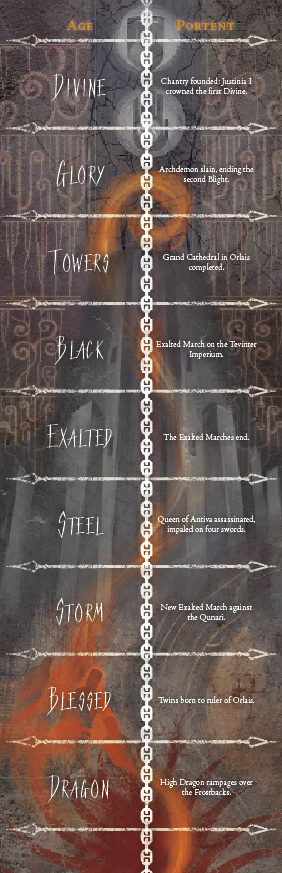
Dragon Age II takes its name from the Chantry calendar, adopted to replace those of Tevinter and the individual races. The year is 9:30 Dragon, or the thirtieth year of the ninth age. Each age spans one hundred years, and it is during the ninety-ninth year that the clerics of Val Royeaux watch for portents and omens of the future. They advise the Divine on a new name for the following age, one that will foretell the century to come: the sighting of a mature dragon, believed extinct, was said to herald a time of violence and upheaval.