
Left 4 Dead Guide Essentials The Infected
The Infected
Those who have died and reanimated are referred to as the infected. These are victims of unknown origin and transmission.
The infection manifests itself in different ways, sometimes simpluy reanimating dead tissue and at other times triggering monstrous mutations, giving the undead strange and terrifying abilities.
There are two subsets of infected: the common infected and the special infected. In a wide majority of cases infection leads to death and reanimation, turning a corpse into a common infected or zombie.
The common infected have abilities similar to those of a normal human. But in the rare cases where the postmortem mutation has occured, the corpse becomes a special infected, often referred to as an infected boss.
These infected variants have different abilities and characteristics, as detailed in this chapter.
By no means is this a definitive resource, but rather a compilation of facts based on firsthand accounts and credible reports from reliable sources.
Common Infected (aka Zombies)
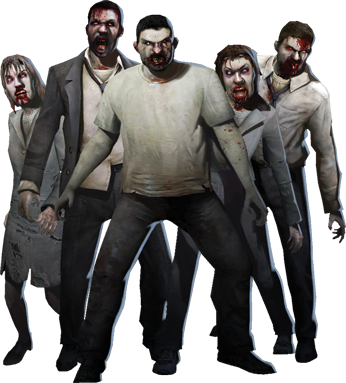
Despite the rabid speculation of the so-called experts, it’s unclear what really caused the dead to rise. And nobody may ever really know the answers to all the hows and whys of the outbreak. But it is clear that the recently deceased have somehow reanimated and begun attacking the living.
Although they’re officially referred to as the common infected, many survivors simply call them zombies, since they resemble the walking dead popularized by horror movies.
However, such comparisons can be dangerous because the common infected share few traits with the fictionalized zombie—see the “Zombie Myths” sidebar.
Most notable is the speed of the common infected, which has caught many a survivor completely off guard. Their clothes are also deceptive.
Realize that some of the common infected died and reanimated while on the job. Although they may be dressed as police officers, soldiers, or doctors, they have no intent to assist the living.
Anti-Zombie Tactics
Zombies can be killed in a number of ways, but the headshot is by far the most effective method. All it takes is one bullet with any firearm to score a kill.
However, headshots can be difficult to perform during chaotic attacks. So aim for center mass, pumping three to four rounds (or one shotgun blast) into a zombie’s chest.
Some weapons can tear off a zombie’s arm or leg. Severing limbs is just as fatal as a headshot.
Individually, the common infected aren’t much of a threat, but in great numbers they’re an absolute menace. During swarm attacks, locate the possible entry points and cover all of them. If in an open area, go back to back with your teammates and hold your ground while covering all directions.
A Boomer’s bile, activated car alarms, and finales can all trigger swarm attacks. The director can trigger them as well, so when you hear the cries of infected accompanied by swelling dramatic music, get ready to make a stand.
Shining a flashlight on idle or sitting zombies gets their attention and prompts them to attack. Sometimes these nonthreatening zombies can be avoided.
It’s possible to kill a zombie with melee strikes, but it takes repeated blows. For best results, melee a zombie away from you, take aim, and shoot it in the head as it stumbles backward.
Avoid taking to rooftops or other elevated positions and sniping all visible infected. Doing so just wastes ammo.
The director continually spawns more infected, so it’s impossible to kill them all or completely clear a level. So keep moving and shoot only the zombies that get in your way.
Zombie Myths
As in any crisis, misinformation floods the airwaves and permeates the streets as those in power try to come to grips with the situation. The recent outbreak is no exception.
The government’s own CEDA is partially responsible for the circulation of some these rumors, but the panicked public is largely to blame for the proliferation of these fallacies, fueled by pop culture anecdotes derived from books, movies, and video games.
Here are a few of the common misconceptions being spread about zombies, countered by fact-based rebuttals.
Zombies are slow and clumsy. You can easily walk right past them.
False. For reasons unknown, tissue decay has not set in, and thus the common infected have the same mobility as the living. They can run, climb, jump, and perform vicious melee attacks, sometimes at seemingly superhuman speeds.
The only way to kill a zombie is by shooting it in the head.
False. While headshots are fatal and often the quickest way to dispatch zombies, the undead can just as easily be neutralized by severing a limb, lighting them on fire, or simply shooting them in the torso several times.
If you’re bitten by a zombie you’ll turn into one.
Unknown. There are reports of this occurring, but there is no hard evidence to suggest that zombie bites or fluid transference results in zombification. Still, it’s best to avoid any direct contact with the common infected.
Zombies are weak and stupid. As long as you shut yourself in a room you’ll be okay.
False. It’s true zombies haven’t been seen turning doorknobs, but they can easily break through doors and boarded-up windows.
Staying put in a room or structure with multiple insecure entry points is a death sentence, even if you’re well armed. You’ll run out of ammo at some point, and the zombies just keep coming.
Since they’re dead, zombies have dulled senses, making it difficult for them to detect the living.
False. While it’s unclear how effective the zombies’ senses of taste, smell, and touch are, their sight and hearing are sharp. Upon making visual contact with the living, they launch directly into attack mode, charging at their prey at top speed.
Even slight noises prompt them to investigate in the direction of the disturbance. Loud, high-pitched noises send the common infected into an absolute frenzy, causing multiple infected to swarm to the source in search of prey.
Some survivors have witnessed such swarms when car alarms or metal detectors are set off.
A zombie’s heart doesn’t beat, causing the blood in its circulatory system to congeal.
False. The functionality of a zombie’s heart is unknown, but the blood remains in a liquid state. Survivors engaging the common infected at close range with shotguns have reported being sprayed with infected blood, particularly when firing a decapitating headshot.
Direct contact with a zombie’s blood is not advised, but it doesn’t appear to be fatal, either.
Some survivors have been completely coated with infected blood and have shown no signs of infection. However, it’s strongly advised to avoid contact with infected blood when possible, especially around the eyes and mouth.
Stay away from cemeteries. That’s where the zombies are coming from.
False. There have been no confirmed reports of the dead literally rising from the grave. The infection seems to have affected only the recently deceased.
As a result, zombies are much more likely to be found at hospitals, coroner’s offices, funeral homes, and crematoriums. Quarantined buildings and evacuation centers are also likely locations and are best avoided.