
Civilization Beyond Earth Guide Starting a Game Getting to Know Your Opponents
Brasilia
- Sponsor benefit: Units have +10% Strength in melee combat.
Its development checked briefly by the Great Mistake, Brasilia roared back as the preeminent South American economic entity and a world-class military power. Brasilia's military was the backbone of many peacekeeping forces deployed to restore order, and the nation was able to establish itself as a major trading partner with the rest of the world. With the wealth of the Andean highlands and the Amazon acting as a highway to the continent's interior, Brasilia experienced tremendous growth and development as order returned to the world. An early adopter of the Inflection Point theory, Brasilia's aerospace industry and veteran air forces allowed them to launch the very first Seeding expedition.
Playstyle
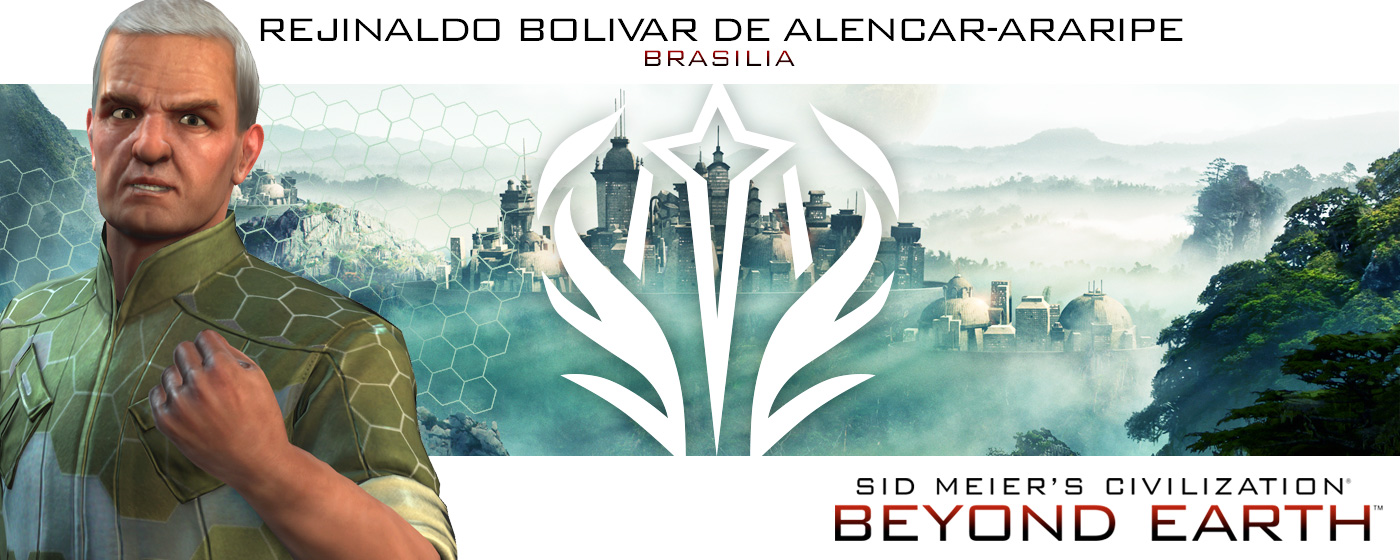
One look at Rejinaldo de Alencar-Araripe tells you that you're dealing with a lifetime soldier. Don't mistake him for a total warmonger: this isn't Earth, and its leaders don't always have Earth's sensibilities (or lack thereof). It's often quite possible to negotiate with de Alencar-Araripe and avoid conflict, but you won't want a small military or a vulnerable border to be involved in the discussion. Keep your military deployed near de Alencar-Araripe's border to discourage any ventures into your land. His people have a modest bonus in direct combat. It's not enough to win a war by itself, but he'll have enough troops to exploit that advantage unless you're a good defensive fighter.
Playing as Brasilia is quite fun if you're a direct domination player. Though you can take any of the other Sponsors into battle, Brasilia is the best choice out of the bunch. Their melee bonus makes it easier to take and hold cities, fend off enemies in rough terrain, and win wars with fewer casualties. This leads to an upward spiral because your units start off better than their rivals, survive more often, gain more levels, and become even more lethal in the next war.
Take Might virtues to get an even greater leg up on your opponents. Faster levels and quick training help you put a great army out in the field, and the bonuses against aliens gives you something to attack in the early game if there aren't any rival Colonies nearby. You want to have multiple units up to Level III by the time any serious threat gets close enough to conquer.

Rejinaldo Leonardo Pedro Bolivar de Alencar-Araripe
- Strengths: Health, Military, Production
- Weaknesses: Diplomacy, Growth
Contrary to expectations, de Alencar-Araripe appears considerate, understanding, and unassuming in dealing with both his own people and outsiders. Usually dressed in a simple military uniform devoid of medals or rank, he eschews most of the trappings of leadership, reflecting his humble beginnings and rise through the enlisted ranks. He is slightly built, perhaps wiry, reflecting the malnutrition and illnesses of his childhood. In his early 70s, he may be elderly, but he is still fit and far from feeble. He carries himself with military bearing, ramrod straight and with precise movements, although he has the habit of punctuating his dialogue with flamboyant gestures. His use of language is equally precise and careful, and he is erudite if not verbose. De Alencar-Araripe is always busy, insisting on overseeing the work of his colonial officers and officials, and he appears distracted when speaking with others. He also tends to be pessimistic, assuredly because of his life experiences.
Said to be the finest soldier ever produced by the Western hemisphere, Rejinaldo Leonardo Pedro Bolivar de Alencar-Araripe began his celebrated career at the age of 16 by enlisting in Brasilia's Corpo de Fuzileiros Navais, lying about his age in the finest military tradition. His first assignment as a Marine was in support of a Security Council operation in northern Myanmar, where he saved his platoon, called in air support, and coordinated evacuation after their transport was shot down. His ascent after that was meteoric, rising quickly to Sargento and then attending the prestigious Academia Militar das Agulhas Negras to become an officer. Commissioned as an Aspiriante at the outbreak of the Peshawar Crisis, he was part of a continent hastily sent to Asia to help quell the crisis and deliver humanitarian supplies. Again, his heroism was proven at the Battle of Route Blue, as he stepped into command after the first, second, and third commanders of the forces protecting the refugee camp were killed in battle.
A complete listing of his military accomplishments would exceed the scope of this article, but there were few battlefield commanders held in as high regard as de Alencar-Araripe. Resisting staff duty until it became impossible to do so and still serve his nation, de Alencar-Araripe has been in no less than nine combat tours, seven of them as a commander on the front lines. His talent for planning and improvisation with limited resources are legendary, and, when not serving in combat, he has been a fixture at Agulhas Negras, training the next generation of military minds.
Somehow, in this illustrious military career, he has found time to write the seminal volume of military sciences in the post-Mistake world: the three-volume Principles of Modern Warfare and the slimmer On the Training and Conduct of Soldiers (for enlisted soldiers and military cadets). As proponents of special forces, total victory, aerospatial power projection, and professional NCOs, these volumes have served as the blueprint for infantry doctrine around the world, their pithy maxims backed up by examples from history and de Alencar-Araripe's own career. From anyone else, these books would be grandiose; in de Alencar-Araripe's case, they are statement of fact.
A national hero for Brasilia, his name came quickly to the top of the list for commanders of the first Seeding projects. Despite a career "in the mud," de Alencar-Araripe was endorsed by the Brasilian Air Force and the Space Department. Never one to decline a chance to serve his country, de Alencar-Araripe honed the first Seeding to leave Earth's orbit into the professional, dedicated force that was the hallmark of his military career.