
Civilization Beyond Earth Guide Core Concepts
Changed Concepts
Pods and Expeditions (More Involved Than Villages)
There are two types of free goodies that are present on the game map: Resource Pods and Expedition sites. The former are available from the very beginning of the game and are not seeded over time. As Colonies settle, they'll start to gobble Resource Pods up with their explorers and wandering military units. Once they're gone, that's it for the game's free pods.
Resource Pods contain bonus Culture, Science, Energy, or an occasional solar collector (an orbital that generates Energy over time for its area of effect). None of these bonuses are huge, but you can still get a fair boost to your early game if you're lucky and find multiple pods. They're especially powerful as a boost to Culture, which is normally quite slow to accumulate during those early turns. This can get Colonies one or two virtues before their time, allowing for faster growth or capabilities in that section of the game.
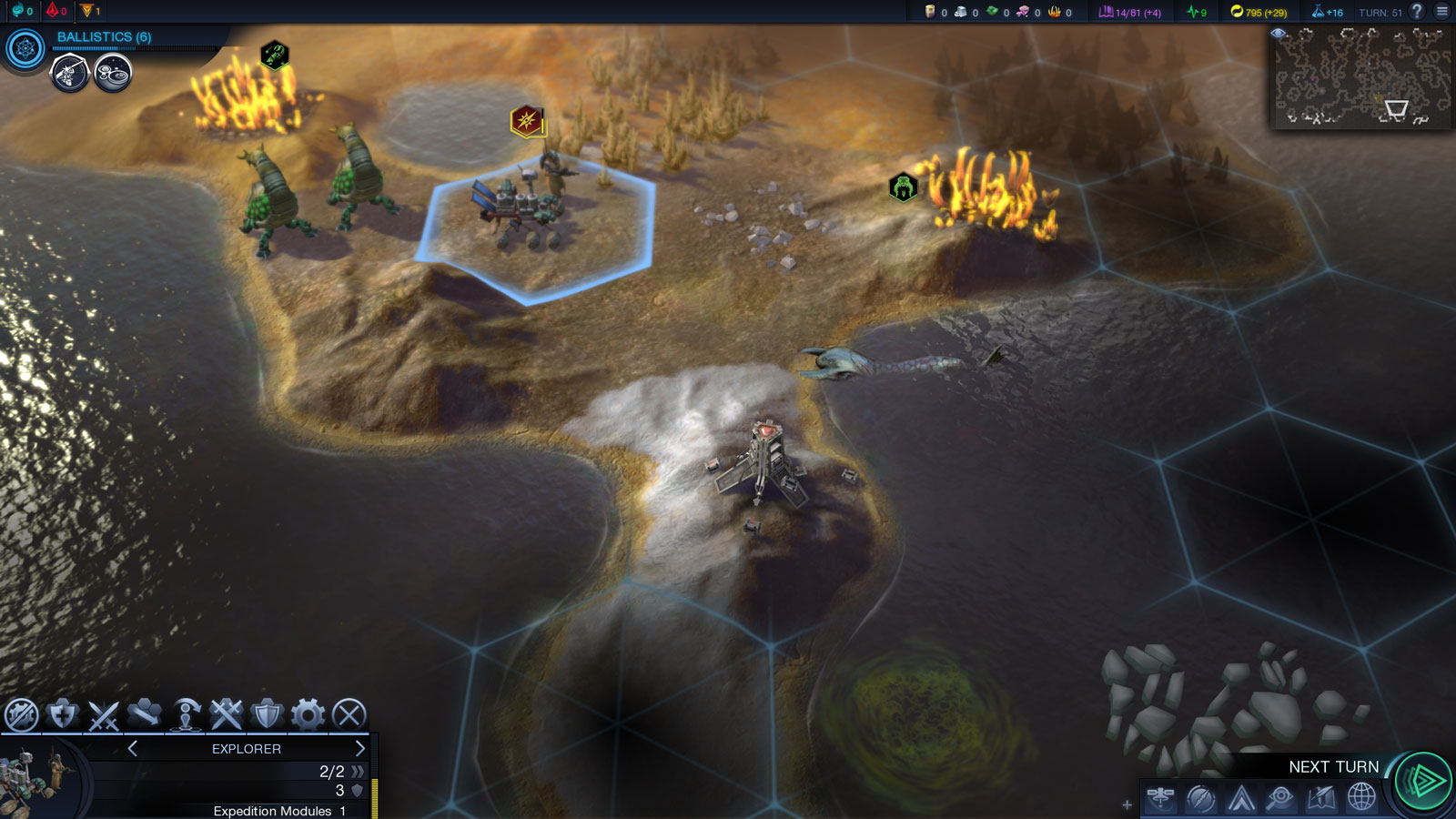
Expeditions are more involved, but they also contain greater rewards. You find Expedition Sites starting from the beginning of the game. There are only a few starting points of this type, but more generate over time. Destroyed stations and alien nests sometimes become Expedition Sites, as do the areas where orbitals fall from the sky.
While any of your units can pick up Resource Pods, Expedition Sites aren't usable by anyone except explorer units. This is one of the reasons that explorers are so useful to each Colony. Get them over to any derelict settlement, alien skeletons, crashed satellites, ancient tombs, caves, or Progenitor ruins that you find.
Explorers work on these tiles for a good amount of time, much like workers improve tiles. However, explorers don't have to be inside your borders to launch an expedition, so feel free to wander the world looking for these treasures.
Other Colonies complain if you work on a site that's close to their borders. You have the option of apologizing after you get your loot, or telling them to deal with it. If you promise not to do this again, you get better relations with the civilization in question (and this is compounded if/when you keep that promise). Otherwise, they're going to be even angrier when you break your promise and keep making expedition sites that they think should be theirs.
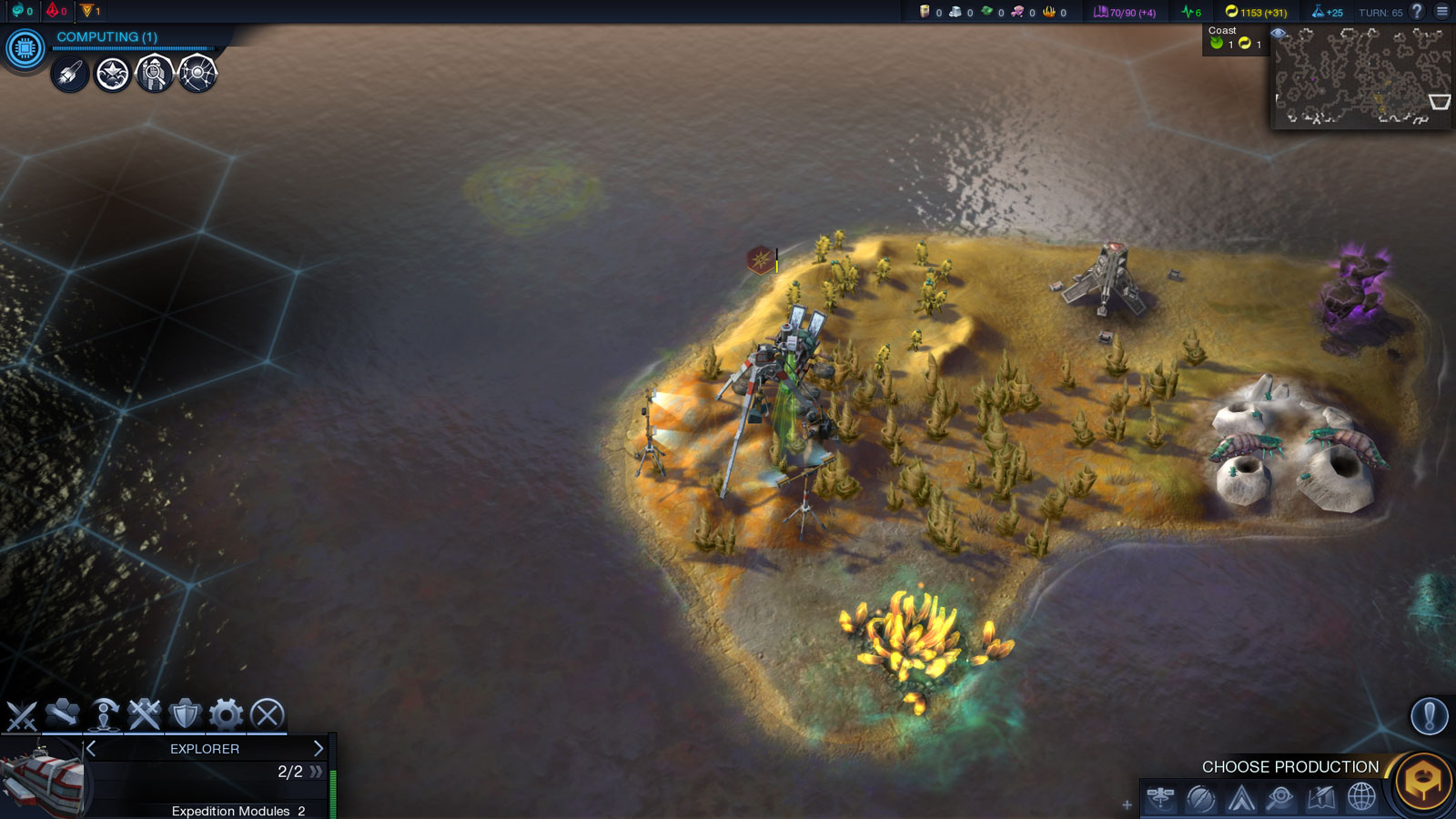
Very few things in the game provide the same level of rewards as expeditions. You're able to get free units, affinity levels, technological progress, population points, Production, and other great things from these sites. Going after expedition sites is a major way to secure an advantage even once the early game has finished. Keep explorers around, having them at the ready in case new sites are discovered or are created.
Virtues
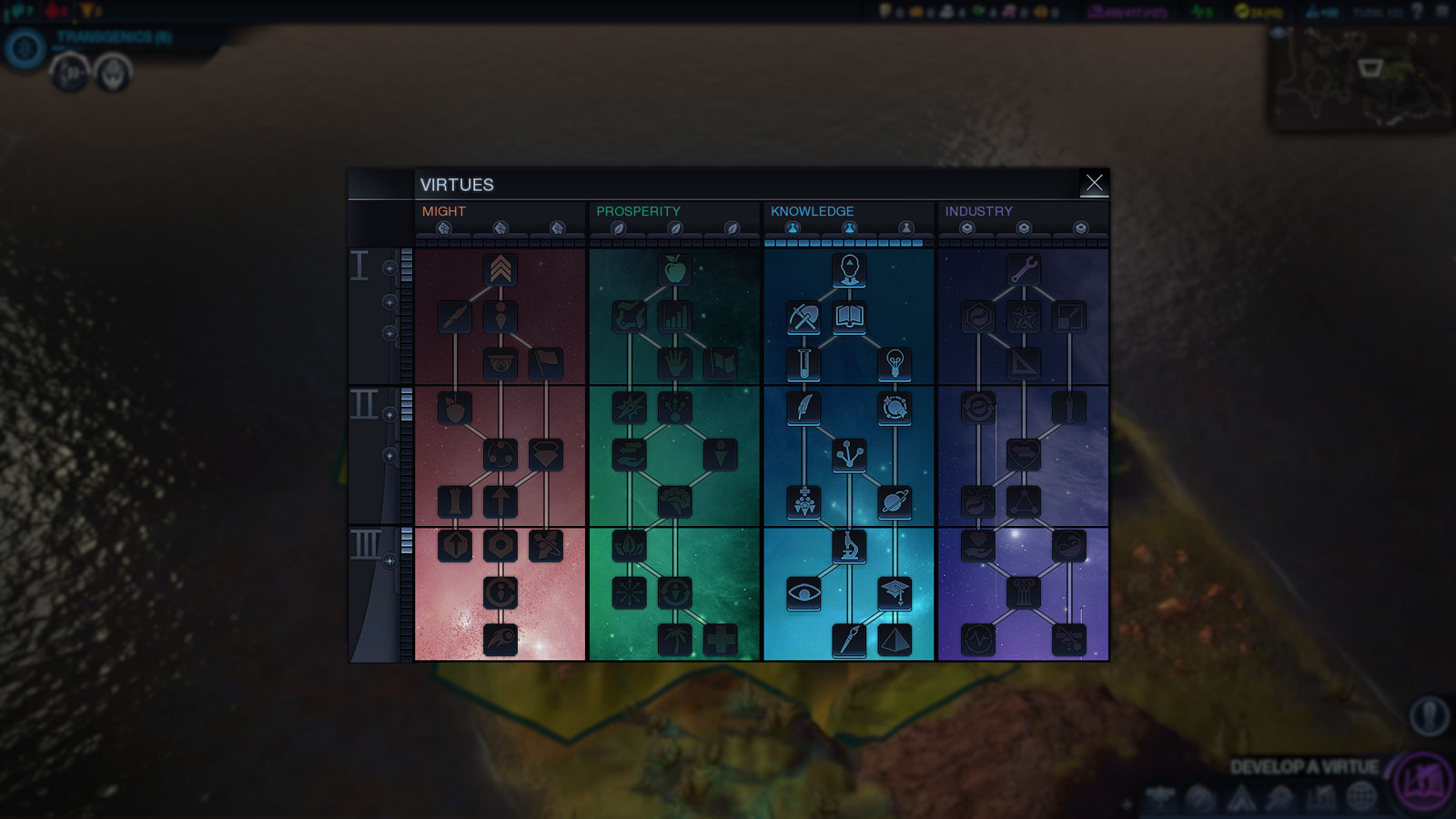
Virtues let you control the passive bonuses that influence your Colony's growth and development. There are four types of virtues: Might, Prosperity, Knowledge, and Industry. All of them are useful to each player, but they obviously favor different aspects of your Colony's power.
Culture builds over time to let you choose more and more virtues, and the bonuses within each branch of the virtue system get more impressive.
Colonies and Sponsors
Chapter 02 discussed the various sponsors and starting options that define your early Colony. This is a somewhat distinct change from Civilization V. There, you chose a nation, and that determined your passive bonuses, unique buildings, and unique units. In Civilization: Beyond Earth, your sponsor is one of several choices during game creation, so there are way more options than ever before for customizing the exact Colony you're trying to forge.
Try a wide range of combinations to learn which combination is best for your style of play. Some of these are going to be better depending on the map you end up choosing, so think heavily about that before committing to your final selections.
Unit Stats and Development
Head over to Chapter 04: Units to learn about the statistics, training, and use of units in this game. This chapter explains what each unit can do and also goes over the general function of your military and civilian units.
Health
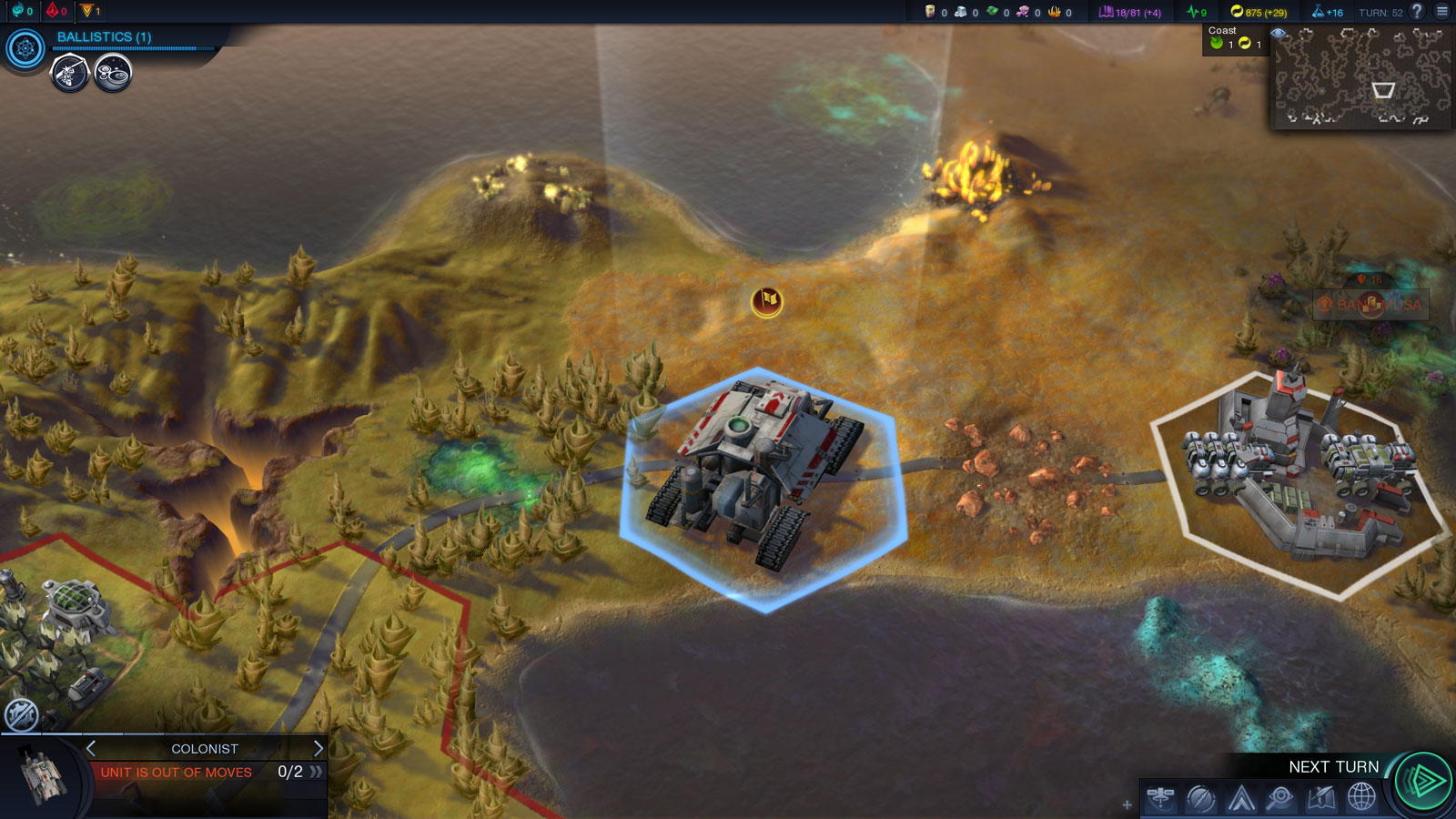
There is always a limiting factor that controls your cities' growth. This is essential for creating a game that isn't simply a matter of spamming colonists and settling as many cities as possible, as quickly as possible. This version of Civilization brings back health concerns. Your Colony experiences penalties for various tiers of low Health and gets bonuses for several possible levels of good Health.
Tiers of Health
- Panicked: -20 Health and beyond -10% Production, Science, and Culture, double Intrigue from enemy actions, 50% reduced city Growth, -50% outpost Growth
- Troubled: -10 to -19 Health -10% Production, Science, and Culture, double Intrigue from enemy actions
- Shaky: -1 to -9 Health -10% Science and Culture
- Stable: 0 to 9 Health +20% outpost Growth
- Prosperous: 10 to 19 Health +10% Production, +20% outpost Growth, -50% Intrigue from enemy actions
- Utopian: 20+ Health +10% Production, Science, and Culture, +20% outpost Growth, -50% Intrigue from enemy actions
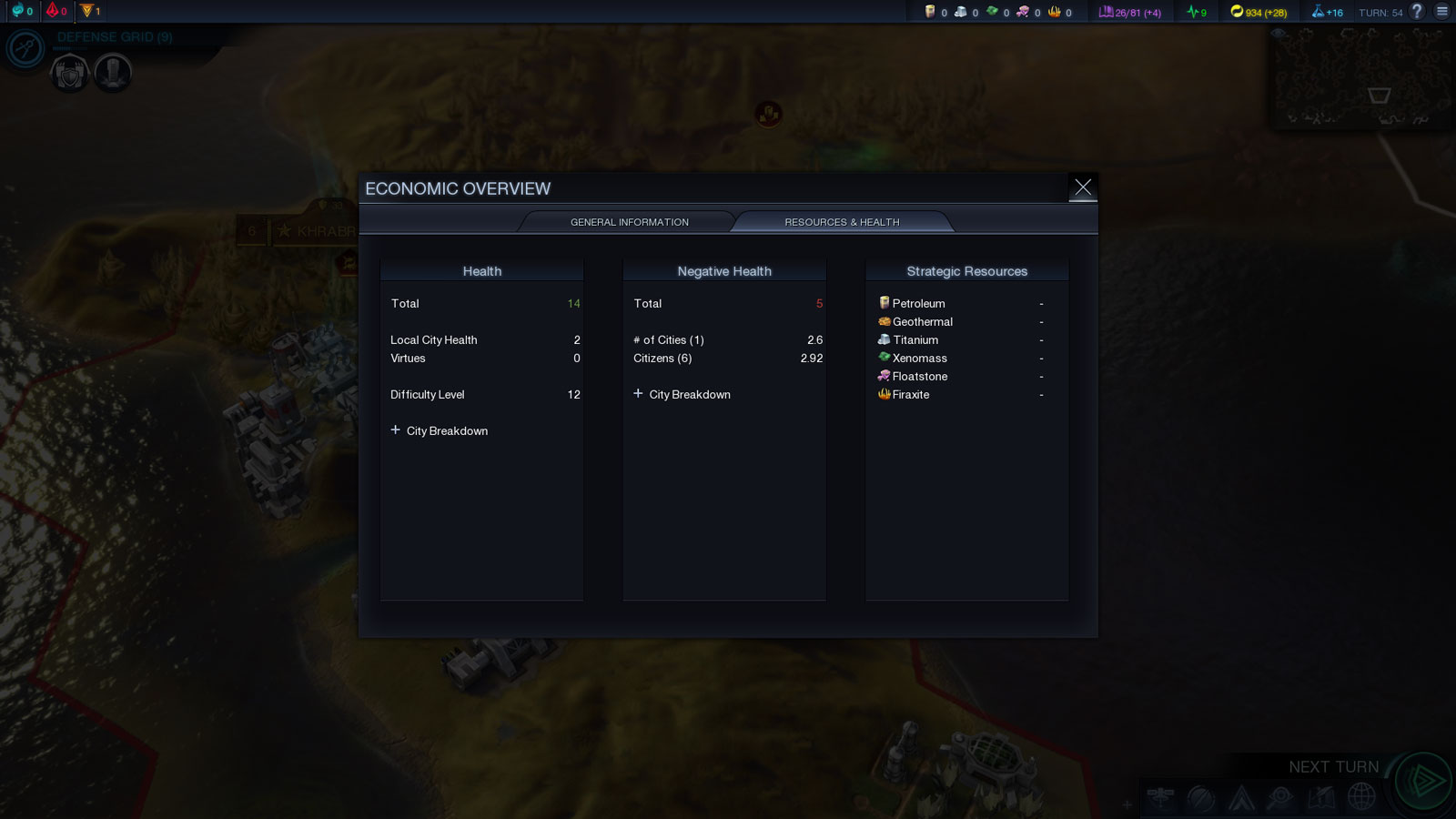
Health decreases when you have more citizens and more cities. Each city costs more than several citizens, so you must be cautious about founding outposts when your Health is already low.
To get an idea where your Colony's Health is currently resting, look at the top of the screen. Highlight the Health symbol; it will be green if you are getting bonuses from high Health or red if you're in penalty territory. When you highlight your Colony's Health, you get to see a breakdown of your bonuses or penalties and the influences that give you your net Health tally.
Higher difficulty levels increase the challenge of the Health system by starting you with a lower amount of positive Health. Be even more careful about fast expansion when you move up to higher tiers of difficulty! Before founding many outposts, wait for more buildings that have Health bonuses.
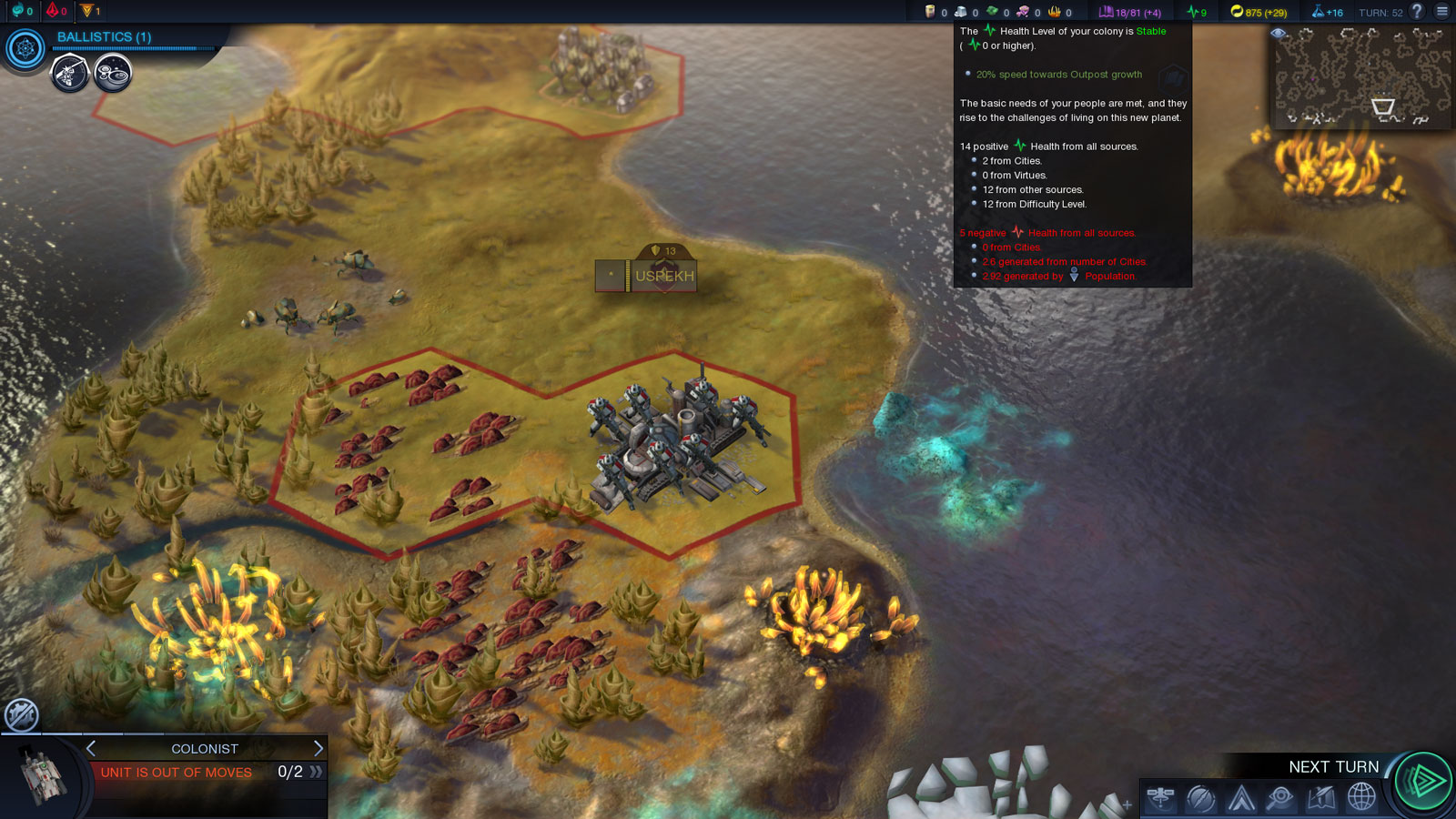
Your Health gets even worse when conquering new territory. Enemy cities that are annexed cost you additional Health until the people have had time to adjust. There isn't anything that you can do to rush this, so watch out for your Health during successful combat campaigns.
Buildings with Health bonuses, constructed in all of your cities, make a huge difference in your Colony's total Health, but that isn't all that you can do. Certain wonders aid in this system, and Prosperity virtues are also amazing for improving Health. In fact, the final tier of Prosperity virtues comprises one of the best ways possible to have a massive nation that still is constantly healthy no matter what you do.
It's okay to dip into negative Health from time to time. This doesn't cripple your nation on a short-term basis. Instead, it adds penalties that really add up over time. If you get out of negative Health fairly quickly, there isn't a big downside to this. So, make sure to prioritize Health buildings when Health is getting low, but don't overbuild them. Having too much Health is wasted, and the bonuses stop coming in at +20 Health; it's easy to overshoot in the late game, so start to cut back heavily once you approach the positive Health cap.
Energy (Money in a New Era)
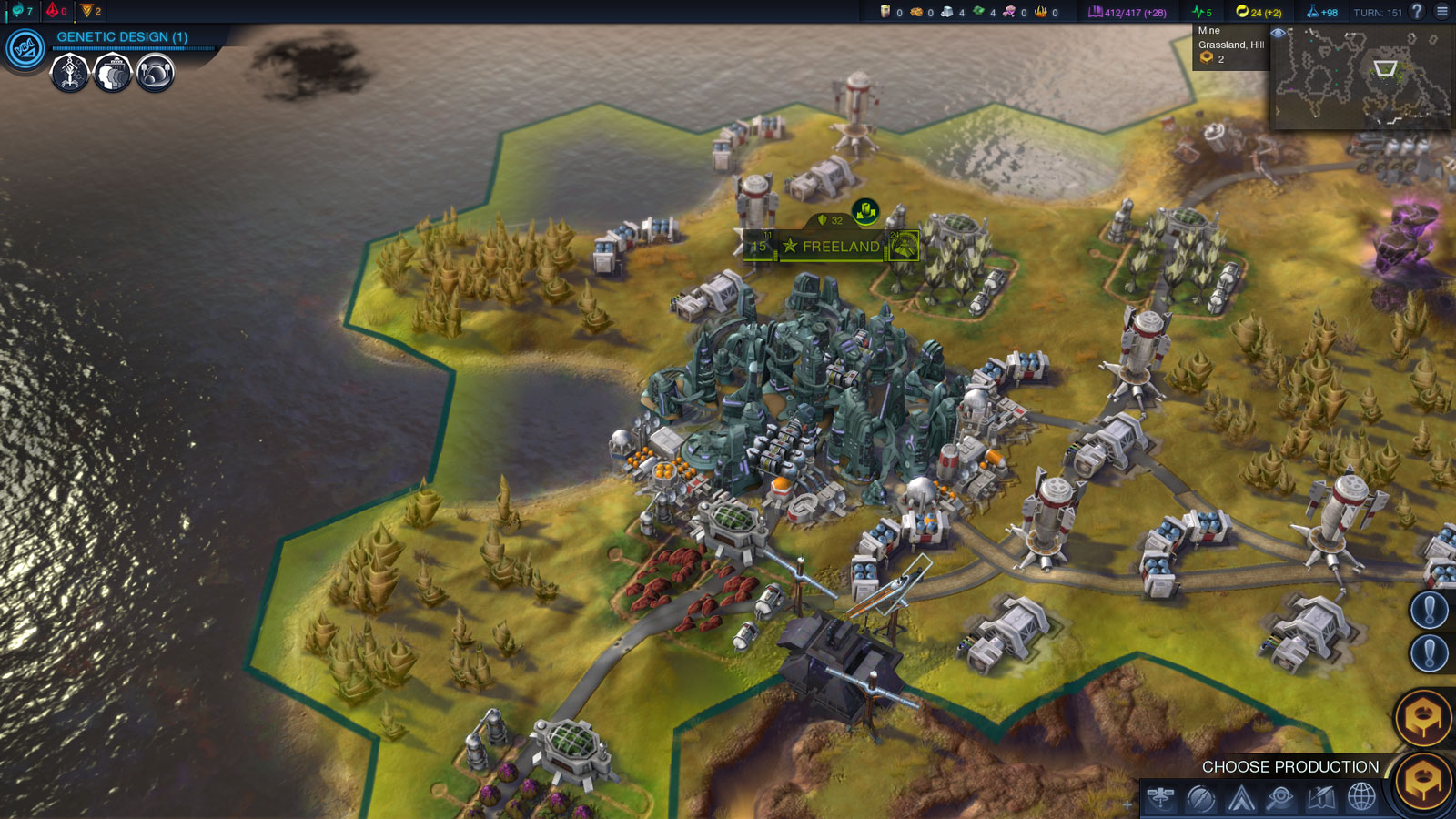
Energy is what makes the world go around. You gain it through tile improvements like generators, Energy-producing buildings, foreign trade routes and specific station routes, and by working water-based tiles near rivers, oceans, or lakes. Some resources also yield Energy when your citizens work them.
Sometimes, you also get Energy from finding Resource Pods, pillaging enemy tiles, destroying alien nests, or negotiating for it during diplomatic meetings.
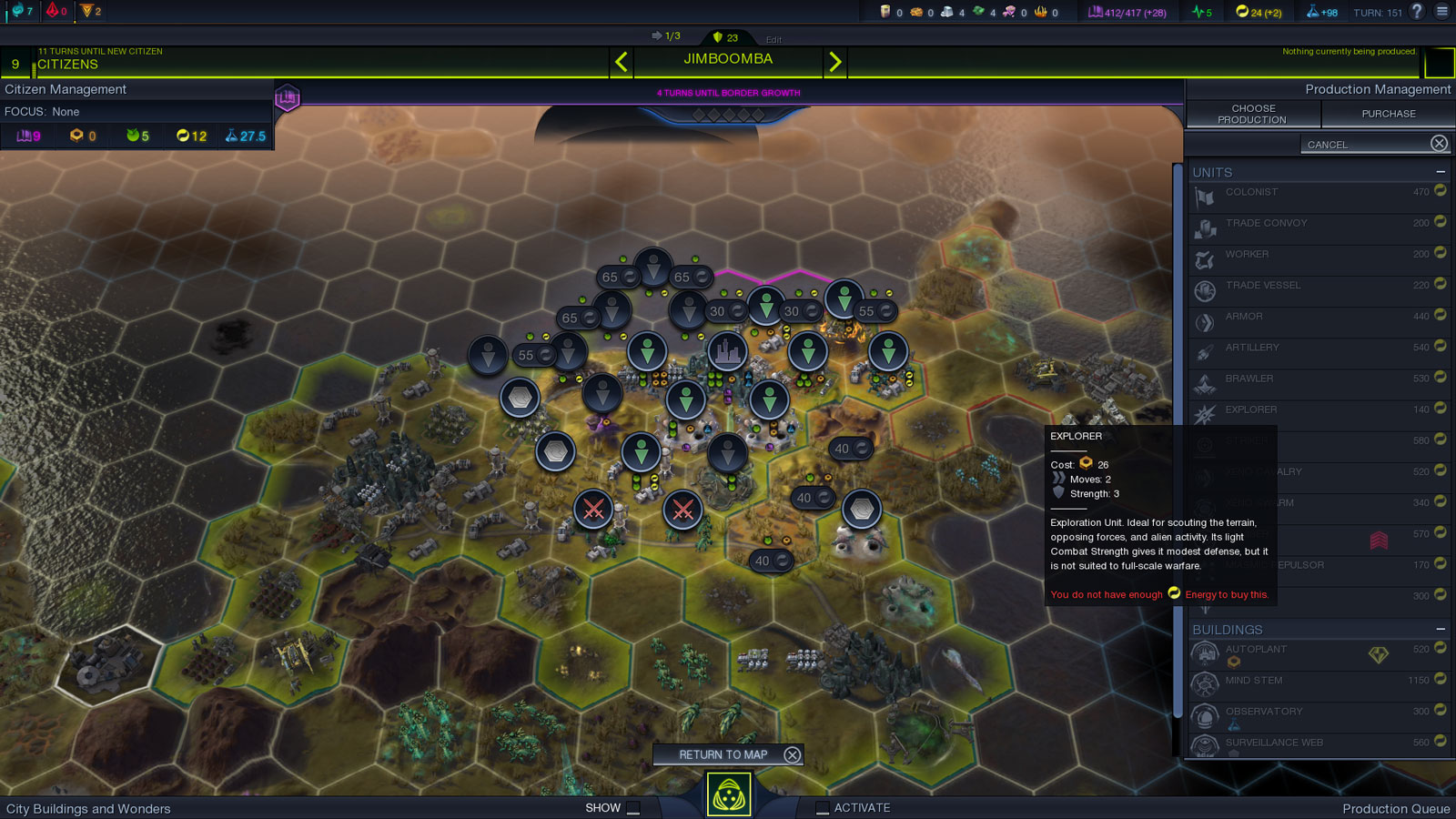
Thus, there are many ways to earn Energy. Think of it like you would money in other Civilization games. This is a resource that lets you quickly construct buildings, train units, and pay for all of these items over time. A strong economy can do all of these things without making sacrifices. A decent economy can pay for itself without any problems, but it cannot afford to waste Energy on fast construction or training.
Weak economies are a big danger to your society. They'll have trouble paying for buildings in your cities, and that limits the amount of development that you can do. Use workers to improve Energy yields on your tiles, and prioritize economic buildings when you're worried about your net income.
Your Energy is shown in gold at the top of the screen. Highlight it to see where your Energy is going (toward building and unit maintenance mostly, but also to roads). Additionally, you can see where you're getting your income. City connections, trade routes, and buildings are all vital to a healthy economy.
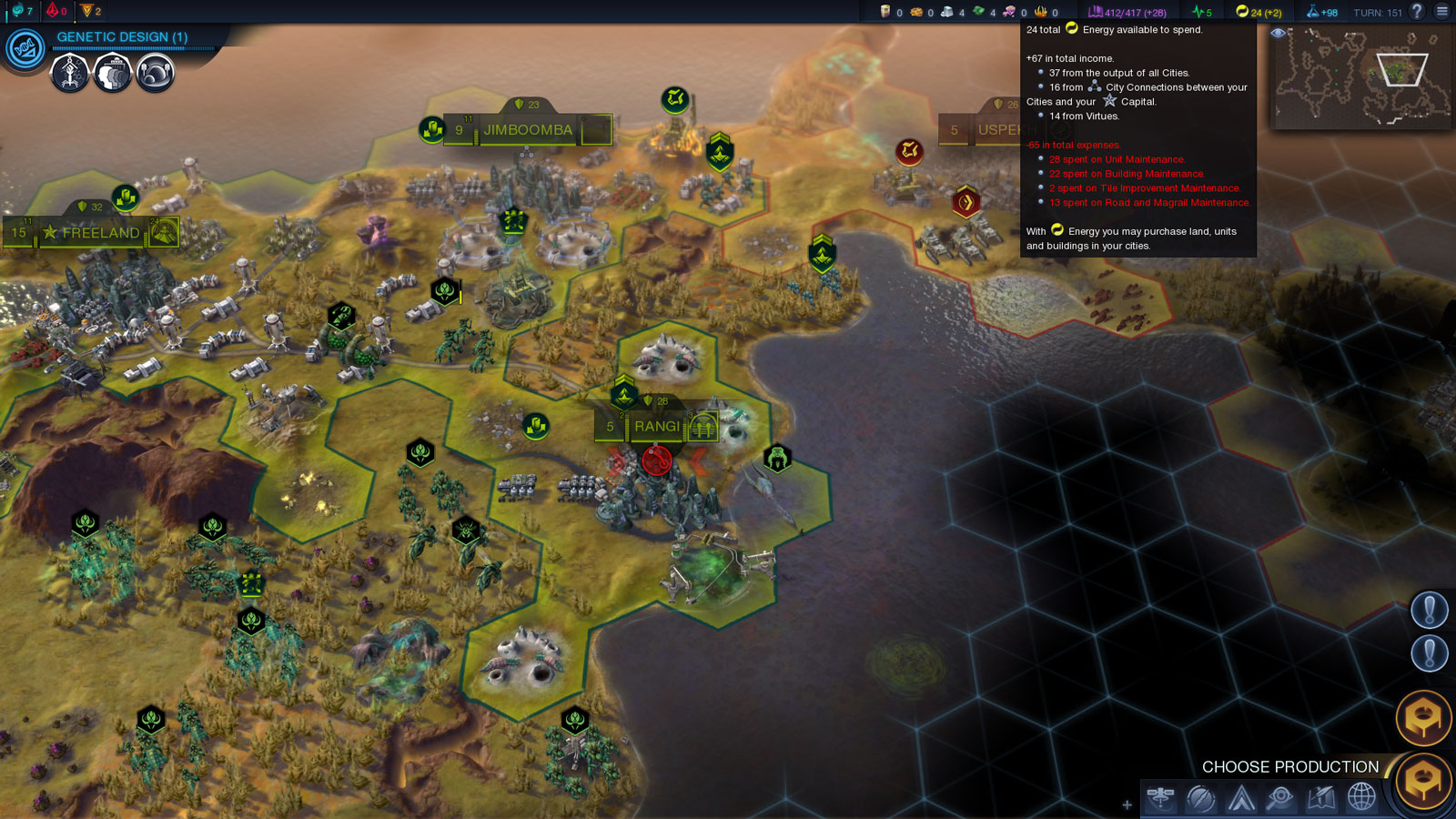
When your budget totally fails, your upkeep starts being funded by Science instead of Energy. That's a nightmare scenario; you won't advance quickly, and your rivals are likely to pull ahead of you. Reduce the size of your military if you must, switch Production entirely over to economic buildings, and hope for the best!
A strange danger when it comes to Energy is to hoard too much of it. A few players like to feel nice and cozy with a huge pile of Energy credits at their backs. Admittedly, this is way better than being totally broke, but not using your money is still very bad for your Colony. Energy doesn't do anything for you on its own; Energy that isn't invested into buildings, units, or expanded borders is practically wasted. Don't fall into this trap.
Keep enough Energy on hand at all times to protect against a sudden border attack. As a rough estimate, you could look up a good defensive building (like the defensive perimeter). Check the purchase price for those, and add in two military units. That, at most, should be your cap for Energy carryovers unless you have a specific strategy for hoarding money, as some Industry players do because of their interest bonuses.
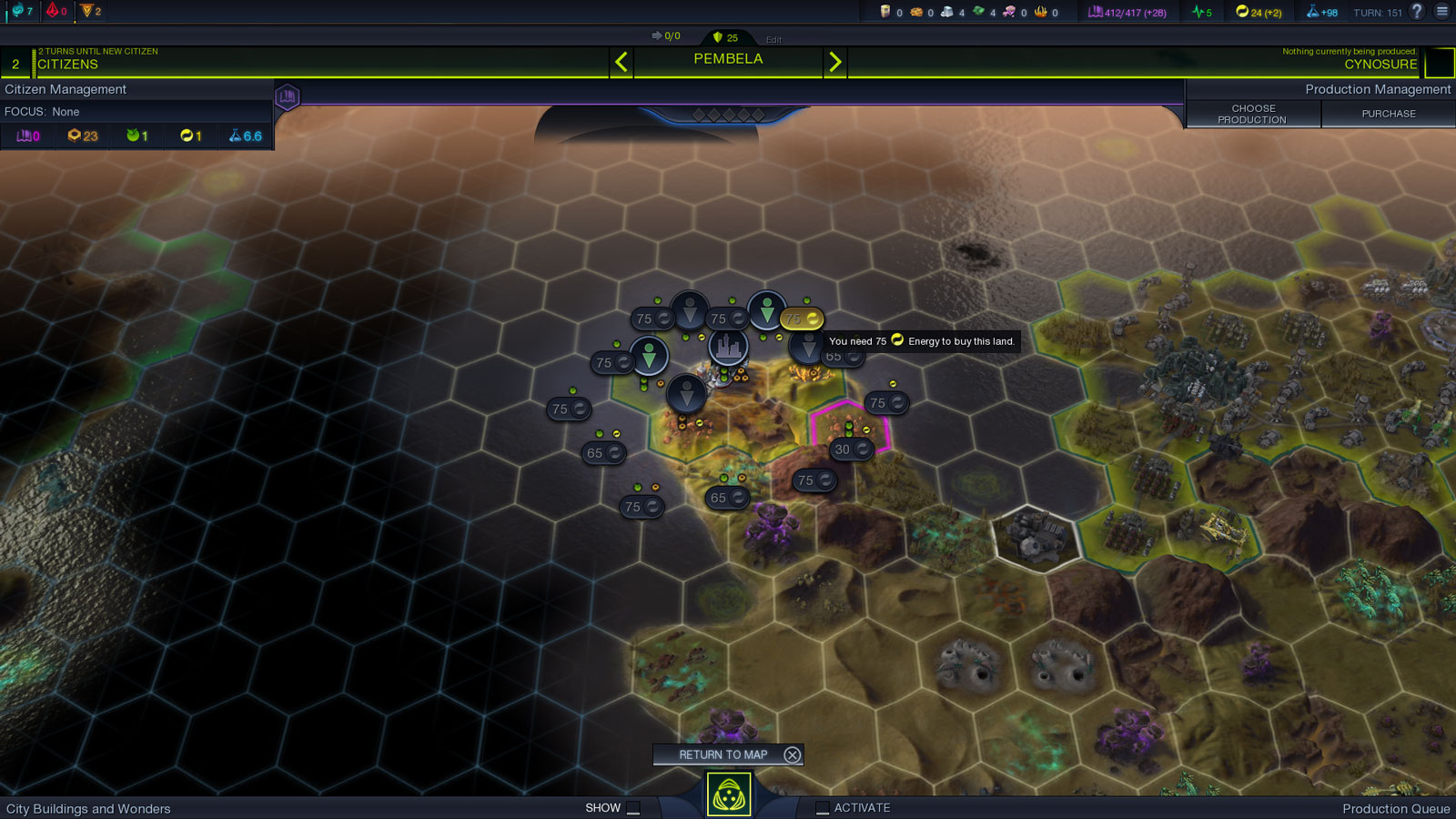
You should spend everything over your Colony's rainy day fund as soon as you get it. Purchase Growth and Production buildings in new cities for the maximum benefits during peaceful times. During war, you probably need to devote that Energy to reinforcements or defenders.
It's also easy to forget about tile purchases. City borders expand on their own, so some players don't bother with purchasing border expansions. However, this is a mistake. Grabbing tiles with resources can substantially help a city expand. You can also block off areas to frustrate enemies who are trying to get past you for colonization or exploration. Connect your border as soon as possible so that others must bribe you for open borders or simply give up on territory that you are isolating.
Aliens (Much Worse Than Green Barbarians)
Aliens are a neutral party on your new world. They're not cheering for any Colony in particular, and they can turn rather aggressive if people attack them. Even when everyone is nice, aliens are a nuisance. They attack Workers, Colonists, Trade Units, and anything that gets too close to their nests. They block off territory and stay near miasma, which is already an environmental hazard on its own.
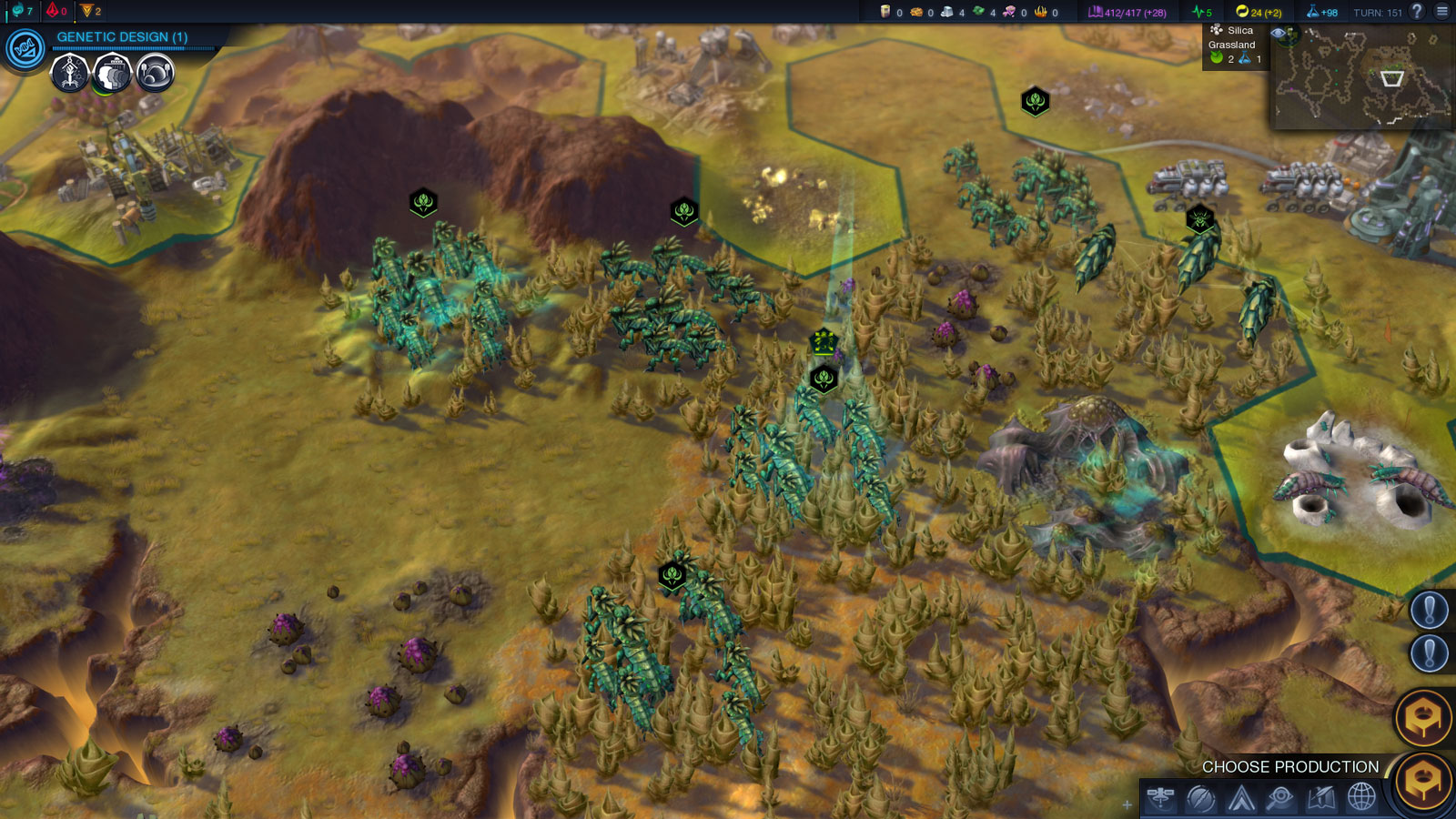
Choose fairly early on how you're going to deal with the alien threat. You can try to avoid fights with them using ultrasonic fences and careful movement to keep your units out of fights. Or, you can clear out aliens and their nests to make room for even more human expansion. You can also buy a tile with an alien nest, become friendly with them, and then use them for defense.
The former method is safe, and it doesn't cost much in terms of Energy or Production. You let the aliens have their space, you keep them away from your cities with the fences, and that's all there is to it.
The aggressive method costs more but has several major benefits. You must train a larger military in the early game because the aliens aren't pushovers. Fight your way to their nests, destroy them, and you get both Experience (from the fighting) and resources (from the nest itself). You also can grab that land afterward and settle it, if you want.
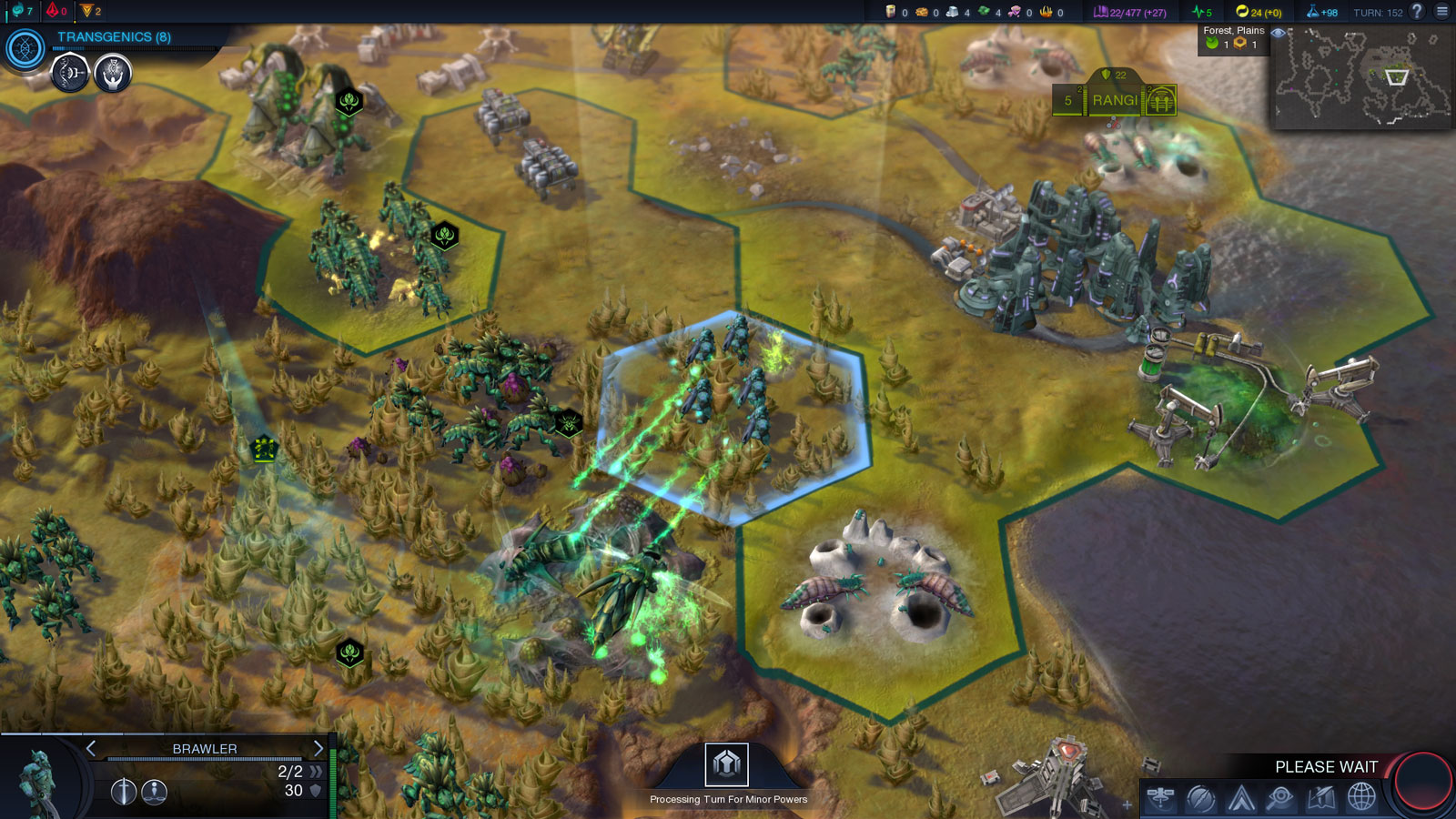
Fighting the aliens causes them to become more aggressive toward humans. Their icons change colors as they get angrier (green is stable, orange is hostile, and red is infuriated). Though this status returns to normal over time, it isn't a quick process because aliens trigger further conflict once they're upset. They'll push more assertively into human territory and bring buddies with them.
When you do go after alien nests, make sure to take multiple units. During the early game, your best soldiers can't hope to fight off multiple alien attackers, and nests spit out plenty of units. They have fliers, ranged attackers, and ground troops. Luckily, their largest units either spawn in the open ocean and can't come up on land, or they're just large, simple worms that destroy territory but don't gang up with the units from the alien nests. That's a relief.
If you constantly attack aliens, at least a few rival Colonies are going to take offense. AI players that aren't harming the aliens get a substantial diplomatic penalty when dealing with Colonies that are attacking the aliens. Still, you can't be friends with everyone, and this won't always lead to war if you are nice to the other Colonies in different ways.
Befriending the aliens will help maintain a good defense for your cities, and allow your units to move freely among them. This may take a while to take effect, as you must first buy a tile occupied by an alien nest, and then refrain from attacking the aliens for 60 turns. It might be best to settle a city next to an alien nest and heavily guard it until you can buy or build an ultrasonic fence. After waiting the 60 turns, the aliens' icon turns blue indicating that you are now friends with them. You are then free to settle cities without worry of alien attacks, and use them as a defensive barrier when at war.
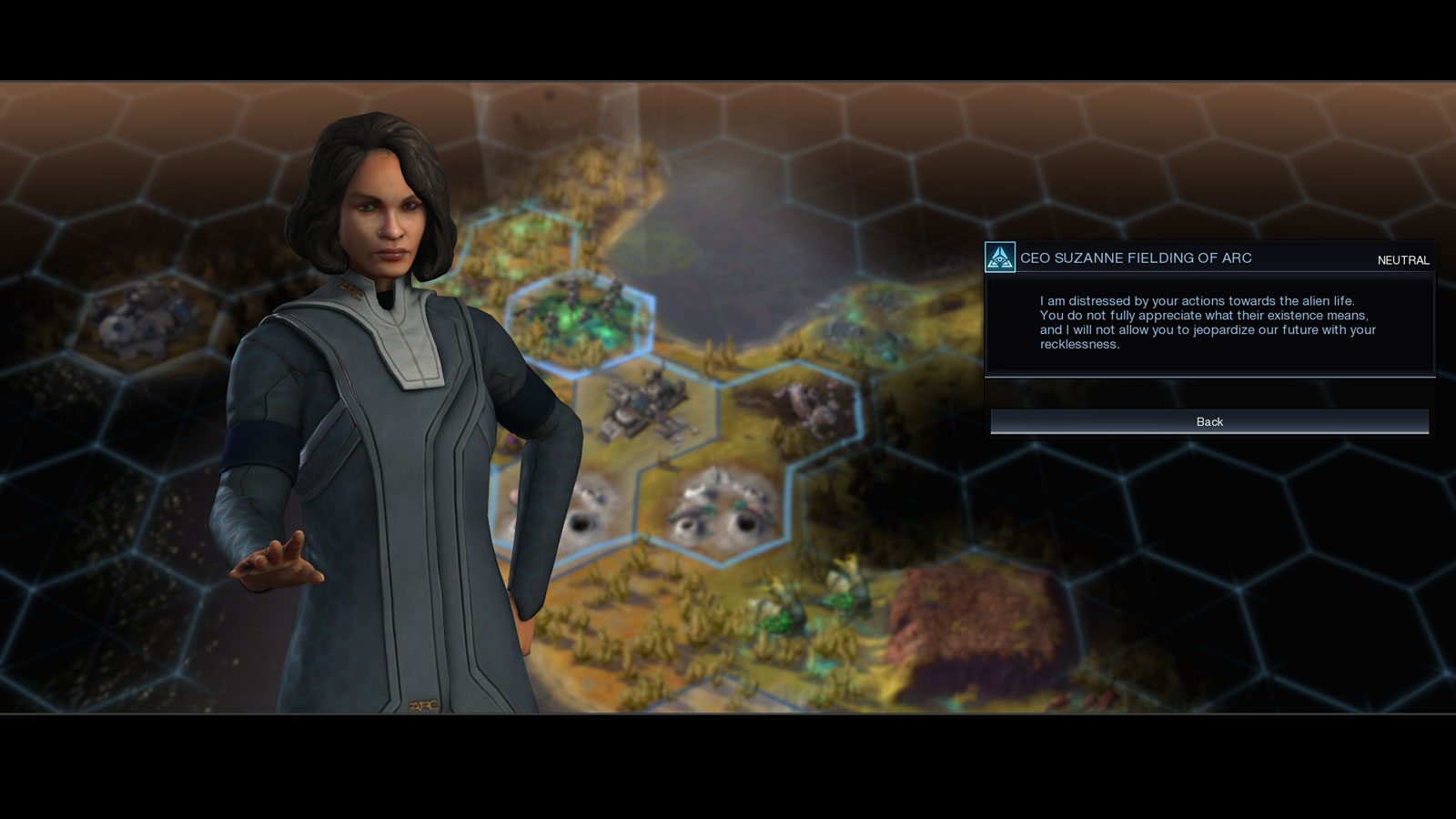
Though you can't totally remove aliens from the game without settling the entire map, the presence of aliens still diminishes over time. New alien nests only appear in neutral territory on Xenomass that hasn't been improved yet. As the Colonies' borders expand, there is less and less land available to the aliens for these new nests. Also, humanity gets access to better weapons, and it becomes much easier to clear out alien nests with smaller groups of troops.
Alien units are great for training your military. They have limited Combat Strength, and you often know what to expect from them. They also don't come in gigantic numbers, so a force with two or three units can usually handle almost everything the aliens have to throw at you.
Alien hunting is diplomatically dicey, as stated earlier, but it also has limits. You can't get more than two levels for each unit while hunting aliens. After 30 XP, you simply don't learn anything new from fighting the green hordes.
Stations (Neither a City, nor a State)
When you're ready to learn about stations, go to Chapter 13. It covers all of the nuances of these locations so that you know how to trade with or exploit these groups.
Stations take up only a single tile and generate different resources for their trade partners. They function in a vaguely similar way to City-States in Civilization V, but they don't have the same level of power and influence. You won't have to face station units, or worry about major diplomatic changes unless another Colony was already trading with the station that you attack. However, if you attack them, they will attack back as if it were a city attacking.
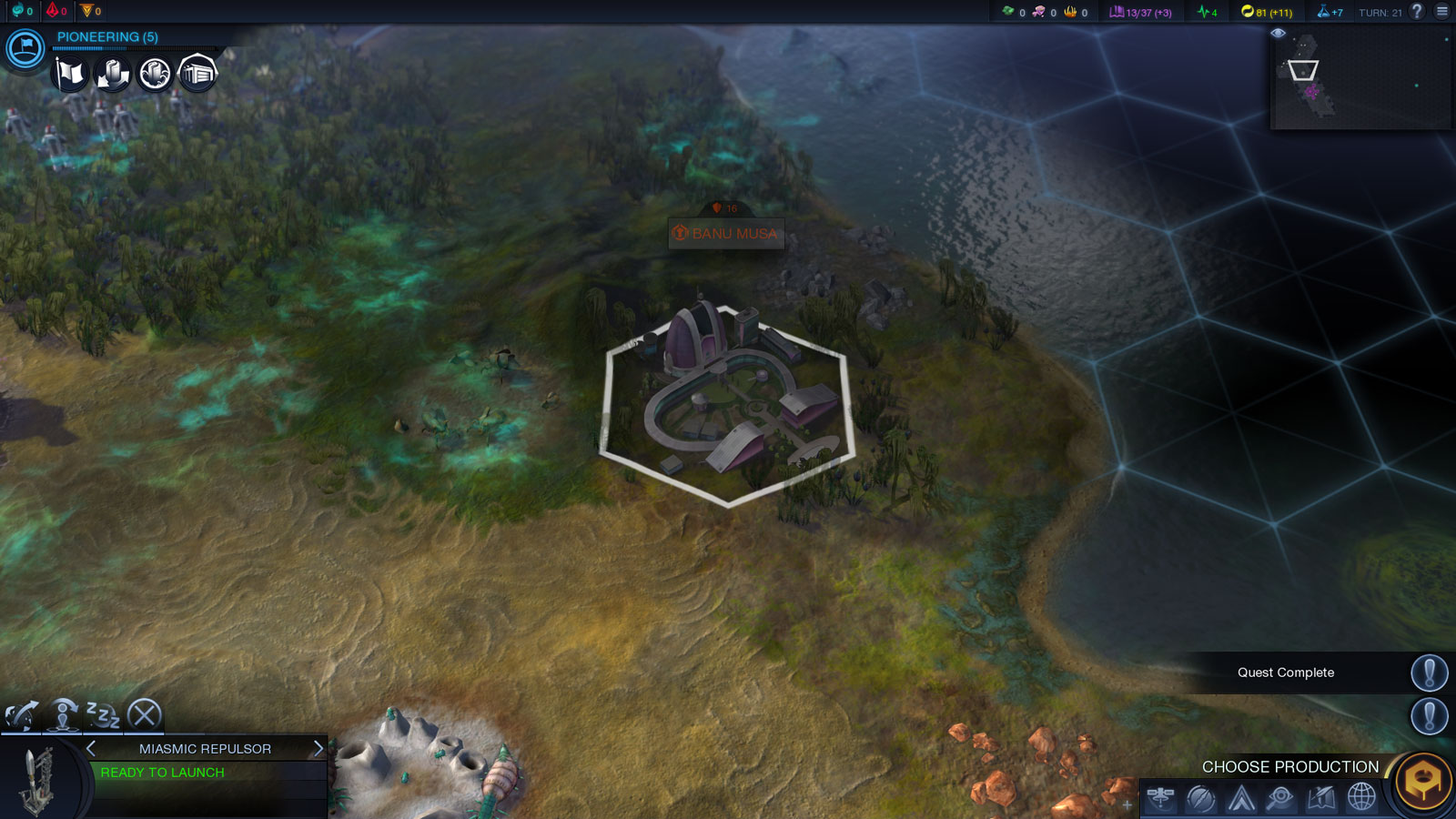
The Technology Web
Earlier Civilization titles had a Research tree that gave you options about what to study without giving you too much room to do anything strange. There were often several major paths of Research, and it was very costly to try to pursue one of them to the exclusion of the others (especially because some Technologies were dependent on others from peripheral branches).
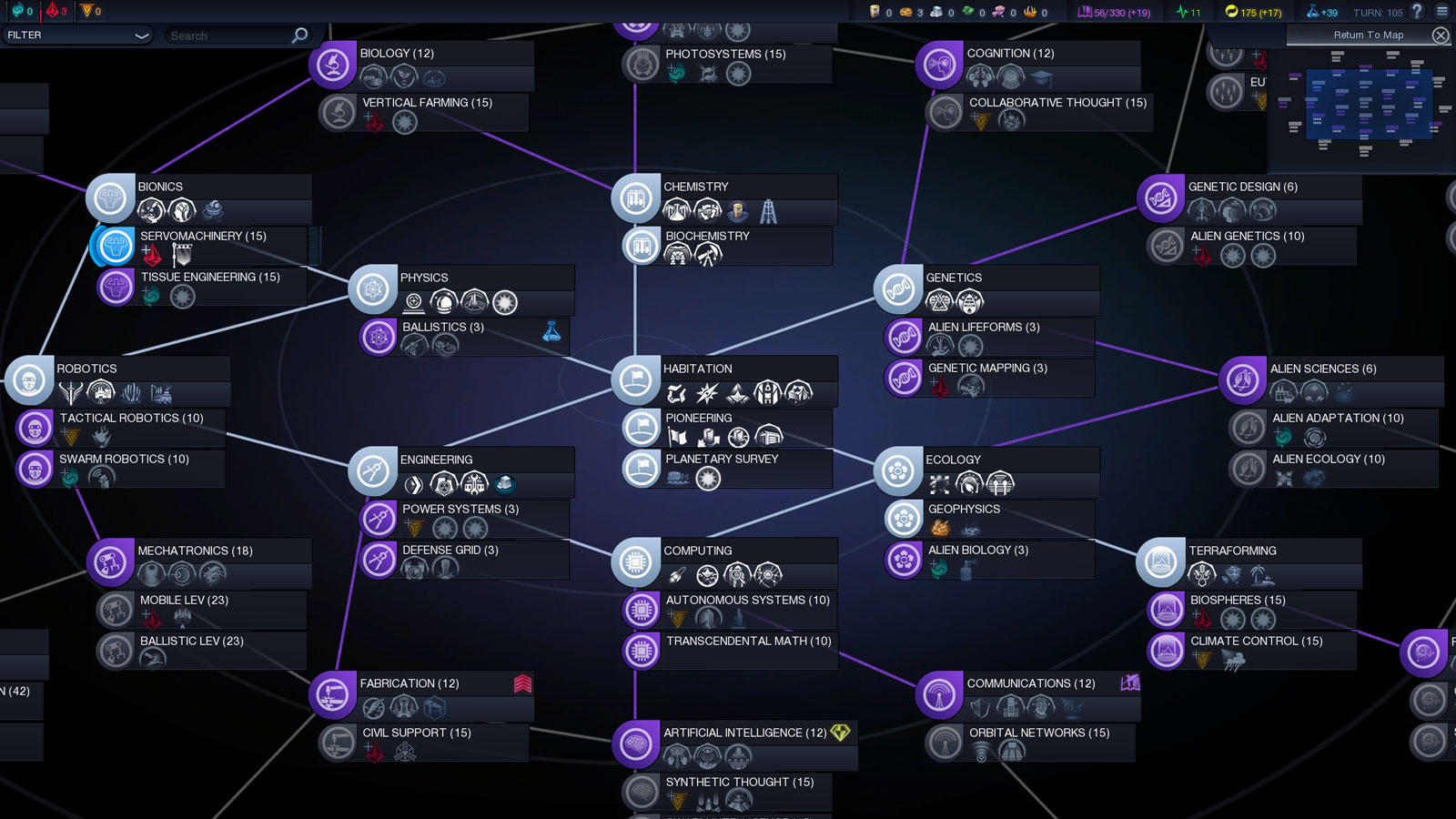
That system is now a web, which makes more of a difference than it might sound. In the Technology web, you can research anything that touches on a branch that you've already mastered. It's possible to go extremely far in whichever direction you want because nothing in the game requires you to have multiple precursor Technologies. In fact, it's quite the opposite: you often have Technologies that are unlocked by any one of several choices, making it very easy to navigate toward the bonuses and buildings that you want to acquire the most.
Chapter 08 discusses all of the Technology in the game and how the Research system works. This is a very exciting area of the game, so have fun exploring it! The chapter also talks about maximizing Science output so that you complete your Research in a timely manner.
Diplomacy
The fine art of negotiation, threats, and trade makes a return. Though there is no longer a diplomatic means of victory, you still must use this system carefully if you want to come out on top. Poor diplomatic skills can lead to very tricky battles against multiple opponents. Skilled use of Diplomacy allows you to turn enemies against each other and gain substantial benefits while you wait for others to eliminate their own chances for victory.
Your Reputation
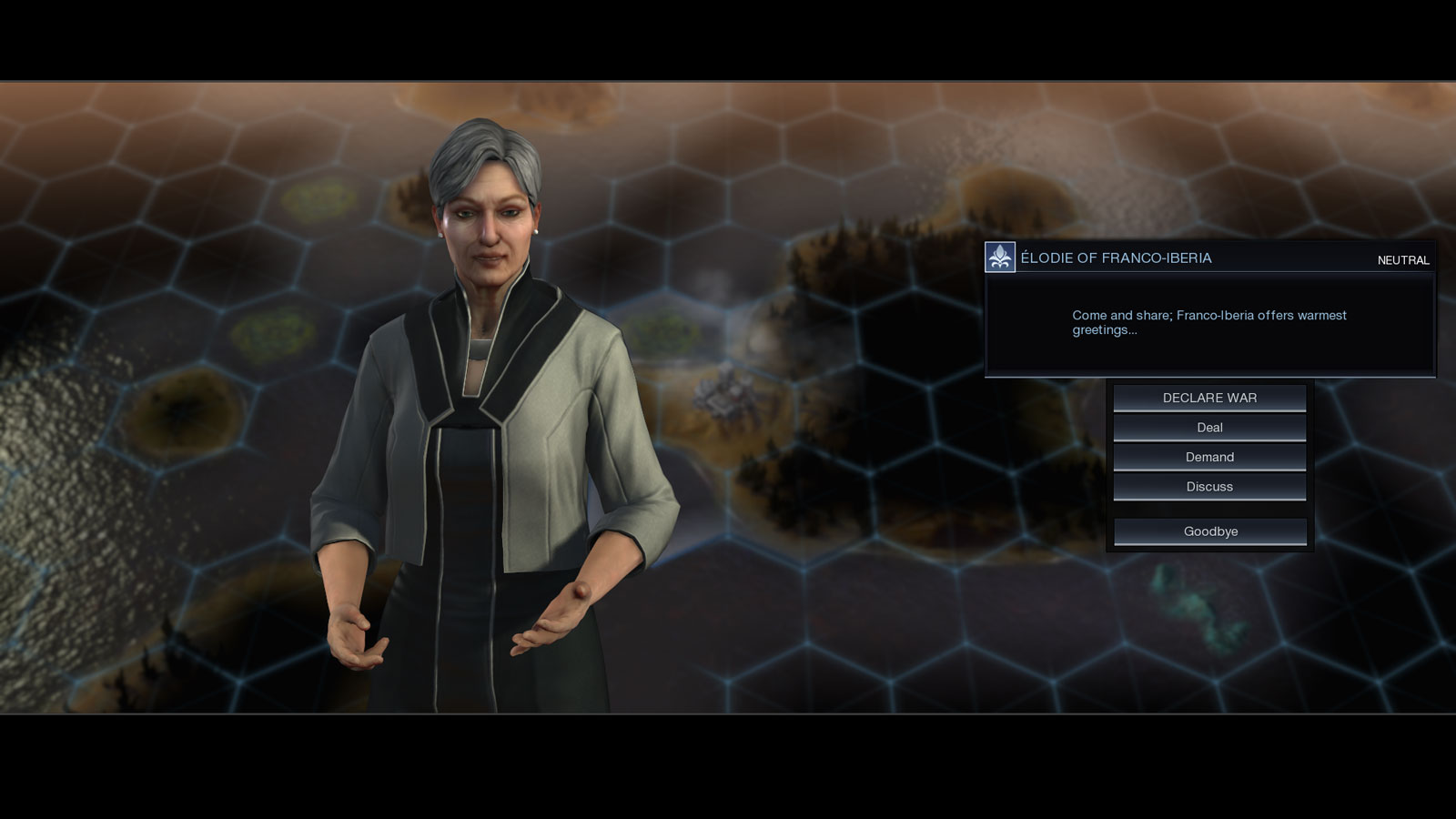
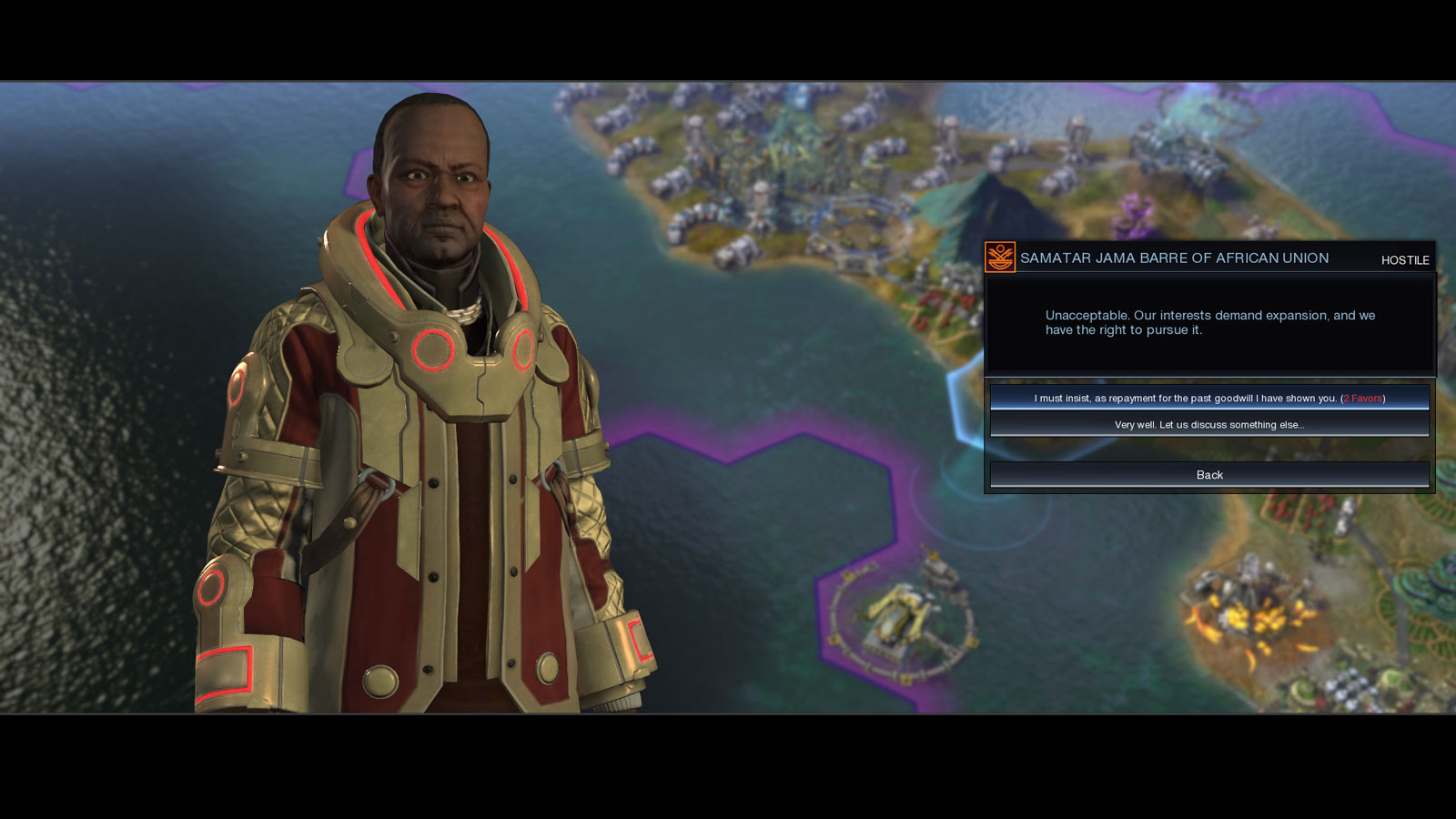
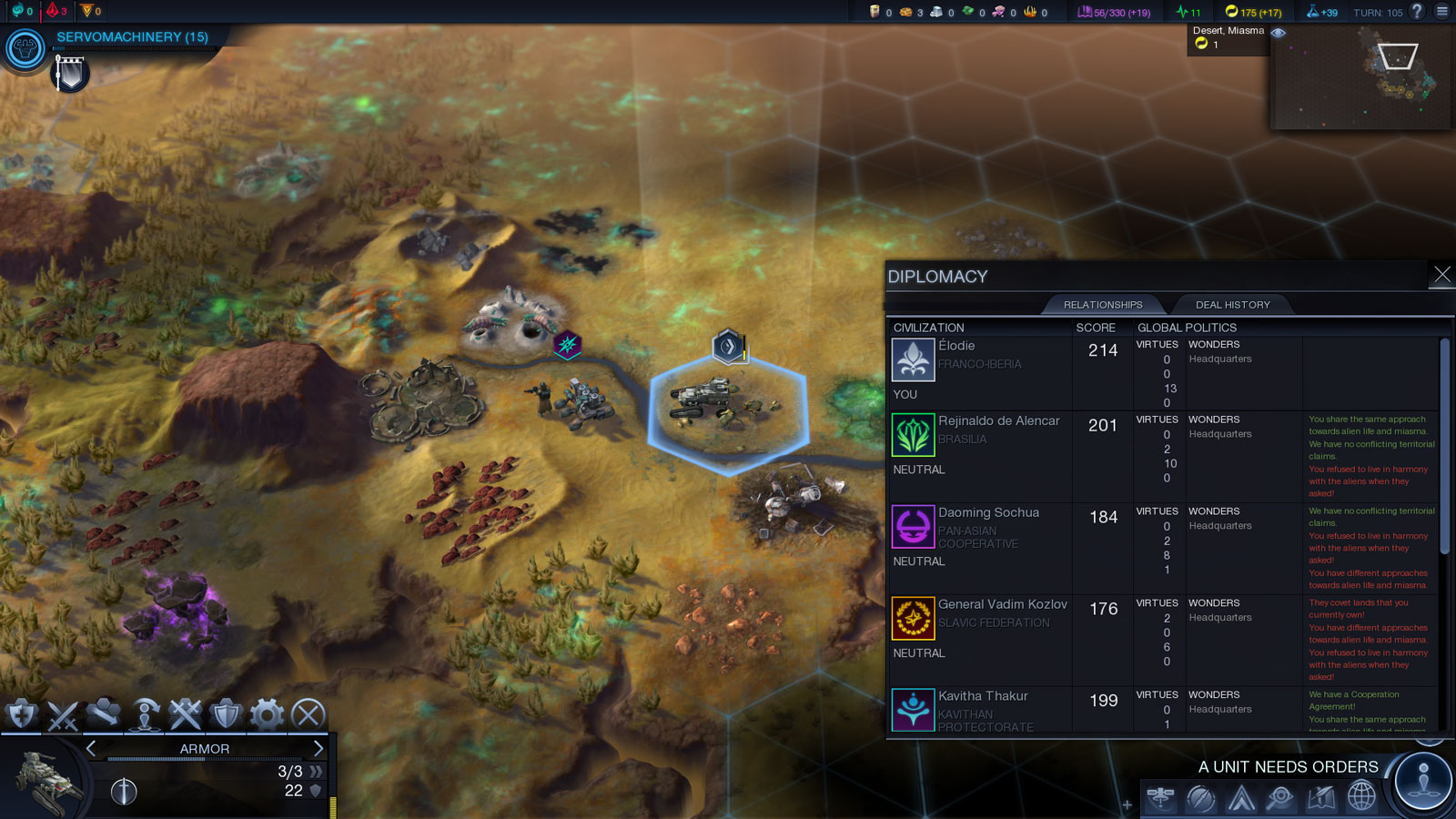
First, some words about the way other Colonies view yours. There are quite a few ways to influence the way people think about you. You might be in an alliance with others, on friendly terms, neutral, hostile, or even at war with your rivals. Think of the positive side as being further and further away from war, and the entire spectrum as one long drop into aggression. The more ways you endear yourself to a rival, the better they'll feel about you (and the more negative activity it will take to have them declare war against you).
Diplomatic States
- At War You can enter enemy territory, attack their units, and take their cities.
- Peace: You cannot attack rival units or enter their territory without an open borders agreement; peace will last until the end of a ceasefire agreement and then return to a normal status.
- Hostile: The rival nation is upset with yours, often for multiple reasons; war is close.
- Neutral: Your rival has balanced or minimal feelings about your Colony.
- Friendly: Similarities in government or interests have brought you close to this nation.
- Guarded: Negotiations aren't as likely to go well and the mood is sour, but war can still be averted with considerable effort.
Diplomatic Gestures and Agreements
- Cooperation Agreement: You gain increased trade benefits from international routes to this rival and gain line of sight from their covert agents in third-party territory.
- Alliance: You gain open borders and cooperation agreements with this rival and will automatically declare war if they enter into war with any third party.
- Open Borders: You can travel in the other nation's territory without provoking war (not possible unless you're at least neutral with the given nation).
- Condemnation: One nation lowers their diplomatic status with another as a show of anger; this may lead to war, but it does not have to.
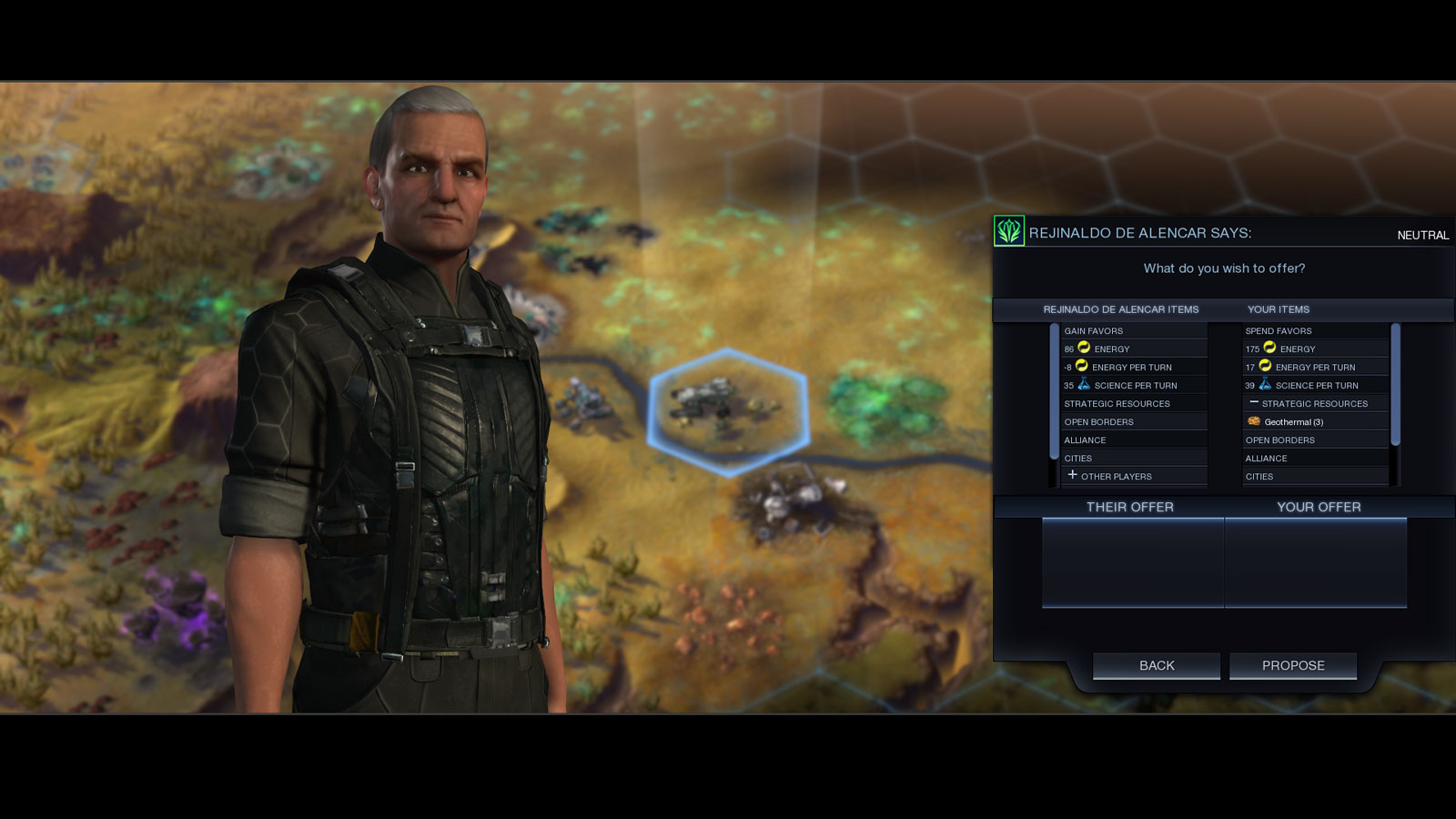
Now that you know the continuum, it's useful to learn how to improve or upset relations between your Colonies and your rivals.
Ways to Improve Relations
- Have the same Affinity as another nation (must have at least seven levels in your dominant Affinity).
- Provide gifts of resources, units, or cities.
- Promise to do what a rival asks you to do.
- Fulfill your promises.
- Establish a trade route between your city and a rival's.
- Treat the aliens in the same manner as your rival.
- Take a city that was conquered by a third party, and then liberate it for the rival in question.
- Establish a cooperation agreement or alliance with a third party that your rival is also close to.
- Lower your relationship with a third party that your rival also is hostile or at war with.
- Declare war on a third party while your rival is at war with them.
Ways to Sour Relations
- Have a different affinity than your rival.
- Refuse a demand.
- Make a demand of your own against your rival.
- Break a promise that you made.
- Launch expeditions near a rival's territory.
- Keep your military units or orbitals close to another person's borders.
- Expand your Colony until your borders close in on a rival.
- Get caught using covert operations against one of your rival's cities.
- Attack a station that your rival is trading with.
- Raise your relations with a third party that your rival is hostile toward or at war with.
- Lower your relations with a third party that your rival is friendly with.
- Fight offensive wars or take enemy cities (even if they started the war).
- Have a history of war with the rival.
Making Friends
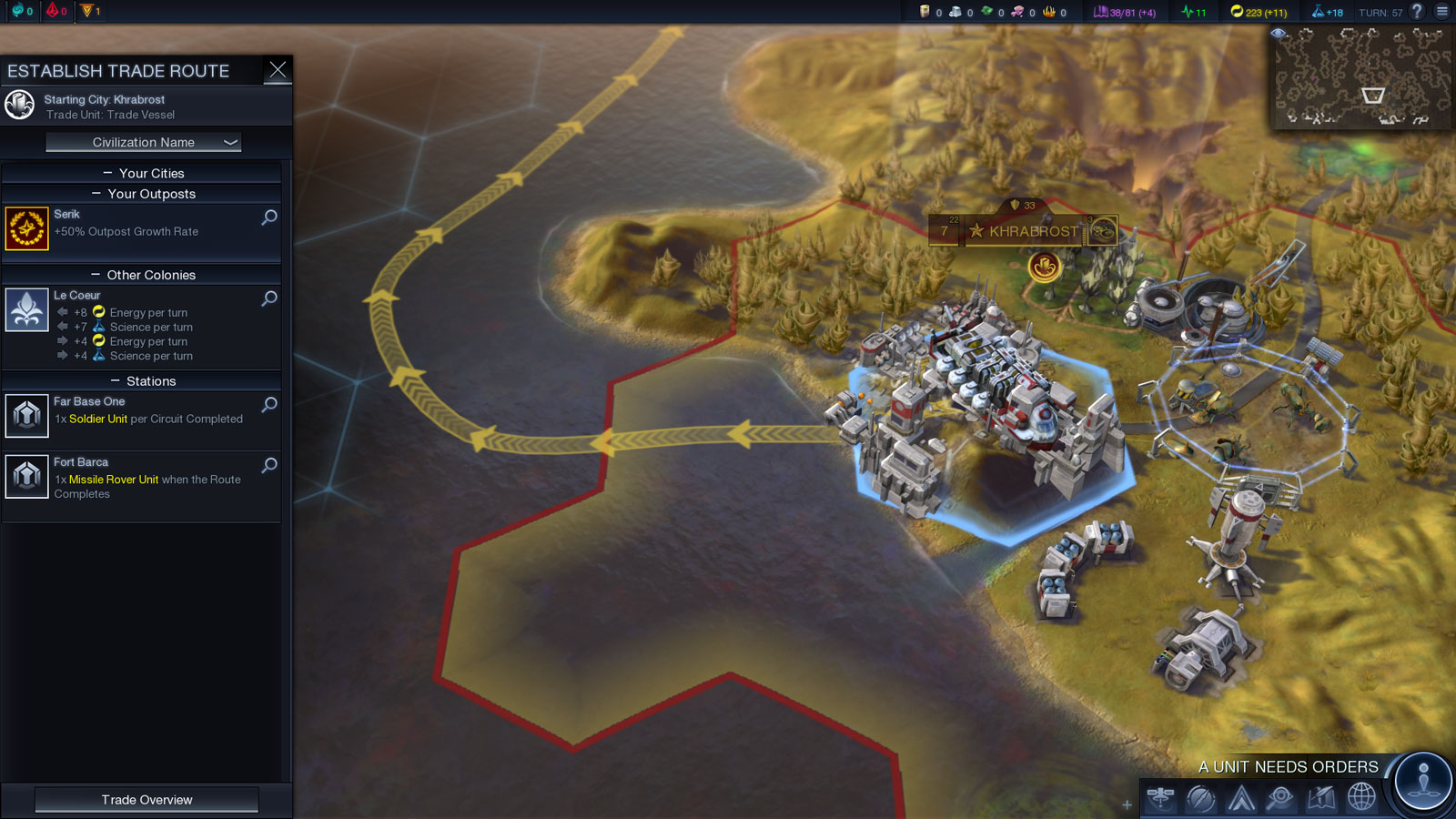
For easy resources and a safer way of life, trade heavily from the beginning of the game. Seek cooperation agreements to improve the yields of these routes, and try to agree to any reasonable demands that the other Colonies make. Go ahead and steal an Expedition Site here and there, but be willing to back off and promise to stop doing that once each Colony notices. You can then gain points with them by sticking to your word; send your explorer to another Colony's border, and resume your activities there.
If you heavily court another Colony, make sure to stick with that until there is a good reason to break from that friendship. Team up with them during any useful wars to get even more brownie points with your buddy. When the target of that war is far away, you're often safe from harm and don't have to contribute much. When the enemies are close, you have the potential to get territory quite easily because the enemy must fight a two-front war (or worse).
Using Enemies
You don't have to be nice to get ahead. Try not to anger the entire world at the same time, though, because that leads to challenging wars, and it's nice to know that you're going to win a fight before you start it.
Pick your enemies based on several factors: are they close enough to conquer, are they already hostile toward you, and would they be easy to defeat? Look at city Combat Strengths and unit numbers, the level of Affinity they are at and gauge each Colony's friendships before you act. If a nation is already being condemned by their rivals, it's safer to go after them. Never pick on the popular Colonies unless you're ready to fight more enemies at the same time.
Diplomatic Tells
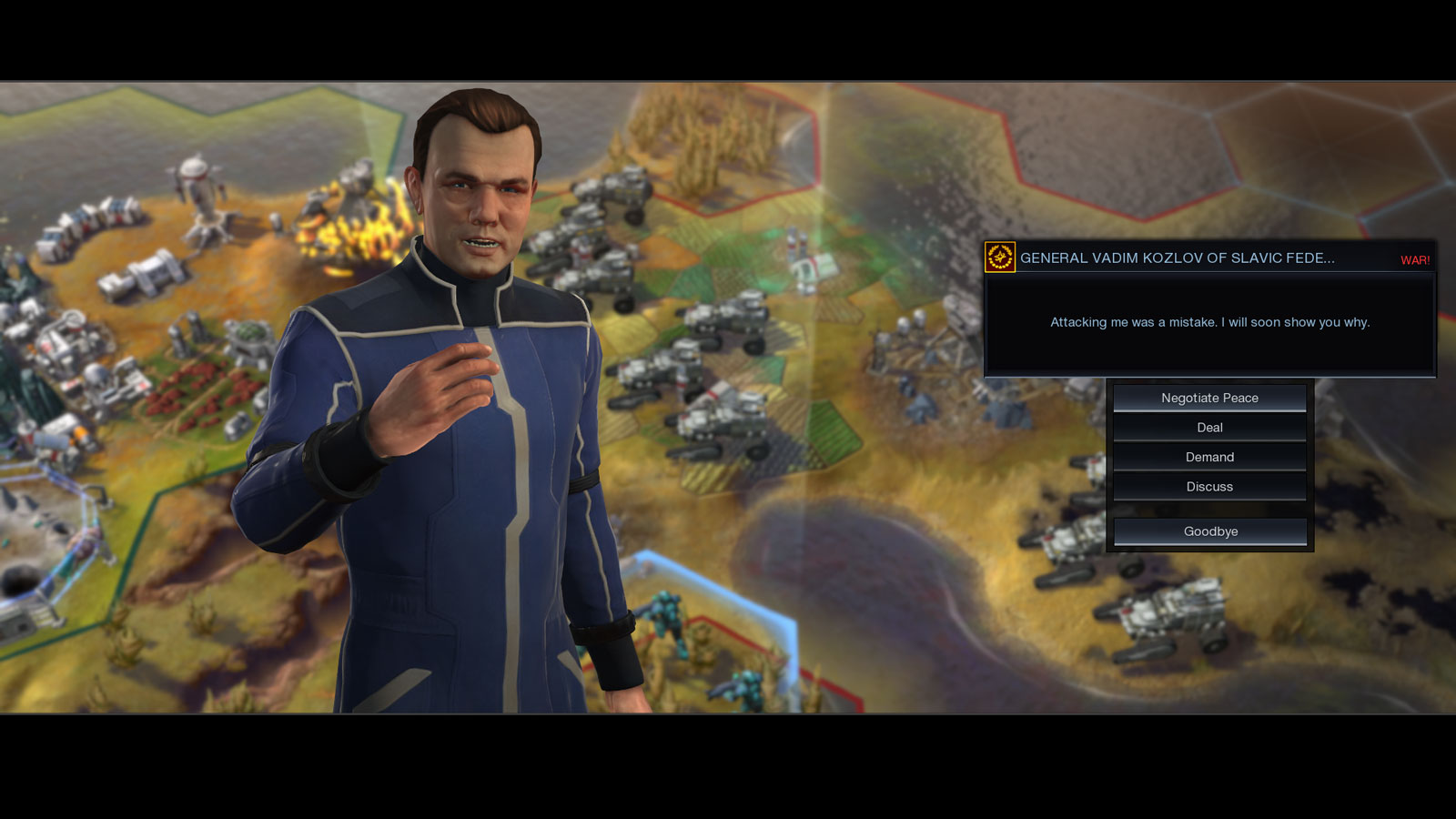
A computer opponent often makes it clear when it wants to start a fight. Units lining up on your border are only one giveaway that war is coming. Watch the way that your neighbors treat you. If a rival suddenly condemns you for almost no slight, and then they mock you or demand something, they're looking for a pretext. It doesn't even matter at that point if you were once friends with that rival. They're spoiling for a fight, and they're going to keep making negative requests and statements until they're hostile toward you. Then, it's on.
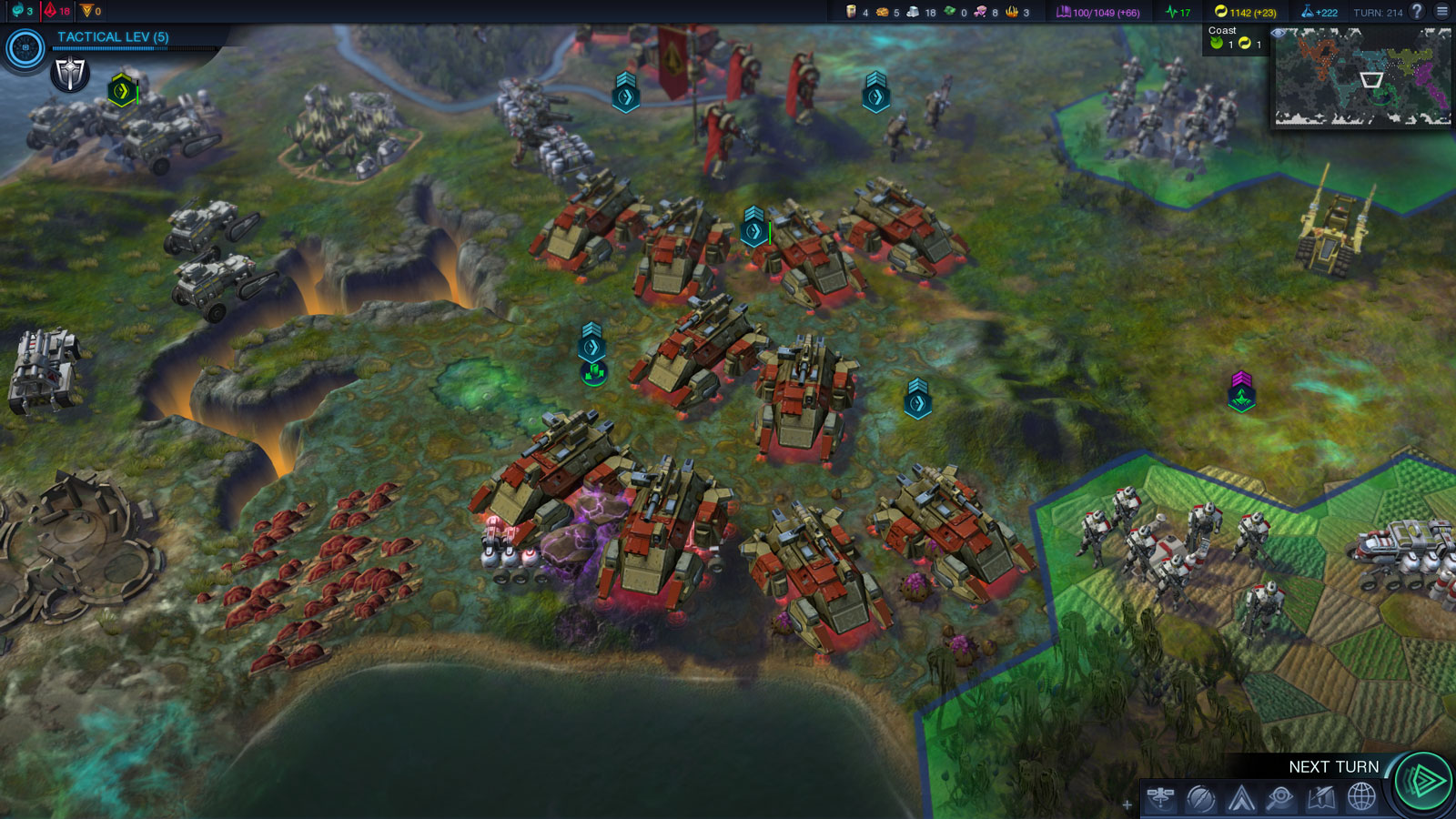
Don't wait and be idle about this. Get your army ready, and make sure that your cities are defended. Station troops in advantageous ways to ambush enemies if and when they attack. Consider purchasing tiles to consolidate your territorial holdings and split up your enemy's advance. The sooner you're ready, the easier it's going to be to deflect the invasion and route those jerks before they get any cities or pillaging done.
Victory
The game ends when either time runs out (500 turns in a standard game) or when one of the nations instantly wins by getting one of the five end scenarios. You can do this with military force, Research, and a strong economy, or by pursuing one type of Affinity to its late stages and finishing a project that it unlocks.
Chapter 15 ends with a substantial discussion on victory methods and how to maximize your chances of success with each of them.
On the other hand, you lose a game instantly if another Colony wins or manages to destroy the last of your cities. If you make it to the end of the game and don't have the high score, that also counts as a loss.