
Civilization Beyond Earth Guide
Starting a Game
Before immediately jumping in, it is important to first learn about Civilization: Beyond Earth's options, hotkeys, setup, and Colonies. These features (with the exception of the Colonies) are similar close to earlier Civilization releases. Colonies are covered at the end of this chapter.
Game Selections
First, load the game and look at the main menu. There are a few features here, and it is worth finding out what they all do.
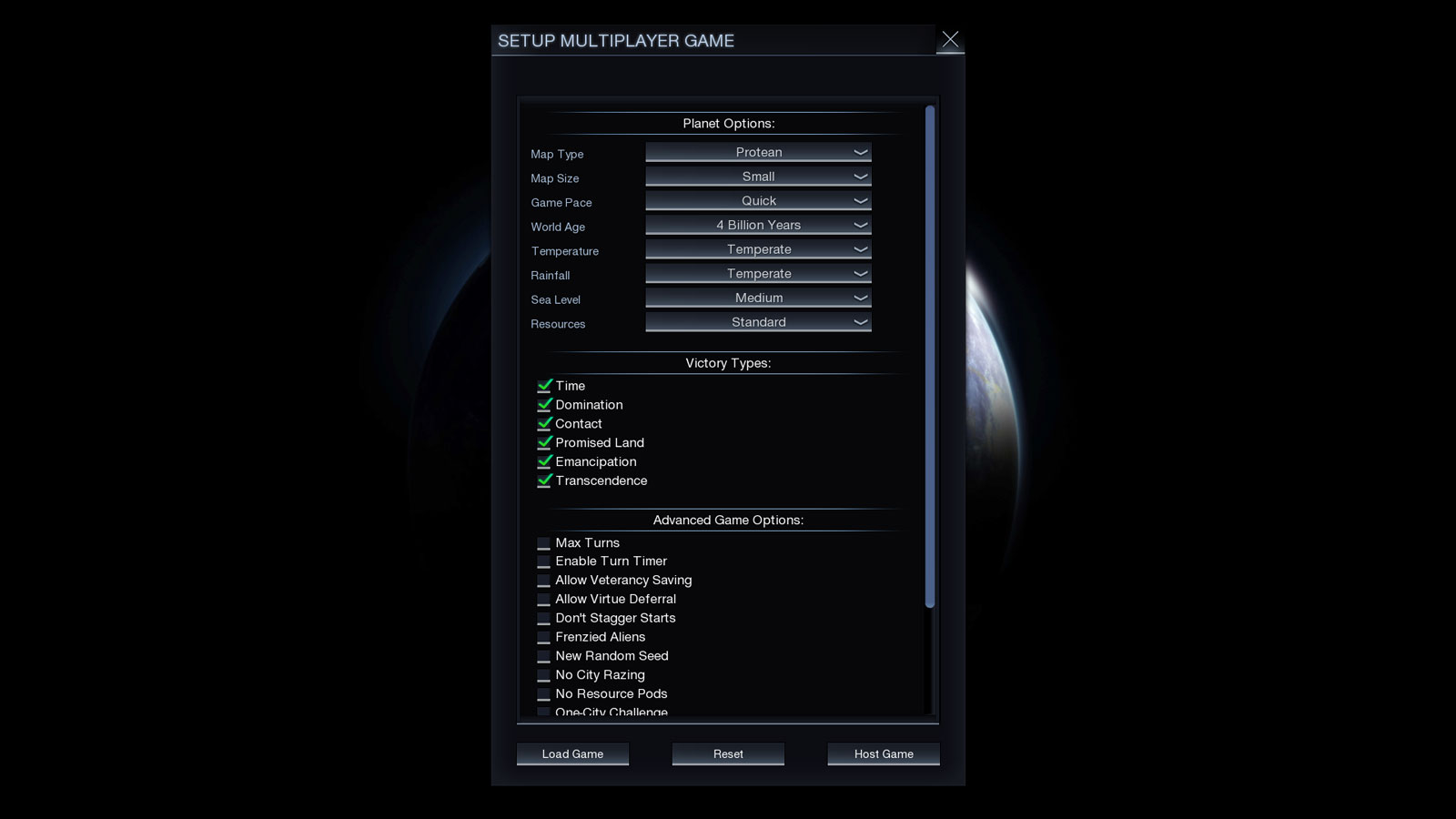
Single Player is for creating or loading a game against the computer. A later section of this chapter will deal with the actual setup of a game.
Multiplayer is similar in setup, but it is important to understand if the game is to be set up locally (Hot Seat, using the same computer for all players) or across multiple computers (Standard). If playing with multiple computers is more suitable, there are two options. Games can be set up on the local network (which only allows computers connected to the same network) or through the Internet. Setup continues similarly to Single Player.
The Mods system allows the ability to control which game mods are used in upcoming games. This is not a major feature during the early weeks of the game's release, but it becomes more and more exciting as time goes on. People create all sorts of fun mods to play with that may feature different units, alter the rules, or generate new map challenges, scenarios, etc. Search online to find ongoing content and keep the game fresh for months (or years) to come!
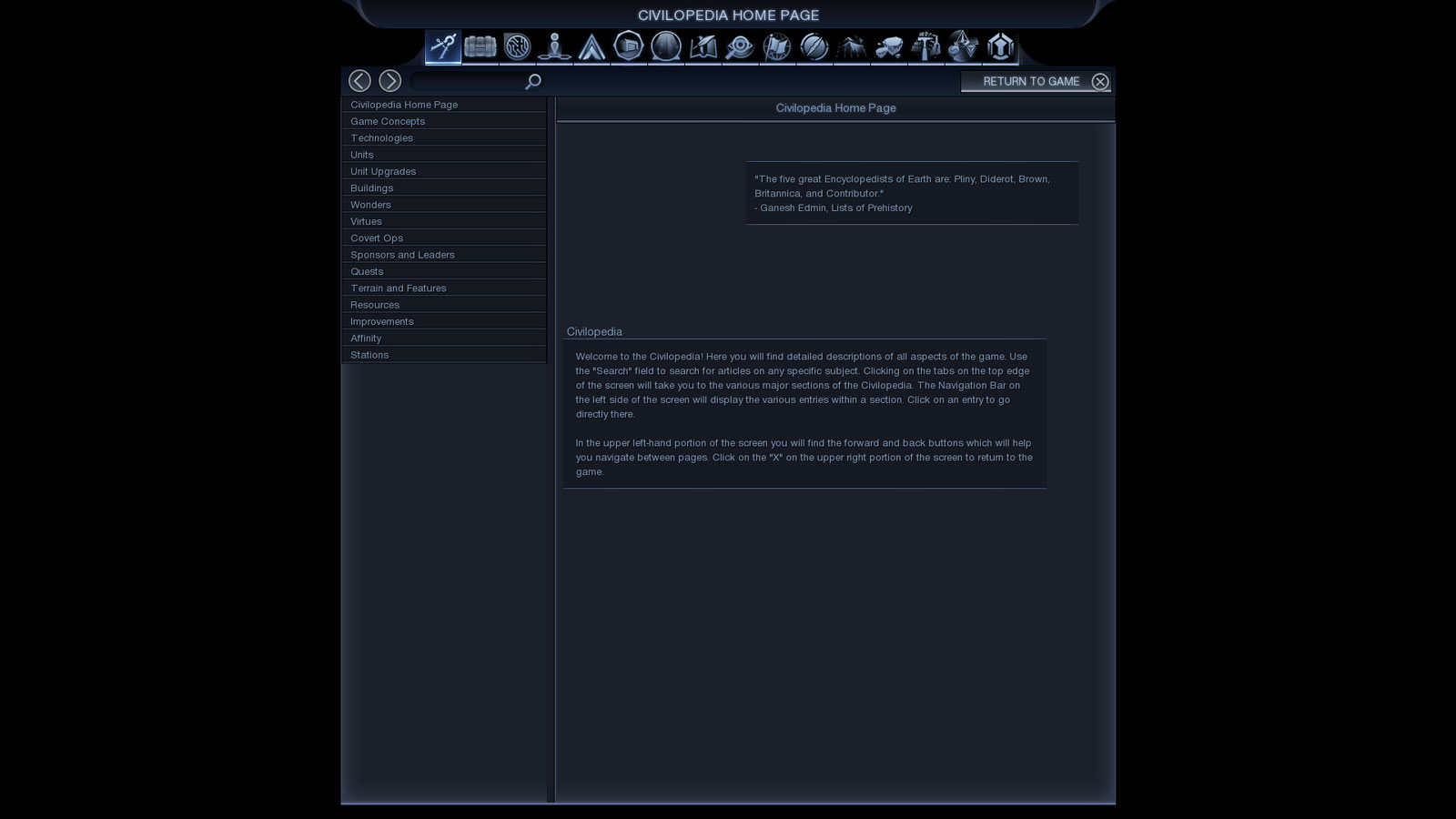
The Other selection on the menu gives several choices. Latest News provides information on any updates on the game and its continued development. The Civilopedia is a perfect source for fast information about units, buildings, concepts, and so forth. This guide covers everything that is in the Civilopedia, but it makes looking up basic stats quicker while in game.
The Hall of Fame keeps track of the player's best games; it lists the score, civilization, type of victory, settings, and time played. This is a good way to see which styles are the strongest. It is helpful for continued growth as a player. It is a good way to see what aspects and playstyles need to be worked or avoided.
View Replays reviews previous games to look through a stunning number of metrics. Use this system to learn where the best power spikes are so preparing for them in the future becomes easier. "Oh, I'm often strongest here and weakest at this point in the game." Knowing those things is wonderful for mitigating enemy attacks and maximizing forays.
View the Credits to see all of the people who put their time into this game.
Options was saved for last, as it hosts a number of interesting features that should be mentioned.
The Options Menu
The Options menu has multiple tabs. The Video and Audio Options let you control how the game is presented. That is mostly dictated by the computer setup and personal interests, so explore these settings to see which is the most comfortable.
Use Multiplayer Options to determine the name that appears when playing locally. This may not be too important, but can help when notifying other players which game to join.
The Interface Options start to get a bit more involved. If there are any problems with the system or more autosaves are needed this is the section that would prove most useful. This tab also allows the Spoken Language, Mouse settings, and the Map Drag Speed to be changed.
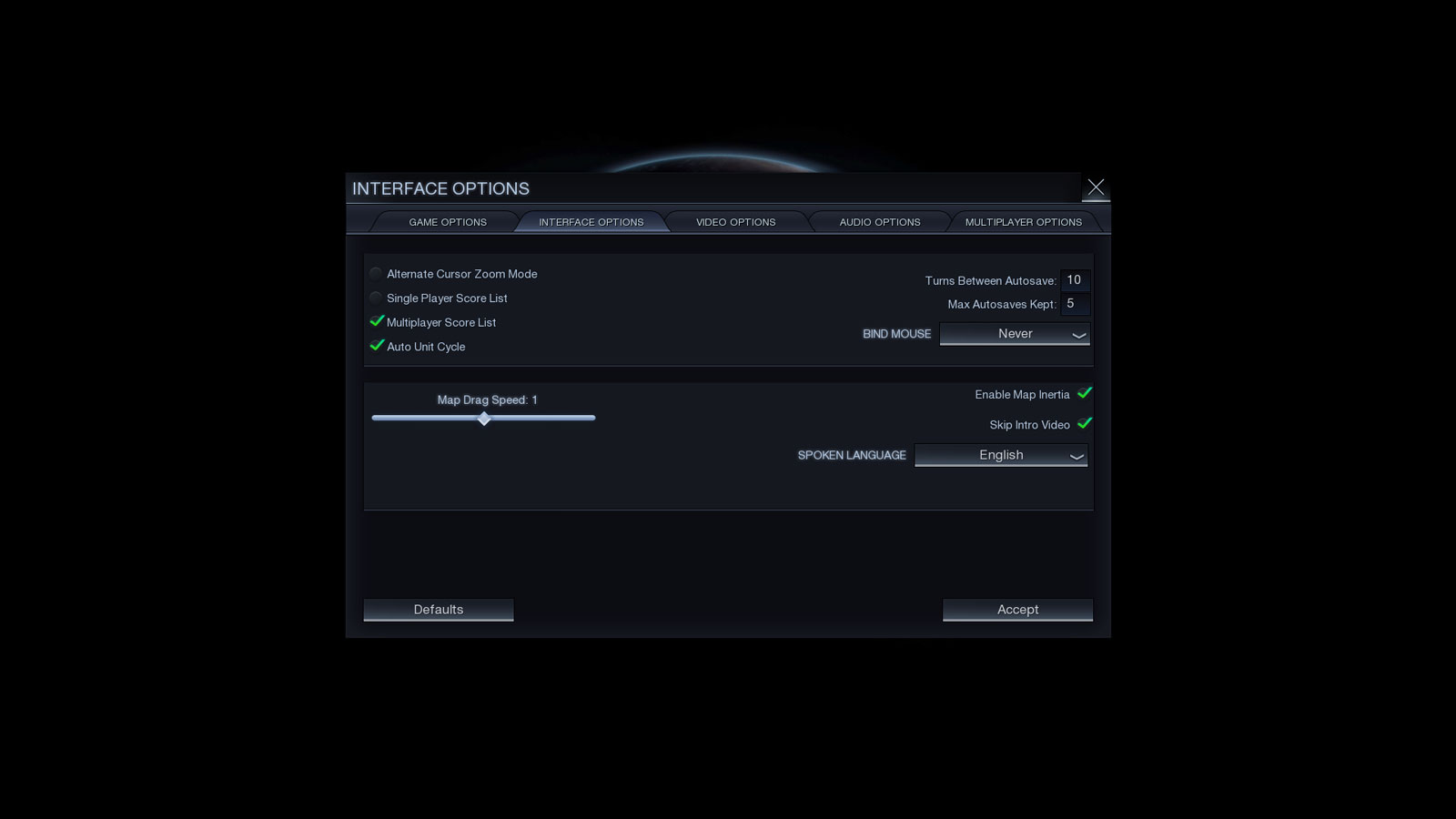
The Score Lists in the Interface Options tab are useful, too. By default, the game keeps the score in the Diplomacy menu during single-player use. Players have the option to toggle the score list on, making it easier to view in game without opening the Diplomacy menu. This is helpful for keeping tabs on opponents. Seeing their scores all the time allows players to view any changes that are occurring.
Game Options has even more settings to explore. It may be a good idea to check both options that limit automated workers. In not checking these, workers may end up doing the complete opposite of what the player may consider beneficial, if not watched closely.
To speed up the game by a huge margin, use quick combat and quick movement in single-player and multiplayer games. Cutting off these animations reduces the cinematic nature of the game, but it shaves many minutes off of playtimes.
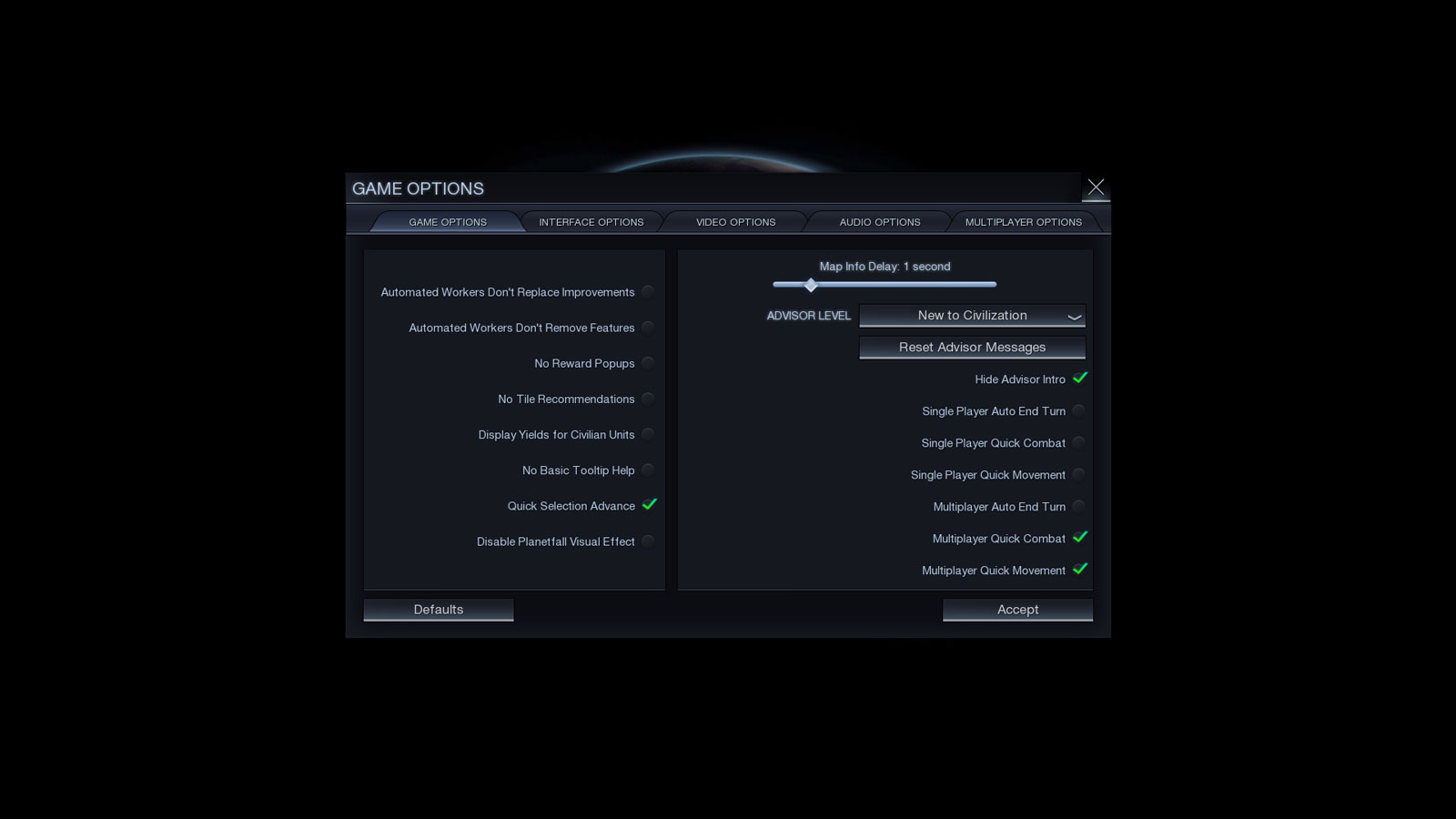
The Advisor Level is used to determine how much help a player may need. Each level pertains to different degrees of help. For example, New to Civilization would be perfect for a player who has never played any Civilization games. Players can turn this off once they know the game well.
General Hotkeys
It is easy to ignore hotkeys when the mouse can take care of any problem in the game. However, learning the hotkeys make it faster and easier to switch between multiple systems in the game. The faster this process is, the easier it will be to take advantage of everything the game has to offer.
General Hotkeys
|
Action |
Hotkey |
|---|---|
|
Civilopedia |
F1 |
|
Economic Info |
F2 |
|
Military Info |
F3 |
|
Diplomacy Info |
F4 |
|
Virtues Screen |
F5 |
|
Tech Web |
F6 |
|
Covert Ops Overview |
Ctrl-E |
|
Notification Log |
F7 |
|
Victory Progress |
F8 |
|
Quest Log |
F9 |
|
Trade Route Overview |
F10 |
|
Quick Save |
F11 |
|
Quick Load |
Ctrl-F11 |
|
Hex Grid |
Shift-G |
|
Menu |
Esc |
|
End Turn |
Enter |
|
Next Unit |
Period |
|
Previous Unit |
Comma |
|
Zoom Out |
- |
|
Zoom In |
+ |
|
City Manager |
Insert |
|
Zoom In |
Page Up |
|
Zoom Out |
Page Down |
|
Show Resource Icons |
Shift-R |
|
Yield Icons |
Shift-Y |
|
Orbital Layer |
Shift-O |
|
Save |
Ctrl-S |
|
Load |
Ctrl-L |
|
Next City |
] |
|
Previous City |
[ |
Unit Hotkeys
It takes longer to learn and remember all of the unit hotkeys. It is not necessary to get all of them down quickly, or even at all. Just remember the few that are used the most: "H" to heal, "F" to fortify a unit and let it sleep in an area, "B" for ranged attacks (think of it as "bombard," and you'll remember it every time), and "S" for air strikes.
Unit Hotkeys
|
Action |
Hotkey |
|---|---|
|
Move Mode |
M |
|
Explore (Automated) |
E |
|
Sleep |
F |
|
Alert |
A |
|
Do Nothing |
Spacebar |
|
Delete the Unit |
Delete |
|
Attack |
Ctrl-A |
|
Ranged Attack |
B |
|
Set up Artillery |
S |
|
Fortify until Healed |
H |
|
Fortify |
F |
|
Rebase Mode |
Alt-R |
|
Air Strike Mode |
S |
|
Air Sweep |
Alt-S |
|
Intercept |
I |
|
Found City |
B |
|
Build Improvements (Automated) |
A |
|
Repair an Improvement |
P |
|
Construct a Road |
R |
|
Construct a Magrail |
E |
|
Route to Mode |
Shift-Ctrl-R |
|
Remove Road |
Alt-R |
|
Clear a Marsh |
Alt-I |
|
Clear Miasma |
S |
|
Add Miasma |
S |
|
Construct a Farm |
L |
|
Construct a Generator |
G |
|
Construct a Paddock |
I |
|
Construct a Mine |
I |
|
Construct a Plantation |
I |
|
Construct a Quarry |
I |
|
Construct a Work Barge |
I |
|
Construct a Terrascape |
T |
|
Construct a Node |
O |
|
Construct an Array |
D |
|
Construct a Dome |
U |
|
Construct a Biowell |
Y |
|
Construct a Manufactory |
W |
|
Construct an Academy |
Q |
|
Construct a Geothermal Well |
I |
|
Construct a Petroleum Well |
I |
|
Remove Forest |
Alt-I |
|
Cancel Last Mission |
Backspace |
|
Construct an Expedition |
I |
|
Construct a Xenomass Well |
I |
|
Construct a Float Stone Quarry |
I |
|
Construct a Firaxite Mine |
I |
Setting up Your Own Match
Some players like to jump in immediately and figure out everything on the fly. That's great! Go ahead and make a game now, and get started. Come back to this guide later, when you're ready to learn more.
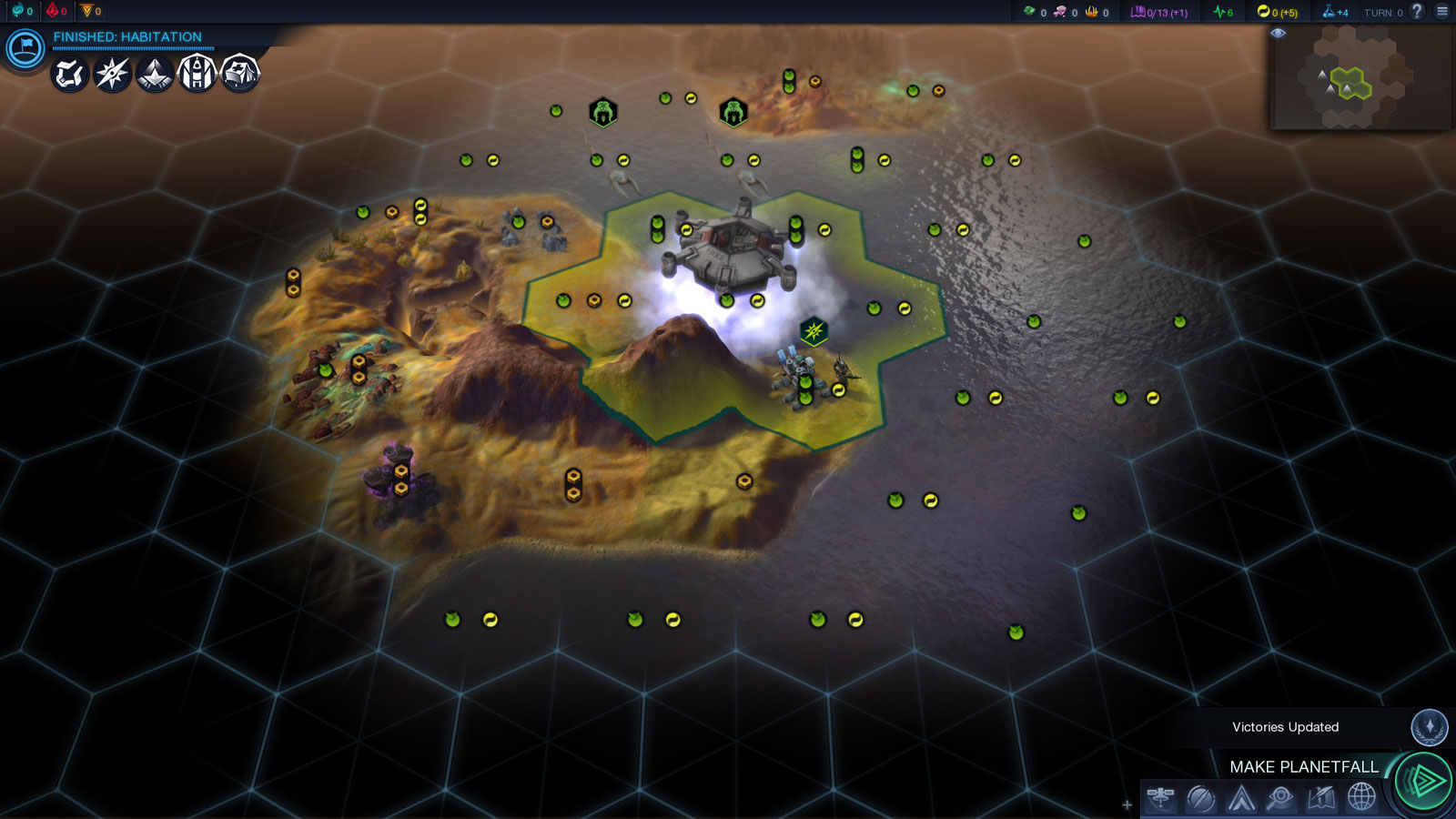
The Setup Option allows the player to choose a number of features for their game. Including but not limited to, Game Pace, Difficulty, Map Size, Sponsor, Colonists, and Planet to name a few.
Play Now starts a match with most of the settings that were used for the last game.
The Basic Setup Screen
The basic menu takes you through a series of five choices to customize your nation. The first one is likely to be the most important of all: who are you going to play? Your Sponsor determines your Leader, your Colony's primary bonus, and their city names, colors, etc. All of the Sponsors are good, but their bonuses vary. Find a Sponsor that matches your playstyle to get the best advantage out of it. Covert Operations fans are going to love ARC. Big traders favor Polystralia. Brasilia mows down the field with tough troops.
Sponsors
- ARC: Good spying (Flexible)
- Pan-Asian Cooperative: Best wonder builders (High Points, High Risk)
- Franco-Iberia: Free Technology when they reach cultural milestones (also Flexible)
- Slavic Federation: Orbital bonuses (better mid and late game)
- Polystralia: Bonus trade routes (Development)
- Kavithan Protectorate: Outposts become cities faster (Expansion)
- Brasilia: +10% combat strength in melee (Conquest)
- People's African Union: +10% Food in growing cities if your nation is healthy (Growth)

After picking a Sponsor, choose a type of Colonist. Colonists give bonuses to every city. This selection should be based on the intended focus (e.g., fast growth requires Food and good Health, research demands Science).
Colonists
- Scientists: +2 Science in every city
- Refugees: +2 Food in every city
- Aristocrats: +3 Energy and +1 Health in every city
- Engineers: +2 Production in every city
- Artists: +2 Culture and +1 Health in every city

The Spacecraft Choices are slightly less important but still essential. This is a minor bonus that helps during the early stages of the game. A player who loves to explore, may want the Continental Surveyor to see all the coastlines on the map. Someone who is particular on where they land, and want a wider area to land, would want Retrograde Thrusters. A player intent on gathering resources will want Tectonic Scanner. An Energy hungry player will want Fusion Reactor. And someone who wants to either avoid aliens or befriend them might want Lifeform Sensor.
Spacecraft Choices
- Continental Surveyor: Reveal coasts on the map.
- Retrograde Thrusters: Extra territory for choosing your first city.
- Tectonic Scanner: You see Petroleum, Geothermal, and Titanium resources automatically.
- Fusion Reactor: +100 Energy.
- Lifeform Sensor: Reveals alien nests.

Cargo is a fun choice. You get a free bonus and all of them are really good. All of these heavily favor an advantage for the early game, so it is best to think about the first focus as a Colony. Hydroponics and Machinery are for players who plan on growth, expansion, and a powerful mid or late game. Weapon Arsenal is a power play for someone who thinks that their early turns can be leveraged into an aggressive advantage against their opponents. Laboratory is for players that want to trade, and settle new cities immediately. And Raw Materials is for players that want to focus on the Health of their Colony.
Cargo Choices
- Hydroponics: +1 Population in your first city
- Laboratory: Free Pioneering Technology
- Raw Materials: Free clinic in your first city
- Weapon Arsenal: Free soldier
- Machinery: Free worker

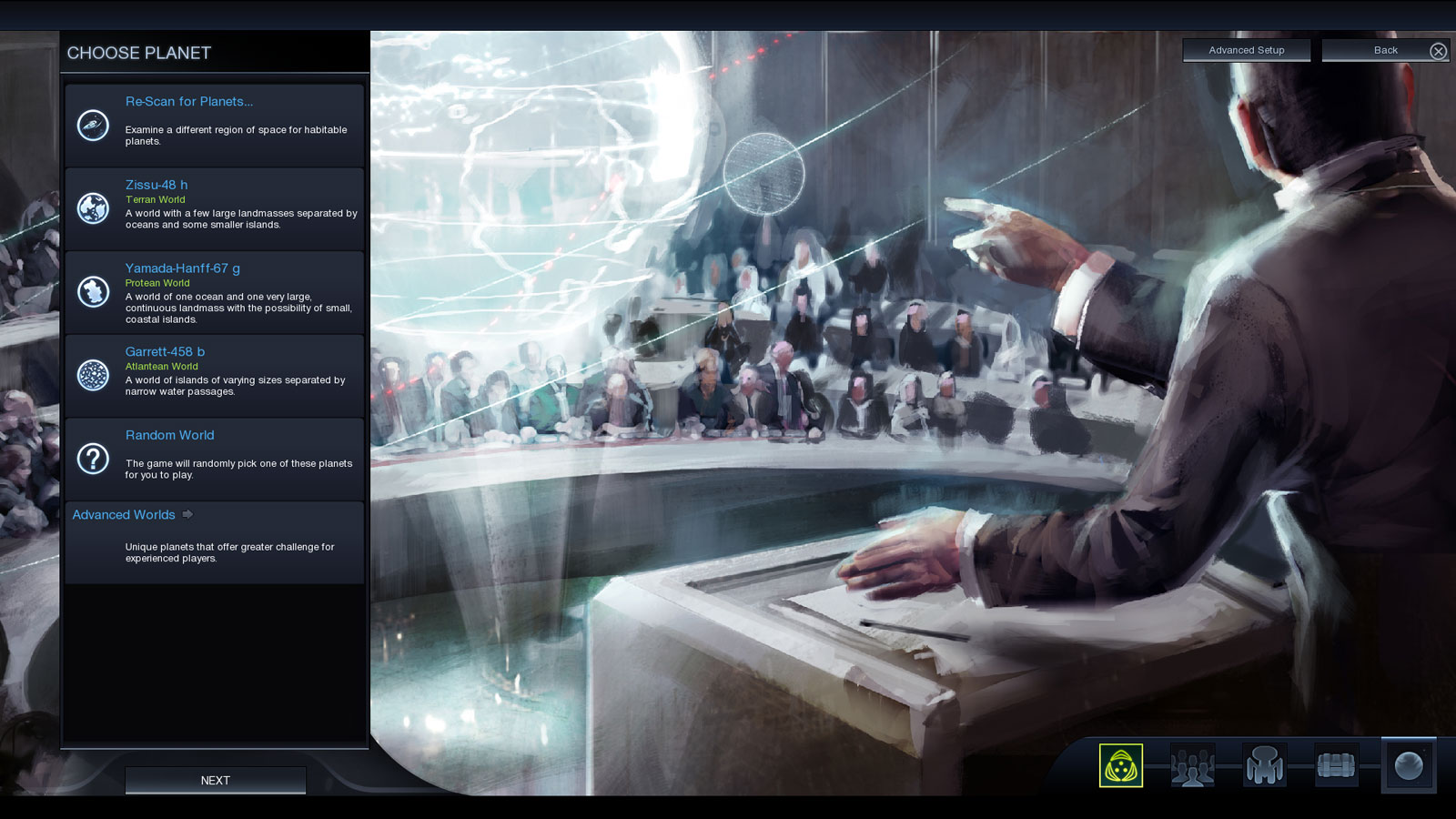
Finally, choosing a planet to land on. This is another playstyle choice, it would be wise to pick a planet that best suits the desired gameplay. More islands (Atlantean worlds) slow down early expansion and conquest, as well as warfare. Terran worlds create tiers of competition. There is usually heavy friction on a person's starting continent, but the action slows in the middle as people build up for cross-continental rivalries. A player who likes heavy warfare and conflict might enjoy Protean worlds, as they have few limiting factors to get in the way of conquest.
Advanced worlds let you try out specific maps that are made with a particular challenge or theme in mind.
With that, you now know everything to set up a great match. Before you begin, though, you should take a deeper look at each of the available sponsors and leaders. Some of this information is fun flavor and backstory, but you should also study the leaders so that you get a feel for how the AI plays them. This helps you to recognize trends, motivations, when they're going to attack you, and so forth.
Getting to Know Your Opponents
There are eight Colonies vying for control of this new world. Learn about the strengths and weaknesses of each so that you know how to outmaneuver all of your foes.
People's African Union
insert artwork 2KGMKT_CIV_BE_LEADER_PROFILE_IMAGE_PEOPLES_AFRICAN_UNION
- Sponsor benefit: +10% Food in growing cities when healthy.
The chartering of the People's African Union was the culmination of what has been called the sub-Saharan Renaissance. A new generation of political thinkers and cultural organizers used the chaos of the years following the Great Mistake to build pockets of good governance and stability. Then, they gradually expanded and combined forces, focusing on continental self-reliance, traditional values of communalism, and a newly developed sense of shared destiny. These states were able to create strong stewardship of Africa's ample mineral and biological resources and counter the ecological damage within their borders. The People's African Union was one of the earliest backers of the Seeding, and it has profited greatly by its equatorial positioning in serving as a launch base for many expeditions.
Playstyle
The People's African Union is a wealthy ally in terms of its size and population. Its leader, Barre, is good at growing a small colony into a large country without wasting too much time. Expect his focus to be on mostly peaceful expansion while developing his cities. He won't like warmongers or alien killers most of the time, and these traits are likely to get you in trouble with him.
If you're playing as the People's African Union, exploit your strong growth potential. A 10% Food bonus is substantial, but you must watch out for unhealthiness in your nation. Too much of that, and your bonus goes away, leaving you in a deficient position compared with your rivals.
Don't expand too quickly! Make sure that your cities grow large and healthy before settling new ones. This ensures that you keep your bonus going and that you have high populations to work with. Prosperity virtues are well suited for this style of play.
Samatar Jama Barre

- Strengths: Diplomacy, Growth, Health
- Weaknesses: Production
Barre is a variation on the "wise old chief" archetype. He is likely to be a trustworthy opponent and ally, a character whom players would prefer to favor rather than resist. He is slightly overweight and aging, with an air of benign neglect about his clothing and hygiene. He behaves in a cordial, beatific, possibly na•ve fashion, as he speaks in soft tones, smiles frequently, and shrugs off insults and slights. He doesn't get angry with others as often as other Leaders. Should you stab him in the back, he appears sad and resigned, as if you hadn't grown up the way he had hoped, rather than furious and vengeful. That doesn't make him a pushover, however: he holds the line against his enemies with ruthless efficiency, especially when his people are threatened. Still, he consistently operates with an air of unflappable optimism and good humor.
His given name means "doer of good" in Somali; the family name is a line of historical Somali diplomats.
Avuncular, genial, affable, affecting an air of bonhomie, Samatar Jama Barre wished to be addressed as Kubwa Mjomba ("great uncle" in Swahili) by those he both commanded and protected. Despite his seeming benevolence and absent-minded demeanor, he was nonetheless an efficient and effective administrator, an able diplomat, and ruthless when necessary. Barre was amused and likely pleased when detractors likened him to the traditional African village chieftains of the past, claiming him to be a throwback and out of step with the new world in the wake of the Great Mistake. But the People's African Union made a wise choice when he was selected as one of their colony governors.
Rising from the poverty and violence of the inundated streets of Hargeisa, Samatar joined the African Union's resurgent military forces, eventually rising to the rank of Major. For three decades, he served in a variety of increasingly important posts, military and civilian, rising steadily in both ability and influence. He was able to overcome lingering tribal tensions, dealing with the polyglot cultures of Africa with both reverence and common sense. Barre displayed those same diplomatic skills when negotiating with those outside the African Union, and he brought to culmination several international agreements that helped propel the Union's colonization effort before he was selected to command one of those colonies.
Barre proved to be just as efficient against any perceived threat to the well-being and safety of those under his protection. In dealing with nascent warlords, religious fanatics, and local dictators, he either brought about an equitable peace or bludgeoned them into submission. Although never known as a military genius, his troops were extremely loyal to their "great uncle" and fought with abandon for his approval. Samatar Barre never lost a battle, although he took no credit for his victories and viewed them as lamentable necessities.
Though not religious himself, he was tolerant and accepting of others' religious traditions. In the end, it was this tolerance, coupled with his intellect and personality, that would shape the African Union's colony on the new planet.
Pan-Asian Cooperative

- Sponsor benefit: +10% Production toward wonders and +25% worker speed.
Although badly affected by the Great Mistake and the upheaval that followed, the Pan-Asian Cooperative emerged as a strong transnational entity. Centered on the old People's Republic of China, the Cooperative spans Asia from the Mongolian steppes to the megalopolis of Bangkok, with even former regional rivals South Korea and Japan laying their differences aside to work in the framework of the Pan-Asian Cooperative. It is a powerhouse of industry, home to world-class R&D and high-tech corporations, and boasts a skilled population living in Earth's most populous cities. Although relatively new to spaceflight and space colonization, the Pan-Asian Cooperative has quickly caught up to or passed the old Space Bloc as it embraces the Seeding.
Playstyle
Daoming Sochua leads the Pan-Asian Cooperative, a group that develops their cities quite well for research and culture. Expect them to keep up well in the science race, with modern military units and good locations to defend.
The downside of Sochua's leadership is that she won't field enough of those nice, modern units. She's not much of a killer, so you're in great shape against her if you can survive the early push into her territory. Don't attack quickly if you're going after the Pan-Asian Cooperative. Instead, lure them into battles outside of their cities and orbital territory. In the open field, they're weak and vulnerable. Beat off this early rush, and then head into the Colony's juicy interior.
Or maybe you're looking to join the Pan-Asian Cooperative? They have a similar playstyle to Egypt on the last Civilization release. Gain major points and advantages by securing multiple wonders without as much investment in time or production. This makes it easier to develop good cities and a strong empire. However, it makes you a clear target for both human and AI opponents. Do not neglect your military. It's okay to play things defensively, but don't be a pushover. Your wonders won't mean anything if you lose your cities.
Consider starting off with a free worker. The Pan-Asian Cooperative bonus cuts at least a turn off of most activities that workers need to accomplish. This lets you grab substantial bonuses in your early cities that much sooner.
Daoming Sochua
insert artwork 2KGMKT_CivBE_Concept_Leader_Daoming_Sochua_PAC_General
- Strengths: Culture, Energy, Science
- Weaknesses: Military, Diplomacy
Sochua is a driven, overachieving scientist-engineer who is willing to push ethical boundaries in pursuit of scientific advances. She is particularly proud of her Chinese cultural heritage and encourages the old traditions in everything from dress and housing to diet and manners, albeit adapted to the alien environment of the new planet. This dichotomy is reflected in her dress, for she often wears traditional Chinese clothing topped with an open white lab coat. She is a brilliant woman who is one step short of a "mad scientist," and she made her mark in research on and exploitation of new energy sources. She is relatively youthful[md]in her late 30s[md]but accomplished. She has no close family or confidants, only underlings. Polite but stern and demanding, her dealings with non-Asians range from dismissive to aggressive. She typically keeps her emotions inscrutable and under control but may display them if she thinks she can gain an advantage by doing so. She can be a loyal ally or a fierce adversary, depending on her own agenda.
Born to a Chinese mother and Cambodian father, Daoming Sochua was raised in the traditions of both cultures. She tested at genius levels at a very young age and progressed rapidly through the state-sponsored school systems for gifted children. She quickly surpassed her parents, who were both university professors in the sciences, and her bright siblings in her studies. Entering university in her early teens, she proved focused and motivated to dominate her older peers.
By the age of 30, she held four PhDs in electrical engineering, nano-electronics, nuclear physics, and bubble fusion. Pioneering groundbreaking methods for extracting energy from sources heretofore thought exhausted, as well as deep-sea and off-world resources, Daoming Sochua was presented with numerous international awards before joining the Pan-Asian Cooperative's Bureau of Scientific Revolution. She was specifically recruited by the Cooperative Space Agency for her experience with energy research and unconventional power systems. Daoming was brilliant, driven, and single-minded in her roles, whether as a researcher or administrator.
When she was appointed to head a number of innovative (and perhaps dangerous) projects undertaken by the Cooperative, she revealed a talent for administration. Motivated by the Seeding, she volunteered to head one of the missions to colonize other planets for Pan-Asia. At the time, she was in charge of research studies aimed at overcoming the Inflection Point, knowledge that would serve her in good stead in her new role. Throwing herself into her role as mission leader, Sochua brought her characteristic single-mindedness to decisions on the outfitting and launch of "her" colony, driving her crew and staff unrelentingly. Although not beloved by the colonists on the one-way trip, she was highly respected, which was all that Daoming Sochua expected or demanded.
Kavithan Protectorate
insert artwork 2KGMKT_CIV_BE_LEADER_PROFILE_IMAGE_KAVITHAN_PROTECTORATE
- Sponsor benefit: Outposts and cities acquire new tiles twice as fast.
After both the Great Mistake and rising sea levels displaced its population, many commentators were quick to dismiss the Indian Protectorate[md]to their great loss. Whereas other countries might have been content to wallow in despair, the Indian Protectorate underwent one of the greatest cultural transformations that a civilization has undertaken, becoming culturally dynamic, indomitably optimistic, and cleverly resourceful. With one-sixth of Old Earth's population within its borders, and under the charismatic, enlightened guidance of syncretic religious mystic and prophet Raj Thakur, the Protectorate has launched a space program that is the pride of its people. The program is celebrated in song and movie, with every boy and girl from Punjab to Tamil aspiring to work on "our Prophet's Dream." Now Raj Thakur's only child, Kavitha, has assumed her father's mantle. Work continues on the Prophet's Dream and life on new worlds.
Playstyle
Kavitha Thakur is the epitome of a peaceful expansionist. She's capable of declaring war, but it's likely that you're only in danger if her borders slam into yours and your treatment of aliens and other Leaders goes against her. Use trade convoys to keep her happy, and you might end up with a loyal friend instead of an enemy whom you can't trust.
If you're playing against Thakur, give her a little time to overexpand. She'll throw cities all over the place, leaving them somewhat exposed. That makes her a valuable target once you have your military geared up and ready to go. Someone else might beat you to the punch, but that can be turned into a victory, as well. You can always let them tire themselves out in the early phases of the war, join Thakur by declaring war against her opponent, and "defend" her territory by claiming the cities that she's lost. You can always eat the rest of her cities later, as she'll be in even worse shape than before due to the first war.
When playing as part of the Kavithan Protectorate, your job is to expand quickly but safely. This isn't as easy as it sounds. Fast expansion is easy with this sponsor, but that leads to low Health and a higher risk of invasion from enemies who are jealous of all your new land. Always defend your colonists and their outposts as well as possible, and augment your city's natural defenses with extra units. Consider trade routes to more martial stations so that you can beef up your military without having to sacrifice extra production time in your cities.
Kavitha Thakur

- Strengths: Growth, Culture
- Weaknesses: Military, Infrastructure, Science
A revered religious icon thrust into a position of both political and military power, Thakur is calm, almost to the point of being detached, as if she exists in two places at once. Although she appears young, she is likely very old; she speaks slowly, carefully considering her words and drawing on decades of memories and experience. Her goal is a peaceful coexistence to heal the wounds endured by the generations following the Great Mistake. Insults and aggressive tones are meaningless to her and fall on deaf ears. Her responses are almost always cordial, thoughtful, and even-handed. However, if driven far enough, she will use the sheer numbers and devotion of her followers to protect those who share a similar ideology.
Although Western scholars are almost uniformly incredulous, the followers of Kavitha Thakur hold fast to the claim that she was born on the first day of June, 17 years before the events of the Great Mistake, making her well over 200 years old. More reliable estimates concede that she may be considerably older than the average life expectancy.
As the daughter of revered northern mystic Raj Thakur, Kavitha had a strong spiritual connection at a young age. She often experienced near-catatonic states of "disembodied concentration," during which she was said to have had visions of the far future. To the devotees of her father, this only served to solidify their belief that she would one day supplant him in his role, as he himself had declared upon her birth.
Nearly 80 years after Raj Thakur's journey to the Kush, Kavitha's followers numbered in the hundreds of millions as the stories of her and her father became legend among desperate and forgotten peoples. Despite a number of political and military candidates tailored for the position, when it came time to elect a leader for the now geographically diverse region under their control, no one saw a means to overcome Kavitha's popularity. Swept up in a nearly uncontested vote and thrust into a position of political authority she neither desired nor prepared for, Kavitha focused her early efforts on what she knew best: humanitarian campaigns. She focused her vast resources on repairing the damage done by her predecessors to the people of the Indian subcontinent.
Franco-Iberia

- Sponsor benefit: Gain a free Technology for every 10 virtues developed.
When the Eurozone collapsed after the Great Mistake, Franco-Iberia emerged to fill the gap the European Union left behind. Now this transnational empire spans much of the area around the Mediterranean, regarding itself as the cultural guardian of the best of Western civilization. Its prosperity made it a beacon for refugees, and its sagacious social policies meant that it continued to grow and develop while other Colonies struggled to regain what they had once held. Now home to many of the great minds of the age, Franco-Iberia views the Seeding as the next logical step in the process of leading the world by example. The Rock of Gibraltar, it is said, is the border of the solar system; Franco-Iberia is ready to continue beyond the end of this Old Earth.
Playstyle
Who is afraid of dignified, elderly Elodie? Sensible leaders. Sane people. The observant. Elodie may not look like a fierce opponent, but her quiet style of governance is more effective than you might realize at first glance. Her ability to pursue virtues (and get free technology periodically) ensures that she has a flexible nation that reaps many bonuses from any direction she takes. The Franco-Iberian European Union can go in many directions, as the match dictates. Free tech can be chosen from anywhere on the tree that is available, high culture leads to similar flexibility, and Elodie's interest in energy lets her buy whatever she can't build directly.
Don't let Elodie build quickly off on her own. This is a critical way to lose your game, even if you are well on your way to a perfect domination ending. "Ah, she just got her Mind Flower. We're cool for a while." No, you aren't.
Treat the Franco-Iberian European Union with the respect it deserves. They aren't a rampaging force that you must defend against, but they'll have energy to spare, a military of decent standing, and no overt weaknesses. They're a tough nut to crack. Make sure to pressure them long before you think that you need to. Use spies to get information and wealth from them, and then join another nation when they're interested in going after Elodie. Your goal isn't just to get land; it's to knock her down a few pegs before she gets so tough that it's "not worth going after her."
So how do you win with the Franco-Iberian European Union? Patience. Beeline toward research that gets you Culture as quickly as possible. The free techs that you gain are so far apart that they're helpful without being mission-critical. Instead, it's the virtues themselves that are your big draw. Pick a direction that you want, and push hard with your virtues to make it happen. The Franco-Iberian European Union can be a military power, a peaceful expansionist, a researcher, or whatever else you need. That is very nice in a multiplayer game, when enemies won't be sure what to make of you. Use that. Don't be the opponent they're expecting. Switch categories of virtues after you've gotten what you need in the early game, and either heat up your military if your neighbors look soft or become a quiet building powerhouse if everyone else starts fighting things out.
Elodie

- Strengths: Culture, Energy
- Weaknesses: Health, Science
Known only as Elodie, she traces her bloodline to the aristocrats of France and Italy. In her mid-60s, Elodie is elegant, well spoken, and aristocratic; she is polite but reserved when dealing with those she perceives as social inferiors and gracious with her "equals." She is chic and elegant in dress and coiffure, adding her own stylish touches to even the most mundane and pragmatic wear, like a spaceship jumpsuit. However, left to her own tastes, she would tend to favor the latest styles and have an extensive wardrobe, changing her clothes frequently to suit the situation. Elodie is multilingual, with the affectation of dropping words and phrases from the Romance languages into her dialogue no matter which tongue she is speaking. Elodie is slightly flamboyant in her mannerisms and gestures, akin to the nobility of old Europe. Well educated and sophisticated, she also tends to allude to works of great art and literature in her conversation, with the occasional bon mot. Velvet with a hint of steel, Elodie strives to be admired, as well as respected, by other leaders[el] but she will settle for feared if necessity dictates.
Long wealthy, Elodie's lineage traces back to the nobility and privileged elite of France and Italy a millennia before the Great Mistake. Her family's prestige and influence was not, however, based on its peerage but rather on the immense fortune it had amassed over the previous two centuries from its holdings in agriculture, food processing, pharmaceuticals, and textiles. Opportunities since the Great Mistake have made it even richer. Its pharmaceutical operations were critical during the "super bug" pandemic after the Great Mistake, and the family farms, orchards, and vineyards in Portugal, France, Sicily, and Greece remained relatively untouched by the fallout, providing ample income from food production.
Born in Europe's foremost fertility and maternity clinic in Braga, Elodie was her parents' only child. Raised in luxury along the Cote d'Azur and Costa del Sol, Elodie became a media darling as a teen, although she was not always portrayed in a flattering light. Reaching maturity, she parlayed that exposure and her experience with the press into a platform for her politics and cultural cachet. Although raised in the Catholic traditions of the New Papacy, Elodie professed to follow no specific religion. She was, however, a staunch monotheist and brought her faith into all her dealings.
Accused by her detractors as an isolationist and a European elitist, Elodie certainly possessed a famously acerbic tongue and quick wit. A strong believer in the value of the Western cultural tradition, she believed that it was up to the educated European elite to guide the masses for their betterment, ensuring the survival of high culture. The best way to do this on Earth was the independence and sustainability of the new Union. More vital, in Elodie's view, was to ensure that Franco-Iberia planted colonies off-world.
When Franco-Iberia announced its plans to launch a "Seeding," Elodie used her considerable influence and family connections to get her name on the short list for command. Using her media savvy, she managed to get the mass media's backing, making her a popular choice among the citizenry of the Union despite her age. Beyond the operational matters (and Elodie had a knack for choosing able lieutenants), she also personally oversaw the construction of the Canon, the definitive collection of Western art, letters, and music that became the template for inclusion in the cultural banks of other Seeding projects. Hence, when the colony ship set out, it not only carried people and technology from Franco-Iberia but also some of old Europe's great art works and schematics for duplicating many of Europe's great architectural wonders. Elodie's new colony was designed not only to prosper but also to look good doing so.
Slavic Federation

- Sponsor benefit: Orbital units stay in orbit 20% longer, and the first one launched grants a free Technology.
Polyglot, multiethnic, and spanning Eurasia and Eastern Europe, the new Slavic Federation covers territory beyond what the czars could ever have dreamed. Although rich in resources, much of its land was barely developed until the time of the Seeding, and the Slavic Federation has grown wealthy with providing the materials for many space programs around the world. Politically fractious but united around its signature massive space engineering projects, the Federation sees itself as the keepers of the last true national space program. It continues to rise from the wreckage of the Great Mistake[el] one rocket, one space station, and one starship at a time.
Playstyle
Vadim Kozlov is a direct man. He'll field a good army, build well-protected cities, and bombard the heck out of anyone who tries to mess with him. He's one of the more likely leaders to go after you if you present any sign of weakness. Keep your borders secure, and settle cities defensively if they're near his land. Use hills and rough or impassable terrain to limit access to your territory.
As with most Colonies, you can buy time or even friendship by trading heavily with Kozlov. Let him direct his energy toward other rivals, and watch for any moment of weakness. Kozlov's best strength is in his great military and defensive cities. If he loses the first of those during a war, be ready to take the latter from him before he recovers.
Should you join the Slavic Federation, be prepared for a life of hard work. You won't be sitting back on your passive bonuses and waiting for an easy victory to come to you. The Slavic Federation gets most of its power from the skies. Grab Technology quickly to ensure that you have access to a leaf tech that has affinity experience that you want. If your explorers find a free orbital, launch it, and then get that affinity tech to have your soldiers become marines much sooner than everyone else. Use that opportunity if it becomes available, and try for an early push against an opponent whom you don't like having on your border.
Later in the game, devote a major city to orbital creation. Pop out good orbitals, and use them to supplement your city's natural resources and defenses. You can afford to be more aggressive than most because the Slavic Federation is so nasty on defense. Having orbitals to protect your troops is a great thing, and your cities won't be defeated easily if you take advantage of that. Let enemies kill themselves in your territory, and then expand back into theirs once their units have been squandered.
Vadim Petrovich Kozlov

- Strengths: Military, Infrastructure, Orbital Use
- Weaknesses: Health
Kozlov is the epitome of the self-made man in the new order: after a childhood in the industrial cities of Poland and Belarus, he rose through the ranks of the Roscosmos program and eventually became known as the "Hero of the Slavs." He is a quiet, stoic, and efficient leader, personifying the authoritarian military that figures so prominently in the government. From his days in space, he is careful, analytical, and direct; he expects those same qualities from everyone. In his early 40s at the time he was selected to head the colony, he was physically fit and mentally sharp. He is a "by the book" career officer with absolute dedication to his command and the Slavic Federation. He is equally comfortable in a spacesuit or uniform but eschews most casual or civilian dress. Save for his insignia of rank and nationality, he wears no personal jewelry or trinkets, not even his wedding band. His gestures are minimal, and he uses his voice as an instrument of command: soft when consulting or giving advice, stentorian when giving orders or angered. Whichever tone he may use, however, people tend to listen.
The most celebrated cosmonaut since Yuri Gagarin, Vadim Kozlov came from a working-class family but rose to heroic stature in the years before the Seeding. The eldest son of parents who labored as itinerant steelworkers and welders, Vadim acquired his limited formal education in industrial cities scattered across the Federation: Krakow, Bydgoszcz, Lublin, Minsk, Vitebsk, Donetsk, and Dnipropetrovsk. Vadim answered the call for construction volunteers issued by Roscosmos, the resurgent Federation space agency. Minimally trained in zero-G construction methods, Kozlov was sent to work on building the second Federation Earth orbit station. He was soon promoted to foreman of his shift due to his aptitude for weightless labor combined with practical experience in heavy construction.
Inducted into the armed forces and immediately given the rank of Colonel, Vadim took advantage of part-time educational programs to gain a comp diploma in aerospace engineering. Over the next decade, he became the public face of the Federation efforts to exploit the vast resources of space. Vadim Kozlov was the first citizen of the Federation to set foot on Mars. For this, he was made a "Hero of the People" and promoted to General in Roscosmos. Six years later, he led the mission to map Sol's asteroid belt in preparation for mining operations; for this success, Kozlov was awarded a second Hero's medal and promoted again.
Incredibly popular among the working class, a devoted family man, and fiercely loyal to the Slavic state that had rewarded his hard work, Kozlov eschewed offers to enter politics or move into the civilian realm. At the age of 35, he was overseeing Roscosmos construction projects on Earth, Mars, and in space. He was not reticent in pitching in personally to do manual labor during inspections of construction sites on Earth, elevating his reputation even more as a self-effacing, self-made, successful servant of the people. Both professionally and personally, Vadim Kozlov appeared content.
Yet Vadim made no effort to disguise his desire to return to space. In his early 40s, when the Slavic colonization effort was launched, Kozlov volunteered to head one of the missions. He was promptly accepted and threw himself into the role of mission commander with the vigor and consummate professionalism for which he was famed. It has been surmised that his beloved wife urged him to volunteer, as she hoped to give their children opportunities on a new world not available in the overcrowded and calcifying Slavic Federation. Whatever the truth of such rumors, in the colony mission, Kozlov was able to combine all the loves of his life: space travel, exploration, engineering, family, and Federation.
Polystralia

- Sponsor benefit: Gains two free Trade Route slots in their capital.
When they realized that the rising seas were creating a common threat, Australia, the Pacific archipelagos, New Zealand, and the major South Asian Colonies united to form the Commonwealth of the Pacific, better known as Polystralia. Together, these Colonies tried to safeguard and preserve their coasts and the unique biodiversity of the Pacific and South Indian oceans, and they became a world leader in climate engineering. Long a crossroads for trade, Polystralia's economic power stems from its unique relationship with the great oceans. Its port cities bustle with freight cranes and train shipments, as well as new ideas and technologies. Resilient and rich, Polystralia's relatively small Seeding program is one of the best financed and most focused.
Playstyle
Hutama thought that he would make a bad expedition leader? Bah, nonsense! Hutama is a man with many friends and few enemies. His Colony's focus on trade keeps them out of trouble most of the time, earning them a huge amount of resources in the meanwhile. Expect Polystralia to be a late-game powerhouse if you leave them alone. They have all the tools that they need to explode in the early- to mid-game. They'll have energy to burn, resources galore, and few real problems from neighbors compared with most.
Don't let them get into that position. Use Hutama's weaker military against him. Gobble up his land while it's still soft.
If you're playing as Polystralia, it's time to earn! Use trade routes as a dynamic way to shore up any weaknesses in your nation. Settling a new city? Use internal trade routes to get it up to speed at a blinding rate with free food and production. Nothing new to develop in terms of cities? Trade with other Colonies to keep the peace, bring in Energy, and earn free Science, as well.
Polystralia can be incredibly flexible under the proper leadership.
Hutama

- Strengths: Diplomacy, Energy, Health
- Weaknesses: Production, Expansion
Hutama first came into public notice as a 20-year-old college student at the Universitas Sumatera Utara in Medan, Indonesia, heading a grass-roots movement protesting differential resources assigned to reclamation projects across the Commonwealth. Ubiquitous on social networks and media broadcasts, Hutama's cheerful face, trilingualism, and informal quips endeared him to audiences across the Commonwealth. From Perth to Vanuatu, Hutama was instantly recognizable, parlaying this into a career in politics. He is urbane and polished, a natural diplomat with a flair for the dramatic. Empathy, humility, humor, and respect are all virtues that define Hutama in his interactions with others, and his considerate tone and linguistic training makes him an ideal diplomat and proxy for his people. Although he is calm by nature and his primary concerns are the health and well-being of the colonists, he is a pragmatist and will use force when warranted in his view. He is also a savvy economist and has even mastered the intricacies of modern warfare and trade as diplomatic tools.
Elected to the Commonwealth Parliament before his 30th birthday as a junior member of the opposition, he famously launched the Platypus Inquiry, which ended up splitting the majority of the coalition. The old government was toppled and a new government was ushered in, with Hutama as Interior Minister. Once in high office, he continued his work against corruption, crony contracts, and waste, all while retaining his famous irreverent, informal sense of humor. His weekly Internet broadcast "Question, Minister" mixed populism, no small amount of flashy production, and occasionally serious politics. Hutama is credited with delivering the popular vote needed on a referendum on funding Polystralia's merchant fleet, on being an early backer of the Tahiti2 Island Project, and on providing universal access to fresh water.
Hutama's "spread the wealth" populist politics were key to his success, but it would be wrong to assume that these were cynical ploys. His sharpest criticisms were always reserved to people exploiting the public well-being, and his own personal charities were devoted to alleviating suffering throughout the Commonwealth. Gadfly though he might be on the screen, this was motivated by a strong sense of public justice.
Notably, Hutama seems to have misread public attitudes about the Seeding. After publicly calling into question the Commission Report on the Inflection Point, he resisted Polystralia's efforts to strengthen its space program and start Seeding construction. After a series of sharp political defeats (and a decline in his weekly show ratings), Hutama reversed his position, although his support carried something of a satirical edge. But when the time came to nominate leaders, Hutama's loyalists across the Commonwealth put his name forward[md]even after Hutama devoted an entire program to reasons why he would be a bad expedition leader.
Brasilia

- Sponsor benefit: Units have +10% Strength in melee combat.
Its development checked briefly by the Great Mistake, Brasilia roared back as the preeminent South American economic entity and a world-class military power. Brasilia's military was the backbone of many peacekeeping forces deployed to restore order, and the nation was able to establish itself as a major trading partner with the rest of the world. With the wealth of the Andean highlands and the Amazon acting as a highway to the continent's interior, Brasilia experienced tremendous growth and development as order returned to the world. An early adopter of the Inflection Point theory, Brasilia's aerospace industry and veteran air forces allowed them to launch the very first Seeding expedition.
Playstyle
One look at Rejinaldo de Alencar-Araripe tells you that you're dealing with a lifetime soldier. Don't mistake him for a total warmonger: this isn't Earth, and its leaders don't always have Earth's sensibilities (or lack thereof). It's often quite possible to negotiate with de Alencar-Araripe and avoid conflict, but you won't want a small military or a vulnerable border to be involved in the discussion. Keep your military deployed near de Alencar-Araripe's border to discourage any ventures into your land. His people have a modest bonus in direct combat. It's not enough to win a war by itself, but he'll have enough troops to exploit that advantage unless you're a good defensive fighter.
Playing as Brasilia is quite fun if you're a direct domination player. Though you can take any of the other Sponsors into battle, Brasilia is the best choice out of the bunch. Their melee bonus makes it easier to take and hold cities, fend off enemies in rough terrain, and win wars with fewer casualties. This leads to an upward spiral because your units start off better than their rivals, survive more often, gain more levels, and become even more lethal in the next war.
Take Might virtues to get an even greater leg up on your opponents. Faster levels and quick training help you put a great army out in the field, and the bonuses against aliens gives you something to attack in the early game if there aren't any rival Colonies nearby. You want to have multiple units up to Level III by the time any serious threat gets close enough to conquer.
Rejinaldo Leonardo Pedro Bolivar de Alencar-Araripe
insert artwork 2KGMKT_CivBE_Concept_Leader_RejinaldoLeonardoPedroBolivardeAlencar-Araripe
- Strengths: Health, Military, Production
- Weaknesses: Diplomacy, Growth
Contrary to expectations, de Alencar-Araripe appears considerate, understanding, and unassuming in dealing with both his own people and outsiders. Usually dressed in a simple military uniform devoid of medals or rank, he eschews most of the trappings of leadership, reflecting his humble beginnings and rise through the enlisted ranks. He is slightly built, perhaps wiry, reflecting the malnutrition and illnesses of his childhood. In his early 70s, he may be elderly, but he is still fit and far from feeble. He carries himself with military bearing, ramrod straight and with precise movements, although he has the habit of punctuating his dialogue with flamboyant gestures. His use of language is equally precise and careful, and he is erudite if not verbose. De Alencar-Araripe is always busy, insisting on overseeing the work of his colonial officers and officials, and he appears distracted when speaking with others. He also tends to be pessimistic, assuredly because of his life experiences.
Said to be the finest soldier ever produced by the Western hemisphere, Rejinaldo Leonardo Pedro Bolivar de Alencar-Araripe began his celebrated career at the age of 16 by enlisting in Brasilia's Corpo de Fuzileiros Navais, lying about his age in the finest military tradition. His first assignment as a Marine was in support of a Security Council operation in northern Myanmar, where he saved his platoon, called in air support, and coordinated evacuation after their transport was shot down. His ascent after that was meteoric, rising quickly to Sargento and then attending the prestigious Academia Militar das Agulhas Negras to become an officer. Commissioned as an Aspiriante at the outbreak of the Peshawar Crisis, he was part of a continent hastily sent to Asia to help quell the crisis and deliver humanitarian supplies. Again, his heroism was proven at the Battle of Route Blue, as he stepped into command after the first, second, and third commanders of the forces protecting the refugee camp were killed in battle.
A complete listing of his military accomplishments would exceed the scope of this article, but there were few battlefield commanders held in as high regard as de Alencar-Araripe. Resisting staff duty until it became impossible to do so and still serve his nation, de Alencar-Araripe has been in no less than nine combat tours, seven of them as a commander on the front lines. His talent for planning and improvisation with limited resources are legendary, and, when not serving in combat, he has been a fixture at Agulhas Negras, training the next generation of military minds.
Somehow, in this illustrious military career, he has found time to write the seminal volume of military sciences in the post-Mistake world: the three-volume Principles of Modern Warfare and the slimmer On the Training and Conduct of Soldiers (for enlisted soldiers and military cadets). As proponents of special forces, total victory, aerospatial power projection, and professional NCOs, these volumes have served as the blueprint for infantry doctrine around the world, their pithy maxims backed up by examples from history and de Alencar-Araripe's own career. From anyone else, these books would be grandiose; in de Alencar-Araripe's case, they are statement of fact.
A national hero for Brasilia, his name came quickly to the top of the list for commanders of the first Seeding projects. Despite a career "in the mud," de Alencar-Araripe was endorsed by the Brasilian Air Force and the Space Department. Never one to decline a chance to serve his country, de Alencar-Araripe honed the first Seeding to leave Earth's orbit into the professional, dedicated force that was the hallmark of his military career.
American Reclamation Corporation (ARC)

- Sponsor benefit: Covert operations are 25% faster and cause 25% more Intrigue.
The third largest economy in the world is the American Reclamation Corporation (ARC), Old Earth's first and most powerful megacorporation. Beginning as a geo-engineering firm specializing in environmental risk mitigation, ARC is credited with designing and carrying out the recovery plan that saved North America from dissolving after the Great Mistake. Although rumors abound about ARC's methods and corporate shenanigans, there is no doubt that it has become a power unto itself, receiving grudging respect even from those who denounce it. Now ARC is involved in almost every Colony's Seeding project and recovery plan. From crop science to tidal power generation to security contracting, ARC has a project or product for every problem. Unique among Seeding projects in that ARC's colonial ventures are entirely private, many other Seeding programs rely on ARC financing and products.
Playstyle
Suzanne Fielding is one of the most ruthless leaders in the game; she'll sell you out in a moment's notice, even if you've been friends in the past. Her capable spies add the potential for dangerous intrigue, and her amoral play means that she's a tricky neighbor to have. One of her biggest weaknesses that she has is that she doesn't keep any friends for long. She'll sometimes goad someone into joining her for a war, but just as often, she's the one getting attacked. For an easier time dealing with ARC, play nicely as long as you safely can, and join in whenever anyone else wants to pound them. With this tactic, you get closer ties with the other attacker, and ARC must fight a two-front war.
Playing as ARC is much more fun than fighting against them. This sponsor begs to be used for constant dirty tricks. Their bonuses are quite synergistic because you get to launch more covert operations and then have them cause even more Intrigue on top of that. It's easy to get money, science, techs, or units from your agents' hard work. In the later game, even Colonies that can't attack directly can be laid low by top-tier spies. Stealing a domination opportunity by launching a Coup on someone's capital: priceless.
Suzanne Marjorie Fielding
insert artwork 2KGMKT_CivBE_Concept_Leader_SuzanneMarjorieFielding_ARC
- Strengths: Science, Infrastructure, Spying
- Weaknesses: Culture, Diplomacy
Egotistical? Paranoid? Cunning? Disingenuous? Suzanne Fielding has been characterized as each by historians, and ascribed many other personality traits, as well. Whatever the fact, she is an intense, driven woman who operates in total accord with her beliefs in conservatism, material progress, and economic realism. She is well dressed and groomed in the corporate mode, with an obvious commitment to impressing with her professional appearance and demeanor. While charismatic, her affability seems calculated to gain an advantage in business and political dealings. However, when thwarted, she can quickly shift to hostility and threats. Overall, whatever the circumstances, she strives to present the appearance that all is "going according to plan"[el] hers, of course. She rarely raises her voice's volume, either in excitement or anger, and strives to appear in control at all times. If she does speak loudly or with excitement, be assured that it is calculated, used as a tool as she does all other affectations.
Suzanne Fielding was the eldest of three siblings, all daughters, born on the Texas Gulf Coast to a Mexican-born mother and an African-American father. Her father was the owner of three hardware stores in the region, and Suzanne joined her father in running the business as a teenager. Accepting a scholarship to Louisiana State University, she graduated with honors and a double major in economics and accounting. Driven by a desire to help reclaim coastal lands lost to the rising sea level in her home states, she was hired by the relatively new American Reclamation Corporation (ARC) to an entry-level position. Both meticulous and daring, and surprisingly adept at corporate politics, Fielding rose steadily through the ARC Accounting Division until, within 15 years, she was heading several operations simultaneously as Operations Manager.
When ARC CEO Michael Modersky signed the Trans-Mississippi Recovery Initiative, he personally asked Fielding to oversee the governmental resource coordination, to which she turned her considerable acumen. It was Fielding who caught the accounting chicanery that led to the FBI's Operation Riverboat and subsequent political fallout. Guiding the government to continue funding during the roiling controversy that followed, Fielding also kept the Initiative on track and on time, such that when Modersky stepped down as CEO, Fielding (who had since been elevated to CFO) was the logical choice for CEO. Sidestepping the Board of Directors, Fielding's appeal to the shareholders enabled her to hold both the CEO and CFO positions for ARC, making her the most powerful woman in the most powerful corporation in the world.
With Fielding at the helm, ARC turned from retail and manufacturing to financial and other services. Fielding used the balance sheet and financial weight of ARC as a massive lever, engineering a series of shifts on Old Wall Street to unseat banks and exchanges. As ARC's capital reserves blossomed, many wondered what Fielding would do next. Few expected that she would announce ARC pursuing its own private Seeding venture, drawing on its vast engineering and manufacturing resources and gaining a waiver from the government to conduct private space operations. The biggest surprise was when Fielding announced she would personally lead the first such expedition. With enough money to buy the world, the woman who led ARC found more meaning in starting over with a new planet.