
Civilization Beyond Earth Guide Core Concepts
Familiar Concepts
Unit Stacking Limits
Stacking limits return and are unchanged from the last release of Civilization. Tiles can hold one military unit and one non-combat unit at the same time. Other units of the same type can pass through that tile as long as they have enough movement to reach another tile within range before having to stop for the turn.
Cities can also hold air units and trade units, but neither of these can move around the map under your control.
Zone of Control
Units and cities provide a zone of control around themselves. This prevents enemies from moving freely between two tiles that are both adjacent to the unit/city in question. If you start a movement inside a zone of control and finish that movement inside a zone of control, you lose all the remainder of your Movement Points for that turn. This allows units to block enemy progress through their areas, even when it's not their turn to attack.
Melee units that are fortified along roads or near open territory are very good at doing this because they allow their friends to move quickly through the area but stop anyone else who tries to squeeze in there.
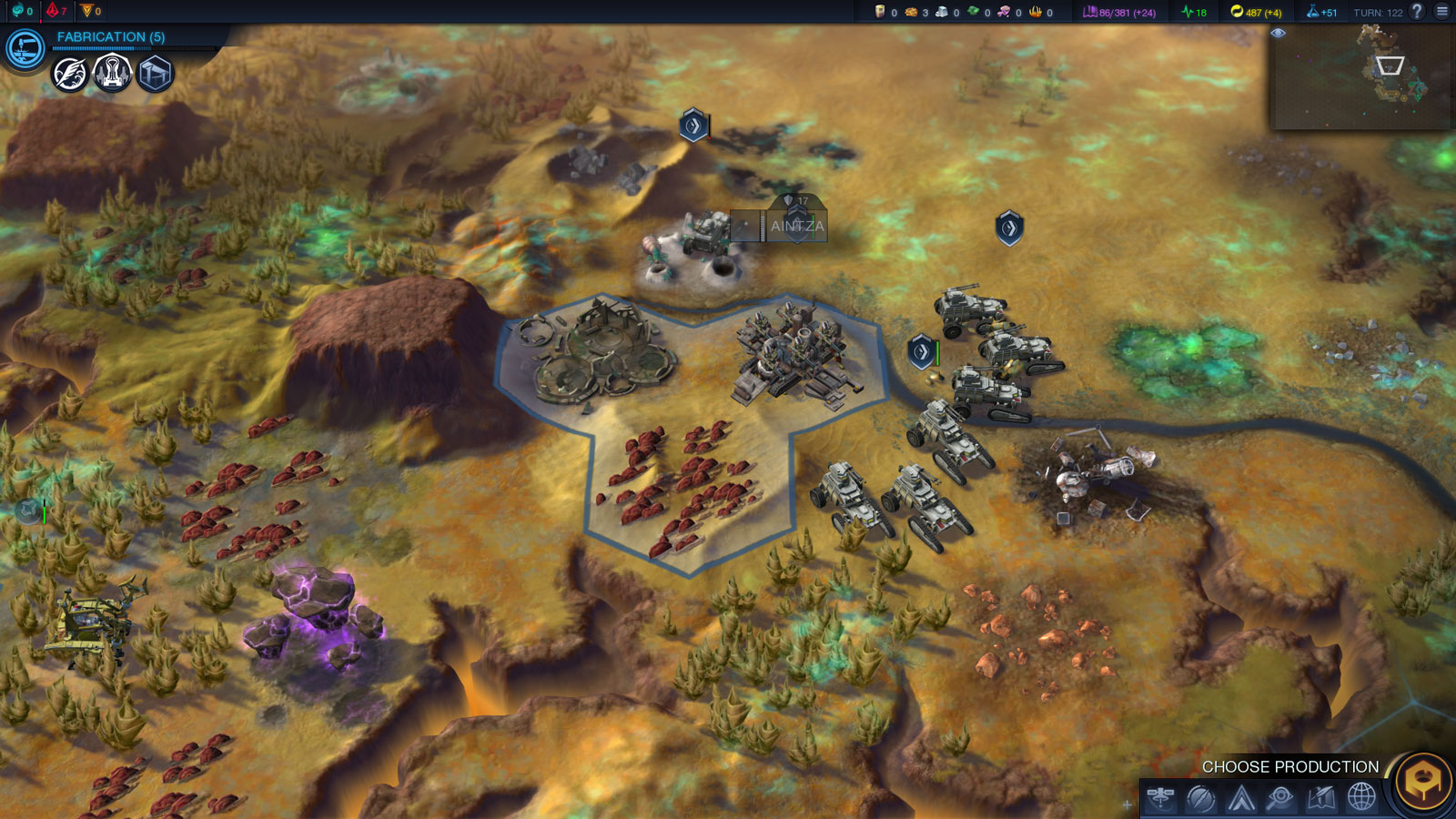
Use your fast units to go out and around enemies so that you don't have to worry about their zones of control. There are also special units that get the ability to ignore zones of control. These units make ludicrously good raiders because it's easier for them to get into enemy territory, do some damage, and get out, even if your opponent manages to send adversaries over to them.
Because zones of control are so effective, you don't always need to have a full line of troops to create a wall. Having troops with a single tile that's empty between them can still halt most enemy movement rather effectively. You might even lure enemies to wedge themselves in there, forcing them to fight with flanking penalties and probably some heavy exposure to ranged fire from your units farther back.
Cities
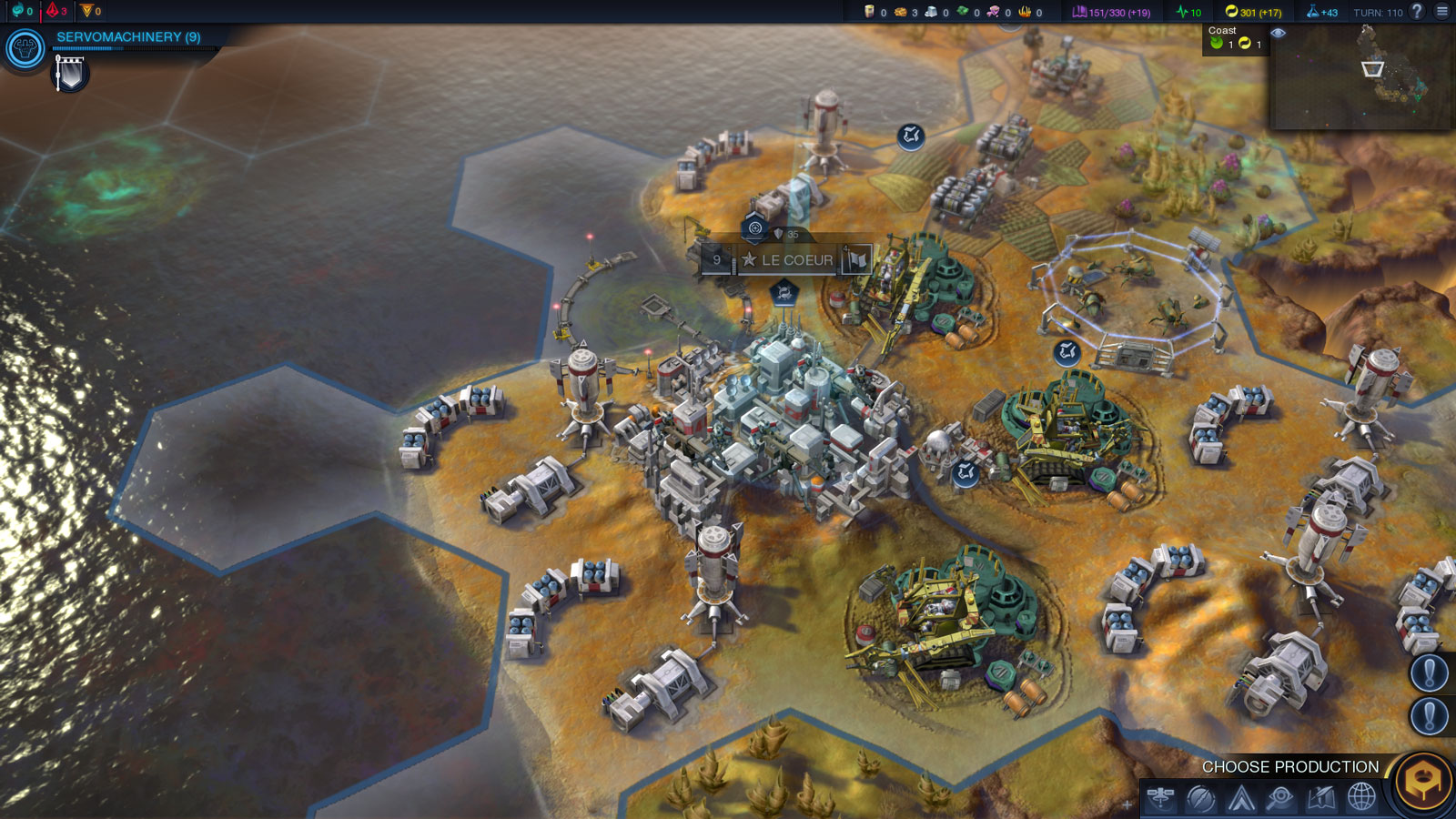
Cities have a slightly different way of running than they did in Civilization V. You still construct buildings and improve tiles to help the city yield more resources. Early citizens of each city are all devoted toward working the tiles that surround the town itself. After you get more citizens and have special buildings with specialist slots, you start to see a division between tile laborers and specialists who staff the buildings to give the city more specialized output.
The biggest change with cities is that you don't found them as quickly in this game. Colonists are trained from any city that can devote the time to train them. Note that Growth is halted during colonist training, so make sure that your city can afford not to grow for a little while. Once your colonist is done, have a tougher unit escort them to the new city site, and build an outpost with the Colonist special command.
That's where things change compared with the old days. Your new "city" starts off without much power or any citizens at all. You must wait while the outpost expands its borders to have nearby territory. This is hastened with trade convoys or trade vessels, and some starting bonuses and virtue selections help with it, too.
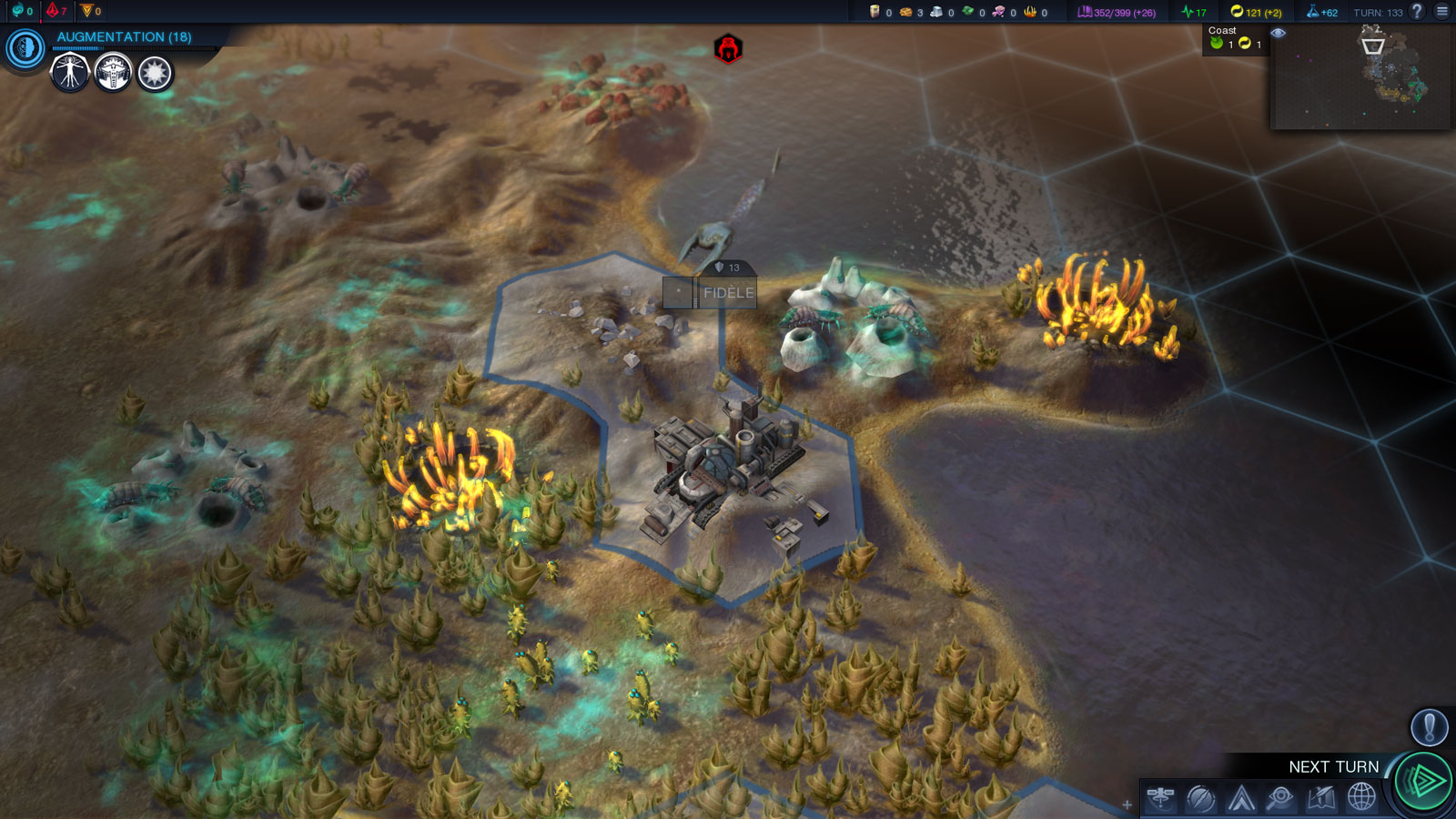
No matter what, it's going to take some time. Protect the outpost with your military, as outposts have low Combat Strength and can't counterattack. Even aliens are decent at taking out undefended outposts!
When ready, the outpost becomes a small city. It normally starts with one citizen and works a single tile beyond its base. That's when you can start trading with the city for resource bonuses, produce buildings, and train units. Make sure to maximize Food and Production during this early stage; these things get cities going very quickly. The more population they have, the more tiles they can work to improve their base resource generation. The more Production they have, the faster that city can get buildings to improve its output. Culture, Health, and Science are all secondary resources that are more important once a city can take care of itself. Until then, have your other cities train units for the new town and do what they can to raise the Health, Culture, and Science of your Colony.
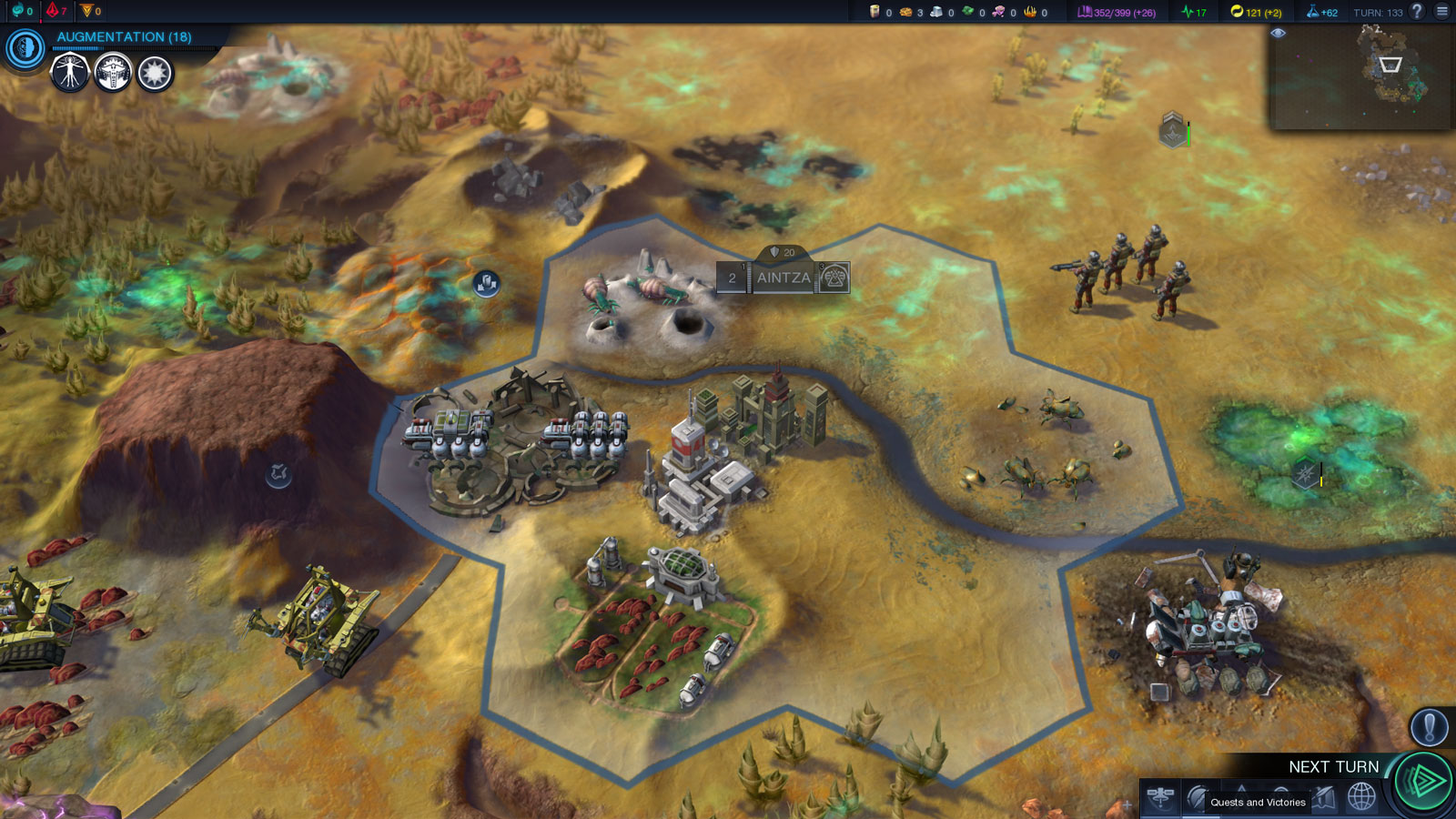
You can't found new cities near existing stations, cities, or outposts. Make sure to give yourself room to grow, but don't have too much room and leave your people spread out where you can't defend them.
Internal City Matters
Cities have several features that are hidden inside their own screens. Click on a city's banner to get into the City Management screen. From there, you can change the city's Production, purchase troops or buildings outright, turn on the queue by holding shift so that you can line up several items for construction at the same time, or look at what you've already created.
This screen also shows your borders and the plans for the city's cultural progress. If you don't like the tiles you already have, it's possible to spend Energy to purchase additional tiles for your city to work. Though eventually somewhat expensive, this really helps when getting good resources for your most important cities. Why wait?
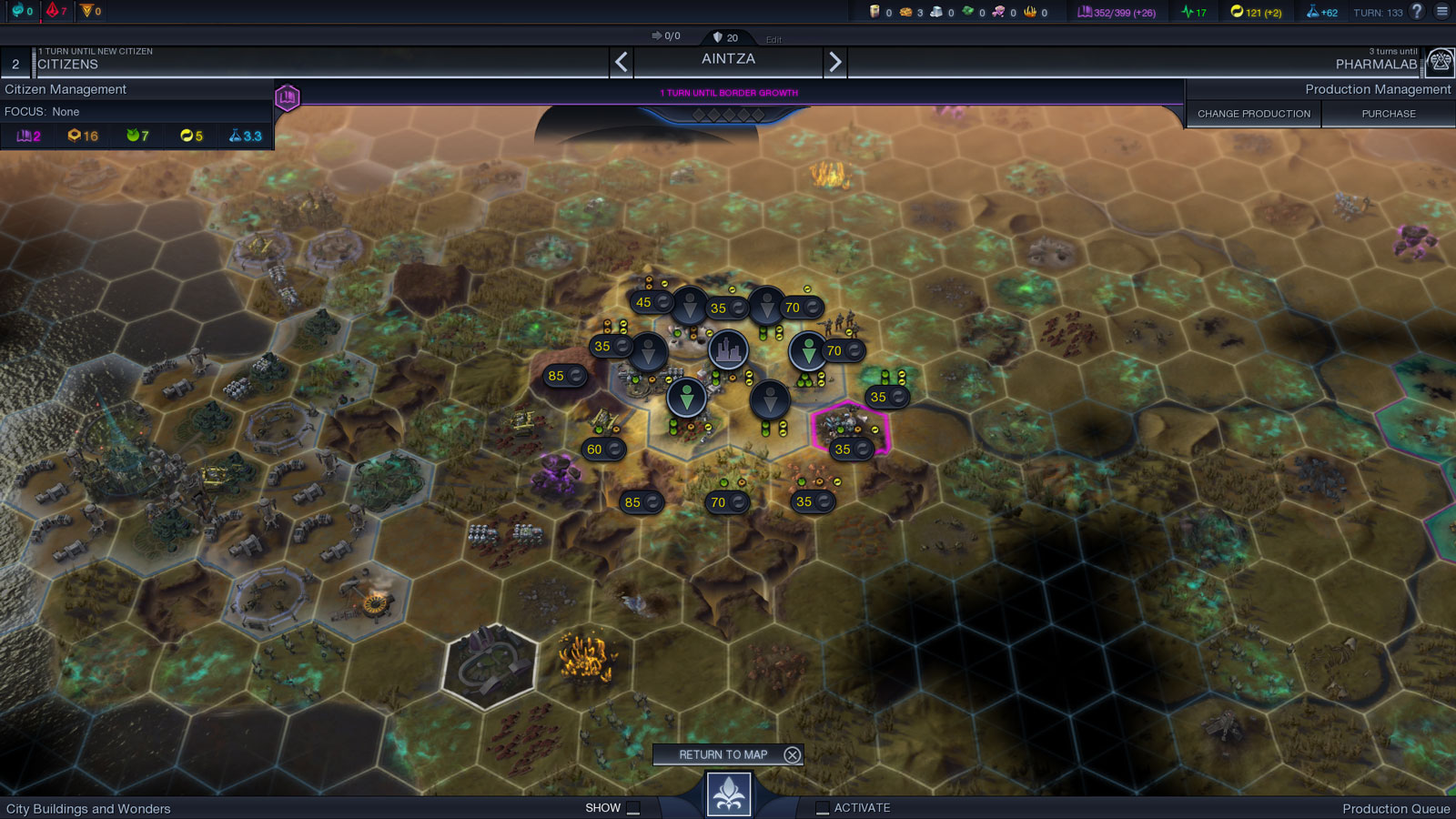
Cities assign their citizens to work tiles automatically, so you don't even need to lift a finger. However, you can customize this by clicking on workable tiles to put citizens onto them or take them off. This gives you the power to control the output of your city. Add more workers to heavy Production tiles to make a more industrial town. Go for Food for fast Growth, or Energy if your Colony is strapped for resources.
If you manually put a citizen onto a tile, they'll stay locked there because you told them to go there. Click on the tile again to remove a locked citizen from their job.
While in the City Management screen, you should also look at the city's output. Do they have enough Food to grow? Are they growing, but slowly? Is their Production fast enough to produce buildings every few turns, or are they languishing with low Production yields?
See where your cities are weakest, and find ways to help them get over their troubles.
If you want your city to focus on one resource, just click the Culture, Production, Food, Energy, or Science icons to make the citizens automatically work tiles with the most of that resource.
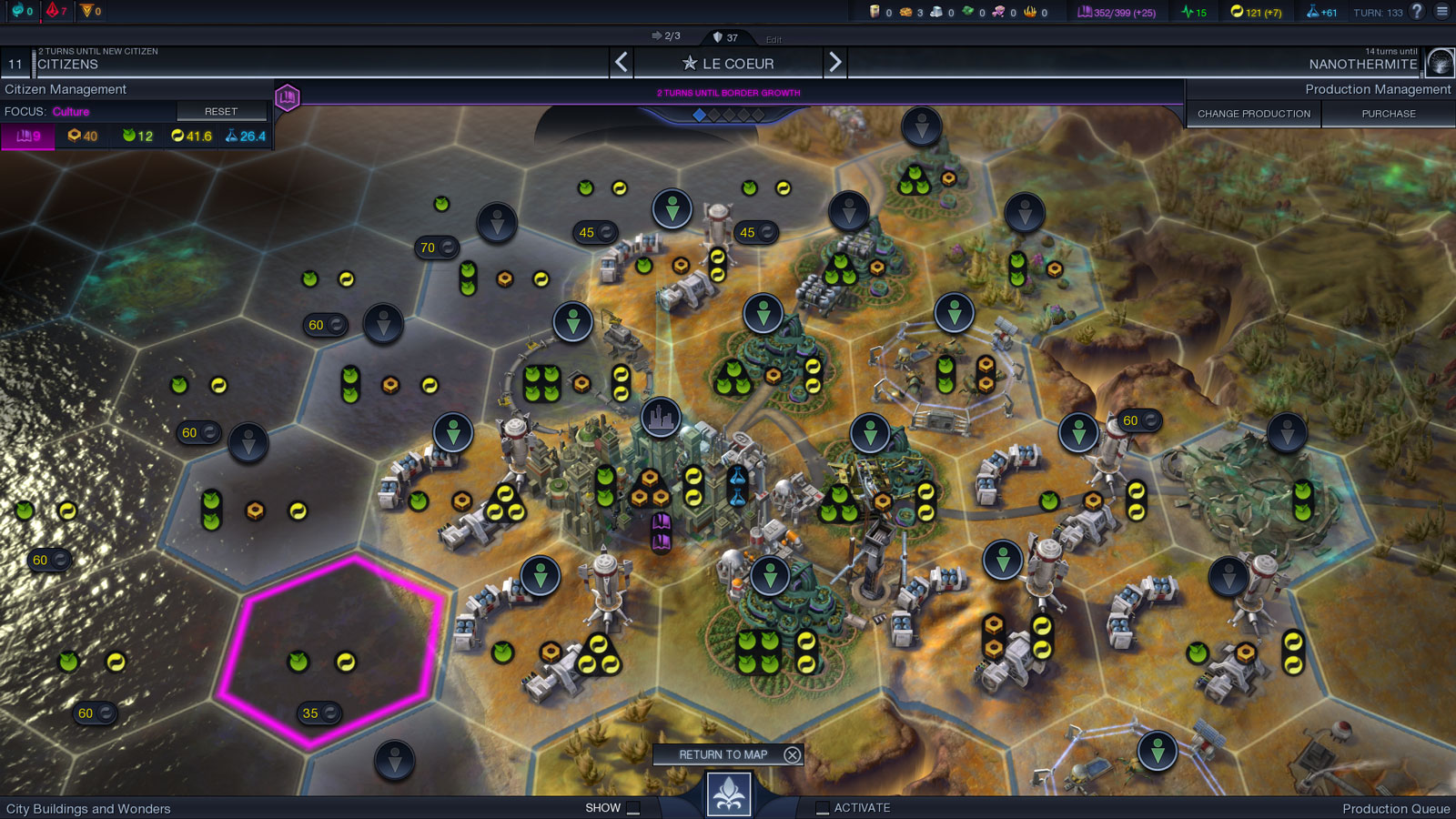
Internal trade routes are almost a universal solution because they develop cities so quickly. However, you can also focus the Production of that city on areas where it's weak. Use buildings to shore up low Growth, Production problems, or Energy concerns.
External City Matters
When you're outside of a city, look at the banner and see how much information is there. The city name is flanked by all sorts of data. The city's Combat Strength is the central number. The higher it is, the more damage the city does, and the lower it takes damage from all attacks. You can also see the turns until the city gains a new citizen and produces its next unit or building.
Once cities enter battle, there is a chance that they will be defeated and taken by another Colony. Both ranged attacks and melee attacks are often needed to accomplish this because cities have high Health and can get impressive Combat Strength, as well. They'll also frequently have garrison units to boost their Strength even more, or ranged units that give them even more attack opportunities. The ranged units can fire out of the city safely each turn without facing any return fire on the opponent's turn.
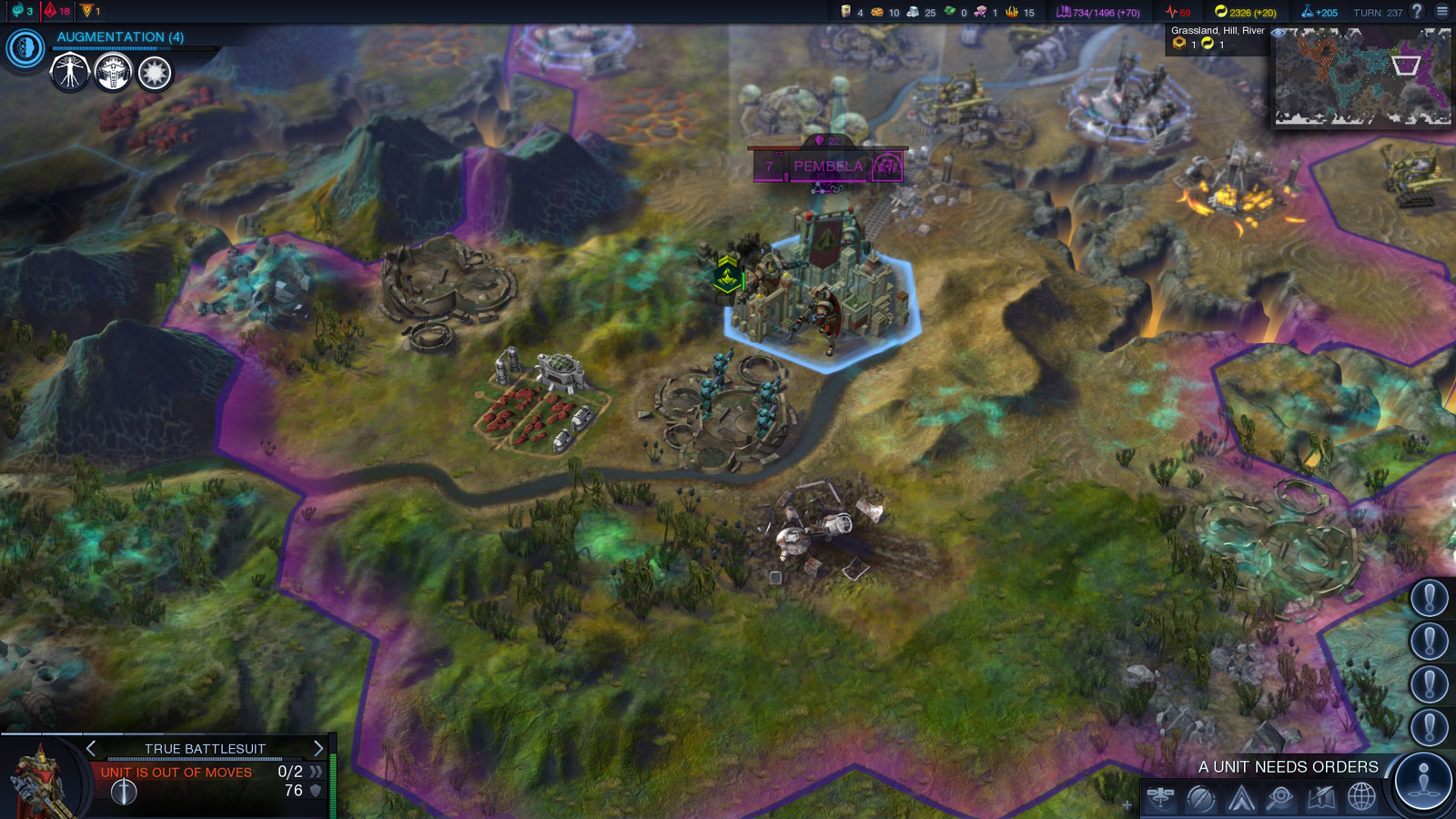
You can treat conquered cities in several ways. Razing them takes a number of turns to burn the city to the ground. As the new owner, you won't get any points from keeping the city because it's gone. This is going to upset other Colonies quite a bit. You might get called a butcher here and there. But if you don't have the Health to hold a city, or if you're certain that the enemy can take it back[el] well, then you might want to burn it down a little.
Annexing a city has a massive Health cost because you immediately absorb the city, its population, and their Resistance into your Colony. Resistance is a temporary Health penalty that fades over time. Once it's gone, you're in much better shape, and that city will act like your regular cities in terms of its Health costs.
Puppet cities are easier to manage. You won't have access to the city's Production menu, so it's going to build whatever it wants. However, you get the yields from the city and only a limited amount of Health problems. You're best off making a puppet city when national Health is low, and then annexing the city later, when you're ready to absorb the full brunt of Health problems.
Martial law is one other rub when taking enemy cities. Whether you annex or make a puppet city, you still must initiate martial law when conquering a city. This prevents you from using that location for Production until the martial period ends. The larger the city is, the longer this takes. It's usually wise to avoid annexing the city during this period because you can't make new buildings to assist with the extreme Health issues.
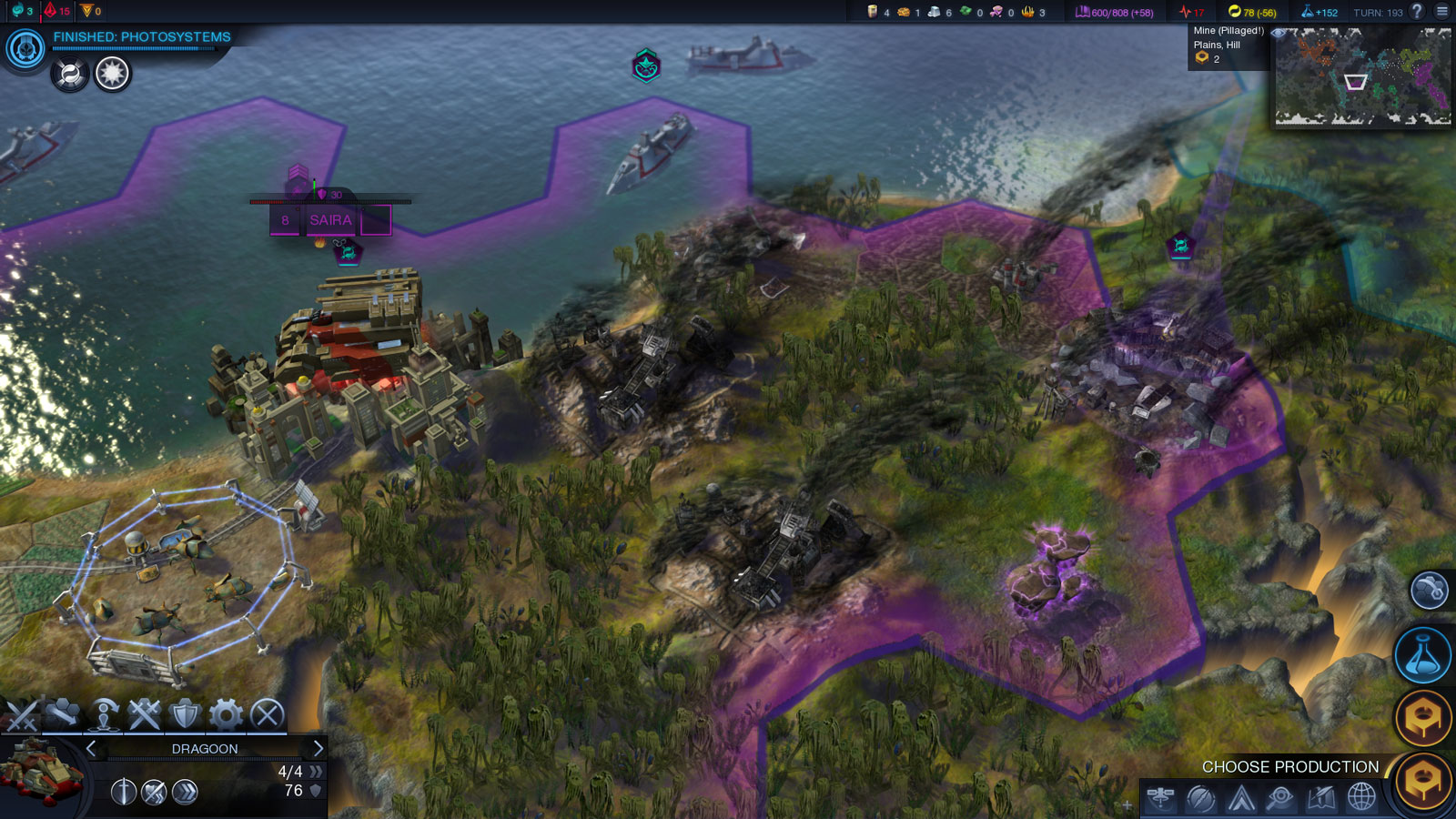
Cities get so much out of their buildings and wonders, but these are covered in the chapters ahead. Chapter 05 fully discusses buildings, their construction, and their values.
Growing Food
Food is responsible for the growth of each city. Without local sources of Food, your city will stagnate or even fall in population. Larger cities have more power to produce buildings and train units, and they are worth more points for your Colony. As such, you need to master Food output so that your Growth stays strong.
Cities get their Food from working some tiles (such as grassland), from improvements (e.g., farms and biowells), from internal trade routes, and by constructing certain buildings. The sooner you get a city's Growth moving, the better off you're going to be. Higher city populations have a major effect on what the city can do, and chopping down the number of turns to reach a high population is one of your best ways to expand quickly without being vulnerable. But you do have to watch your health, because the higher the population, the lower the Health gets. Build Health buildings to counteract this.
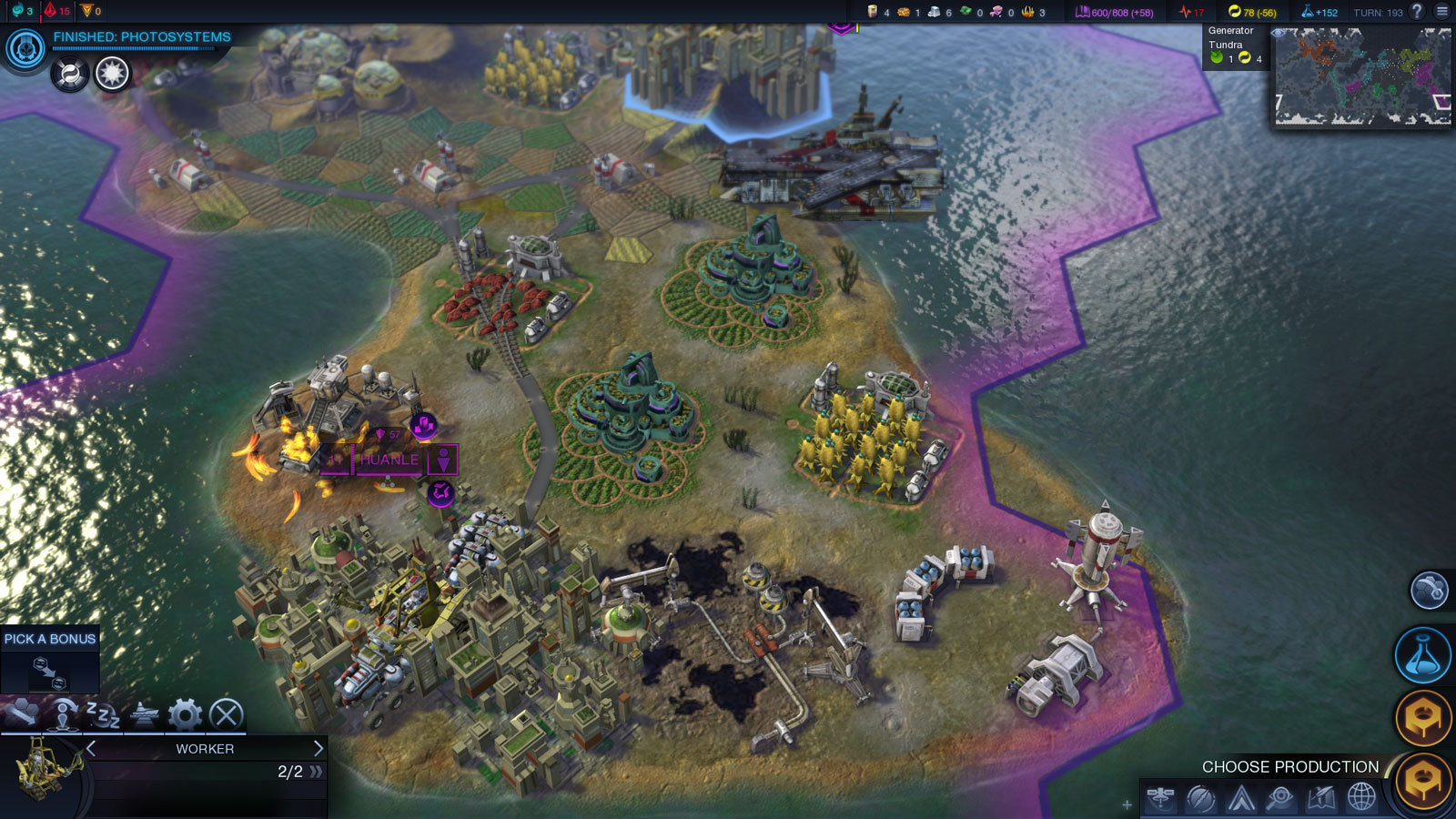
For new cities, get internal trade routes flowing immediately, and try to construct vivariums as soon as you can. This kick-starts your population growth. You must have two Food coming in for every citizen of the city, and Growth only occurs if you have excess Food coming in. The more you get, the sooner you earn another point of population. Go into your City Management screen, and highlight Food to learn more about what you're getting from that town.
Watch out when enemies or aliens get within three tiles of your city. Hostile units on your tiles, even when they're not attacking you, cause your citizens to abandon their work on those spaces. Too many incoming troops can cause even a great city to starve because they won't have anywhere to farm. If you want to thrive, protect both your city proper and also the land around it.
Culture
Culture is a familiar concept in Civilization. This resource lets you customize your bonuses through the virtue system, and it also helps your cities grow locally. The national tally of your Culture is what builds up and unlocks virtues. These cool abilities help your Colony in a variety of ways, so Culture is always going to be important. It won't matter where you're getting the Culture. All that matters to the virtue system is how many total points you have and how many Culture points are needed for the next reward. Larger empires have higher virtue costs, but this can also be controlled if you invest in the Knowledge branch of virtues.
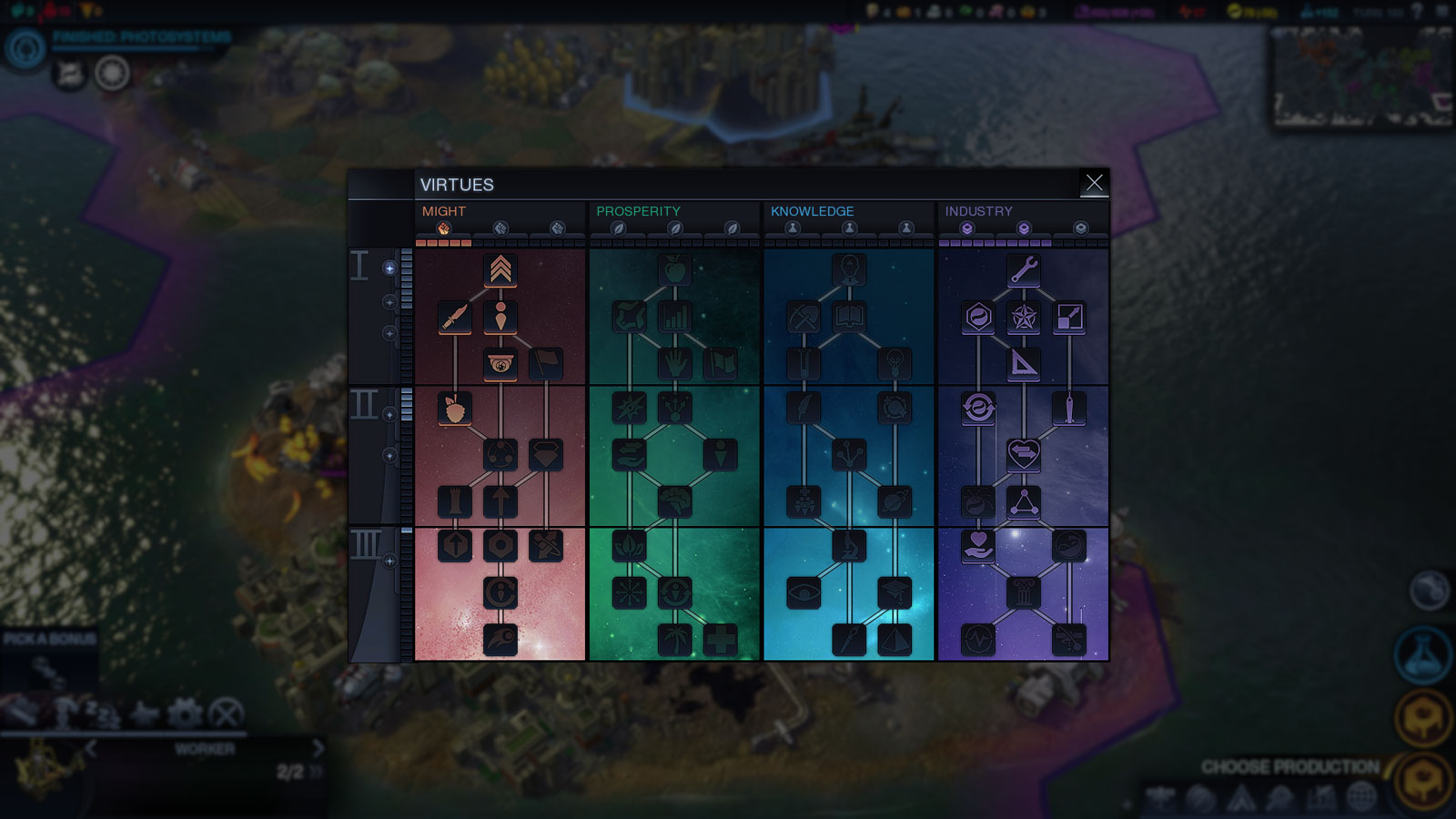
Culture still has an effect at the local level. Local Culture controls the border growth for each city. Cities without any cultural generation take a very long time to get access to new tiles. This stagnates their Growth and prevents the Colony from gaining a large defensive border around the tiles that they're using. More Culture is always good, and at least a modest base generation of Culture in each city is sensible.
Old Earth relics are the least expensive Culture building in your arsenal. Make sure that all cities get one of those early in their careers, and then try to get more Culture once you've established the city's Food and Production systems.
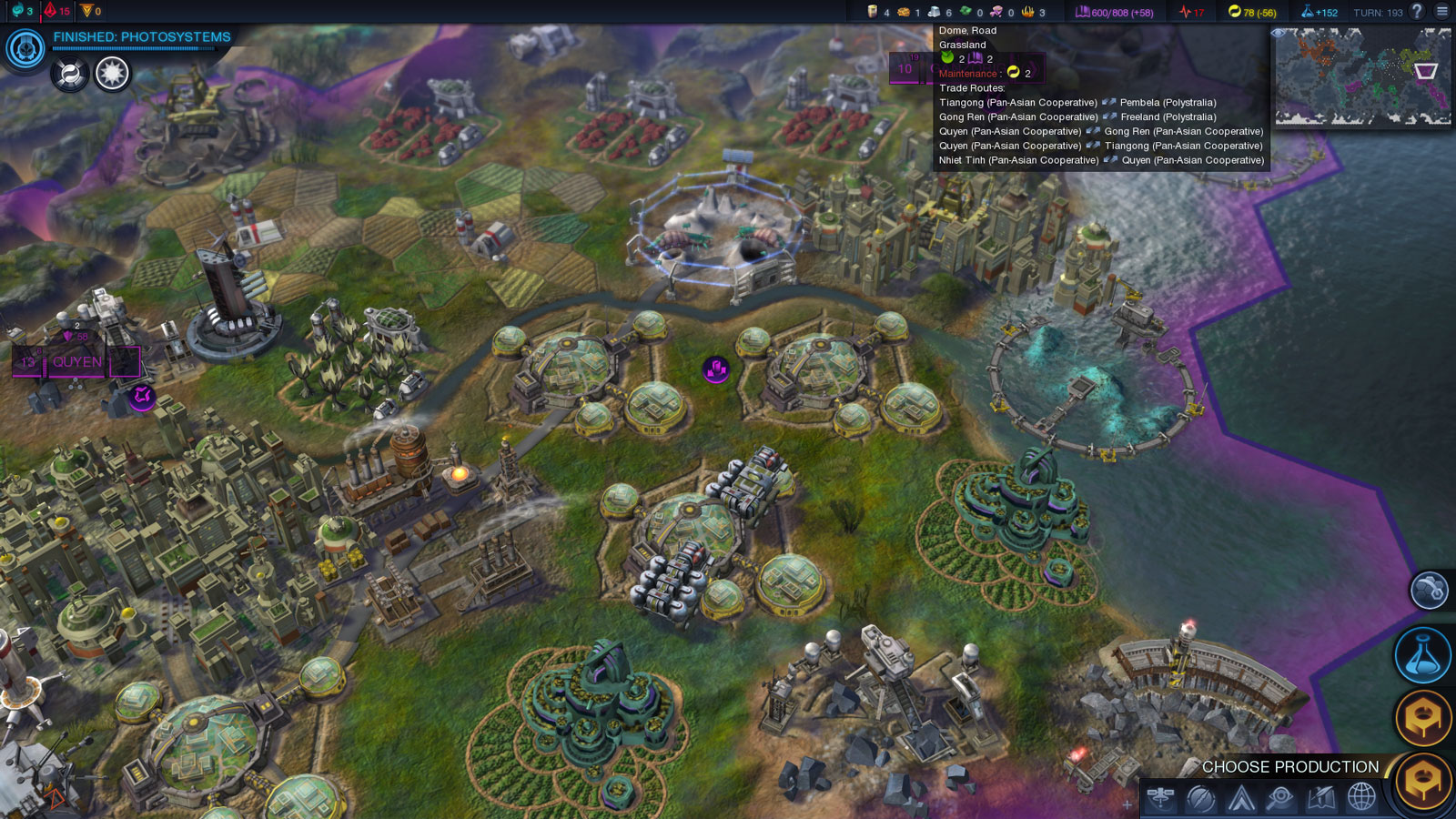
You can even create massive Culture-generating cities if you have enough Technology and time. First, get plenty of citizens (the more, the better). Then, work on buildings that have artist slots and that generate Culture, as well. Use trade routes to beef up your Food supply so that you can spare more citizens for those artist slots. Then, have workers improve tiles with domes. These generate Culture and make your city even more of a hot spot for Culture vultures around the land.
Workers
Workers are your best tool for developing the full potential of cities. They move around the countryside, improving the output of tiles without more than an investment in time. Only a few of the higher-end improvements cost Energy per turn, so you usually get something for nothing when it comes to tile improvements.
All of the basic upgrades are available when you start the game. In Civilization V, you'd have to research a variety of techs to be able to upgrade many of the tiles around your home. That knowledge is already part of your Culture in this game. People know how to mine, farm, make plantations, and so forth. Instead, they only need new Technology for improving strategic resources or for using more advanced improvements that have even better bonuses.
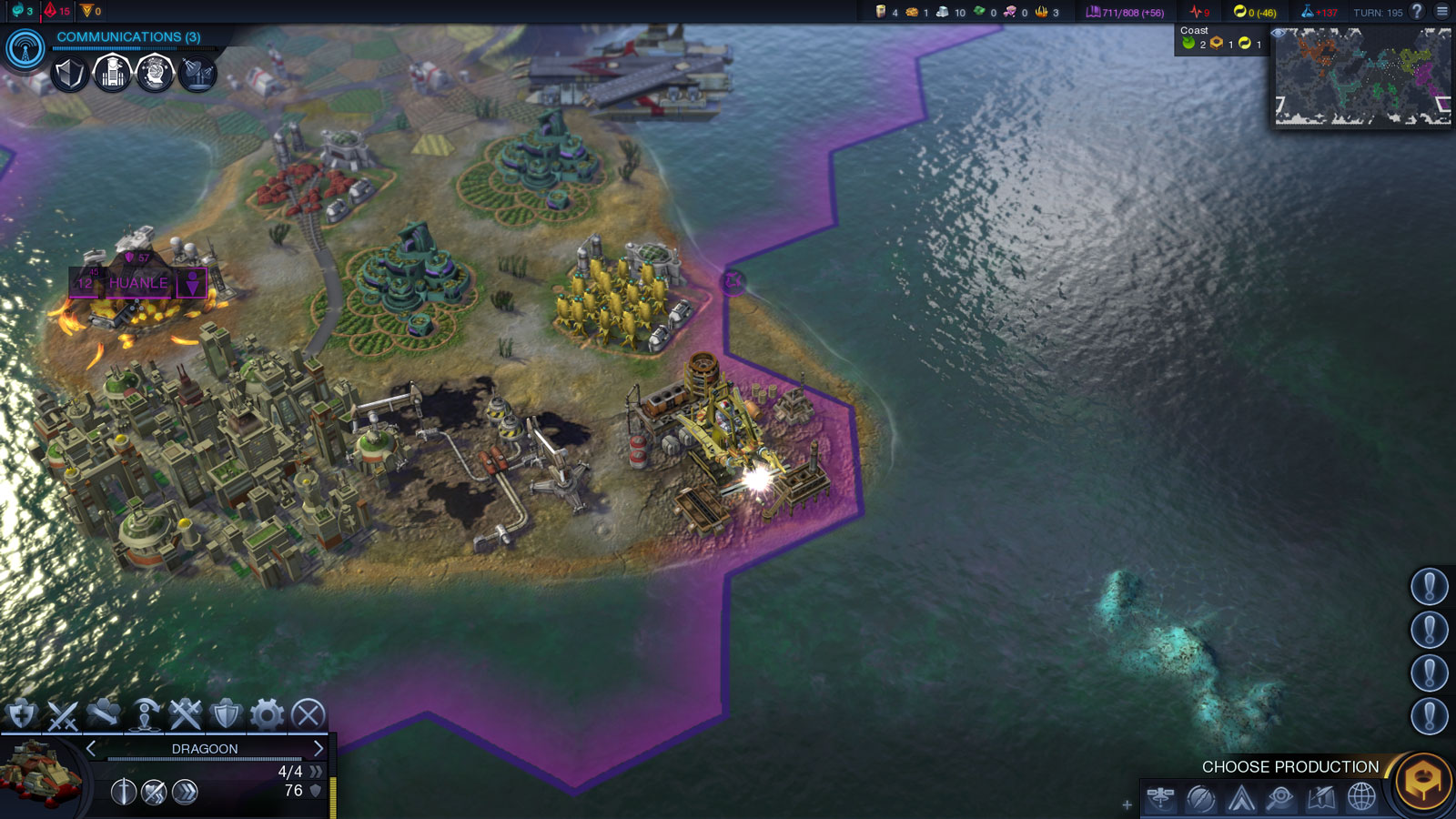
Once you get a worker, look inside your border at the tiles that are being worked by your city. If you aren't sure which tiles are being used, go into the City Management screen and take a peek. Just note the tiles that have people on them, and take your worker to the tile that is generating the most bonuses. Improve it!
Tile improvement always yields something good, so you don't have to stress about which improvement to use until you really have gotten used to the system. At that point, you start to know what your Colony needs the most. "Anything would help here, but I'm going to need major Growth for this city." Build more farms. "This is my military heart. I'm going to pump out units here." Look for hills to mine. "I want to get rich." Settle near rivers or water tiles, and build generators.
Shoot for having at least one improved tile for every citizen in your cities, at least during the early game. This maximizes your cities' outputs by getting as many resources as possible out of all the tiles they work. The best tiles to improve are the ones with special resources on them. These have good yields already, and they get even better when improved.
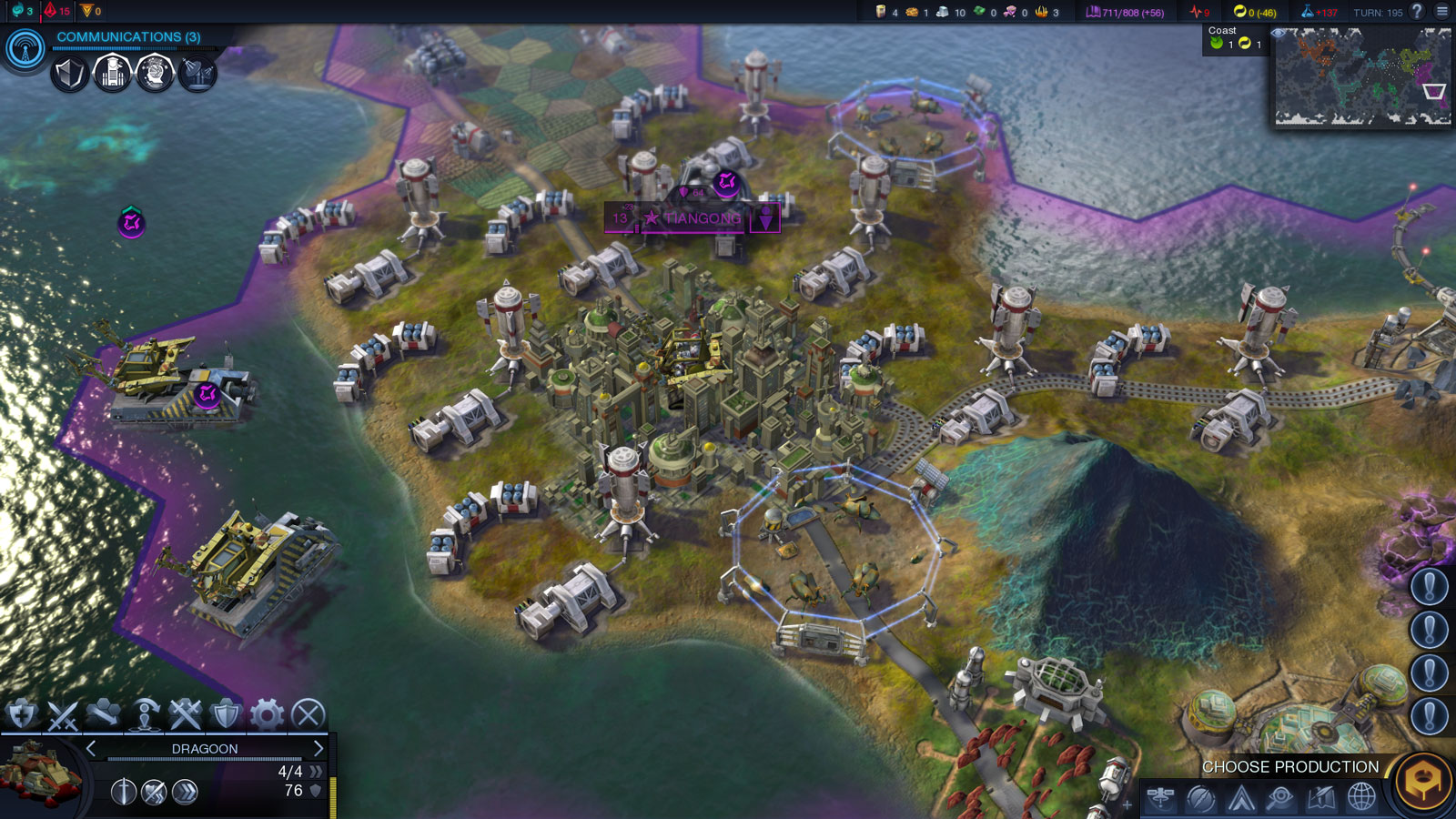
As long as you can afford the upkeep, train a worker for every city you have. Developed cities should do the training for newer cities so that the smaller towns can save their Production for buildings. Send the workers over to the new city, and put them to work.
Don't neglect good road networks. These cost Energy to maintain but reward you with Energy when you connect cities to your capital. That's a great way to earn Energy while decreasing transit times between your cities. This is worth quite a bit unto itself during times of war or when you're simply shuffling people around.
Protect your workers by putting military units on the same tile. This doesn't count against unit stacking, so workers and their defenders can move together whenever you like. Enemies capture workers when attacking them, and you won't want to lose your friendly helpers.
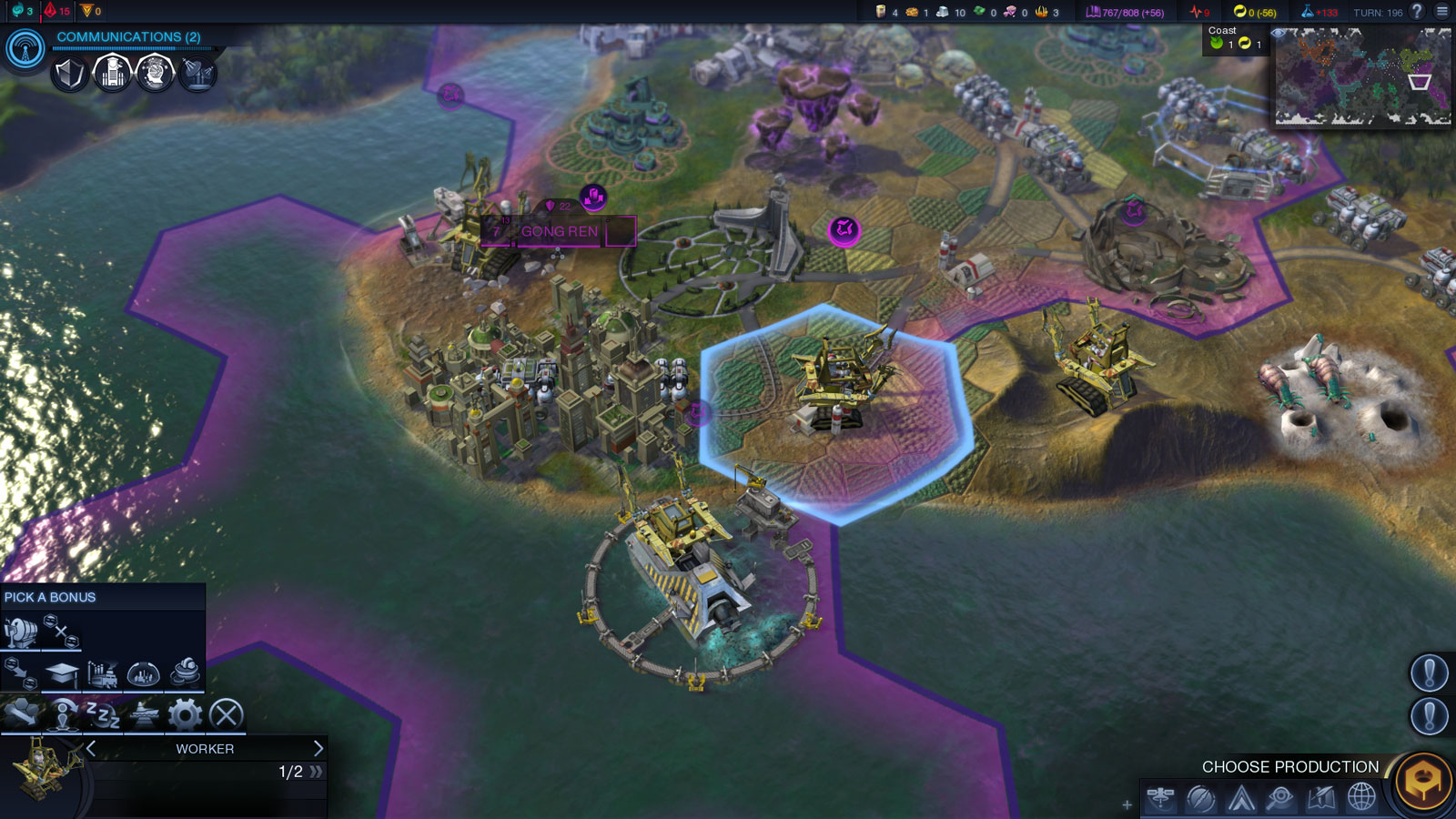
If the threat is too great, hurry your workers into a city, and hide them inside there while the danger passes. You can't stack more than one worker in each city, but any spare workers can flee toward more distant locations. You won't want those guys near a battlefield, anyway; they'll get trashed or captured while your defenders are trying to save the city itself.
Military units are able to rip up tile improvements. This gets them Energy and leaves the tile damaged. The tile won't have usable roads anymore, and the yield bonuses from your improvements go away. Send a worker out to that tile when the enemy is dead or chased off, and use the Repair function to quickly restore function to the area. It's much easier to repair a tile than to improve it.
Tile Improvement List
|
Improvement |
Location(s) |
Bonuses |
|---|---|---|
|
Farm |
Desert, Grassland, Plains |
+1 Food, +1 Food (from Vertical Farming), +1 Energy (from Vertical Farming), +1 Production (from Industrial Ecology), +1 Science (from Artificial Evolution) |
|
Generator |
Any basic terrain |
+2 Energy, +1 Energy (from Augmentation), +1 Energy (from Organics), +1 Production (from Planetary Engineering) |
|
Mine |
Hills, Gold (resource), Copper (resource), Silica (resource), Titanium (strategic resource), Firaxite (strategic resource) |
+1 Production, +1 Energy (from Biometallurgy), +1 Production (from Power Systems) |
|
Quarry |
Basalt (resource), Floatstone (strategic resource) |
+1 Production, +1 Production (from Physics) |
|
Plantation |
Fiber (resource), Fruit (resource), Fungus (resource), Tubers (resource) |
+1 Food or Production, +1 Food (from Photosystems) |
|
Well |
Petroleum (strategic resource), Geothermal (strategic resource), Xenomass (strategic resource) |
Gathers resource, +1 Energy for Geothermal Well (from Power Systems), +1 Science for Xenomass Wells (from Alien Genetics), +1 Culture for Xenomass Wells (from Alien Domestication) |
|
Work Barge |
Coral (resource), Algae (resource) |
+1 Food or Culture |
|
Paddock |
Chitin (resource), Resilin (resource) |
+1 Food or Production, +1 Culture (from Alien Lifeforms) |
|
Academy |
Any non-resource, traversable tile |
+3 Science, +1 Culture (from Protogenetics), -2 Energy (Maintenance) |
|
Manufactory |
Any non-resource, traversable tile |
+3 Production, +1 Science (from Nanorobotics), -2 Health, -2 Energy (Maintenance) |
|
Array |
Any non-resource, flatland tile |
+1 Science, +1 Energy, +1 Orbital Coverage, +1 Science (from Orbital Automation), -2 Energy (Maintenance) |
|
Node |
Any non-resource, traversable tile |
+2 Energy, +1 Science (from Hypercomputing) |
|
Dome |
Any non-resource, traversable flatland tile |
+2 Culture, City Hit Points +10, +1 Energy (from Biospheres), -2 Energy (Maintenance) |
|
Biowell |
Any non-resource, traversable tile |
+1 Health, +2 Food, +1 Culture (from Alien Genetics), -2 Energy (Maintenance) |
|
Terrascape |
Any traversable tile |
+2 Food, +2 Production, +2 Culture, -6 Energy (Maintenance), +1 Food, +1 Production and +1 Culture from Ecoscaping (Prosperity virtue) |
Specialists
Specialists are city citizens that do not work on tiles. Instead, they go into slots inside the buildings that you've constructed. There are slots for a wide range of specialists, and each type adds different bonuses toward your city's yields.
Many specialist slots add two points from one resource to your city. This is powerful when you no longer have good tiles to work on because they're all used up, or if your city is located in a region without many good tiles in the first place. Usually, it's a combination of those problems. That's when specialists start to become the most useful; however, they're always good for specializing the output of a city. If you need resources to be of one specific type, it's great to use specialists to push as hard as possible for one type of yield.
Types of Specialists
|
Specialist |
Bonus | |
|---|---|---|
|
Artists |
+2 Culture |
Holosuite, CEL Cradle, Soma Distillery |
|
Engineer |
+2 Production |
Autoplant, Alloy Foundry, Node Bank |
|
Trader |
+2 Energy |
Thorium Reactor, Petrochemical Plant, Field Reactor, Biofuel Plant, Xenofuel Plant |
|
Scientist |
+3 Science |
Xenonursery, Institute, Gene Smelter, Nanopasture |
|
Grower |
+2 Food |
Cloning Plant, Mass Digester, Civil Creche |
|
Unemployed |
+1 Production |
Don't have a citizen work a tile or become a specialist |
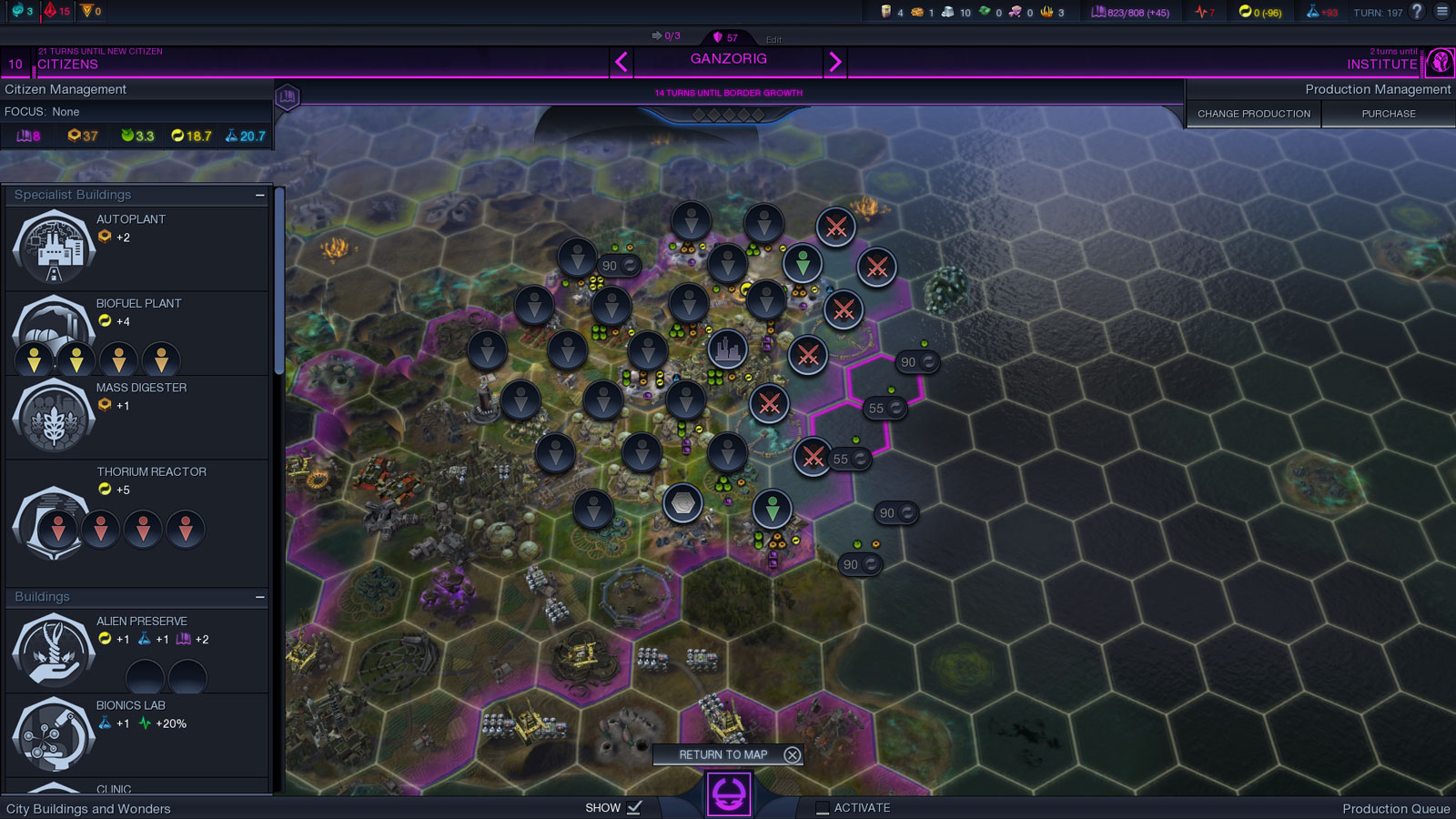
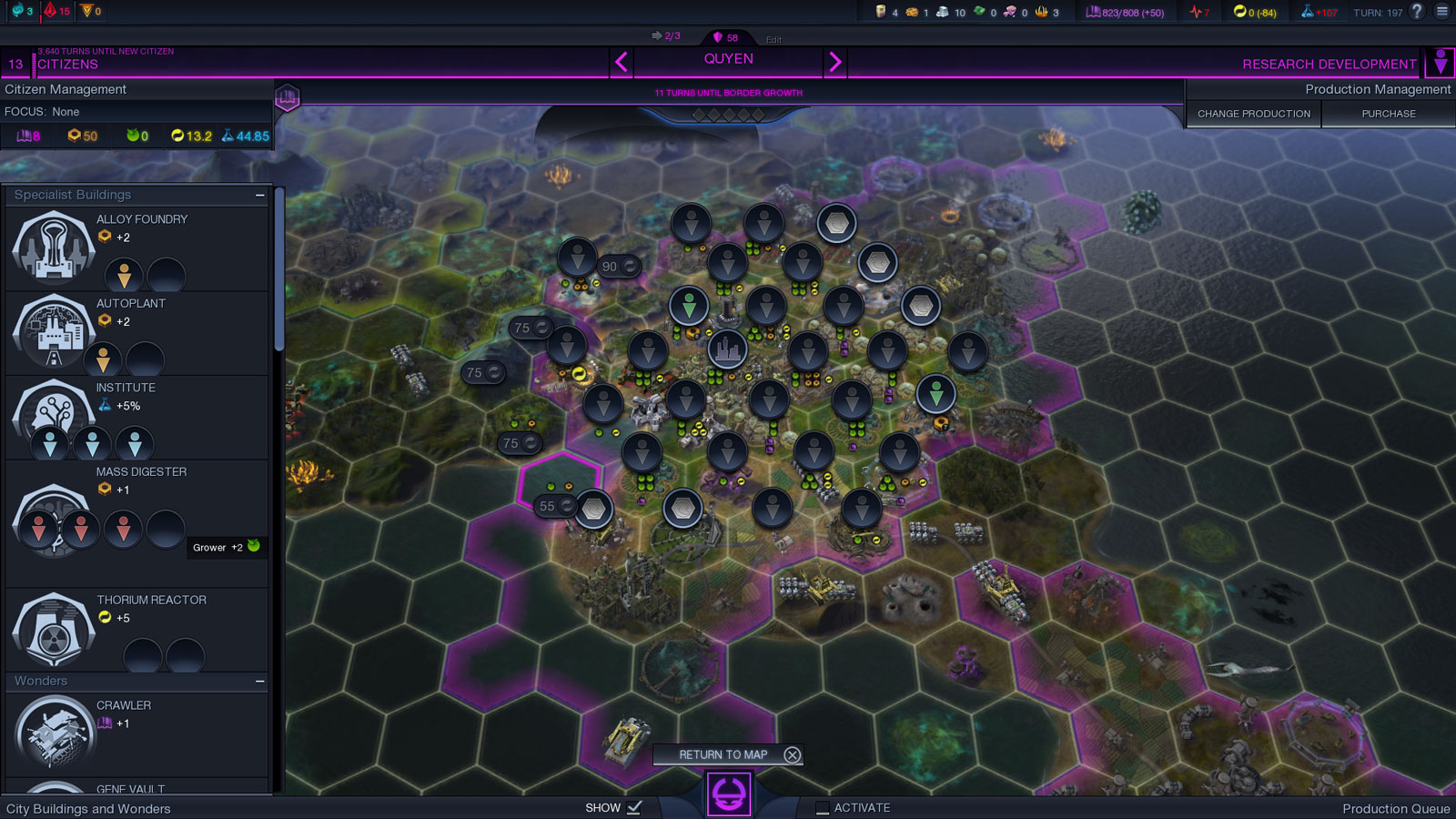
To play around with your specialists, go into the City Management screen, and open the City Buildings and Wonders panel at the bottom of the screen. Scroll through the menu of buildings that appears, and click on slots to fill them with specialists or empty ones that are already being used.
To ensure that you don't pull people off of tiles that are being used well, click on occupied unproductive tiles before doing anything with your specialists. This turns those citizens into unemployed workers. Those are going to be the first ones assigned to your specialist slots, so you don't need to worry about which tile they're abandoning.
Garrisons
Make sure to leave defensive units inside your cities, especially if there is any chance at all that aliens or hostile units can get there within the next few turns. These garrisoned units raise the Combat Strength of the city, making it harder for enemies to deal damage (and causing them to take more damage if they use melee attacks against the city).
Either use units with high Combat Strength for this role, or grab a powerful ranged unit. Though they won't contribute as much to the city's direct survival, ranged units deal damage from inside the city without having to worry about counterattacks. They'll keep their Health high and be able to attack every round that there are enemies nearby. Additionally, enemy targets won't be able to attack them. This is nice because many ranged units have weaker Combat Strength and can easily be killed in the open field.
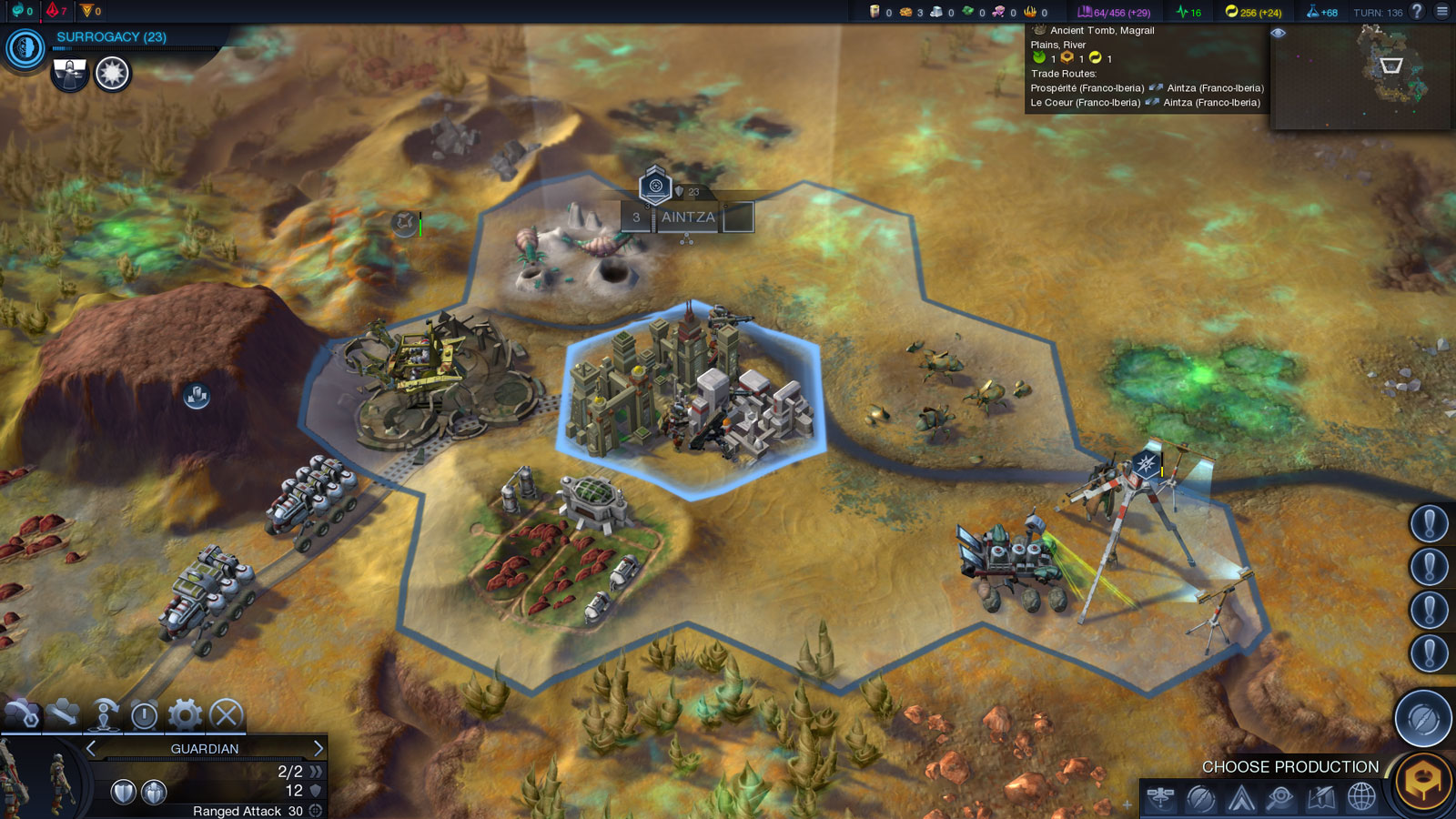
Units with bonuses while in cities or inside friendly terrain are usually quite good as garrisons.
Resources
Basic and strategic resources abound in the new world. Basic resources improve the yields of the tiles that they're on. Strategic resources do this, as well, but they're also added to your Colony's pool once their tiles have been improved. Your resource pool determines how many special units and buildings you can create. Orbitals often require Titanium and Petroleum. Affinity units usually need Xenomass, Floatstone, or Firaxite. Some buildings rely on Geothermal power.
The full value and use of all these resources is outlined in Chapter 07: Terrain, Features, Resources, and Artifacts.
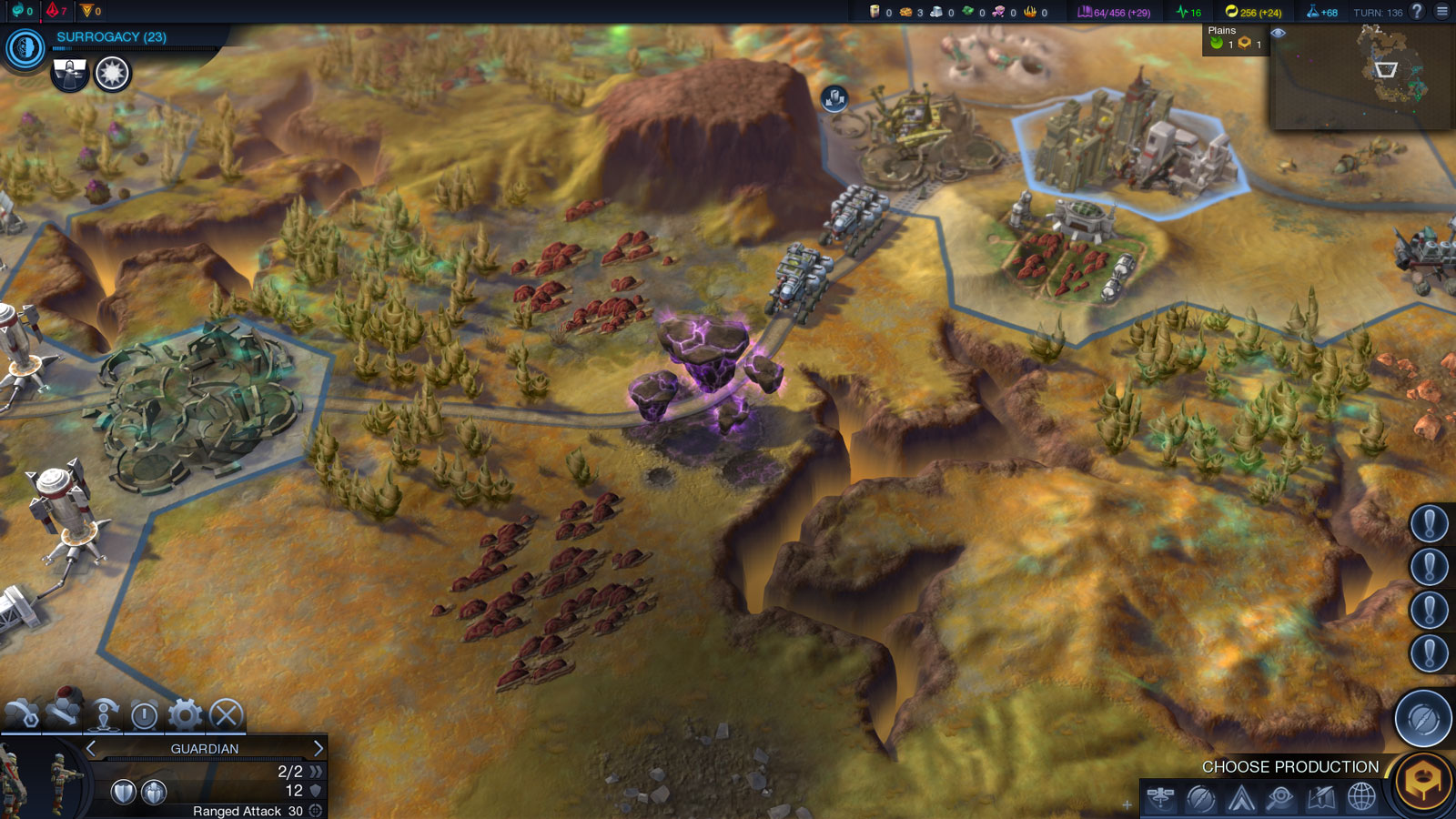
Spies Return
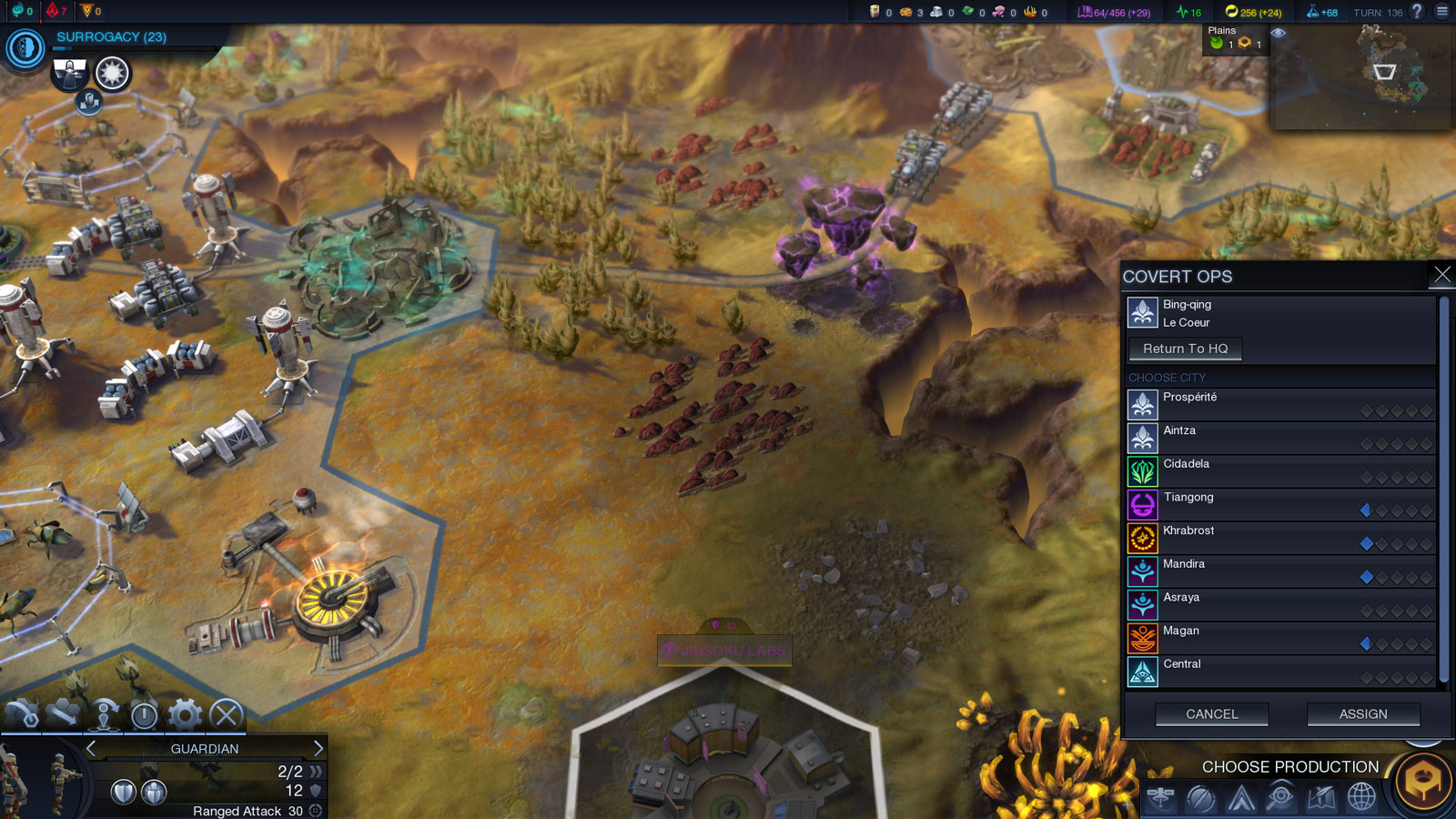
Spies, also known as Covert Agents, are a great way to gain resources and attack enemies without making it clear who is doing what. You earn these subtle tools after you research Computing and construct the Spy Agency.
Once earned, spies go where you tell them to go and do whatever you ask to aid the Colony. Used offensively, defensively, and for pure information gathering, these men and women put their lives on the line for you.
Spies are fully covered in Chapter 14: Covert Operations: Spies, Damned Spies, and Statistics.
The Fog of War and Terrain Effects
Always remember that the map is not the territory. Even when you scout well and think that you know what is ahead, there can be complications. This game uses a fog of war. If your units don't have visual range on a tile, it's a good idea to avoid moving through that area. Even if you've explored an area previously, you won't get constant updates on city foundings, tile improvements, or troop movement unless you keep your eyes on the target.
This is why it's very useful to have units at the edge of your borders (or beyond). Waiting safely inside your cities can lead to surprise attacks and very challenging defensive work. The more you watch the areas near your cities, the better informed you're going to be about future turns.
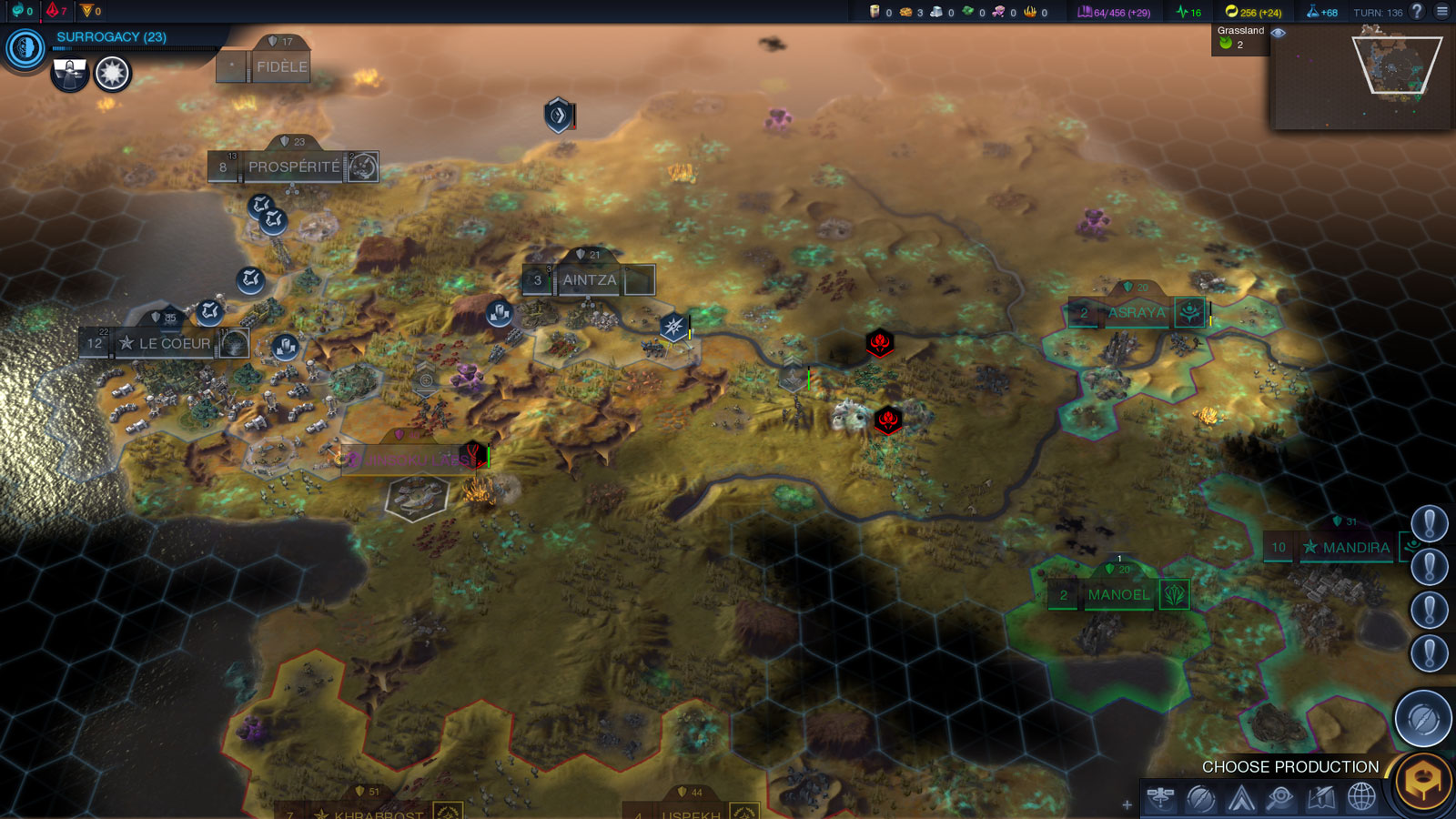
Spies whom you use in enemy cities extend your line of sight to that area. Use them extensively!
Units on hills or in open terrain have much better sight than anyone in thick terrain, such as forests. Remember when your vision is limited, and be careful about moving weaker units through such territory. Ambushes by aliens and your rivals can happen at any time.
Not only is rough terrain dangerous for breaking line of sight, it's also slower to move through. Hills, forests, and marshes are all tiles that take more than one Movement Point to get into. Factor that into your plans when moving people around, and don't get caught in a tile that you can't defend. Most tricky terrain is at least more defensive (granting Combat Strength bonuses if your units are attacked there). However, marshes leave your people even more exposed, so they're just awful in general. Fortify your units on the far side of marshes to lure attackers into coming after you on such exposed tiles.
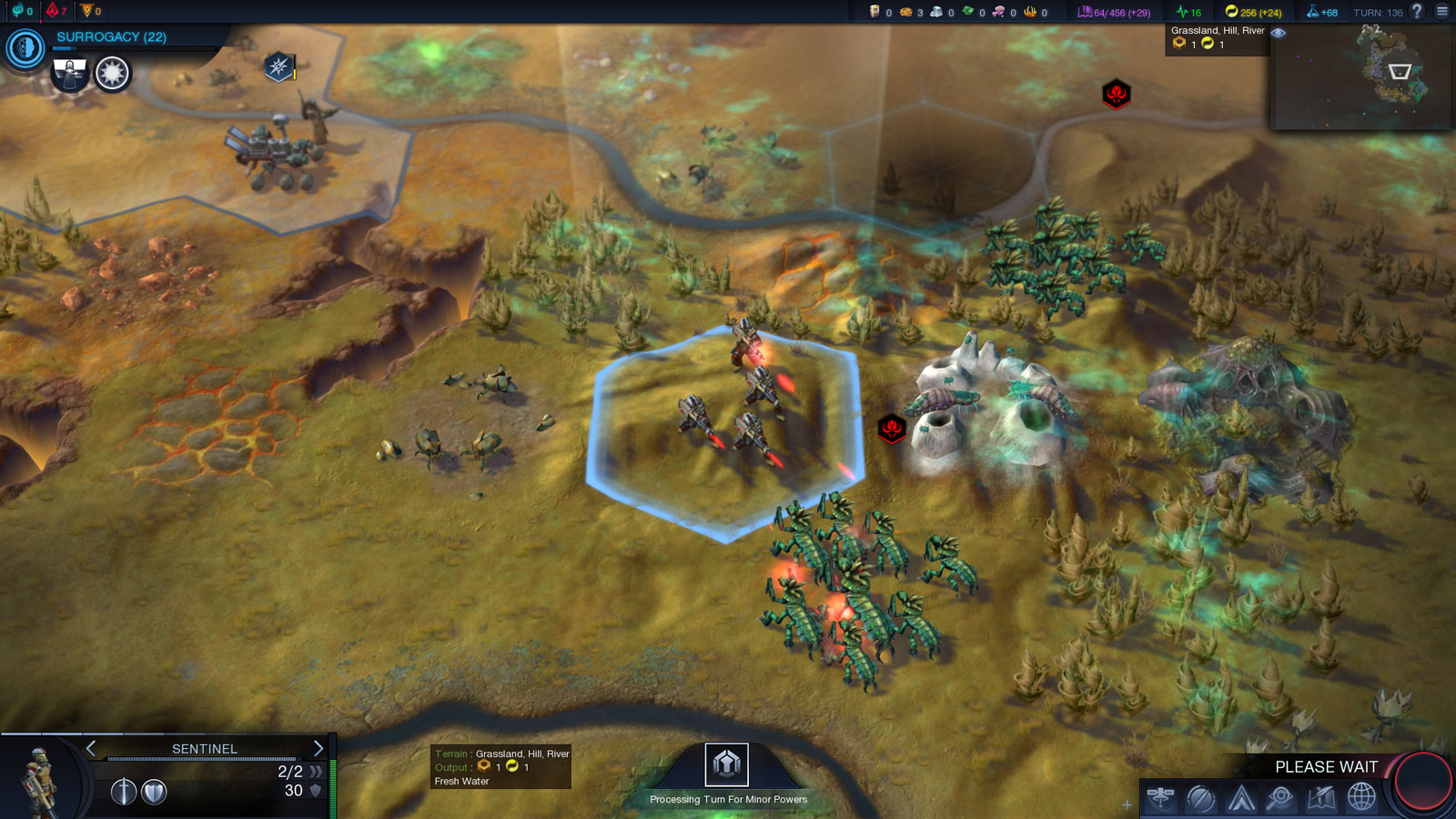
Rivers are another example of tough territory to bypass. If you aren't using proper roads or magrails, your movement ends after crossing a river, even if you have tons of Movement Points to spare. It is also difficult to attack across a river, and you lose some of your Combat Strength for those attacks. Thus, it's a good idea to fortify units on the sides of rivers so that enemies must face a dangerous battle if they attack you there. And if they try to go around, they'll lose their movement when they try to get across the river elsewhere. Go ambush them before they recover!