
The Sims 3 Guide Essentials A Day in the Life
Skills

Sims are not mentally static creatures. Their minds are hungry for knowledge and new skills. Skills not only help unlock new wishes for you to promise your Sims, but skills also help Sims advance careers and money-making enterprises, result in new social interactions, and keep a positive mood so those Lifetime Happiness points keep rolling in.
Skills are also a good way to cultivate a unique personality in each of your Sims. Why fill a house with a bunch of Sims who are great at the guitar when you can have a parade of talents, like logic, cooking, and painting, too? There are 10 different skills to develop in The Sims 3.
These skills can be initiated by several methods, such as taking classes at specific locations in Sunset Valley, by picking up a book that specializes in a skill, or by engaging in the activity related to the skill itself. Here are the 10 skills and where you need to go to learn them:
Athletic: Llama Memorial Stadium
Charisma: City Hall
Cooking: Hogan’s Deep-Fried Diner or Little Corsican Bistro
Fishing: EverFresh Delights Supermarket
Gardening: Landgraab Industries Science Facility
Guitar: Wilsonoff Community Theater
Handiness: Fort Gnome Military Base
Logic: Landgraab Industries Science Facility
Painting: Community School for the Gifted
Writing: Doo Peas Corporate Towers
Taking a skill class is typically one of the first wishes your Sims dream up when they move to Sunset Valley, so don’t deny them. Use their eagerness to jump-start their development.
Classes cost §400 to attend, but you acquire the first level of a skill faster at a class than if you pick up a beginner’s level skill book at the local bookstore.
Beginner-level books are cheaper, though. However, as you gain skill levels, you can buy more expensive books designed specifically for certain skill tiers that help advance your Sim to the next skill level.

Reading a book about a specific skill takes longer than a class, but it is a good way to advance a skill set during off-hours.

Some skills are directly related to a Sim’s traits. An athletic Sim will naturally be predisposed to the Athletic skill. The Sim will excel at the skill that matches up with their respective trait. Here are the traits that match up with skills, so you can see what your Sim potentially has a leg up on when they first move into Sunset Valley:
Charisma: Charismatic
Cooking: Natural Cook
Fishing: Loves the Outdoors, Angler
Gardening: Loves the Outdoors, Green Thumb
Guitar: Artistic, Virtuoso
Handiness: Handy
Logic: Genius
Painting: Artistic
Writing: Bookworm, Artistic
Each skill is split into 10 different levels of mastery. As a Sim masters a skill, they learn new things, like talents and socials. New opportunities can also result from advancing a skill. Each skill level takes longer to learn than the last. You will likely tear through the first two levels of a skill.
However, as you climb the rungs of the skill, the time needed to develop the skill increases. (You can speed up the process by maintaining a high mood, too. Happy Sims learn things faster.) By the time you reach levels 8, 9, and 10, plan on devoting dozens of game hours (not real world hours) to the pursuit of skill mastery.
Performing actions related to a skill is a good way to not only cultivate a skill, but also work on a money-making plan related to the skill. Let’s use the Writing skill as an example. Once you have the first level of the Writing skill, you can start on a novel. While your Sim works on the novel, she is also practicing writing.
When the Sim pushes back from the computer, it results not only in a ream of pages, but a nice bump toward the next skill level. The same goes for cooking. While cooking a dish, particularly a new recipe learned by advancing to the next skill level in cooking or by buying a new recipe from the bookstore, you add to your Cooking skill.
Track Skill Development

It’s easy to monitor your Sim’s skill development. When your Sim is engaging in an activity that improves a skill, the Skill meter appears above its head. This is a blue meter. (The meter that tracks progress on a specific activity, such as exercise or fishing, is green.) The meter fills from the bottom up.
When the meter fills to the top, your Sim’s skill improves to the next level. Any new actions, talent, or socials unlocked by raising the skill level appear on-screen to the right.
If for any reason you must interrupt the Sim who’s developing a skill, you do not lose any progress. The Skill meter remains in the exact same place the next time you work on the skill level.
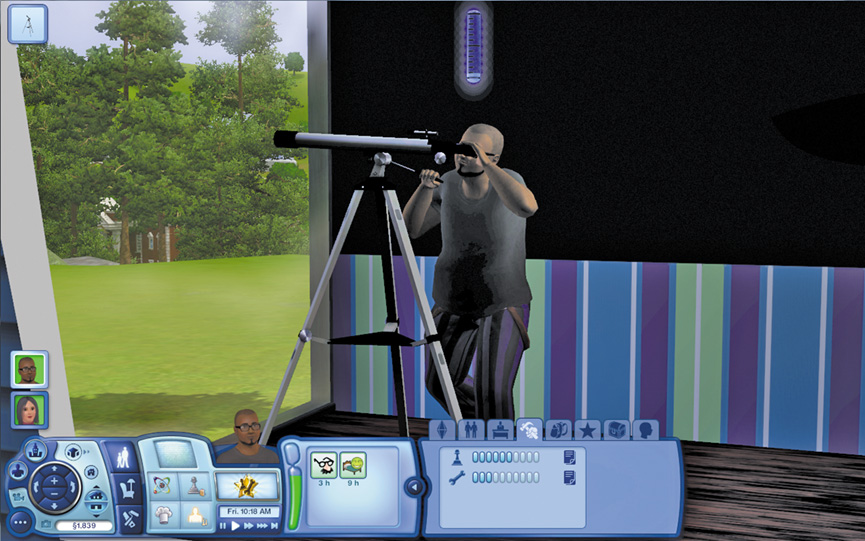
The Skill panel is an easy place to track your Sims’ skill levels. Any skill the Sim has learned appears in the Skill panel. A meter next to the
skill shows which level the Sim is. Move the cursor over the meter to see how close the Sim is to the next level. Click on the page to the right of each skill measurement to read the Skill Journal. The Skill Journal offers a detailed look at that specific skill, such as how long the Sim has been working at the skill, and how many of a certain object/item related to that skill the Sim has made.
The Skill Journal also displays skill-specific challenges associated with that skill. Challenges are requirements that, when met, result in improved results or financial rewards for activities related to that skill. For example, one of the challenges for the Writing skill is Specialist Writer.
A Sim who writes five novels in a specific genre earns the reward of penning more hits and best-sellers in that particular genre, which results in more royalties. Each skill challenge is associated with a title, such as Body Builder or Comedian.
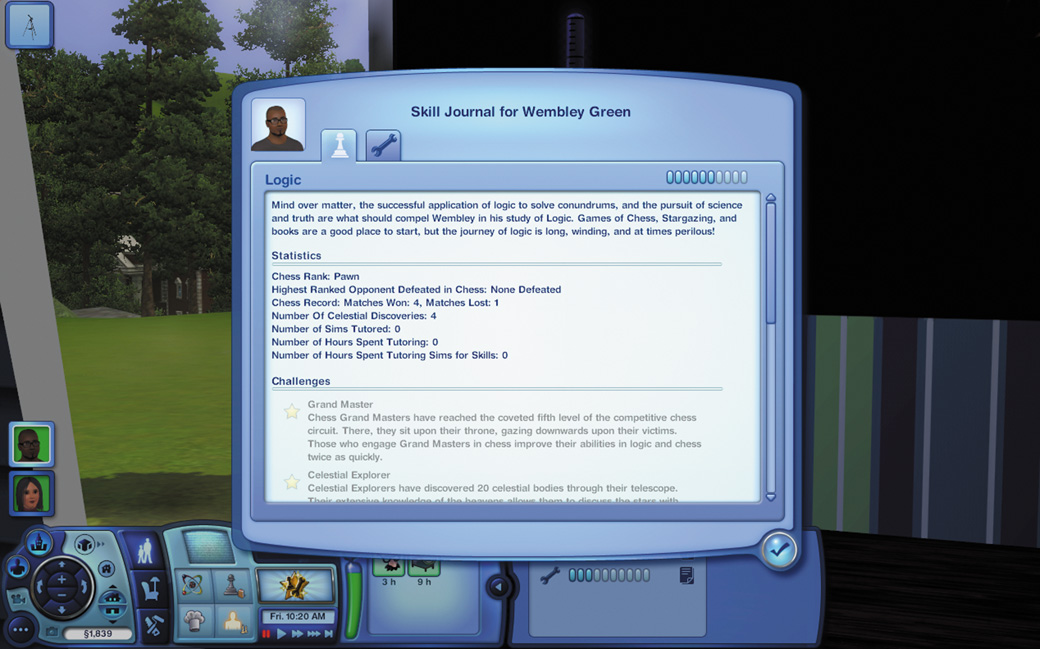
Use the Skill Journal to track progress on a skill and look at any skill-specific challenges.
Skills as Careers
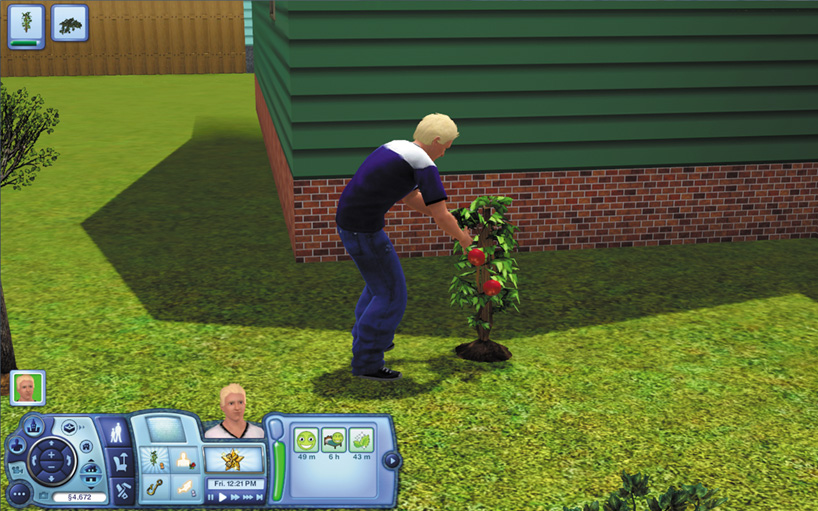
Not every Sim needs to run out and get a full-time job. Sims can develop skills to the point that they start bringing income into the household. Skills that result in money-making opportunities are also a good way to augment the income of a Sim who has a full-time gig but doesn’t make a lot of Simoleons because they have not earned many promotions just yet.
The Writing skill, for example, can be developed into an authoring career. As Sims develop the Writing skill, they learn how to create genre novels. Some genres are worth more on the market than others, so advancing the writing skill to get at those more lucrative genres is a good plan.