
Portal Guide Essentials Gameplay
Apparatuses
From the looks of it, you’re going to be spending quite a bit of time in the Aperture Science Computer-Aided Enrichment Center. Thus, it’s a good idea to familiarize yourself with the equipment they use to perform their wondrous brand of science.
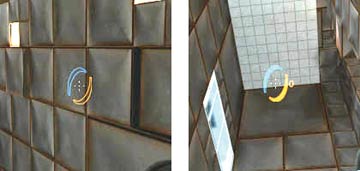
The reticle on the left indicates that you can’t open a portal on that surface. The one on the right with the filled outline indicates that it’s A-OK.
Aperture Science Handheld Portal Device
This “portal gun” is your primary means of navigating the mind-bending environments you encounter in the Enrichment Center. While the science behind its operation is probably impossible for you to comprehend, its functions are simple: hit FIRING MODE 1 for a blue portal, and FIRING MODE 2 for a orange portal. When you enter a blue portal, you’ll exit through a orange portal, and vice versa. The portal gun’s oval-shaped reticle is comprised of two half circles, one blue and the other orange, corresponding to each color of portal. You’ll see a smaller oval next to the side that’s been most recently fired; this is useful during fast-paced puzzles. You can also determine whether you can open a portal on a given surface simply by looking at the reticle—if the outline of the oval is filled in, fire away, but if it’s is empty, you’re going to have to find another way.
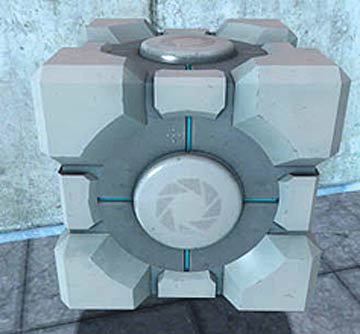
Weighted Storage Cube
These invaluable objects are scattered all throughout the Enrichment Center’s test chambers. Use them to hold down buttons, deflect energy balls (see Ball Launchers and Catchers), smash turrets, and as steps to reach elevated surfaces that portals can’t get you to. If you happen to inadvertently dispose of one (by, say, dropping it into a pool of goo), you can usually find a replacement at the nearest Aperture Science Vital Apparatus Vent.
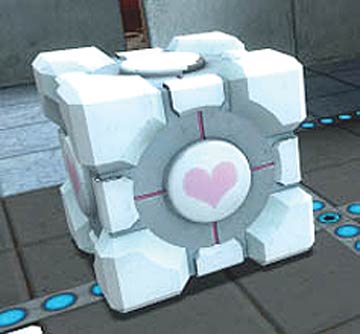
Weighted Companion Cube
The Weighted Companion Cube is, for all intents and purposes, identical to any other Storage Cube you encounter, except for the charming hearts emblazoned on its six sides. These were designed to engender nurturing feelings in test subjects, for the psychological portion of Test Chamber 17’s exercise. Don’t get too attached to your “friend,” though....
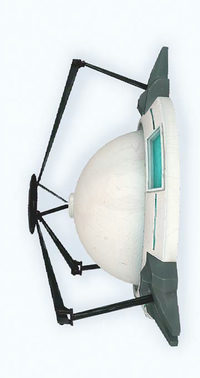
Ball Launchers and Catchers
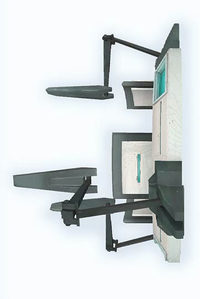
These are among the deadliest testing devices in the Enrichment Center, but also some of the most vital when it comes to solving certain puzzles. Ball Launchers periodically emit a pulsating orb of energy that travels slowly in a straight line and bounces off of flat surfaces for a set amount of time before dissipating. Your job is typically to goad these energy balls—which are deadly to the touch—toward a Ball Catcher by means of portals and/or Storage Cubes in order to trigger some sort of puzzle-related event, such as opening a door or activating a lift. When an energy ball comes into contact with a Catcher, the Launcher that emitted it shuts down.
Turrets
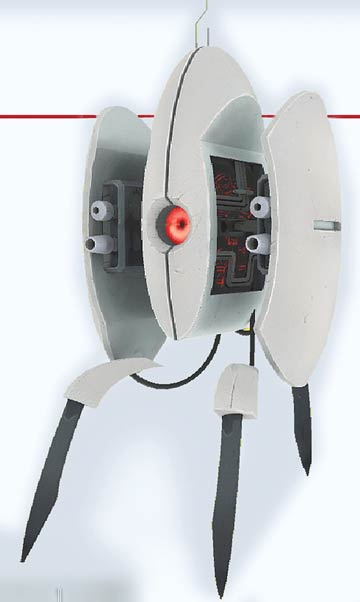
Although these turrets were originally designed to populate obstacle courses for the testing of military androids, you encounter more than a few of them during your stint as an Enrichment Center test subject. Unfortunately, they don’t seem to care whether their targets are organic or synthetic: If you come into contact with their laser sights, you receive an indiscriminate barrage of machine gun fire. Luckily, clever use of your portal gun should provide you with ample methods of dispatching them. You can simply teleport to their flanks and tip them over, drop Storage Cubes on their heads via ceiling-deployed portals, or creatively coax energy balls into making contact with them. Once you’ve figured out to foil one, though, don’t feel compelled to do so immediately—they say the funniest things when you play a bit of peekaboo with them.
Aperture Science Material Emancipation Grid
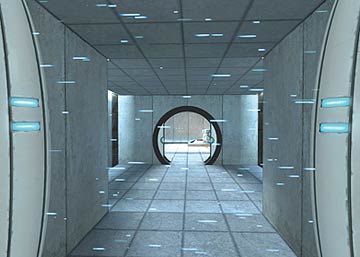
These transparent energy fields are normally used to mark the end of a level, but they’re occasionally found within the test chambers as puzzle elements. When you encounter one in this context, keep in mind that any object you carry through it will disintegrate. Furthermore, any portals you place while through an Emancipation Grid will disappear when you cross to the other side. Usually, you’ll have to concoct some clever way to get around this restriction.