
Build, Discover, Survive! Mastering Minecraft, Revised and Expanded Guide You Can Do Anything with a Little Practice
Enchantment and Using Experience
Minecraft isn’t a run-of-the-mill RPG or any game where levels give you more health, damage, and other basic stats. You’re a farmer, a miner, and a survivor. These stats aren’t really going to change for you.
Instead, you use levels to enchant your weapons, armor, and tools, to make them better at doing various tasks. We’ll now discuss gaining and using experience, and what you can get with the enchanting system.
Gaining Experience
Almost every activity in Minecraft gets you experience. This comes in the form of glowing orbs that appear when you do something important: kill monsters, breed animals, mine special items, smelt ores, etc. Collect these orbs by walking close to them; they’ll try to reach you on their own if you go anywhere near them!
Activities That Generate Experience
- Animal breeding
- Bottles of Enchantment
- Cooking food and other various items in a Furnace
- Destroying Monster Spawners
- Fishing
- Killing monsters or having them die within several seconds of being damaged by your character
- Mining ore or smelting it
- Killing regular farm animals is worth experience too, but not much
Levels Require Different Amounts of Experience
Getting from level 1 to 2 takes much less experience than going from level 39 to 40. As you progress higher and higher in level, the amount of experience needed to go higher increases. You don’t want to stockpile levels beyond whatever point you currently need. In general, level 30 (for Enchanting Table work) or level 39 (for Anvil work) is the highest that you ever need to go. Pushing for levels beyond this yields diminishing returns. You’re much better off spending your levels to enchant something and then progressing in levels again.
Experience Required to Gain a Level
| Level(s) | Experience Required | Total Experience Required |
|---|---|---|
| 1 | 7 | 7 |
| 2 | 9 | 16 |
| 3 | 11 | 27 |
| 4 | 13 | 40 |
| 5 | 15 | 55 |
| 6 | 17 | 72 |
| 7 | 19 | 91 |
| 8 | 21 | 112 |
| 9 | 23 | 135 |
| 10 | 25 | 160 |
| 11 | 27 | 187 |
| 12 | 29 | 216 |
| 13 | 31 | 247 |
| 14 | 33 | 280 |
| 15 | 35 | 315 |
| 16 | 37 | 352 |
| 17 | 42 | 394 |
| 18 | 47 | 441 |
| 19 | 52 | 493 |
| 20 | 57 | 550 |
| 21 | 62 | 612 |
| 22 | 67 | 679 |
| 23 | 72 | 751 |
| 24 | 77 | 828 |
| 25 | 82 | 910 |
| 26 | 87 | 997 |
| 27 | 92 | 1089 |
| 28 | 97 | 1186 |
| 29 | 102 | 1288 |
| 30 | 107 | 1395 |
| 31 | 112 | 1507 |
| 32 | 121 | 1628 |
| 33 | 130 | 1758 |
| 34 | 139 | 1897 |
| 35 | 148 | 2045 |
| 36 | 157 | 2202 |
| 37 | 166 | 2368 |
| 38 | 175 | 2543 |
| 39 | 184 | 2727 |
| 40 | 193 | 2920 |
| 41 | 202 | 3122 |
| 42 | 211 | 3333 |
| 43 | 220 | 3552 |
| 44 | 229 | 3782 |
| 45 | 238 | 4020 |
| 46 | 247 | 4267 |
| 47 | 256 | 4523 |
| 48 | 265 | 4788 |
| 49 | 274 | 5062 |
| 50 | 283 | 5345 |
As you can see, the amount needed for a single level rises substantially over time. In earlier versions of the game there were specific levels where things got much harder, but that isn’t as much the case now. Though the quantities needed to level up rise, they never go up by an alarming amount.
For many people, the ideal will be to get to level 33, enchant their favorite item, and level up to 33 again. This way, you always have access to the most powerful enchantments in case you need to enchant something else rather suddenly. However, it is slightly more efficient to ping pong between 27 and 30, if you’re not worried about enchanting something at any given moment.
Losing Experience
Death causes your character to lose a huge amount of experience. Some of your experience falls to the ground, and you can retrieve it if you make it back to your corpse in time, but the rest is gone forever. Wear armor and stay away from deadly drops, Lava, and unwinnable fights to avoid death’s experience penalty. Furthermore, spend your experience to invest in enchanted items and Books, so your experience isn’t sitting around doing nothing.
Making an Enchanting Table
When you’re ready to spend some experience levels, make an Enchanting Table. You need Diamonds, Obsidian, and a Book to do this. Make a Diamond Pick to mine the Obsidian, gather more Diamonds as needed, and use Leather and Paper to make your Book.
When you’re done, you have an Enchanting Table ready to go, but it can’t handle major enchantments. Basic Enchanting Tables only add low-cost enchantments to items. These are still nice, but the really incredible stuff requires more effort.
We Need More Power
To give your Enchanting Table more options, place Bookshelves around it. It takes 15 Bookshelves to fully power an Enchanting Table. Arrange these Bookshelves two blocks away from the table in either a U-shape around the table or wedged into a nearby corner.
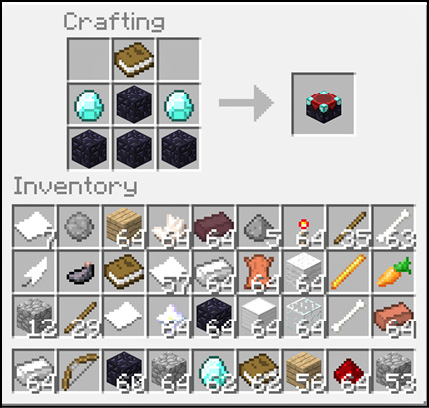
Bookshelves only count if they are two spaces away—they can’t be adjacent to the Enchanting Table. Stack the shelves two high but not three high. Diagonal spaces count just fine. Given these double stacks, you can have 18 Bookshelves in your U, which is more than you need.
You need a huge amount of Leather and Paper to craft all of those Bookshelves. We suggest you create a large animal pen, lure at least two Cows there, and start breeding them as soon as possible. Visit the pen every five minutes to feed the Cows even more Wheat. Don’t kill any of the Cows in your pen until you have roughly eight adults.
Once you hit that mark, perform some minor culling after each breeding session. After a major breeding session, slaughter two Cows and keep the count between six and eight adults every time you go out after that. The pen starts to fill really quickly, and you get quite a haul of Leather.
Grow Sugar Cane along local waterways and harvest it each time you go out. This stuff grows like a weed, so getting piles of it for Paper isn’t a big deal. If it isn’t going quickly enough, reinvest some of the harvested Sugar Cane into additional stalks to increase your yield.
The Finishing Touch
Now that you have 15 Bookshelves near your Enchanting Table, you can use high-level enchantments. Interact with the Enchanting Table to open the interface for enchanting items. Place a weapon, tool, or piece of armor in the slot on the left. You need to add Lapis Lazuli as well, but this material is easy to harvest while you’re out looking for Diamonds and other precious underworld materials.
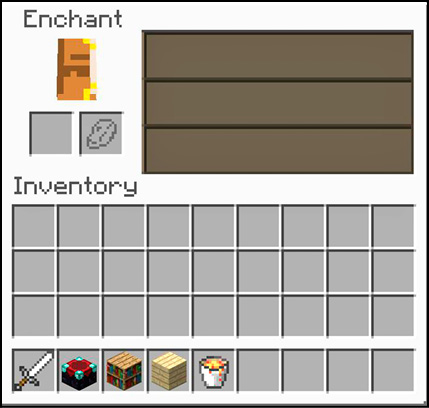
The strange lettering on the right is associated with the cost of your possible enchantments. The higher the cost (in levels), the better your potential enchantment will be. Items that are enchanted directly like this can end up with multiple effects, so you might get something really awesome out of this.
Items have three possible tiers of enchantments. Each tier costs one Lapis and one character level (so enchanting can cost you up to three levels per item). You are guaranteed at least one effect, which will be listed in the description of the item when you hover over it in the enchantment interface. You may also get other effects, but this is determined randomly after you decide what level of enchantment to give the item.
Also, there are minimum total character levels required for each tier. Even though a full enchantment only costs three character levels, you need to be character level 30 to unlock the ability to spend that much at once.
Select the cost that you’re willing to pay, click on that bar, and enjoy your enchanted item. Anything you enchant gets a pretty glow to show that it’s magical. This makes it easier to sort enchanted items in your inventory, so you don’t lose them, put them in a Chest to be forgotten, or make some other mistake.
Other Means of Enchanting
There are several other ways to enchant your equipment. Let’s go over those quickly.
Priests
Villages often have Priests. These special Villagers can add specific enchantments to your items. They’ll show the enchantment in the trading interface, so you don’t have to guess what you’ll get. Add the item you want enchanted, pay some Emeralds, and that’s that. This is a somewhat costly process in terms of resources, but you don’t need to spend a single level. That’s neat!
Enchanted Books
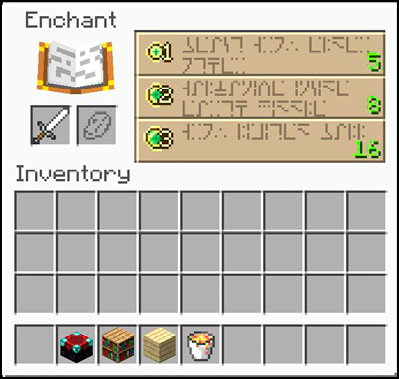
Craft Books and then enchant them at your Enchanting Table. You can stack multiple enchantments on a single Book and then transfer all of them onto another item when you have a combination that you like. You do this by working with an Anvil and using the Enchanted Book and the item that you’re trying to enchant. This costs additional levels.
Book enchanting is a very costly process. You’re likely to spend many more levels investing in the final item than you would by just going to the Enchanting Table with the same item. However, Enchanted Books are useful. They’re the best way to infuse an item with a specific combination of powerful enchantments. Otherwise, you’re playing a game of chance each time you spend your levels. You might end up with a fairly weak enchantment and produce a Diamond Sword that doesn’t do anything you care about. That’s a bummer.
Anvils
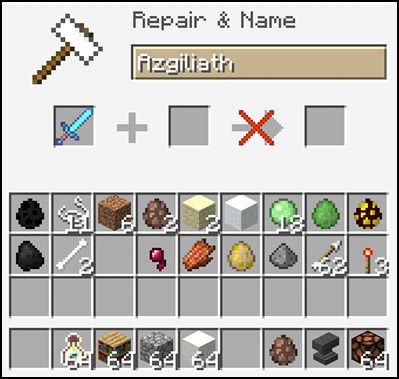
Anvils let you combine items, including their enchantments. The primary item is saved, and the secondary item is destroyed but all of its pertinent enchantments are transferred to the primary item. Enchantments that aren’t allowed to affect a specific item are not transferred, so they’re simply lost. Thus, you can’t put armor enchantments on a Bow, even if you combine a Bow with an Enchanted Book that has multiple armor enchantments.
Anvils can also combine two regular items, as long as they’re of the same type. Two Diamond Picks with the same enchantments could be used in the Anvil together. The second would be destroyed to repair the primary one.
Types of Enchantments
| Enchantment Type | Maximum Ranks | Equipment Type | Description |
|---|---|---|---|
| Aqua Affinity | I | Helm | Increases underwater mining rate dramatically |
| Bane of Arthropods | V | Sword | Increases damage to Spiders, Cave Spiders, Silverfish, and Endermites by 2.5 per rank |
| Blast Protection | IV | Any Armor | Reduces explosive damage and reduces knockback |
| Depth Strider | III | Boots | Reduces water’s slowing effect by 1/3 per level |
| Efficiency | V | Tools | Increases mining/harvesting speed by 30% per rank |
| Feather Falling | IV | Boots | Reduces damage from falling and Ender Pearls |
| Fire Aspect | II | Sword | Adds 3 rounds of burn damage (or 7 at rank II) |
| Fire Protection | IV | Any Armor | Reduces fire damage and decreases burning duration |
| Flame | I | Bow | Sets your Arrows on fire, adding three rounds of burning to targets hit |
| Fortune | III | Tools | Multiplies the number of drops from Coal, Diamonds, Emeralds, Nether Quartz, and Lapis Lazuli |
| Infinity | I | Bow | You don’t need more than one Arrow to fire your Bow forever |
| Knockback | II | Sword | Increases knockback against your targets |
| Looting | III | Sword | Slain monsters drop more regular loot and have a higher chance to drop their rare treasures |
| Luck of the Sea | III | Fishing Rod | Reduces the chance of getting poor results from fishing and raises the chance of getting higher quality items |
| Lure | III | Fishing Rod | Greatly improves the speed at which you fish |
| Power | V | Bow | Increases Arrow damage by 25% (+ 25% more per rank) |
| Projectile Protection | IV | Any Armor | Reduces incoming damage from Arrows, Blazes, and Ghasts |
| Protection | IV | Any Armor | Reduces many types of damage taken |
| Punch | II | Bow | Increases knockback by Arrows |
| Respiration | III | Helm | Lets you stay underwater for 15 seconds more per rank, improves vision underwater, and slows suffocation |
| Sharpness | V | Sword | Increases damage by 1.25 per rank |
| Silk Touch | I | Tools | Allows you to harvest resources directly to get Cobwebs, ore blocks, Ice, etc. (one of the most desirable enchantments) |
| Smite | V | Sword or Axe | Adds 2.5 damage per rank against undead monsters |
| Thorns | III | Any Armor | Adds a chance to wound attackers for 1-4 damage |
| Unbreaking | III | Anything | Increases durability of the item |