
Build, Discover, Survive! Mastering Minecraft, Revised and Expanded Guide Tools, Resources, and Consumables
Blocks and Resources
This section covers the objects that make up most of the world in Minecraft. Most of the blocks here are for either ground cover, such as Dirt, Stone, Bedrock, and Netherrack, or for structures that appear on top of those blocks (including various flowers and decorations).
Air
| Location | Gathered With | Uses |
|---|---|---|
| Empty space throughout all worlds | N/A | N/A |
You cannot mine or collect air. It is all around, making up the Minecraft world’s empty space, but it has a major use for your character.
When you remove an object from an area, air is left behind. This is true even when surrounded by Water or Lava, though these substances quickly flow into the empty space unless there is something to stop them.
Allium
| Location | Gathered With | Uses |
|---|---|---|
| Flower Forest | Anything | Magenta Dye Recipe |
Allium is a pink flower found in Flower Forest areas. You can harvest it with your bare hands and use it to create Magenta Dye. One piece of Allium creates two pieces of Magenta Dye.
Azure Bluet
| Location | Gathered With | Uses |
|---|---|---|
| Plains, Sunflower Plains, and Flower Forests | Anything | Light Gray Dye |
Azure Bluet is a light-colored flower found in multiple biomes. Each piece harvested can be replanted for decoration or used to make Light Gray Dye in a 1:1 ratio.

Banner
| Location | Gathered With | Uses |
|---|---|---|
| Crafted | Anything | Awesome decorations |
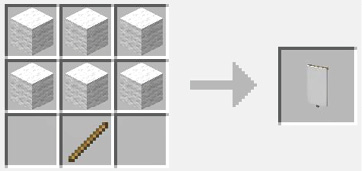
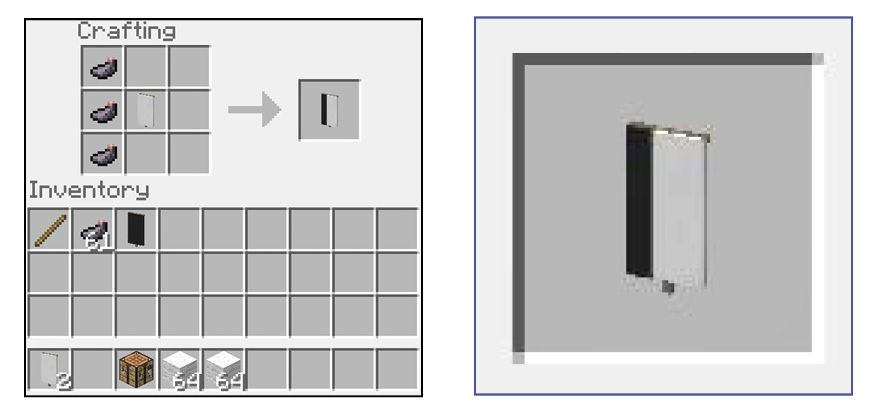
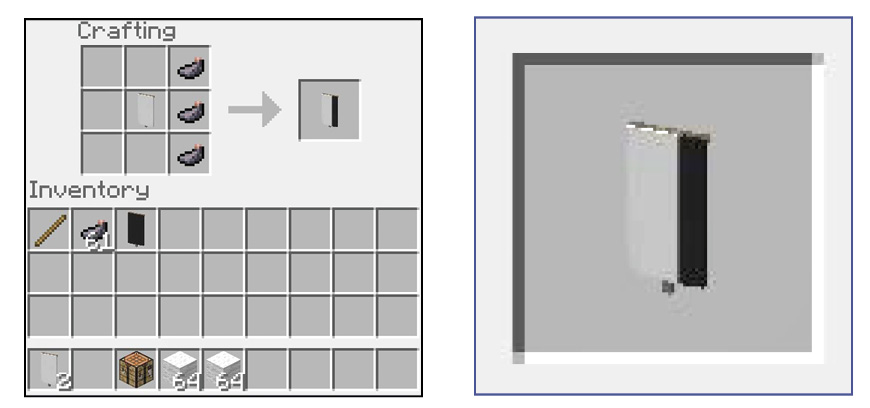
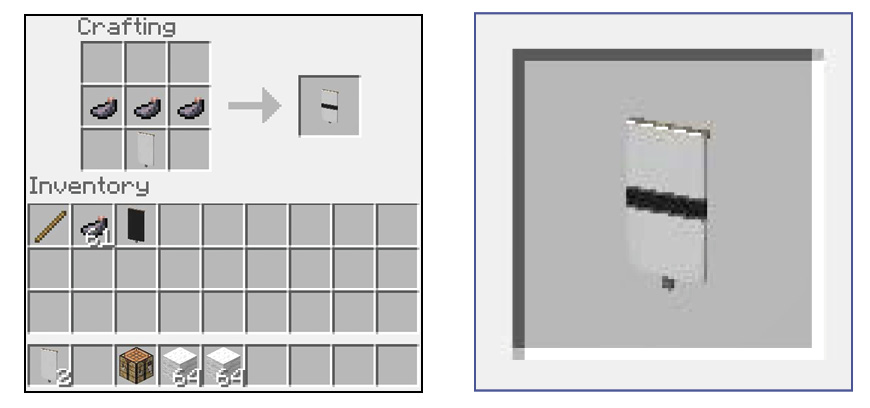
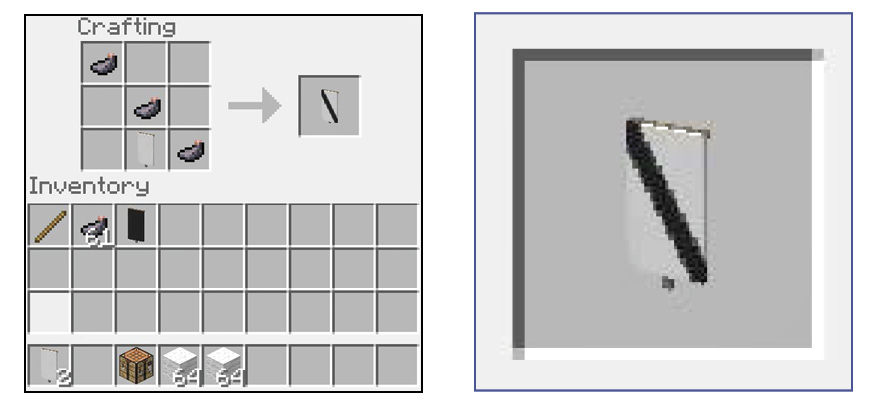
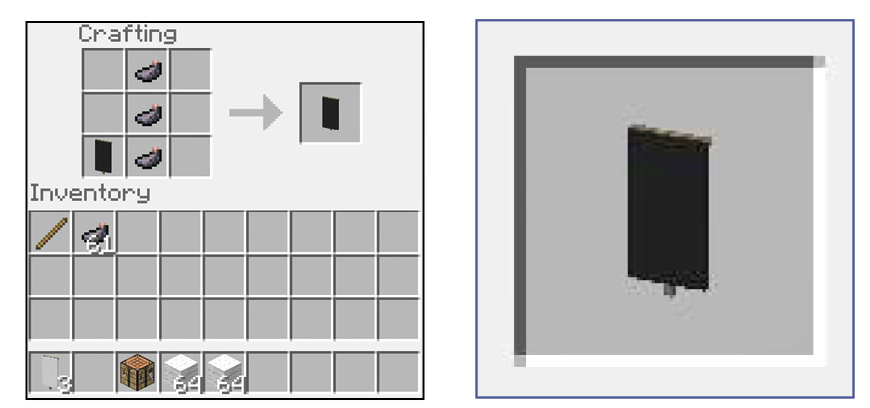
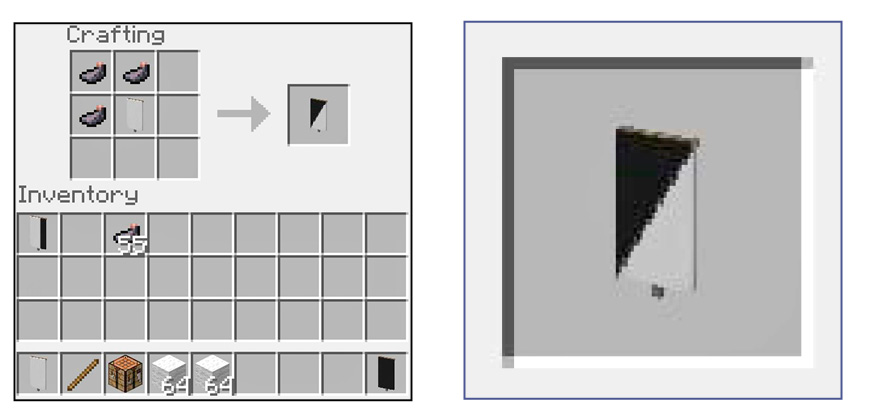
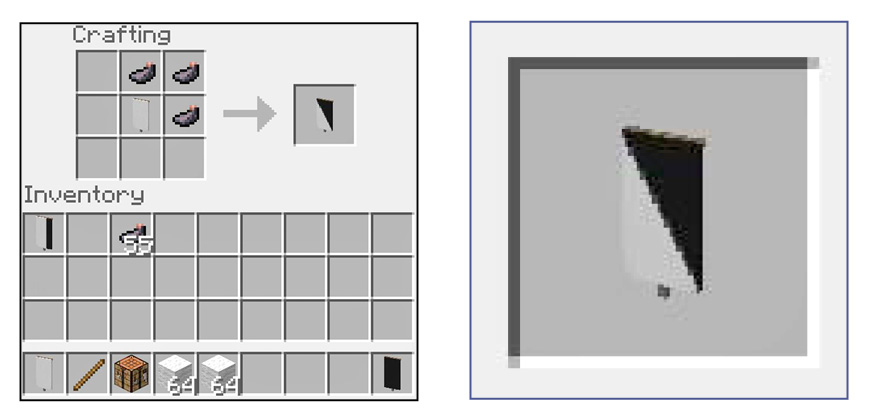
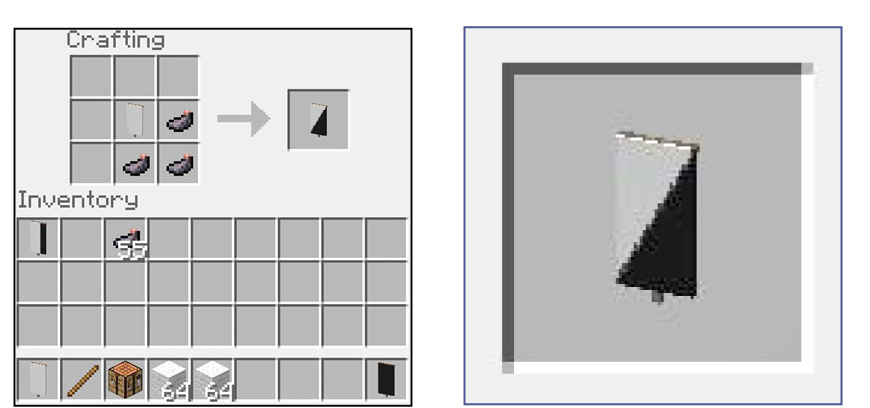
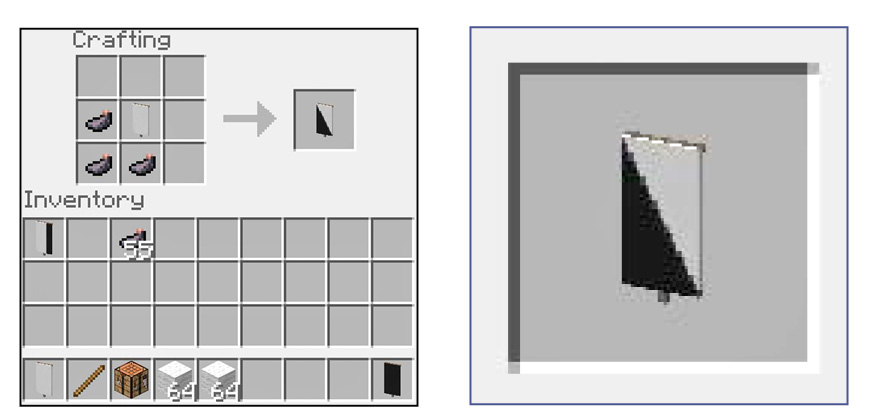
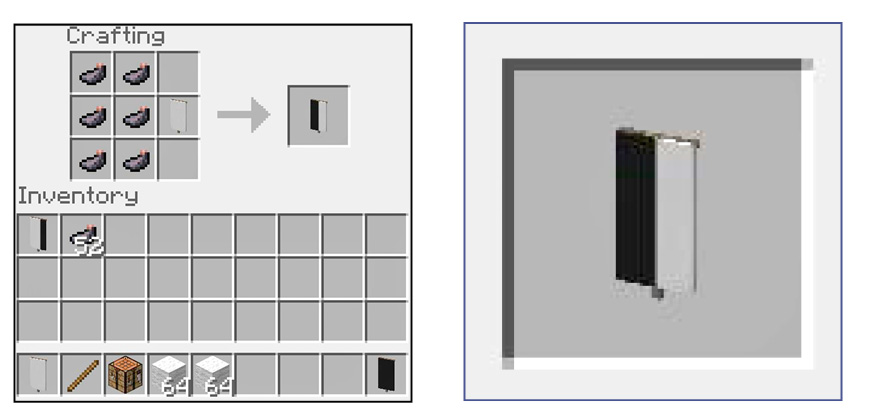
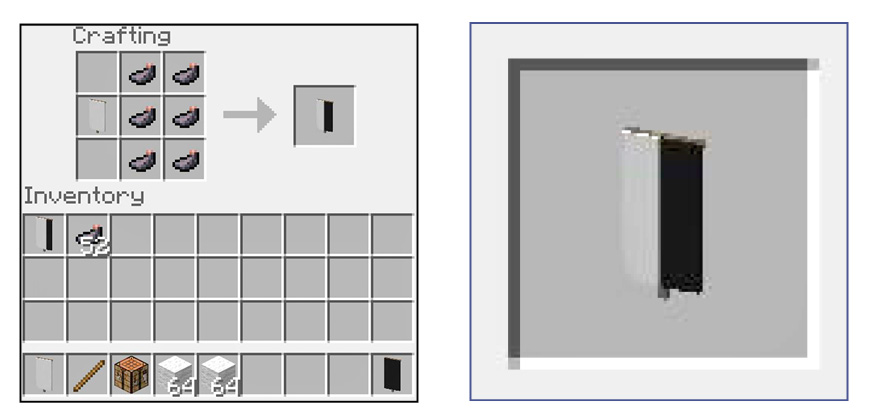
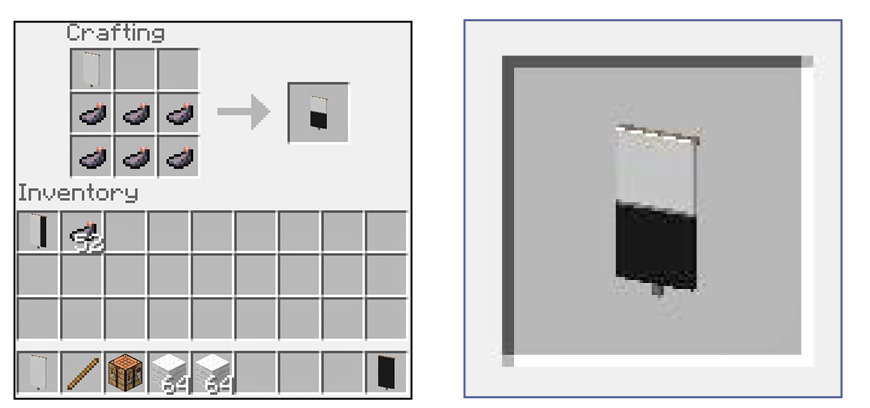
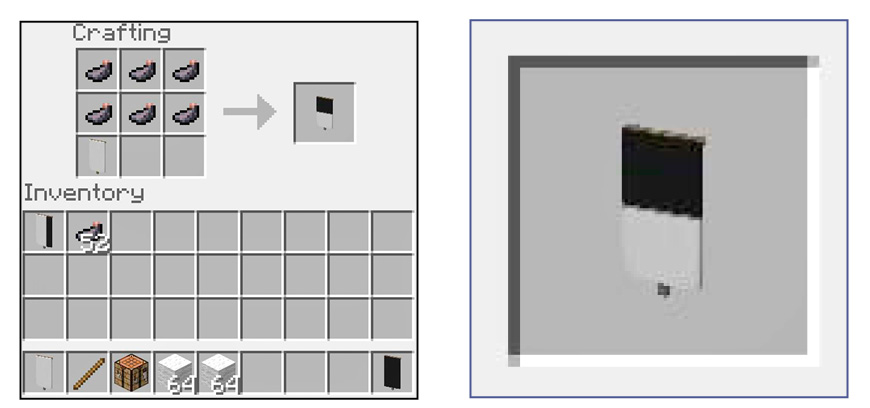
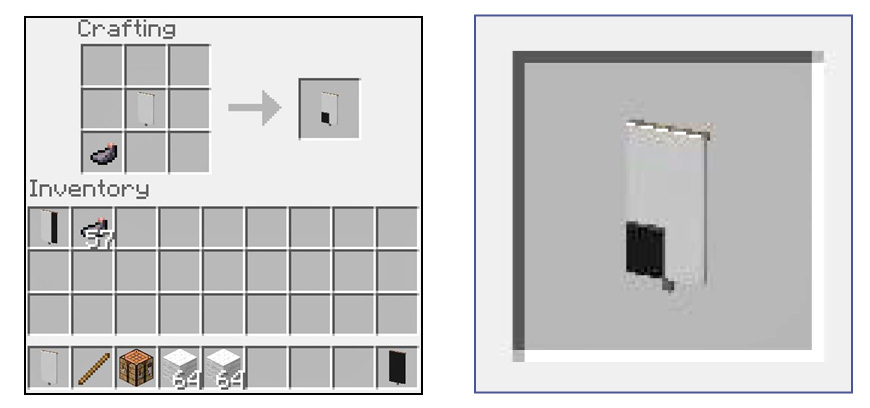
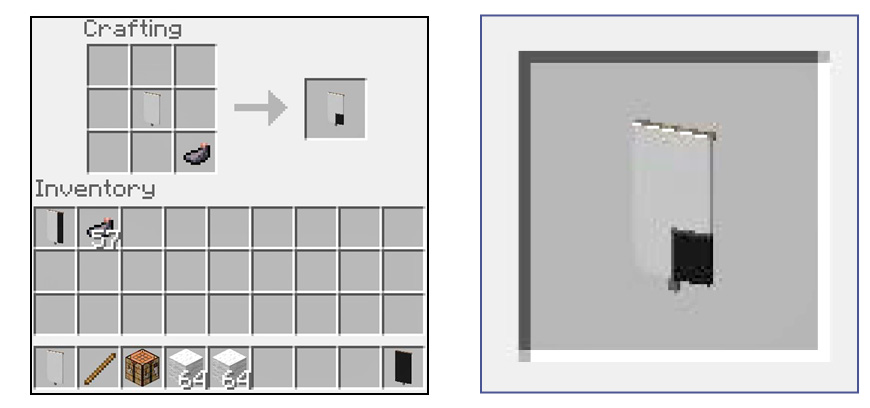
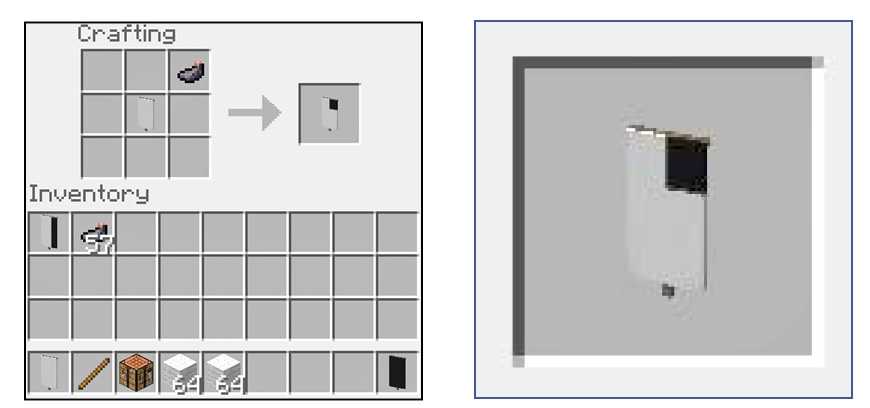
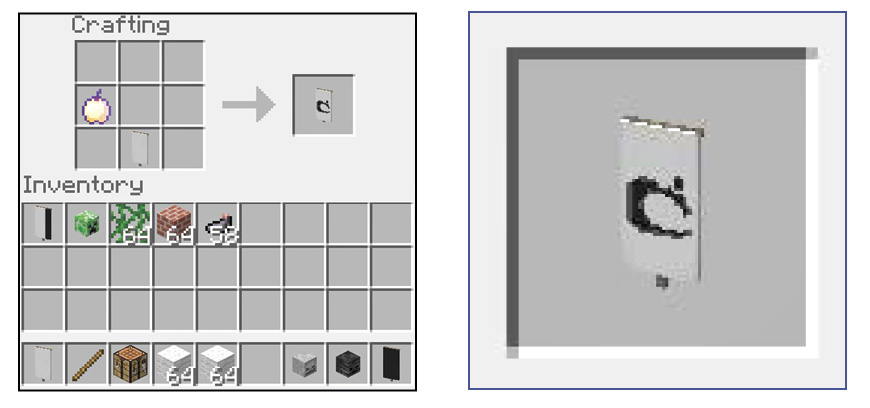
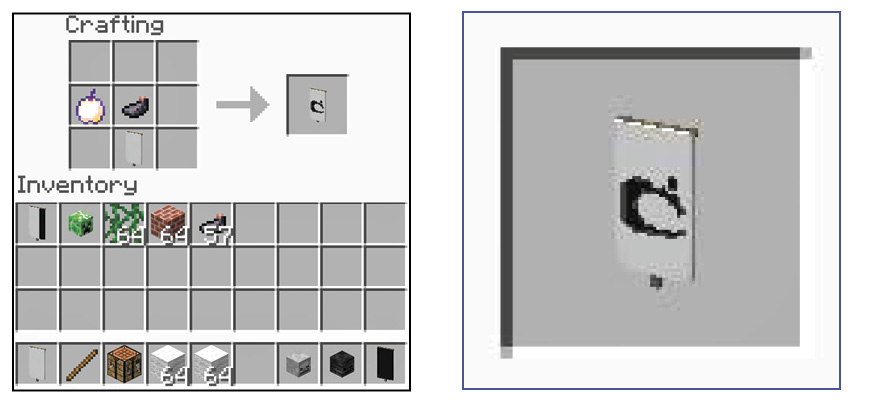
Banners are crafted to decorate regions with many different styles. You can place Banners on the ground, onto walls, put them in Item Frames, and arrange them in different orientations. Creatures can move through Banners as if they weren’t there, so don’t count on these as barriers against enemy movement.
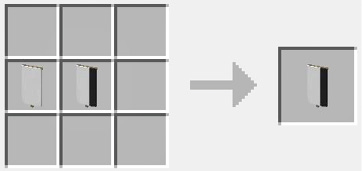
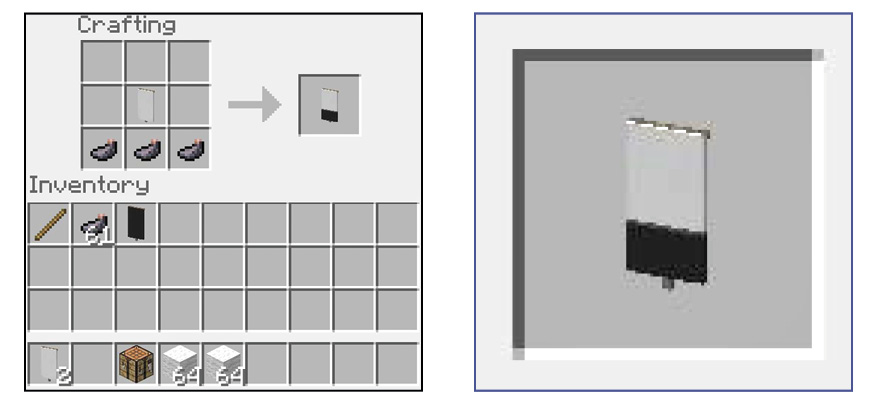
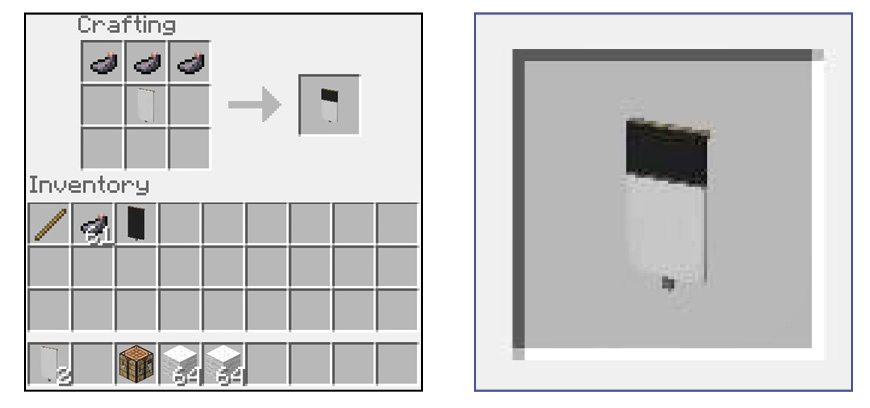
The initial Wool color determines the base color of the Banner you’re making. Once completed, you can then decorate the Banner by crafting it with a huge array of materials. This can be a costly process, if the ingredients are hard to come by. To compensate for that, it’s possible to copy Banner patterns. This way you can make multiple awesome-looking Banners and only need to spend the Wool and Sticks for each new Banner while retaining your symbol. Do this by crafting using your completed Banner and a plain Banner of the same color.
Recipe
| Ingredients | Crafting Recipe | Result |
|---|---|---|
| Wool (6), Stick |
|
Banner |

Recipe
| Ingredients | Crafting Recipe | Result |
|---|---|---|
| Banner (2) |
|
Both Banners must have the same base color, and one Banner must be free of patterns; it will receive the final pattern of the other Banner |

Stripe Patterns
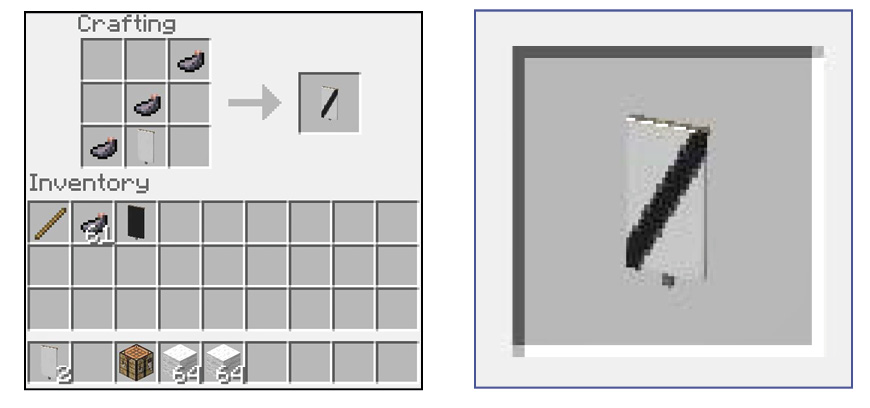
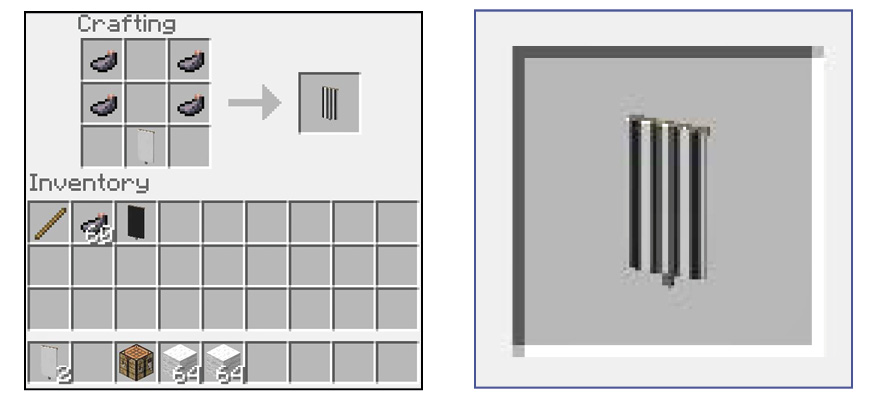
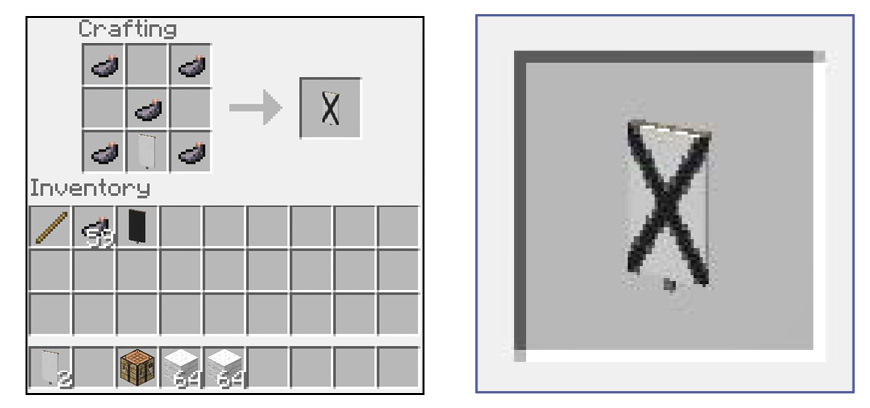
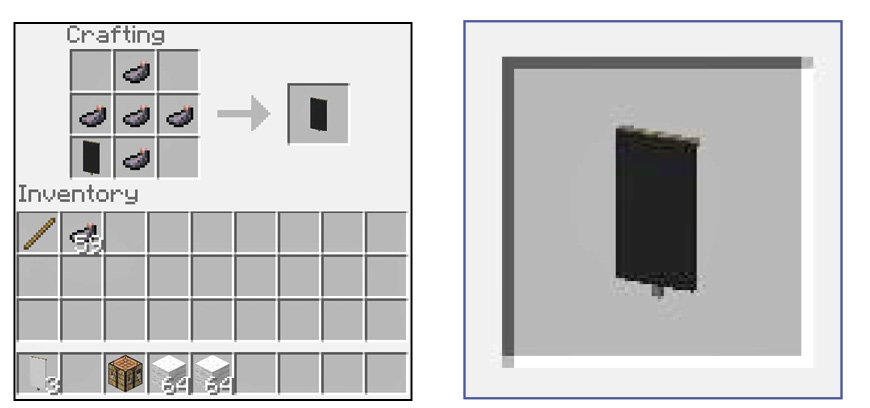
Halftone Patterns
Shapes
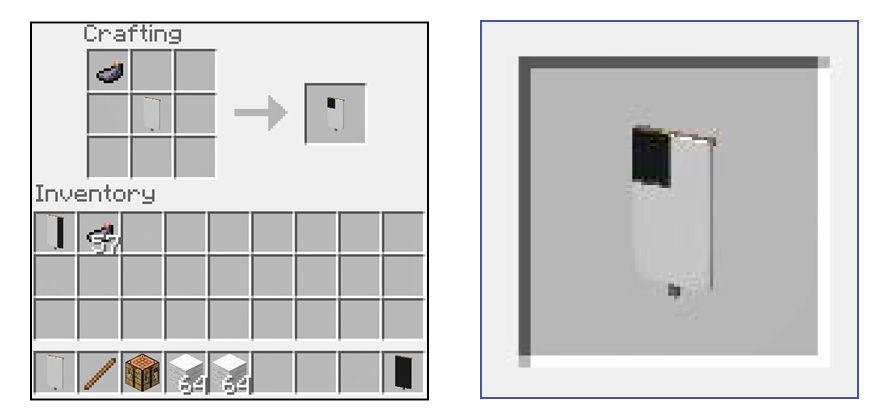
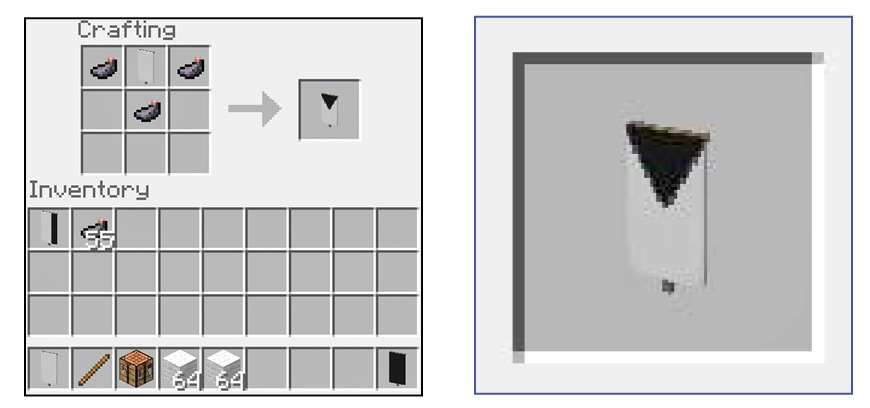
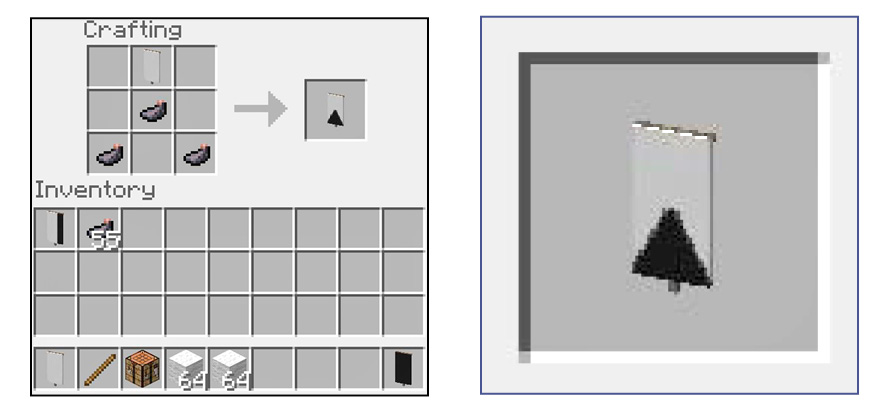
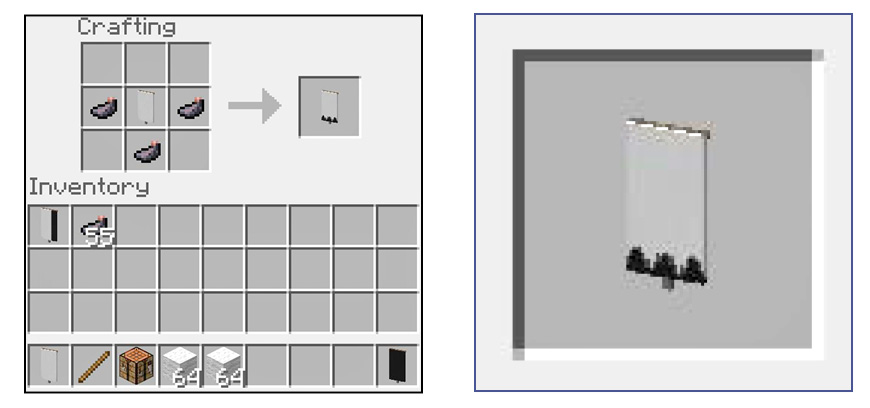
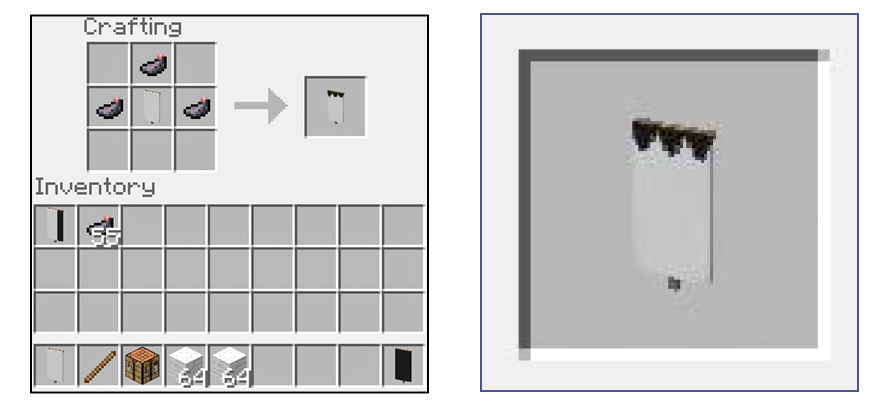
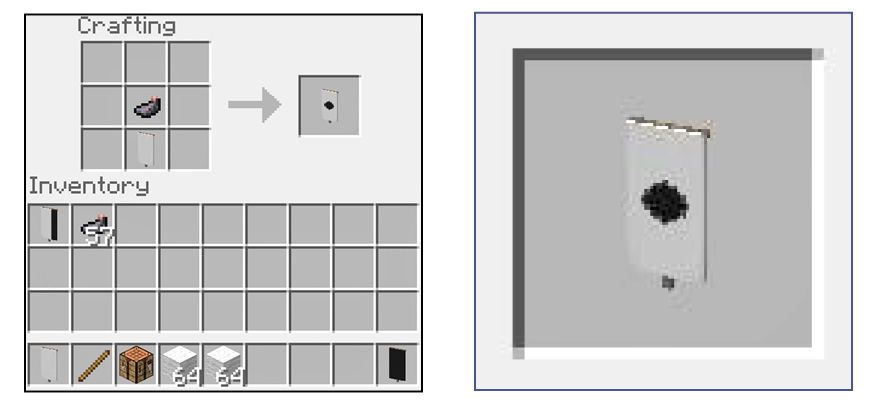
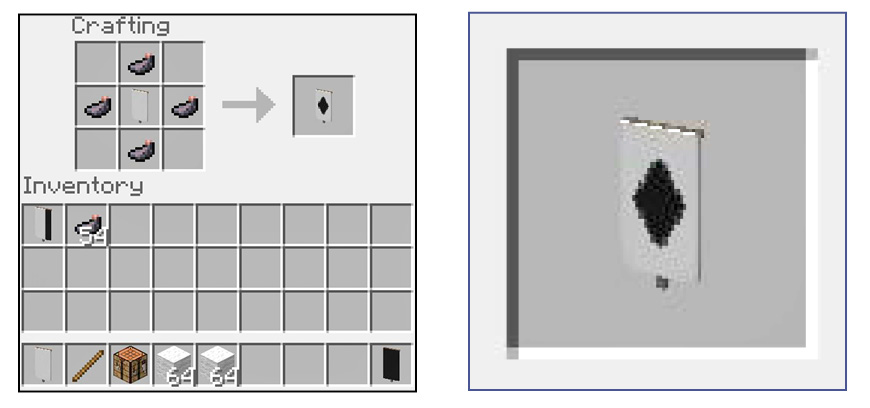
Borders
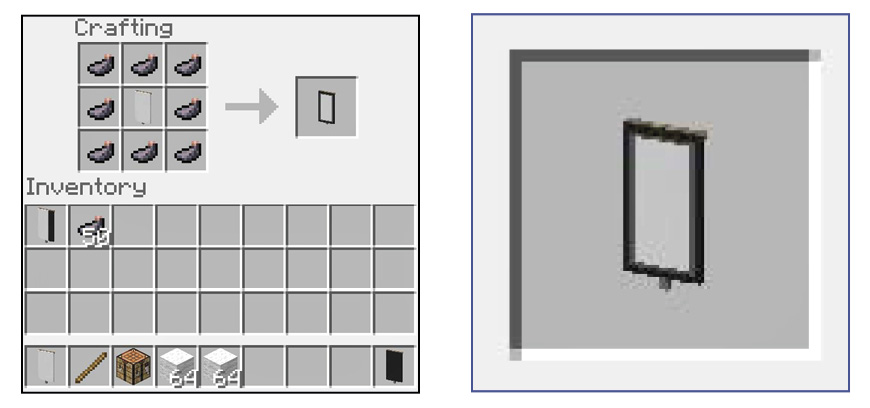
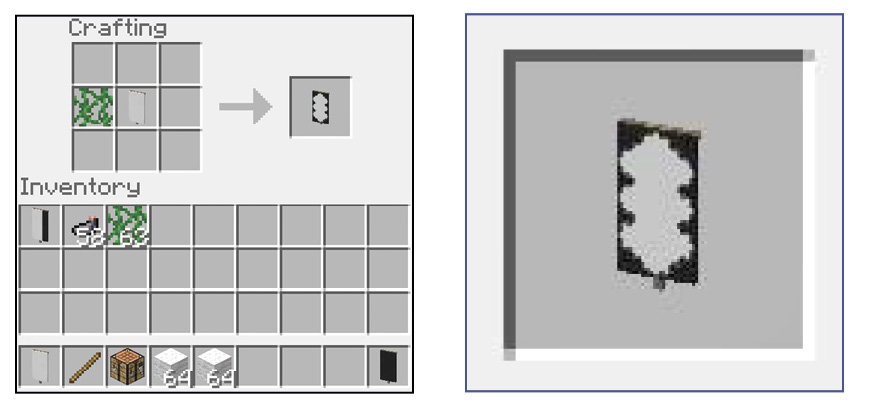
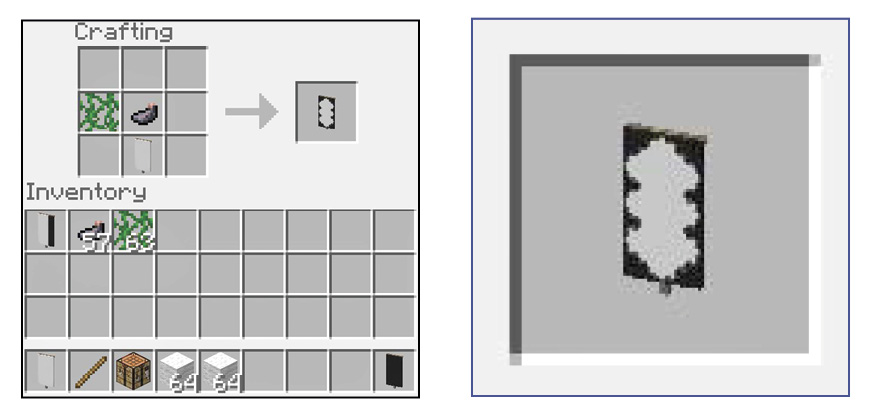
Backgrounds
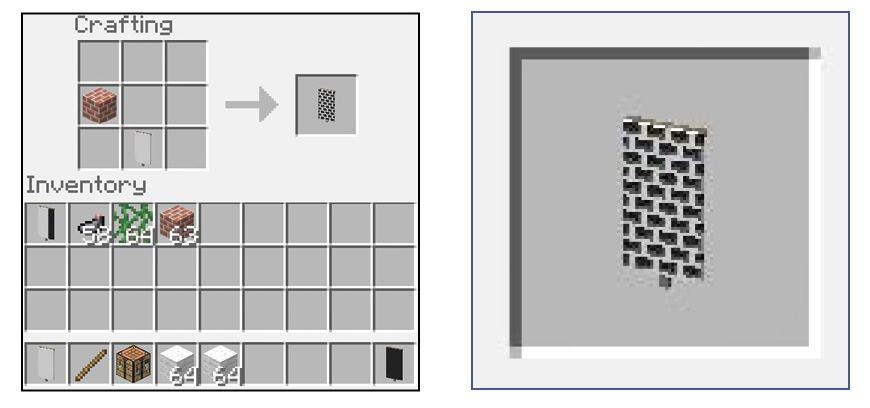
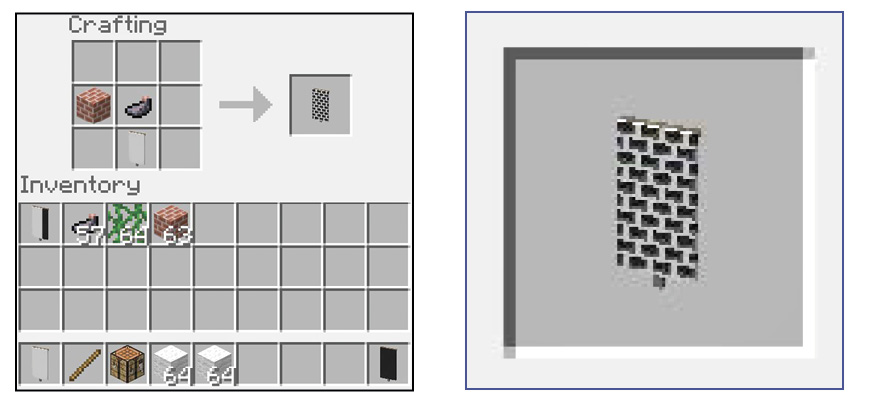
Gradients
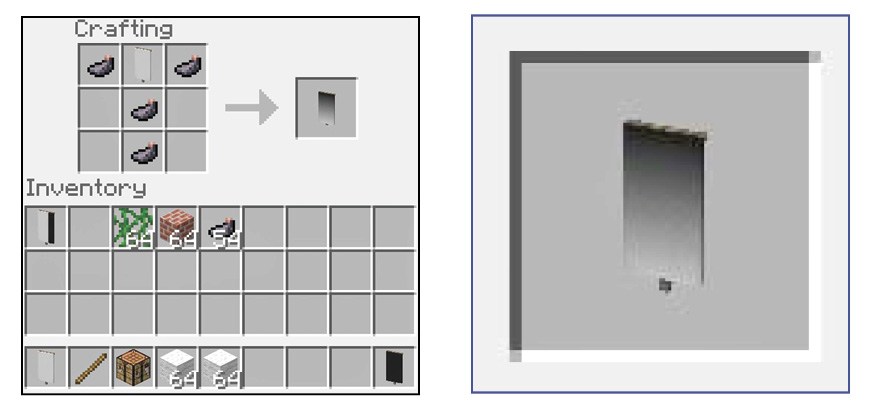
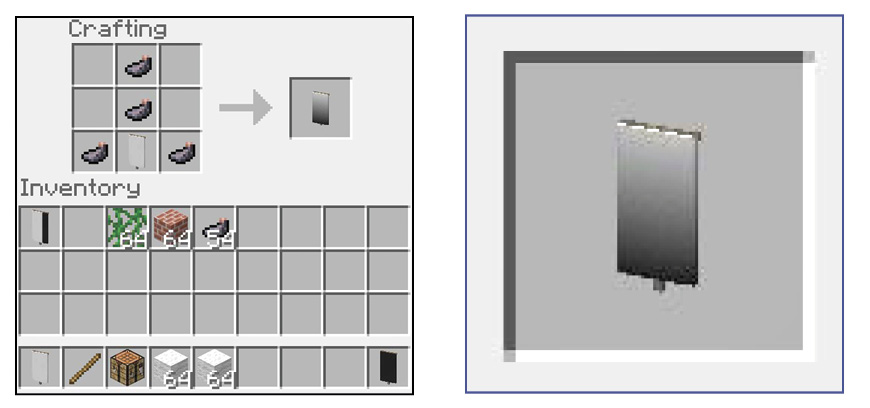
Symbols
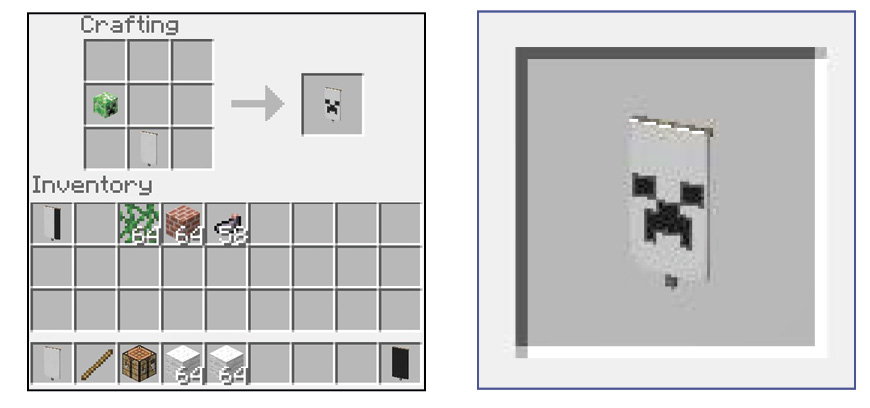
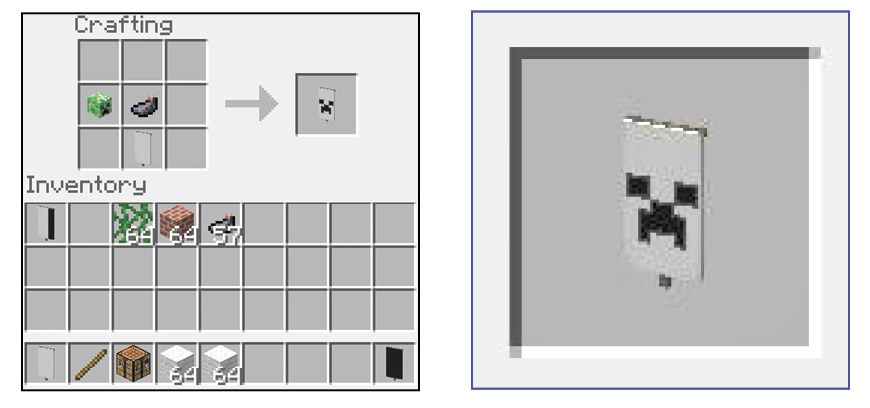
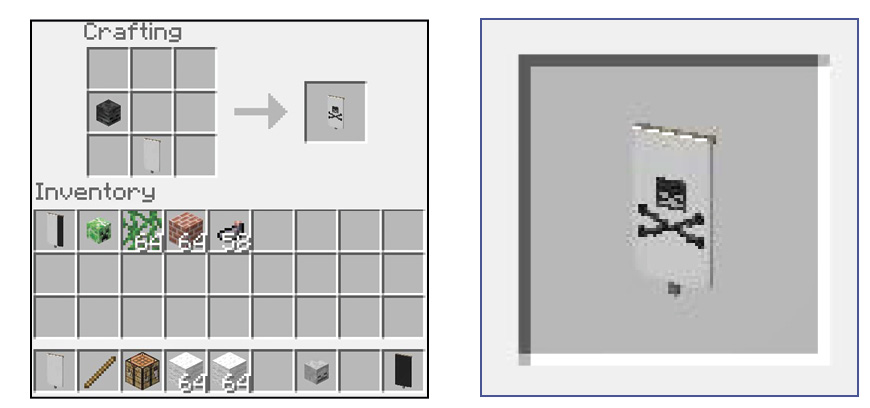
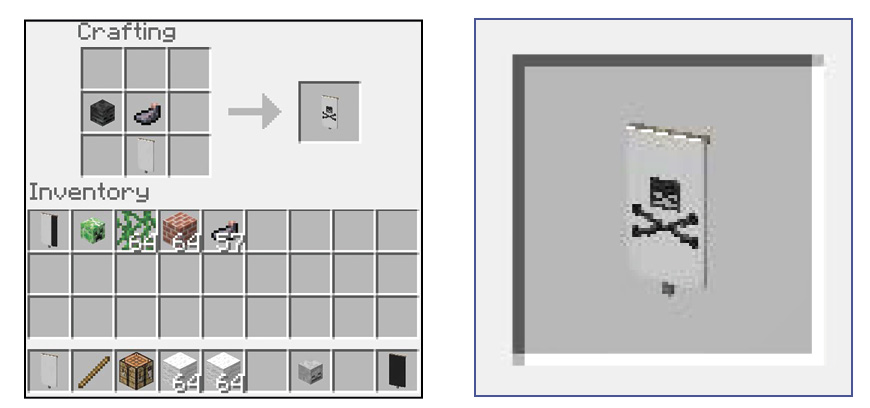
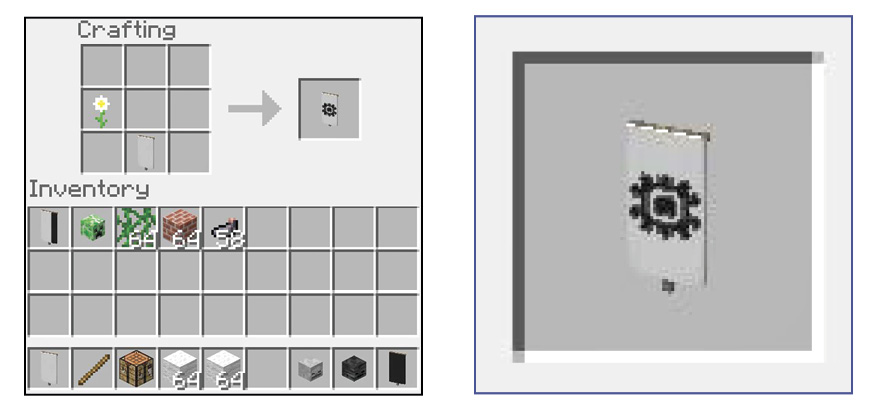
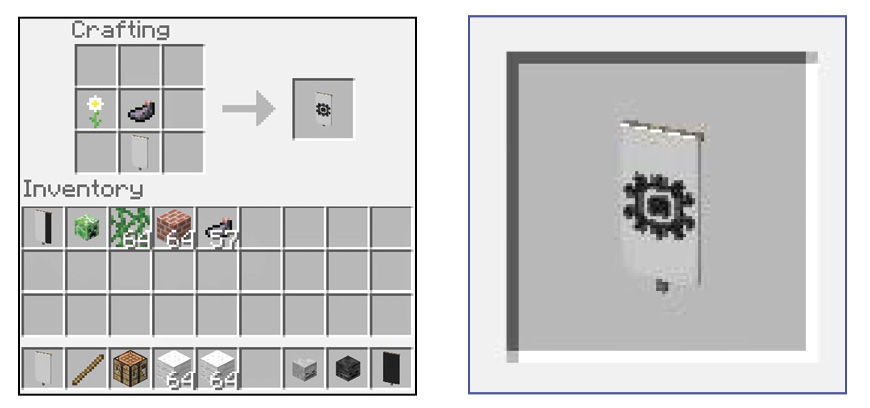
Bedrock
| Location | Gathered With | Uses |
|---|---|---|
| Bottom of all worlds and at the top of the Nether | N/A | N/A |
Bedrock normally prevents players from getting outside the borders of the world. You find it commonly near the bottom of the Overworld (until eventually it covers everything). It’s also at the bottom and top of the Nether. Normal mining and explosions do not damage Bedrock. Only special cheat codes or specific circumstances can be used to damage even a single piece of the rock.
When you see Bedrock, that’s your hint that it’s time to mine outward instead of downward!
Blue Orchid
| Location | Gathered With | Uses |
|---|---|---|
| Swamps | Anything | Light Blue Dyes |
Blue Orchids are found in Swamp biomes and make Light Blue Dye in a 1:1 ratio. They’re quite pretty, so it’s nice to gather them for Flower Pots if you like their color.

Cactus
| Location | Gathered With | Uses |
|---|---|---|
| Deserts, Mesas | Axe | Refined into Cactus Green (a dye), trash pits |
Cacti are spiky plants that you usually find in the desert. They hurt any player or monster that tries to bump into them, so be careful when you walk near a patch of these things. Use an axe to chop a few down if you’d like to harvest them. If you dig out the block beneath a cactus, that also causes the plant to drop.
A very fun trick is to make a garbage pit with Cacti inside. These plants destroy almost anything that comes into contact with them. You can dig out a modest pit with room for Cacti on each side, and then throw anything you’re done with into the pit.
Note that Cacti grow on sand, so harvest some while you’re in the area. Bring the plants home and create your own patch as decoration or to injure monsters that come close to your home.
Coal Ore
| Location | Gathered With | Uses |
|---|---|---|
| In areas of Stone blocks | Pickaxes | Burning in a furnace |
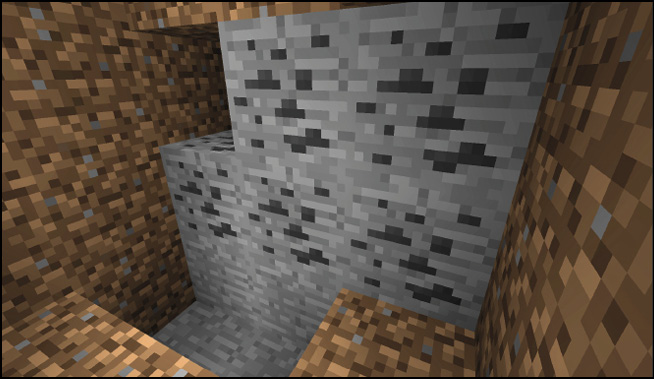
Coal Ore is a fairly common sight in large, stony areas. Dig through the Stone until you see flecks of dark material in the walls, and focus on harvesting those as often as possible. This nets a fair amount of experience for your character, and it gives you free fuel for your furnaces! Coal is a long-lasting material for burning, so you can smelt ore, cook food, and keep your home looking nice and cozy for days on end.
Cobblestone
| Location | Gathered With | Uses |
|---|---|---|
| Seen in special areas (such as Strongholds and Dungeons) | Pickaxes | Construction material, used for making stone tools, Furnaces, Dispensers, and many other items |
Cobblestone is one of the most common crafting ingredients in the game. You get it by cutting into Stone with a Pickaxe; simply beating on Stone with your bare hands will not work. Make a Wooden Pickaxe, break a few Stones, and then go back to make a Stone Pickaxe for yourself. Now you’re ready to harvest Cobblestone in large quantities.
You can make buildings, tools, and decorative items all with the same Cobblestone. It’s great stuff, and you can always get more without investing much time. Dig down into the soil, and there’s likely to be more Stone waiting to be found.
Because Cobblestone always orients itself the same direction after you place it, these blocks offer a way to see which direction you’re heading. Look very closely at the top of a Cobblestone block. In the block’s upper-left, when you’re facing north, there is a small “L” on the stones. Use this as a way to tell where you’re going if you can’t see the sun or moon and don’t have a map or compass.
Cobweb
| Location | Gathered With | Uses |
|---|---|---|
| Mine Shafts | Shears that have Silk Touch | Slows movement (when walking or falling) |
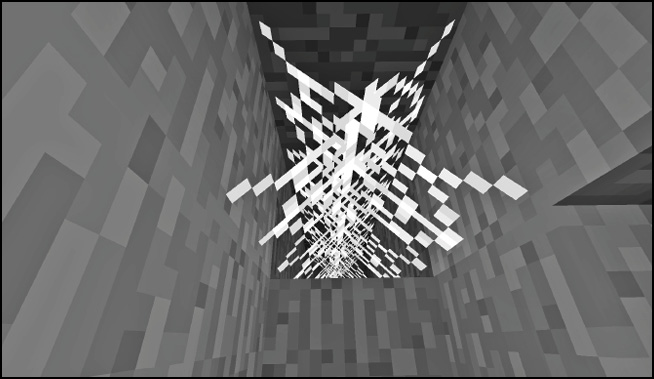
Cobwebs are naturally found in abandoned mine shafts. They slow down anything that tries to move through them, so put them in areas with your traps to make them even more effective.
You cannot harvest Cobwebs with normal equipment because they’re fragile. You need a set of Shears enchanted with Silk Touch to gather Cobwebs without breaking them. Afterward, you’re free to hang these Halloween decorations wherever you like. Place them near a Tripwire with a nasty trap or two.
Cocoa
| Location | Gathered With | Uses |
|---|---|---|
| Grow on Jungle Trees | Anything | Making Cookies and Brown Dye |
Cocoa grows on Jungle Trees, so it’s exclusive to specific biomes. Once you find the trees, harvest some Cocoa Beans to bring home and plant on the trunk of a Jungle Tree to start your own Cocoa farm. You need only a single block of a Jungle Tree to work with, so grow such a tree and cut it down except for its trunk.
Then plant your Cocoa Beans and wait for their third growth stage to harvest them. Break them open, collect the Beans, and you’re ready to replant and repeat the process. You can use Cocoa Beans to make Cookies (a low quality food item) or a dark brown Dye.
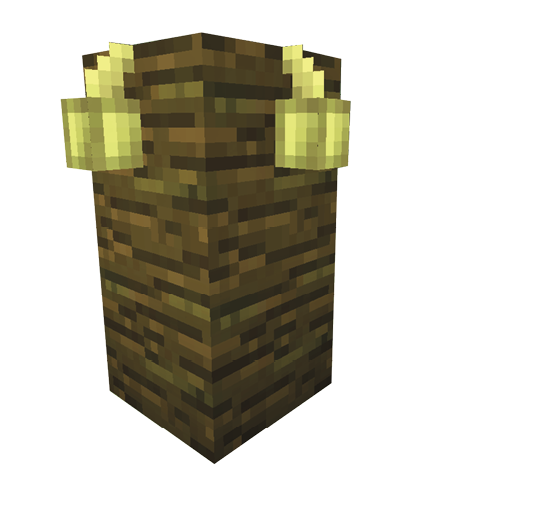
Command Block
| Location | Gathered With | Uses |
|---|---|---|
| Special | N/A | Use specific commands when activated by a Redstone current |
You can put Command Blocks into custom maps by using the following text entry:
command /give <player name> minecraft: command_block <desired quantity>
Command Blocks are complex items that most players don’t mess around with. However, if you’re making a world for Adventure mode, these handy tools let you create teleporters, traps, and even control the game world directly.
Dandelion
| Location | Gathered With | Uses |
|---|---|---|
| Common grassy flower | Anything | Makes Dandelion Yellow Dye, or is used as decoration |
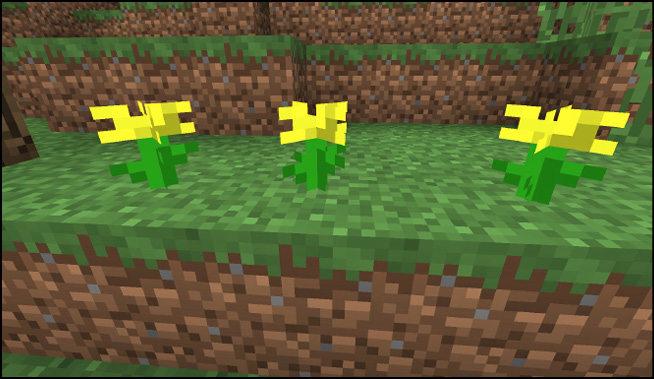
Dandelions are easy to find because they grow in many biomes: Plains, Forest, and others as well. You won’t have trouble getting your hands on these. A single flower can be turned into Dye whenever you like, or you can plant them on your own in grass, tilled dirt, or regular dirt.
And that’s about all there is to Dandelions. They’re pretty much weeds.
Dead Bush
| Location | Gathered With | Uses |
|---|---|---|
| Hot/Arid areas of the Overworld | Shears | Decoration only |
Dead Bushes are available in warmer areas and cannot be gathered without using Shears. They’re drab in color and aren’t used in any crafting recipes. If you want to make a place look inhospitable, they’re somewhat useful for that.
Diamond Ore
| Location | Gathered With | Uses |
|---|---|---|
| Deep inside the Overworld | Iron or Diamond Pickaxes | High-quality tools |
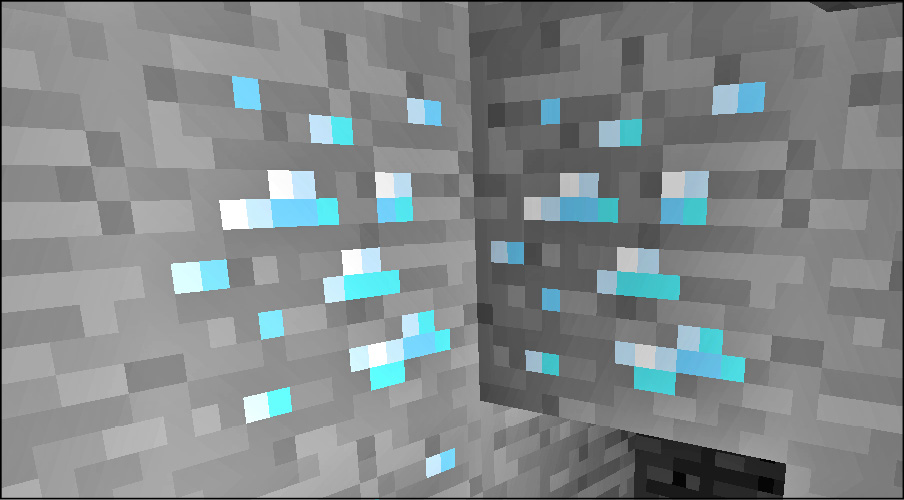
Diamond blocks are found in the Overworld’s lowest levels. If you press F3 to look at your character’s position, you can see your “Y” value. This tells you how close you are to the bottom of the world. Diamond is found only between 0-15 in the “Y” values. This means you have to dig far down into the earth to collect any of them, and it’s rare even at those depths.
Also, bring at least an Iron Pickaxe when you hunt for diamonds. It’s impossible to mine these blocks when you have inferior equipment. If you find Iron Ore on the way down, you can always make a Workbench, a Furnace, refine the Iron, and craft an Iron Pickaxe right there.
The tools you make with Diamonds are the best in the game. Always focus your best enchantments on them, because these items last for a very long time. They’re amazing!
Dirt
| Location | Gathered With | Uses |
|---|---|---|
| The Overworld | Shovels | Construction and farming |
Dirt is one of the easiest things to gather in Minecraft. Use it to make sod buildings, obstacles, or to lay the foundation for some farmland (many crops grow on Dirt). Grass blocks become Dirt when you dig them up, and Dirt that you place in direct sunlight often shifts to a Grass block eventually.
Shovels let you dig into Dirt very effectively, but any object can be used to harvest Dirt, including your bare hands. To turn regular Dirt into tilled Farmland, use a Hoe.
Dragon Egg
| Location | Gathered With | Uses |
|---|---|---|
| The End | Special Technique | None yet |
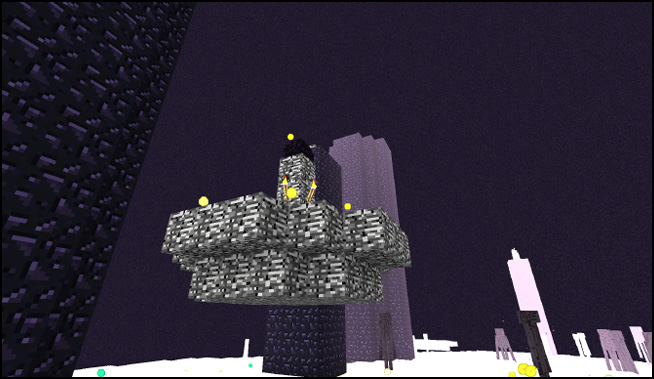
Dragon Eggs fall when you slay the Ender Dragon. You cannot walk up and harvest a Dragon Egg normally; it’ll teleport away from your character and could even end up being irretrievable. Instead, you need to dig underneath the Dragon Egg two blocks down. Place a Torch there, and then break the block between the Dragon Egg and the Torch. Collect the egg after it “breaks” on the Torch. Use this same technique to quickly harvest Gravel or Sand by dropping their blocks onto a Torch. It’s a neat trick.
Emerald Ore
| Location | Gathered With | Uses |
|---|---|---|
| Extreme Hills biomes, well below the surface | Iron or Diamond Pickaxes | Trading with villagers |
Emerald Ore is brutal to find. Don’t even look for it outside of Extreme Hills; you must locate one of those biomes and then create a mine that leads below a “Y” value of 30. Emeralds are down there, but not very many of them. They’re spread out and don’t occur in veins, so finding them requires patience.
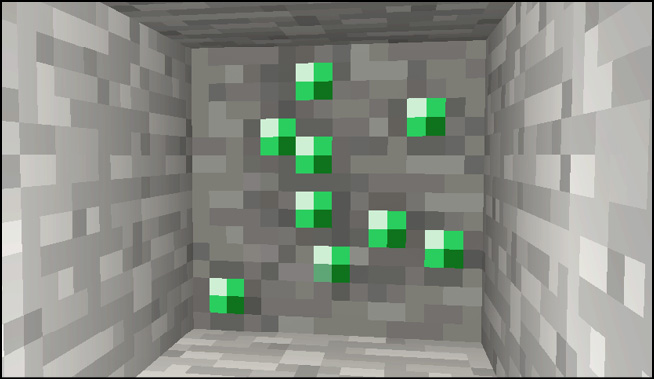
If at all possible, bring a Pickaxe with Fortune any time you hunt for Emeralds. These enchantments make your time so much more productive because you get many extra Emeralds (2x - 4x, depending on how good your enchantment is and how lucky you are).
End Portal Block
| Location | Gathered With | Uses |
|---|---|---|
| Strongholds | N/A | Create a Portal into The End |
Each Overworld has several Strongholds hidden within a certain area, not too far from where the first player begins his or her journey. End Portal Blocks (also called End Portal Frames in some versions of the game) are inside these Strongholds.
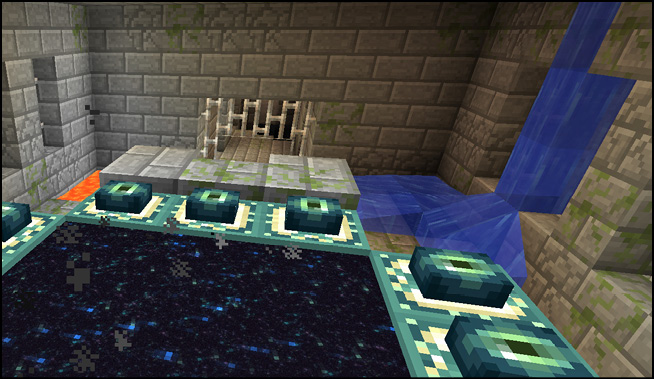
Insert Eyes of Ender into these blocks to complete a Portal. Every End Portal Block must be charged by Eyes of Ender before the Portal begins to function. When it does, you can travel into The End and face the threat of the Ender Dragon!
End Stone
| Location | Gathered With | Uses |
|---|---|---|
| The End | Pickaxe | Construction material |
End Stone is a block type that dominates The End. It’s resistant to damage and explosions, so it’s a decent building material if you manage to harvest enough of it. The only problem is you can’t easily pop back and forth to The End until you slay the Ender Dragon. That said, there is a way to gather this stone even if you haven’t killed the dragon yet. To do this, place an Ender Chest in The End, harvest the stones, and put your loot in the chest. This way, when you die in The End and respawn in the Overworld, your stones will be waiting in any Ender Chests you place there!
At this time, there aren’t any crafting recipes that use End Stone.
Farmland
| Location | Gathered With | Uses |
|---|---|---|
| Villages | Shovels | Growing crops |
Farmland is created when you use a Hoe on Dirt or Grass blocks. This nice, tilled soil lets you grow a variety of items, with Wheat being the most common. Plant seeds in your Farmland and give them time to grow to create a renewable source of food.
Proper growth requires light (from any source), a Water block that is at most four tiles away, and time. We discuss farming in detail at several points in this book, because it’s a great way to keep your characters fed!
Fire
| Location | Gathered With | Uses |
|---|---|---|
| The Nether | N/A | Destruction or decoration |
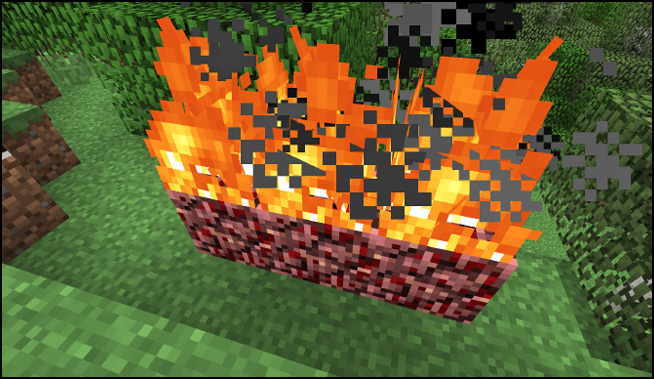
You can find Fire on its own in the Nether, but it can be triggered in other areas with the use of Lava, Flint and Steel, lightning strikes, and from various enemy attacks. Whenever fire touches vulnerable wooden objects, it spreads, igniting them as well. This can destroy wooded areas and buildings and put characters at risk.
To fight fires, either attack the flames directly by hitting the object that’s on fire, put blocks on top of the fire, or douse the area with Water. Whatever you do, work quickly! A small fire can quickly become one that’s too large to handle.
Gold Ore
| Location | Gathered With | Uses |
|---|---|---|
| Deep inside the Overworld | Iron or Diamond Pickaxes | Create Gold Ingots that are used for golden tools, clocks, armor, and a few special items |
You can find Gold between the Bedrock and “Y” values up to 30 in the Overworld. It’s a bright yellow ore that is very easy to spot once you uncover it. Make sure you use an Iron or Diamond Pickaxe, and then harvest it like you would any other type of ore.
Once refined into Gold Ingots, you can do many things with this metal. Golden tools, weapons, and armor are pretty but not terribly effective. It’s best to save most of your gold for Clocks, Golden Apples, and Redstone construction (because certain powered items require Gold).
Grass
| Location | Gathered With | Uses |
|---|---|---|
| Dirt areas that are exposed to decent levels of light | Shovels | Same as Dirt |
Grass blocks are found wherever Dirt is given good light and time to grow. Grass itself grows on top of Grass blocks; flowers and shrubs can also grow this way. Dig into Grass blocks to collect Dirt, or cut through the Grass above with any object to grab Seeds. The best way to get material for a Wheat farm is to rip up huge swaths of Grass until you have enough Seeds to start your farm. If the Grass is thick enough, you can get dozens of Seeds in just a minute or two of running around. That’s enough to kick start a farming project.
Gravel
| Location | Gathered With | Uses |
|---|---|---|
| The Overworld | Shovels | Gathering Flint |
Gravel appears in areas with Dirt and Stone. It has a more rugged surface, so you can tell what is Stone and what is Gravel with just a glance. When tiles underneath Gravel are destroyed, the Gravel blocks above fall into place as if affected by gravity. This is true for Sand as well. Make sure to avoid standing underneath Gravel when you mine, because your character takes damage if you’re struck by falling Gravel.
A quick way to harvest this material is to dig down two blocks under the stack of Gravel. Put a Torch underneath the Gravel stack before destroying the block of Stone or Dirt that holds the Gravel in place. This causes the entire stack of Gravel to fall onto the Torch, destroying the blocks and turning them into a resource that’s easy to gather. Quick mining without even damaging your tools. That’s pretty nifty, eh?
Hardened Clay
| Location | Gathered With | Uses |
|---|---|---|
| Mesas, Deserts, and River areas | Pickaxe | Construction material |
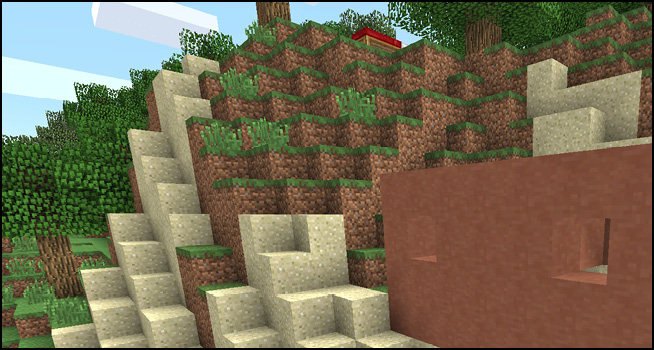
Clay is a natural block in the Overworld. You can find heavy concentrations of it in certain biomes, such as Rivers and Mesas. Collect these blocks as if you’re mining Stone. Bring them back to your house to use as a construction material with even more decorative options.
You can make Hardened Clay by cooking Clay in your Furnace. Hardened Clay can then be stained with any dyeing agent to give it a more desirable color.
Huge Mushroom
| Location | Gathered With | Uses |
|---|---|---|
| Mushroom Islands and Roofed Forests | Axe | Gathering Mushrooms, Shade Farming |
Mushrooms grow in low or no-light areas. Huge Mushrooms are really cool-looking and grow naturally in somewhat uncommon biomes. If you want to reproduce these interesting features, use Bone Meal to grow regular Mushrooms into their giant cousins.
Because Mushrooms prefer areas with low light, they’re great for making underground farms.
Ice
| Location | Gathered With | Uses |
|---|---|---|
| Cold areas | Any tool with Silk Touch | Decoration, Transportation |
Ice forms in cold regions of the Overworld. One often sees it on the surface of Water, but it can also be on open ground. You can smash Ice with a Pickaxe (or any other object if you’re willing to spend more time).
Movement on Ice is fast and slippery. This makes it possible to cross distances quickly and jump a bit farther as well.
Placing smaller blocks on top of Ice is interesting. For example, a Stone Slab on top of Ice retains the slippery characteristic that is common on Ice. If you run Water over Ice, this property works as well, so Water transportation over Ice is faster than it otherwise should be. Some players use this as a way to rapidly funnel objects that fall into Water to a central area.
Iron Ore
| Location | Gathered With | Uses |
|---|---|---|
| Underground, in the Overworld | Pickaxe | Powerful tools |
Iron Ore is a modestly common mineral that appears throughout the world. It can appear at practically any elevation, as long as there are Stone and Dirt blocks present. Look for a brownish, rusty tinge to a Stone block. That’s what Iron Ore looks like.
After mining Iron Ore, you must smelt it in a Furnace before it turns into Iron Ingots; these are what you need for your recipes. Toss all of your Iron Ore into the Furnace and wait for it to cook completely. Remove the Iron Ingots and try making a variety of tools with it, including improved basic tools (Pickaxes being the best choice), Shears, Buckets, and more.
Smelted metals give you experience after you remove them from a Furnace. It’s not a huge bonus, but it’s still nice to get.
Lapis Lazuli Ore
| Location | Gathered With | Uses |
|---|---|---|
| Deep under the Overworld | Pickaxe | Decorative elements |
Lapis Lazuli is a blue mineral found in very deep tunnels under the ground. Your “Y” location value should be near 15 to find Lapis Lazuli. It’s easy to mine with any decent Pickaxe, and it doesn’t take long to gather. Veins of this mineral often yield a large amount of the blocks, so you come back with a good haul if you find even one or two veins.
Large Fern
| Location | Gathered With | Uses |
|---|---|---|
| Grass blocks | Shears or any tools | Decoration |
Ferns grow in Jungles, Taigas, and Mega Taigas. They appear on grass blocks, much like regular Grass, Dead Bushes, and Tall Grass. You can find smaller and larger Ferns, but the main difference between them is that you get two Ferns if you cut them down with Shears.
Ferns can be broken with any tool to get Seeds, or cut down with Shears to harvest for decoration. If you want to make an area look nice with Ferns, build Flower Pots and plant Ferns in them around your property.
Ferns are usually spaced out a bit, so they’re not necessarily a great source of Seeds. Thick areas of Grass are superior, because you can harvest it much faster.
Lava
| Location | Gathered With | Uses |
|---|---|---|
| The Overworld or the Nether | Bucket | Light, Furnace fuel, garbage disposal |
One frequently finds Lava in the deep recesses of the Overworld, and it’s even more common in the Nether, where it is practically the world’s lifeblood. You can sometimes even find Lava near or on the Overworld’s surface if you’re lucky. Or unlucky, as the case may be.
Lava is quite dangerous. It sets flammable things on fire if they come into contact with it or stay too long beside it. Anything that catches fire takes damage over time—armor can’t save you from this. If you’re on fire, jump into Water or pour out Water from a Bucket to save yourself. It’s possible to survive Lava without Water, but you must have a great deal of health before you’re set aflame.
Lava makes a telltale bubbling noise when you’re nearby. Always use caution when you hear this noise so you don’t wander over an edge and fall in. It’s difficult to swim out of Lava once you’re in it.
Pour Water over Lava to create Obsidian blocks, a type of dark, hard rock that can be used for special construction. If Lava is poured over Water instead, you end up with Cobblestone.
Leaves
| Location | Gathered With | Uses |
|---|---|---|
| On Trees | Shears | Decoration |
Trees automatically spawn Leaves around themselves. These blocks prevent easy movement, so they’re sometimes quite annoying. Destroy them with any tool that you have, or use your bare hands if you like. Shears gather Leaves instead of destroying them, but at least they’re very quick about finishing the task.
Breaking Leaves provides a chance to drop items, including Saplings of the Tree that spawned the Leaves. You might also get an Apple here and there, but this isn’t a reliable way to get much food.
If you destroy every Wood block on a Tree, the Leaves nearby begin to disappear, dropping Saplings or Apples as if they were destroyed by hand. If you want to clear Leaves and have some time, simply kill the Tree and walk away. The Leaves go away on their own, and you don’t have to bother with anything.
Lilac
| Location | Gathered With | Uses |
|---|---|---|
| Forest and Flower Forest biomes | Anything | Magenta Dye |
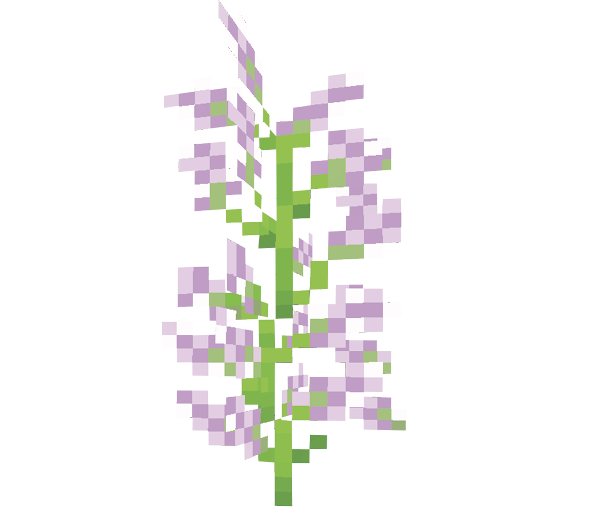
Lilacs are harvested from certain forests, and you can easily turn them into Magenta Dye. If you cut them with Shears, you can plant them as decoration around your house. They have a pleasing color, so you might as well grab a few if you find a place where they grow.
Lily Pad
| Location | Gathered With | Uses |
|---|---|---|
| Grows on Water blocks in swampy areas | Anything | Decoration, bridges |
Lily Pads grow on top of the Water in swamps, and you also occasionally find them when you fish. These items are decorative, but they have minor functionality as well. It’s possible to walk on top of Lily Pads, so they’re sometimes used as bridges when people don’t feel like bringing blocks of heavier material all the way out to a waterway.
Monster Egg
| Location | Gathered With | Uses |
|---|---|---|
| Deep in the Overworld | Anything | Spawns Silverfish |
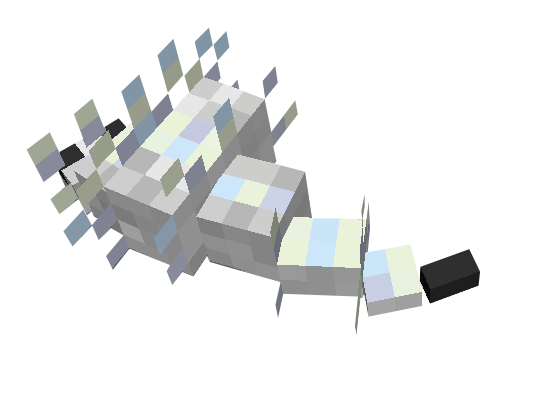
Stone isn’t always what it appears to be. Certain blocks of Cobblestone, regular Stone, and Stone Bricks are actually Monster Eggs. They break to reveal Silverfish, nasty little beasts that try to call their friends to swarm you.
One most often finds Silverfish in strongholds and underneath Extreme Hills biomes. It takes a bit more time to break a Monster Egg compared to a normal block of the same type, so it’s possible to realize that you’re dealing with one before you unleash the beast. When this happens, it’s best to back off and mine elsewhere.
Monster Spawner
| Location | Gathered With | Uses |
|---|---|---|
| Special areas | Pickaxe | Creates monsters! |
Monster Spawners are found in rare areas: dungeons, abandoned mineshafts, Strongholds, and Nether fortresses. These blocks create a specific type of monster; you can tell which by looking inside the Spawner’s cage.
Conditions must be right for a Monster Spawner to create one of its creatures. If you illuminate an area around a Monster Spawner, then it cannot generate any creature that wouldn’t normally appear in bright areas. This provides a way to deactivate Monster Spawners without breaking them. Make the conditions poor for the monsters, and then you have the option of setting up a kill room. Monster Spawners with deadly traps are a great way to generate free experience for your character!
Moss Stone
| Location | Gathered With | Uses |
|---|---|---|
| Dungeons, jungle temples, and Mega Taiga biomes | Pickaxe | Decoration and construction |
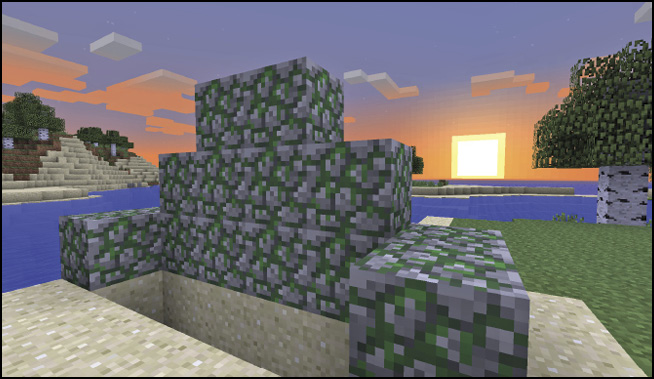
Moss Stones are blocks of Stone that have vines growing on top of them. They’re pretty cool-looking and let you spice up your home base. Gather these with any normal Pickaxe, or make your own by crafting Cobblestone and Vines together.
Recipe
| Ingredients | Crafting Recipe | Result |
|---|---|---|
| Cobblestone, Vines |

|
Moss Stone |
Mycelium
| Location | Gathered With | Uses |
|---|---|---|
| Mushroom Islands | Shovel | Mushroom farming |
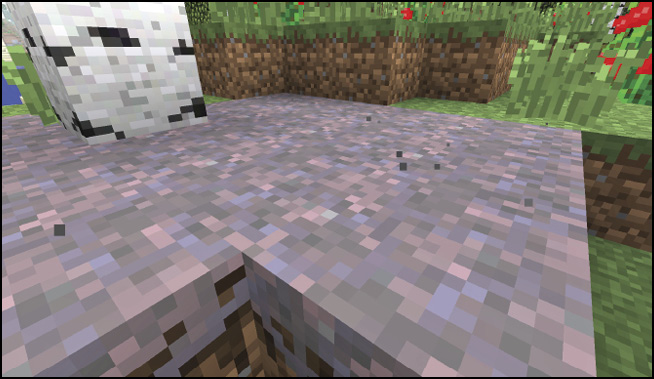
Mycelium is a special type of Dirt block. You find it all around Mushroom Islands, and it allows Mushrooms to grow well even in direct light. If you want to spread Mycelium, cut Grass off of the Dirt blocks around Mycelium to give it space to grow!
Nether Brick
| Location | Gathered With | Uses |
|---|---|---|
| Nether Fortresses | Pickaxe | Construction |
Nether Bricks are the general foundation of Nether Fortresses, a special set of areas in the Nether. These dangerous locations have powerful monsters but the potential for a few rare prizes as well.
Smelt Netherrack to make smaller Nether Bricks. These are crafted in quantities of four to make blocks of Nether Brick. It’s non-flammable, but otherwise has no special properties. If you’re building a defensive area in the Nether and don’t have Cobblestone to use, this is a fair alternative.
Recipe
| Ingredients | Crafting Recipe | Result |
|---|---|---|
| Nether Brick (4) |
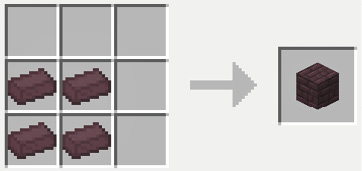
|
Nether Brick Block |
Nether Quartz Ore
| Location | Gathered With | Uses |
|---|---|---|
| The Nether | Pickaxe | Special tools |
Nether Quartz Ore is found commonly in the Nether; it’s a pale vein of minerals seen inside of the Netherrack. It looks alarmingly like marbled flesh. Mine Nether Quartz Ore and then smelt it to get Nether Quartz. That material is used for several decorative elements, as well as for Redstone Comparators and Daylight Sensors. Neat stuff!
Nether Wart
| Location | Gathered With | Uses |
|---|---|---|
| The Nether, in Nether Fortresses | Anything | Brewing |
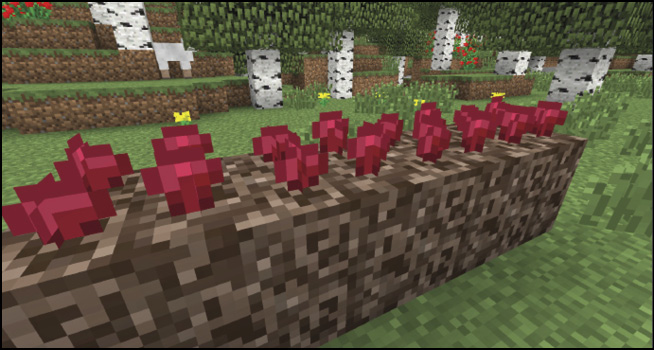
Nether Wart is an herb that appears naturally only in the Nether. It grows on top of Soul Sand, so you must have both Nether Wart and Soul Sand anywhere you want to have a Nether Wart garden.
You can’t do any substantial brewing work without Nether Wart. It’s a core ingredient that leads to almost all good things. So brewing isn’t particularly fun or viable until you gather these herbs.
To get them, go into the Nether and search for Nether fortresses. They contain gardens of Nether Wart along certain staircases, and you sometimes find Nether Wart inside Chests in these forts as well.
Netherrack
| Location | Gathered With | Uses |
|---|---|---|
| The Nether | Pickaxe | Construction and decorative fireplaces |
This type of stone is found in the Nether, and it’s that area’s most common resource. It’s easy to mine Netherrack, but it doesn’t have many uses. It isn’t a pretty stone to work with, and it can be a hazard because any fire that gets onto Netherrack burns forever.
However, this does point to one neat use of Netherrack. A fireplace is great if you put a piece of Netherrack underneath its viewing area. Light the Netherrack with Flint and Steel, and encase the fire in some type of nicer stone fireplace, so your house doesn’t burn down. That’s pretty cool.
If you wish, you can also turn Netherrack into Nether Bricks by smelting it. Nether Bricks aren’t flammable, so they’re more useful and look a little nicer.
Obsidian
| Location | Gathered With | Uses |
|---|---|---|
| Anywhere | Diamond Pickaxe | Construction, Enchanting Tables, Portal to the Nether, specialty items |
Obsidian is formed when Lava and Water crash together. This can occur naturally (especially in impressive underground caves) or encouraged by dumping a Water-filled Bucket on top of a Lava pool. The end result is a dense black stone impervious to everything but a Diamond Pickaxe, and even that takes a bit to penetrate the material.
Obsidian has a number of specialty uses in addition to being an impressive construction material. First, you need it to construct Enchanting Tables (which, in turn, can provide enchantments to help you mine Obsidian). It’s also required in constructing Nether Portals, the only means to travel to the Nether. It can be used to make Ender Chests, which allow you to access anything stored in them, across any location. Finally, Obsidian is used to make Beacon Blocks, which create skyward light beams and provide status effects to nearby players.
Oxeye Daisy
| Location | Gathered With | Uses |
|---|---|---|
| The Overworld | Anything | Decoration, makes Light Gray Dye |
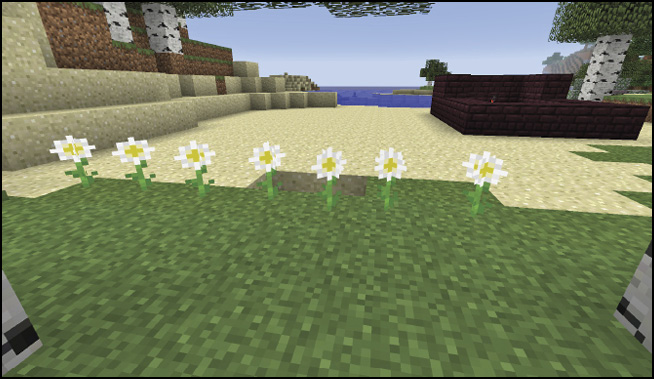
Oxeye Daisies are white flowers with yellow centers. They grow on Grass or Dirt areas in plains and flower forests. They can be used to make Light Gray Dye, but mostly they are simply pretty to look at and add some color to your garden or environment.
Packed Ice
| Location | Gathered With | Uses |
|---|---|---|
| Ice Plains Spikes biome in the Overworld | Pickaxe (with Silk Touch enchantment) | Decoration and construction |
Packed Ice is only found in the rare Ice Plains Spikes biome, and it can be harvested only by using the Silk Touch enchantment. Packed Ice blocks are darker, not transparent, and can’t melt. If you (or a monster) walk on them, you can slide, which makes Packed Ice walkways slightly faster. Most often, Packed Ice is used to create decorative ice spikes, similar to the area where it’s naturally found.
Peony
| Location | Gathered With | Uses |
|---|---|---|
| The Overworld | Anything | Decoration, makes Pink Dye |
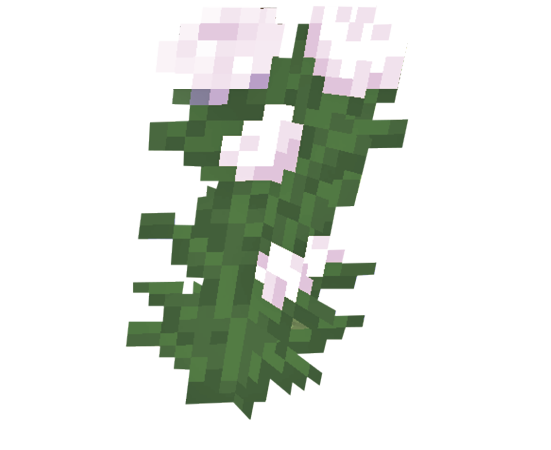
Peonies are pink flowers that grow on Grass or Dirt in forests or flower forests. They’re very pretty plants and can spruce up your home garden, or they can be used to make Pink Dye.
Poppy
| Location | Gathered With | Uses |
|---|---|---|
| The Overworld | Anything | Decoration, makes Rose Red Dye |
Bright red poppies are among the most common flowers in the Overworld, found pretty much everywhere except swamps. They make any location more festive and add drama to any dense forest. You can pick Poppies and plant them all around your house and grounds. They can also be crushed down and used in Rose Red Dye.

Prismarine
| Location | Gathered With | Uses |
|---|---|---|
| Crafting Item | Crafted | Decoration |
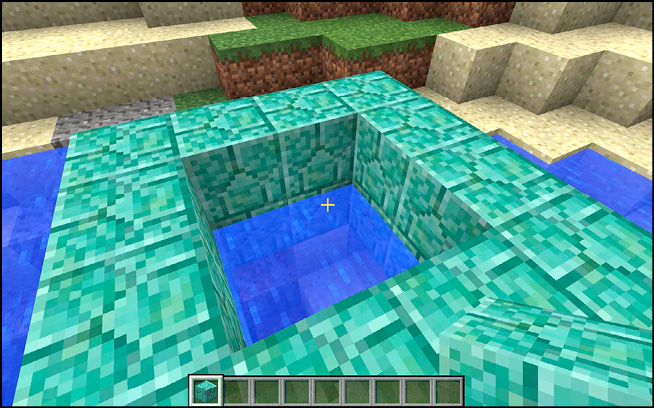
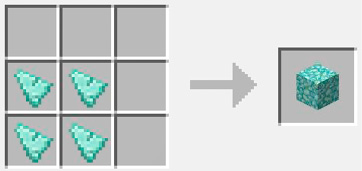
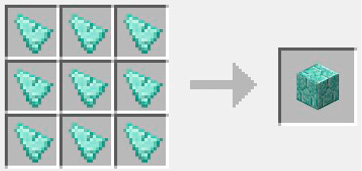
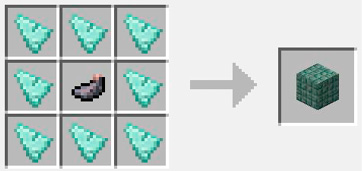
Blocks of Prismarine are used to decorate people’s homes and tunnels. Their various forms are made with Prismarine Shards and Ink Sacs (in the case of Dark Prismarine).
Prismarine is a rare type of stone that you won’t find except around ocean temples. Make sure to harvest this if you ever see it, because the stones are very useful for colored accents and have their own animation changes over time. Seriously awesome stuff.
Recipe
| Ingredients | Crafting Recipe | Result |
|---|---|---|
| Prismarine Shard (4) |
|
Prismarine Block |
| Prismarine Shard (9) |
|
Prismarine Brick |
| Prismarine Shard (8), Ink Sac |
|
Dark Prismarine |
Redstone Ore
| Location | Gathered With | Uses |
|---|---|---|
| Underground, deep in the Overworld | Iron Pickaxe or better | Redstone circuits, Blocks of Redstone, brewing, creating bright lights, Clocks, Compasses, specialty items |
You can find Redstone Ore in the bottom 16 levels of the Overworld. You have to dig deep, but once you get there, it isn’t too tough to find. Make sure you have at least an Iron Pickaxe with you, because nothing else will release the glowing red ore.
The glow of Redstone is linked to its most wonderful property: it can transmit and conduct energy. Redstone Ore itself produces light and bright red particles when anything nearby touches it, making it useful as a monster alert system.
You can use the Redstone gained when you split Redstone Ore apart even more creatively. Redstone Torches form a power source, and Redstone Dust (also called Redstone Wire) can be sprinkled along a path to transmit that power. Thus, you can use Redstone to make any number of electromechanical creations that can move or shift whenever you want. This includes working Dispensers, Repeaters, Pistons, Droppers, and much more. Any working mine needs a long Minecart rail system marked with Redstone torches and strengthened by Redstone-linked Powered Rails.
You can also use Redstone to make your daily Minecraft life a bit more regular; it’s a necessary ingredient in both Clocks and Compasses. Clocks help you to plan out your day, and a Compass is a vital piece of equipment for any explorer—it can be a life saver.
Finally, Redstone is a component employed in brewing. It’s used to make Mundane Potions (the base for many other potions), and it can be used to strengthen other potions or revert them back to a lower tier.
Redstone Dust (Redstone Wire)
| Location | Gathered With | Uses |
|---|---|---|
| Anywhere | Anything | Redstone circuits |
The moment you plunk down a piece of Redstone in the world, it crumbles into Redstone Dust. The pieces of dust make a line capable of transmitting Redstone power from one location to another, which leads to another name for this material: Redstone Wire. Any energy flowing through the line makes it glow bright red.
The essence of Redstone Dust is that it allows you to create working, moving, and shiftable mechanical creations. It’s a vital component of Redstone-based circuits. The Redstone Dust links a power source, such as a Redstone Torch, a Lever, or Button, to a transmitter component, such as a Door, a Repeater, a Piston, or an Activator Rail to start a Minecart. This allows you to transmit energy to create a desired effect. For example, you can make a door on the far side of your house open by pressing a button. Or you could climb into a Minecart and ride down into the underground depths. Any types of things are possible with Redstone-powered materials, and you’re limited only by your quantity of Redstone Dust and your imagination.
For more information on Redstone, check out the Redstone section in the “You Can Do Anything with a Little Practice” chapter.
Rose Bush
| Location | Gathered With | Uses |
|---|---|---|
| The Overworld | Anything | Decoration, makes Rose Red Dye |
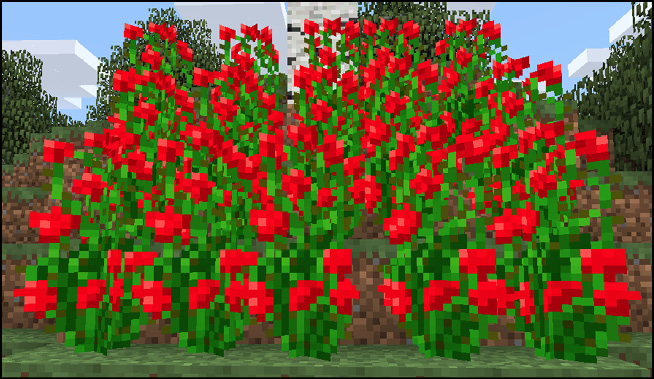
These are shy plants, found only in forests and flower forests. However, if you stumble upon them, Rose Bushes are renowned for their beauty. They make a gorgeous addition to any garden, and they can be used to make Rose Red Dye.
Sand
| Location | Gathered With | Uses |
|---|---|---|
| The Overworld, along coasts and in deserts and some mesas (as Red Sand) | Shovel | Construction, Sandstone Blocks, Glass, TNT, farming |
Some people may discount Sand as an unimpressive material, but they’d be wrong! While Sand may not seem exciting, it definitely has its uses. Sand can be stacked on its own, as in a seawall against the ocean, or compressed into Sandstone and used to construct anything else. It’s also a necessary ingredient for Glass; all you have to do is melt it in a Furnace.
Sand is a wonderful base on which to grow Cacti and Sugar Cane, so it’s a nice addition to your farm. Most areas have at least some Sand nearby, so it usually isn’t difficult to acquire.
Finally, add some Sand to your Gunpowder to make an explosive creation! TNT can be used to blow up mountains, expand your mines, and generally stir up some fun. You owe it to yourself to at least try to blow something up.
Slime Block
| Location | Gathered With | Uses |
|---|---|---|
| Crafted item | Anything | Transportation |
Slime Blocks look almost like living Slime monsters, which makes sense; they’re made from Slimeballs. Slime Blocks have a few unique properties. They can make anything bounce that lands on them—including you! If you want a trampoline, you can make a pretty fun one with Slime Blocks. Additionally, they can slow down things that move over them, which makes them useful for traps. Finally, if Water flows over a Slime Block, it speeds up anything moving over it. Build a Slime Block pathway with guard rails just under a river, and you have a perfect transport device. Have your character use it as a quick slide, or shift materials down the river like an old-fashioned logging operation.
Soul Sand
| Location | Gathered With | Uses |
|---|---|---|
| The Nether | Shovel | Traps, transportation, farming, making a Wither |
The Nether holds a number of dangers, and wandering into a stretch of Soul Sand doesn’t help. This gray-brown substance, often found near large Lava fields, slows down anything walking through it. It’s also slightly smaller than most other blocks, adding a slight challenge to getting out of it.
However, Soul Sand’s slowing property makes it perfect for traps! A track of Soul Sand around your property can slow down and corral large numbers of monsters, which you can then mow down en masse. This also works against players in PvP multiplayer situations.
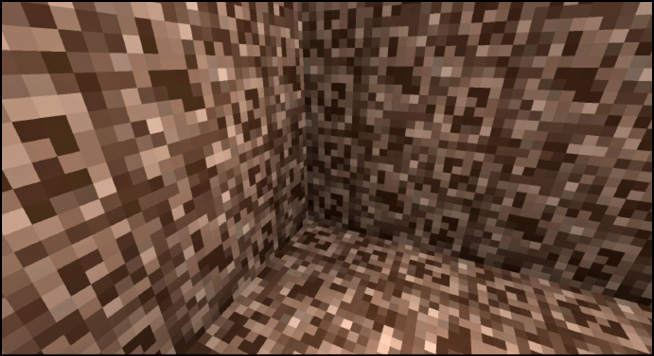
Soul Sand is the only material on which to grow Nether Wart, the primary component of all potions. If you’re interested in brewing, make sure you have an ample supply of Soul Sand!
Finally, Soul Sand can also be used to summon a horrible monster, a Wither. But you should really know what you’re facing before you do this; you don’t want to mess with Withers unless you’re prepared in advance.
Sponge
| Location | Gathered With | Uses |
|---|---|---|
| The Overworld (Underwater) | Anything | Decoration or absorbing water |
Sponges, when dry, absorb up to 65 blocks of Water from the area that they’re placed in. Once full, they become Wet Sponges and won’t absorb any more Water until they’ve been dried out in a Furnace.
Sponges are sometimes found when you kill Elder Guardians near an ocean temple. There are also rooms inside some of these temples that have Wet Sponges already inside of them. Break them to steal these rare items and take them home as loot!
Stone
| Location | Gathered With | Uses |
|---|---|---|
| The Overworld | Pickaxe | Construction, some specialty components |
Stone is something you seek out in your early days of Minecraft. It’s one of the most common materials in the Overworld, but sometimes you have to dig before you get to it, depending on your circumstances. From that point on, though, you face no shortage of Stone and Cobblestone (the material produced when you break Stone).
If you want to form your Cobblestone back into Stone, all you have to do is smelt it in a Furnace, turning it back into Stone blocks. You can use these to make Stone Slabs or Stone Bricks. You can also make a few specialty components: Redstone Comparators and Redstone Repeaters.
The most common use of Stone is as a general construction material. It’s pretty durable and fairly nice looking, and it has a very realistic appearance. Try using Stone to make a truly impressive castle or bridge!
Stone Brick
| Location | Gathered With | Uses |
|---|---|---|
| Crafted item | Pickaxe, Furnace | Construction, decoration |
Stone Brick is a decorative material made from Stone, and it provides a different look than other building materials. Stone Bricks are very similar to Clay Bricks, except they require slightly less material and time to make.
Strongholds and temples use Stone Bricks in their construction, so you can get an idea of what they look like when you visit these locations. Additionally, Stone Bricks can be chiseled (Chiseled Stone Bricks) or covered in moss (Mossy Stone Bricks) for even more decor choices.
Sugar Cane
| Location | Gathered With | Uses |
|---|---|---|
| The Overworld, near Water | Anything | Farming, making Paper and Sugar |
You can find Sugar Cane growing as a series of three long, thin, green tubes anywhere near Water. Farming your own supply is pretty simple; knock down the top two pieces and plant it along the Water’s edge. It grows as a stack, and you can harvest the top pieces as they become available. Of course, you can always make more impressive Sugar Cane farms. All you need is the Sugar Cane itself, Water, something nice for it to grow on (Dirt and Sand), and your imagination.
It’s a good idea to have a fair supply of Sugar Cane as your game progresses. You need Sugar Cane to make Paper, and without Paper, you can’t make Bookcases. And without Bookcases, you can’t have a fully powered Enchanting Table. Any excess Sugar Cane can be processed into Sugar, which is useful for making Cakes and some potions.
Sugar Cane itself creates air pockets in Water. You can intersperse Sugar Cane within Water to make small airlocks. It can also block the flow of Lava, which is a pretty neat trick for a simple plant.
Sunflower
| Location | Gathered With | Uses |
|---|---|---|
| The Overworld, in Sunflower Plains | Anything | Decoration, Dandelion Yellow Dye |
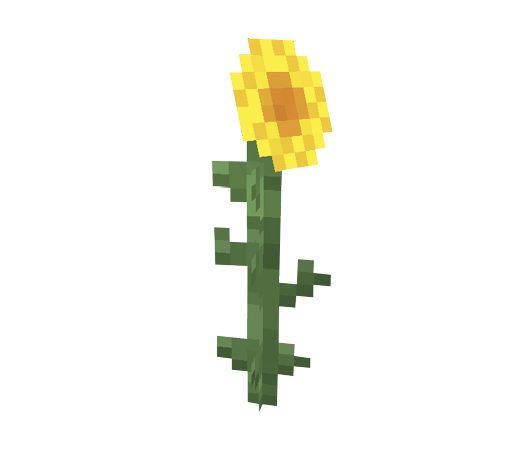
These lovely yellow flowers are found only in special Sunflower Plains, where they add a bright counterpoint to the smooth green landscape. You can pick Sunflowers at your leisure, and they make a nice addition to your living space. If you want, you can crush them to make a nice yellow dye, the same dye made with Dandelions.
Tripwire
| Location | Gathered With | Uses |
|---|---|---|
| Anywhere | Anything | Traps |
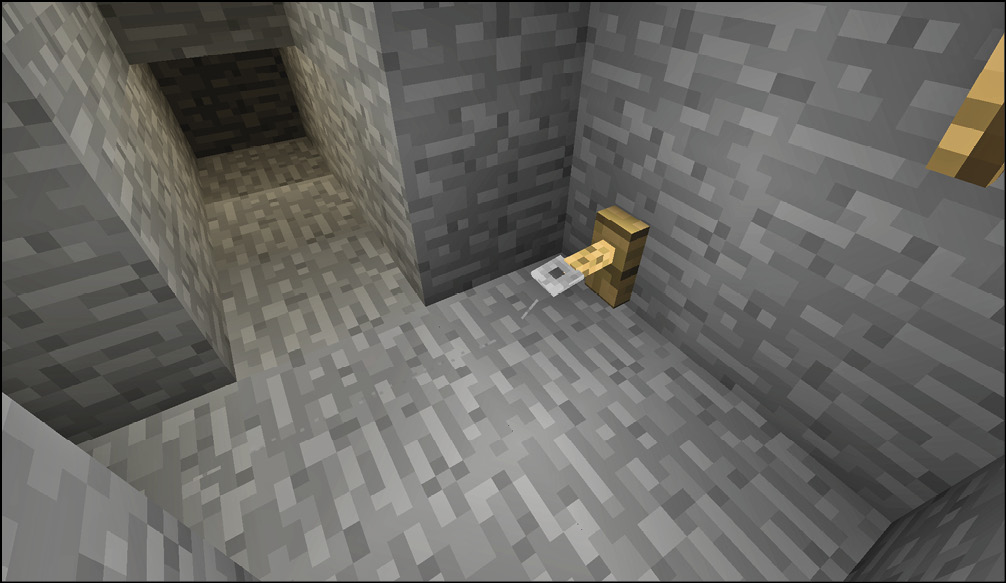
No trap would be complete without a Tripwire! Made when you place a piece of String, the small gray Tripwire connects signals from Redstone-powered circuits to Tripwire Hooks on opposite ends. When something collides with the Tripwire, a pulse is sent to the Tripwire Hooks, triggering the trap.
It’s very difficult to see a Tripwire unless you really look for it. If you do see one, though, you can cut it with Shears, which disarms the trap.
Traps are much more common in multiplayer games, but they do occur in jungle temples in single-player. If you ever explore a jungle temple, it’s best to keep your eyes open and your Shears ready for Tripwires! This can spare you from a painful arrow to the knee or a falling rock pile.
Tulip
| Location | Gathered With | Uses |
|---|---|---|
| The Overworld | Anything | Decoration, making Dyes |
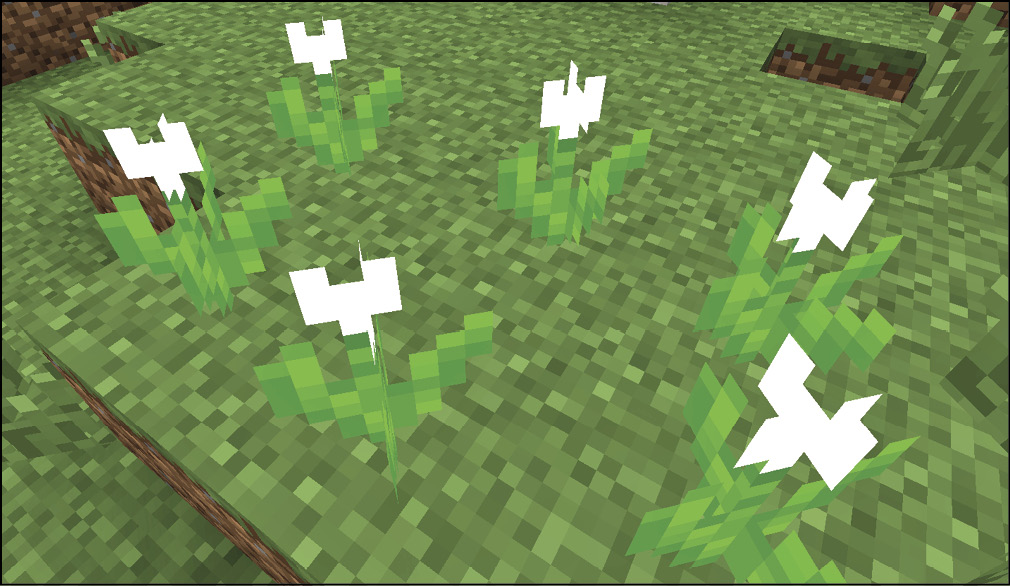
What flower grows between your nose and your chin? Easy! Tulips—get it? Two lips! Okay, well, maybe not… Instead, you can find Tulips on the plains, including sunflower plains, and in flower forests. They come in a wider variety than most other flowers; you can find white, pink, orange, and red Tulips.
Like other flowers, Tulips can be put around your house as decoration. You can also make dyes, depending on the color of your Tulips: Light Gray Dye from white Tulips, Orange Dye from orange Tulips, Pink Dye from pink Tulips, and Rose Red Dye from red Tulips.
Vines
| Location | Gathered With | Uses |
|---|---|---|
| The Overworld, in swamps and jungles | Shears | Transportation, decoration |
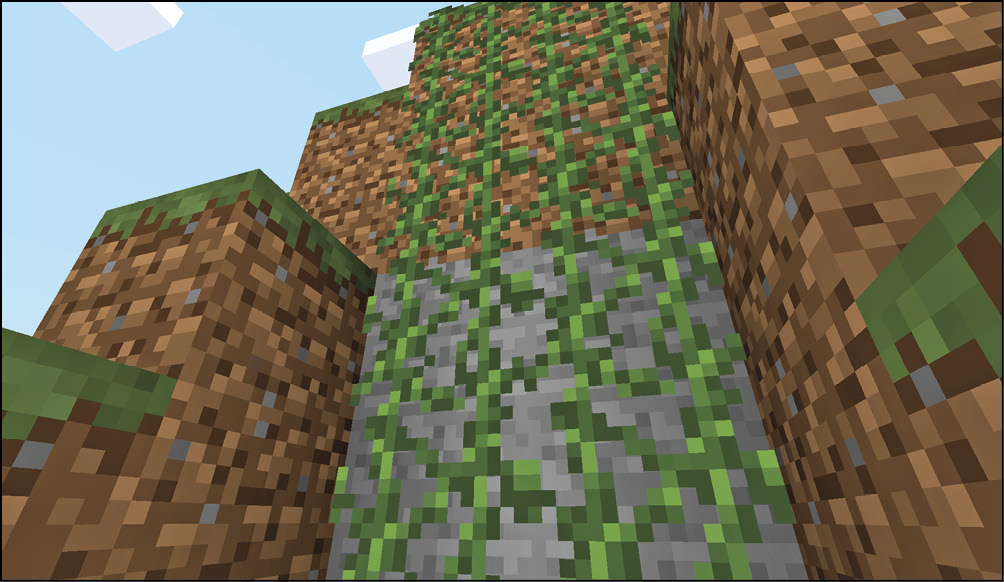
Jungles and swamps are covered in dense vegetation, and the trees are surrounded by quickly growing Vines. However, these Vines provide some real benefits: they can be climbed, just like Ladders, and they can hide you or anything you build from sight.
To climb a Vine, simply move onto it from any solid block. “Sneaking” on a Vine causes you to stop; you can use this to hover in place. Falling onto a Vine greatly reduces falling damage, so they make a good safety system.
If you want to grow your own set of Vine “ladders,” you must harvest the Vines with Shears. Vines grow only on solid blocks, and they grow down into any empty space below them. They don’t need light to grow, either. Vines are perfectly happy to take over any territory beneath them, under any condition. Vines block line of sight, so monsters (even Endermen) and other players won’t see things behind them. You can make secret passageways and hidden nooks using hanging Vines. They can even be placed over Chests, making them perfect for creating your own jungle temple.
Wood
| Location | Gathered With | Uses |
|---|---|---|
| The Overworld | Axe | Construction, making Wooden Tools, making crafting materials, fuel |
Wood: it’s what you gather your first day, every time. Most biomes have at least a reasonable supply of trees, and if you don’t find any, it’s worth running and searching for them. Wood comes from any type of tree (Oak, Spruce, Birch, Jungle, Acacia, and Dark Oak), and you need Wood (as Wooden Planks) to make your Crafting Table. From there, you use Wood to make your first set of Wooden Tools, especially a Wooden Axe to get more Wood, and then to create other useful items, like Chests and Torches. Other useful items you make from Wood include Fences, Ladders, and Doors. And if you can’t find any Coal early on, Wood is your first means of making your own light; burning it in your Furnace helps stave off the darkness and creates Charcoal in the process.
As you become more comfortable with the game and gain access to additional materials, Wood becomes less valuable, but you never want to be completely without it. Even if you deforest the area around you, it’s worth starting a sapling farm. Without Wood, you can’t make any tools at all, and that is a true problem.