
Dungeon Siege III Guide Essentials Lorebook
The World Of Ehb
Knowledge is power, legionnaire, and you’ll find a wealth of knowledge pertaining to the history of Ehb and its inhabitants here, in the Lorebook. Every scrap of lore you can acquire over the course of the adventure has been painstakingly transcribed here, presented in the order in which they’re encountered during the adventure. Now you can peruse Ehb’s rich history at your leisure...
Bounty Notice
Pilgrims’ Road
Our employer has put a bounty, in the sum of 500 gold coins, on the heads of all legionnaires—dead or alive. In the former case, only confirmed kills will be paid. Good hunting!
Remnants of a Fallen Empire
Legion Chapterhouse
Many centuries ago, explorers from the Empire of Stars crossed the Aranoi Desert and discovered a fertile country, rich in arable land and mineral resources. The Imperial explorers were soon followed by tradesmen and prospectors, and in time, this new land—called Ehb—became an Imperial colony.
When the Empire of Stars collapsed, Ehb was a refuge for the 10th Legion, the finest and best-trained of the Imperial armies. The noble legionnaires protected Ehb during the War of Legions, when the old Empire tore itself apart. The 10th Legion also defeated the wicked Seck, who briefly occupied Ehb after the war. At the war’s end, the commanders of the 10th Legion established the new and independent kingdom of Ehb, which persisted in relative peace and prosperity for over 400 years. Throughout Ehb’s history, the 10th Legion provided stability and protection for the kingdom, though they left rulership of the kingdom to an independent monarchy.
Raven’s Rill
Legion Chapterhouse
The town of Raven’s Rill sits astride the clear mountain stream that shares its name. In ancient times, this was the site of a portage, where travelers would pull their boats from the water and carry them down a short trail, past the waterfall and rapids, before re-entering the Rill. The village was founded here for this reason, and it became a convenient waystation where travelers could rest and resupply before continuing downriver.
Most of the residents are of mixed Virsk and Lescanzi blood, so they tend toward darker hair and complexion. The town is administered by a boyar—an archaic title of nobility. For the past two centuries, this title has been held by the Bassili family, who claim to be descended from famous Imperial explorers, Fedwyrr and Klars. Rumors suggest that the Bassilis are actually descended from a grumpy mule driver who is mentioned in Fedwyrr’s journals—a claim that is steadfastly denied by the family.
Lords of the Wild
Legion Chapterhouse
Among the most feared denizens of the Rukkenvahl forest are the dakkenweyr—the Beast Lords. They walk upright, but they hate the races of men, and they have power over all the beasts of the land. These creatures display an alarming intelligence, and they decorate themselves with river mud, clay, and occasionally blood.
Dakkenweyr share features in common with many dangerous beasts, such as bears, wolves, and wolverines, suggesting kinship to all. It is said that dakkenweyr are relics of a vanished age, before any beast had bowed its head to humanity. They dwell in wild, untamed places, far from the centers of human habitation. Hunters and trappers claim to know when they have trespassed into a dakkenweyr’s territory by judging the aggressiveness and intelligence of local animals. Large predators that dwell within a dakkenweyr’s territory are uncharacteristically hostile toward intruders.
Rukkenvahl Lore: The Mournweald
Legion Chapterhouse
The ancient forest—known as the Mournweald—has always been a strange and unpredictable place. Local people believe that the Mournweald has a consciousness—an awareness of its own. Few have ever entered the forest—barriers of thorns and roots have kept them out.
We have only rumors and half-remembered stories to tell us of the forest’s interior, but it seems to be different for every person who ventures inside. Some stories tell of a trackless, primeval wood—a relic from the time of the creator gods, at the dawn of the world.
At the heart of the Mournweald is the great tree where the Legion is said to have made their last stand. It has only been seen by a rare few, who seem to have been “invited” inside. They speak of great rifts in the ground, crossed by bridges—sometimes natural, sometimes manmade—as if the forest is guiding them to its heart. But the path is not always there when they try to retrace their steps, and many who have entered the forest have never come out again…
The Wanderers
Legion Chapterhouse
Of all the desert peoples, the Lescanzi are best known to the kingdom of Ehb. They are a wandering race, driven from their ancestral homeland centuries ago. In the intervening years, they have spread across the Aranoi Desert and its surrounding nations, earning coin as itinerant peddlers, storytellers, and mercenaries.
The Lescanzi are a mongrel people, intentionally mixing their bloodline with as many other tribes and clans as they can. Their women are known to seduce the most attractive and intelligent foreign men, hoping to enrich the bloodline of their people. They also borrow freely from the customs, clothing, and technologies of other cultures. It is believed that Lescanzi blood flows in the veins of most commoners throughout the Rukkenvahl.
Most Lescanzi worship a pair of deities called the Dark Sister and the Faithful Hound. These two entities have many proper names, but the recurring image of a darkly beautiful woman and her devoted mastiff is common across all the clans.
Legion Lore: The Causeways
Legion Chapterhouse
In ancient days, Legion mages built the Causeways to allow quick passage from one part of the kingdom to another. Though all legionnaires are permitted to enter the Causeways, only a few are granted the ability to open and close the gates. Even fewer know how to construct them.
The art of fabricating Causeways is thought to have originated in the Empire of Stars. By the time of the Empire’s fall, each of the Imperial Legions had its own complicated network of Causeways, which they used to their advantage during the terrible War of Legions. Entire armies would move from one side of the Empire to another, in the space of a night, and it was impossible to predict where the next battle might occur. This led to absolute chaos, and ultimately to the dissolution of the Empire. The 10th Legion may originally have withdrawn to Ehb because this kingdom was, at the time, a backwater, and no enemy Causeways extended so far from the Imperial heartland.
The Causeways pass through another world—though its name is long forgotten. Nor does anyone remember how that world was first discovered or what relationship it may have to our own.
The Rukkenvahl
Legion Chapterhouse
South of the Green Range lies a thickly forested valley. Royal cartographers refer to this region as the Rukkenvahl, an archaic Virsk word meaning “vale of ravens.” Anyone wishing to enter or leave Ehb by land must pass through the Rukkenvahl, but it remains the most sparsely populated part of the kingdom.
The forest is ancient and brooding, and it is still gripped by the ancient forces of nature. Its people are simple, superstitious folk, more willing to trust in pagan magics than the distant promises of the Azunite Church. The Rukkenvahl’s name arose from the flocks of ravens that once blackened its skies. The birds are fewer in number now but can still be seen with regularity.
Only one settlement of note can be found here, and that is the village of Raven’s Rill. It lies along a clear mountain stream—the only safe source of water in the valley, from which the village took its name.
Birth of the Legion
Legion Chapterhouse
Our Legion was founded in the Empire of Stars, nearly 1,400 years ago, on the far side of the Aranoi Desert. At the time, the Empire was wracked by civil war. The Emperor had been murdered, and the commander of the 3rd Legion had usurped the throne, while the heartland was ravaged by goblins and barbarians.
Three friends were encamped upon the barren Plain of Tears when they shared a vision of a radiant child, with golden hair and piercing eyes. He told them to go forth and gather a company of heroes from all the nations and tribes of the Empire. And they would know the worth of each hero by a simple test. Any man or woman who shared their vision of the Radiant Youth would be admitted to their fellowship, while those who did not see the child would be turned aside.
And when the founders assembled their host, they numbered more than a thousand, and they rode against the usurpers of the 3rd Legion and drove them from the Imperial City. Thus was the 10th Legion born.
Boris’s Orders
Pilgrims’ Road
Boris,
Take a detachment of soldiers south, and destroy the bridge that leads into the swamp. Our employer believes that a few legionnaires may have survived our attack on the Montbarron Estate, and she wants to be sure that they do not escape the valley.
Lescanzi Orders
Stormsong Cavern
Sister Vera,
Make ready the required incantations and pre-ritual preparations and await my return. Let us hope our catch has information on where others of Legion blood can be found. This promises to be a very profitable campaign. I must discuss important matters with our employer, and I will be visiting the town’s graveyard to “restock” our necessary supplies. I will return well before the midnight hour is upon us. Do not disappoint me.
Zaria
The Headmaster’s Journal
Gunderic Manor
Lord Stephan has become very secretive of late. He has commissioned me to create an elaborate magic door to guard his study. As my knowledge of magical constructs is without equal, the task was arduous, but not impossible. I must say, I am rather proud of the final result—although I was unable to give the guardian much of a sense of humor, despite my best efforts.
Before I attempt to build any more constructs, I should probably make a better study of human behavior. On that note, perhaps I should get out and talk to someone who isn’t a scholar, from time to time. Furthermore, perhaps I should venture into town and talk to a woman…for once. Mother would be so disappointed in me.
Lord Stephan has asked that I change the password on the door, as he will likely forget the arcane words that I chose. The new password will be “Nagog.”
—Headmaster Peverell
Lord Gunderic’s Journal
Gunderic Manor
With each passing day, the pain of losing my Isabella grows keener. I find myself taking the Causeway to the Raven’s Rill cemetery more and more often, just to be close to her. My daughter asks why I am always gone, and my students mutter that I’ve lost my mind. Perhaps they’re right. I’ve become soft and weak…but no more. Tomorrow, I will return to the mausoleum one last time and seal Isabella’s sarcophagus behind a wall of mortar and stone. I intend to break the Causeway connection, as well, so that I might never return to that place. I will let my wife go and be free of this sorrow, at last.
Lord Gunderic’s Journal: Entry 24
Gunderic Manor
Tragedy compounds upon tragedy. So soon after losing my beloved Isabella, now I find that my daughter, Alise, has taken ill. As all the old gods are my witnesses, I will not lose her as I lost her mother. I will find a way to save her.
Lord Gunderic’s Journal: Entry 40
Gunderic Manor
At long last, hope! In my studies, I have found evidence of an artifact that will save my Alise and keep her at my side. It is called the Heart of Nagog, and according to my texts, it is held by the First People in the Eastern Swamp. I’ve already begun mustering my forces—within the week, the Heart shall be mine.
Lord Gunderic’s Journal: Entry 83
Gunderic Manor
The Heart of Nagog is mine at last. It cost the lives of most of my loyal retainers, but to possess the Heart I would gladly pay any price. Already it begins to reveal its secrets to me. I feel it watching me, studying me, just as I study it. But my mind is the greater and I will have its secrets before it has mine.
A Missive from Hugh Montbarron
Gunderic Manor
My Dear Friend Stephan,
Our scouts have located the half-giant brigand we have been hunting. The brute has hidden himself within the Heroes’ Crypt, a blasphemy I cannot bear to dwell upon. Still, with Jeyne Kassynder on the march, we cannot spare the time or the manpower to root him out. Meet me at the Heroes’ Crypt at sunset, and we will seal its doors together. After we defeat Jeyne Kassynder, we can deal with this Drakomir at our leisure.
Yours in Brotherhood,
Hugh Montbarron
Gunderic Manor: A History
Gunderic Library of Arcana
In a family marked by tragedy and ill fortune, Geoffrey Gunderic—the 6th of his line—was perhaps the lone exception. He was widely respected by his comrades in the Legion, who appointed him Grand Mage in the year 960. During his tenure, he established a rigorous system of education for mage apprentices and offered his own family’s estate as a magical academy for the Legion.
Throughout the following centuries, Gunderic Manor served the Legion as a training ground for apprentice mages. Probably its most famous alumnus was the traitorous Grand Mage, Olvis—rumored to be the illegitimate son of Rossal Gunderic and a Lescanzi witch.
During the Affair of the Goblin Pretender, Olvis’s close disciples seized control of Gunderic Manor. The new Grand Mage, Merik, had little choice but to liberate the manor by force. After that, Gunderic Manor acquired a somewhat darker reputation, and most Legion mages chose to study at the Stonebridge Collegium instead.
Coalfire Stones
Gunderic Library of Arcana
Named after their creator, Eva Kollfehr, coalfire stones were once quite common, in the early years of the kingdom. They glowed white-hot, while being moderately warm to the touch. Legion mages crafted these magic stones to power simple mechanical creations and small automatons.
Each coalfire stone was unique to the object it powered, so mages sometimes used them as keys, to guard valuables. For example, if a coalfire stone was used to power a lock mechanism, the mage could remove the stone and be certain that the lock could not be opened until the coalfire stone was put back in its place.
The Life of Merik
The Inner Sanctum
Perhaps the greatest of all the Legion’s mages was Merik, who rose to prominence during the Affair of the Goblin Pretender, when the traitorous Grand Mage Olvis led the kingdom to the brink of civil war. It was Merik who defeated the plans of his former master, and as a reward, he was appointed to the position of Grand Mage, in Olvis’s place.
Over the next 60 years, Merik served a series of monarchs, while standardizing the study and practice of magic in the Legion. But in the year 1144, Merik fell into a trap, set by a notorious goblin inventor, who stole Merik’s staff. This theft led to the release of the wicked Seck from their ancient prison.
Fortunately, Merik was freed from his prison by the future Lady Montbarron, and he assisted her in reclaiming his staff and defeating the Seck. Merik’s later years were marred by a bitter disagreement with his only son, the brilliant Gerhart Manx. Sadly, the two never reconciled, and Merik died a well-respected but sorrowful man.
Torn Letter
Gunderic Library of Arcana
Lord Gunderic caught some rather foolhardy thieves in the manor today. I’m still having trouble getting the smell of their scorched flesh off my best set of robes. The unfortunate footpads managed to steal Headmaster Peverell’s coalfire stone while he was in town. Apparently he was trying to flirt with a local beauty (unsuccessfully no doubt), named Ludmila, when his pocket was picked. In any event, the would-be thieves sneaked into the manor and got as far as the lecture hall before they were caught.
Lord Gunderic was enraged with Peverell and forbade anyone from removing the bodies—or the coalfire stone. He said it was a perfect deterrent for future stupidity. Seems foolish to me, since the stone opens the gate to the guarded section of the library. But I’m not about to bring that up when Gunderic is in one of his dark moods.
Children of the Swamp
Gunderic Library of Arcana
The Eastern Swamp is inhabited by the First People, who long ago fell into inbred decadence. Their numbers are few, and they live in foul hovels and nests, which usually lie beneath the towering roots of the giant mangrove trees.
First People settlements are marked by grisly cross-poles, from which hang many desiccated heads. Surprisingly, these heads do not belong to victims of the First People—they are actually their own deceased relatives, whose spirits are captured after death and bound inside their heads. Amongst these people, reunion with the River of Souls is seen as a terrible thing—a loss of tribal and clan affiliation and an unwelcome union with hated foreign peoples.
The First People are an ill-favored race, with very pale skin and limp, dark hair. Because their population is so small, and they breed only with one another, they tend to look alike, and outsiders can rarely tell one from another.
Lord Gunderic’s Journal: Entry 95
Gunderic Library of Arcana
Lies! Treachery! The Heart of Nagog saved my daughter from death, but not in the way I hoped. Her shade is trapped within this hall now, damned as I have surely damned myself. I will destroy the Heart—it is the only way. Forgive me, Alise.
The River of Souls
Gunderic Library of Arcana
From the teachings of the Azunite Church…
When a mortal body dies, the spirit is compelled to leave this world, returning to the source of all life—the River of Souls. If the mortal led a good life, and his spirit is unencumbered by sorrow or regret, he slips easily from the world and finds his way to the river. There, he rejoins all the spirits that came before, becoming one with his brother- and sister-souls. The experiences of his life enrich the river and all the souls that dwell within.
But if a mortal lived a wicked life, or if he cannot free himself from the cares of his mortal life, then he will not find his way to the river. Instead, he will remain trapped in this world, and his mind will gradually decay into madness. From these unfortunate spirits, foul ghosts and specters arise. To release them from their torment and send them back to the river, they must be confronted and slain.
Scribbled Note
Gunderic Library of Arcana
These worthless books all miss one key point. Once a mage has bound himself to the Heart, it is all but impossible to destroy it, or to allow it to be destroyed. The Heart protects itself. Even now, I feel it in my mind. It is a struggle even to write this—even to imagine the Heart’s destruction. Perhaps I…
Artifacts of the Creators: Volume IV
Gunderic Library of Arcana
And so it was that Nagog the Maker fell from the sky and came among the First People, who dwelt in the Eastern Swamp. The First People worshipped Nagog as a god, and he loved them for it, but Nagog was sorely hurt by his fall and in due course died. Before he expired, he gifted the First People with the Heart, an enormous gemstone said to contain great power to heal or harm, said even to be able to return the dead to life. It resides there still, held in the holiest shrine of the First People.
The Heart of Nagog: Pagan Rituals
Gunderic Library of Arcana
By observance of the proper rituals, performed at the auspicious time, a mage may call forth the great powers that lie within the Heart of Nagog and tether it to his own. By this merging of mortal soul and ancient, immortal essence, the mage’s power is made vast and unimpeachable. No force in the world of mortals can sever this bond, save by the destruction of the Heart of Nagog itself. He who desires this outcome should beware, for the sundering of the Heart will cause all of its power to flow into the mage, making him like unto a god himself.
The Creator Gods
Gunderic Library of Arcana
Centuries before the birth of the Azunite Church, the ancients told stories of the long-lost gods who created our world. Legends of the so-called creator gods are so old that we have only fragments of the original tale. We are told, for example, that the cosmos is arranged in a series of increasingly spiritual realms, with the material world at the bottom and unknowable divine paradises at the top. The creator gods occupied the lowest of these divine realms, and they shaped our world as they saw fit.
Then, thousands of years ago, the creator gods tumbled from the heavens. None of the stories tell us why. A few may have survived in our world, for a time, but they have long since died, if they ever existed at all. Of their servants, we know little more. The messengers of the gods were called archons—spirits of fire who carried out their gods’ will. Some mortals have claimed descent from the archons…but their lines are long dead, and we cannot say if such a thing could be true.
Lord Gunderic’s Journal: Final Entry
The Inner Sanctum
I am beset by traitors and fools! The Kassynder woman and her horde of fanatics are marching on the valley, but the Heart tells me what to do. With its power I can protect myself, protect my family. I have called my mages and apprentices together—we will seal the walls, and when the time comes, we will crush our enemies!
The Heroes’ Crypt: Part I
The Inner Sanctum
Following the death of Lady Montbarron, commonly known as the Farmer, a glorious tomb was constructed in the Rukkenvahl, overlooking the lowlands to the south. It was commissioned by the Lady Montbarron’s son, Wilhelm, and Lord Tescelin Gunderic, representing the two Legion families who dwell in the valley.
At first, the crypt was only intended as a resting place for the Lady Montbarron and her 14 companions—the heroes who had fought and defeated the Seck. But many others had died in that struggle, and their families petitioned the king to move their remains to the new crypt, as well. As time passed, many hundreds of bodies were relocated to the Heroes’ Crypt—legionnaires, Azunite priests, and even ordinary citizens who had fought in the brief war with the Seck.
A History of the Seck Resurgence
The Inner Sanctum
In the year 1144, a notorious goblin, known only as the Inventor, attempted to take revenge upon the 10th Legion for their defeat of his people, years before. He set a trap for the Grand Mage, Merik, entombing him in a block of ice and stealing his magical staff.
Unfortunately, the staff had a secret purpose. Its power kept the evil Seck imprisoned in the Chamber of Stars, underneath Castle Ehb. When the staff was taken from the hands of the Grand Mage, the Seck were set loose, and they raised an army of beasts to destroy the Legion and the kingdom of Ehb.
At this critical moment, a heroine arose, from the farmlands of the west. She gathered 14 heroes to her side and led them against the minions of the Seck. In the Chamber of Stars, she confronted the demigod-king of the Seck, and she slew him. For her valor, this simple farm girl was granted a noble title and lands of her choosing. She became the first Lady Montbarron and was inducted into the ranks of the Legion…
Thief’s Letter
East Forest
Emaus,
I’ve heard rumors of a treasure room in the old Legion Chapterhouse. My source tells me that it’s hidden behind a large bookcase, on the upper floor. If all the genealogies are returned to the shelves, a secret door will open, and the treasure will be yours. Just don’t forget who tipped you off—I expect my share of the loot!
Your old chum,
Andrei
The House of Manx
Shadowrift Cavern
The Manx name was first adopted by the eccentric Gerhart Manx, only son of Grand Mage Merik. Gerhart sought to distance himself from his all-too-famous father, so he moved to the city of Stonebridge, where he spent most of his time in the company of goblins.
This was, at the time, a considerable scandal. Gerhart’s father, Merik, had twice been betrayed by goblins, and he hated their kind. He refused to speak to his son, ever again. After being disowned by his father, Gerhart took the name Manx, which he passed on to his own children.
Like all the great magical families, the Manxes are believed to be descended from Numerius the Wise, one of the original founders of the Legion. If this is true, then the bloodline is almost 1,400 years old.
The House of Gunderic
East Forest
In the final days of the War of Legions, the 10th Legion fought a pitched battle with their ancient rivals, the 3rd Legion, at the edge of the Aranoi Desert. The 3rd was beaten, but a large contingent of men surrendered, led by their Grand Mage—Raymund Gunderic.
The 10th Legion commander showed mercy to the survivors, granting them sanctuary in the newly formed kingdom of Ehb. Raymund Gunderic was given a noble title, on the condition that he administer the valley of Rukkenvahl and keep the northern lands safe.
The Gunderics proved an ill-fated line, prone to a dark and brooding temperament. The present lord, Stephan, is said to be no exception. But his manor continues to serve as a training ground for all the mages of the 10th Legion.
The House of Montbarron
East Forest
The youngest of the great Legion families is the Montbarrons. The founder of the line was the famous heroine, commonly known as the Farmer, who rose from obscurity to defeat the wicked Seck and save the kingdom from disaster.
Following her victory over the Seck, she was granted noble title and lands by King Konreid, becoming the first Lady Montbarron. She was also inducted into the Legion, where she held an honored place until her death, in the year 1192.
Her son, Wilhelm, became a well-respected legionnaire and married a daughter of the Bolingar line. Since then, the Montbarrons have been one of the most influential families in the country.
Wilhelm’s grandson, Hugh Montbarron, was elected as Grand Master during the Legion Conclave of 1260.
Arakun Spiders and Their Kin
Town Hall
The kingdom of Ehb is home to a wide variety of monstrous spiders. For this, most scholars blame the evil Seck, who tried to seize control of this land before the founding of our kingdom.
During the Imperial era, the Seck were well-known for breeding giant and intelligent arachnids. The so-called Arakun spiders generated silk that was prized across the Empire, and their eggs were priceless delicacies amongst the aristocracy. Male spiders were often trained and sold as guard animals, fetching a hundred gold coins or more for a single arachnid.
When the Seck came to Ehb, they brought their spiders with them, housing countless thousands in the ancient ruins of Wesrin Cross. The Seck were defeated by the Legion, but some of their Arakun spiders inevitably escaped, and their descendants are still with us. They have interbred with native spiders, creating larger and more intelligent hybrids, while retaining the advantages of both species. Females that are allowed to survive and flourish can grow to monstrous size, especially in remote regions like the Rukkenvahl.
Virsk Folklore: The Dakkenweyr
Town Hall
Uniquely among human cultures, Virsk tradition insists that humanity can trace descent from the beasts of old. “In those days,” say the tales, “there were no bears, no wolves, no lions—only a vast family of beasts who could change their forms at will.” According to these legends, the creator gods decided to appoint seneschals amongst the beasts to enforce their will. These were the first dakkenweyr.
But the gods soon realized that although the dakkenweyr would listen to their commands, they did not carry them out, allowing the beasts to do whatever they liked. So the gods revoked their favor from the dakkenweyr and created human beings to impose order upon the world. And men dutifully separated the beasts into breeds that were separate and distinct, forbidding them from changing their shapes, and bringing order to the natural world.
The dakkenweyr were cast out, at the command of the gods, and they retreated into the remotest wilderness, where they gazed upon men with hate…
The Heroes’ Crypt: Part II
The Heroes’ Crypt
Soon after the crypt’s construction, it was common for pilgrims to travel the road north, stopping to pay their respects to the heroes of the Resurgence. Often, these pilgrimages would be led by some of the surviving heroes, such as the Azunite sister, Ulora, and the dwarf, Gloern. The Rill Road became known as the Pilgrims’ Road, and the large numbers of pilgrims would commonly make accommodations in Raven’s Rill, enriching the local villagers.
As time passed and more of the original heroes died, their sarcophagi were added to the Hall of Heroes on the lowest level of the crypt. A special burial hall was carved into the rock, at the far end of the Hall of Heroes, to accommodate the Lady Montbarron herself. The last of the heroes was Gloern the dwarf, who continued leading the yearly pilgrimages until his death, in the year 1220.
Groundskeeper’s Journal
The Heroes’ Crypt
If you have found this, know that my name is Mihael, a groundskeeper of the Heroes’ Crypt. I have been trapped in here with this ravening half-giant for many days. Drakomir is his name, and he came to the crypt to steal the relics that are buried within. He took me as a hostage and commanded me to lead him to the richest treasures.
But in recent days, a change has come over him. Instead of fleeing with his gold, he stays on the lowest level of the crypt. He claims that he no longer wishes to leave—that he must protect the riches from those who would take them away. I can only assume that he is afflicted by the secret magic that guards this place.
Now the doors of the crypt have been sealed. Perhaps the Legion intended to trap the half-giant in here, until their battle with Jeyne Kassynder is won. But I think they will lose their war, and I shall never escape.
I bear no grudge against the Legion—they could not have known that I was still alive. I write this only in the hope that you, the one reading this note, might remember old Mihael, and pray for my soul. May Azunai bless you and keep you.
Old and Faded Parchment
The Heroes’ Crypt
To the groundskeepers of the Heroes’ Crypt,
I write this letter in the year 1220, knowing that my death is near. Guard the secret I am about to reveal, and pass it along to those who come after you.
Twenty years ago, the last surviving heroes contrived a plan to protect the crypt after we were gone. We had seen what happened to other sacred sites, and we did not want the graves of our comrades to be despoiled as well. It was the archmage, Zed, who first suggested the idea of a spell—a protective enchantment to guard against those with greed in their hearts.
The spell was a masterwork. Any thief who tries to steal the relics of the crypt will be afflicted by a terrible madness. He will become obsessed by a desire to remain in the crypt and protect its riches from others like himself. The thief will become a guardian of all that he wished to steal.
The spell will not affect the Legion or any man or woman of Legion blood. But be warned: If a thief dies here while afflicted with this spell, his spirit will remain in the crypt. And if it is not cast out, it could grow powerful indeed.
Yours in fellowship,
Gloern the dwarf
The Azunite Church
First People Village
During the early years of the Empire of Stars, Azunite faithful began to appear in remote, outlying regions of the Agallan Mountains. For centuries, they were an obscure sect of peaceful warriors, offering shelter and aid to anyone who visited one of their sanctuaries. Later, as the faith grew stronger, a struggle erupted between the traditional beliefs of the Empire and the new, growing faith of Azunai. This struggle eventually led to the War of Legions and the dissolution of the Empire. The Azunite faith was adopted by the strongest Imperial legion—the 10th—and was carried west to the kingdom of Ehb.
The Azunite Church became the dominant faith in Ehb and in other inheritor states of the Empire, preaching a simple doctrine of diligent labor and service to one’s neighbors and kin. Traditionally, the church venerated men and women who protected those weaker than themselves, much as the historical Azunai protected humanity against the tyrannical giant, Zaramoth. This doctrine was well-suited to the Legion, and most legionnaires were strong supporters of the church until the rise of Jeyne Kassynder, who subverted control of the faith and turned it against them.
Founder of the Faith: St. Elisheva
First People Village
St. Elisheva was a nomad—probably of Nevitic descent—who lived in the years following the death of Azunai, but before the Empire of Stars. Tradition tells us that she was a homely young woman, rejected by the men of her tribe. She was often left to guard the tribe’s children, when their parents were away on a hunt or otherwise occupied. It was a responsibility she accepted with diligence and humility, and without complaint. On one such occasion, the tribe’s camp was set upon by Lescanzi brigands, with their vicious hounds. Elisheva bravely stepped forward to meet the brigands, knowing that she would certainly be overpowered and killed.
Instead, she received a vision of Azunai, who appeared, shield in hand, to hurl back the brigands and their hounds. Azunai then spoke to Elisheva, praising her for her brave defense of the helpless, and promising to instruct her in martial technique if she would promise, in turn, to teach those techniques to others and do the work of the Defender throughout the world. Elisheva agreed, becoming the first convert to the Azunite faith and—eventually—founder of the church.
Stonebridge: Technology
Stonebridge City
The technological wonders of Stonebridge are powered by the Great Foundry, which lies beneath the city. Long ago, the ovens and furnaces of the foundry were fed with coal. But now, they are animate and alive, fueled by spirits of elemental fire. Each elemental is bound to a furnace or an oven, providing a source of intense heat. This heat turns water into steam, powering great underground engines and bringing the gears of Stonebridge to life.
Pillars of the Legion: Book 1
The Grand Chapterhouse
The first principle of the Legion is Vigilant Defense.
First and foremost, the 10th Legion is the defender of Ehb and its people. We are the solid, unyielding core that holds the nation together. Legionnaires are not mercenaries—we secure the trust of Ehb’s people through selfless and tireless service.
When our enemies marched against Ehb, during the War of Legions, we rode out to meet them, and we kept the people safe. When the Seck rose up and took control of our cities and towns, we vanquished them, and imprisoned the last of their race in the Vault of Eternity. And when our enemies set them free, we fought their armies of beasts, and we slew their demigod-king.
As long as the bloodline of the Legion survives, we will protect our people, and we will trade our blood for theirs, if need be.
Pillars of the Legion: Book 2
The Grand Chapterhouse
The second principle of the Legion is Fair Judgment.
In the days of the old Empire, “justice” was another word for “the whims of the powerful.” He who had the most horsemen, or the wisest magicians, or the cleverest assassins determined what was proper and what was just.
But in the kingdom of Ehb, all are equal before the law, and the chapterhouses of the Legion are sacrosanct. No violence is permitted within their walls. Citizens may bring their disputes to the Legion authorities and be confident that our judgments are fair and our leaders are incorruptible. Fugitives may take shelter in our midst, and we will protect them.
Any legionnaire who proves unworthy of the people’s trust will be expelled from the Legion—and from Ehb.
Pillars of the Legion: Book 3
The Grand Chapterhouse
The third principle of the Legion is Allegiance to the Crown.
In the days of the old Empire, the 10th Legion was absolutely loyal to the sovereign. Indeed, we were called the Emperor’s Legion, and we were the only Legion trusted to bear arms within the limits of the Imperial City.
We carried this tradition to the kingdom of Ehb, which we founded by our own hands. When the nation was first established, the people elected a king, and we pledged our loyalty to him and to his descendants. The day that oath is broken will be the day the Legion falls.
Pillars of the Legion: Book 4
The Grand Chapterhouse
The fourth principle of the Legion is Reconciliation.
Our Legion was founded, centuries ago, to bring peace to a warring and divided Empire. The Imperial throne had been usurped by the commander of the 3rd Legion, the Emperor had been slain, and the heartland was ravaged by a barbarian horde.
But when we emerged victorious, we convinced our allies to pardon our former enemies. We reconciled with the men and women of the 3rd Legion, on the condition that they help us rebuild, and the Empire was made strong, once again.
Throughout our history, we have been peacemakers, and vengeance is not our way. When our enemies are at our mercy, we offer them a chance to relent. If they refuse, our justice is firm but fair.
The Goblin Renaissance
The Grand Chapterhouse
In the year 1154, King Konreid signed a treaty with the goblins, granting them rights as citizens of Ehb. Most cities and towns immediately passed laws to prevent any goblins from settling in their midst. But in Stonebridge, Mayor Rupert Ketzler sensed an opportunity. Ketzler knew that the goblins were rich, so he invited them to settle in his city. Goblins poured into Stonebridge, spending their gold and buying up properties. Some of the people were angry, at first—until they realized that the goblins’ wealth could make them rich, too.
What followed was a golden age, as the humans adopted goblin technology and the Collegium was established to educate humans and goblins alike. Probably the most famous figure of the age was the legendary goblin Brimfallow, who single-handedly doubled the number of patents on file in the Contracts Office.
By the time Mayor Ketzler died (having bought himself a noble title, not to mention the biggest manor in town) and was succeeded in office by his son, Stonebridge had become the richest city in Ehb. Many humans were now wealthy merchants, exporting the products of goblin inventions to Glacern, Bisselberg, and beyond.
Archons: Legend or Truth?
The Grand Chapterhouse
According to the oldest stories, archons were spirits of fire, shaped by the creator gods. They served the old gods as messengers and heralds, communing with mortals on the gods’ behalf. The tales describe them as female, usually bearing a staff or a spear, with eyes of brilliant flame.
At the dawn of the First Age, the creator gods tumbled from the heavens, but the archons seem to have outlived their masters, if the old accounts can be believed. They were said to wander the divine and mortal realms, seeking their lost gods. Ancient stories describe meetings between archons and humans, in which an archon helps a human right a wrong or passes judgment upon a human for a particularly wicked act. In a few rare stories, an archon falls in love with a human male…but those stories almost never end well.
The Stellar Emperors revered the archons, viewing them as god-ancestors of the Imperial line. Empress Iansha—who united the Ilion tribes and founded the Empire of Stars—was believed to be the offspring of an archon and a tribal chief. All the later emperors claimed descent from her—and thus from an archon, as well.
Glitterdelve Mine
The Grand Chapterhouse
The caverns of Glitterdelve were first described in the journals of the famous Imperial cartographers, Fedwyrr and Klars. After the founding of Ehb, dwarves migrated to this region, and they extended the natural caverns into a vast network of mining tunnels, discovering iron, coal, precious metals, and gems. The wealth of Glitterdelve financed the growth of the early kingdom and transformed the city of Stonebridge, which lay downriver from the mines, into a major trading hub.
In the middle of the 10th century, the miners dug deep enough to unleash explosive vapors, which rapidly accumulated in the tunnels, causing the Great Blast of 943. Hundreds of miners were killed, and most of the existing tunnels and caverns collapsed. (The legend of Goldsniffer Mags—the pack mule who saved the lives of several trapped miners—dates from this event.)
Following the Great Blast, the dwarves were forced to dig all their tunnels anew, and in so doing, they reinvented the art of mining. Dwarven geomancers built a vast magical system—the Stonestream—to regulate the flow of water and air through the mines, preventing the buildup of explosive gas. This system is still in place today.
Crypts of the Sacred Blood
The Grand Chapterhouse
Long ago, the Legion established the Crypts of the Sacred Blood as the most honored burial site in Ehb. Kings and queens were laid to rest alongside Legion heroes and martyrs of the Azunite faith.
Perhaps inevitably, wealthy commoners wanted to be buried in this hallowed ground, as well. They paid for the privilege to establish their own family tombs, connected to the growing underground complex. After the Seck Resurgence, this practice became more and more commonplace, until the crypts had become a vast underground labyrinth, stretching throughout the southern farmlands, and no one knew all its twisting and turnings.
In time, the crypts were extended beneath the town of Stonebridge, stopping only when they finally met the Great Foundry. Wealthy citizens of Stonebridge still entomb their dead in the crypts, expanding the tunnels in new directions when they run out of space. Officially, the crypts are maintained by no one, so all manner of vermin and undesirables can be found within. Many tunnels have collapsed, and some sections are now cut off from the rest.
Peoples of Ehb
The Grand Chapterhouse
Ehb was colonized by settlers from the Empire of Stars, so most of its human citizens are descended from the two ethnic groups that formed the core of the old Empire: the Ilion and the Virsk.
The sovereigns of the Empire were of Ilion descent, as were most of the original founders of the 10th Legion. The oldest and most distinguished Legion families are almost exclusively Ilion. Their traditional culture values both intellectual and martial pursuits, while eschewing most manual labor, except for farming. Old Ilion families have names like Montmercy or Guiscard, and some reference place names, like du Marnay or du Blanc.
The Virsk, on the other hand, are renowned as craftsmen and artisans. Occupations and their secrets tend to be passed from one generation of a family to the next, so that particular lineages are known as supremely talented shipbuilders, sculptors, goldsmiths, and the like. Old Virsk families continue to reside in Stonebridge, and in the southern port of Bisselberg. They have names like Grimmelhaus, Mieterzoon, and Ketzler, and their ancient language can still be heard in archaic words like dakkenweyr (“beast kin”) or Rukkenvahl (“vale of ravens”).
The Towns of the East
The Grand Chapterhouse
The so-called “bergs” of the coast are a collection of towns that lie south and east of Castle Ehb. Originally settled by Virsk mariners who sailed down Ehb’s eastern coast in Imperial days, the bergs are more cosmopolitan than the Rukkenvahl or the farmlands of the west. For centuries, they carried on a brisk monsoon trade with the dryads of Greilyn Isle and the goblins of Gonsiir.
Largest and oldest of the bergs is Bisselberg, formerly the holy seat of the Azunite Church before Jeyne Kassynder built her Spire. Youngest of the towns is Drakkenberg, which sprang up at the edge of the Dragon’s Rathe after the death of Old Scorch. Drakkenberg has achieved great wealth by exploiting the previously untouched mineral wealth of the Rathe, and it has a considerable population of goblins.
The bergs provide most of Jeyne Kassynder’s manpower, including priests and lay soldiers. These towns are heavily under Azunite sway, and their populations are generally zealous in their faith.
Stonebridge: Government
Meisterhall
Stonebridge is governed by the council of meisters, who are elected from among the leading citizens of the town. Each meister holds a major city office: Mayor, First Constable, Chief Barrister, Master of the College, or Spokesman for the Guilds.
The meisters administer all state functions, though in practice, these are few in number. The Stonebridge government is strictly laissez-faire, preferring to keep taxes low and laws few, while encouraging individual enterprise.
Stonebridge territory includes the town proper and the rich farmlands to the south, which once fed most of western Ehb. The city is a free republic, and it owes no allegiance to any external power. Neither the former monarchy of Ehb nor the Azunite Church has any authority within the bounds of the city.
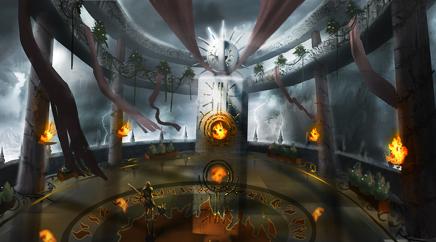
History of Stonebridge, Volume 1
Meisterhall
Stonebridge: The Early Years
Founded centuries ago by a shrewd Imperial trader, Stonebridge was first settled by craftsmen and merchants of Virsk descent. They gave the town its industrious, mercantile spirit, and their quaint, half-timbered houses are still common throughout Stonebridge. When Ehb became an independent kingdom, Stonebridge was granted a town charter, as well as autonomy from noble rule. The townsfolk were governed by an elected mayor and a council of guildmasters, instead of a noble lord.
Stonebridge suffered terribly during the Seck Resurgence, but the city recovered with remarkable speed. Under the leadership of mayor Rupert Ketzler, Stonebridge became the first city to invite goblins to settle within its limits. The goblins brought considerable wealth and technology, and Stonebridge enjoyed a long period of prosperity, becoming the largest and wealthiest city in Ehb.
The office of Lord Mayor would remain in the Ketzler family for over a century, passed from father to son, through five generations. Despite their unapologetic greed, the Ketzlers presided over a golden age in Stonebridge, popularly known as the Goblin Renaissance.
History of Stonebridge, Volume 2
Meisterhall
The Fall of the Legion in Stonebridge
The last of the Ketzler mayors was Tomas, elected at age 14, after the accidental death of his father. By that time, the office of Lord Mayor had become a hereditary affair. No one questioned the election of a mere lad—and a tiny, girlish one, at that—as long as he was a Ketzler. Besides, he had his mother and his three aunts to look after him. And they were the Tobelmann sisters—the richest and prettiest young women in Stonebridge.
Then the king of Ehb was slain, and suspicious eyes were cast upon the Legion. The Tobelmann sisters looked at the wealthy chapterhouse and saw the riches that could be theirs—so they began to speak openly against the Legion, casting doubt and suspicion in the people’s minds. And when Jeyne Kassynder arrived in Stonebridge, the Tobelmann sisters were waiting, with a mob of townsfolk behind them.
The mob surged into the city square and fell upon the legionnaires, while others (including the Tobelmanns) ransacked and looted the chapterhouse. By day’s end, all the legionnaires were dead—and the townspeople were faced with the horror they had wrought…
History of Stonebridge, Volume 3
Meisterhall
The Tomcat Rebellion
After the fall of the Legion, a sense of guilt fell over the city. The people were ashamed at what they had done, and they had no more patience for the young mayor, Tomas Ketzler, or for his mother, Elsa Tobelmann, who had helped rouse the city against the Legion.
The people assembled in the city square and voted Tomas Ketzler out of office—the first time a Ketzler had lost the office of mayor in over a hundred years. But Tomas’s mother would not give up power so easily. With the right friends, Elsa knew she could take the city back. She sent a letter to the royal princes, knowing that they were planning war against Jeyne Kassynder, and they were desperate for allies. She offered her city’s support if the princes would help her retake control of Stonebridge.
But her letter was intercepted, and a copy found its way onto the desk of Rainald Kassel, guildmaster of the ironmongers. (To this day, no one knows who intercepted the letter, or how they did it.) The letter revealed that Elsa Tobelmann planned to stage a coup against the city on the evening of the Midsummer Feast. So the people decided to stage a surprise of their own…
History of Stonebridge, Volume 4
Meisterhall
The Battle of Midsummer’s Eve
Elsa Tobelmann’s mercenaries came riding into the city square at midnight, on the evening of the Midsummer Feast. Young Tomas Ketzler—the former mayor—rode at their head, bearing the tomcat banner of his forefathers. The rebels assumed that they would find a mass of drunken revelers, too exhausted to put up a fight. Instead, the “drunken revelers” rose to their feet, brandishing swords. And from side streets, phalanxes of goblins appeared, bristling with muskets and enormous firecrackers.
Goblin rockets swooped in all directions, bursting over the heads of the mercenaries, sending them diving for cover. Poor Tomas Ketzler fell off his horse, which spooked and fled, dragging the young man by one foot, shedding bits of armor as he bounced from one cobble to the next. His mercenaries took this as a signal to retreat, and they fled in wild disarray.
The people of Stonebridge broke into a merry pursuit, chasing the rebels halfway to Wesrin Cross before collapsing into exhausted heaps and issuing a series of ragged cheers. Neither Tomas Ketzler nor his mother, Elsa Tobelmann, was ever seen in Stonebridge again.
History of Stonebridge, Volume 5
Meisterhall
The Rise of the Meisters
After the infamous Tomcat Rebellion—so named because the symbol for the Ketzler family had been a bristling tomcat—the people of Stonebridge declared another day of celebration, and joyful drinking and debauchery ensued.
Rainald Kassel, who had coordinated the city’s defense, met with the town’s guildmasters and merchant lords, and they revised the town’s charter to their liking. Henceforward, Stonebridge would be ruled by a council of its most prominent citizens—the meisters of Stonebridge. Most importantly, Stonebridge was declared a free and independent republic. Rainald Kassel became the first mayor of the city, under the new regime.
Since the meisters took power, technology has advanced at a rapid pace, and the city’s fortunes have improved. Stonebridge has remained stubbornly neutral in the war between the royal princes and Jeyne Kassynder, forbidding either side to trespass on their territory. Perhaps the only significant trouble has been the rise of an elusive criminal mastermind, the Dapper Old Gent, who has confounded the city authorities for the better part of 30 years.
Stonebridge: The Great Foundry
Great Foundry
Beneath the streets of Stonebridge lies the Great Foundry, a cavernous network of excavated tunnels and galleries. In the year 1175, the guild of ironmongers was granted permission to use the space beneath Stonebridge to build the massive furnaces, smelters, and forges that would power the machines in the city above.
The Great Foundry is a hot, hellish place. In the early days, its fires were fueled by coal from the Glitterdelve, but a rebirth of magic at the College has wrought great changes in the foundry. Now the furnaces are animate and alive, fueled by elemental spirits of fire.
To work the foundry, the ironmongers called upon the services of cyclopses. The details of this arrangement are uncertain, but the cyclopses have toiled without complaint for over a hundred years. Attempts to speak to the cyclopses have met with little success—only guild members are permitted to enter the foundry, and the cyclopses are never permitted to come out.
Ironmongers Guild Charter
Great Foundry
Charter
Granted to the Guild of Ironmongers, in the year 1179.
Be it known that the guild shall have the exclusive right to produce works of iron, steel, and bronze, and also to trade such works, within the city of Stonebridge.
Further, that the guild shall maintain and operate the Great Foundry, for the benefit of the city. The guild may collect reasonable fees from all citizens who draw heat or mechanical power from the foundry.
Failure to ensure the continual operation of the foundry may result in fines, prosecution, and public humiliation of those who are deemed responsible.
Cyclops Workers’ Demands
Great Foundry
We Demand
At least one day of rest per week.
Shifts lasting no more than 18 hours.
Provision of monocles to those cyclopses whose vision has failed them.
Most of all, we demand fair compensation for our labor! No wages, no work!
The Ketzlers of Stonebridge
The Crypts of the Sacred Blood
For over a century, the city of Stonebridge was dominated by the Ketzler family, whose origins were rather more humble than most people remember. In the old Virsk tongue, “ketzler” means cat-catcher, and the family originally earned their coin by capturing stray animals in the city streets.
But their fortunes changed, thanks to Rusk Ketzler, a local sellsword, drunk, and ne’er-do-well. Rusk numbered among the 14 companions of the Lady Montbarron, who saved the kingdom from the Seck. (Rumors suggest that, in fact, the heroes had found a drunken Rusk Ketzler in an upstairs room of the inn, where he had fallen out of bed, attempted to solicit an ungodly sum of coin for his services, and then vomited explosively at their feet. They tactfully refused his offer, and left him where he lay.)
Rupert Ketzler was rather more clever than his elder brother, and he capitalized shamelessly on Rusk’s fame, getting himself elected as mayor by a near-unanimous majority. His descendants held the office for four generations after him, ending with the disastrous reign of the young Tomas Ketzler.
Azunite Dispatch
Frostspire Mountain
To all officers in the field:
As you know, we have cornered the royalist army in the Glitterdelve Mine. We believe that the pretender, Queen Roslyn, and the rest of her “Tumbledown Court” are also trapped inside. Roslyn must not be allowed to escape—it is imperative that she be captured or slain.
The majority of the royalist forces are old men and teenage boys, with a few surviving veterans scattered among them. You will find that most of their soldiers are ill-trained and poorly equipped. They consist of former courtiers, page boys, and dispossessed nobility, with no experience against well-trained soldiers.
Be advised that certain rumors are circulating amongst our men. Reports suggest that “legionnaires” were sighted in the Eastern Swamp, and further, that they killed some of our people and helped the royalist survivors escape. We do not know whether these reports are accurate, but it is possible that these “legionnaires” may come to the aid of Roslyn and her court. Take no chances, and do not underestimate them.
Issachar, First Exarch and Knight of St. Jeyne
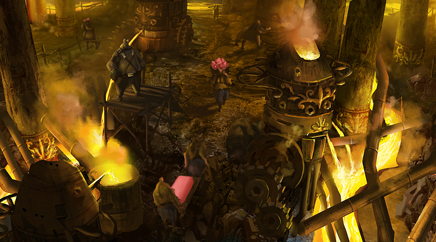
History of Ehb
The Tumbledown Court
This text chronicles important events in Ehb’s 450-year history.
845—Kingdom of Ehb is founded by the 10th Legion.
1144—Seck Resurgence. The evil Seck escape their prison in the Chamber of Stars and lay waste to the kingdom. They are defeated by the heroes, who slay their demigod-king.
1145—The leader of the heroes—a simple farm girl—is granted a noble title by King Konreid and becomes the first Lady Montbarron.
1154—King Konreid signs a treaty with the goblins. Mayor Ketzler of Stonebridge invites goblins to settle in his city.
1175—Excavation of Great Foundry begins in Stonebridge. Beginning of “Goblin Renaissance.”
1192—Following the death of Lady Montbarron, the Heroes’ Crypt is constructed in the Rukkenvahl.
1220—Death of Gloern the dwarf, last hero of the Seck Resurgence.
1264—Death of King Hendrick, under mysterious circumstances. Jeyne Kassynder places blame upon the Legion and begins to rally the people against them.
1265—Fall of the 10th Legion.
1266—War erupts between the royal princes and Jeyne Kassynder. Kingdom of Ehb collapses. Meisters take power in Stonebridge.
1294—Present day.
Spy’s Report: Jeyne Kassynder
The Tumbledown Court
Your Majesty,
At your request, our spies continue to hunt for information about Jeyne Kassynder, but we have learned little more than we already knew.
As a child, Jeyne was a ward of the church—a common story for many orphans, and also for bastard children of the noble class. She spent her early years in Bisselberg, at an Azunite school. By all accounts, she excelled in her studies and was believed to be possessed of an otherworldly power—a sign of favor from Azunai, the priests claimed.
Of her handmaids, we also know little, but we did uncover one intriguing fact. We managed to find an elderly woman who once resided in Bisselberg, not far from the school where Jeyne grew up. She claims to have seen several of Jeyne’s handmaids on the grounds of the school. This was many years ago, when Jeyne was only a child, but her handmaids looked just as they do now, suggesting that they have not aged at all, in over 40 years. This strengthens my own (controversial) belief that they are archons—though their interest in protecting Jeyne Kassynder is still a mystery to me.
Kings and Queens of Ehb
The Tumbledown Court
Perhaps the best-loved monarch in Ehb’s later history was King Konreid, whose reign was interrupted by the Seck Resurgence. Konreid was taken captive by the Seck and imprisoned in Castle Ehb, until he was freed by the heroes. His health declined sharply after the Seck were destroyed, probably due to the torture that he suffered at their hands. But he signed a treaty with the goblins shortly before his death, granting them full rights as citizens and setting the stage for the prosperity of the Goblin Renaissance.
A golden age followed, lasting several generations, until the reign of King Hendrick. Regarded as vigorous and handsome in his early years, Hendrick became increasingly bitter and paranoid with age. He grew particularly suspicious of the Legion, and he began to seize their chapterhouses and estates. Shortly thereafter, King Hendrick was found dead, the Legion was blamed, and the kingdom collapsed into civil war.
Hendrick had two sons. The younger, Nedderic, disappeared on a diplomatic mission to the ice giant king of Utraea. The elder, Roland, was killed in the siege of Glacern. That leaves Roland’s daughter, Roslyn, as the sole surviving heir to Ehb’s throne…
Spy’s Report: The Spire of Azunai
The Tumbledown Court
Some 20 years ago, when Jeyne Kassynder had finally consolidated her power over the Azunite Church, she dispatched a small army of stonemasons to the holy mountain of Jhereb. There, they began construction of a new stronghold and cathedral—the Spire of Azunai.
Today, construction work on the Spire reportedly continues, but the great fortress is essentially complete. It stands atop Mount Jhereb, with the seminary town of Aegis Bay at the base of the mountain, far below. None but officials and soldiers of the church are permitted to enter, but its walls are strong, and it is said to be defended by heavy cannons.
According to our sources in the east, Jeyne Kassynder has convinced the church hierarchs to relocate their capital to the Spire—far from the distractions of Bisselberg, the traditional seat of the faith. This may be an attempt by Jeyne Kassynder to further isolate moderate factions of the church, and to surround herself with her most ardent and fundamentalist supporters. Jeyne is said to dwell in the uppermost reaches of the Spire, along with her mysterious “handmaids,” about whom we still know very little.
Who Is Azunai?
Spire Dungeon
Legend tells us that Azunai was a human of Nevitic descent who lived during the First Age, before the Empire of Stars. Born into a nomadic tribe, he led a rebellion against the wicked giant-king, Zaramoth, and freed humanity from the tyrant’s oppression. In the final confrontation with the giant-king, most stories agree that Azunai was slain. For centuries afterward, he was merely seen as a historical hero, until the famous vision of St. Elisheva and the birth of the Azunite Church. The faithful assume that the mortal Azunai and the divine Azunai are a single entity, but we cannot prove that this is so.
The apostate-philosopher Hildesmund refers to Azunai as a “sunset-god”—perhaps the last surviving deity, since the fall of the creator gods, and heir to their place in the cosmic order. He also points to the startling similarities between the so-called Radiant Youth—a spirit-guide who has appeared to members of the 10th Legion since its founding—and visions of Azunai, as described by the saints. Hildesmund has even gone so far as to suggest that the two figures are one and the same, though neither church nor Legion authorities have ever supported his claims…
Report from Issachar
Chancel of Azunai
My Lady Kassynder:
Our losses at Glitterdelve were terrible, as you know. Casualties numbered over 3,000, not counting desertions.
At your request, I have compiled a report of our current strength at the Spire. We have 8,000 regular soldiers under arms, mostly assigned to the seminary-town of Aegis Bay, at the base of the mountain. These men are supported by 2,000 mercenaries—including Lescanzi, goblins, and a few cyclopses.
With the recent rumors of an alliance between the Legion, the royal court, and the city of Stonebridge, I strongly advise that you maintain all these forces at the Spire, while I raise new levies from Drakkenberg and the cities of the coast. I believe that I can assemble at least 10,000 additional soldiers and return to the Spire by the 15th day of Dusken-fall. We can then march against Stonebridge, without fear of leaving the Spire unprotected.
Your servant, as ever,
Issachar, First Exarch and Knight of St. Jeyne