
Assassin's Creed: Revelations Guide Essentials Extras
Story Recap & Glossary
The Assassin’s Creed series storyline tells of an ancient struggle between two opposing forces: the Templars, who seek to bring order to the world through absolute control, and the Assassins, who endeavor to preserve its freedoms.
Both factions operate in secret, continually vying for possession of archaic artifacts and futuristic technologies to advance their cause throughout their centuries of conflict. By exploiting the capacity to relive moments in history via the recent Animus tech, the contemporary Assassins and Templars gain insights into events that affect the present – and so the two threads of the narrative weave together.
The first Assassin’s Creed opened with the events of 2012, finding the dominant Templars on the brink of realizing their dream of a new world order. Each new chapter fills in another piece of the jigsaw puzzle, adding greater depth and new revelations to the common backstory.
We begin this section with a quick recap of the Assassin’s Creed Revelations storyline. To refresh your memory on key events and plot strands in all four core episodes – and to perhaps further whet your appetite for installments to come – we follow this with a story glossary packed with known facts and lively speculation…
Revelations: Key Events
The Revelations story continues directly from the conclusion of Assassin’s Creed Brotherhood. Any triumph felt by the Assassins at claiming the Apple of Eden hidden beneath the Colosseum has been tempered by the tragic death of Lucy Stillman at the hands (though not, it is clear, at the behest) of a horrified Desmond.
After stabbing her while under the control of forces unknown – though strongly suggested to be the First Civilization entity known as Juno – he collapses. Believing his condition to be a consequence of the Bleeding Effect, his Assassin friends place him in a special Animus program in an attempt to at least forestall fatal mental deterioration.
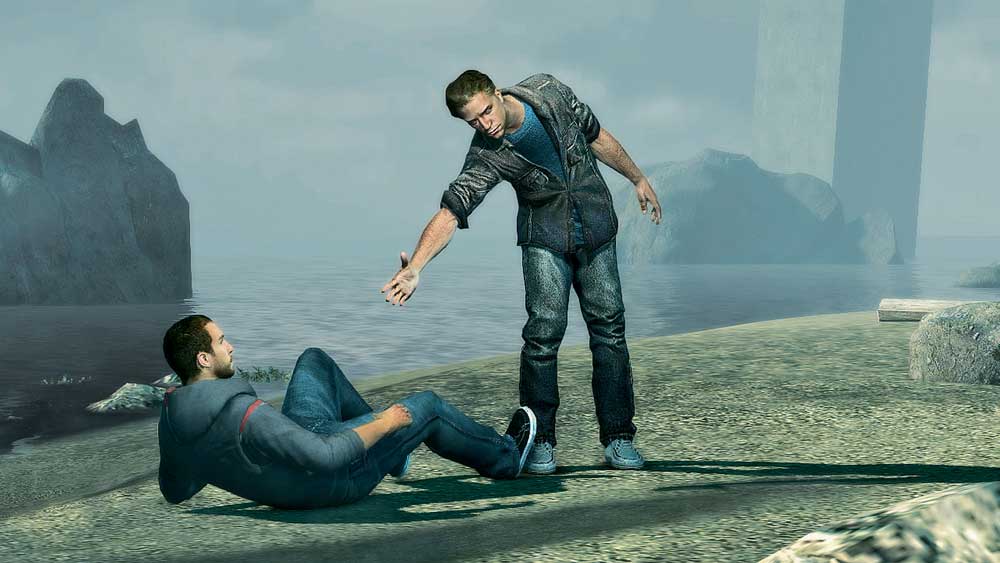
As his body is transported from Italy to a new (but, at this stage, unspecified) destination by Shaun, Rebecca and their commander William, Desmond regains consciousness (in a manner of speaking) on a strange island. He meets Subject 16
( 01), now fully realized in a virtual body, who explains that Desmond is inside the original Animus test program – and that his mind has been fragmented, pushed to the brink of irreversible dementia, by the experience of reliving the lives of Ezio and Altaïr.
Sixteen informs Desmond that he can preserve his sanity by creating a Synch Nexus. This can be achieved by visiting key but hitherto unseen moments in the stored memories of his ancestors, “finishing” their lives (or at least the parts of significance).
This will enable the Animus software and his beleaguered synapses to somehow separate the two additional existences from his core identity – allowing him to awake from his coma.
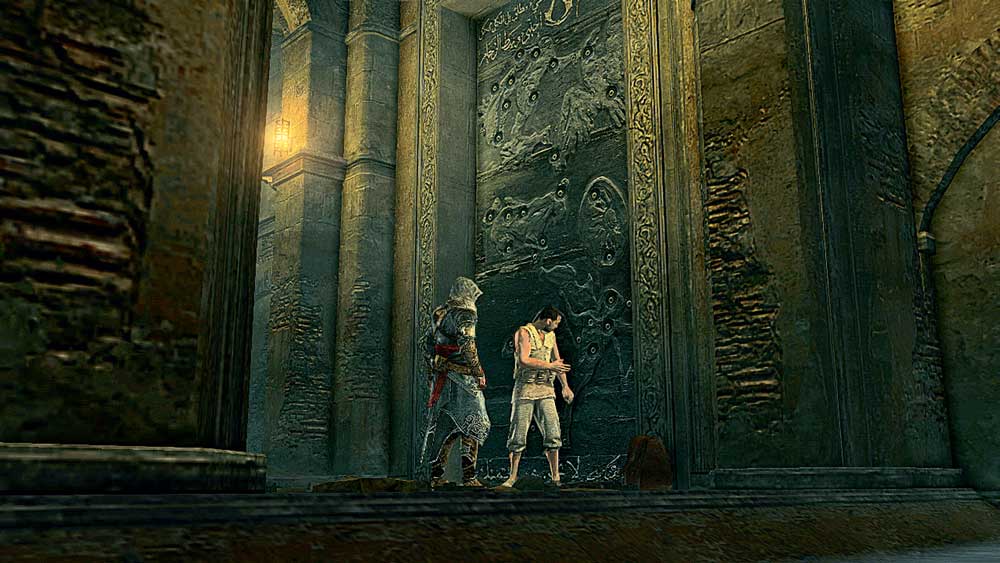
Desmond resumes his exploration of Ezio’s memories. We learn that, in his later years, the Master Assassin grew restless in the peace established by the end of Brotherhood’s narrative.
Puzzled by revelations he had witnessed but failed to entirely comprehend, particularly the inexplicable experience of being used as a communication conduit through which Minerva could address the mysterious “Desmond”, Ezio travels east to investigate a secret library created by his predecessor, Altaïr.
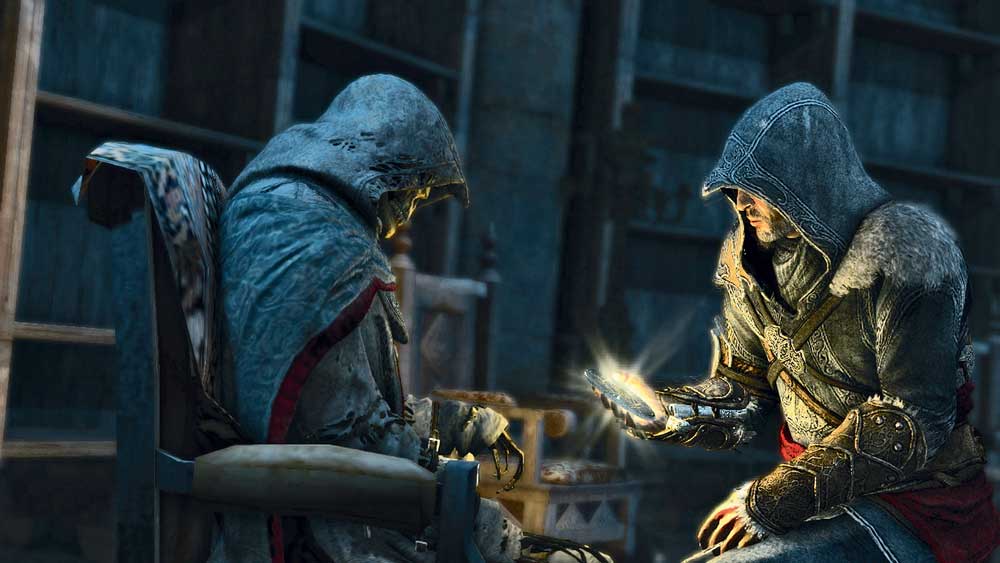
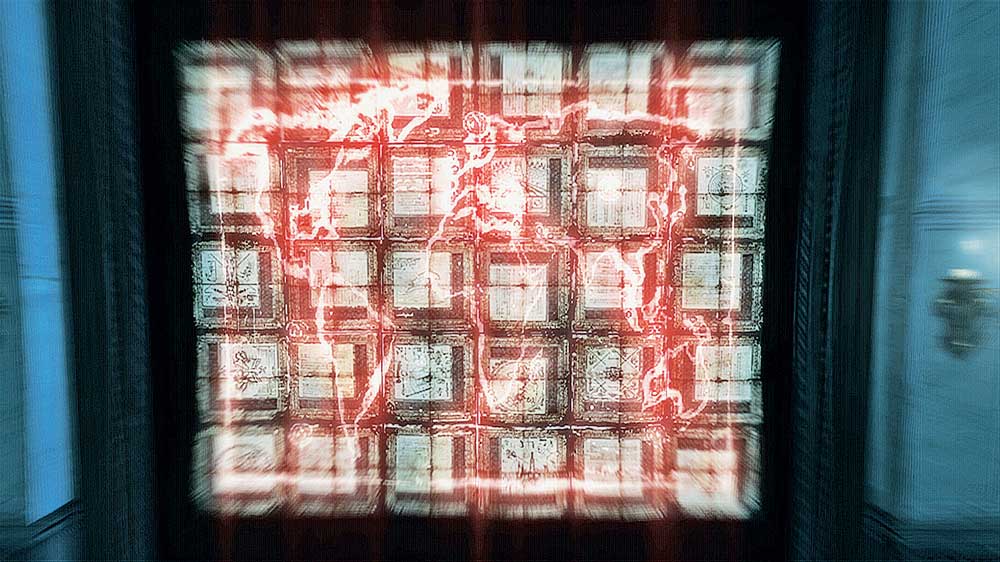
He arrives in Masyaf to find it under the control of Byzantine Templars, and narrowly escapes death when his identity is discovered. He finds that the library’s impregnable entrance is locked ( 02), and that the Templars have long labored to gain access without shadow of success. To open it, he must find five unique keys to fit the openings on the imposing doorway.
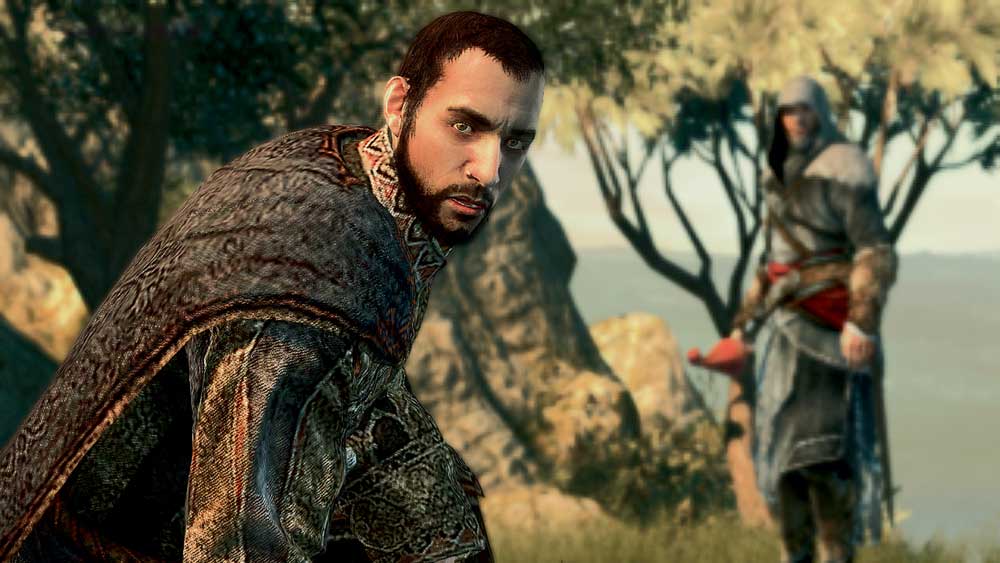
To retrieve the keys, Ezio travels to Constantinople. On arrival he is drawn inexorably, perhaps by fate, into the intrigues of the imminent Ottoman royal succession following a chance encounter with the Sultan’s grandson, Suleiman.
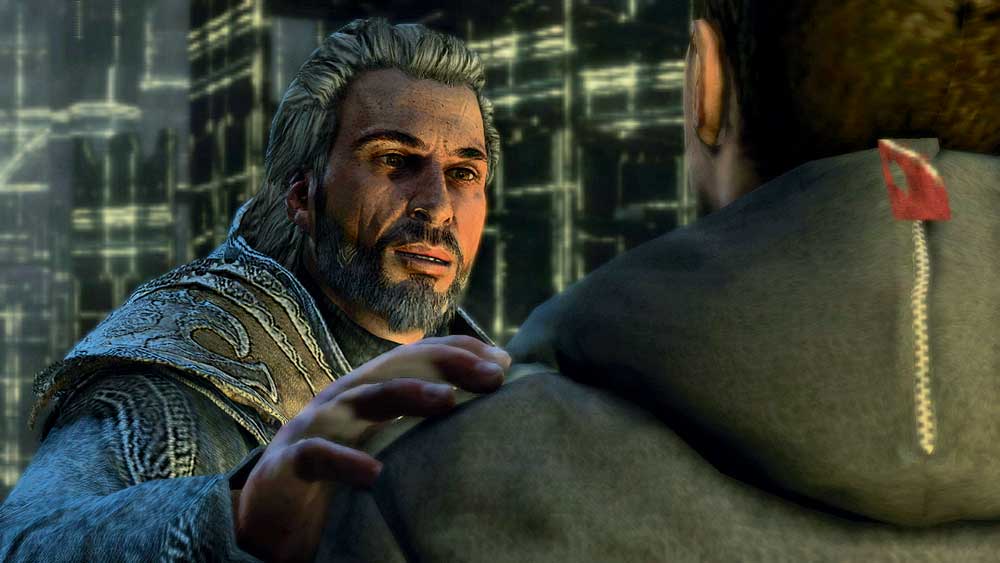
Upon examination of each key, Ezio experiences lucid waking dreams that recount events from Altaïr’s life with astonishing clarity. In time, nearing the end of his search, Ezio learns that Suleiman’s uncle, Prince Ahmet ( 03) – groomed to succeed his father, yet an unpopular choice among citizenry and soldiery alike – is in league with Byzantine Templar agents.
A flawed yet not entirely unsympathetic character, Ahmet wishes to possess the secrets of Masyaf’s library – and the powers they may bring – to bring peace and unity to the empire he is poised to rule
Despite Templar interference and the machinations of the covetous Ahmet, Ezio acquires the keys and returns to Masyaf. Inside the secret library he finds no books, no repository of incalculably valuable knowledge, but only Altaïr’s skeletal remains, a sixth key resting in his hands (fig 4). As with those collected before, it communicates a powerful vision.
In this, he finds that the secret chamber is not a library, as previously believed, but a strongroom. A dying Altaïr bids farewell to his son before entombing himself and his Apple of Eden to await Ezio’s arrival. His final act is to “record” this last memory on the key, evidently a First Civilization artifact like the Pieces of Eden.
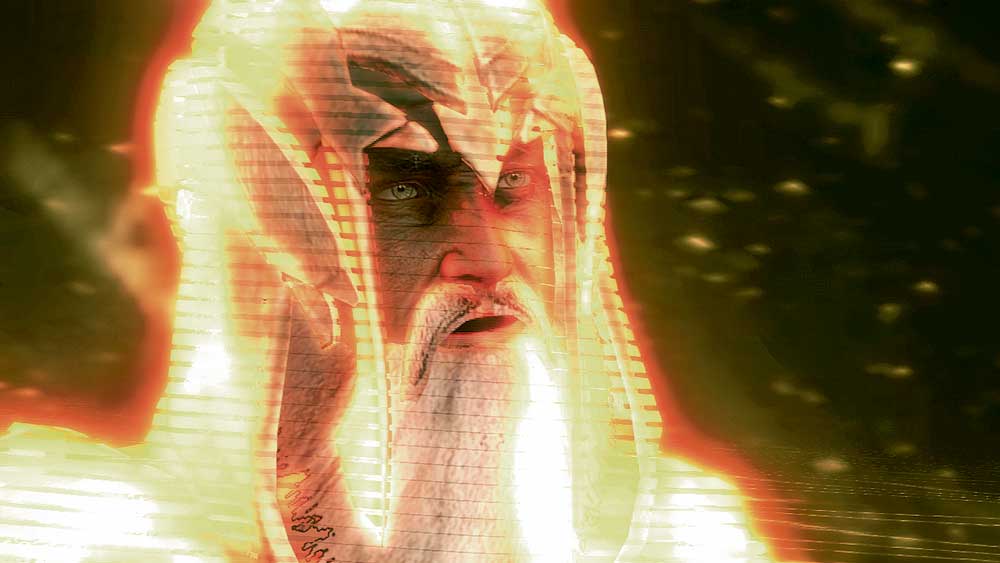
Ezio resolves to leave Altaïr’s Apple of Eden where it lies, yet the device bursts into life. As he speaks to Desmond through the ages, he finally recognizes his role as a prophet: “I am only a conduit for a message that eludes my understanding”.
Though Ezio cannot see Desmond, he reaches out to lay a hand on his shoulder ... and Desmond is transported to a different place. In this otherworldly domain, Tinia (fig 5) – the third member of the First Civilization triumvirate after Minerva and Juno – tells Desmond how his people tried but failed to survive the great Catastrophe revealed at the close of Assassin’s Creed II. The last act of the triumvirate was to transmit their accumulated knowledge to a single underground vault located in what is now known as the state of New York. Tinia informs Desmond that the answers to his questions lie inside this long-hidden place.
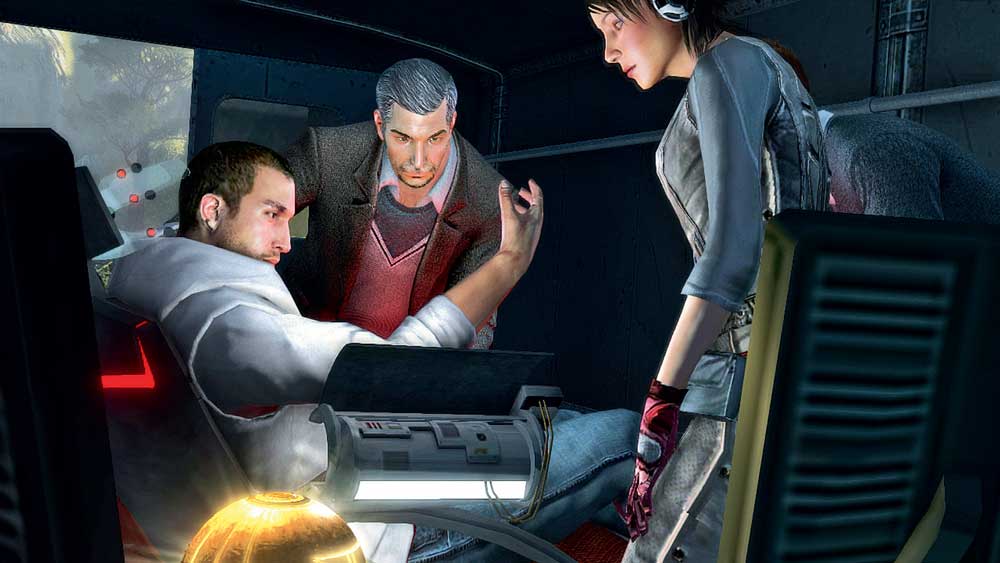
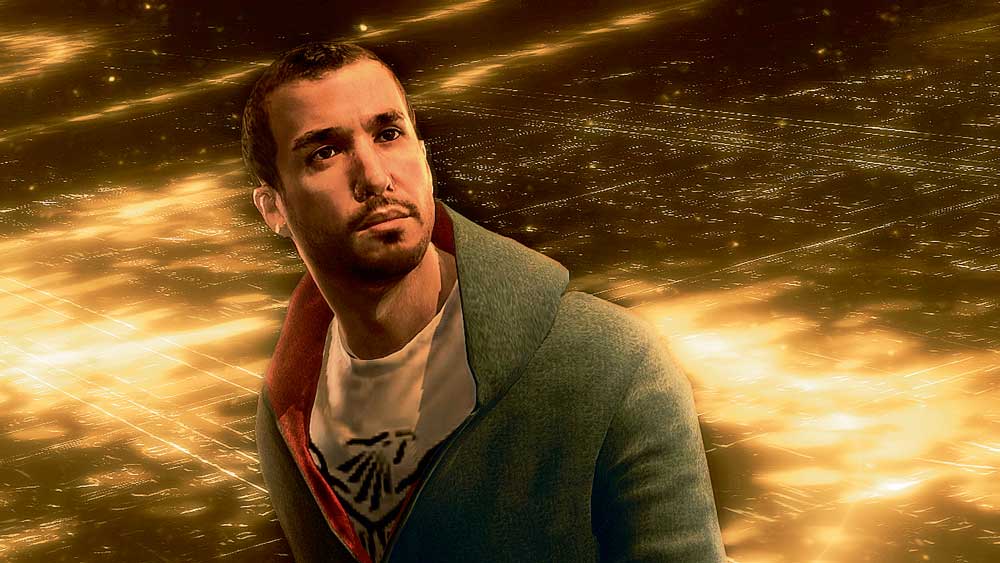
In the present day, the Assassins land and pass through Syracuse airport in Onondaga County, New York. Oblivious to Desmond’s travails within the Animus, they are astonished when he begins to regain consciousness as they travel towards an unspecified destination (fig 6). After taking a moment to regard William, revealed to be his father, Desmond experiences a strange connection with the nearby Apple of Eden, which pulses in response.
“I know what we need to do,” he says.
Assassin’s Creed Glossary
The Assassin’s Creed series storyline is packed with recurring themes, characters, symbols and concepts set against a fascinating backdrop of alternative histories and conspiracy theories. In this brand new version of our glossary, we offer concise summaries of topics and individuals of note – with, of course, a little healthy speculation and possible interpretations of unresolved mysteries.
Templars
The Templar Order
In established histories, the Knights Templar order received papal recognition in 1129 and found fame through their military engagements in the Holy Land during the Third Crusade. However, the Templar organization – as represented in the Assassin’s Creed canon – is certainly far, far older.
Though the Knights Templar order was supposedly disbanded in 1312, this abrupt dissolution merely allowed the “true” Templars to vanish from public life and avoid further scrutiny, secretly infiltrating institutions of power and manipulating world events to suit their agenda.
The modern Templars conceal and bankroll their activities through Abstergo Industries, a multinational corporate conglomerate that – in contrast to centuries of subtle behind-the-scenes machinations – enables the organization to boldly conduct many of its less sensitive operations in plain sight.
While this new public façade represents a subtle evolution, the order’s principle goal remains unchanged: to achieve absolute power by acquiring and exploiting First Civilization technology to unify humanity.
Though individual agents may be corrupt, and even willfully callous or cruel, it would be erroneous to characterize the Templar order as being necessarily “evil”. They ostensibly strive to appoint themselves as humanity’s custodians. “To achieve true peace,” Ahmet argues in Revelations, “mankind must act and think as one body, with one master mind.”
Where leading Templar figures such as Al Mualim and Rodrigo Borgia once sought to exert control on a regional or continental level, their successors aspire to no less than global dominium.
Abstergo Industries
Taking its name from the Latin verb meaning to “cleanse” or “wipe away”, Abstergo is the modern identity of the Templar Order. This public front facilitates operations on a worldwide scale, with more sensitive enterprises (such as the development of the Animus and the acquisition of First Civilization artifacts) concealed in classified R&D programs. These are staffed by Templar loyalists and individuals either ignorant of their true role, or enjoined by intimidation or subversion to reveal no word of their activities.
Abstergo is active in countless fields, from telecoms to pharmacology, enabling the Templar order to exploit (if only indirectly) the finest scientific minds, bleeding‑edge technology… and, of course, the political lobbying power and operating capital of a world-leading corporation. “The average American household contains three dozen Abstergo-owned products at any given moment,” Desmond’s mother once told him during his childhood.
Abstergo’s most valuable invention is the Animus, a device that allows for the exploration of genetic memories. Human DNA, it transpires, records the experiences of every living person with astonishing accuracy, with each individual passing data on their life to their offspring at the moment of conception – a discovery unknown in mainstream science.
The Templars have used the Animus to identify bloodlines that will lead them to the locations of First Civilization artifacts known as Pieces of Eden. These devices are defined by their astonishing capacity to generate illusions, and influence (indeed, control) human minds.
The Templars are racing to obtain an Apple of Eden with the express intention of installing it into a telecommunications satellite developed by an Abstergo subsidiary. From its position in orbit, they hope to use it to control Earth’s population. The Eye-Abstergo satellite is set for launch on December 21 st , 2012 – a portentous date.
ASSASSINS
The Assassin Brotherhood
For over 2,000 years, the Assassin Brotherhood has been fighting a war. Their weapons are intelligence, stealth and surprise. They will send a lone agent against a legion, and halt the march of ten thousand soldiers with the death of one. Assassins are sworn to preserve free will and to defend the liberty of every man, woman and child against abuses of power.
The most famous line in their creed – “Nothing is true; everything is permitted” – is the Brotherhood’s raison d’être, a defense of every individual’s right to act of their own volition. The Templar philosophy of attempting to engineer peace and stability via the enforced surrender of self-determination is anathema to the Assassins, who regard it as little more than enslavement.
A clear example of the differences between the Templar and Assassin ideologies, in their purest forms, is witnessed during a conversation between Ezio and Ahmet in Revelations. When confronted after the murder of Yusuf and kidnap of Sofia, Ahmet proposes to use the power of a First Civilization artifact (though he would not precisely know it as such) to “destroy the superstitions that keep men divided”:
Ahmet: “We both strive for the same end, Ezio. Only our methods differ. Do you not see that? Peace. Stability. A world where men live without fear. People desire the truth, yes, but even when they have it, they refuse to look. How do we fight this kind of ignorance?”
Ezio: “Liberty can be messy, Ahmet. But it is priceless.”
Ahmet: “Of course. And when things fall apart, and the lights of civilization dim, Ezio Auditore can stand above the darkness and say proudly, ‘I stayed true to my creed’.”
When the Templars survived Altaïr’s campaign and retreated to the shadows to regroup, the Assassins were also forced to adopt a more covert operation. By Ezio’s time, they had become every bit as secretive as the Templars. The modern day organization exists under great pressure, and employs the cell structure of underground political resistance groups. Such strategies are essential to enable the Brotherhood to avoid the superior tracking and surveillance techniques that the resurgent Templars can employ through Abstergo.
Desmond Miles
Desmond Miles was raised in a secret Assassin compound called The Farm. Unaffected by his parents’ stories of the aeonian struggle against the Templar Order and the teachings of his tutors, he fled the commune at the age of sixteen.
Rejecting his former life (indeed, describing The Farm’s occupants derogatively as a “cult” and his parents as “conspiracy freaks” when quizzed about his upbringing), Desmond lived anonymously in New York until kidnapped by Templar agents in September 2012.
Held in captivity for several days, Desmond (labeled “Subject 17” by his abductors in the Abstergo laboratory) is compelled to use the Animus technology to experience episodes from the life of a direct ancestor, Altaïr Ibn-La’Ahad.
After unwittingly leading the Templars to a specific memory featuring an Apple of Eden, Desmond escapes the secret facility with the aid of Lucy Stillman, an Assassin agent working within the Templar ranks.
Moved by their struggle, and perhaps beginning to gain perspective on his unorthodox upbringing, Desmond pledges to help the Assassins fight back against the Templars. After extensive adventures in the life of another ancestor, Ezio Auditore, Desmond discovers the present-day location of a second Apple of Eden.
The “Bleeding Effect”, a consequence of heavy Animus use, enables him to assimilate his progenitor’s many years of training and combat experience to become a master Assassin, but the experience also begins to take a toll on his perception of reality.
Traveling to Italy, the Assassins recover the second Apple from a secret vault where Ezio had hidden it many centuries before. On touching the device, however, Desmond’s body is commandeered by a strange force – almost certainly instigated by Juno, a First Civilization entity – that also freezes his companions, and forces him to kill Lucy. This leads to the events of Revelations, as recounted in the Story Recap on page 202.
In considering Desmond’s overarching significance, it is necessary to make a distinction between affiliation and bloodline when using the term “Assassin”. The Assassin Brotherhood has recruited many individuals, all of whom are valued for their contribution.
In their respective times, the likes of Shaun Hastings and Yusuf Tazim earn the title of Assassin through their dedication and contributions to the faction’s cause. But when Subject 16 declares the Assassins to be “children of two worlds” during Assassin’s Creed II, he specifically references the rare bloodlines that run through Desmond Miles, Ezio, Altaïr, and others back to Adam and the genetic union with the First Civilization race.
In this sense, Desmond and others of his bloodline are “true” Assassins who exhibit powers that ordinary humans could not hope to possess.
In Revelations, we discover that Desmond’s genes contain an unusually high concentration of First Civilization DNA – a “gift” that his father William attributes to no more than one in ten million.
What makes Desmond so unique is that he is the convergence of several important bloodlines. This, presumably, is the source of his (and his progenitors’) physical acuity, powers such as Eagle Sense, and the capacity to more successfully interact with First Civilization technology.
In a short but telling conversation between Rebecca and William, Miles senior is heard to comment that he does not have the “right genes to properly wield” the Apple of Eden retrieved from beneath the Colosseum in Rome. This might also explain why, when Juno addresses Desmond in Rome before the death of Lucy, his companions cannot hear her words – and, indeed, remain oblivious to her existence.
Lucy Stillman
Lucy Stillman was raised by the Assassin Brotherhood and trained by William Miles, Desmond’s father. She became involved with Abstergo Industries when the company took an interest in her postgraduate research in cognitive neuroscience, which enabled her to gain a position on the Animus project – and, of course, to infiltrate one of the Templars’ most secret programs.
Regarded more as a hostage than a conventional employee during her time with the Animus division, she later helped Desmond escape the Abstergo laboratory. Lucy then assumed control of a small Assassin cell including Shaun Hastings and Rebecca Crane, tasked with monitoring and protecting Desmond during his return to the Animus to experience the life of Ezio Auditore.
When Desmond touches the Apple long hidden beneath the Colosseum at the end of Brotherhood, a force compels him to stab Lucy with his Hidden Blade as she and her fellow Assassins stand frozen. Juno’s words at this time appear to make it explicitly clear that this occurs at her command: “There is one who would accompany you through the gate. She lies not within our sight. The cross darkens the horizon.”
The final two sentences of this statement are open to a variety of interpretations, but the most plausible explanation is that Desmond’s blossoming friendship – indeed, suggestions of growing intimacy – with Lucy might distract or deter him from the road the First Civilization would have him travel.
“The cross darkens the horizon,” feels like an oblique reference to secret Templar affiliation, which her Assassin upbringing renders unlikely, or perhaps a future betrayal.
A line from Subject 16 (spoken during Brotherhood after the completion of ten “Rift” puzzles) could also insinuate a hidden allegiance, or simply that Desmond’s burgeoning relationship with Lucy would never come to pass. “She is not who you think she is,” cautions Sixteen. “Everything you hope to become, everything you hold dear. It’s already gone.”
Shaun Hastings
The historian in Lucy’s Assassin cell, Shaun was a university lecturer whose radical opinions saw him swiftly ejected from the ivory towers of academia. This same intellectual flexibility made him an ideal recruit for the Assassins, who needed somebody to reconcile accepted historical accounts with the secret wisdom of Templar influence on world events. With his remarkable knowledge of dates, people and culture, Shaun maintains the Database for Animus users and keeps Assassin agents informed with real-time research.
Rebecca Crane
Rebecca’s development of the Animus 2.0 (and successive updates) has enabled the Assassins to stay abreast with advances made by the Templars. She is often forced to work with stolen and salvaged components to keep her team’s equipment functional – testament to her remarkable resourcefulness.
This state of affairs led to the import of Subject 16’s data cache into the Animus 2.0 after the installation of an Abstergo memory core appropriated from their laboratory by Lucy.
A geek and a technophile, Rebecca’s interest in hacking and her knowledge of countersurveillance measures enabled Lucy’s Assassin cell to remain hidden from Templar attention during their time in Italy.
William Miles
William Miles is Desmond’s father. He raised his son in a remote Assassin community called The Farm, located in the Black Hills of South Dakota, outside Rapid City. A senior member of the modern-day Brotherhood, William once oversaw the operations of a number of Assassin compounds throughout the Midwest during the 90s and early 2000s.
This included an involvement with the training of each community’s children, including his son Desmond (and, later, Lucy Stillman), to prepare them for the conflict against the Templars.
William’s devotion to the Assassin cause has left little time for his family. While his wife could understand the demands of his calling, young Desmond could not. His growing estrangement led the young Miles to run away from The Farm to live in New York City.
There is no reason to believe that the Brotherhood – and, therefore, his father – knew of Desmond’s whereabouts until his capture by the Abstergo Lineage Discovery and Acquisition Department.
Recently, William has taken responsibility for supervising Assassin cell structures operating throughout the world. After Desmond stabs Lucy, William arrives to assume direct control of their unit. He then flies with them to Syracuse, NY, presumably to reach a location discerned from information transmitted by the Apple of Eden found beneath the Colosseum prior to Lucy’s death.
Subject 16
An Assassin captured by Abstergo Industries, Subject 16 – real name Clay Kaczmarek – preceded Desmond Miles as an unwilling Animus test subject.
The fate of Subject 16 is a stark warning of the dangers of prolonged exposure to the Animus. Having acquired the memories of many different ancestors, his own personality was corrupted by the Bleeding Effect.
Working against his captors, Subject 16 hacked into the Animus and uploaded a “living” digital facsimile of his mind into the machine – later transferred to the Brotherhood’s Animus 2.0 after Lucy’s theft of the Abstergo memory core.
He then broke up his AI into many discrete fragments and scattered them throughout the Animus for Desmond – a man he knew the Templars were actively searching for – to discover (and, in doing so, automatically reassemble) at a later date.
Exhausted, paranoid, and suffering from the accumulation of too many overlapping identities, he committed suicide days later with the only implement available to him – a ball-point pen. His final act was to use his own blood to daub messages and symbols on the walls of the Abstergo laboratory in the hope that another Assassin blessed with Eagle Vision – presumably Desmond – might read them.
From Desmond’s first experiences inside the Animus, Subject 16 has watched his successor, looking for opportunities to communicate with him. Indeed, many of the most tantalizing (yet often highly cryptic) clues have been provided by Sixteen.
When the two meet in the Animus test program after the events of Brotherhood, Subject 16 takes it upon himself to guide his fellow Assassin in the steps necessary to negate the Bleeding Effect and regain consciousness in the real world.
Sixteen “distracts” the Animus software to allow Desmond to spend more time with Ezio, and later appears to sacrifice himself as the code that they exist in seeks to delete them. Whether this is his final contribution to the story, however, is far from certain.
Ezio Auditore da Firenze
A Master Assassin from the Renaissance era, Ezio spends much of his life embroiled in the age-old battle with the Templars. After accumulating the scattered pages of Altaïr’s “Codex”, Ezio travels to a First Civilization vault hidden beneath the Vatican.
Entering the main chamber, Ezio encounters a holographic projection of a woman who introduces herself as Minerva. Ezio is dazzled by her words and the (to his mind, supernatural) visions that surround him, but cannot make sense of their import.
Ezio eventually hides an Apple of Eden he obtains during his struggles against the Templars in another vault beneath the Colosseum. By ensuring that clues to its location are only visible to an individual with Eagle Vision, Ezio knows that only one of his kind – which will turn out to be Desmond – can discover its location.
A period of relative peace follows, during which time Ezio grows restless. Curious to learn the genesis of the Brotherhood, he begins to research the history of the Assassins, which leads him to the discovery of a reference to Altaïr’s “secret library”.
After his quest to obtain the five keys required to open Altaïr’s final resting place – each one a First Civilization device that communicates a scene from Altaïr’s life – Ezio finally accepts his role as prophet, communicating one last message (Tinia’s address) across the centuries to Desmond. With this, he finally relinquishes his role as an Assassin to, we can safely assume, begin a new life with Sofia Sartor – and, at long last, perpetuate his bloodline...
Prince Suleiman
Young Prince Suleiman – the future Sultan, Suleiman the Magnificent – acquired a fondness for dressing in peasant garments and travelling incognito in search of unvarnished political opinions. It is during one of these outings that he meets Ezio. Impressed with his wisdom and broad knowledge of the world, and grateful for the assistance he later renders, Suleiman and the Assassin become friends.
Suleiman’s father, Prince Selim, and his uncle, Prince Ahmet, are vying for the right to succeed their father. After surviving an assassination attempt by the Byzantines, Suleiman feels he can no longer trust anyone inside the Sultan’s immediate circle.
With Ezio’s help, he investigates the true purpose of the Byzantine’s plotting. Their combined efforts lead to the discovery of Ahmet’s involvement with the Templars and, ultimately, his death at the hands of Selim.
Sofia Sartor
Sofia is the Venetian proprietor of an old bookshop in Constantinople. Unbeknownst to Sofia, this shop is built on the ruins of a trading post once owned by the Polo brothers, Niccolo and Maffeo, who took possession of Altaïr’s collection of books, his Codex, and the five keys hundreds of years previously.
With her deep knowledge of scripts and ciphers, Sofia helps Ezio to decode the clues left behind by the Polo brothers in the margins of Altaïr’s ancient books. This enables him to find the keys to the secret library in Masyaf.
Despite Ezio’s efforts to conceal his status as an Assassin, he cannot prevent Sofia from becoming entangled in his conflict against Ahmet and the Templars, though he is quick to save her when she is taken hostage.
It is likely that Sofia, like Altaïr’s wife Maria Thorpe, is also a forebear of Desmond.
Yusuf Tazim
Leader of the Assassin Brotherhood in Constantinople, Yusuf wages a war against the Templars as they conspire to wrestle power back from the Ottoman dynasty that supplanted their Byzantine empire. He introduces Ezio to techniques and innovative technologies used by local Assassins, lending aid and assistance from his arrival in the region. This collaboration sadly leads to his untimely death, presumably at the hands of agents working for Prince Ahmet or his Templar allies.
Prince Ahmet
Prince Ahmet is the Sultan’s favored son, groomed from his early years to succeed him. After discovering a Masyaf Key and investigating its purpose, Ahmet becomes obsessed with obtaining the knowledge and power that may rest inside the mysterious library, which leads him into contact with the Templars – and, by extension, to betray his family by working with the Byzantines the Ottomans had fought to overthrow.
It could be argued that Ahmet is a Templar more by conviction than true allegiance – especially as he clearly laments the ideological divide that precludes friendship with Ezio and Suleiman, who he greatly admires.
When confronted by Ezio, he reveals his affinity for the Templar philosophy: “I will open that library, and I will find the Grand Temple. And with the power that is hidden there, I will destroy the superstitions that keep men divided.”
Suleiman’s request that Ezio spare his uncle’s life rather underlines the fact that he believes Ahmet to be misguided, but not beyond redemption. His father Selim shares a different view, however, and executes his disgraced brother without compunction.
Tarik Barleti
Tarik is the leader of the Janissaries, the Sultan’s elite household troops. He considers Ahmet a poor choice of Sultan, a man who would bring ruin to the empire in a time of crisis, and is brazenly forthright in sharing this opinion.
Ezio and Suleiman grow suspicious of Tarik, and appear to find confirmation that he is in league with Byzantine forces when he is seen to sell weapons to Manuel Palaiologos. This is but a ruse: Tarik is, in fact, secretly investigating the Byzantine’s plans and Ahmet’s fraternization with the Templars, seeking to better understand (and, later, destroy) these enemies of his Sultan.
In a tragic and unfortunate twist, Ezio only discovers this fact after inflicting a mortal wound, believing him to be a traitor – though Tarik, in his “white room” valediction, is noble enough to attribute the cause of his death to his own hubris.
Manuel Palaiologos
Manuel Palaiologos works with the Templars to satisfy his lust for power. He sees the Order as a means to an end – the reconquest of Constantinople in the name of his Templar uncle, Emperor Constantine XI.
When Ahmet and Palaiologos join forces, with Ahmet adopting the role of leader, Manuel bides his time as he works to find the Masyaf Keys for the man who seems poised to inherit the Ottoman throne.
Needing weapons for the army the Byzantines require to challenge the Sultan, Manuel forms a misguided alliance with Tarik to purchase arms from the Janissary captain. This ultimately leads not to the glory he craves, but a meeting with Ezio’s blade.
Altaïr Ibn-La’Ahad
When Desmond is first subjected to the Animus in the events of Assassin’s Creed, the memory he explores is that of Altaïr Ibn-La’Ahad (“The Son of None”). After inflicting a grievous blow to Templar power in his time by assassinating a sequence of high-ranking Order officials, Altaïr learns that he has been betrayed by the Brotherhood’s leader, Al Mualim, and is forced to kill him.
When Altaïr picks up the mysterious Piece of Eden wielded by his former mentor, the device triggers a holographic projection of Earth. Several locations are clearly marked around the globe, indicating that this Apple may have recorded the resting places of other Pieces of Eden or First Civilization vaults and temples.
As Desmond explores Ezio’s life in Revelations, he experiences several of Altaïr’s later memories. These show how Altaïr, after years fighting the Mongol threat, is once again betrayed by men of his own Brotherhood, and loses both a son and his love, Maria Thorpe.
At the age of 91, after entrusting the Polo brothers with his library, his Codex (to spread the Brotherhood’s creed to Europe) and the keys to the Masyaf strongroom, Altaïr locks himself away to die, his Apple safely entombed with him. His secret sepulture remains undisturbed for the hundreds of years prior to Ezio’s arrival. At this point, his successor accomplishes what Altaïr (having already passed on his genetic code) could not: to communicate the Apple of Eden’s message (Tinia’s address and the accompanying visions) to Desmond in the far future.
Animus
A core concept of Assassin’s Creed is the capacity of human genes to carry “genetic memories”. Each time DNA is passed on, the sum of a progenitor’s experiences, up to moments before conception*, is passed on to the resultant offspring. Every generation of humans, therefore, is a biological archive containing the sum of all previous generations – or, at least, the experiences of those who procreated, up until the births of their final children.
Genetic memories remain largely dormant, vestigial, untapped in modern homo sapiens. With the aid of the Animus, however, they can be isolated and decoded. The device requires a live human subject to operate, not only as the source of the DNA but as the necessary agent to interpret the memory.
Advanced software extrapolates the available information to build a complete simulation, converting the ancestral memory into a full virtual representation. As the subject relives the memory, the Animus then captures and records a projection of their experience that is accessible to others as audiovisual media.
Intensive users of the Animus technology tend to experience dangerous side effects. The uncontrolled resurgence of memories outside of the Animus suggests that the technology can unlock a process that continues within the subject, causing hallucinations and leading to mental instability: the Bleeding Effect.
As explained in a conversation between William and Rebecca in Revelations, the Animus technology uses a scalable technique known as “avatar projection” to control how much a user looks or feels like any one of their ancestors.
This was developed when Templar researchers discovered that subjects find it less traumatic to relive ancestral memories when they retain a clear sense of their own identity. Interestingly, in a moment that could be a mere detail or subtle foreshadowing, Rebecca goes on to comment that avatar projection may cause problems when differences are significant: “Like if a man tried to relive a woman’s memories for instance. Very disorienting.”
*For male parents, naturally. Further in utero transmission of data, though not confirmed, may occur between mother and child – as suggested by Desmond remaining with Maria Thorpe after she and Altaïr conceive their firstborn in a scene from Assassin’s Creed II.
Bleeding Effect
The Bleeding Effect is the process whereby a subject interacting with the Animus “assimilates” the memories of his or her ancestors. This phenomenon has the initially advantageous consequence of endowing the recipient with a degree of their forebear’s knowledge and training.
This can confer an acrobat’s practiced techniques of balance, acquired over a lifetime; an athlete’s willpower in pacing and maximizing stamina; or simply years of practice in wielding a sword. In Desmond’s case, in addition to heightened athleticism and combat prowess, it may also have been the catalyst for the manifestation of his Eagle Vision.
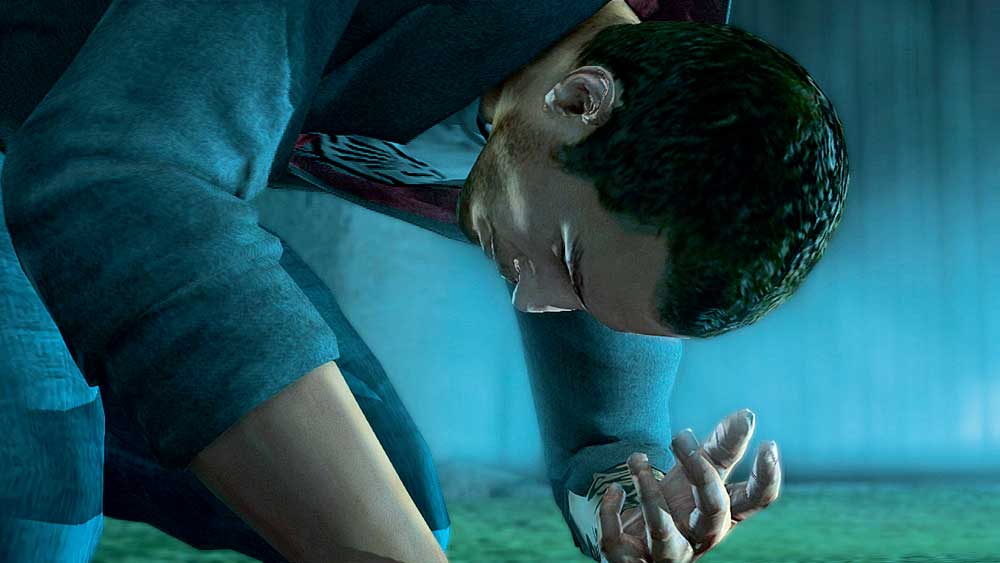
These benefits are not without an attendant cost, though, as the Bleeding Effect leads to potentially deadly complications. It is these side effects that cause Desmond to experience hallucinations and even full “memories” while disconnected from the Animus technology in Assassin’s Creed II.
At the end of Brotherhood’s story, his mind becomes fragmented and confused by the accumulation of multiple overlapping identities ( 01). This most unhealthy byproduct of the Bleeding Effect is why Subject 16 lost his grasp on reality, and ultimately took his own life to escape the madness that consumed him.
The living ghost of Subject 16 reveals that the worst symptoms of the Bleeding Effect can be negated by creating a Synch Nexus. This can be accomplished by “completing” the memories of the ancestors whose lives an Animus user has previously explored.
Eagle Vision & Eagle Sense
Eagle Vision is a potential talent locked away in most humans, but innate to individuals with a sufficiently high concentration of First Civilization genes (the “children of two worlds”, descendants of Adam – and presumably Eve).
It grants the facility to discern and interpret signs and details that are invisible to others. Eagle Sense is an extension of that gift, sharpening all of the user’s senses. This enables Ezio, more practiced in later life, to eavesdrop on conversations, and to infer the path that an individual has taken (or will take) with a glance (fig 2).
Juno suggests that the true “sixth sense” possessed by her race, dormant in our species (who all share the capacity to some degree, but lack the means or understanding to exploit it), has even greater potential – but only if Desmond can unlock it. “Awaken the sixth!” she exhorts, forcefully, at the conclusion of Brotherhood.
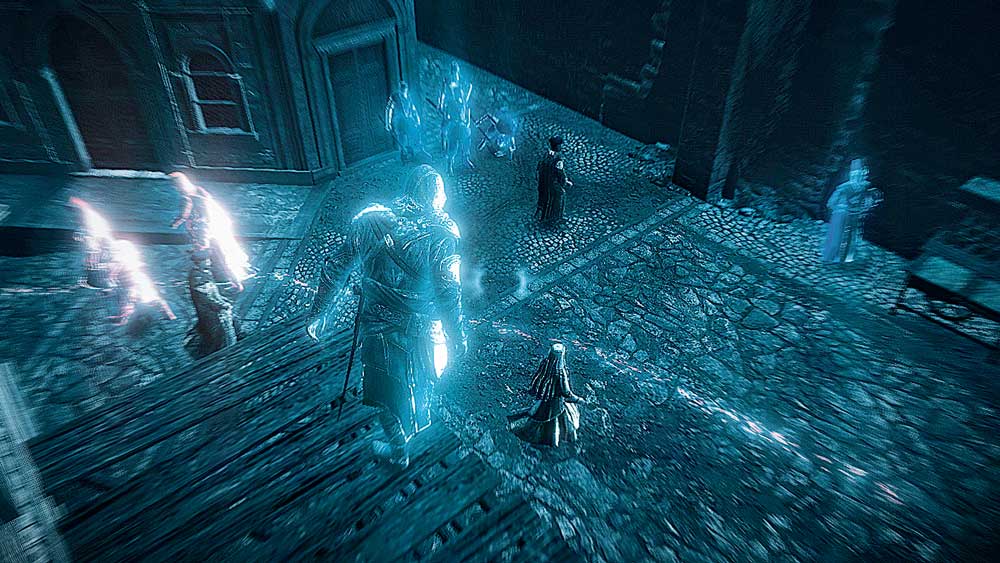
One can assume that the First Civilization’s advanced interaction with mankind through time is due to some form of precognitive ability. This might explain how Those Who Came Before foresaw future events in order to deliver the messages to Desmond, millennia later, in a most circuitous yet sophisticated manner. From this perspective, Minerva’s words are especially revealing when she says that the First Civilization experiences time “differently”. Likewise, Tinia gives further credence to this theory when he tells Desmond that the place where they meet is a “nexus of time”.
Pieces of Eden
Pieces of Eden are ancient artifacts that the First Civilization once created to control humans. Secret history holds that the Templars have possessed various Pieces of Eden through the centuries, using them to influence world events.
Al Mualim (Altaïr’s former mentor) is responsible for much of what is known about the powers and physical characteristics of the artifact also referred to as an Apple of Eden – for instance, that it could conjure disguises and create multiple simulacra of the holder.
Of far greater interest to the Templars is the effect that Al Mualim wrought on the stronghold of Masyaf while experimenting with its potential. It subjugated the minds of the entire town, turning civilians into obedient soldiers or causing them to see old friends as enemies. It seems certain that this power is the one the Templars intend to exploit with the Eye-Abstergo satellite.
We currently know of two Apples of Eden: the one once held by Altaïr, and another hidden beneath the Colosseum by Ezio (later retrieved by Desmond). In a secret email in the first Assassin’s Creed, it was revealed that a Piece of Eden possessed by the Templars was destroyed in an explosion at Denver International Airport. This may have been Altaïr’s Apple.
The conclusion of Assassin’s Creed Brotherhood reveals an unexpected feature of the artifacts. Though they clearly extend certain powers to humans who wield them, with the degree of control exerted dependent on First Civilization genes, Pieces of Eden can also be employed to remotely manipulate the user – as Desmond experiences when he plunges his Hidden Blade into Lucy’s abdomen.
Masyaf Keys
The keys that Ezio acquires to open Altaïr’s tomb are another First Civilization device – memory seals that were widely used by Those Who Came Before to archive their experiences. They enable the user to store memories for later playback. It has been suggested that the Templars developed the Animus by reverse-engineering hitherto unseen artifacts. The Masyaf Keys, if not a direct inspiration, are closely related to an equivalent First Civilization technology.
Codex
The Codex is a collection of documents where Altaïr captured his thoughts, many of which concerned his discoveries regarding the Piece of Eden. After Altaïr entrusted the Codex to the Polo brothers, it went on an adventure of its own – plundered by Genghis Khan and inherited by his grandson, before Marco Polo acquired it for his contemporary, Dante Alighieri.
The thirty pages of the Codex were then scattered by Ezio’s great-grandfather to prevent them from falling into Templar hands. Years later, Ezio was able to collect and restore the parchments.
The hotchpotch nature of the work, consisting of blueprints, journals and revelations, is likely deliberate, an attempt to distract from the singular hidden message of the Codex. The pages can be arranged to form a map, drawn with invisible marks that reveal themselves to Eagle Vision (fig 3).
This shows the location of the vault under the Vatican – the first step by which Altaïr directed the prophet Ezio to deliver a vital message to Desmond and, later, to journey to Masyaf.
Prophet & Prophecy
For all of its revelations and blueprints, the true message of Altaïr’s Codex is one of a prophecy. It tells of a prophet who will use Pieces of Eden to open a First Civilization vault. Rearranging the pages of the Codex into a map then shows the location of that vault.
The traditional role of a prophet is to deliver a message from the gods. This is ostensibly what Ezio does, capturing a speech from Minerva and passing it on to Desmond via genetic memory at the conclusion of Assassin’s Creed II. That Ezio cannot comprehend her words is almost irrelevant – he’s no more than a conduit*. Though facing Ezio, Minerva addresses Desmond directly in revealing the fate of her race, and the need for urgent action to save his own.
In Brotherhood, Ezio takes a more direct role, acquiring an Apple of Eden then hiding it away for Desmond to retrieve. The events of Revelations, where Altaïr once again directs Ezio across the centuries to deliver a message for Desmond ( 04), further illustrate the astonishing capacity of Minerva, Juno and Tinia to manipulate human minds through time.
*Though it is interesting that the language barrier is not an issue – evidence, perchance, of another remarkable First Civilization technology.
Vaults & Temples
The First Civilization vaults and temples visited over the course of the Assassin’s Creed story are sealed chambers where Those Who Came Before apparently worked, each laboring with a different method designed to save the world.
Vaults were placed underground to avoid both the war that raged above (between humans and their masters) and the imminent Catastrophe – the coronal mass ejection that scorched the face of the earth.
After the cataclysm, the few survivors of the First Civilization decided to transmit the knowledge of all vaults into a single location: the very destination that Tinia instructs Desmond to visit at the close of Revelations (fig 5). Here, Tinia declares, Desmond will find answers to all of his questions, and possibly a way to prevent another Catastrophe from occurring.
Vaults and temples can be unlocked with specific codes, or the appropriate First Civilization technology, but there are further genetic or individual determinants involved in the security protocols. For example, when Ezio chooses to relinquish his Apple by placing it in the Vault beneath the Colosseum in Rome, he uses Eagle Vision to hide a password so that only a descendant such as Desmond can retrieve it in the future.
Of what is known, it seems the First Civilization had only ever intended for Assassins to use the vaults and temples – or, more specifically, pure and hybrid bearers of their DNA. This is why Ezio could enter the Vatican vault that remained resolutely sealed to Rodrigo Borgia in Assassin’s Creed II.
How the Templars have apparently acquired so many artifacts throughout history is open to speculation, but it is certain that the Catastrophe and the war with humans did not allow for the orderly inventory and internment or destruction of all First Civilization technologies, as Juno confirms:
“You possess the potential for understanding. But you broke our tools. Or turned them against one another. We have destroyed what we could. Sealed away what we could not. Most. Not all. And it does not take many to unwind the world.”
Glyphs and Rifts
After hiding an AI simulation of himself within the Animus, Subject 16 was able to conceal his software ghost and an assortment of messages and clues from his captors by creating symbols that would only reveal themselves to a brother Assassin’s Eagle Vision (fig 6).
In essence, Glyphs and Rifts are software hacks that enable the finder to access a hidden data cache. They are not part of the original memory, and so stand out as breaks in the program where Desmond disappears from the audiovisual feed viewed by those monitoring him.
The Truth
“The Truth” is the name given by Subject 16 to a data file that he hid within the Animus software, discovered during the events of Assassin’s Creed II. This code was broken into segments to conceal the message from unwelcome eyes, and was reassembled by Desmond during his first journey into Ezio’s life.
When decrypted, it was revealed to be a recording of an actual genetic memory of Adam and Eve, dating back to the time of the First Civilization and recovered during Abstergo’s investigations (fig 7). It indicates that Subject 16 – and, by extension, Altaïr, Ezio and Desmond – must be directly descended from Adam’s bloodline.
If this revelation were not enough, the “puzzles” Sixteen created to lock each fragment also exposed the startling degree to which the Templars have influenced world history and instigated many famous and terrible events.
There are intimations that Pieces of Eden were exploited by Adolf Hitler in the development of Germany’s war machine, and by President Lyndon B. Johnson in the Kennedy Conspiracy.
The infamous Russian mystic Grigori Rasputin held Templar office while inveigling himself into the court of Tsar Nicholas II. With this knowledge, the Bleeding Effect clearly wasn’t the only burden threatening Subject 16’s grasp on reality.
Adam and Eve
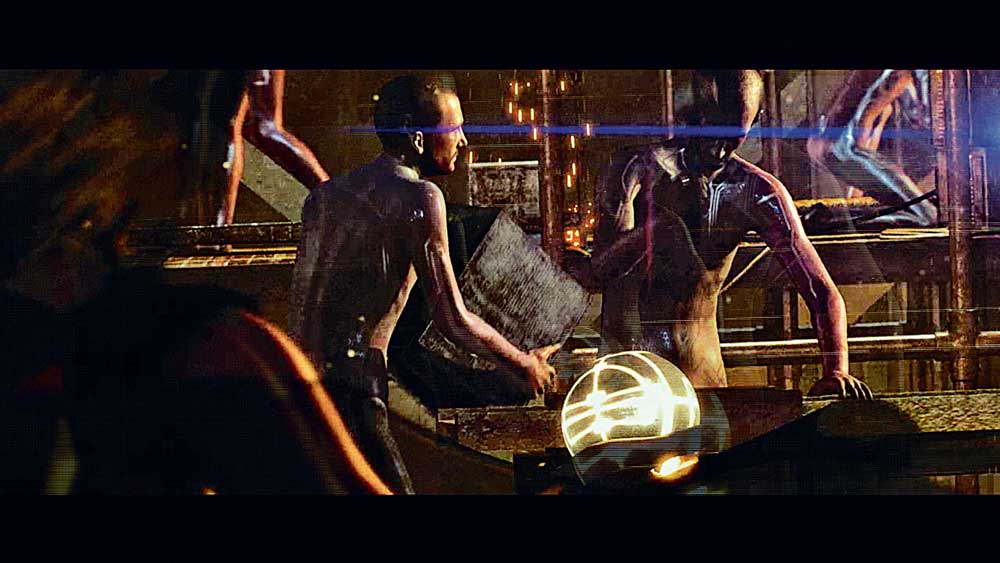
Adam and Eve (fig 8) were born during the final years of the First Civilization. They appear in “The Truth”, the data file that Subject 16 hid within the Animus prior to his death before the events of Assassin’s Creed (but only discovered in the following episode).
The video shows Adam and Eve rebelling against their godlike masters in Eden – a First Civilization stronghold where human slaves are at work – by daring to steal a Piece of Eden.
This act of defiance may have been the first defense of free will committed by the incipient Assassin line; indeed, the brief fury in Juno’s Brotherhood address intimates that it may even have contributed in part to the eventual extinction of the First Civilization.
The “Bloodlines” Glyph in Assassin’s Creed II and Juno’s soliloquies at the conclusion of Brotherhood (among other pieces of evidence) confirm that the First Civilization created “hybrid” humans – Adam and Eve – who possessed genetic material from their ruling race.
Juno adds detail to Minerva’s account of the First Civilization’s downfall by confirming that the hybridization was a project of their society’s twilight. At war with their slaves and unable to resist the Catastrophe, the First Civilization deliberately spliced their DNA into chosen humans as a way of preserving their genetic stock.
“After, when the world became undone,” Juno intones, “we tried to pass it through the blood. Tried to join you to us. You see the blue shimmer. You hear the words. But you do not know.”
Desmond is a distant son of Adam, half human and – though the manifestations are subtle – half god-race. If Subject 16’s predictions are true, then a descendent of Eve possesses the other half of the First Civilization DNA sequence. If she and Desmond were to conceive children, might their offspring represent the rebirth of the First Civilization?
Could it be that certain First Civilization artifacts were sealed away not to protect them from human hands, but planted and, where necessary, strategically released to monitor and guide events in history?
Dire warnings of a second Catastrophe aside, it is possible that Minerva, Juno and Tinia are primarily motivated by a desire to guide the descendants of Adam and Eve to a particular destination. Altaïr and Ezio, as prophets, were subtly enjoined to sow seeds in time that now germinate to line Desmond’s path – a track that appears to lead inexorably to Eve. Do the Capitoline Triad truly see him as Earth’s savior from the impending Catastrophe, or the means to create scions in a new era?
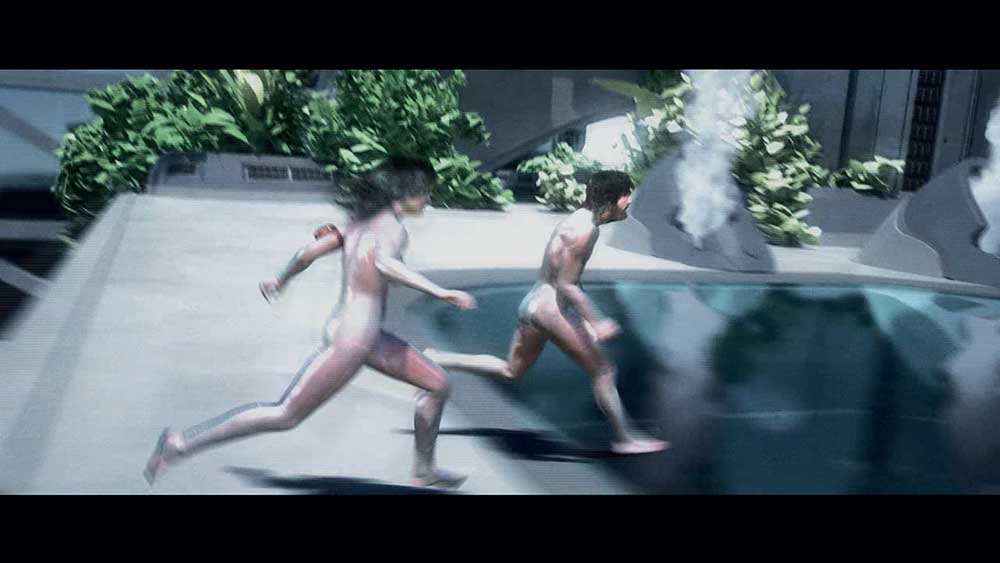
First Civilization
Also referred to as “Those Who Came Before”, the First Civilization is held to be an advanced race that came to inhabit the Earth before mankind. Having remolded a primitive indigenous species into the slaves and workers that would later be known as humans, the First Civilization created certain devices (later described as Pieces of Eden) to control their workforce.
Most humans, but not all, are believed to retain the dormant but still receptive neural configuration that rendered their ancestors vulnerable to enslavement by the technology.
To early mankind, the advanced nature of Those Who Came Before made them appear godlike, and they were long worshipped as divine saviors. Far from intangible, these beings walked among us and gave rise to the many different deities and pantheons of the cultures over which they ruled.
Nevertheless, a war eventually broke out between the First Civilization and humans eager to win their freedom from eternal servitude. In their weakened state, Earth’s overlords were unable to prevent the great Catastrophe that would deny them existence (fig 9).
So why are the First Civilization members so intent to help save their destroyers, here in the future? Are Minerva, Juno and Tinia ghosts in their machines, like Subject 16 within the Animus memory core?
Or are they sophisticated recordings, intuitive echoes of a dead civilization? At the end of Revelations, Tinia claims to have no clear vision of what might happen in Desmond’s time or his.
For a race that can apparently employ human history as a preternaturally intricate Rube Goldberg machine, steering a single individual – Desmond – to a specific place and moment in time, this appears somewhat unlikely.
We know of the genes carried by Desmond’s line, and hints of an impending Catastrophe, but inferring the true motivation of beings of such incomprehensible sophistication is, at least for the moment, an impossibility.
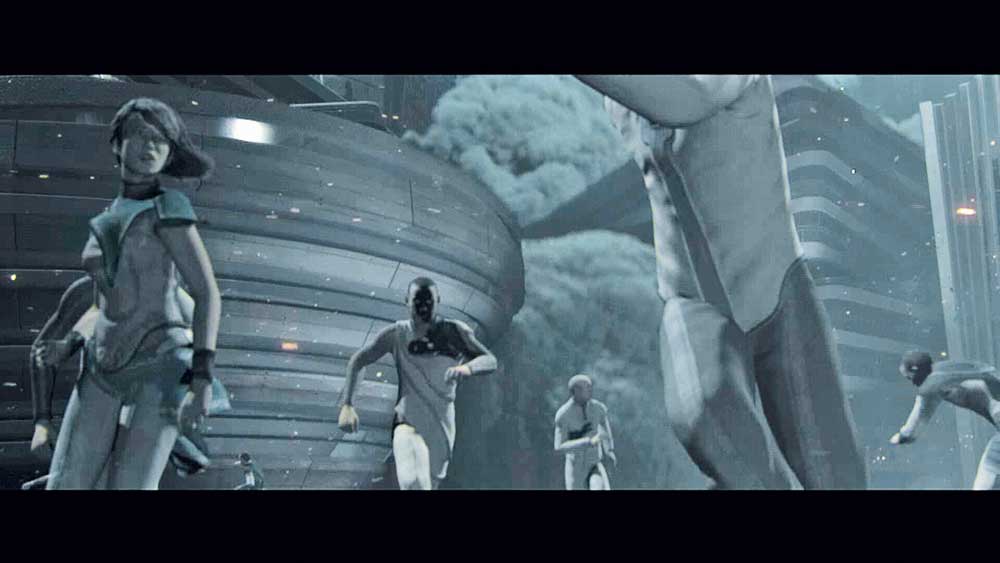
Capitoline Triad
The Capitoline Triad of Tinia, Juno and Minerva was a select sub-pantheon of supreme deities worshipped in Rome long before the Holy Roman Empire, prior even to the Republic. Ezio’s encounter with Minerva confirmed that these deities were actually members of the First Civilization, their elevated status and accorded reverence potentially corresponding to some hierarchy of leadership among “Those who Came Before”.
Minerva
Even though Minerva’s message is wildly incomprehensible to him, Ezio still describes the holographic “visions” he was shown as miraculous and magical when recounting them to his fellow Assassins. It is a perfect demonstration of how the First Civilization came to be regarded as gods by less sophisticated humans.
Minerva is the holographic projection of a female entity who speaks to Ezio – or, more accurately, through Ezio – when he enters the Vault beneath the Vatican at the denouement of Assassin’s Creed II.
Though apparently long dead, Minerva was one of the last surviving members of the First Civilization after the Catastrophe annihilated her race many thousands of years ago. She warns of another imminent Catastrophe in Desmond’s time, and claims that her kind had been developing a way to prevent it, with their labors hidden in secret vaults around the world.
Juno
When Desmond penetrates the vault where Ezio hid an Apple at the end of Brotherhood, Juno reveals that the Catastrophe was so powerful that the few First Civilization members who survived it knew they were doomed to extinction.
Researching ways to perpetuate their race, they attempted to interbreed with mankind, or at least splice their own genetic code into human DNA for safekeeping (“We tried to pass it through the blood. Tried to join you to us”).
Subject 16’s secret documents back up a hybridization project that began with Adam and Eve, and later perpetuated (at least partially) by the lineages that includes Altaïr, Ezio and Desmond.
Juno’s point about looking into the future, but eyes “turning inward” to deal with a rebellious human threat, recalls Minerva’s message that they should have been able to avoid the Catastrophe but were distracted.
Pieces of Eden were locked away in vaults for safety, not safekeeping, to secure them from the hands of mankind – and yet Desmond is told to find such a device and activate it. It may be that the Pieces of Eden are not abandoned relics for the Assassin Brotherhood to protect or exploit, but tools wielded by the First Civilization across centuries to achieve their aims – be they benign or otherwise.
The perfunctory murder of Lucy (and Desmond’s enforced surrender of free will in being the implement of the act) at Juno’s apparent volition indicates that she, if not her peers, regards the First Civilization’s former slave race without sentimentality. She may indeed act to serve a greater good – and yet it is hard to escape the conclusion that her methods could be drawn from a Templar manifesto…
Tinia
The third in the deified First Civilization triumvirate, Tinia – also known as Jupiter and Zeus – informs Desmond that their long-sealed vaults were each dedicated to researching a single method by which the Catastrophe might be averted. Minerva, Juno and Tinia tested six methods in total, though none were completed before the coronal mass ejection scorched the planet.
Tinia reveals the existence of a single vault where he and his ilk stored all of the knowledge they gathered from their research, which lies a mere stone’s throw from the location where Desmond awakes at the end of Assassin’s Creed Revelations. Tinia makes it clear that this is where Desmond must go – but why?
It could be that the First Civilization intends to save the Earth from a second imminent Catastrophe, and that Desmond will find the means to do so in Tinia’s vault. But if Those Who Came Before were sufficiently close to having the technology at their disposal, why could they not prevent the first Catastrophe from occurring when they had the opportunity to do so?
There may be another explanation. When they warn of a second Catastrophe, perhaps the First Civilization entities do not mean a cataclysm against which they would be once again powerless.
They could be referring to the launch of the Eye-Abstergo satellite, which might lead to the extermination of the Assassins – and, therefore, the DNA stock carried by Desmond and others. With the loss of its last genetic vestiges, the First Civilization would truly become extinct.
How exactly do Tinia, Juno and Minerva intend to revive their race? Children born of two hybrids (Desmond, and a descendent of Eve, each carrying half of the First Civilization DNA stock) could very well be the solution they aspire to.
Subject 16’s inane ramblings on Animus Island even suggest that it may be possible for a personality stored in the Animus technology to be transferred into a new physical vessel – a chilling prospect.
But why, then, should Desmond save mankind from a Catastrophe, be it solar in origin or due to the actions of Templars, only to engineer the return of godlike entities who once ruled us as slaves?
The Catastrophe
The Catastrophe was a solar flare – or coronal mass ejection ( 10) – that long ago scorched the world, flipping the polarity of Earth’s magnetic field and exposing all life forms to deadly radiation.
Small pockets of First Civilization survivors attempted to rebuild, but their numbers were too few; with a certain irony, their human creations proved more robust, and usurped their former masters. In time, vegetation and erosion dissipated any meaningful trace of the First Civilization’s existence.
Instead of recording their nature and achievements, mankind deified Those Who Came Before and declared them of supernatural origin. The only evidence of the First Civilization now rests in their hidden subterranean vaults, and the remaining artifacts so highly prized by those who have grasped the truth.

Symbols
From Subject 16’s Glyph and Rift revelations to the icons found on Abstergo literature, the extent to which the conspiracies of Assassin’s Creed have spanned the ages is reflected in the recurrence of powerful symbols.
Assassin’s Creed Brotherhood’s closing scenes reveal two symbols of particular interest. When Desmond asks about the location of the remaining vaults in Juno’s temple, the Apple projects a Masonic Eye and a Phrygian Cap (fig 11).
These could very well refer to the one document where the two symbols come together: the 1789 Declaration of the Rights of Man and the Citizen , a defining document of the French Revolution.
Interestingly, the Masonic Eye – a historically recurring signifier of the all-seeing eye of God – was also adopted in 1782 as part of the symbolism on the reverse side of the Great Seal of the United States.
It appears on the American dollar bill. We learn from Tinia at the end of Revelations that the First Civilization transmitted their accumulated knowledge into a single vault located in the state of New York. Could the Apple have pointed the way to another of Desmond’s ancestors from the 18th Century, either in France or the United States?
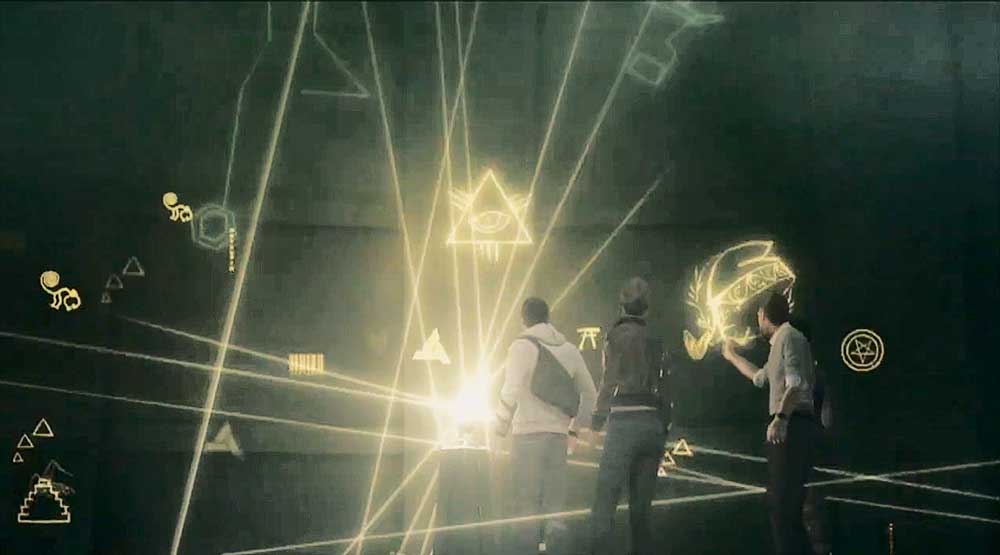
Tinia